
Our readers keep the lights on and my morning glass full of iced black tea. As an Amazon Associate, I earn from qualifying purchases.
Specs are compiled from manufacturer listings and verified buyer reviews and can change over time — please confirm the key details on the product page before buying.
Swapping in an aluminum radiator with a fan is one of the smartest cooling upgrades you can make, but the real challenge isn’t the metal—it’s the fitment. A radiator that looks perfect in photos can fight you on mounting points, hose sizes, and fan wiring once it’s in your garage. This guide breaks down the top options by what actually matters: core size, inlet and outlet dimensions, and which vehicles they genuinely bolt onto.
I’m Min — the founder and writer behind Gadgets Feed. This guide is built by comparing the manufacturers’ published specifications and the patterns across verified customer reviews, so you get each pick’s real strengths and trade-offs instead of marketing spin.
Whether you’re restoring a classic or cooling a swap, finding the right aluminum radiator with fan means matching core dimensions and hose ports to your exact chassis before you buy.
Our Picks at a Glance


How To Choose The Best Aluminum Radiator With Fan
An aluminum radiator with an electric fan bundles three jobs into one box: the core sheds heat, the shroud directs airflow, and the fan pulls air through when you’re sitting still. The key is to pick a combo that matches your specific engine and chassis, not just the one with the biggest core.
Check your inlet and outlet sizes first
The hose ports are the first place swaps go wrong. A radiator listed with 1.38″ inlets needs hoses sized for that opening, and if your stock setup uses 1.25″ ports, you’ll be changing hoses instead of just bolting things up. Measure what your current radiator uses before ordering.
Row count tells you about density, not just thickness
A 2-row core has two tubes running through it, while a 3-row has three, which means more surface area touching the coolant. For a hot V8 or a swapped engine, a 3-row gives you more reserve capacity. For a daily-driven four-cylinder, a well-built 2-row is often plenty.
Fan CFM matters at idle, not on the highway
At speed, air rushes through the core naturally, but in traffic your fan does the work. A fan rated at 1250 CFM moves enough air for most builds, while a 1500 CFM unit pulls harder for bigger engines. Match the fan’s pull to how much stop-and-go driving you actually do.
Quick Comparison
| Model | Best For | Row Count | Inlet / Outlet | Weight | Amazon |
|---|---|---|---|---|---|
| smileracing 3 Row★ Best Overall | Hot Rods & V8 Swaps | 3 Row | 1.38″ / 1.38″ | 19.69 lbs | Amazon |
| DNA Motoring RA+FS-HC92-42-2Budget Champion | Honda Manual Transmissions | 2 Row | 1.25″ / 1.25″ | 6 lbs | Amazon |
| DNA Motoring RA+FS-HC92-42-AT-2Transmission Friendly | Honda Auto & Manual | 2 Row | 1.25″ / 1.25″ | — | Amazon |
| BDFHYK HO3010123 | Honda & Integra Daily Drivers | 2 Row 30mm | — | 11.38 lbs | Amazon |
| LUXERAD 3 Row Corvette | Corvette & S10 Conversions | 3 Row | — | 20.4 lbs | Amazon |
| ALLOYWORKS Cherokee XJ | Jeep Cherokee 4.0L Off-Road | — | — | 20.3 lbs | Amazon |
| LUXERAD 3 Row Chevy | Classic Chevy Muscle | 3 Row | 1.5″ / 1.57″ | 23.6 lbs | Amazon |
| Primecooling 56MM 3 Row | Chevy C/K Series Trucks | 3 Row 56mm | — | 27.6 lbs | Amazon |
In‑Depth Reviews
1. smileracing 3 Row Aluminum Racing Core
Our pick — 4.5★ from 80+ verified ratings; the strongest balance of quality and price.
The V8 swap specialist that hot rodders keep coming back to
This is the pick for anyone dropping a V8 into something it never came in. Built from AA5052 aluminum with a polished exterior, the 3-row core measures 23.70″ x 14.88″ with a 1.73″ thickness, and the whole assembly weighs 19.69 pounds. The inlet and outlet are both 1.38″, which is the size to match when you’re planning hoses for a 350 or 327 small block.
The fit list is specific: it targets 1982-2002 Chevy S10 and S-10 Blazer V8 conversions plus 1984-1990 Corvettes. Buyers report it drops into a 1929 Chevy truck with a 327 and an LS-swapped S10 without drama. It works great for a 350 small block, but fan mounting hardware isn’t included—bring your own bolts.
The fan shroud and two 12″ slim fans are pre-assembled, so you’re getting the complete cooling package in one box. At 19.69 pounds it’s substantial without being awkward to lift into place, and the 3-row density gives you real reserve for a hot-running engine.
Why builders choose it
- 3-row AA5052 core sheds heat fast
- Pre-assembled shroud with two 12″ slim fans
- Proven on 350 and 327 small blocks
Plan around this
- Fan mounting hardware not included
- Fit is mixed on some chassis—measure twice
Reach for this if: you’re building a V8 swap or hot rod and want a complete cooling setup with room to grow.
Look elsewhere if: you need a true bolt-on for a stock daily driver—this rewards careful measuring.
2. DNA Motoring RA+FS-HC92-42-2 2-Row
A featherweight Honda cooling fix that comes in at just 6 pounds
For Honda owners on a budget, this 2-row is the lightest option in the lineup by a mile—6 pounds total, which is a 3.3x gap versus the 19.69-pound smileracing unit above. The core is 14.25″ x 13.75″ with an overall size of 14.50″ x 16.50″, and the 1.25″ inlet and outlet match the stock hose sizing on most manual-transmission Civics.
It’s built for a specific audience: 92-00 Civic, 93-97 Del Sol, and 94-01 Integra with manual transmissions and D15, D16, B16, or B18 engines. The fan shroud is pre-assembled, and the low-profile 12V fan spins up to 5500 rpm to pull air at idle. The fan shroud uses a probable plastic material, which keeps weight down and cost low.
Fit feedback splits along predictable lines. It slides right into an EJ1 coupe and a 1999 CRV with minimal mods, but a 1997 Civic owner found the dimensions wrong and the rubber mounts misaligned. This is a part that rewards you for confirming your exact chassis code before purchase.
Lightweight cooling: at 6 pounds it’s easy to maneuver into tight engine bays, and the 5500 rpm fan keeps airflow moving in traffic.
Best for: budget Honda builds where every pound counts and you’ve verified your transmission type.
Skip if: your Civic has an automatic—this unit is manual-transmission only.
3. DNA Motoring RA+FS-HC92-42-AT-2 2-Row
The Honda twin that welcomes both automatic and manual gearboxes
This is the sibling of the previous pick, but with one crucial difference: it’s built for both manual and automatic transmissions across the same 92-00 Civic, 93-97 Del Sol, and 94-01 Integra chassis. That means it handles the transmission cooler lines that automatics need, with a G1/8 transmission cooler thread size and the same 1.25″ inlet and outlet sizing.
Construction steps up here—full T-6061 aluminum instead of the plastic shroud on the manual-only version. The core is identical at 14.25″ x 13.75″ with a 1.50″ thickness, and the 12V fan is wired with a 3-pin connector. Owners mention it keeps a 96 EK Auto Honda cool, though swapping the drain plug o-ring for a copper crush washer is a common fix.
The honest catch is the fan connector. The stock Honda plug is an oval rectangle with two vertical pins, while this unit uses a cross-shaped connector with one vertical and one horizontal pin. That means cutting the original plug from your stock fan and wiring it to the new one—a mild annoyance, not a dealbreaker.
Reach for this if: you drive an automatic Honda and want the T-6061 aluminum build quality.
Look elsewhere if: the idea of rewiring a fan connector makes you nervous—plan for it.
4. BDFHYK HO3010123 2-Row Aluminum

The replace-and-forget cooling swap for Honda daily drivers
If your factory radiator is leaking or clogged and you just want a solid replacement, this 2-row unit with a 30mm core is the straightforward answer. It’s built around OE-style fitment references, which means it aligns with factory mounting points for the Civic 1992-2000, Del Sol 1993-1997, Integra 1994-2001, and Acura EL 1997-2000.
The package includes the radiator, an electric cooling fan, and an instruction manual, so nothing else is hidden in the box. At 11.38 pounds with a 53 x 44 x 22 cm footprint, it’s manageable to install solo. The included fan keeps airflow moving during low-speed driving, stop-and-go traffic, and when you’re just letting the engine idle.
Buyers flag two things to transfer from your old unit: the metal pressure cap at the top and the rubber shock mounts don’t come with this radiator, so keep those parts when you do the swap. Once installed, it outperforms the factory part and holds temperature without overheating.
What buyers appreciate
- OE-style fitment for multiple Honda models
- Fan and manual included in the box
- Reported to outperform the factory unit
Before you start
- Pressure cap and rubber mounts not included
- Leak reports occasionally surface—inspect on install
Best for: Honda owners replacing a tired factory radiator who want a complete kit in one box.
Think twice if: you expect every mounting piece to be included—you’ll reuse your cap and mounts.
5. LUXERAD 3 Row Full Aluminum Corvette

Hand-TIG-welded cooling built for Corvette V8s and S10 conversions
This 3-row unit brings precision craftsmanship to the table—100% handmade TIG welding on durable aluminum, which is the kind of construction that holds up to years of heat cycling. It targets the 1984-1990 Corvette 5.7L V8 and the 1982-2002 Chevy Blazer S10 conversion with 4.3L, 2.8L, 2.5L, or 2.2L engines.
The overall size comes in at 29.21″ x 20.47″, and each of the fans pushes 1250 CFM—enough pull to keep a big V8 cool sitting in traffic. The maker backs it with a one-year warranty, which is a real commitment for a cooling part. Customers note noticeably cooler running with no leaks and solid weld quality.
The fitting note that keeps coming up: check your exact year and chassis before ordering. It’s reported to fit a 75 Corvette with stock mounts and a 76 Nova with minor shroud work, but a 70s Ford owner found it wasn’t close to the right size. This one rewards builders who measure their core opening first.
Hand-built density: the TIG-welded 3-row core with 1250 CFM fans is built for V8 heat loads that overwhelm stock radiators.
Reach for this if: you’re cooling a Corvette or S10 V8 and want TIG-welded quality with a warranty.
Look elsewhere if: your chassis isn’t on the fit list—measure your opening carefully.
6. ALLOYWORKS Full Aluminum Cherokee XJ

The Cherokee XJ cure for engines that always run hot
Jeep XJ owners know the struggle—these 4.0L engines tend to run hot, especially with modified parts bolted on. This ALLOYWORKS unit is purpose-built for the 1991-2001 Jeep Cherokee XJ 4.0L and Comanche L4 L6, using full T-6061 aluminum construction with the shroud and fans included.
The maker claims a 35% to 45% improvement in cooling temperature, and owner reports confirm it. An LS-swapped XJ owner reports a steady 180°F, while a stock 99 XJ cools quickly. At 20.3 pounds it’s a solid, planted piece that looks right at home in the engine bay.
The wiring is the honest caveat—it’s not plug-and-play. The temp switch is ground-operated, and the fan wiring needs some attention during install. A few owners also note the passenger side fan can fail, so it’s worth bench-testing both fans before you bolt everything up. Plan for a bit of wiring work, and this radiator delivers exactly what it promises.
Why XJ owners pick it
- Holds 180°F even on LS-swapped builds
- Full T-6061 aluminum with included shroud
- Designed specifically for the 4.0L heat load
The honest trade-off
- Wiring requires modification, not plug-and-play
- Occasional passenger fan failure reported
Best for: Cherokee XJ owners battling chronic overheating who don’t mind basic wiring work.
Think twice if: you want a true plug-and-play install—this expects some electrical effort.
7. LUXERAD 3 Row Full Aluminum Chevy
The 1500 CFM muscle car cooler for Monte Carlos and El Caminos
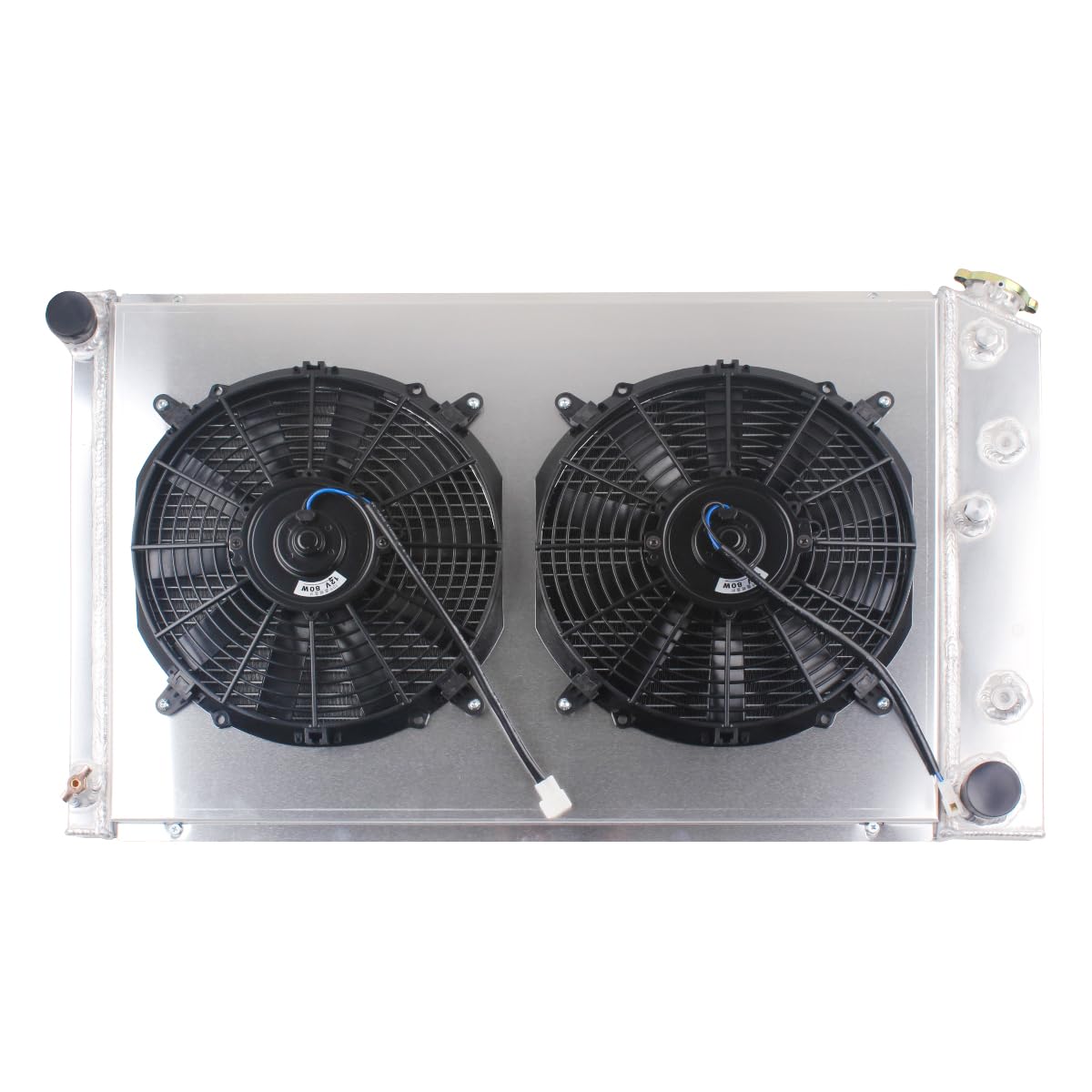
When you’re building a classic Chevy, this 3-row brings the airflow. Each fan pushes 1500 CFM—higher than the Corvette unit’s 1250 CFM—which gives you more pull for bigger engines like a 383 or 454. The overall size is 18.25″ x 31.63″ including the inlet and outlet, with a 1.5″ inlet and 1.57″ outlet.
Fitment covers a wide classic Chevy range: 1978-1987 Monte Carlo and El Camino SS, plus C20, C30, K20, K30, P10, Buick Regal, and GMC C15 and C3500. The trans cooler is included with a φ32×215×G1/4 fitting, and the build uses 100% precision handmade TIG welding. Reviewers point out the truck runs 10 degrees cooler with no leaks, and auxiliary coolers fit easily.
The size note is honest: it’s built for 383-class engines comfortably, but owners suggest thinking twice before trusting it with anything much bigger. One IROC owner with a 305 noted the stock fans can run weak, and a left fan shorted out at 500 miles. For a mild street build, this delivers solid value.
High-flow cooling: the 1500 CFM fans and 3-row core handle classic V8 heat, with a trans cooler already fitted.
Reach for this if: you’re cooling a classic Chevy muscle car in the 383 range and want high CFM airflow.
Look elsewhere if: you’re running a 454 or bigger—consider a heavier-duty core.
8. Primecooling 56MM 3 Row Core C/K Series

The heaviest-duty cooling combo for Chevy and GMC trucks
At 27.6 pounds, this is the most substantial unit in the lineup, and it’s built for the toughest job: cooling Chevy and GMC C/K series trucks. The 56mm 3-row core uses aircraft-grade AA5052 aluminum with a raw finish, 100% TIG-welded and pressure-tested to prevent leaks.
Fitment is broad: it covers Chevy C10, C20, C30, K10, K20, K30, and Suburban L6 V8 models from 1974-87, plus Blazer V8 1987-91 and a range of GMC models through the early 90s. The package includes the radiator, two 12″ fans, and a shroud, all pre-assembled around that 56mm core density.
The wiring is the recurring discussion point—the harness doesn’t include a clear diagram, and some owners found the wiring too short for a clean install. The fans themselves kick on when needed and hold temperature well. A C30 owner running a 454 noted the unit sits about half an inch shorter than stock, solved with double-stacked isolators. Budget for a bit of wiring effort and possibly a temp kit, and this is a tank of a radiator.
Where it shines
- 56mm 3-row core is the thickest in this lineup
- Aircraft AA5052 aluminum, pressure-tested
- Built for truck duty with 2 x 12″ fans included
Plan for this
- Wiring diagram not included—bring your own expertise
- Sits slightly shorter than stock on some models
Best for: Chevy and GMC truck owners who want maximum core density and don’t fear wiring.
Think twice if: you expect a perfect bolt-on—measure your mounts and plan for electrical work.
Understanding the Specs
Row count and core thickness
The number of rows tells you how many tubes run through the core, while the thickness in millimeters measures the core itself. A 3-row 56mm core like the Primecooling unit has more surface area touching coolant than a 2-row 30mm unit, which means it can absorb more heat before the fans need to spin up. Match the density to your engine’s heat output, not just your budget.
CFM on the electric fans
CFM stands for cubic feet per minute—how much air the fan moves. A 1250 CFM fan handles most street builds, while a 1500 CFM unit pulls harder for bigger engines or heavier traffic. The fan does its real work at idle and low speed, so if you spend time in stop-and-go traffic, lean toward the higher CFM option.
FAQ
How do I know if an aluminum radiator with fan fits my car?
What does the inlet and outlet size mean for my hoses?
Will a 2-row radiator cool my V8 engine?
What is the fan CFM rating and why does it matter?
Do these radiators include the transmission cooler?
Is the fan wiring plug-and-play on these radiators?
How long will an aluminum radiator with fan last?
Why do some radiators leak after installation?
Final Thoughts: The Verdict
For most builders, the aluminum radiator with fan winner is the smileracing 3 Row because it pairs a dense AA5052 core with two pre-assembled 12″ slim fans at a reasonable weight. If you want the lightest Honda option, grab the DNA Motoring 2-Row. And for the heaviest truck duty, the Primecooling 56MM is the one to reach for.
How We Picked
We do not accept paid placement. Every pick is matched to a real buyer and a real use-case; we do not hands-on test units.
Sources & Methodology
Specifications: manufacturer listings and product documentation. Review insights: verified customer reviews, as of August 2026. Pricing: not shown on this page (it changes often); check the current price via the retailer link.
As an Amazon Associate, Gadgets Feed earns from qualifying purchases. This does not affect which products we feature.