
Our readers keep the lights on and my morning glass full of iced black tea. As an Amazon Associate, I earn from qualifying purchases.
Specs are compiled from manufacturer listings and verified buyer reviews and can change over time — please confirm the key details on the product page before buying.
When a loved one’s memory starts slipping, the daily risk of a missed dose—or worse, a double dose—becomes a constant worry. An Alzheimer’s pill dispenser is designed to take that worry off your shoulders by locking medications away until the right time, then sounding an alarm and releasing exactly one portion. The hard part is picking the right one: some rely on complex apps, others on simple buttons, and a few add fingerprint locks or Bluetooth tracking. The best picks balance security (so no one overdoses accidentally) with simplicity (so a caregiver can set it up in minutes and the user can actually get their pills out). Here is how to choose a safe, reliable unit—and which models are worth your trust.
I’m Min — the founder and writer behind Gadgets Feed. This guide is built by comparing the manufacturers’ published specifications and the patterns across verified customer reviews, so you get each pick’s real strengths and trade-offs instead of marketing spin.
Whether you are caring for a parent with dementia or managing your own chronic condition, finding the right alzheimer’s pill dispenser means weighing safety features like locking lids and tamper-proof mechanisms against ease of setup and daily use.
Our Picks at a Glance

How To Choose The Best Alzheimer’s Pill Dispenser
A poorly chosen dispenser can frustrate both caregiver and user. A weak lock or a hard-to-silence alarm turns a safety tool into a daily hassle. Focus on these four specs when choosing a dispenser for memory loss.
Locking Mechanism & Tamper Resistance
A true lock is the number-one safety feature. A true Alzheimer’s pill dispenser must physically prevent the user from accessing more than one dose at a time. Look for a built-in lock with physical keys, a combination lock, or a fingerprint reader that only the caregiver can override. A simple latch that a curious hand can pop open is not enough—reviewers report that some locking lids are “a hex nut easily opened by child with pen,” which defeats the whole purpose.
Alarm and Alert System
For hearing loss, combine an 80–85 dB alarm with a flashing LED light. The best dispensers combine an 80–85 decibel beep (about as loud as a kitchen blender) with a bright flashing LED light. Some models let you set up to 6 daily alarms, which is essential for complex medication schedules involving multiple pills at different times. A reminder that only stops when the dose is actually dispensed is a huge plus.
Ease of Setup and Daily Use
A dispenser with 3 labeled buttons and a large LCD is easier to program than one requiring a smartphone app. Look for “one-function-per-key” designs—no long-press combos or tiny icons. The daily action should be simple: press a button or flip the device to release the pills. Check for large, easy-grip handles to avoid frustrating tray operation.
Capacity and Dosing Flexibility
Most high-capacity models hold a 28-day supply for a single daily dose, or 14 days for a twice-daily schedule. Compartments must hold multiple pills, including large fish oil capsules or calcium tablets. Interchangeable dosage rings let you change how many times a day the machine dispenses (1, 2, 3, or 4 times) without reprogramming everything. A transparent lid is a nice bonus—you can see at a glance if pills are running low without open up the tray.
Quick Comparison
| Model | Best For | Capacity | Daily Alarms | Lock Type | Amazon |
|---|---|---|---|---|---|
| Betife Automatic Pill Dispenser★ Best Overall | Caregivers wanting app-based tracking | 28-day | Up to 6 | None (manual latch) | Amazon |
| EziMedPil 28-Day Locked DispenserBest Value | Dementia safety with a frosted lock | 28-day (672 tablets) | Up to 6 | Key lock | Amazon |
| JULOS Automatic Pill DispenserBest Alarm | Reliable 80dB alarm plus flashing light | 28-day | Up to 6 | Key lock | Amazon |
| Betife 2nd Gen Pill Dispenser | Mix-proof seal & extra-large display | 28-day | Up to 6 | Key lock | Amazon |
| Live Fine Pill Dispenser | Customizable sound/light with 9 doses | 28-day | Up to 9 | Key lock | Amazon |
| PillCalendar Bluetooth Dispenser | Fingerprint lock & rechargeable battery | 31-day | Up to 6 | Fingerprint + key | Amazon |
| MedReady 1700FL Dispenser | Made in USA with 48-hour battery backup | 28-day | Up to 4 | Key lock | Amazon |
| Ideerfit 28-Day Dispenser | One-press slide-door for weak hands | 28-day | Up to 6 | None (slide door) | Amazon |
In‑Depth Reviews
1. Betife Automatic Pill Dispenser
Our pick — over 4.5★ from 550+ verified ratings; the strongest balance of quality and price.
The Bluetooth-connected dispenser that logs every dose for remote caregivers.
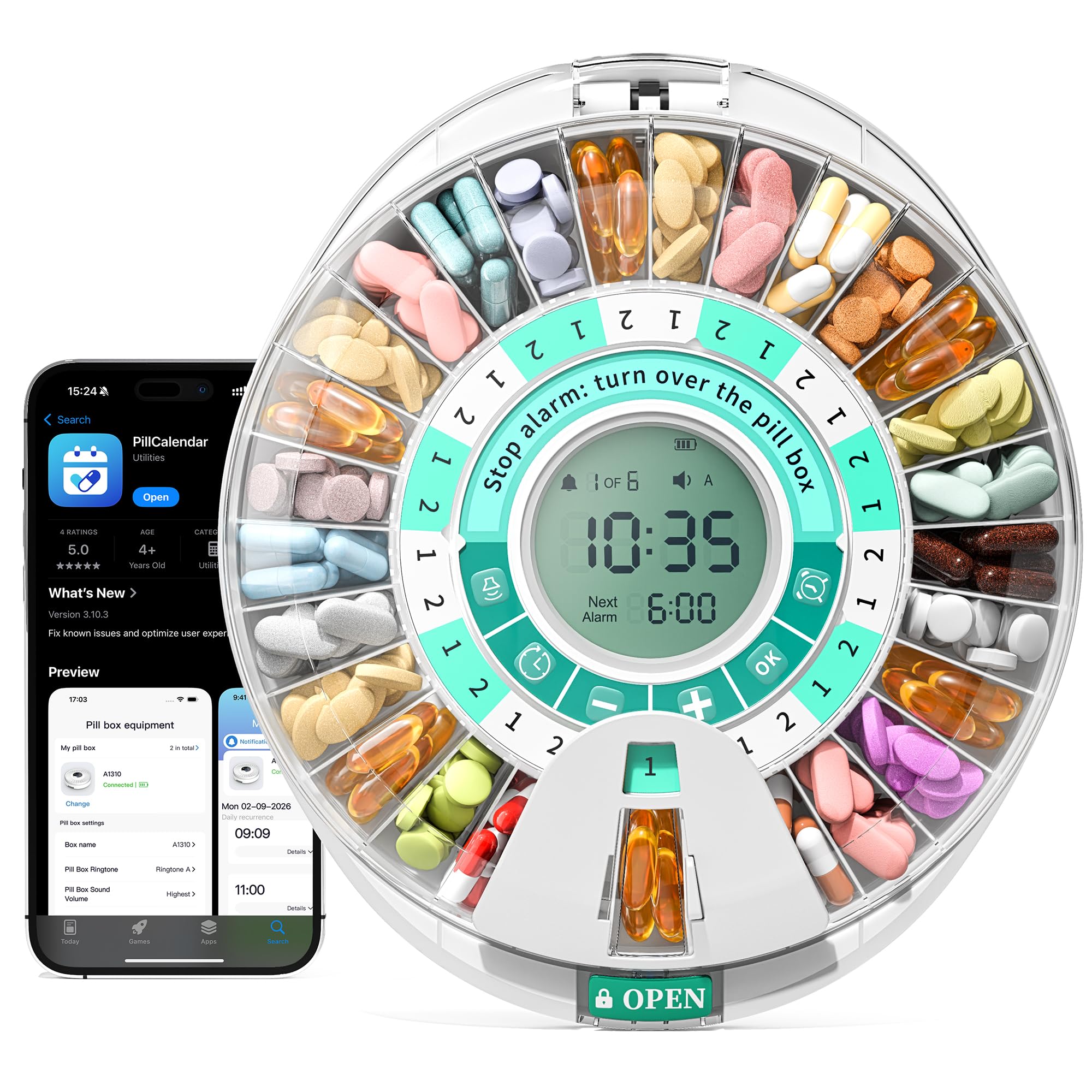
You can set up medication routines from anywhere with the Betife—its Pillcalendar app connects via Bluetooth so you can program up to 6 daily alarms, upload photos of each pill, and name the device (“Grandma’s Box”) from your phone. The app also logs every taken and missed dose into weekly and monthly charts, which helps during doctor visits or for your own confidence. If apps are not your thing, you can still control everything with the 6 physical buttons and XL display on the device itself.
At 2.14 pounds, it is one of the heavier units here, but the trade-off is a sturdy build with lids that pop open at the push of a button. Owners consistently praise the lid functionality and the large capacity that holds many pills without cramming. The recurring honest feedback: pills can occasionally get stuck in the dispensing chute, leading to skipped doses—so you may want to load it with a slight shake to settle everything.
The Clear Wins
- App-based medication log with weekly/monthly stats
- Large capacity with pop-up lids that stay open for easy loading
- Color-coded days you can rearrange to your schedule
The Honest Catch
- No physical lock—pills are accessible if someone opens the lid
- Pills sometimes jam in the chute; requires a shake to dislodge
- Runs on 4 AAA batteries only, no AC adapter option
Who this fits: Tech-comfortable caregivers who want real-time compliance tracking without constantly calling to check.
Think twice if: You need a tamper-proof lock to prevent a dementia patient from accessing multiple days at once.
2. EziMedPil 28-Day Locked Automatic Pill Dispenser
The lockable frosted lid that stops double-dosing while protecting privacy.
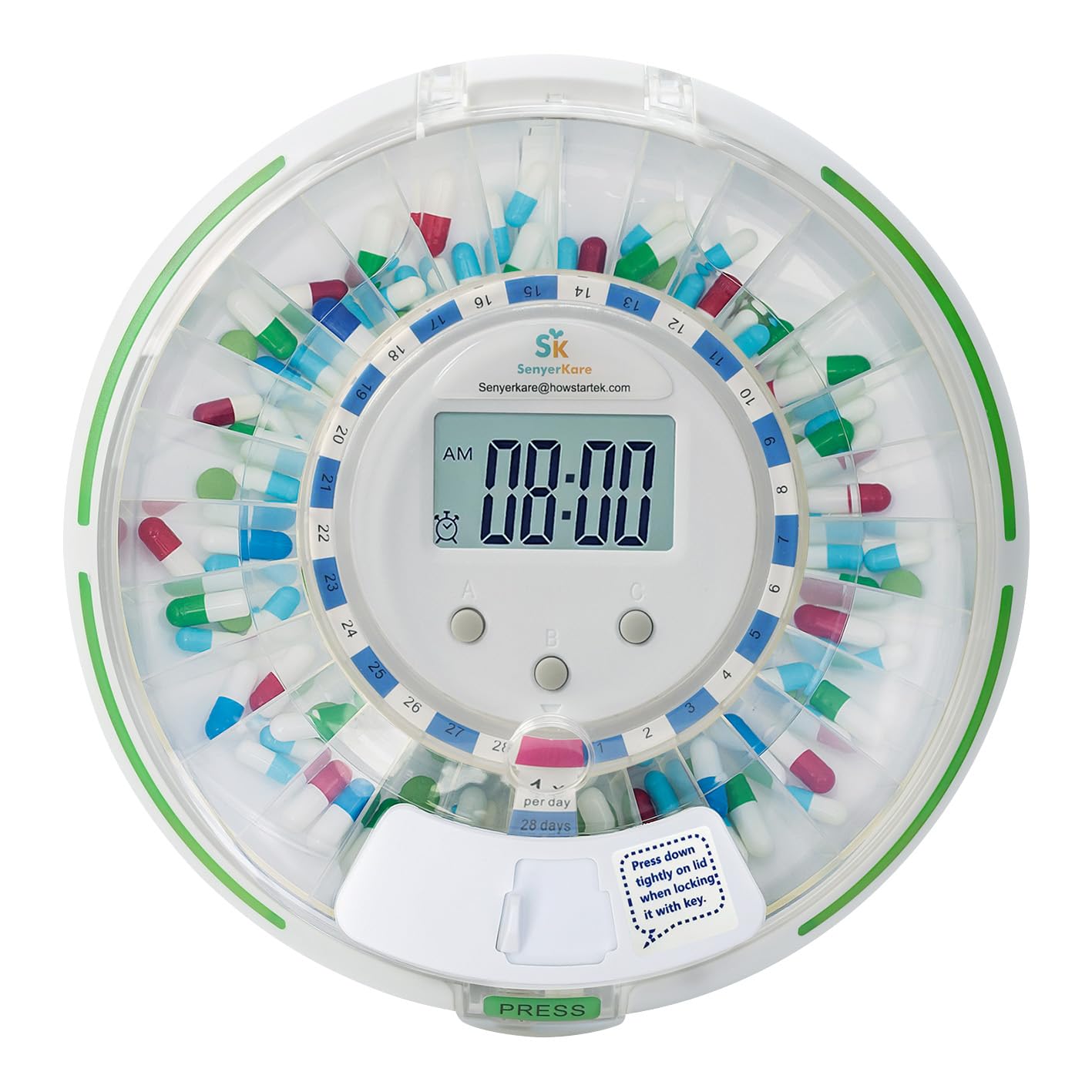
Buyers report this pick “eliminated wife’s wrong/forgotten/double doses.” The frosted, lockable lid keeps prying eyes and hands away from the medication supply, and the 28 compartments each hold up to 24 aspirin-sized tablets for a total capacity of 672 pills. The built-in mini magnifying glass is a thoughtful touch for reading tiny dosage labels, and the two anti-slip grips on the back make flipping the unit easier for someone with weak hands.
At 1.9 pounds, it is noticeably lighter than the Betife (2.14 pounds), so it travels better. The alarm offers two ringtones plus a mute option, but dispensing requires flipping the device upside down—owners mention that very small pills can miss the catch tray. The lock itself has drawn mixed feedback; some owners found it too basic (a hex nut), so treat it as a deterrent rather than a vault.
Why It Works
- Lockable frosted lid prevents visual confusion and unauthorized access
- 672-pill total capacity means fewer refills
- Magnifier and anti-slip grips aid users with poor eyesight or weak hands
Trade-Offs
- Lock is a simple hex nut—a determined child could open it
- Small pills can be missed when flipping the device
- Setup instructions are a bit short; clock logic trips some people up
Best for: Caregivers who need a lockable, high-capacity dispenser that fits a countertop and doesn’t require an app.
skip it if: Your user has severe arthritis—the upside-down shake action is not ideal for everyone.
3. JULOS Automatic Pill Dispenser
The loud 80dB alarm and bright flashing light combo that ensures no dose goes unnoticed.
JULOS keeps it simple: 3 labeled buttons for all programming, a super-bright LCD, and an 80-decibel alert paired with a high-visibility flashing light. The transparent lid lets you check remaining pills without open up the tray. It includes 6 dose rings for flexible scheduling and 2 physical backup keys. Owners say it works great for dementia patients on 2 to 4 daily doses, and the memory-save feature means you never need to re-program after changing batteries.
The honest downside is a locking mechanism some found flimsy—a 90-year-old with dementia managed to open it in one case. The alarm requires turning the unit upside down to stop, which can cause small pills to shift into wrong slots if done too abruptly. It runs on batteries only, with no plug-in option, which limits its reliability during power outages if the batteries run dry.
Reliable… with caveats: The 80dB alarm and flashing light are genuinely effective for users with hearing or vision loss. But the lock is not a high-security solution, and the battery-only power means you will want to keep spares handy. For a light-touch safety option in a home with supervision, it is a strong mid-range pick.
Reach for this if: You want a straightforward, app-free dispenser with a loud alarm that a tech-savvy younger person can set up for an elderly parent.
Look elsewhere if: You need a heavy-duty lock for unsupervised use or you prefer AC power over batteries.
4. Betife 2nd Gen Automatic Pill Dispenser
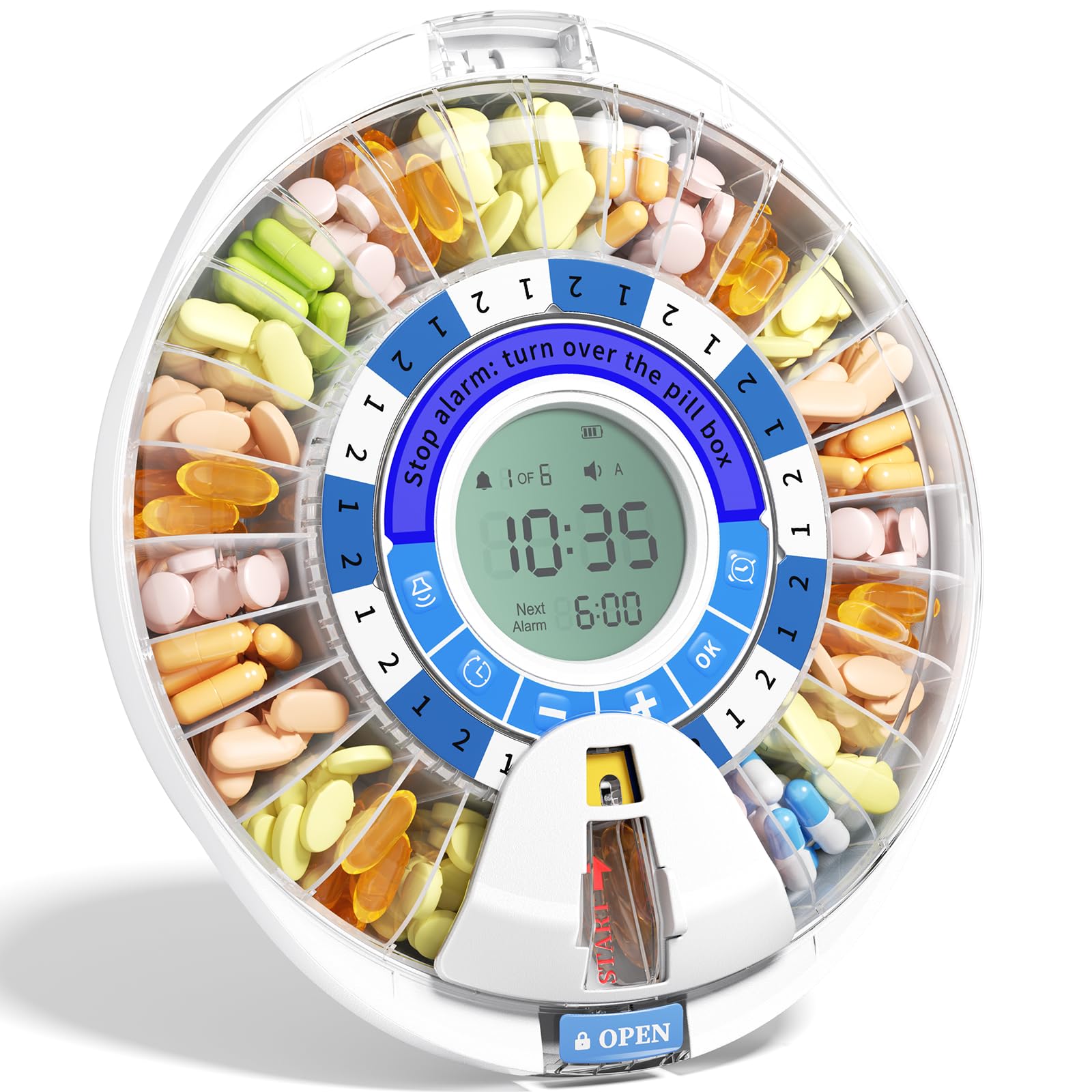
The 2nd Gen with a precision seal that stops pills from migrating between slots.
This Betife upgrade tackles the common “pills mixing into wrong days” problem with a <2 mm tray-to-cover seal that physically blocks pills from wandering. The extra-large LCD screen (XL compared to the previous generation) makes the time and alarm icons readable without reading glasses, and the 6-button console follows a strict one-function-per-key design—no long-press combos or confusing menus. The built-in lock adds a layer of child and dementia protection.
Owners praise the sturdy build and large compartments that accommodate many supplements. One buyer reports filling it every 2 weeks for a twice-daily schedule and says “she hasn’t missed a dose since we got it.” The catch: the key lock is still a basic mechanism, and the unit is battery-powered (4 AAA) with no AC option, which one reviewer docked a star for. It is also heavier at 2.16 pounds, so it is less suited for travel bags.
Smart refinement: The mix-proof seal addresses the most common failure of cheaper dispensers. If you are replacing a unit that frequently scrambled pills, this is the upgrade to buy. Just plan for battery replacements every few weeks.
Who it’s perfect for: Families who had trouble with pills migrating between days in a previous dispenser.
Who should pass: Anyone who needs a travel-friendly lightweight or a unit with an AC power backup.
5. Live Fine Automatic Pill Dispenser
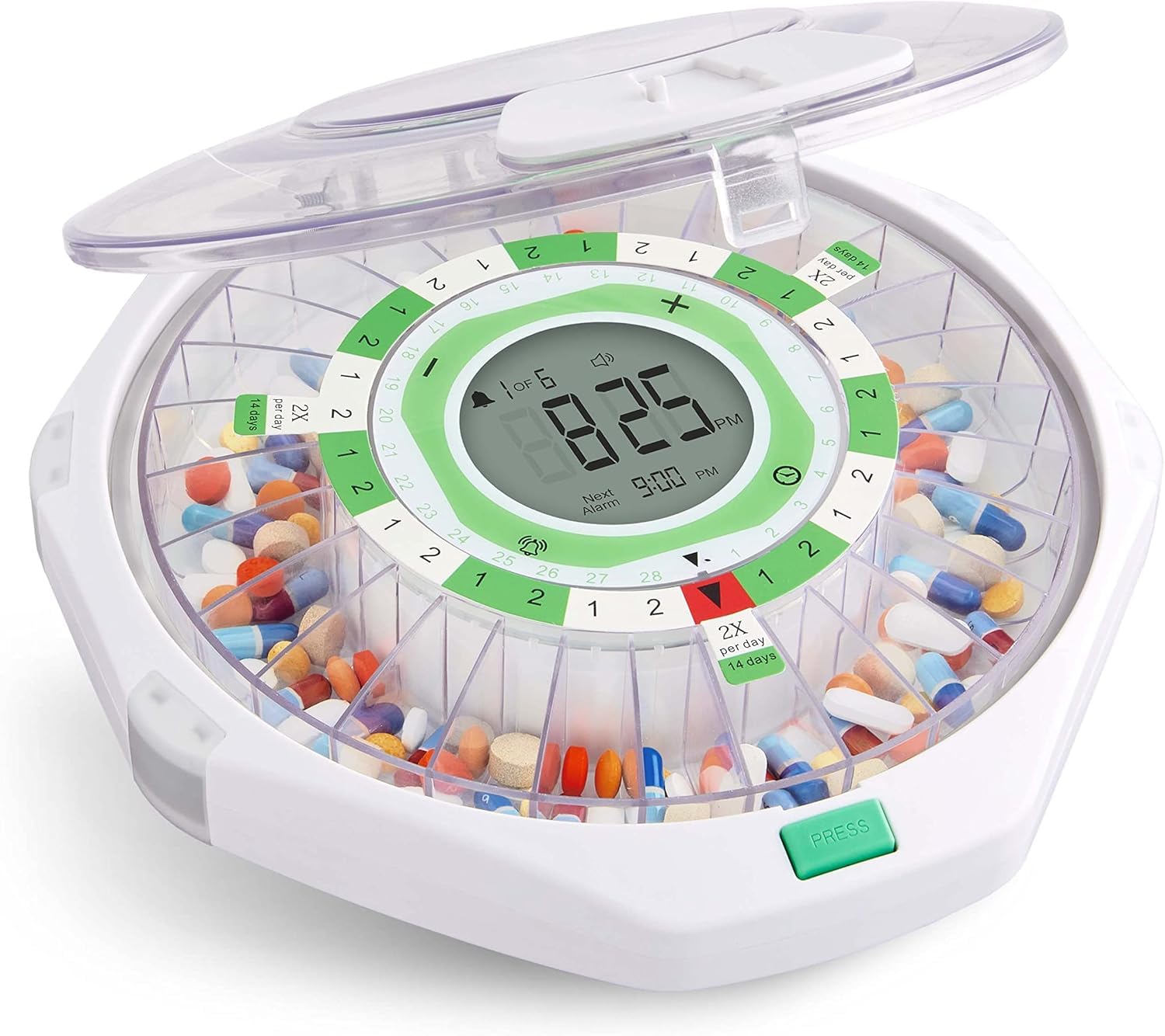
The 9-alarm dispenser with 3 customizable beep patterns and adjustable volume.
Most dispensers max out at 4 or 6 daily alarms; the Live Fine goes up to 9, making it ideal for complex medication schedules with multiple doses throughout the day. It also offers 3 beeping patterns and 3 volume levels (low, high, silent), so you can match the alert tone to the user’s sensitivity. The extra-large digital LCD shows the time, upcoming alarm, battery level, and number of alarms set—all at a glance. The lockable cover uses a manual key, and the smooth sliding retrieval window is easy for seniors to operate.
At just 1 pound, it is the lightest dispenser in this lineup, which helps for travel. Owners highlight its rock-solid reliability and say “the reliability is MORE than worth the price.” The trade-off: some find the setup more complicated than they expected, and the flipper accessory for mounting can be unstable, causing the device to fall if bumped. The 28-slot tray (not 31) means a twice-daily schedule requires filling every 2 weeks.
Standout Features
- 9 programmable daily alarms—more flexibility than any competitor here
- 3 beep patterns & 3 volume levels for personalized reminders
- Lightest in the review at 1 pound; easy to pack
Know Before You Buy
- Setup has a learning curve; some owners found it “too hard to figure out”
- Mounting flipper is unstable; the unit can fall over
- 28 compartments (not 31), so you may refill slightly more often
Grab this for: Anyone on a 5+ times daily med schedule who needs a lightweight, lockable unit with adaptable sound options.
Pass on it if: You want a plug-and-play experience—the programming demands patience.
6. PillCalendar Bluetooth Dispenser
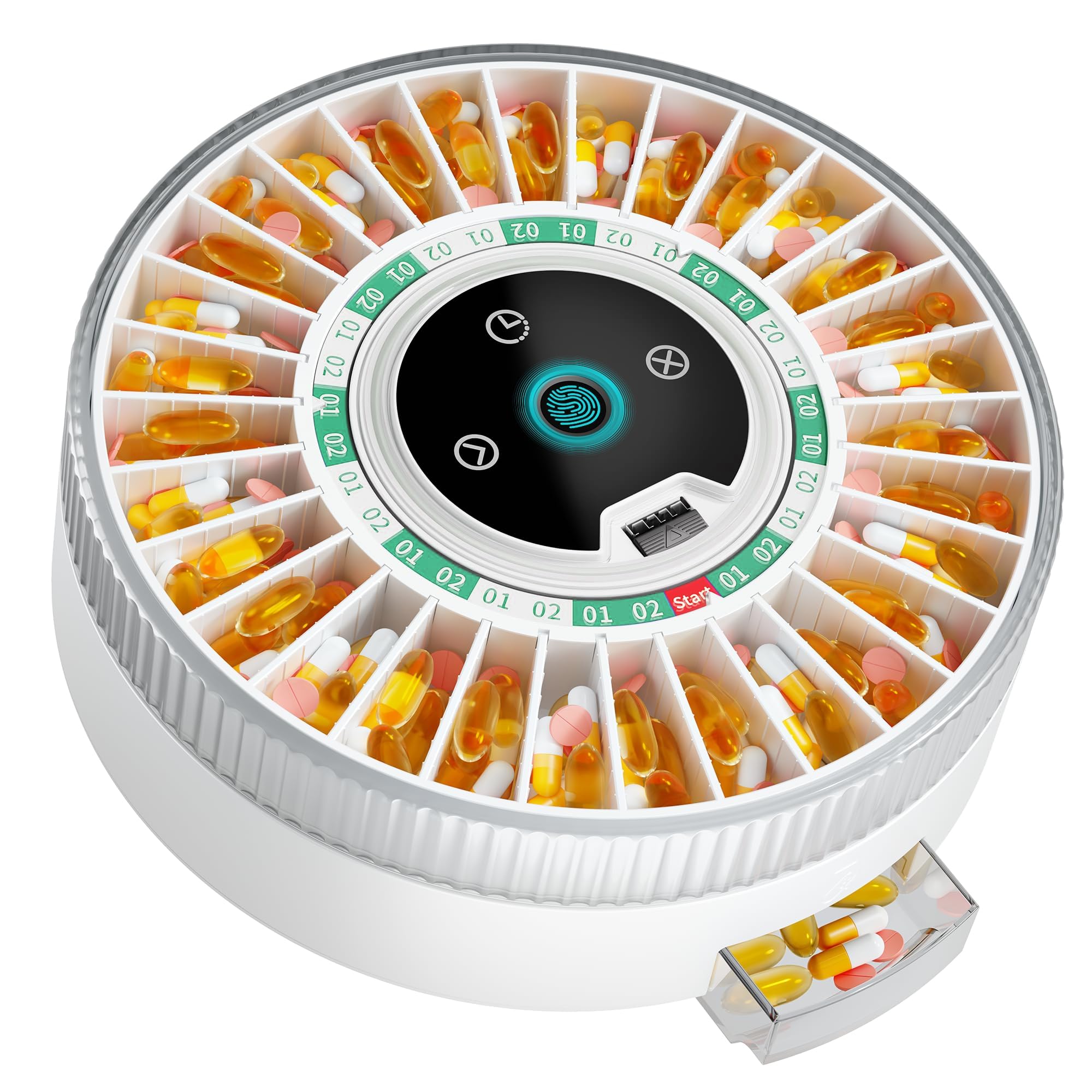
The fingerprint-reading dispenser that blends modern security with a press-to-open design.
open up a medication dispenser with your thumb feels futuristic, but it also means no keys to lose and no combination to forget. The PillCalendar uses an advanced fingerprint sensor plus a mechanical backup lock, providing dual layers of security that effectively block children or a confused user from overdosing. It runs on a 1200mAh rechargeable battery (2-hour fast charge) that lasts a month in low-power mode, and it connects via Bluetooth 5.0 to a free app for remote management.
The press-to-open design eliminates the need to lift or flip the whole unit, making it great for users with arthritis or weak hands. It has 31 compartments and 7 double-sided dose rings, offering more flexibility than the standard 28-slot design. Owners call it “easy to use” and love the fingerprint access. A small caveat: the app is necessary for initial setup, and some found the standby button finicky—the trick is letting the device time out on its own rather than pressing it off.
Cutting-edge convenience: The fingerprint lock and rechargeable battery set this apart from every other pick here. If your loved one can manage a touch sensor, this removes the “lost key” hassle entirely.
Best fit for: Tech-savvy caregivers who want biometric security, an app dashboard, and no disposable batteries.
Not for: Users who need a simple no-app experience or who cannot reliably use a fingerprint sensor (e.g., very dry or arthritic fingers).
7. MedReady 1700FL Automatic Pill Dispenser
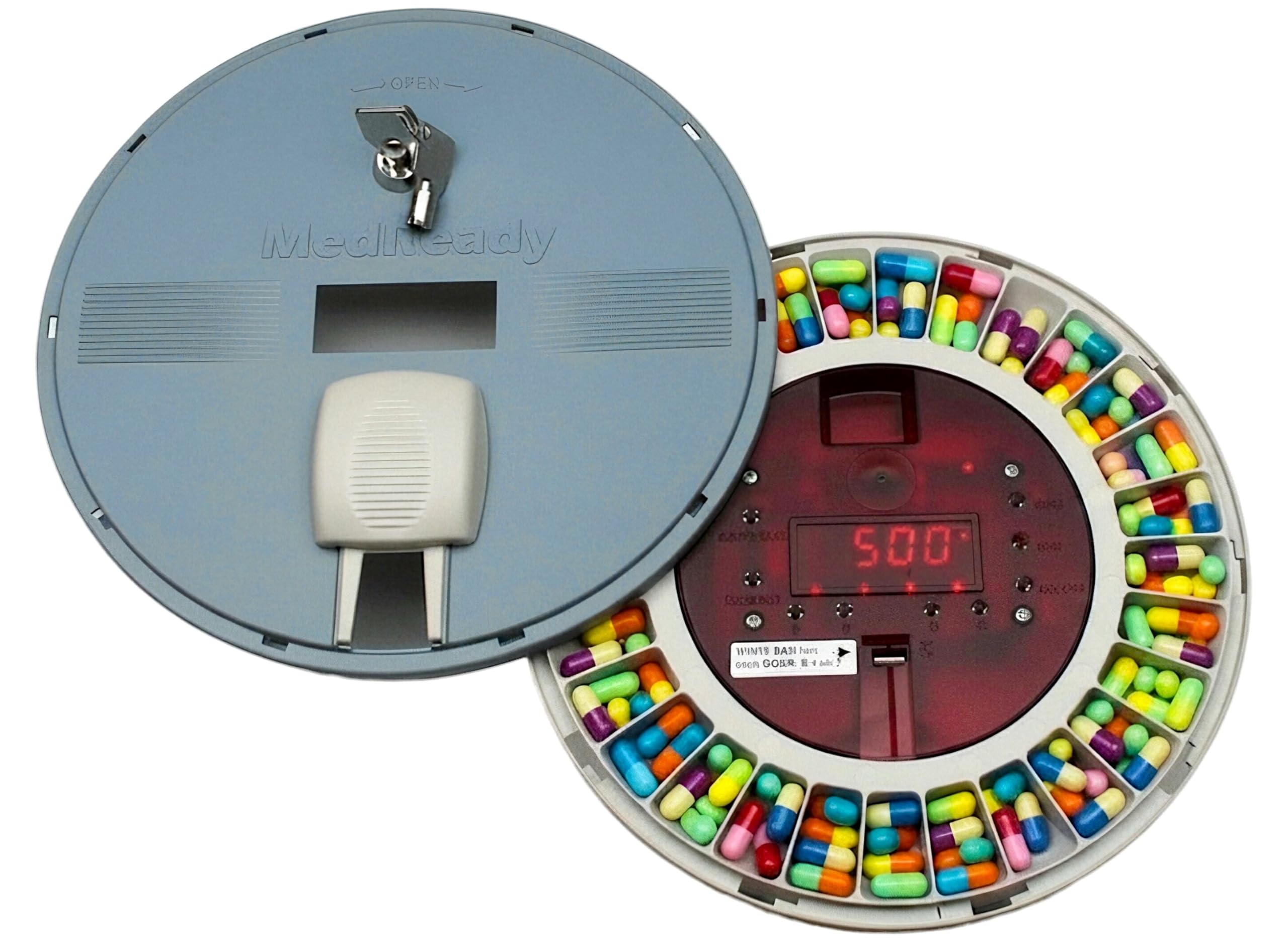
The US-made workhorse with a rechargeable backup that keeps running through power outages.
MedReady has been in the medication management game for over 25 years, and it shows in the 1700FL. The 85-decibel low-frequency alarm combined with a bright red flashing LED is designed specifically for seniors who are hard of hearing or live in noisy environments. Each alert can run up to 30 minutes, and you can enable sound only, light only, or both independently. The rechargeable NiMH battery provides up to 48 hours of backup during outages, so the schedule stays on track even when the grid goes down.
The 28-compartment tray holds up to 9 standard pills per slot, and the sloped exit ramp makes retrieval easy for arthritic hands. It supports 1 to 4 daily doses and can be adjusted in minutes. Customers note “~90% compliance” over a 2-3 year period. The honest complaints: the wheel turning is quite loud, and the battery connection can be flimsy. At 3 pounds, it is the heaviest unit here, so it is best left on a nightstand or kitchen counter.
The Strengths
- Made in USA with a real customer support team in California
- 48-hour rechargeable battery backup—no panic during storms
- 85dB low-frequency alarm penetrates walls and hearing aids
The Trade-Offs
- Loud mechanical wheel noise when turning
- Flimsy battery connection reported by some
- No clear lid—you cannot see remaining pills without open up
Reach for this if: You want a durable, US-assembled dispenser with genuine battery backup and a long track record (since 2013).
pass on it if: Quiet operation matters—this machine is not subtle with its clicking and alarms.
8. Ideerfit 28-Day Pill Dispenser
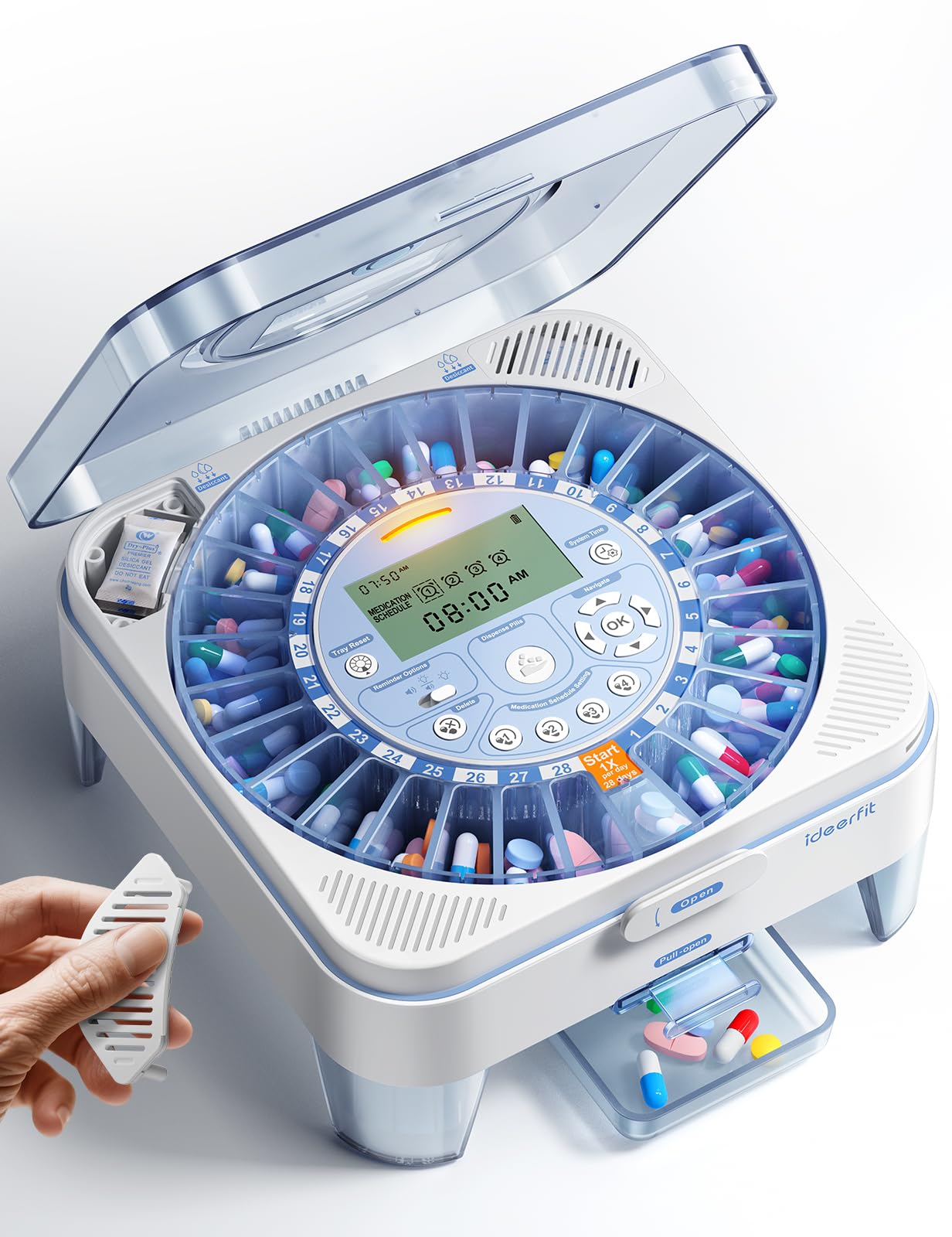
The one-press slide-door dispenser that drops pills into a cup—no shaking or flipping.
For a user with weak grip strength or shaky hands, the hardest part of a pill dispenser is physically getting the pills out. The Ideerfit solves that with a press-to-dispense button that opens a slide-door tray and drops the pills directly into a small cup. No tipping, no flipping, no shaking. It also includes a clear timing window that lets you take a dose up to 15 minutes early or 30 minutes late, which is a forgiving design for someone whose daily routine is not perfectly rigid.
The moisture-proof build features dual desiccant chambers and a water-resistant silicone seal, keeping pills stable in humid bathrooms or warm climates for 7+ days. Each compartment fits up to 16 calcium tablets or 14 typical vitamins. Owners of a mom with dementia call it “the highlight of my life” and report easy setup. The most common knock: the slide-door tab requires strong fingers to pull if you need to use the manual override—one owner with weak hands found it impossible.
Thoughtful design: The one-press cup system is genuinely easier for frail hands than any tilt-and-shake dispenser here. Just be aware the slide door can be stiff initially, and it is best for home use, not formal care facilities.
Who this suits: Seniors with arthritis, Parkinson’s, or significantly reduced hand strength who need a gentle dispense mechanism.
Not for: Nursing homes or assisted living facilities—the manufacturer explicitly labels it for home/non-institutional use only.
Understanding the Specs
Dosage Rings
A dosage ring is a plastic insert that sits inside the pill tray and tells the dispenser how many times per day to release medication. Most dispensers come with a set of interchangeable rings (e.g., 1x, 2x, 3x, or 4x daily). You drop in the ring that matches your medication schedule, and the machine rotates the tray by that many slots per day. This is far simpler than programming each alarm individually and prevents you from accidentally setting the wrong number of doses.
Locking Mechanism (Key vs. Fingerprint vs. None)
The lock is the primary safety barrier between a confused user and an overdose. A key lock requires a physical key (2 are usually included) to open the tray—this works but poses the risk of losing the key. A fingerprint lock (like on the PillCalendar) open up with a touch, eliminating lost keys, but may struggle with very dry or arthritic fingers. Some simple dispensers have no lock at all (just a latch), which is fine for a cognitively sharp user but risky for someone with Alzheimer’s who might open all the compartments at once.
FAQ
Will an Alzheimer’s pill dispenser work for someone with dementia who struggles with new gadgets?
How often do I need to refill a 28-day dispenser?
Can the lock be opened by someone with Alzheimer’s?
What happens if a dose is missed? Does the dispenser lock it away?
Can I use a pill dispenser for vitamins and supplements, not just prescriptions?
How long do the batteries last in these dispensers?
What is the difference between a “digital alarm pillbox” and a “locked automatic dispenser”?
Can I travel with a 28-day pill dispenser?
Do I need a smartphone app to use these dispensers?
What is the typical warranty or return policy for these dispensers?
Final Thoughts: The Verdict
For most people, the alzheimer’s pill dispenser winner is the Betife Automatic Pill Dispenser because it combines Bluetooth app tracking with a large, easy-to-load tray and a crowd-pleasing pop-lid design. If you want a lockable security-first option, grab the EziMedPil with its frosted privacy lid and 672-pill capacity. And for the user who struggles with grip strength, the Ideerfit one-press slide-door design is the easiest to operate hands-down. Pick the one that fits your home situation—and breathe easier knowing the medication schedule is handled.
How We Picked
We do not accept paid placement. Every pick is matched to a real buyer and a real use-case; we do not hands-on test units.
Sources & Methodology
Specifications: manufacturer listings and product documentation. Review insights: verified customer reviews, as of July 2026. Pricing: not shown on this page (it changes often); check the current price via the retailer link.
As an Amazon Associate, Gadgets Feed earns from qualifying purchases. This does not affect which products we feature.