
Our readers keep the lights on and my morning glass full of iced black tea. As an Amazon Associate, I earn from qualifying purchases.
Specs are compiled from manufacturer listings and verified buyer reviews and can change over time — please confirm the key details on the product page before buying.
Picking the right processor for your new AM5 gaming PC depends on one question: do you need raw core count or the special 3D V-Cache that cuts through stutter in demanding titles? The AM5 socket (a modern CPU slot called LGA 1718) now spans entry-level chips up to flagship 12-core monsters, and the wrong choice leaves money on the table or performance stuck behind a bottleneck. This guide lays out exactly which chip suits your resolution, your GPU, and your budget.
I’m Min — the founder and writer behind Gadgets Feed. This guide is built by comparing the manufacturers’ published specifications and the patterns across verified customer reviews, so you get each pick’s real strengths and trade-offs instead of marketing spin.
Whether you play fast competitive shooters at 1080p or push high-refresh 4K with ray tracing, the best am5 cpu for gaming depends on matching the right cache size, core count, and boost clock to your actual setup — and I’ve broken it all down below.
Quick Picks
- AMD RYZEN 7 9800X3D — Top Performer
- AMD Ryzen™ 9 9900X — High-Speed Versatility
- AMD Ryzen™ 9 7900X3D — Cache King
- AMD Ryzen™ 7 9700X — SFF Star
- AMD Ryzen 7 7700X — Best Value
- AMD Ryzen 5 7500X3D Box — Entry X3D
- AMD RYZEN 5 7600X3D — Budget Champion
How To Choose The Best AM5 CPU For Gaming
Every AM5 processor fits the same physical socket, but they split into two camps: the X3D models with extra cache that helps in simulation, strategy, and open-world games, and the standard models with higher clock speeds that boost lighter or less cache-sensitive titles. Your first decision is which camp your library lives in.
3D V-Cache: The Anti-Stutter Technology
A special layer of extra memory physically stacked on the processor die. 3D V-Cache means more game data sits right on the CPU instead of calling out to slower system memory — you see the benefit as smoother frame pacing in games like “Cyberpunk 2077,” “Starfield,” and demanding battle royales. X3D chips generally win in 1080p and 1440p gaming, even with lower clock speeds.
Core Count vs. Clock Speed
Game engines today rarely use more than eight cores well, so a 6-core chip with a high boost clock (like a Ryzen 5 series at 5.0 GHz and above) can beat a 12-core workhorse in pure gaming. Extra cores help if you stream, record, or run background tasks while playing, but for a dedicated gaming rig, six or eight fast cores is the balance.
Motherboard and Cooling Considerations
Every AM5 CPU in this list needs a dedicated aftermarket cooler. High-end X3D models like the Ryzen 9 7900X3D actually run relatively cool when gaming, but standard X-series chips — especially the Ryzen 7 7700X — can run hot, so a good air cooler or a 240mm liquid cooler (a radiator with two fans) is strongly recommended. Your motherboard’s VRM (the voltage regulator that feeds the CPU) also determines how much boost the processor can sustain under load.
Quick Comparison
| Model | Best For | Cores / Threads | Max Boost Clock | Cache | Amazon |
|---|---|---|---|---|---|
| Ryzen 7 9800X3D | Ultimate pure gaming | 8 / 16 | 5.2 GHz | 104 MB | Amazon |
| Ryzen 9 9900X | Gaming + heavy productivity | 12 / 24 | 5.6 GHz | 76 MB | Amazon |
| Ryzen 9 7900X3D | Creator + gamer hybrid | 12 / 24 | 5.5 GHz | 140 MB | Amazon |
| Ryzen 7 9700X | Compact SFF gaming build | 8 / 16 | 5.5 GHz | 40 MB | Amazon |
| Ryzen 7 7700X | Best value 8-core gaming | 8 / 16 | 5.4 GHz | 80 MB | Amazon |
| Ryzen 5 7500X3D | Entry-level 3D V-Cache | 6 / 12 | 4.5 GHz | 102 MB | Amazon |
| Ryzen 5 7600X3D | Best value X3D gaming | 6 / 12 | 4.1 GHz | 96 MB L3 | Amazon |
In‑Depth Reviews
1. AMD RYZEN 7 9800X3D
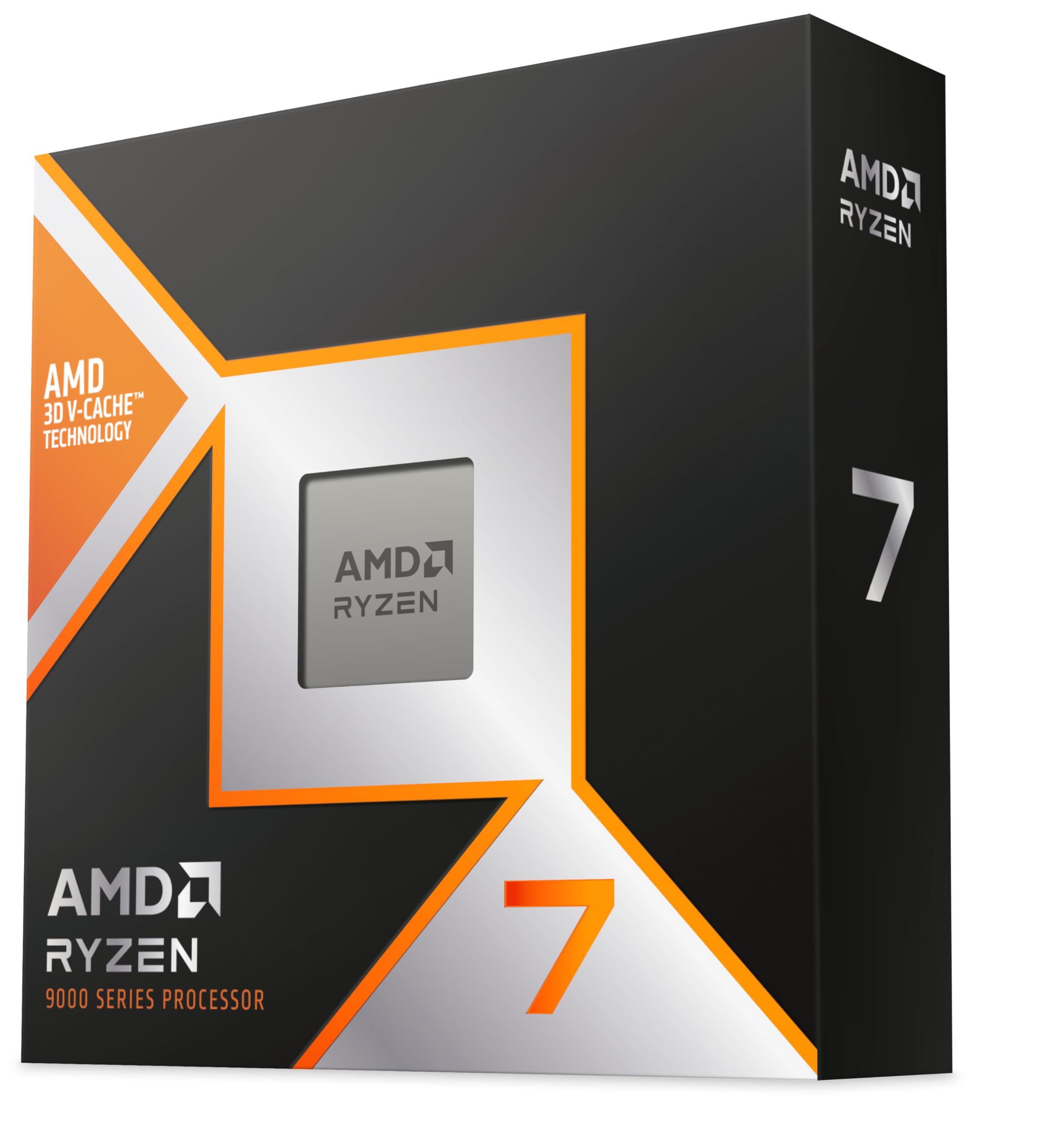
You get the smoothest gameplay of any AM5 chip, thanks to a second-generation 3D V-Cache that hits 104 MB total cache
This is AMD’s current crown jewel for gaming, built on the newer “Zen 5” architecture with a second-generation 3D V-Cache (a stacked layer of extra memory) that pushes total cache to 104 MB. That extra memory directly feeds the processor faster, which translates to noticeably smoother 1% low frame rates (the moments when a game would normally hitch or stutter) in almost any title you throw at it.
AMD claims a +~16% IPC uplift (instructions per clock — basically how much work each cycle does) over the previous generation while keeping great power efficiency. At 8 cores and 16 threads with a 5.2 GHz max boost, it strikes a balance that pure gaming rigs love — more cores than you need for games alone, but not so many that you pay for silicon you won’t use. The brand markets it as “the world’s fastest gaming processor,” and reviewers confirm it sits at the top of the AM5 stack.
The catch: you pay a premium for that top-dog status, and you still need to budget for an external cooler (it does not come with one). The 9800X3D also demands a good motherboard to feed its 5.2 GHz boost properly. It is overkill if you game at 4K where the GPU is the bottleneck.
The king of frames: The 9800X3D is the single fastest AM5 gaming chip available, with the 104 MB of cache and 8-core advantage over the 7600X3D to prove it — but it comes at a flagship price.
Reach for this if: you want the absolute best gaming performance money can buy on AM5 and you pair it with a high-end GPU (like an RTX 5080 or faster) to see the full benefit.
Look elsewhere if: your gaming is at 4K where the GPU is the bottleneck, or if you need more than 8 cores for video editing or 3D rendering alongside gaming.
2. AMD Ryzen™ 9 9900X

Twelve cores that clock higher than any other chip on this list
The Ryzen 9 9900X boosts all the way to 5.6 GHz versus the Ryzen 5 7600X3D’s 4.1 GHz boost. That speed advantage makes it a standout in games that respond to raw clock frequency rather than cache size, like competitive shooters and older titles where the engine doesn’t lean on 3D V-Cache.
It packs 12 cores and 24 processing threads, built on “Zen 5” architecture, with 76 MB of cache and support for DDR5-5600 memory. That gives you serious muscle for multitasking: if you stream, encode video, or run virtual machines while gaming, the 9900X handles the load without breaking a sweat. The boost clock also helps it lead in synthetic benchmarks and any scenario where single-thread speed is king.
On the trade-off side, the 9900X lacks the 3D V-Cache that gives X3D chips their gaming edge, so in cache-hungry games like “Factorio,” “Civilization,” or “Microsoft Flight Simulator,” you may see lower 1% lows compared to a 7900X3D or 9800X3D. It also needs decent cooling to sustain that 5.6 GHz boost under all-core loads.
Clock-speed champion: The 9900X offers the highest max boost clock across the AM5 lineup at 5.6 GHz, making it the go-to for gamers who also need heavy multi-threaded productivity.
Ideal for: the gamer who also streams, edits, or runs compilation tasks and wants the highest single-core frequency possible alongside 12 cores of throughput.
skip it if: your only use is gaming and you want the smoothest frame delivery in simulation or strategy titles — an 8-core X3D chip like the 9800X3D will serve you better.
3. AMD Ryzen™ 9 7900X3D

Twelve cores with a massive 140 MB cache for heavy gaming and creation
The 7900X3D combines the most cache on this list — a whopping 140 MB — with 12 cores and 24 threads, making it the choice for someone who both games at high settings and does serious productivity work. That 140 MB cache is far larger than the Ryzen 7 7700X’s 80 MB total cache, which is exactly what cache-sensitive game engines need for consistent frame delivery.
Its boost clock hits 5.5 GHz, and it supports DDR5 memory with unlocked overclocking. AMD recommends a liquid cooler for this chip, and it runs at a maximum operating temperature (Tjmax) of 89°C. The 12-core count gives you 12 cores versus the 6-core Ryzen 5 7600X3D in raw multi-threaded tasks, so if you render video or compile code while keeping game performance high, this hybrid does both.
The main trade-off: the 7900X3D’s boost clock is slightly lower than the non-X3D 9900X’s 5.6 GHz, and in games that don’t benefit from the 3D V-Cache, the 9900X can edge ahead. Also, buyers report that some software may not perfectly schedule across the two CCDs (chiplet dies) to always use the cache-first cores for games.
Creator-gamer hybrid: The 7900X3D’s 140 MB cache makes it an excellent pairing for a high-end GPU in simulation games, while 12 cores ensure smooth rendering jobs.
Grab this if: you edit 4K video or do 3D modeling on the same rig you game on, and you want the extra cache to prevent stutter in open-world titles.
Not for you if: you only game and don’t need the extra 12 threads — an 8-core X3D chip like the 9800X3D will cost less and game just as well or better.
4. AMD Ryzen™ 7 9700X

Zen 5 efficiency that runs cool enough for a small-form-factor case
The Ryzen 7 9700X delivers serious gaming performance — it’s built on the newer “Zen 5” architecture with a 5.5 GHz max boost, 8 cores, and 16 threads — but its standout feature is a 65W TDP (thermal design power, a measure of how much heat it produces under load). That is remarkably low for an 8-core chip, and it means you can cool it with a compact air cooler inside a small case. Owners mention running the 9700X at low-mid 60s°C under 4K gaming with an RTX 5080, a temperature that is exceptionally cool for a modern CPU.
With 40 MB of cache and DDR5-5600 support, the 9700X performs well in all modern games, and customers note it can even beat the 7800X3D in certain IPC-heavy (instructions-per-clock heavy) titles after some memory tuning with 6000MT/s CL28-26 RAM and PBO (Precision Boost Overdrive, AMD’s automatic overclocking feature). It runs so cool that a simple budget air cooler is enough — one verified reviewer paired it with a Noctua NH-U12A and saw great results.
The catch: the 9700X lacks the 3D V-Cache found on the pricier X3D models, so in titles that absolutely depend on that extra cache for smooth 1% lows, the 7600X3D or 7800X3D will outperform it at a similar or lower cost. Also, there is no stock cooler in the box.
Small-build powerhouse: At just 65W TDP with 8 Zen 5 cores and a 5.5 GHz boost, the 9700X is the go-to for compact cases where every watt of heat matters.
Perfect for: small-form-factor builders who want low thermals and power draw without sacrificing 8-core gaming and productivity performance.
Think twice if: your game library is dominated by cache-sensitive simulation titles — an X3D chip like the 7600X3D will give you smoother frame-times even with fewer cores.
5. AMD Ryzen 7 7700X

Eight fast Zen 4 cores that overclock well without the X3D premium
The 7700X is the value anchor of the 8-core AM5 lineup, delivering 5.4 GHz max boost and an 80 MB total cache on the proven “Zen 4” architecture. It can push over 100 FPS in the most popular games right from the start. With 8 cores and 16 threads, it covers the same core count as the more expensive 9700X and 9800X3D, and it is unlocked for overclocking — one verified buyer reports running 32GB of 6000MT/s CL30 RAM stable with good overclocks.
The included integrated RDNA 2 graphics (a basic GPU built into the processor) actually lets you play light games like Apex at 1080p low at 44-63 FPS, or Fortnite at 90-120 FPS, which is handy for troubleshooting or a temporary setup without a dedicated graphics card. Reviewers call it excellent for gaming and productivity after six months of use, noting it runs hot under load (the “X” suffix chips tend to) and recommend a good aftermarket cooler, ideally an AIO (all-in-one liquid cooler) to keep temperatures under 70°C under 60% usage.
The main trade-off: the 7700X is on the older Zen 4 architecture, so the per-clock efficiency is slightly behind Zen 5 chips like the 9700X, and it lacks 3D V-Cache entirely. If the price gap to an X3D chip is small, the X3D will offer better gaming consistency.
Reliable 8-core workhorse: The 7700X offers a strong 5.4 GHz boost and solid overclocking headroom at a mid-range price, but it does need decent cooling to stay happy.
Stick with this if: you want an 8-core chip for gaming and productivity at a comfortable price, and you are okay investing in a quality cooler to keep its thermals in check.
Pass it up if: you want lower power draw and newer architecture — the Zen 5 9700X runs cooler at 65W TDP and may be worth the extra spend.
6. AMD Ryzen 5 7500X3D Box
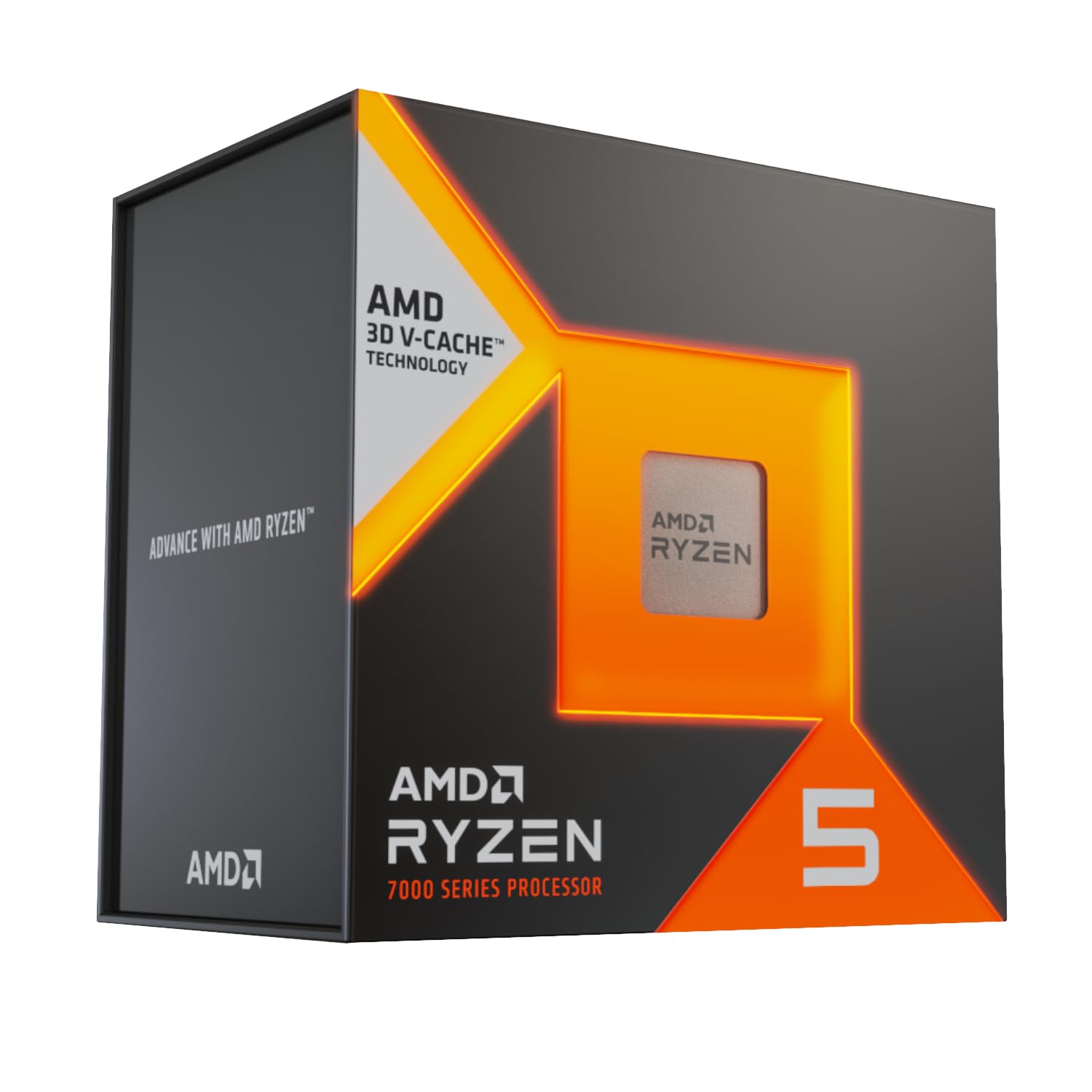
Your cheapest ticket into the 3D V-Cache club without sacrificing AM5 compatibility
The Ryzen 5 7500X3D brings the X3D cache technology — a total of 102 MB — to a 6-core, 12-thread “Zen 4” processor with a 4.5 GHz speed. That 102 MB cache sits close to the 9800X3D’s 104 MB and is larger than the 7700X’s 80 MB total cache, which gives it a distinct edge in games that rely on that big pool of on-chip memory for smooth frame delivery.
AMD positions it as a new “X3D entry-level solution” for the AM5 socket, promising it is faster in AAA titles and competitive gaming than comparable processors in the same price range. With 6 cores, it pairs well with mid-range GPUs like an RTX 5070 or Radeon RX 9070, especially at 1440p resolution where the cache helps prevent the 1% low stutter that can ruin an experience. Its spec sheet shows 4.5 GHz speed, which is lower than non-X3D chips, but the cache often compensates in gaming workloads.
The trade-off: the 7500X3D has only 6 cores, so for any serious productivity like video editing or 3D rendering, an 8-core chip like the 7700X or 9700X will finish tasks faster. And with a 4.5 GHz boost clock, games that are frequency-sensitive rather than cache-sensitive may run slower than a higher-clocked 6-core chip.
Budget V-Cache: The 7500X3D delivers a 102 MB cache at a low entry price, making it a smart pick for gamers on a budget who want that anti-stutter technology.
Good for: the budget-conscious builder who plays cache-hungry titles like simulation, open-world, and strategy games and wants to spend money on a GPU instead.
Not ideal if: you need more than 6 cores for work tasks or you play esports titles that favor high clock speeds over cache size.
7. AMD RYZEN 5 7600X3D

The value balance that brings 3D V-Cache to a 6-core budget-friendly package
The Ryzen 5 7600X3D packs 6 cores and 12 threads with a massive 96 MB of L3 cache (the extra on-chip memory that helps games run smoothly) on the Zen 4 architecture. Compared to the 7900X3D, it has 6 cores versus 12 and 12 threads versus 24, but for pure gaming that extra cache often matters more than raw core count. Reviewers point out a “Strong 1% low uplift over 9600X” and real gameplay figures like “F1 25 1440p: ~160 fps avg, 120 1% lows with 5070 Ti, high preset + RT,” showing this chip can handle ray tracing without hitching.
With a 4.1 GHz max boost clock versus the Ryzen 9 9900X’s 5.6 GHz, the 7600X3D relies on its 96 MB of L3 cache to outperform higher-clocked non-X3D chips in gaming. Reviewers call it “basically a 7800x3d for less” and note that “few games use extra cores,” so the 6-core count is rarely a bottleneck for pure gaming. It runs at a modest 65W, stays cool, and works with cheap DDR5 RAM and an air cooler, making the total build cost very attractive.
The catch: its 4.1 GHz boost is the lowest max frequency of any chip on this list, so in frequency-bound titles — especially older esports games at 1080p — it may not match the peak FPS of a 5.4 GHz 7700X. It also needs an aftermarket cooler (none included), and some shoppers say the boost can be limited by motherboard power delivery if you use a budget board.
Value gaming king: With 96 MB L3 cache and a wallet-friendly price, the 7600X3D delivers strong X3D gaming performance for the money — buyers call it “best value CPU.”
Buy this for: a pure gaming build where your budget needs to stretch — the 7600X3D pairs brilliantly with a mid-range GPU and cheap RAM for 1440p high-refresh gaming.
Step up if: you play esports at 1080p and want peak frame rates, or you need the extra cores for streaming or video work alongside gaming.
Understanding the Specs
3D V-Cache
This is a physical layer of extra memory (L3 cache) stacked on top of the processor die. In gaming, more cache means the CPU can store more of the game’s active data right on the chip instead of fetching it from slower system RAM. You see the benefit as smoother frame delivery with fewer sudden stutters, especially in simulation, open-world, and strategy games where the CPU has to crunch a lot of unique data per frame. All X3D models (7600X3D, 7500X3D, 7900X3D, 9800X3D) carry this.
Boost Clock
This is the maximum frequency the processor can reach under load, measured in gigahertz (GHz). A higher boost clock generally translates to more instructions processed per second, helping in games that rely on single-threaded performance — like competitive shooters and older titles. All AM5 chips can also run at a lower base clock when idle to save power. The 9900X tops the charts at 5.6 GHz, while the 7600X3D sits at 4.1 GHz, the lowest on this list.
Core and Thread Count
A core is a physical processing unit on the CPU; a thread is a virtual lane the operating system uses to send tasks to that core. Most modern games use between 4 and 8 threads effectively. More cores (12 on the 7900X3D and 9900X) help when you stream, record, or run heavy background apps alongside your game. For a dedicated gaming-only rig, 6 or 8 cores is usually the optimal range — paying for 12 cores you do not use can be a waste of budget.
Thermal Design Power (TDP)
Measured in watts, TDP tells you roughly how much heat the CPU generates under typical load and guides your cooler choice. A 65W TDP chip like the 9700X or 7600X3D can be cooled by a compact air cooler and is ideal for small cases. A higher TDP chip like the 7700X runs hotter and typically needs a beefier air cooler or a liquid cooler (an AIO with a radiator) to maintain peak boost without throttling.
FAQ
Do I need a new motherboard for these AM5 CPUs?
What kind of RAM do I need for an AM5 gaming build?
Is the Ryzen 5 7600X3D better than the Ryzen 7 7700X for gaming?
Do any of these AM5 CPUs come with a cooler in the box?
How many cores do I really need for gaming in 2025?
Will my AM5 CPU support PCIe 5.0 graphics cards and SSDs?
What is the difference between Zen 4 and Zen 5 architecture?
Can I use the integrated graphics on these CPUs for gaming?
Final Thoughts: The Verdict
For most users — gamers building a balanced rig — the best am5 cpu for gaming winner is the Ryzen 5 7600X3D because it delivers the critical 3D V-Cache that prevents stutter in demanding titles, all at a price that leaves room for a strong GPU and fast DDR5 RAM. If you want the absolute highest frame rates in any game regardless of cost, grab the Ryzen 7 9800X3D. And for a compact, low-heat gaming build that does not sacrifice 8-core power, the standout is the Ryzen 7 9700X.
How We Picked
We do not accept paid placement. Every pick is matched to a real buyer and a real use-case; we do not hands-on test units.
Sources & Methodology
Specifications: manufacturer listings and product documentation. Review insights: verified customer reviews, as of July 2026. Pricing: not shown on this page (it changes often); check the current price via the retailer link.
As an Amazon Associate, Gadgets Feed earns from qualifying purchases. This does not affect which products we feature.
Product prices and availability are accurate as of the date/time indicated and are subject to change. Any price and availability information displayed on Amazon at the time of purchase will apply to the purchase of this product. As an Amazon Associate I earn from qualifying purchases.
CERTAIN CONTENT THAT APPEARS ON THIS SITE COMES FROM AMAZON. THIS CONTENT IS PROVIDED "AS IS" AND IS SUBJECT TO CHANGE OR REMOVAL AT ANY TIME.
Amazon and the Amazon logo are trademarks of Amazon.com, Inc. or its affiliates.