
Buying your first amateur drone is less about choosing a brand and more about matching three rigid constraints — weight limits that skip FAA registration, battery voltage that dictates real airtime, and transmission tech that either locks your view or cuts it. Misjudge any of those, and you either land a paperweight or a bill for a lost quadcopter.
I’m Min — the co-founder and writer behind Gadgets Feed. I’ve spent hundreds of hours cross-referencing transmission ranges, gimbal axes, battery cell chemistry, and wind-resistance ratings across the sub-250-gram category so you don’t have to parse conflicting spec sheets.
Whether you’re after stable 4K footage or a practice platform that survives your learning curve, this guide to the best amateur drone breaks down exactly which specs deliver real reliability indoors and out.
How To Choose The Best Amateur Drone
Every drone on this list can fly; the ones worth your money can also return home reliably. Focus on three pillars — flight time per battery, camera stabilization method, and transmission resilience — and you will avoid the typical beginner pitfalls of losing signal mid-flight or spending your whole day charging packs.
Weight Class and Registration Requirements
Drones under 250 grams takeoff weight skip FAA registration and Remote ID requirements for recreational flyers. This threshold dictates everything from portability (folds into a jacket pocket) to legal overhead. Models between 249g and 550g need a Remote ID module built-in or add-on, adding cost and setup complexity.
Camera Stabilization: Gimbal Axes vs. EIS
Mechanical gimbals physically counteract drone movement. A 2-axis gimbal handles pitch and roll; a 3-axis gimbal adds yaw stabilization for buttery pans. Electronic Image Stabilization (EIS) crops and smooths the frame in software but can introduce jelly effect during fast yaw turns. For amateur pilots prone to jerky sticks, a mechanical gimbal is more forgiving.
Transmission Tech and Real-World Range
Basic Wi-Fi FPV systems cut out after 300 meters in open fields; buildings and trees reduce that to under 100 meters. Drones using a dedicated digital transmission protocol (like potensic PixSync 2.0 or Holy Stone repeater) sustain clean feeds at 1-4 km. For any serious outdoor flying, avoid pure Wi-Fi and look for a controller with a signal repeater or wired digital link.
Quick Comparison
On smaller screens, swipe sideways to see the full table.
| Model | Category | Best For | Key Spec | Amazon |
|---|---|---|---|---|
| Potensic ATOM LT | Mid-Range | Longest flight time per battery | 3000mAh battery, 40 min per pack | Amazon |
| Holy Stone HS790 | Premium | Professional-grade gimbal stability | 3-axis mechanical gimbal, 4K/30fps | Amazon |
| DJI Neo 2 | Premium | Gesture & palm control selfies | 151g, omnidirectional obstacle sensing | Amazon |
| Bwine F7GB2 Pro | Premium | Longest total flight time (3 batteries) | 75 min total, 3x 2600mAh packs | Amazon |
| Bwine F7MINI | Premium | Built-in screen controller & sub-249g | 5.5-inch built-in screen, 249g | Amazon |
| Holy Stone HS600 | Premium | Range & wind resistance | 20000ft range, Level 6 wind resistance | Amazon |
| REDRIE HK33 (4K Gimbal) | Mid-Range | 2-axis gimbal on a sub- budget | 2-axis gimbal, 4K photo, 300m range | Amazon |
| REDRIE HK33 (GPS Version) | Mid-Range | GPS follow & waypoint for beginners | GPS auto-return, 45 min flight time | Amazon |
| Oddire HK11 | Budget | Price-conscious entry with GPS return | 7.7V battery, 48 min flight time | Amazon |
In‑Depth Reviews
1. Potensic ATOM LT GPS Drone

The Potensic ATOM LT squeezes a 3000mAh intelligent battery into a 249-gram airframe — that is 40 minutes of real flight per pack, not the padded numbers some brands quote. PixSync 2.0 digital transmission keeps a clean 2.5K feed at distances over a mile with minimal breakup.
The Sony sensor delivers 2.5K/30fps footage with ShakeVanish 2.0 EIS, which smooths out gimbal-less jitters better than competitors at this price tier. Four GNSS constellations (GPS, GLONASS, Galileo, BeiDou) lock satellites faster, reducing the pre-flight wait from painful to acceptable.
SurgeFly 2.0 offers three flight modes tailored for beginners — from a docile pad to sporty response. Active braking during RTH prevents the fly-away panic some budget GPS drones induce. A spacious travel case and two Type-C/Lightning adapter cables round out the kit.
Why it’s great
- True 40-minute per-battery runtime from 3000mAh cells
- PixSync 2.0 digital transmission holds signal at 4 km
- Quad-GNSS for fast satellite acquisition
Good to know
- EIS can induce wobble in aggressive yaw turns
- GPS-only mode requires open outdoor space to initialize
2. Holy Stone HS790 6K Photo Drone
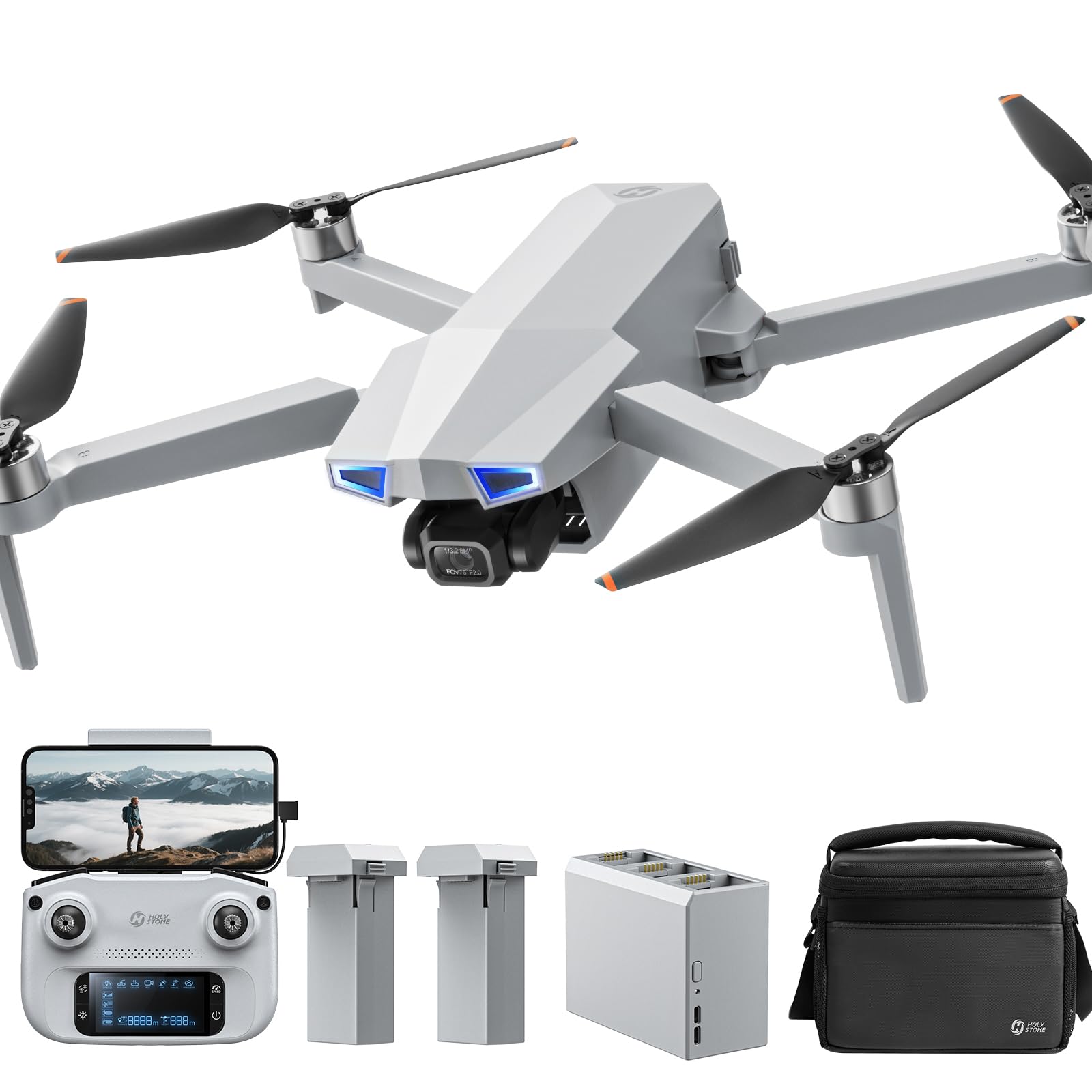
The HS790 brings a true 3-axis mechanical gimbal to the sub- amateur segment, allowing cinematic pans and tilts without the artificial crop of EIS. The 3200mAh batteries each push flight time past 30 minutes, and the Smart PD Charging Hub doubles as a power bank for field recharging.
Holy Stone’s WiFi Repeater transmission claims 30,000 feet — real-world performance around 2 km in suburban conditions — and the AI QuickShots (rocket, dronie, circle) automate complex moves for content creators. The 6K photo mode interpolates to 38 effective megapixels, though actual sensor resolution is lower.
Built-in Remote ID eliminates the need for an external module, and the 1506 brushless motors provide quiet climb at Level 5 wind resistance. Beginners benefit from Altitude Hold and Headless Mode, while experts can disable assists for full manual control.
Why it’s great
- 3-axis gimbal for butter-smooth video without EIS artifacts
- Fast-charging hub doubles as portable power bank
- Built-in Remote ID, no extra module needed
Good to know
- App stability reported as inconsistent across firmware versions
- Gimbal struggles to keep horizon level during fast sport-mode turns
3. DJI Neo 2
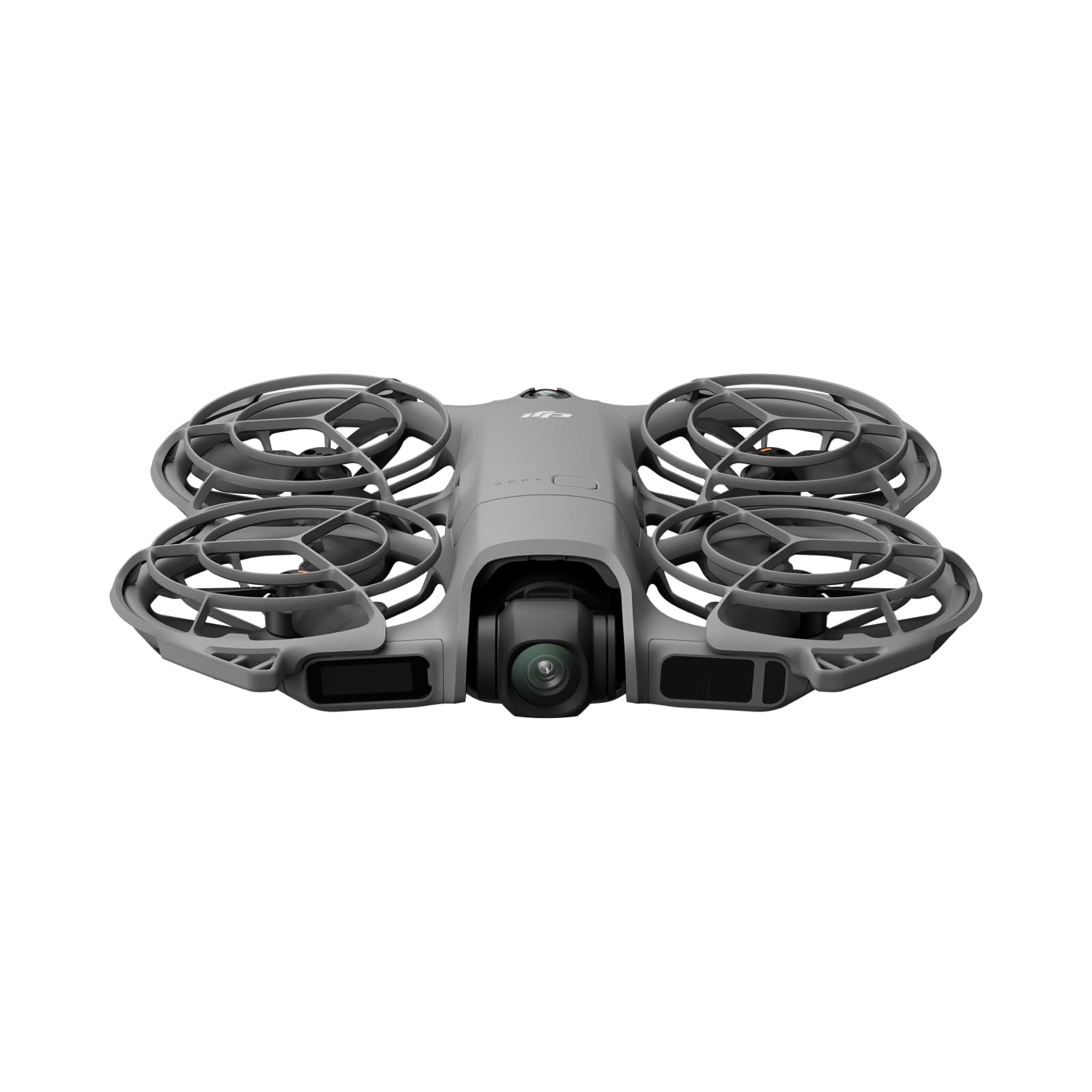
At just 151 grams, the DJI Neo 2 is the lightest drone in this roundup and the only one with omnidirectional obstacle sensing — a feature that normally debuts on far costlier models. The full-coverage propeller guards and palm takeoff/landing eliminate the hardest part of learning: the launch pad.
ActiveTrack 4.0 locks onto moving subjects reliably, and SelfieShot gives you a one-tap framing trigger. The C0 safety certification means you can fly it in most EU sub-250g zones without an operator exam. Gesture control works up to 3 meters away, letting you start recording without the controller.
Flight time hovers around 18-19 minutes per battery — shorter than most peers — but the DJI ecosystem offers ample spare battery accessories. The 4K/30fps footage benefits from DJI’s gimbal stabilization legacy, producing smooth clips even in light wind.
Why it’s great
- Omnidirectional obstacle sensing prevents crashes in tight spaces
- Palm takeoff and gesture controls for zero-learning-curve flights
- 151g ultra-portable design with full propeller guards
Good to know
- Short 18-minute battery life demands spare packs for longer sessions
- No remote controller included in base package
4. Bwine F7GB2 Pro

With three 2600mAh batteries delivering a combined 75 minutes of flight, the F7GB2 Pro eliminates range anxiety for extended mapping or touring sessions. Each pack is UL 2054 certified and features safety-tested discharge protection — rare at this price point.
The 3-axis gimbal works alongside a 120-degree FOV CMOS sensor that handles night scenes better than most budget sensors, capturing usable footage at dusk. Level 6 wind resistance and a 2000m service ceiling mean you can fly confidently in high-altitude locations like mountain passes.
The detachable camera is a useful feature for transport (removes strain on the gimbal) and the included hard shell case keeps everything organized. FAA Remote ID is certified, and Bwine backs the unit with a 2-year warranty — unusual confidence for a sub- drone.
Why it’s great
- Three UL-certified batteries for 75 minutes of total airtime
- Detachable 3-axis gimbal camera for safe transport
- Level 6 wind resistance with 2000m altitude capability
Good to know
- SD card must be FAT32 formatted and inserted before power-on
- DJI-style hard case is bulky for everyday carry
5. Bwine F7MINI
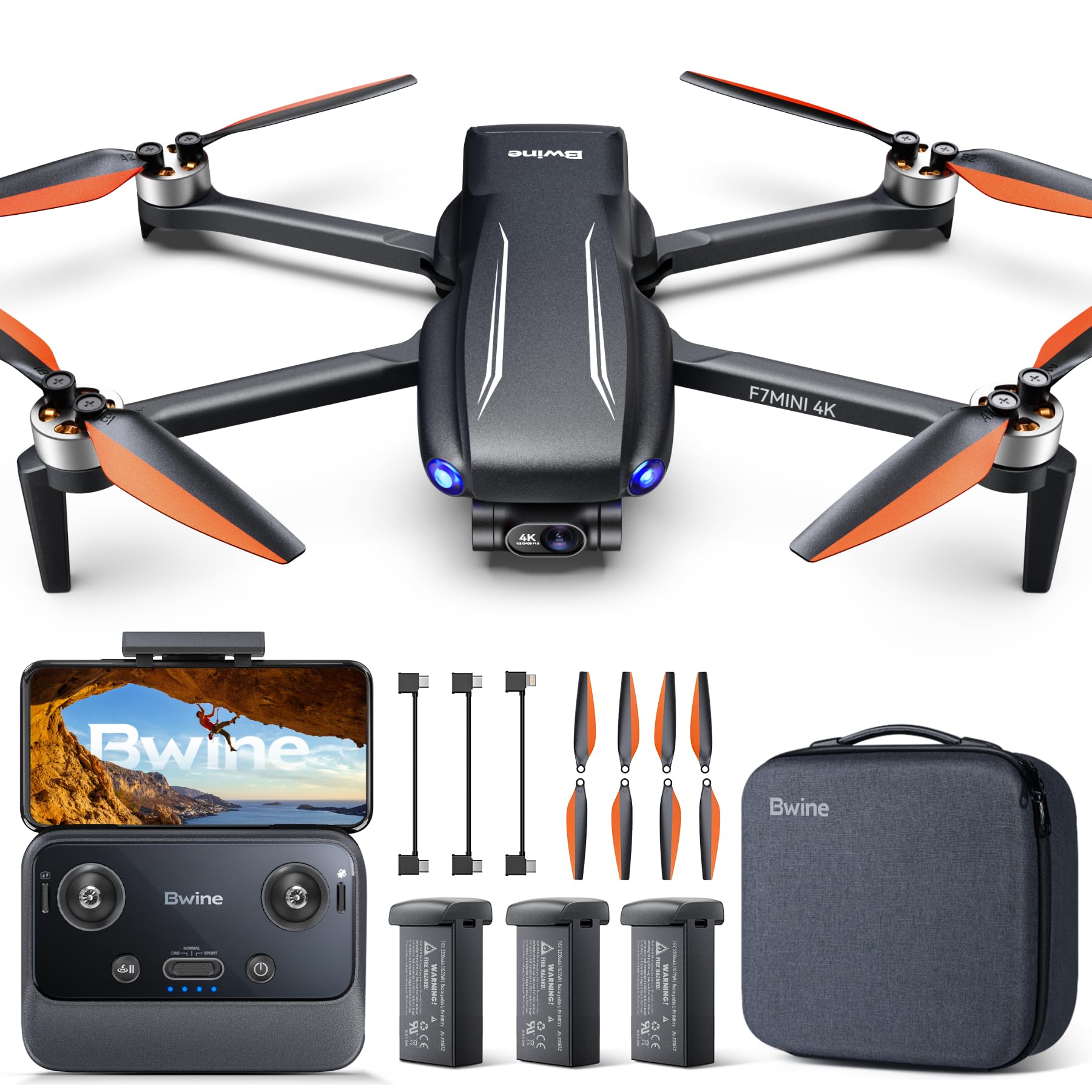
The F7MINI’s standout feature is its 5.5-inch built-in HD touchscreen controller — no phone mount, no screen brightness struggle, no drained handset battery mid-flight. The controller’s brightness holds up in direct sunlight, a rare advantage for outdoor flyers.
Weighing exactly 249 grams with battery, the F7MINI skirts FAA registration entirely. The 3-axis gimbal pairs with EIS for dual-layer stabilization, and the 48MP photo mode (interpolated from a 1/2-inch CMOS sensor) outputs files that survive social media cropping well.
Three 2200mAh batteries deliver 96 total minutes of flight, and PD 3.0 fast charging brings each pack back in under 90 minutes. The 120dB locator buzzer is a practical safety net for crashes into tall grass — far louder than the typical beeper found on cheaper units.
Why it’s great
- Built-in 5.5″ screen eliminates phone dependency and sunlight glare
- Sub-249g weight avoids FAA registration entirely
- 120dB buzzer helps locate the drone after a crash
Good to know
- Transferring files from controller to phone is slow; use a computer
- EIS and gimbal together can introduce latency during fast maneuvers
6. Holy Stone HS600

The HS600 pushes transmission range to a claimed 20,000 feet (roughly 6 km) via a WiFi repeater integrated into the controller — the best range in this group. The 2-axis gimbal plus EIS stabilization captures 4K/30fps footage that holds up well in moderate wind up to Level 6.
FAA Remote ID is built in, so there is no extra module to attach. The controller connects to your phone via a single USB data cable, bypassing WiFi interference and delivering a lower-latency video feed than peer drones that rely on a phone-to-controller WiFi bridge.
The 2500mAh battery delivers about 28 minutes of real flight per charge, and the included carrying bag is compact enough for day trips. Beginners will appreciate the one-key return and lost-signal auto-return, which are among the most responsive in this price tier.
Why it’s great
- Industry-leading 20,000ft transmission for long-range exploration
- Wired USB controller connection reduces video lag
- Built-in Remote ID compliant with FAA regulations
Good to know
- No RAW photo format and no ISO/exposure time adjustment
- Camera sensor tends to overexpose bright scenes without manual override
7. REDRIE HK33 4K Gimbal Drone
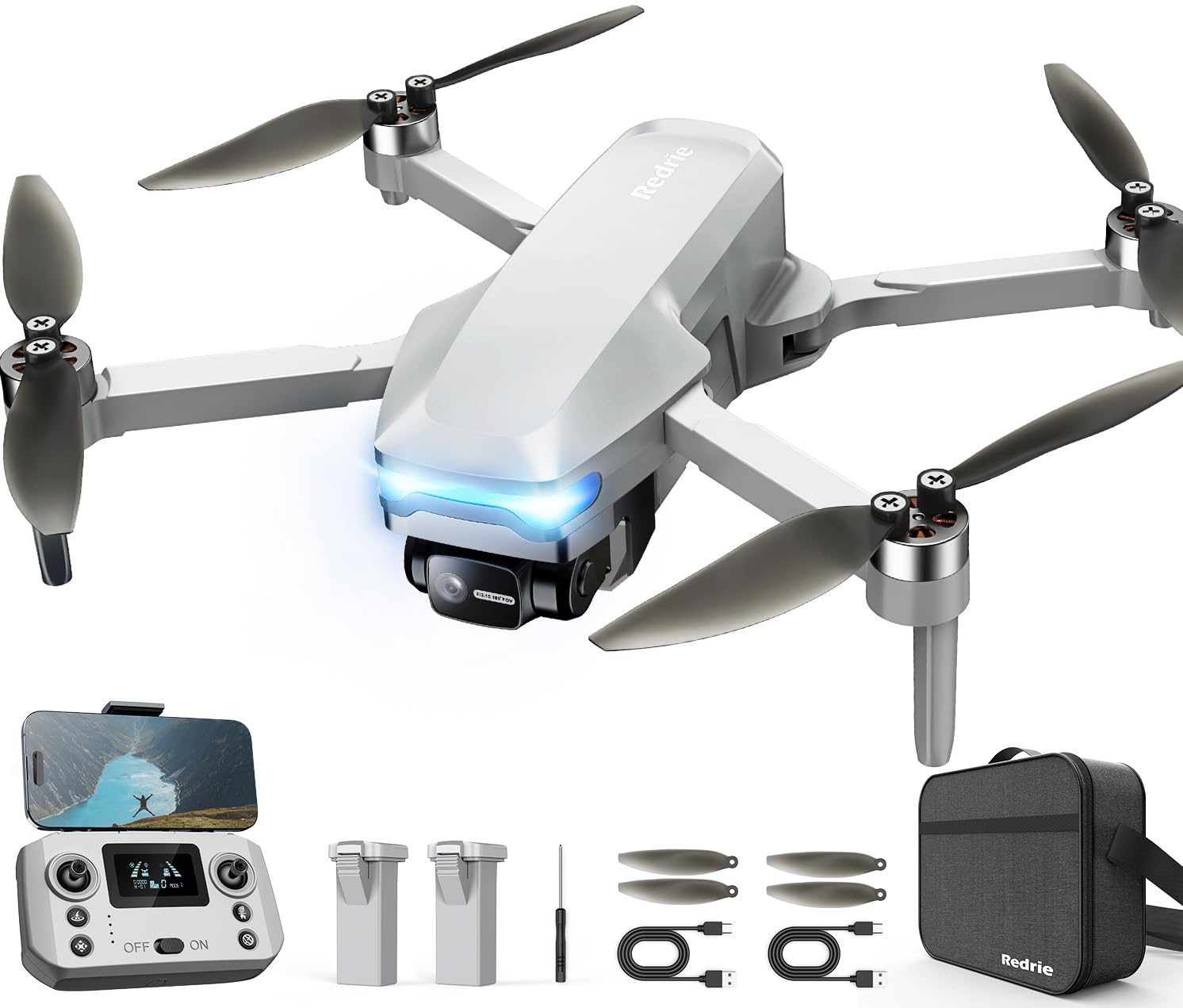
The REDRIE HK33 offers a 2-axis mechanical gimbal at a price where most competitors rely on EIS alone. The gimbal physically stabilizes pitch and roll, keeping horizon lines level during forward flight and turns — a clear advantage over EIS-only drones that crop the frame.
Two 1800mAh batteries deliver a combined 40-45 minutes of flight, and the brushless motors handle Level 5 wind well for a drone in this weight class. The 5G WiFi FPV feed reaches 300 meters reliably, with a signal repeater extending range to 500 meters for cruise flights.
GPS auto-return triggers on signal loss, low battery, or range exit — essential safety features that prevent fly-aways. The folding frame and included carrying case make this the most portable gimbal-equipped drone under the threshold.
Why it’s great
- 2-axis mechanical gimbal at a budget-friendly price point
- Brushless motors provide quiet, stable flight in Level 5 wind
- GPS auto-return safeguards against fly-aways
Good to know
- Video quality and stabilization are mediocre compared to higher-tier models
- Weak cell phone holder on the controller
8. REDRIE HK33 GPS Drone
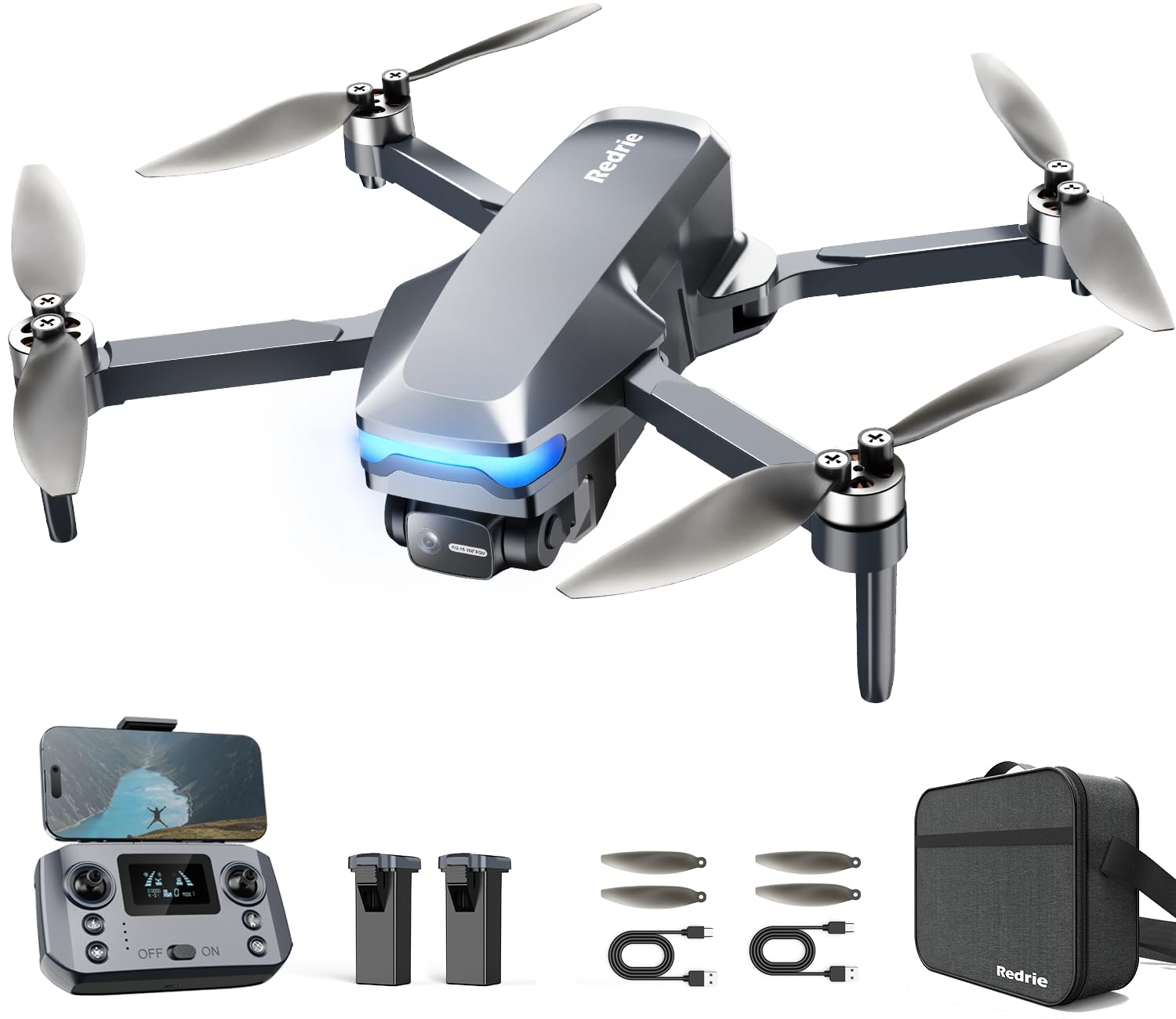
This second REDRIE HK33 variant prioritizes intelligent GPS functions over the gimbal. GPS Follow, Route Planning, and Fly Around modes automate complex shots without requiring steady stick inputs from the pilot — ideal for solo adventurers who want hands-free tracking.
The 4K photo sensor (4096x3072P) and 2K video (2048x1088P) output files that look crisp on social feeds and phone screens, though the lack of a mechanical gimbal means you rely on physical vibration reduction for stability. The 110-degree wide-angle lens captures broad landscapes without distortion.
The two 1800mAh batteries provide 45 total minutes of flight. At under 250 grams, this drone skips FAA registration and folds into a compact case. Beginners report quick success with the QR-code video setup guide, getting airborne within minutes of unboxing.
Why it’s great
- GPS Follow and Waypoint modes automate complex shots
- Under 250g, foldable, and includes a carrying case
- Quick setup with QR-code video guide
Good to know
- No mechanical gimbal; relies on physical vibration reduction
- Video quality and stabilization are poor relative to gimbal-equipped peers
9. Oddire HK11

The Oddire HK11 is the entry-level wildcard: at a budget-friendly price, it packs a 7.7V battery (higher voltage than the typical 3.7V or 7.4V found at this tier), delivering more consistent power to the brushless motors. The result is stable hover and better wind resistance than cheaper 3.7V alternatives.
The 4K camera provides crisp stills, and the GPS auto-return, Follow Me, and Waypoint functions are unusually feature-rich for this price bracket. The 249-gram design avoids FAA registration, and the foldable frame makes it backpack-friendly. Users report that the drone survives concrete crashes remarkably well.
Flight time is a combined 48 minutes from two 1800mAh packs — sufficient for a full park session. The app includes built-in filters and background music for quick social media uploads, an appealing convenience for casual content creators who skip post-processing.
Why it’s great
- 7.7V high-voltage battery for robust motor performance
- GPS functions (auto-return, follow, waypoint) at a budget-friendly price
- Durable airframe survives beginner crashes well
Good to know
- Requires compass calibration before each flight sequence
- App interface can be finicky; use the XDRONE GO app
FAQ
Do I need FAA registration for a drone under 249 grams?
What is the real-world transmission range of this amateur drone class?
Should I buy a drone with a 2-axis or 3-axis gimbal for my first quadcopter?
How do I know if a drone’s battery life claim is realistic?
Final Thoughts: The Verdict
For most users, the best amateur drone winner is the Potensic ATOM LT because it delivers true 40-minute battery runtime at 249 grams, with a digital transmission system that keeps you connected over a mile. If you want professional-grade gimbal stabilization on a mid-range budget, grab the Holy Stone HS790. And for the lightest pocketable option with obstacle avoidance and gesture controls, nothing beats the DJI Neo 2.