
Our readers keep the lights on and my morning glass full of iced black tea. As an Amazon Associate, I earn from qualifying purchases.
Decoding SSB signals buried beneath the noise floor, hitting a repeater thirty miles out with a slim-jim antenna, or chasing DX on 10 meters with an 80W carrier—the amateur radio landscape spans from entry-level dual-band mobiles to full-bore HF base stations. Each rig lives in a different world of frequency coverage, power output, and modulation mode, and choosing the wrong one means either being locked out of the bands you actually use or carrying a chassis full of features you will never touch.
I’m Min — the co-founder and writer behind Gadgets Feed. I have spent hundreds of hours cross-referencing FCC filings, sifting through manufacturer datasheets, and analyzing real-world user reports across the entire amateur radio spectrum to isolate the physical specs and operational limits that actually define a rig’s capability.
This guide breaks down the trade-offs in power stage design, tuner range, and band coverage so you can confidently pick the best amateur radio for your license class and operating environment.
How To Choose The Best Amateur Radio
Amateur radios are not interchangeable appliances—a dual-band VHF/UHF mobile rig for local repeater work has nothing in common with an HF all-mode transceiver built for DX voice contacts across the Atlantic. Your license class, operating location, and the modes you intend to use determine the frequency range, output power, and feature set you actually need.
Band Coverage and Modulation Modes
VHF (2m) and UHF (70cm) dual-band mobiles like the QYT KT-8900 or AnyTone AT-778UVII cover the most active local repeater and simplex channels, operating primarily in FM. To reach beyond line-of-sight and work SSB, CW, or digital modes, you need an HF or 10 meter rig such as the Radioddity QT80 or Xiegu G90, which deliver single-sideband modulation and access to skywave propagation on 160m through 6m.
Output Power Stage and Thermal Management
A 20W mobile radio draws less current and runs cooler than a 50W or 100W unit, but that lower power demands a more efficient antenna to overcome path loss. The BTECH UV-50X2 puts 50W into a fan-cooled chassis, while the Yaesu FT-891 delivers a full 100W on HF with a large heatsink and forced-air cooling. Radios without a fan, such as the AnyTone AT-778UV, rely on a passive heatsink and can reach high case temperatures under sustained TX.
Built-in Antenna Tuner and Field Operation
The Xiegu G90’s internal wide-range auto tuner is a decisive advantage for portable or POTA use—it will match nearly any random wire or end-fed antenna you throw up in the field. Most dual-band mobiles lack any antenna tuner because VHF/UHF antennas are resonant by design, but HF rigs without a tuner require an external unit (such as the LDG series) to operate on non-resonant antennas.
Quick Comparison
On smaller screens, swipe sideways to see the full table.
| Model | Category | Best For | Key Spec | Amazon |
|---|---|---|---|---|
| Xiegu G90 | HF SDR Transceiver | Portable QRP & POTA | 20W output; wide-range internal ATU | Amazon |
| Yaesu FT-891 | HF/50 MHz All Mode | Full-power mobile base | 100W output; 32-bit DSP; 160-6m | Amazon |
| BTECH UV-50X2 | Dual Band Mobile | High-power VHF/UHF | 50W output; VHF-VHF & UHF-UHF monitor | Amazon |
| Radioddity QT80 | 10 Meter HF Mobile | 10m SSB/AM/FM DX | 80W output; TX/RX noise reduction | Amazon |
| Retevis RT95 | Dual Band Mobile | Budget base station | 25W output; CHIRP support; rotatable LCD | Amazon |
| AnyTone AT-778UVII | Dual Band Mobile | Fanless quiet operation | 25W/15W/5W select; VOX; CHIRP | Amazon |
| AnyTone AT-778UV w/ Antenna | Dual Band Kit | Ready-to-go starter kit | 25W output; 770R car antenna included | Amazon |
| Tecsun PL330 | Worldband Receiver | SW/SSB listening & backup | DSP receiver; AM/FM/LW/SW/SSB | Amazon |
| QYT KT-8900 | Dual Band Mobile | Ultra-compact entry level | 20W output; 200 channels; CHIRP | Amazon |
In‑Depth Reviews
1. Xiegu G90 HF Radio Transceiver

The G90 is the most versatile HF transceiver in its class—20W output on SSB, CW, AM, and FM, with a software-defined receiver that delivers a 48 kHz wide spectrum display and waterfall. The internal automatic antenna tuner will match wires, end-feds, and random lengths that would leave most QRP radios unusable, which is the primary reason this rig dominates the portable and POTA scene.
Detaching the display unit from the radio body allows remote head placement, a feature usually reserved for premium mobile installs. The quick-mode buttons reduce menu navigation for common adjustments like RF gain, filter bandwidth, and TX power, though the multi-function button layout does require deliberate memorization during the first few sessions.
Real-world users report working DX on 40m with an inverted V dipole at 25 feet, using the full 20W carrier on FT8 and SSB. The 18-month warranty covers the hardware, and firmware V1.81 is available for download. At 3.53 pounds, this is a rig you can carry in a backpack with a 10 Ah Bioenno battery and work stations across the Atlantic.
Why it’s great
- Internal ATU tunes nearly any wire antenna in seconds
- Color waterfall display with spectrum scope for band awareness
- Detachable faceplate for remote-mount flexibility
Good to know
- 20W output requires efficient antenna to compete with 100W stations
- Multi-function buttons have a learning curve for new operators
2. Yaesu FT-891 HF/50 MHz All Mode Transceiver

The FT-891 delivers a full 100W carrier on 160m through 6m in all modes—AM, FM, USB, LSB, and CW—drawing on a 32-bit DSP architecture inherited from Yaesu’s higher-end FTDX series. Its compact chassis (6.1 x 2.05 x 8.27 inches) fits into a go-box or a compact vehicle install alongside the optional ATAS-120A automatic tuning antenna.
The front panel features a large multi-color LCD with a spectrum scope display mode, and the ZIN button instant zero-beats CW signals without manual tuning. The APF adjustable CW filter provides narrow selectivity without requiring a separate 300 Hz Collins filter. Users note that the menu resets some band-specific settings when changing bands, and the rear-panel audio jack has a mild hiss that heavier FM modulation masks.
In field-day tests with an FC-50 tuner and ATAS-25 antenna, the FT-891 maintained stable 100W output on battery power. The 3-year manufacturer warranty covers parts and labor, making this the safest long-term investment among the HF rigs in this guide. It has no VHF/UHF capability, so you still need a second radio for local repeater work.
Why it’s great
- Full 100W output on all HF bands including 6m
- 32-bit DSP noise reduction outperforms older Yaesu generations
- Ultra-compact footprint for mobile or portable use
Good to know
- No internal antenna tuner—requires external unit for non-resonant antennas
- Phase noise becomes noticeable above 50W; full power best for SSB/CW
3. BTECH UV-50X2 Mobile 50W Dual Band Radio

The UV-50X2 pushes 50W on both 2m and 70cm, a significant step above the typical 20–25W dual-band mobiles. It supports simultaneous VHF-VHF or UHF-UHF monitoring, meaning you can watch two frequencies on the same band while transmitting on a third. The RJ45 microphone port includes a K1 audio adaptor that makes it compatible with aftermarket speaker-mics and digital-mode interfaces.
The chassis is fan-cooled and carries an SO-239 antenna connector at the rear. Users report hitting repeaters beyond 40 miles with line-of-sight on 2m. The screen is a multi-color 4-line display that shows A/B band status, but the volume knob is positioned close to the mic connector, which can interfere with the cable routing in tight vehicle installs.
Two failure reports mention thermal stress on the final amplifier after cold-start operation below freezing, which suggests the 50W stage is sensitive to thermal shock. For base station or temperate-climate mobile use, the UV-50X2 delivers the highest sustainable VHF/UHF power in this price tier. The optional RPS-30M power supply converts it for home use.
Why it’s great
- 50W output on both bands for maximum repeater talk-in power
- VHF-VHF and UHF-UHF cross-band monitoring capability
- RJ45 audio jack with K1 adaptor supports wide accessory range
Good to know
- Volume knob position interferes with mic cable routing
- Some units failed after cold-start thermal cycling near 0°F
4. Radioddity QT80 10 Meter Radio 80W

The QT80 covers 28–29.7 MHz with 80W PEP on SSB and full carrier on AM and FM—enough power to work DX propagation on 10 meters during solar cycle peaks. The TX and RX noise reduction circuits are adjustable and effective at suppressing ignition noise and power-line buzz, and the Automatic Squelch Control (ASQ) filters out static without constant manual adjustment.
The 7-color LCD interface allows the user to change the display tone for visibility in direct sunlight or nighttime operation. Programming can be done from the front panel or via PC software (Windows only). An easily accessible modification opens the radio to 12m and 15m bands, which significantly increases its utility for a technically inclined operator.
Verified output tests show the QT80 delivers its rated 80W+ on SSB, and users report picking up 5×5 signals from Europe and across the United States with a simple dipole. The speaker is adequate for mobile use but lacks the audio depth of larger chassis radios. If 10m is your primary band, this is the most power per dollar in the guide.
Why it’s great
- 80W PEP output provides substantial power for 10m DX
- Adjustable TX and RX noise reduction cleans up noisy bands
- Easy hardware mod enables 12m and 15m operation
Good to know
- Speaker output lacks bass compared to larger mobile radios
- No internal antenna tuner for non-resonant antennas
5. Retevis RT95 Dual Band Mobile Radio

The RT95 packs a 25W dual-band transceiver into a remarkably small chassis (6.42 x 4.88 x 1.54 inches) with a 180-degree rotatable TFT LCD. The radio body and microphone both contain speakers, providing clear audio from two physical sources. The VOX function enables hands-free operation while driving, and the mic gain adjustment lets you compensate for quiet speakers.
CHIRP programming is fully supported, and the VFO mode allows frequency changes and memory edits without a computer. Users report reaching a repeater 10 miles away in a valley, confirming 25W is sufficient for regional coverage. The built-in cooling fan runs continuously during transmit, which users describe as audible—the trade-off for keeping the compact chassis from overheating.
The main rotary knob controls both volume and frequency tuning, and there is no separate volume-only knob. Scan speed is slow at roughly two frequencies per second, which becomes noticeable when skipping through 200 channels. For a first-time base station or mobile install where space is scarce, the RT95 delivers full functionality in a tiny footprint.
Why it’s great
- Rotatable TFT display allows upside-down mounting in tight spaces
- Dual speakers (radio body + microphone) for redundant audio
- VOX and mic gain provide hands-free operation and audio tailoring
Good to know
- Fan is loud under continuous TX; no passive cooling option
- Scan speed is very slow—only ~2 frequencies per second
6. AnyTone AT-778UVII Dual Band Mobile Transceiver
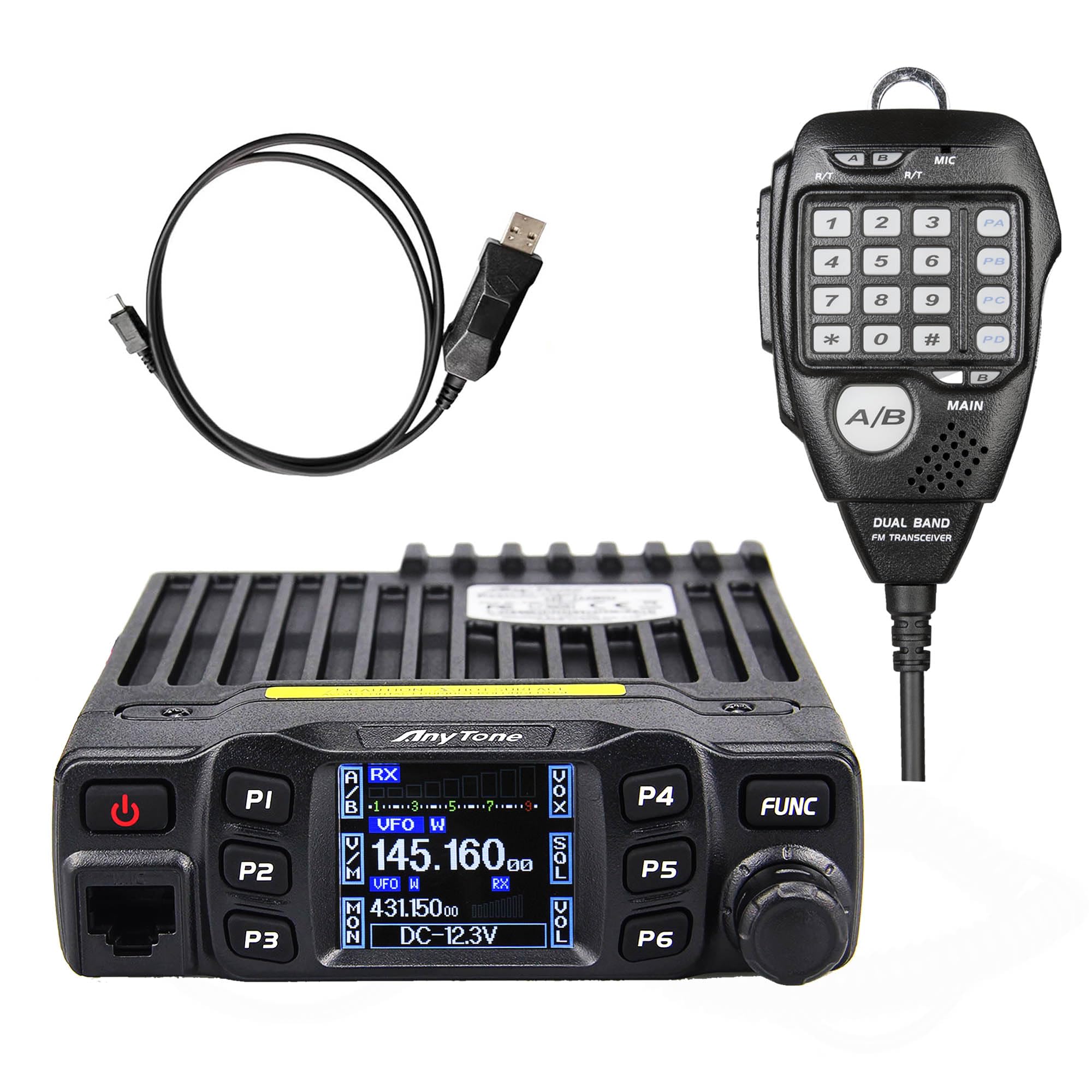
The AT-778UVII achieves zero moving parts by relying on a hefty die-cast heatsink instead of a cooling fan. Power is selectable at 25W, 15W, or 5W to match the duty cycle and thermal load. The 180-degree rotatable TFT display mirrors the RT95, and the rear panel carries a standard SO-239 connector for external antennas.
CHIRP compatibility is confirmed on Windows 10 and 11, and the factory programming software allows mic gain adjustment. Users note that the printed manual is sparse, but the export software and CHIRP community documentation cover all programming functions. The radio has no dedicated volume and squelch knobs—those adjustments are made through multi-function buttons and the menu system.
On-air reports indicate clear audio on both transmit and receive, with reliable access to repeaters 40 miles away when paired with an indoor antenna. The passive heatsink design keeps operation silent, which matters for base station environments where fan noise is unacceptable. Power consumption is approximately 4A at 25W, making it suitable for small switching supplies.
Why it’s great
- Completely silent operation—fanless passive heatsink cooling
- Three power levels (25W/15W/5W) for duty-cycle management
- Rotatable display with bright color screen for installation flexibility
Good to know
- No dedicated volume or squelch knobs—must use menu or P buttons
- Factory manual is minimal; community programming guides essential
7. AnyTone AT-778UV with Car Antenna Kit
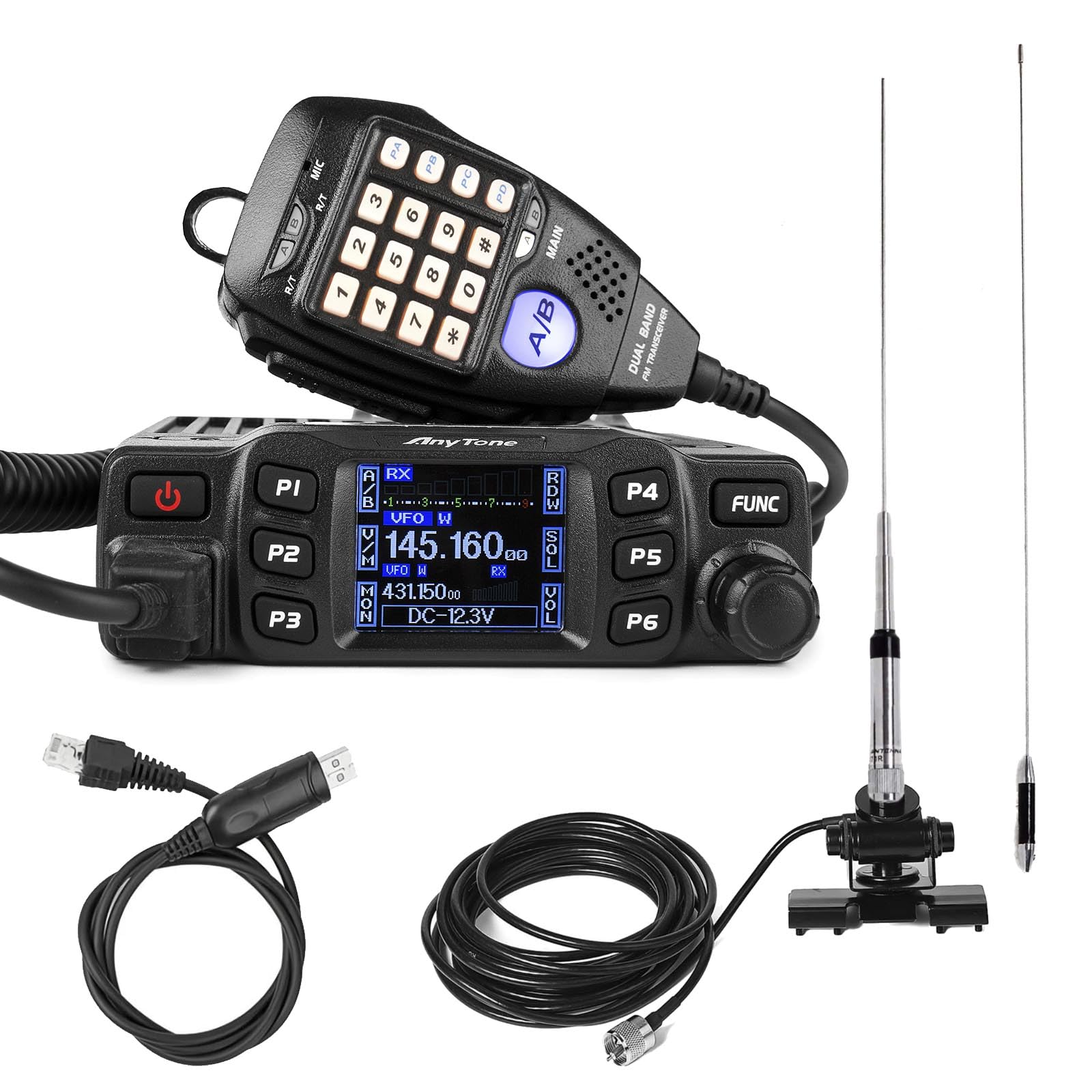
This kit pairs the AT-778UV chassis (functionally identical to the AT-778UVII described above) with a 770R magnetic-mount car antenna, making it a complete out-of-box solution for mobile ham radio operation. The radio retains the same 25W/15W/5W power selection, VOX capability, and CHIRP programming support as the standalone unit.
The included 770R antenna is a quarter-wave design that provides a low-sWR match on 2m and 70cm when mounted on a metal roof. Users report reliable communication up to 15–20 miles in open terrain with this antenna. The package also contains the power cable with fuse holder, mounting bracket, and microphone, so no additional purchases are needed for immediate vehicle installation.
The AT-778UV lacks a cooling fan and relies on the same passive heatsink found in the AT-778UVII. The microphone hook design and function key layout have a learning curve, but the radio can be fully programmed from the front panel or via CHIRP. This is the grab-and-go option for new licensees who want to get on the air without hunting for separate antenna components.
Why it’s great
- Complete vehicle installation kit—antenna, cable, bracket, and radio
- 25W power with CHIRP programming for quick frequency setup
- Fanless design for silent operation during receive
Good to know
- Antenna requires metal ground plane for optimal performance
- Function keys are confusing until programmed via software
8. Tecsun Digital PL330 Worldband Receiver

The PL330 is a DSP-based portable receiver covering AM, FM, longwave, shortwave, and single side band, making it a valuable tool for amateur radio operators who need to scout band conditions or copy commercial/maritime SSB traffic without transmitting. The synchronized detection mode locks onto AM carriers and reduces fading distortion on shortwave.
The 8-ohm internal speaker produces clear, loud audio, and the 3.5 mm headphone jack works with stereo earphones for private listening. Up to 850 memory presets can be stored across all bands, and the sleep timer runs up to 120 minutes. Users report excellent sensitivity on SW with the built-in ferrite bar, and adding an external antenna significantly improves weak-signal SSB copy.
Battery life reaches approximately 22 hours on a set of alkaline cells, and USB charging is supported via the micro USB port. The tuning knob uses detented steps that mute the audio momentarily with each 1 kHz increment, which some users find disruptive during fine-tuning. The lack of a built-in kickstand is a frequent complaint for desktop use. For a non-transmitting receiver that can pull in weak SSB and CW signals, the PL330 is the best companion to a full transceiver.
Why it’s great
- DSP demodulation with synchronous AM detection for enhanced selectivity
- Full SSB coverage for copying amateur and maritime transmissions
- Exceptionally long battery life—22 hours on alkaline cells
Good to know
- Detented tuning knob mutes for an instant at each 1 kHz step
- No fold-out kickstand for desk placement
9. QYT KT-8900 20W Dual Band Mobile Radio

The KT-8900 is the smallest and least expensive dual-band mobile radio in this guide—5.7 x 1.9 x 7.5 inches and 1.8 pounds—yet it still delivers 20W on 2m and 70cm with 200 memory channels. The package includes a free programming cable (non-FTDI) and the unit is fully compatible with CHIRP software, giving new hams a low-cost entry point into mobile operation.
Frequency coverage spans 144–148 MHz on VHF and 420–450 MHz on UHF, and the radio supports MSK, 5-tone, 2-tone, DTMF, CTCSS, and DCS encoding. Dual band and quad-standby mode lets the radio monitor up to four frequencies simultaneously. Users caution that the frequency range is password-locked to the amateur band (password must be obtained from QYT), but CHIRP can toggle the beep volume and enable all features.
The primary trade-off is thermal management: the KT-8900 builds heat quickly during continuous transmission, and the fan runs at full speed audibly. One user measured 31 miles to a 2m repeater with a DIY antenna, indicating 20W is sufficient for moderate range. Second-generation firmware supports selectable narrow/wide bandwidth. If your budget is tight and you need a functional mobile rig for local or portable use, the KT-8900 delivers the essential features at the lowest entry cost.
Why it’s great
- Ultra-compact chassis fits into the smallest vehicle or field install
- CHIRP-compatible with free programming cable included
- Quad-standby monitors up to four frequencies simultaneously
Good to know
- Heats up quickly under continuous TX; fan is loud
- Frequency range is password-locked; modification required for expansion
FAQ
Can I use a 10 meter radio like the QT80 on the CB band?
Does the Xiegu G90 need an external power supply or battery?
What is the difference between a worldband receiver and a ham transceiver?
Final Thoughts: The Verdict
For most users, the best amateur radio winner is the Xiegu G90 because its wide-range internal antenna tuner and 20W SDR performance open up HF digital and voice operation without requiring a separate matching unit. If you want a full 100W for competitive DX or field-day power, grab the Yaesu FT-891. And for a vehicle-ready VHF/UHF setup, nothing beats the BTECH UV-50X2 with its 50W output and cross-band monitoring.
Product prices and availability are accurate as of the date/time indicated and are subject to change. Any price and availability information displayed on Amazon at the time of purchase will apply to the purchase of this product. As an Amazon Associate I earn from qualifying purchases.
CERTAIN CONTENT THAT APPEARS ON THIS SITE COMES FROM AMAZON. THIS CONTENT IS PROVIDED "AS IS" AND IS SUBJECT TO CHANGE OR REMOVAL AT ANY TIME.
Amazon and the Amazon logo are trademarks of Amazon.com, Inc. or its affiliates.