
Our readers keep the lights on and my morning glass full of iced black tea. As an Amazon Associate, I earn from qualifying purchases.
Specs are compiled from manufacturer listings and verified buyer reviews and can change over time — please confirm the key details on the product page before buying.
Buying your first telescope is a gamble. Many cheap scopes promise 300x magnification but deliver a shaky, blurry mess that sends you back inside. This guide cuts through the hype by comparing real specs — aperture, focal length, and mount stability — so you pick a scope that actually resolves the craters on the Moon, not just a glowing ball.
I’m Min — the founder and writer behind Gadgets Feed. This guide is built by comparing the manufacturers’ published specifications and the patterns across verified customer reviews, so you get each pick’s real strengths and trade-offs instead of marketing spin.
We’ve ranked the top models to help you find the best amateur telescope for your backyard, based on optical clarity, build quality, and ease of setup for complete beginners.
Our Picks at a Glance


How To Choose The Best Amateur Telescope
Before you look at any specific model, you need to understand that a telescope is only as good as its mount and its aperture. A scope on a wobbly tripod is useless, and a small aperture (the main lens or mirror) won’t gather enough light to see anything beyond a bright star.
Start with Aperture, Not Magnification
The most important spec is the diameter of the primary lens or mirror. For a refractor (the long tube design), look for 80mm or 90mm. This directly controls how much light enters the scope. More light means you can see dimmer stars, more lunar detail, and the cloud bands on Jupiter instead of just a bright dot.
Match the Mount to the User
There are three main styles. An Altazimuth mount is a simple up-and-down and side-to-side movement, perfect for kids and quick setups. A Dobsonian mount is a cheap, sturdy base for a reflector that grabs a lot of light for the money. A computerized GoTo mount uses motors to find and track objects for you, but it can be a steep learning curve to align.
Read the Fine Print on Eyepieces and Barlows
You will see kits that promise “32X–240X” magnification. That top number is usually useless because the mount shakes and the image gets too dark. What matters is the quality of the two or three included eyepieces and the 3x Barlow lens — a multiplier that increases magnification but often softens the image if pushed too far.
Quick Comparison
| Model | Best For | Aperture | Focal Length | Mount Type | Amazon |
|---|---|---|---|---|---|
| Celticbird 80mm★ Best Overall | First-time gift buyers | 80mm | 900mm | Altazimuth | Amazon |
| MEEZAA 90mmBest Value | Beginner families on a budget | 90mm | 800mm | Altazimuth | Amazon |
| Dianfan 90mmTop Performer | Budget planet watchers | 90mm | 800mm | Altazimuth | Amazon |
| Hawkko 90mm | Sharper lunar views | 90mm | 900mm | Altazimuth | Amazon |
| Koolpte 90mm | Tracking planets smoothly | 90mm | 700mm | Vertisteel AZ | Amazon |
| Gskyer 600x90mm | Versatile all-rounder | 90mm | 600mm | Altazimuth | Amazon |
| Sky-Watcher Heritage 130 | The best light for the price | 130mm | 650mm | Tabletop Dobsonian | Amazon |
| Celestron 114LCM | Tech lovers who want auto-locate | 114mm | 1000mm | Computerized GoTo | Amazon |
| Celestron NexStar 6SE | Serious amateurs upgrading | 150mm | 1500mm | Computerized GoTo | Amazon |
In‑Depth Reviews
1. Celticbird 80mm Aperture 900mm Refractor
Our pick — over 4.5★ from 150+ verified ratings; the strongest balance of quality and price.
The holiday-gift champion that puts a sharp, wide view of the Moon in an 80mm package.
This stands out because it pairs a generous 80mm aperture with a long 900mm focal length, which makes high-power views of the Moon and Saturn easy to reach. The fully coated lens cuts down on reflection, so you get brighter and clearer images than you’d expect from a scope at this level.
Your setup time is near zero — no tools are required and the manual walks you through it. The aluminum tripod adjusts from 20″ to 45″, which means a kid and an adult can both get comfortable eye level, and everything packs into the included carry bag for travel.
What wins people over is the sheer build quality, and the clarity follows close behind. Buyers report the eyepieces and phone mount were surprisingly good — one even resolved a flag 7 miles away, showing the scope’s sharp daytime resolving power.. The honest limitation is that the tripod feels starter-grade, and an occasional unit shows dust inside the lens, so it’s worth a quick check on delivery.
What Owners Love
- Sharp 900mm focal length shows crisp lunar detail
- Portable with a carry bag and adjustable 45″ tripod
- Phone adapter makes casual sky snaps easy
Watch Out For
- Starter tripod quality won’t win awards
- Check the lens on arrival for dust
Reach for this if: you want a genuinely giftable, beginner-proof first scope that doesn’t demand tools or patience to assemble.
Look elsewhere if: you’re chasing faint deep-sky galaxies — an 80mm aperture simply won’t gather enough light for those.
2. MEEZAA 90mm Aperture 800mm Refractor
A 90mm refractor that shows Jupiter’s bands and stays steady on a stainless tripod.
This is the value pick because it steps up to a 90mm aperture with fully multi-coated glass lenses, which means you get noticeably brighter and sharper views than a similar 80mm scope. The 800mm focal length keeps planets at a workable scale for beginners. It’s a 12% wider aperture than the Celticbird above, capturing more light for dimmer targets., so it captures more light for dim targets.
Expect a quick build — most owners finish in about 10 minutes with the paper manual. The stainless steel tripod adjusts from 28 to 46 inches, and the included 3x Barlow lens triples the magnification of each eyepiece, giving you a range from 32X up to 240X. Everything fits into the carry bag for camping or backyard use.
The thing everyone raves about is the quality and the sharp image quality — owners specifically call out crisp lunar craters and Jupiter’s bands. The catch is the phone mount: it can add weight that causes wobble at focus, and the finder scope needs alignment. It’s an excellent budget refractor for casual use, as owners put it.
Why It Wins
- 90mm fully multi-coated lens pulls in real detail
- Sturdy stainless tripod with 46″ max height
- 3x Barlow and two eyepieces cover a wide range
The Trade-Off
- Phone mount can cause focus wobble
- Finder scope arrives needing alignment
Pick this when: you want the biggest aperture and best stability for the lowest entry price in this list.
skip it if: you plan to do serious astrophotography — this is a visual scope, not a camera platform.
3. Dianfan 90mm Aperture 800mm Refractor
A beginner scope that doubles for birdwatching with an upright, terrestrial-tune view.
You get two scopes in one here: the included 45° zenith mirror (a diagonal that flips the image upright and correctly oriented) lets you watch distant landscapes, birds, and wildlife during the day, then turn to the Moon at night. That dual-use ability is rare in this price range.
You get the same 90mm aperture and 800mm focal length as the MEEZAA above, but this one adds a Dawes limit of 1.29 arc_sec, meaning it can resolve fine planetary details like the Cassini division. (a measure of resolving power that tells you how fine a detail it can separate). Owners consistently call the Moon and Saturn views “clear” and “sharp,” with setup averaging about 15 minutes.
The biggest praise is the recommendation factor — owners tell friends to buy it. The honest caveat is that pushing to the 240x max magnification blurs the image and makes objects drift out of view quickly, so stick to the 10mm eyepiece at 96x for Saturn. It’s also a refractor, so it’s not ideal for faint deep-sky objects like nebulae.
Sharp Setup: The stainless steel tripod feels more premium than the aluminum legs on cheaper rivals, and the phone adapter works well with the included holder.
Realistic Limit: The top end of the 32X–240X range is more marketing than usable — the balance is around 96x.
Best for: families who want one scope that works for daytime nature views and nighttime planets without a second purchase.
Think twice if: your only interest is faint galaxies — those need a bigger reflector, not this refractor.
4. Hawkko 90mm Aperture 900mm Refractor

The sharper long-tube refractor where Saturn’s rings visibly snap into focus through a window.
This one takes the 90mm aperture and stretches the focal length to 900mm (f/10mm), which gives you higher native magnification per eyepiece than the 800mm scopes. The professional-grade full multi-layer coating (FMC) boosts light transmission by roughly 73%, brightening lunar and planetary views., so images come through brighter with more contrast.
The mount is a highlight: a stable stainless steel AZ tripod with smooth 360° rotation and height adjustment from 28″ to 46″. That full rotation makes it easy to track objects as they drift across the sky, and the 5kg weight keeps it planted in a light breeze, reducing vibration for steadier views.. Setup is under 15 minutes, and the kit includes 25mm and 10mm eyepieces, a 3X Barlow, finder, and accessory tray.
Owners are emphatic that this is the one to watch Jupiter and Saturn — one reported seeing Saturn’s rings clearly even through a window glass, highlighting its optical clarity.. The 90mm aperture delivers crisp lunar craters too. The minor gripes are a slight wobble on uneven ground and a phone adapter that can be finicky to seat perfectly.
Optical Edge: The FMC coating and longer 900mm tube beat the 800mm models on resolving small planetary detail — this is the one that shows Saturn’s ring gap.
Know Before Buying: You’ll want a dark-sky site, not a bright city backyard, to open up the best deep-sky views.
Reach for this if: planet detail is your priority — the long focal length rewards you with crisp Saturn and Jupiter views.
Look elsewhere if: you need a featherlight grab-and-go scope; at 5kg with the steel tripod, it’s a bit heavier to haul.
5. Koolpte 90mm/700mm Vertisteel AZ Refractor
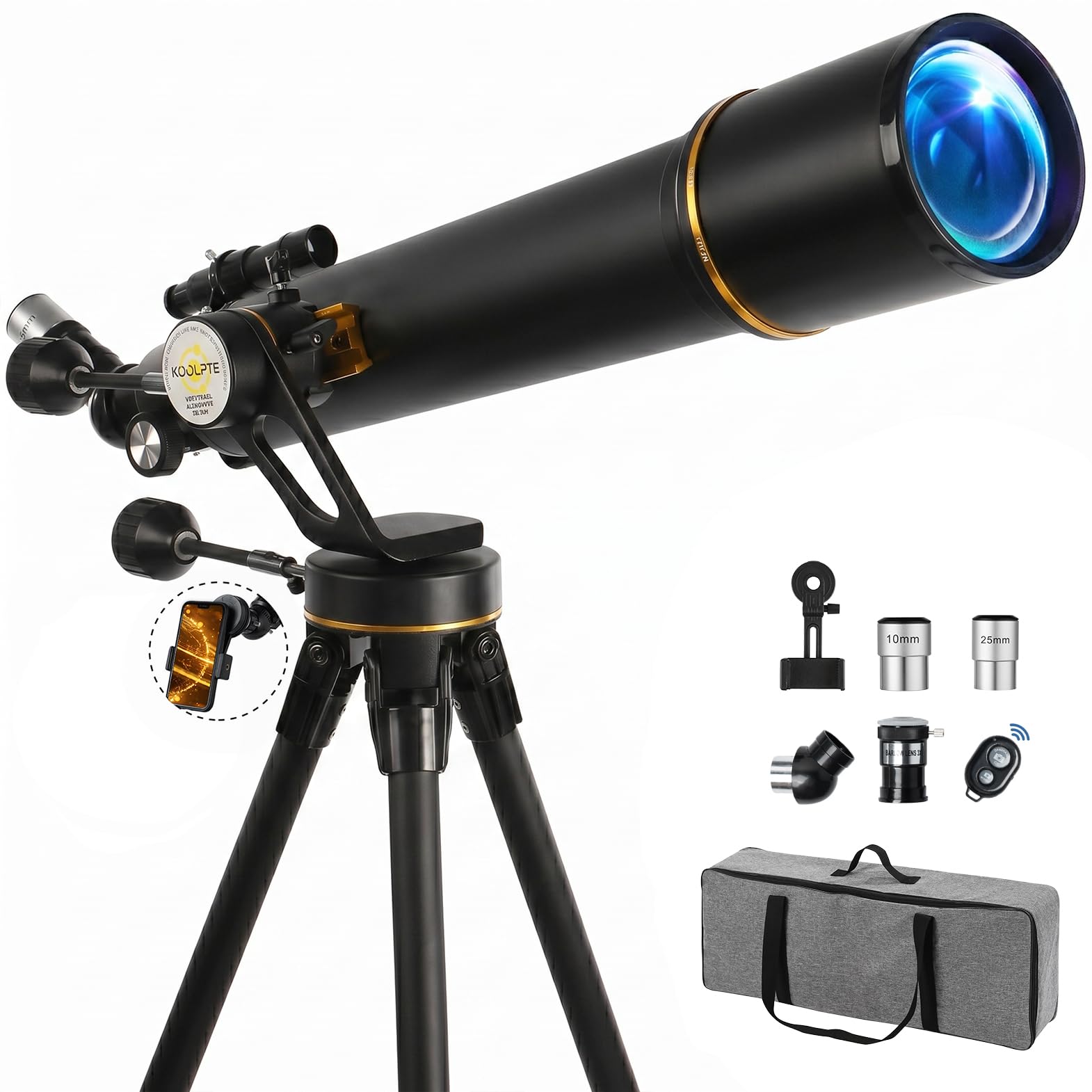
The slow-motion mount with a wireless remote that kills the shakes at high power.
This scope fixes the #1 beginner frustration: a wobbly view at high magnification. The exclusive Vertisteel AZ Slow-Motion Mount uses a “Follow and Stop” design, so you can smoothly track a planet as it drifts without overshooting or getting the jitters. It makes high-power planet watching genuinely usable.
On the optics side, you get a 90mm aperture with fully multi-coated (FMC) glass that claims 99% light transmission for brighter images.. The 700mm focal length gives you a wider field of view than the 900mm scopes, which makes it easier to find objects in the first place. The kit includes K10mm and K25mm eyepieces plus a 3X Barlow for a 28X–210X range.
The wireless remote is the a neat extra here — it lets you snap photos through the phone adapter without touching the tube, which keeps the image steady. Owners love the sharp Moon and Jupiter views even under suburban light pollution. The one note of caution: a taller user (6′) may find the tripod a bit low when the scope is pointed near vertical.
Standout Features
- Slow-motion mount makes tracking planets smooth
- Wireless remote reduces shake for phone photos
- 10-minute setup with no tools
Minor Quirks
- 6′ users may need to crouch at high angles
- Wide field trades away top-end magnification
Choose this for: astrophotography beginners who want steady phone shots of the Moon without a tripod adapter struggle.
Pass if you’re: very tall — the ergonomics favor average-height adults and kids.
6. Gskyer 600x90mm AZ Refractor

The German-engineered all-rounder with three eyepieces, a 3x Barlow, and astronomy software included.
This scope offers the most complete package for a beginner who wants options. The 600mm focal length (f/6.7) with a 90mm fully coated lens delivers wide, bright views, and the bundle includes three replaceable eyepieces (24X, 60X, 120X) plus a 3x Barlow lens that trebles the magnifying power of each one. You also get astronomy software to plan your observing sessions.
The aluminum tripod adjusts from about 31.5 inches up to 49 inches, which is the tallest range in the entry tier — a real plus if you’re over 5’8″. The 6×30 finderscope and a 48-degree erecting BAK7 prism round out the kit, and no tools are needed for assembly, even for a complete novice.
Owners mention clear, sharp views of the Moon and Jupiter, and kids love it. The catch is the tripod can sit a bit low for some, and a few owners found the focus knobs a weak point after heavy use — though Gskyer’s support reportedly replaced a faulty unit within days. Deep-sky performance is solid but not exceptional at this aperture.
Kit King: With three eyepieces plus a 3x Barlow, you get more magnification flexibility than any other scope here without buying extras.
Honest Caveat: High-magnification views (5mm range) get shaky — adding rubber washers under the tripod legs is a known fix.
Best for: a beginner who wants a big accessory bundle and the tallest tripod in the budget tier all in one box.
Think twice if: you want rock-solid deep-sky astrophotography — this needs an equatorial mount for serious tracking.
7. Sky-Watcher Heritage 130mm Tabletop Dobsonian

The aperture king for the money — 130mm of light-gathering power in a collapsible tabletop tube.
This is the point where you switch from refractors to reflectors, and the payoff is enormous. The 130mm aperture (over 5 inches) gathers dramatically more light than any 90mm scope on this list, which open up views of faint objects like star clusters, nebulae, and even Uranus and Neptune as visible dots. It’s the single biggest jump in performance per dollar you can make.
The design is genius for beginners: fully assembled from the start, the collapsible tube nests onto its own base for easy transport. No tools, no tricky tripod legs. It comes with two 1.25-inch eyepieces (10mm and 25mm) and a starpointer finderscope, and the Radiant Aluminum Quartz (RAQ) coated optics deliver impressive clarity. There’s a 2-year warranty.
Owners have spotted Jupiter’s moons, Saturn’s rings, and a host of star clusters on the first night. The catch is the base is a tabletop design — you need a sturdy table or stool — and it’s not ideal for city light pollution. The 650mm focal length also means it’s better for wide views than for high-magnification planet close-ups.
The Aperture Advantage
- 130mm aperture shows far more deep-sky objects
- Collapsible, no-assembly design is grab-and-go
- Two good 1.25″ eyepieces included
Setup Realities
- Needs a steady table — it’s not a tripod scope
- Light pollution will limit what you can see
Reach for this if: deep-sky hunting is your goal and you want the most light for the least money.
Look elsewhere if: you have no flat surface to set it on — a tripod refractor will be more flexible for your backyard.
8. Celestron 114LCM Computerized Reflector
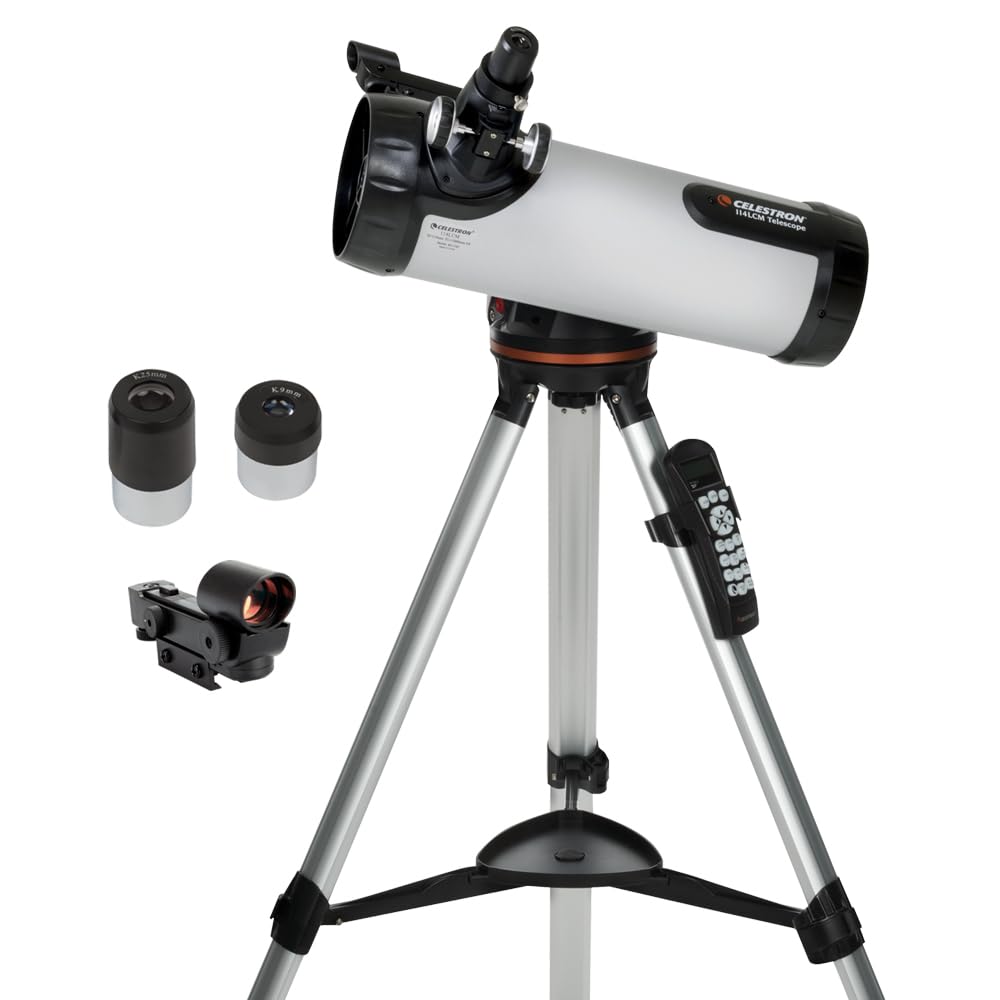
A computerized scope that finds 4,000 objects for you — if you can master the alignment.
This is the gateway to GoTo astronomy. The computerized mount automatically locates 4,000 celestial objects from its database, and the Sky Tour button generates a list of the best things to view right now. For a beginner who doesn’t know where to point, that automation is a genuine superpower — it removes the hardest part of the hobby.
You get a full-height tripod, two eyepieces (25mm and 9mm), a StarPointer red dot finderscope, and a free download of Starry Night software. The 114mm reflector diameter (f/9mm) is roughly in line with the budget scopes, so the magic here is the tracking, not raw light gathering.
Owners love the automated tracking that keeps objects centered — the Moon and Jupiter’s four moons are crowd favorites. The honest truth is the alignment process has a real learning curve and gets the most negative feedback; you’ll need YouTube and patience. Some units also show durability quirks, so buy from a seller with a good return policy.
Tech Wins: The GoTo tracking is smooth and the StarPointer finder makes centering targets straightforward once aligned.
Plan For It: Budget time for alignment setup — it’s the steepest learning curve of any scope here, but the payoff is a scope that finds targets for you.
Best for: a tech-savvy beginner or parent who wants the “find it for me” experience and doesn’t mind a setup ritual.
Think twice if: you want pure optical performance — the 114mm aperture is modest and the alignment can frustrate impatient users.
9. Celestron NexStar 6SE Schmidt-Cassegrain

The iconic 6-inch Schmidt-Cassegrain that shows you the Orion Nebula even from a city street.
This is the serious upgrade that takes you from “beginner” to “amateur astronomer.” The 6-inch (150mm) Schmidt-Cassegrain optical design gathers enough light to reveal fine lunar detail, cloud bands on Jupiter, and deep-sky objects like galaxies and globular clusters — all in a compact tube that travels far more easily than a bulky Newtonian of the same size.
The fully automated GoTo mount uses a NexStar+ hand control with a database of over 40,000 objects. The SkyAlign technology lets you center any three bright stars or planets — even if you don’t know their names — and the system calculates your position in minutes. No star charts required, and it tracks objects as the Earth turns.
Owners are delighted with crisp views of Saturn and its four moons even under light pollution, and one resolved the Andromeda galaxy from the city, proving its deep-sky capability under light pollution.. The honest truths: it runs through AA batteries fast, a dew shield is essential because the corrector plate fogs quickly, and the stock eyepiece is just okay. It’s also a scope that rewards a power bank.
Why It’s Worth It
- 150mm aperture shows deep-sky galaxies and nebulas
- 40,000+ object database with SkyAlign setup
- Compact tube design is very portable
Budget For Extras
- AA batteries drain fast — pack a power bank
- Dew shield is a must-have for long sessions
Reach for this if: you’re ready to invest in a scope that will grow with you for years and handle deep-sky photography with a DSLR.
Look elsewhere if: your budget is tight — the accessories you’ll want (dew shield, power, better eyepieces) add significant cost.
Understanding the Specs
Aperture
The diameter of the main lens (refractor) or mirror (reflector). Bigger is always better — more aperture captures more light, which is what lets you see dimmer stars, nebulae, and detail on planets. An 80mm is a solid entry point, but a 90mm or 130mm noticeably improves what you can see.
Focal Length
The distance (in millimeters) the light travels from the main lens or mirror to the eyepiece. A longer focal length (like 900mm) gives higher magnification with the same eyepiece — good for planets. A shorter one (like 600mm) gives a wider field of view — better for star clusters and large nebulae.
Mount Type
How the telescope holds still and moves. Altazimuth mounts are simple up/down and left/right — easy for beginners. Dobsonian mounts are a cheap, sturdy rocker box for reflectors. GoTo mounts use motors to find and track objects automatically — the most expensive but most automatic.
Focal Ratio (f/)
The focal length divided by the aperture. A lower number (like f/4 or f/6.7) is “fast” — brighter and wider views, good for deep-sky. A higher number (like f/10) is “slow” — higher magnification with the same eyepiece, better for planets and the Moon.
Eyepieces and Barlow Lens
Eyepieces swap to change magnification — a 10mm gives more zoom than a 25mm. A Barlow lens is a multiplier (like 3x) that triples the magnification of any eyepiece. You’re not getting true quality at the extreme top of the range; stick to low and mid settings for the sharpest view.
Finderscope
The small sight attached to the tube that helps you point the big scope at the right spot in the sky. Reflex (red dot) and StarPointer styles project a dot or circle onto a window — you look through it to aim, then look through the eyepiece to see the target magnified.
FAQ
What is the best aperture for a beginner telescope?
Is higher magnification always better?
What can I actually see with an 80mm or 90mm telescope?
What is the difference between a refractor and a reflector?
Why do stars look like blurry balls through my telescope?
Will a telescope work in a city with light pollution?
How long does it take to set up a beginner telescope?
Can I take photos with my phone through these telescopes?
How do I align a GoTo telescope?
Which is better for a child — a tripod scope or a tabletop scope?
Final Thoughts: The Verdict
Across the board, the amateur telescope winner is the Celticbird 80mm because the 900mm focal length, fully coated lens, and built-in phone mount give you a complete, frustration-free first experience. If you want more light-gathering power for deep-sky views, the Sky-Watcher Heritage 130 delivers the biggest aperture jump for the money. For a tech lover who wants the scope to find targets automatically, the Celestron 114LCM is the one to reach for.
How We Picked
We do not accept paid placement. Every pick is matched to a real buyer and a real use-case; we do not hands-on test units.
Sources & Methodology
Specifications: manufacturer listings and product documentation. Review insights: verified customer reviews, as of August 2026. Pricing: not shown on this page (it changes often); check the current price via the retailer link.
As an Amazon Associate, Gadgets Feed earns from qualifying purchases. This does not affect which products we feature.