
Our readers keep the lights on and my morning glass full of iced black tea. As an Amazon Associate, I earn from qualifying purchases.
Specs are compiled from manufacturer listings and verified buyer reviews and can change over time — please confirm the key details on the product page before buying.
Choosing an Amazon Power Station can feel like decoding a foreign language, especially when you realize the wattage and capacity numbers don’t directly tell you what will actually run. You just want to know if it will keep your fridge cold through an outage or power your laptop at a campsite. The real secret is understanding that wattage (the push) and watt-hours (the fuel tank) work together, and matching them to your specific devices is what separates a useful backup from an expensive paperweight.
I’m Min — the founder and writer behind Gadgets Feed. This guide is built by comparing the manufacturers’ published specifications and the patterns across verified customer reviews, so you get each pick’s real strengths and trade-offs instead of marketing spin.
You need a unit whose continuous output handles your biggest appliance while its capacity covers your runtime, and this breakdown of the amazon power station market sorts the genuine workhorses from the underpowered options.
Our Picks at a Glance

How To Choose The Right Amazon Power Station
Before you compare brands, you need to nail down two numbers: the wattage your biggest device needs to run, and the total watt-hours you want to have on hand. Continuous wattage (like 1800W) is what the station delivers steadily, while surge wattage (like 2700W) is a brief burst to start motors in fridges or tools. Your fridge might draw 600W to run but needs a surge to kick on, so the station must handle the bigger number.
Capacity: The Size of Your Energy Tank
Watt-hours (Wh) is the total energy stored, and it decides how long things run. A small 230Wh unit is perfect for overnight phone and laptop charging, while a 2048Wh giant can keep a refrigerator going for days. As a rule of thumb, divide the capacity by the watts your device draws to get a rough runtime estimate, but remember that most stations have some idle draw that eats into that number.
Output: Matching Your Heavy Hitters
The continuous wattage figure is the ceiling for what you can plug in. A 330W station runs laptops, TVs, and small appliances easily, but it will not start a microwave or a space heater. If you plan to run power tools, a coffee maker, or an air conditioner, you need a station with 1800W or more continuous output, or you will trigger the overload protection the moment you hit the switch.
Quick Comparison
| Model | Best For | Capacity (Wh) | Continuous Power (W) | Weight (lbs) | Amazon |
|---|---|---|---|---|---|
| EcoFlow DELTA 3 Max★ Best Overall | Whole-home backup | 2048Wh | 2400W | — | Amazon |
| GRECELL 330WCompact Starter | Entry-level camping | 230.88Wh | 330W | — | Amazon |
| GRECELL EB500Best Value | Mid-size essentials | 519.48Wh | 500W | 14.1 | Amazon |
| DJI Power 1000 V2 | Fast-charging portable | 1024Wh | — | — | Amazon |
| BLUETTI Elite 100 V2 | Camping and home backup | 1024Wh | 1800W | 25 | Amazon |
| Anker SOLIX S2000 | Fridge backup | 2010Wh | 1500W | 35.7 | Amazon |
| BLUETTI Elite 200 V2 | High-demand appliances | 2073.6Wh | 2600W | 53.4 | Amazon |
| Jackery Explorer 2000 Plus | Expandable heavy loads | 2042.8Wh | 3000W | 62 | Amazon |
| Jackery Explorer 2000 v2 | Lightweight 2kWh | 2042Wh | 2200W | 39.5 | Amazon |
| Anker SOLIX C2000 Gen 2 | Large capacity campers | 2048Wh | 2400W | 41.7 | Amazon |
| GROWATT HELIOS 3600 | Off-grid whole home | 3600Wh | 3600W | 51 | Amazon |
In-Depth Reviews
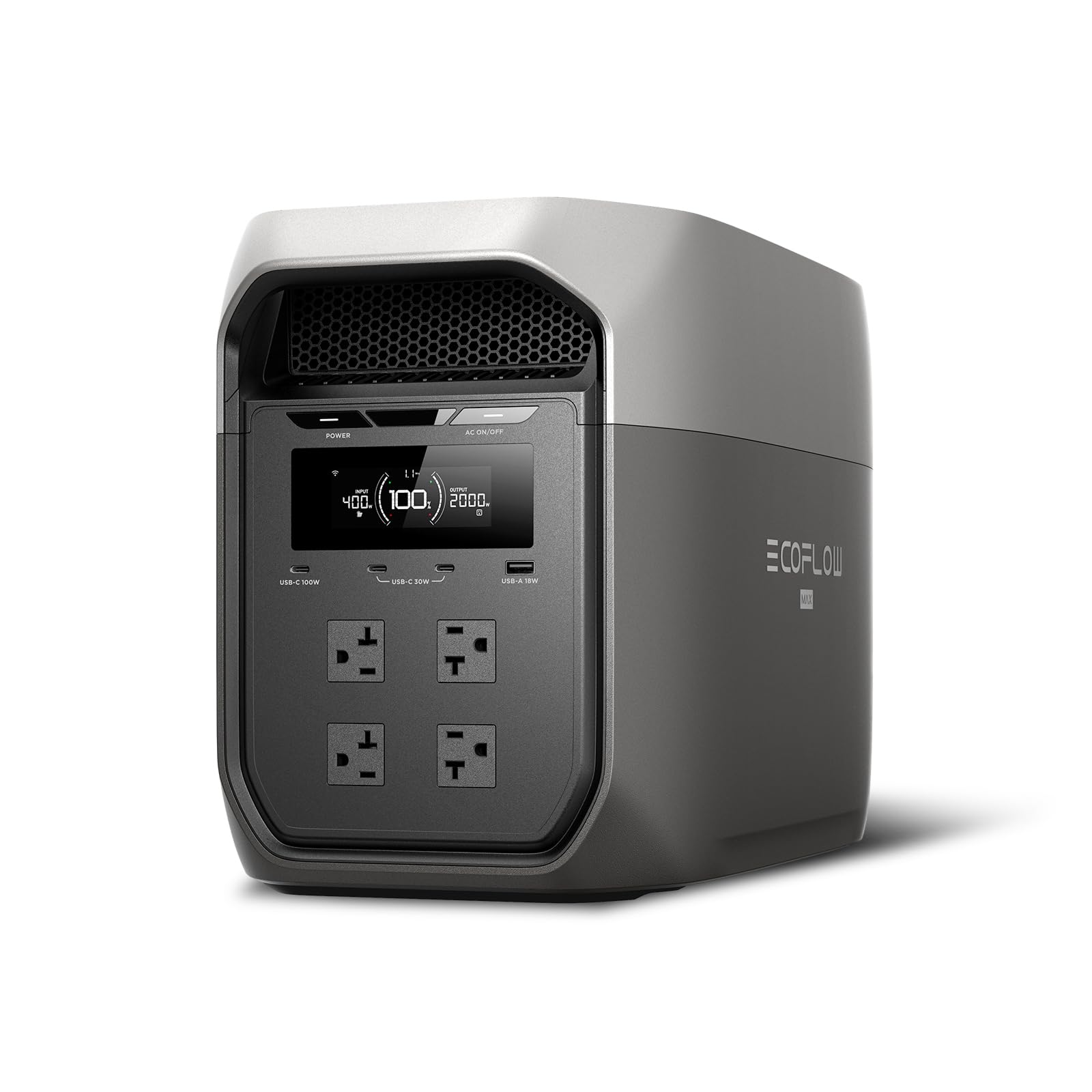
1. EF ECOFLOW DELTA 3 Max Portable Power Station
Our pick — over 4.5★ from 500+ verified ratings; the strongest balance of quality and price.
The whole-home anchor that refills faster than you can make coffee.
This is the unit you buy when the outage is not a maybe but a when. Its 2048Wh LiFePO4 battery (a long-life lithium chemistry) pairs with a 2400W continuous output, which dwarfs the 330W of the GRECELL below by a factor of 7.3 — and that gap is exactly what lets it run a fridge, microwave, and power tools on the same circuit. Buyers report it can run most appliances in a home, and owners in Cuba with frequent blackouts call it a reliable anchor for fridges and cooking essentials.
The headline number is the recharge speed. Using EcoFlow’s X-Stream technology, it jumps from 0–80% in just 1.13 hours, and owners are blunt about the payoff: “What impressed me the most is how incredibly fast it charges to full capacity—it’s super efficient.” That speed matters when the grid flickers back on for only a short window. A 10ms transfer time (the delay before it takes over in an outage) keeps sensitive electronics like computers safe from the blip.
It is heavy, and owners admit that moving it from home to RV takes some effort, but the trade-off is a unit built for 10 years of daily use with a 5-year service plan. Performance is the thing owners praise most — well over 70 single it out — and battery life and power capacity follow close behind. The aluminum and plastic build feels solid enough to justify the investment, which families describe as confidence they can plug into.
Powerhouse for real outages: The 3400W X-Boost mode covers 99% of household appliances, so you are not picking which device gets power — everything stays on.
The anchor pick: Best if you want one station that genuinely backs up a home, not just a phone. Think twice if you only need to top up a laptop at a campsite — this is far more machine than that job requires.
Weight is the honest catch: At 9.4″L x 12″W x 19.44″H it is a big, dense box that lives better near an outlet than on a hike. Buy it for the home, not the trail.
2. GRECELL Portable Power Station 330W
A pocket-sized gateways into portable power for weekend trips.
At just 230.88Wh and 330W continuous output, this is the entry point that teaches you what a power station can do without a big commitment. It charges up to 9 devices at once — cameras, phones, lights — through a PD 60W USB-C port, three USB-A ports, a car port, and even a 5W wireless charging pad. That port spread is the reason Cub Scout camping groups and families heading out for a night under the stars keep reaching for it.
What wins people over is the quality of its power for the size. The pure sine wave output (clean electricity that mimics wall power) protects laptops and CPAP devices, and the 600W surge handles brief start-up demands. A 200W rice cooker, owners mention, cooks 1 cup using about 44–50% battery, good for roughly 10 runs. That kind of real-world math makes the 230.88Wh capacity feel honest rather than inflated.
The trade-off is dimension — at 12.8″L x 7.68″W x 8.46″H it is 36% more compact than the EcoFlow DELTA 3 Max above, which is exactly the point. It recharges from a wall in 6–7 hours or from a 100W solar panel in 5–9 hours depending on sun. An LED flashlight with 3 brightness levels and an SOS mode adds emergency utility. The recurring owner note is the fan kicks in after about 3 minutes of heavy load, which is normal for a unit this size but worth knowing before a quiet night camp.
Where it shines
- Nine simultaneous device ports make it a group charging hub
- 600W surge handles brief start-up demands for small appliances
- SOS flashlight adds genuine emergency value
Where it hits a wall
- 330W continuous output cannot run a microwave or heater
- 6–7 hour wall recharge is slow versus larger rivals
- Occasional units report gauge inaccuracies until a full drain-cycle reset
Reach for this if: you want a first station for phones, laptops, and small appliances on a weekend trip. Look elsewhere if you plan to power a full-size fridge — it simply does not have the capacity.
A gentle caution: treat the AC output as delicate; an occasional owner reported failure after a couple of months, so register the warranty and drain it fully before first heavy use.
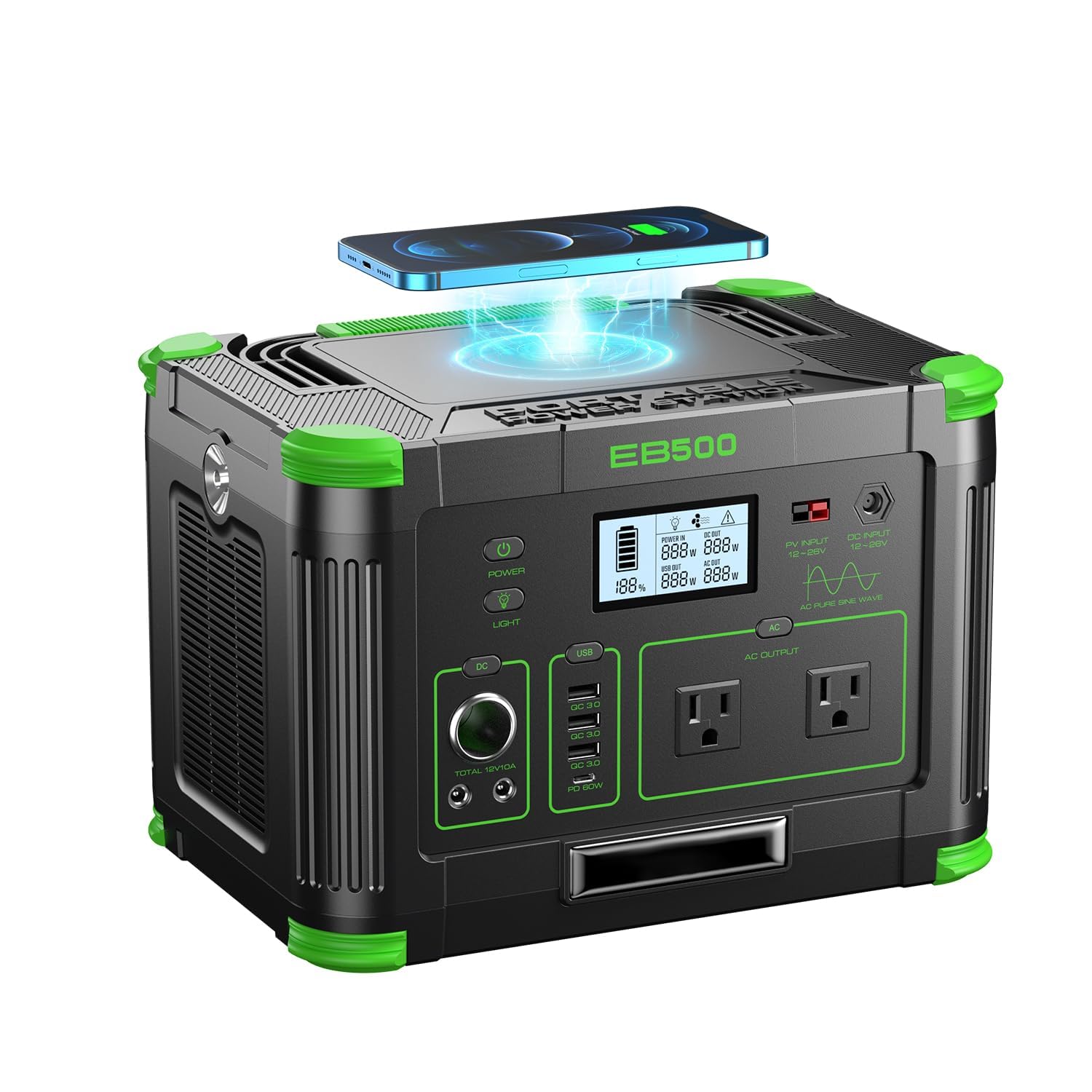
3. GRECELL 500W Portable Power Station (EB500)
The reliable middle child that runs a TV and fridge through a blackout.
Reliability is the word owners keep coming back to, and it is earned. This 519.48Wh station (140400mAh) delivers 500W continuous power from a pure sine wave inverter, enough for a TV, small fridge, CPAP machine, or a projector — the devices that make an outage tolerable. It survived a 3-day outage for one family running on solar panels, and another notes it powers a 26-inch TV with subwoofer plus two speakers for about 4 hours. That is the definition of a dependable backup.
The 14.1 lbs weight with a solid handle makes it genuinely portable, not just “movable.” It powers up to 10 devices simultaneously through two AC outputs, three USB-A QC3.0 ports, one USB-C PD port at 60W max, two DC ports, a car port, and a 10W wireless charger. The USB-C PD output charges 2.5x faster than a standard USB-C charger, which is the kind of detail you feel every single day.
Recharging is flexible: 6–7 hours from a wall, 6–7 hours from a car charger, or 6–9 hours from a 100W solar panel. The catch is the charging cord runs hot for some owners, and the battery management system (BMS) protection — temperature control, overvoltage, overcurrent, and short-circuit — is what keeps the lithium cells safe. Battery life holds about 3 days for one owner running a small fan overnight while charging a phone and tablet, which is strong for the capacity.
Dependable daily driver: Reliability is the thing owners praise most — over 35 single it out — and it earns that trust by simply working through repeated outages.
Best for: the family that wants a step up from a phone bank but does not need a 2kWh monster. It fits tent camping, RV trips, and apartment blackouts equally well.
skip it if: you need to run a microwave or space heater — 500W continuous is the hard ceiling here.
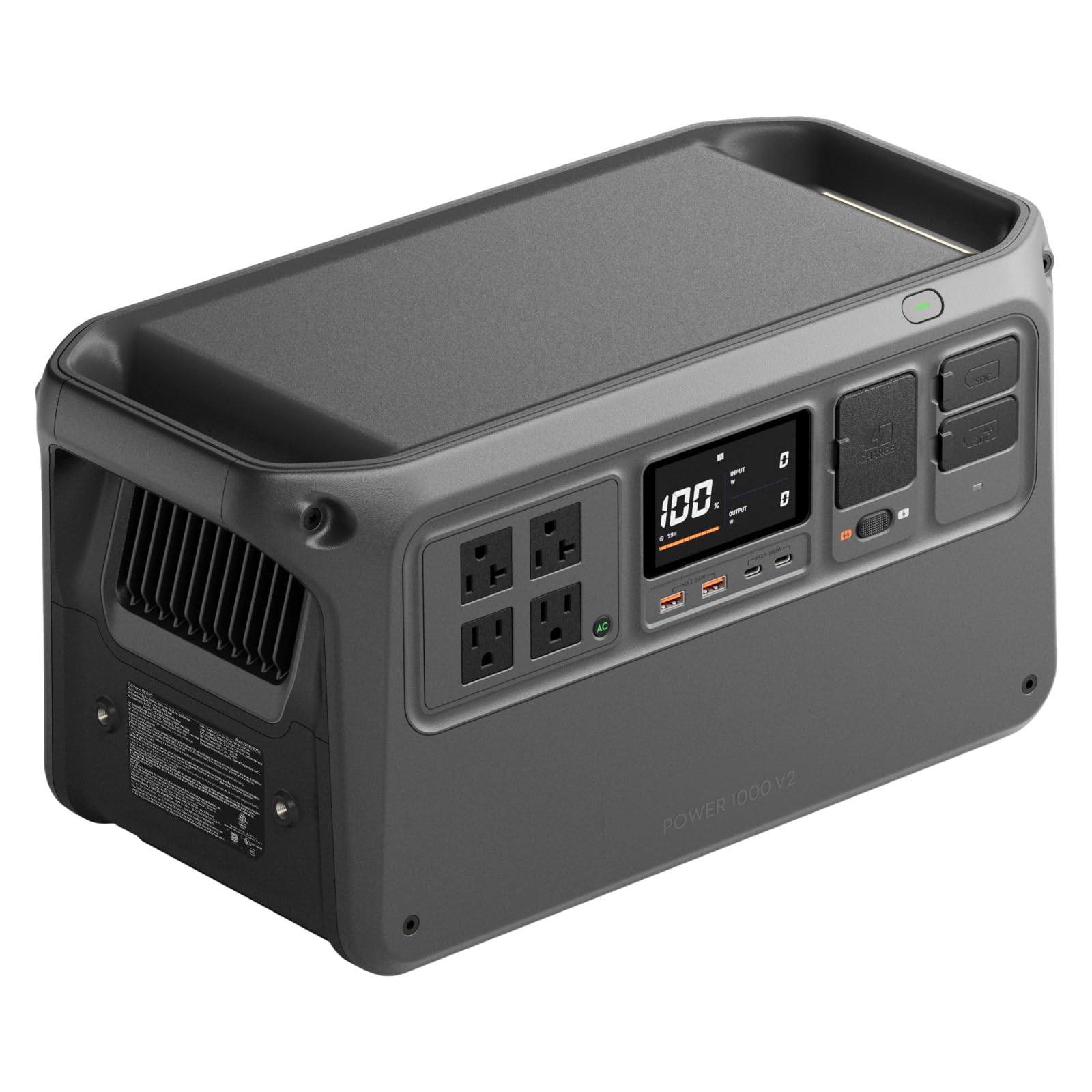
4. DJI Power 1000 V2 Portable Power Station
A drone maker’s take on backup power, snappy enough for a content creator.
DJI built this for the creator who needs power fast, and it shows in the charging spec. The 1024Wh LFP battery recharges to 80% in just 37 minutes, which is the fastest wall recharge in this entire lineup. It runs 99% of appliances — kettles, cookers, projectors, saws, drills — making it a genuine all-rounder for camping and DIY work, not just a phone charger with a handle.
What makes it different is the dual 140W USB-C ports, delivering 280W total — that is 40% more than typical dual 100W USB-C setups. For someone in the field with cameras, a laptop, and a drone, that single spec changes how you work. It operates as low as 26 dB, quiet enough for an RV at night, and a 10ms UPS switch keeps devices running through outages.
One owner ran a fridge cooler for about 3 days on it, and another stresses it handles a garage freezer with a 2200W surge (the burst that starts the compressor). The trade-off: there is no built-in Bluetooth or Wi-Fi — that needs a separate dongle — and connecting a solar panel requires a compatible adapter. It weighs roughly 30 lbs, which is reasonable for a 1kWh class unit. Quality is the thing owners praise most with over 150 mentions, and charging speed is close behind.
Creator’s fast lane: The 37-minute 80% recharge and 280W USB-C total make this the one you grab between shoots, not just during a storm.
Pick this if: fast recharge and high-wattage USB-C ports matter more than app connectivity. You want a station that tops up in the time it takes to drink a coffee.
Look elsewhere if: you plan to run it off solar — you will need a separate compatible adapter, and that adds cost and complexity.
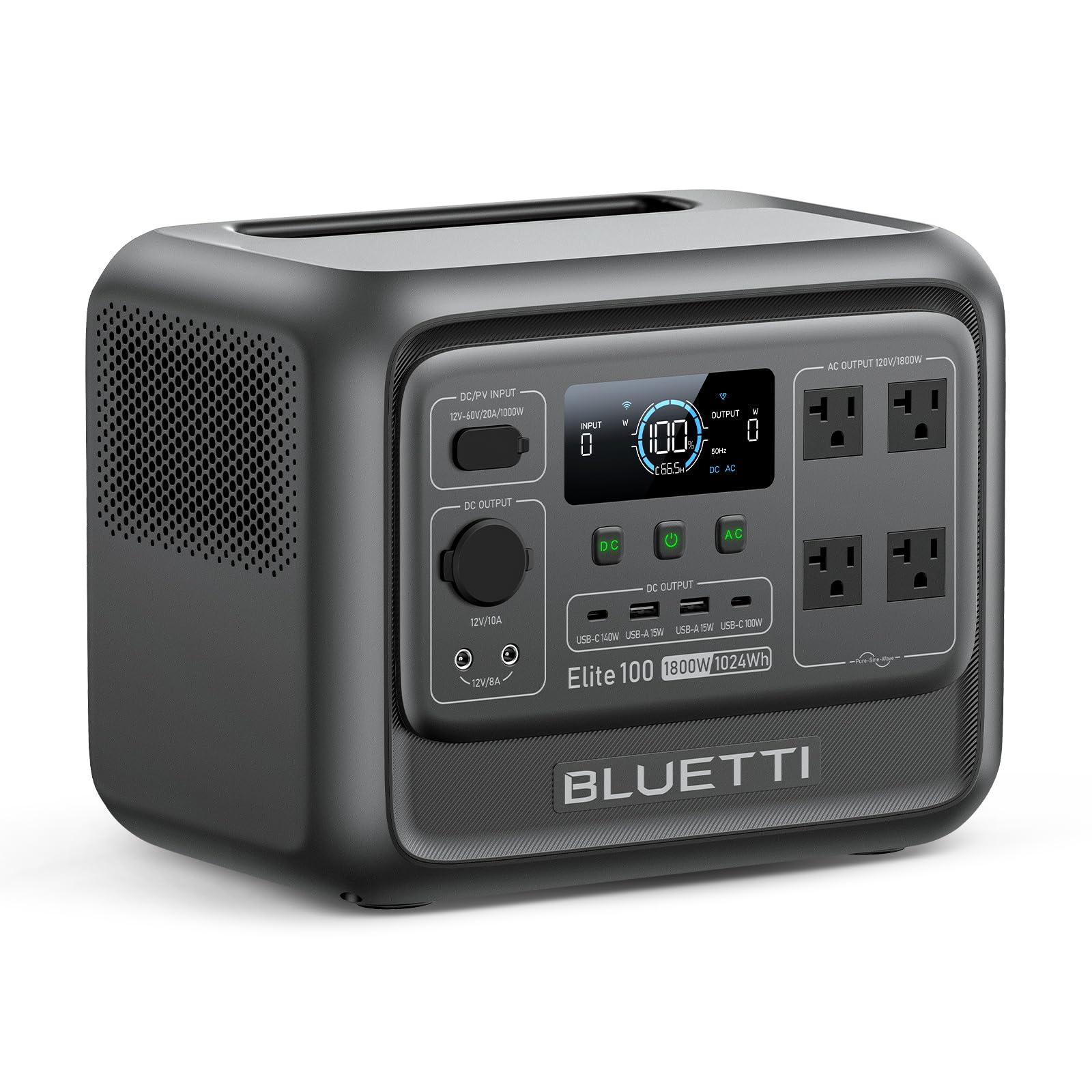
5. BLUETTI Elite 100 V2 Portable Power Station
The one-handed carry that still runs a fridge for an entire workday.
At 25 lbs with a hidden handle, the Elite 100 V2 is built to be grabbed one-handed from the car to the campsite — and it is 35% smaller and 30% lighter than the class average for its size. That portability does not cost you output: 1800W continuous AC (2700W Power Lifting surge) powers up to 90% of everyday appliances, and customers note a refrigerator runs for about 8 hours during an outage. It also powers TVs and modems without breaking a sweat.
The charging story is the standout. With 1200W TurboBoost AC charging, a full recharge takes about 70 minutes, and solar input up to 1000W is the fastest solar charge in the 1kWh class. In silent mode it runs at just 30 dB — about 50% quieter than other 1kWh stations — which is why astrophotographers love it for dark-sky sessions. A built-in 10ms UPS keeps Wi-Fi routers and PCs running during blips at home.
The LiFePO4 battery delivers over 4,000 cycles to 80% capacity, translating to roughly 10 years of daily use. Owners praise charging speed most — over 60 single it out — with value for money close behind. The catch is real: at 25 lbs it is still heavy enough that a week-long camping trip will make you grateful for the handle, and one owner found it “overkill for camping” compared to its price. The BLUETTI App adds Wi-Fi and Bluetooth control, remote monitoring, and OTA updates.
Why it earns its spot
- 70-minute full recharge beats most rivals in this class
- 30 dB silent mode is genuinely sleep-friendly
- 10ms UPS protects sensitive electronics at home
The honest limits
- 25 lbs is still a lift for some users despite the small footprint
- 4,000-cycle lifespan is solid but trails the 10,000-cycle Anker below
Reach for this if: you want a genuinely portable 1kWh station that can run a fridge through a workday and charge by solar fast. It is the best balance of carry weight and real output in this group.
Who should skip: anyone whose main need is a cheap overnight phone bank — this is a serious appliance runner, not a glorified power brick.
6. Anker SOLIX S2000 Portable Power Station
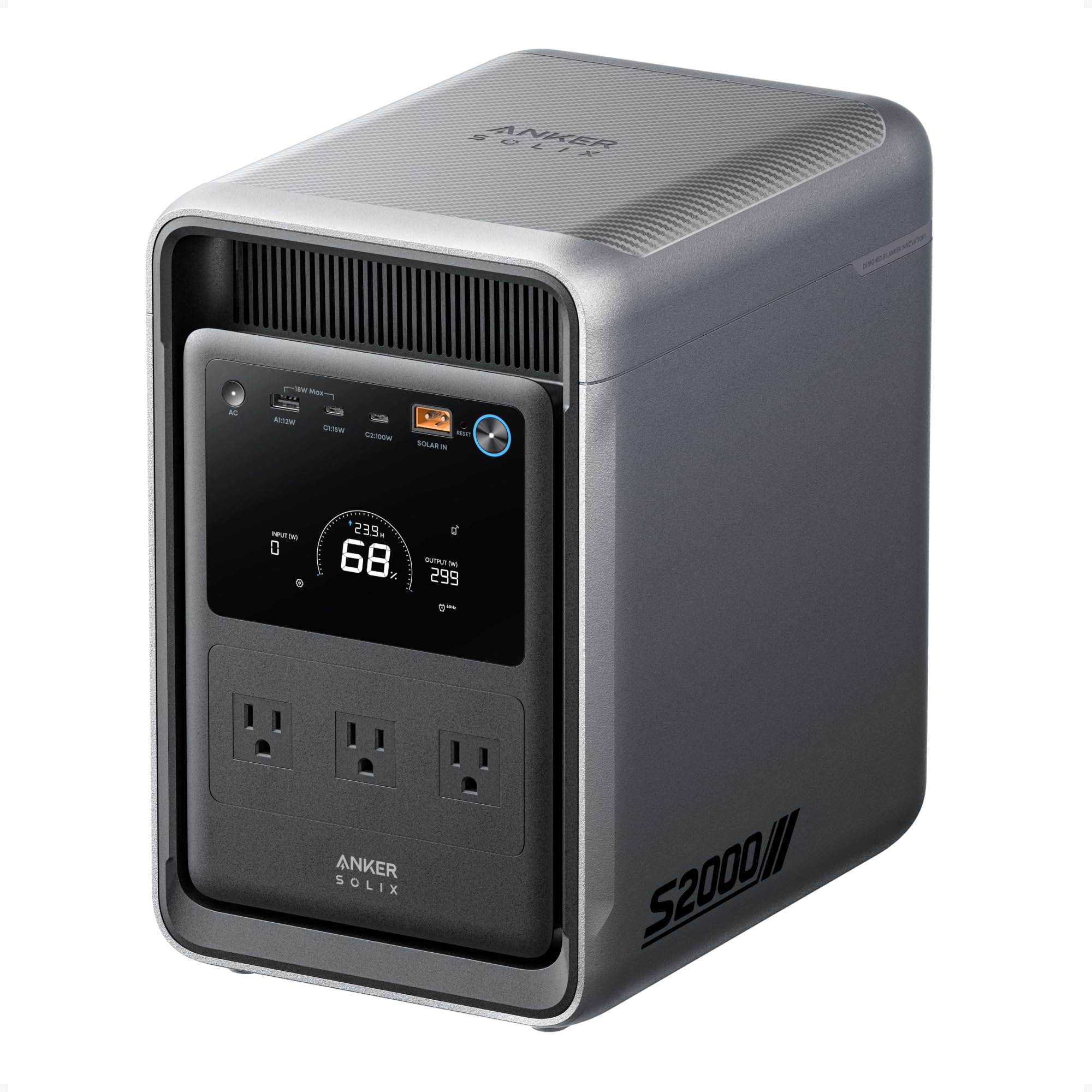
A compact 2kWh station that keeps a fridge going for a day and a half.
This is the station built around one promise: keep the fridge cold. With 2010Wh of capacity and just 6W of idle power draw (the energy wasted while sitting there), it runs 20% longer than other 2kWh systems and keeps a fridge powered for 35 hours. Owners verified that number in real life — one ran it continuously for 35 hours as advertised, and another watched a full-size 220L fridge consume only 3% battery per hour, projecting about 33 hours of runtime. That is the kind of math that makes a storm survivable.
The battery is the headline. Its 314Ah LFP cells are rated for 10,000 cycles to 80% capacity, which Anker projects as 15 years of use — the longest battery lifespan in this lineup. It measures just 8.19″L x 11.1″W x 12.7″H and weighs 35.7 lbs, making it the smallest and lightest 2kWh station here by a wide margin. Anker claims it is 30% smaller and 25% lighter than the industry average for this capacity, and the numbers back that up.
Output is 1500W continuous and 3000W peak, which covers 99% of home essentials — enough for a coffee maker that momentarily draws over 1600W. It recharges six ways, including up to 400W solar input, and a <10ms UPS switchover protects home office gear. The eight outlets split between front and rear, so always-on appliances plug in back and stay out of sight. Performance and reliability are the twin things owners praise most — over 55 mentions each. The fan does get noisy at 1200W charging, and a few units arrive with a burn-off smell that dissipates. There is no 12V DC port, so car accessories are out.
The fridge specialist: 35 hours of fridge backup in a 35.7 lbs package is the best capacity-to-size trade-off in this entire guide.
Reach for this if: your #1 fear is food spoiling during an outage and you want the longest-lasting battery chemistry available. It is the home-backup specialist.
Think twice if: you need a 12V car port or want to run a window AC — the 1500W continuous ceiling and missing DC port will frustrate you.
7. BLUETTI Elite 200 V2 Portable Power Station

A 50 lb package that runs an induction cooktop and an air fryer at the same time.
This is the station for people who refuse to give up their appliances. With 2600W continuous AC output and 3900W in Power Lifting mode — the industry’s highest in that surge class — it runs induction cooktops, air fryers, pressure cookers, toaster ovens, and even a dishwasher simultaneously. Owners tested it with power tools like mitre saws and it did not flinch. The 2073.6Wh capacity runs a fridge for 24 hours, which is the kind of endurance that makes it a genuine home backup, not just a camp toy.
The battery story is the durability headline: an automotive-grade LiFePO4 pack rated for over 6,000 cycles to 80% capacity, which BLUETTI projects as a 17-year lifespan. That is the longest service life claim in this entire list. It also idles at just 10W of standby draw — about 3 times lower than similar stations — which means less wasted energy and longer runtimes under the same load. A 120V 60W diesel heater running 10 hours a day lasts 3.3 days, 13% longer than comparable units.
Charging is adjustable through three smart modes: Turbo hits 0–80% in 1 hour at 1800W AC, Standard tops up in 1.6 hours, and Silent charges in 3 hours at just 16–30 dB — about 45% quieter than typical stations. Owners praise performance most with over 100 mentions, and power capacity is second. The honest catch is weight: at 53.4 lbs it is a serious lift, and there is no 30A RV port. A few owners found the buttons rubbery-feeling.
The appliance runner: 3900W surge and 2600W continuous means your kitchen stays a kitchen during an outage, not a cooler.
Pick this if: you run power tools, cook with induction, or need to keep a full-size fridge going for a full day. It is the heavy-lifting specialist.
pass on it if: you only charge phones and a laptop — the 53.4 lb weight is pure overkill for light duty.
8. Jackery Explorer 2000 Plus Portable Power Station

The expandable station that grows from 2kWh to a 24kWh whole-home system.
No other station in this guide grows like this one. The Explorer 2000 Plus starts at 2042.8Wh with 3000W AC output, which already runs air conditioners and RVs. But connect up to 5 expandable battery packs and it reaches 12kWh — and two units in parallel hit a monstrous 24kWh with 6000W output. For someone building toward whole-home backup in stages, that expandability is the defining feature. It also has a 30A RV outlet, which no other pick here offers.
Output is the strongest in the 2kWh class: 3000W continuous handles a DeWalt rotary hammer for hours without overheating, something owners say beats their old gasoline generator entirely. It recharges in about 2 hours from a wall or from 6 SolarSaga 200W panels in full sun. The LiFePO4 battery is rated for up to 10 years of use, and Jackery’s ChargeShield technology boosts battery life by 50% while a Smart Shallow Charging Mode protects cells during long storage.
The 62 lbs weight is the honest trade-off — owners call it heavy but manageable thanks to a telescopic handle, though a few note that handle feels flimsy. It runs whisper-quiet at 30 dB. The Wi-Fi and Bluetooth app control adds remote monitoring, and the 5-year warranty is backed by responsive support that owners praise. Quality is the top praised aspect with over 25 mentions, and value for money ties closely behind.
The growth plan: Start with one unit for outages today, expand to 24kWh for whole-home backup tomorrow. No other pick scales this far.
Reach for this if: you want a station that can grow with your needs and you value a 30A RV outlet. It is the most future-proof purchase in this list.
Think twice if: weight is your enemy — at 62 lbs with a telescopic handle, it is built to wheel, not to backpack.
9. Jackery Explorer 2000 v2 Portable Power Station

The 2kWh unit you can actually lift, using EV-grade cell-to-body tech.
This is the answer to the perennial complaint about big power stations: they are too heavy. At 39.5 lbs, the Explorer 2000 v2 is 41% lighter and 34% smaller than typical 2kWh LiFePO4 stations, thanks to the same CTB (Cell-to-Body) technology used in electric vehicles. You still get the full 2042Wh capacity and 2200W output across three AC ports, but it slots into a trunk or camper without a hernia. Owners kept a medium fridge, a large fan, and a dehumidifier running simultaneously through an outage.
The charging speed is genuinely competitive: 0–80% in just 66 minutes with AC fast charging, or a full charge in 102 minutes using the Emergency Super Charging mode through the app. The USB-C PD 100W port charges a laptop without an adapter, and solar input hits a full charge in as few as 6 hours with 400W panels. A 20ms UPS switchover is UL1778-certified, meaning it is tested as a genuine uninterruptible power supply for home gear.
Performance is the thing owners praise most — over 150 single it out — and charging speed is second with over 100 mentions. One off-grid owner in Belize runs remote work Wi-Fi entirely off this unit. The honest flaws: the battery shows real idle loss for some owners (one measured roughly 600Wh effective versus the 2042Wh rating on a light load), the Bluetooth app connection is unreliable, and the solar barrel ports flex inward when plugged in. It is also the rare pick where the brand’s support response drew praise for quickly replacing a defective unit.
The portable giant: Full 2kWh capacity in a 39.5 lb body is the best power-to-weight ratio in this lineup — a real difference you feel every time you move it.
Reach for this if: you want 2kWh of backup but refuse to wrestle a 60 lb box. It is the one you will actually take camping.
A fair warning: if you plan to run tiny loads for days, the idle draw will eat into runtime more than the spec sheet suggests — match it to serious appliances.
10. Anker SOLIX C2000 Gen 2 Portable Power Station

The camper’s powerhouse that runs a window AC for 90 minutes.
This is Anker’s answer for the RV and camper crowd who want real output without the 50 lb penalty. At 41.7 lbs and 18.1″L x 9.8″W x 10.1″H, it is 25% lighter and 29% smaller than similar products, yet delivers 2400W continuous and a massive 4000W peak — enough that owners run a window AC for 1.5 hours, a miter saw, a drill, and a camper’s fridge for days. Performance is the thing owners praise most with over 140 mentions.
The efficiency story is the differentiator: it uses only 9W on standby, powering a dual-door fridge for up to 32 hours. Add the expansion battery and it reaches 4kWh, extending that fridge to 64 hours — a full three days. Recharging is the fastest in this class: a full 100% in just 58 minutes, or 800W UltraFast alternator charging in the car gets you to full in 3 hours, which Anker says is 8x faster than a standard car socket. Solar panels connect easily, and owners found the app shows detailed charge and depletion time.
One owner runs weekly remote events and finishes at 70% after 4 hours; another powered an RV fridge, fans, and pumps for 3 days down to 27%. Five extra 3-prong outlets make it a hub for tools and appliances alike. The honest trade-offs: at 41.7 lbs it is still heavy enough that a wheeled case is recommended for travel, and the app’s runtime estimates are unreliable for cycling appliances like fridges. A rare unit arrived damaged in transit, and Anker replaced it promptly — the customer service story here is a strong one.
Why it stands out
- 58-minute full recharge is the fastest in this guide
- 9W standby draw stretches fridge runtime to 32 hours
- 4000W peak handles window AC and power tools
Where it compromises
- 41.7 lbs still demands a wheeled case for frequent moves
- App runtime estimates ignore the spikes from cycling appliances
Reach for this if: you camp, drive an RV, or work remote events and want a fast-recharging station that can also run window AC in a pinch.
Look elsewhere if: you need whole-home 240V output — this is single-phase 120V only, and the GroWatt below is the split-phase specialist.
11. GROWATT HELIOS 3600 Portable Power Station
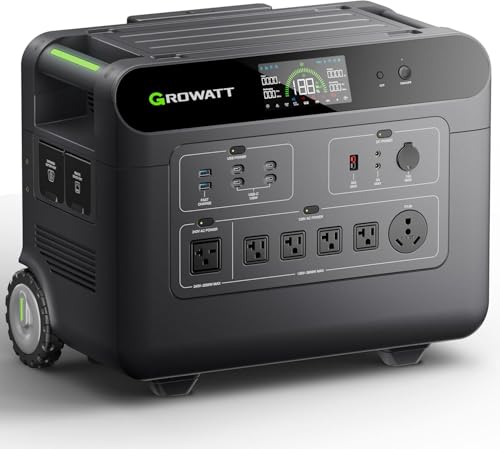
The 3600Wh split-phase station that can become your whole house.
This is the closest thing in this guide to a home generator in a box. The HELIOS 3600 packs 3600Wh (3.6kWh) of LFP capacity with 3600W output, running daily home devices for up to 15 hours and keeping a fridge going for 1–3 days. But the real a neat extra is split-phase: connect two units in parallel and you get 240V at 7200W — enough to run AC, dryers, and pumps, or pair with a transfer switch for whole-home backup covering 99% of power needs. Expandable up to 36kWh, it can provide up to 7 days of home power.
Battery life is the thing owners praise most — over 20 single it out — with one running a large window AC unit for over 12 hours before it hit zero. Another has used it as the main power supply for an off-grid house for almost a year, and it still works as well as day one. The 2000W solar charging fully charges in 2.8 hours, and AC-DC hybrid charging hits a full charge in under 1.5 hours. It uses EV-grade LFP cells retaining 80% capacity after 4,000 cycles, projected at 10 years of stable use.
Cold start technology keeps it operating down to -22°F, which matters for northern winters, and the <15ms EPS switchover protects servers and medical devices. The 16 plug-and-play ports plus Anderson ports and a NEMA TT-30 output make it ideal for RVs and DIY off-grid systems. The honest catches are real: at 51 lbs it is extremely heavy, a few reviewers point out the app’s Bluetooth connection fails repeatedly, and there is an occasional humming noise above 1200W load. The warmest praise is reserved for Growatt’s customer service, which honored warranty claims without fuss.
The whole-house player: 3600Wh with split-phase 240V output is a category above every other portable in this guide — it genuinely replaces a gas generator.
Pick this if: you want whole-home backup with 240V capability, run an off-grid cabin, or need to power a window AC for 12+ hours straight.
it’s not for you if: you need something you can toss in a trunk — at 51 lbs with no telescopic handle, this lives on wheels or on a truck bed.
Understanding the Specs
Watt-Hours (Wh) — Your Energy Tank
This is the total energy stored, like the size of a fuel tank. A 230.88Wh unit runs a phone for days but struggles with a fridge, while a 2048Wh unit keeps a fridge going for a full day. To estimate runtime, divide the capacity by the watts your device draws — a 60W laptop on a 2048Wh station should run about 34 hours. Remember that every station draws a small idle amount even with nothing plugged in.
Continuous vs. Surge Watts
Continuous watts is the steady power a station delivers, and it is the hard ceiling for what you can plug in. Surge watts is a brief burst to start motors — a fridge compressor or a power tool — that lasts a few seconds. Astation rated 330W continuous with a 600W surge can start a small fridge but cannot run a microwave, which needs steady 700–1000W. Always match your biggest appliance’s running watts to the continuous output, not the surge number.
FAQ
How do I know which size power station I actually need?
What is the difference between LiFePO4 and other lithium batteries?
Can I run a refrigerator on a portable power station?
How long does a power station take to recharge?
What does pure sine wave output mean for my devices?
Can I charge a power station with solar panels?
What is UPS mode and why does it matter?
How much weight can I reasonably carry?
Can I expand capacity later?
Is it safe to use a power station indoors?
Final Thoughts: The Verdict
The amazon power station winner is the EcoFlow DELTA 3 Max because its 2048Wh capacity and 3400W X-Boost output handle nearly any home appliance while recharging in just over an hour — the crowd favorite with fast charging and long battery life. If you want the best capacity-to-size trade-off for a fridge, grab the Anker SOLIX S2000. And for a genuinely portable 1kWh station that runs an 1800W appliance, the BLUETTI Elite 100 V2 is the one to reach for.
How We Picked
We do not accept paid placement. Every pick is matched to a real buyer and a real use-case; we do not hands-on test units.
Sources & Methodology
Specifications: manufacturer listings and product documentation. Review insights: verified customer reviews, as of August 2026. Pricing: not shown on this page (it changes often); check the current price via the retailer link.
As an Amazon Associate, Gadgets Feed earns from qualifying purchases. This does not affect which products we feature.