
Finding a mouse that truly respects both hands often means settling for a mirrored shell with side buttons on one side only, forcing left-handed users into an ergonomic compromise or right-handed users into a subpar grip. The search for a symmetrical pointer that delivers identical performance and comfort regardless of which hand is dominant is the central challenge in this narrow category.
I’m Min — the co-founder and writer behind Gadgets Feed. I’ve spent countless hours analyzing sensor specifications, switch durability ratings, polling rate ceilings, and weight distributions specifically within the ambidextrous mouse segment to separate the genuine dual-hand performers from the mere symmetrical lookalikes.
Every mouse on this list was selected based on its ability to deliver equal performance for both left and right-handed users. This guide covers the best ambidextrous mouse choices that balance shape symmetry with button programmability.
How To Choose The Best Ambidextrous Mouse
A truly ambidextrous mouse is defined by more than just a symmetrical body. You need four programmable side buttons — two on each side — so both left and right-handed users can access forward and back functions without twisting their grip. Look for a symmetrical shape that mirrors across the center line, not a right-handed ergonomic design repurposed for dual use.
Side Button Configuration and Programmability
The defining feature of a proper ambidextrous mouse is the ability to reconfigure or physically swap side buttons. Some models ship with magnetic or removable button panels on both flanks, letting you disable the unused side to avoid accidental presses. Software-driven button remapping is essential — ensure the manufacturer’s companion app allows full customization of all six to nine buttons regardless of hand orientation.
Sensor and Polling Rate Demands
Competitive gaming at high refresh rates demands a sensor capable of at least 16,000 DPI and a polling rate of 1000 Hz as a baseline. Premium options now offer 8000 Hz polling, which reduces input latency to 0.125 ms, but this requires a strong CPU to maintain consistent frame timing. For office productivity, a 4000 DPI sensor with 125 Hz polling is sufficient, but you sacrifice the precision that makes ambidextrous mice attractive for gaming.
Weight Balance and Switch Durability
Symmetrical mice must be perfectly balanced front-to-back and left-to-right to avoid favoring one hand. Weight targets below 75 grams are ideal for fast flick shots in FPS titles, while 80-100 grams offers more stability for precise cursor work. Switch durability is rated in millions of clicks — optical switches (rated for 80-100 million clicks) eliminate double-click issues over time, whereas mechanical switches (20-50 million clicks) provide a crisper tactile feel but wear out faster.
Quick Comparison
On smaller screens, swipe sideways to see the full table.
| Model | Category | Best For | Key Spec | Amazon |
|---|---|---|---|---|
| Logitech G PRO 2 Lightspeed | Wireless | Competitive gaming with modular side buttons | 44,000 DPI HERO 2 sensor | Amazon |
| Razer Viper V4 Pro | Wireless | Ultra-lightweight esports performance | 49g, 50,000 DPI sensor | Amazon |
| Glorious Model O | Wired | Budget-conscious competitive gaming | 67g, Pixart 3360 sensor | Amazon |
| Razer Viper Ultralight | Wired | Reliable wired esports performance | 71g, optical switches | Amazon |
| 8Bitdo Retro R8 | Wireless | Retro aesthetic with modern performance | 26,000 DPI PAW 3395 sensor | Amazon |
| MCHOSE A5 ProMax | Wireless | Lightweight budget-friendly gaming | 59g, PAW 3395 sensor | Amazon |
| Logitech MX Anywhere 2S | Bluetooth | Portable office and travel use | 4,000 DPI Darkfield sensor | Amazon |
In‑Depth Reviews
1. Logitech G PRO 2 Lightspeed

The Logitech G PRO 2 Lightspeed sets the benchmark for true ambidextrous design with its modular side button system. It ships with magnetic panels on both flanks — two buttons per side plus blank covers — letting you configure the mouse for left or right-handed use without exposing unused switches. The HERO 2 sensor delivers up to 44,000 DPI with zero smoothing, and the LIGHTFORCE hybrid switches combine optical speed with a satisfying mechanical click.
At 80 grams, the PRO 2 strikes a balance between featherlight maneuverability and purposeful weight for precise flicks. The 95-hour battery life at 1000 Hz polling rate means you charge once every two weeks with moderate gaming sessions. USB-C charging is included, and the receiver extension adapter helps position the dongle close to the mouse for interference-free signal.
Left-handed users will appreciate the included second set of side buttons that mirror the right-side layout. The symmetrical shape is slightly larger than the original G PRO, accommodating medium to large hands with a claw or fingertip grip. The only trade-off is the smooth side surfaces, which can become slippery during extended sessions — grip tape is a recommended addition.
Why it’s great
- Fully modular side buttons work for either hand orientation without exposed gaps
- HERO 2 sensor offers market-leading 44,000 DPI with flawless tracking
- 95-hour battery life at 1000 Hz polling reduces charging frequency
Good to know
- Smooth side panels lack texture, making grip slip with dry hands
- No onboard DPI button on top surface — adjustments require software
- Premium price reflects the modular engineering and esports pedigree
2. Razer Viper V4 Pro
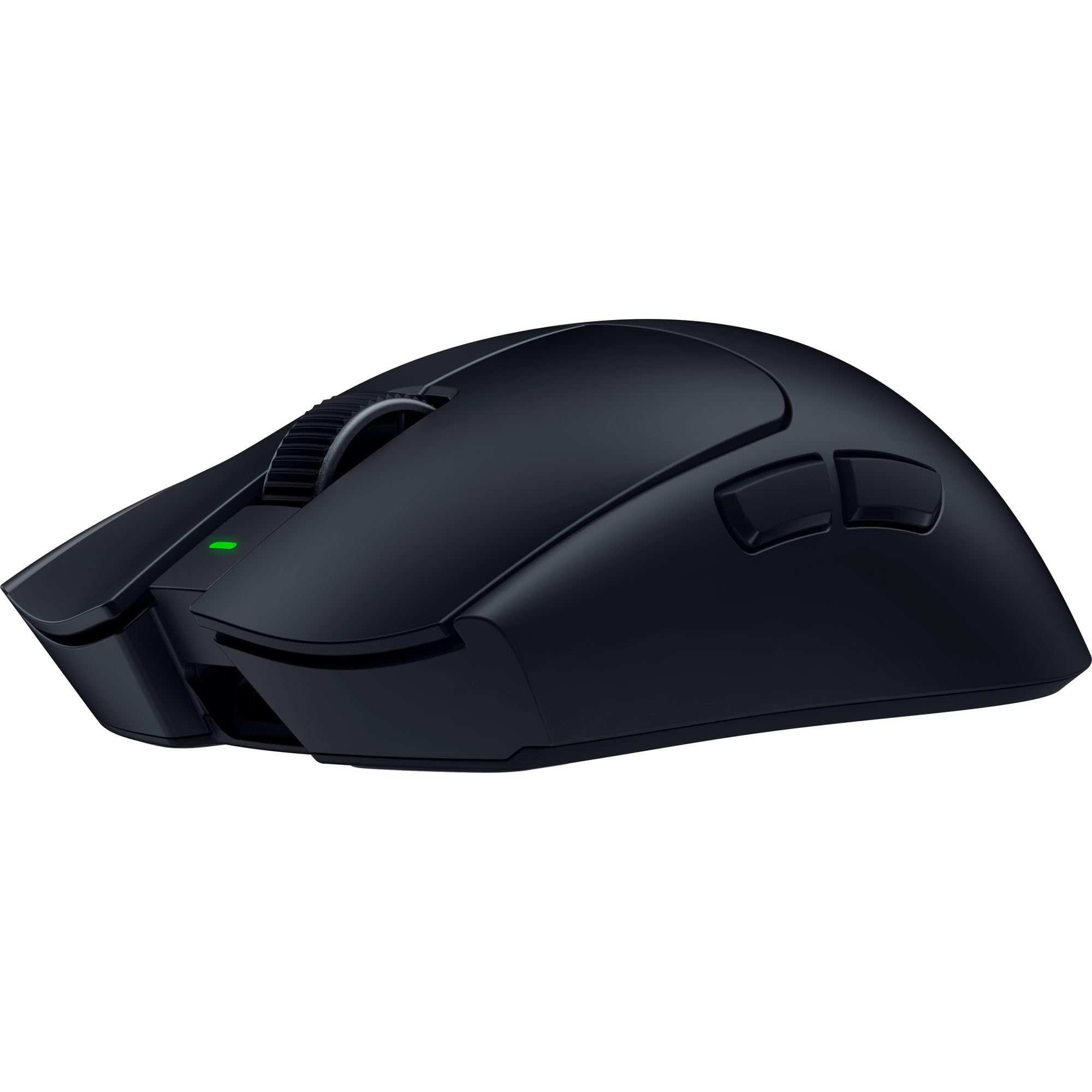
The Razer Viper V4 Pro represents the pinnacle of lightweight symmetrical design at just 49 grams, making it one of the lightest production ambidextrous mice available. The Focus Pro 50K DPI Optical Sensor Gen-3 tracks up to 930 IPS with 90 G acceleration, and the Frame Sync technology aligns sensor data with the PC rendering cycle for lower perceived latency. Native 8000 Hz polling is supported both wirelessly and wired, reducing input delay to 0.125 ms.
Battery life scales with performance: 180 hours at 1000 Hz polling drops to approximately 45 hours at the full 8000 Hz rate. The Gen-4 optical switches are rated for 100 million clicks and deliver a crisp tactile feel without the double-click failure mode common to mechanical switches. The optical scroll wheel uses light-based actuation for consistent tracking during rapid weapon swaps.
The symmetrical shape is a refined version of the Viper Ultimate, optimized for claw and fingertip grips with medium to large hands. The included grip tape improves hold during intense sessions. However, the V4 Pro lacks physical side buttons on both sides — it is right-handed by default, though the symmetrical shell allows left-handed use through software remapping only.
Why it’s great
- 49g weight sets a new standard for effortless flick shots and fatigue-free long sessions
- Native 8000 Hz polling wirelessly delivers sub-0.2 ms input latency
- 180-hour battery life at 1K polling competes with the best in class
Good to know
- No dual-side button configuration — left-handed users rely on software remapping only
- Black finish attracts fingerprints and oil from hands quickly
- Loud click noise may be distracting in quiet environments or shared rooms
3. Glorious Model O Wired

The Glorious Model O Wired remains a reference point for affordable symmetrical performance. Its honeycomb shell reduces weight to 67 grams without structural compromise, and the Pixart 3360 sensor delivers pixel-perfect tracking at up to 16,000 DPI with zero acceleration. The Ascended paracord cable is among the most flexible stock cables in the industry, effectively eliminating cable drag during fast movements.
Omron mechanical switches are rated for 20 million clicks, which is adequate for most users but falls short of the 80-100 million click durability offered by optical switches in higher-tier models. The Glorious G-Skates are made from 100% virgin PTFE and provide a smooth glide on most cloth pads. The software suite allows full customization of DPI stages, lift-off distance down to 0.7 mm, and debounce time.
The symmetrical shape is designed for medium and large hands, supporting palm, claw, and fingertip grips equally. Six buttons are available, but the side buttons are only present on the left side — this is not a true ambidextrous layout for left-handed users out of the box. The RGB lighting adds aesthetic flair without affecting performance.
Why it’s great
- 67g honeycomb design achieves lightweight without drilling holes in a standard shell
- Paracord cable mimics wireless freedom with zero drag during gameplay
- Low 0.7 mm lift-off distance suits competitive FPS players who lift and reposition
Good to know
- Only left-side buttons — right-handed users get the dual-button layout; lefties lose rear button access
- Omron switches rated for 20 million clicks may develop double-click over extended use
- Incompatible with macOS, limiting use for mixed-platform setups
4. Razer Viper Ultralight Wired

The Razer Viper Ultralight Wired delivers a proven symmetrical shape at 71 grams with optical switches that actuate at the speed of light — no debounce delay, no double-click degradation over time. The 5G optical sensor reaches 16,000 DPI with 99.4% resolution accuracy, making it a reliable choice for competitive play. The Speedflex cable is notably flexible, though it doesn’t match the near-zero drag of the Glorious paracord.
The ambidextrous design includes programmable buttons on both sides, with two buttons per flank. Razer Synapse software allows remapping of all six buttons and DPI cycling, though lighting customization requires software installation — settings are not saved to onboard memory, so you lose custom lighting after closing the app. The rubberized texture on the sides provides a secure grip without added grip tape.
The V2 optical switches are stiffer and snappier than the original Viper’s mechanical switches, offering more defined actuation feedback. The DPI indicator is located on the bottom of the mouse, preventing accidental mode changes but also making adjustments slightly inconvenient. The white Mercury finish resists shine buildup compared to glossy black alternatives.
Why it’s great
- Optical switches eliminate double-click failure and register presses at light speed
- True ambidextrous layout with two programmable buttons on each side
- Rougher white finish resists glossy wear from extended use
Good to know
- Cable is less flexible than modern paracord designs, introducing minor drag
- Lighting profiles not saved to onboard memory — lost when Synapse is closed
- Resting finger on right button may cause accidental clicks due to low actuation force
5. 8Bitdo Retro R8 with Charging Dock
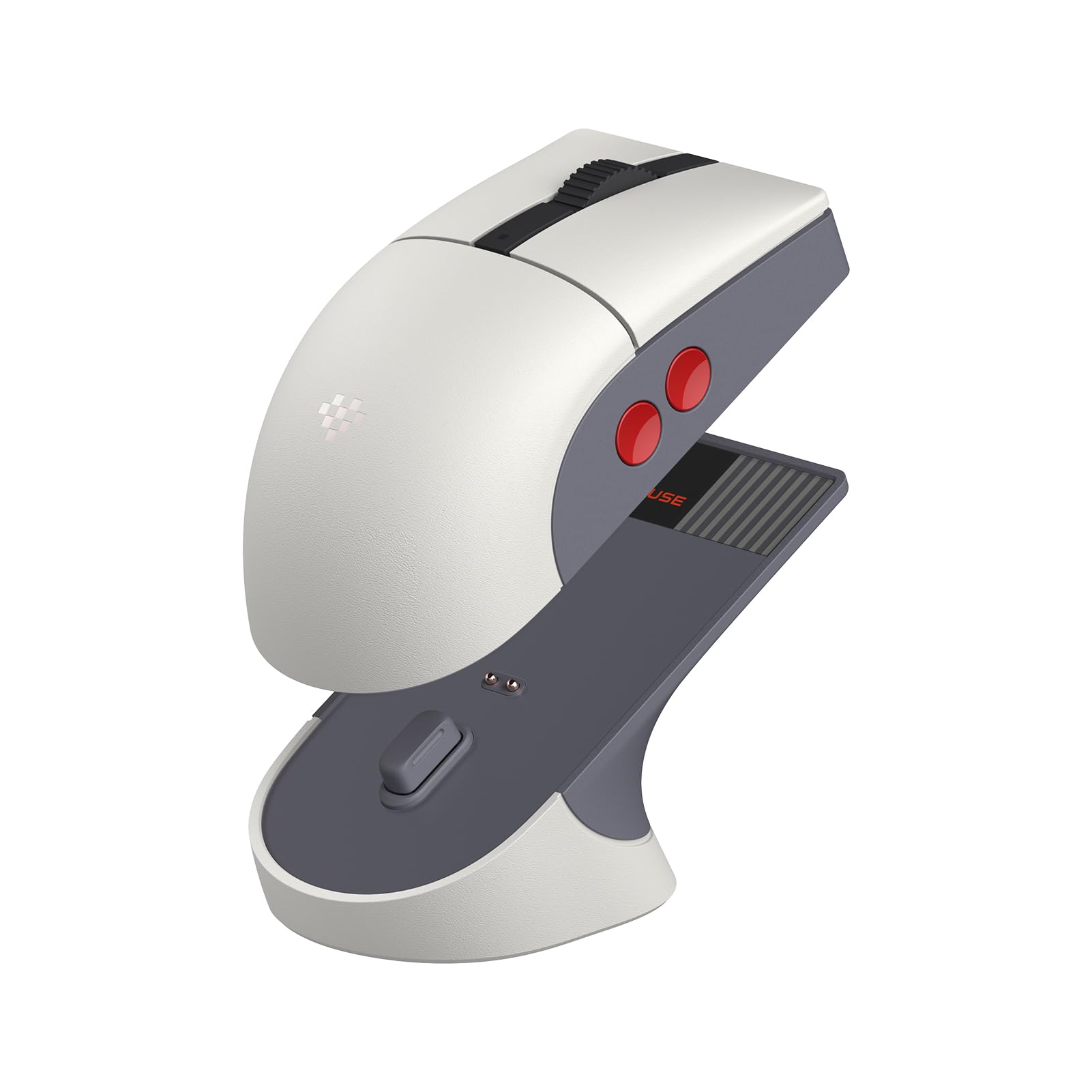
The 8Bitdo Retro R8 combines a nostalgic NES-inspired aesthetic with genuinely competitive internals. The PAW 3395 optical sensor supports DPI up to 26,000 with wireless polling rates of 4000 Hz, delivering sub-0.25 ms latency that rivals flagship esports mice. The Kailh Sword GM X micro switches use a pre-compression system to minimize dead travel, resulting in crisp, immediate actuation with every click.
Connectivity options span Bluetooth, 2.4 GHz wireless, and wired USB-C, with the included magnetic charging dock doubling as a signal extender for the 2.4 GHz adapter. The dock’s storage compartment keeps the dongle secure during transport. Nine programmable buttons include four side buttons — two per side — for true ambidextrous functionality, though the symmetrical sculpt is slightly small for users with larger hands.
The 8BitDo Ultimate Software V2 supports full button remapping and macro creation on Windows, though macOS users report limitations with modifier key macros. The build quality is sturdy, and the retro design elements — gray body, red A/B buttons — make it a standout on any desk. At 54 grams, it’s light enough for competitive play without feeling fragile.
Why it’s great
- PAW 3395 sensor rivals high-end gaming mice at a mid-range price point
- Magnetic charging dock with signal extender eliminates separate dongle placement
- Four side buttons support true ambidextrous use with proper button mapping
Good to know
- Smaller sculpt may feel cramped for users with large hands or palm grip
- Macro functionality on macOS is limited and unreliable in current software
- Retro aesthetic may not suit minimalist or professional desk setups
6. MCHOSE A5 ProMax Wireless

The MCHOSE A5 ProMax delivers flagship-level specs at a budget-friendly price, featuring a PAW 3395 sensor with 26,000 DPI and a 59-gram symmetrical shell. The tri-mode connectivity (2.4 GHz, Bluetooth, wired) provides flexibility across devices, and the 130-hour battery life at 1000 Hz polling means you can game wirelessly for weeks between charges. The switches are rated for 80 million clicks, offering durability that competes with mice costing three times as much.
The build quality is impressive for the price range, with a solid plastic construction and a matte white finish that resists fingerprints. Adhesive grip tape is included in the box for users who prefer additional traction. The symmetrical design accommodates both hand orientations, though the side buttons are only present on the left side, making this a right-handed ambidextrous mouse that lefties can use with software remapping.
The 1000 Hz polling rate is adequate for most competitive titles, though it lacks the higher polling options found on premium alternatives. The USB-C charging port is conveniently located at the front, and the included USB dongle stows inside the mouse body for transport. Some users report that the driver software fails to detect the device on certain systems, requiring use of the bottom DPI button for sensitivity changes.
Why it’s great
- PAW 3395 sensor at this price point is exceptional value for sensor-first buyers
- 59g weight competes with ultra-light mice from established gaming brands
- 130-hour battery life outlasts many premium wireless gaming mice
Good to know
- Only left-side buttons limit true ambidextrous use for left-handed gamers
- Driver software may fail to recognize the device on some PC configurations
- Plastic shell lacks the premium coating feel of higher-end competitors
7. Logitech MX Anywhere 2S Bluetooth

The Logitech MX Anywhere 2S is a compact Bluetooth-only mouse designed for productivity on the go. Darkfield laser tracking works on virtually any surface — including glass desks — eliminating the need for a mousepad in coffee shops or conference rooms. The Micro-USB charging port delivers a full day of use from just three minutes of charge, and the full battery lasts up to 70 days under typical office workloads.
The hyper-fast scroll wheel is the standout feature: spin it freely to fly through long documents, or press it to engage click-to-click mode for precise line-by-line navigation. Logitech Flow enables seamless control across up to three computers, copying and pasting files between them. Seven buttons are programmable through Logitech Options software, though the ergonomic sculpt is designed for right-handed users only.
At just 99 grams, the MX Anywhere 2S is light enough for daily carry in a laptop bag. The compact footprint fits smaller hands comfortably but may feel cramped for palm-grip users with large hands. The graphite finish resists scuffs during travel, and the Bluetooth connection pairs reliably with both Mac and Windows devices without requiring a USB receiver.
Why it’s great
- Darkfield sensor tracks on glass and glossy surfaces without a mousepad
- Three-minute charge provides a full day of use for emergency top-ups
- Hyper-fast scroll wheel dramatically speeds up document and web browsing
Good to know
- Right-handed ergonomic shape — not suitable for left-handed users
- Bluetooth-only connectivity with no included USB receiver
- Micro-USB charging port is outdated compared to modern USB-C standards
FAQ
Can I use an ambidextrous mouse as a left-handed person without software?
Does a lighter mouse always mean better performance in FPS games?
How do I clean the honeycomb holes on lightweight ambidextrous mice?
Can mechanical switches develop double-click and should I choose optical instead?
Final Thoughts: The Verdict
For most users, the best ambidextrous mouse winner is the Logitech G PRO 2 Lightspeed because its modular side button system delivers genuine dual-hand versatility without compromising on HERO 2 sensor accuracy or 95-hour battery life. If you want the absolute lightest symmetrical mouse for esports, grab the Razer Viper V4 Pro at 49 grams with native 8000 Hz polling. And for a budget-friendly option that punches well above its price, nothing beats the MCHOSE A5 ProMax with its PAW 3395 sensor and 59-gram build.