
Managing hypertension requires data that a single morning reading can’t provide. Ambulatory blood pressure monitors track your systolic, diastolic, and heart rate continuously over 24 to 48 hours, revealing masked hypertension, white-coat syndrome, and nocturnal dipping patterns that spot checks miss. These wearables strap directly to your arm and record measurements at programmed intervals while you sleep, work, and go about your day, giving your cardiologist a comprehensive pressure map.
I’m Min — the co-founder and writer behind Gadgets Feed. I’ve analyzed hundreds of hours of clinical validation data, customer-reported accuracy comparisons against mercury sphygmomanometers, and software reliability reports across brands like Omron, Withings, and Garmin to bring you a narrowed-down selection of the most reliable models for continuous monitoring.
After comparing FDA-cleared devices from Omron, Withings, and Garmin against rigorous accuracy and comfort benchmarks, these picks represent the best ambulatory blood pressure monitor choices available today for reliable home and clinical use.
How To Choose The Best Ambulatory Blood Pressure Monitor
Selecting the right 24-hour blood pressure tracker comes down to three non-negotiable factors: clinical accuracy, cuff comfort during sleep, and software that makes data usable for your doctor. Not all monitors labeled “ambulatory” are built for continuous wear protocols.
Clinical Validation and ±3 mmHg Accuracy
The gold standard for any ambulatory monitor is validation against a mercury sphygmomanometer within ±3 mmHg for systolic and diastolic readings. Look for FDA clearance or ESH/BIHS validated devices — these have passed strict protocols including testing across different arm circumferences and irregular heart rates. Models without published validation studies may drift over time, undermining trend analysis.
Cuff Comfort and Tubing Flexibility
For 24-hour wear, cuff design is paramount. A rigid pre-formed cuff with soft inner lining reduces night-time irritation during sleep cycles. The tubing should be long enough (at least 8 feet) to route under clothing and allow bathroom visits without disconnecting. Barrel-type auto-fit designs offer an advantage by eliminating the need for manual wrapping — critical when you’re placing the device on yourself.
Data Storage, Sync, and Physician Reporting
Ambulatory monitoring generates hundreds of data points over 24 hours. Look for memory capacity holding at least 99 readings per user, with Wi-Fi or Bluetooth sync to companion apps that can export PDF reports. The best models automatically timestamp each reading, categorize it by blood pressure stage (normal, elevated, stage 1), and include pulse irregularity detection. This turns raw numbers into actionable clinical documentation.
Quick Comparison
On smaller screens, swipe sideways to see the full table.
| Model | Category | Best For | Key Spec | Amazon |
|---|---|---|---|---|
| Withings BPM Vision | Smart Monitor | Ecosystem Integration | 2.8″ Color LCD + Wi-Fi Sync | Amazon |
| Garmin Index BPM | Connected Monitor | Garmin System Users | Up to 16 users / 9-month battery | Amazon |
| CAVN Barrel-Type | Auto-Fit | Seniors & Easy Use | Auto-Fit 7.1″-16.5″ / 2000mAh | Amazon |
| 52HZ Barrel-Type | Auto-Fit | Quick Daily Tracking | 3-Color Backlight / 2×99 Memory | Amazon |
| Saker U90B | Multi-User | Household Sharing | 4 Users × 199 Readings | Amazon |
| SavvyBloom Auto-Fit | Auto-Fit | Accurate Home Use | Auto-Fit 7.1″-16.5″ / Color LCD | Amazon |
| Graham-Field Mobile Cart | Clinical Cart | Medical Office Use | 110° Swivel Gauge / Glow Dial | Amazon |
| Withings Scanwatch Nova | Hybrid Watch | 24/7 Wearable Tracking | ECG + SpO2 / 30-day battery | Amazon |
| Omron HEM-907XL | Clinical Grade | Doctor-Trusted Accuracy | IntelliSense / 4 Cuff Sizes | Amazon |
In‑Depth Reviews
1. Withings BPM Vision
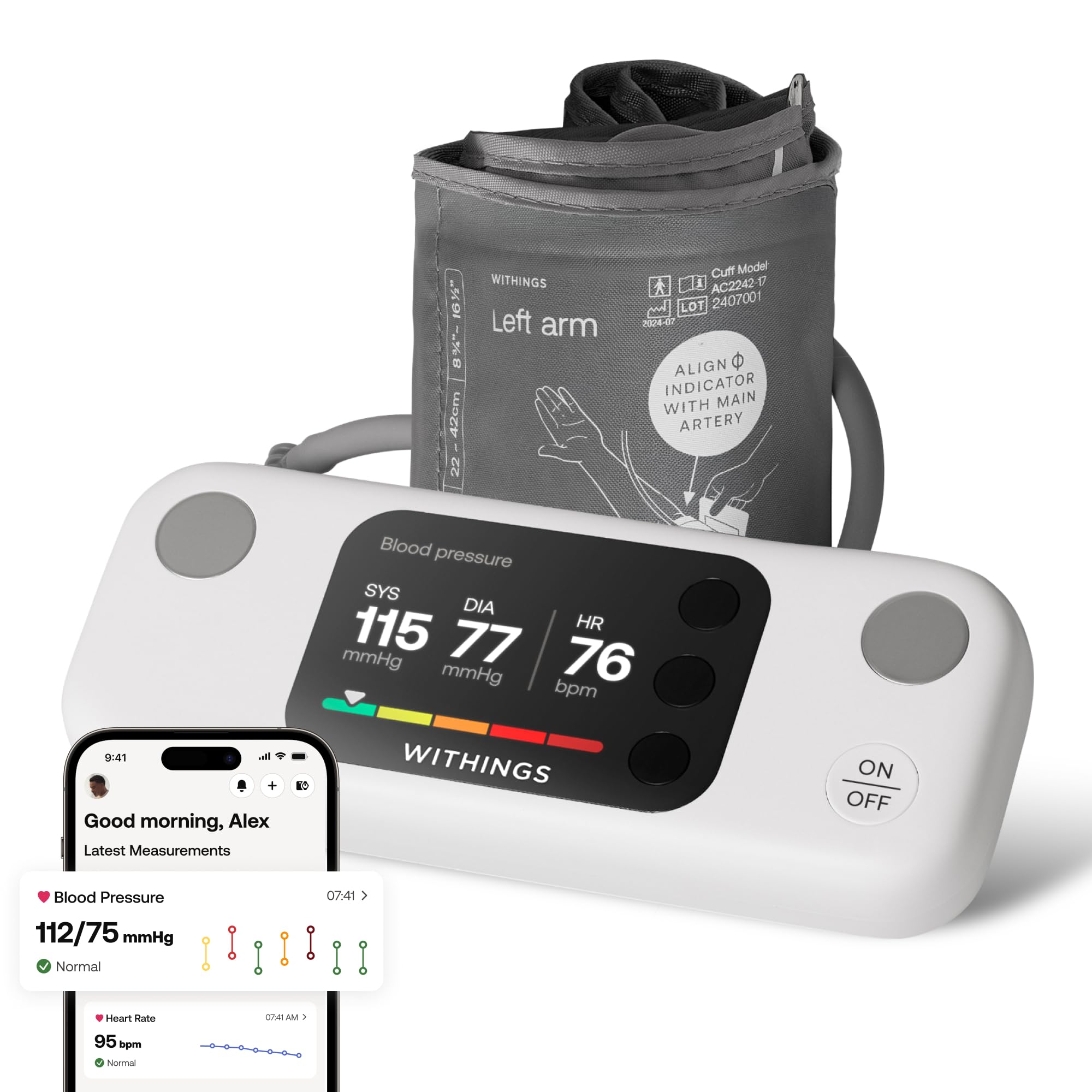
The Withings BPM Vision sets the benchmark for smart ambulatory monitors with its 2.8-inch color LCD that displays systolic, diastolic, and heart rate readings alongside color-coded feedback aligned to American Heart Association hypertension stages. The built-in step-by-step tutorials guide proper arm positioning at heart level, eliminating the most common user error that compromises ±3 mmHg accuracy. Its Wi-Fi sync operates without needing your phone nearby after each reading — readings queue and push to the Withings app and Apple Health when back in range.
The standard cuff (22–42 cm circumference) uses a pre-formed bladder that inflates evenly, and the included protective case doubles as a stand for tabletop use. Battery life reaches one year on a single nonstandard cell, and the three-reading average mode automatically calculates a clinically recommended mean, sending only the average to the app. This device is FDA-cleared but explicitly noted as incompatible with pacemakers due to the measurement algorithm’s interaction with implantable devices.
Where the BPM Vision stumbles is in its multi-user support — two users cannot share one phone profile; each needs their own Withings account. Some firmware versions have shown delayed Bluetooth syncing where individual readings post to the app hours later rather than immediately. The device also holds only one reading in cache before sync, so a prolonged Wi-Fi outage can lose data if you take multiple measurements without connectivity.
Why it’s great
- Large color display with instant hypertension stage feedback
- One-year battery life removes charging anxiety
- Automatic Wi-Fi sync works without phone proximity
Good to know
- Not compatible with pacemakers
- Multi-user setup requires separate app accounts
- Firmware can delay Bluetooth readings
2. Garmin Index BPM

The Garmin Index BPM is the only device in this comparison supporting up to 16 user profiles through Garmin Connect, making it exceptional for family health tracking or small clinic environments. The adjustable cuff fits arm circumferences from 22 to 42 cm, and the integrated display shows readings directly on the device before any sync occurs — no phone needed for basic operation. Battery life of up to 9 months on four AAA batteries means you won’t be tethered to a charging cable during monitoring periods.
One standout feature is the one-touch 3X reading setting, which automatically takes three consecutive measurements with one-minute intervals and averages them — exactly matching American Heart Association protocol for accurate trend data. The device exports 7-day, 4-week, and 1-year reports as PDFs directly from Garmin Connect, printable or email-able to your healthcare provider. The Wi-Fi sync pushes readings automatically in the background without manual pairing each session.
However, the Wi-Fi setup process has been described as slow and unintuitive, and the monitor face is relatively heavy, making one-handed operation challenging for some users. A critical design choice is that the device averages three readings instead of recording each individually — users who prefer granular data points will find this limiting. Some units have also been reported with persistent high readings (systolic 170–180) that did not match Omron clinical references under identical conditions.
Why it’s great
- Supports 16 individual user profiles with separate data
- 9-month battery on standard AAA batteries
- Automatic 3X averaging follows AHA protocol
Good to know
- Reports average of three readings, not individual data
- Wi-Fi setup is slow and not always intuitive
- Some units reported accuracy discrepancies vs Omron
3. CAVN Barrel-Type Blood Pressure Monitor
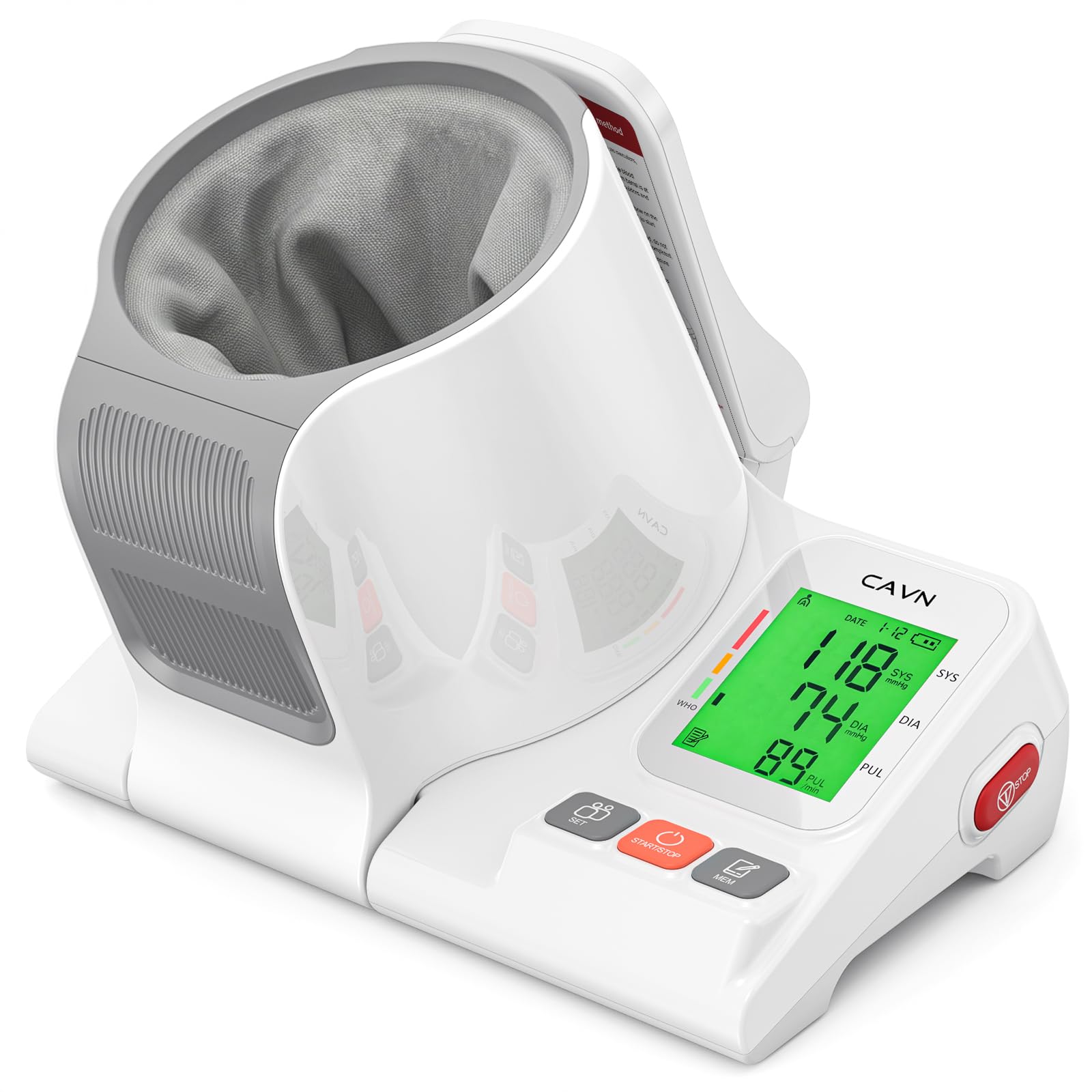
The CAVN Barrel-Type monitor solves the most common ambulatory monitoring problem — incorrect cuff placement — through its slide-in barrel design with a built-in elbow pressure switch. When you rest your elbow on the switch, the monitor knows your arm is at the correct depth and heart level. The auto-fit cylindrical barrel accommodates arm circumferences from 7.1 to 16.5 inches without manual tightening, and the 3-color backlight (green/yellow/red) instantly communicates blood pressure category, which is particularly helpful for elderly users.
Its 2000mAh rechargeable battery with USB-C charging eliminates the cost and environmental waste of disposable batteries — a real advantage for daily home monitoring where battery replacements add up. The two-user memory holds 99 readings per user, separated so family results stay distinct. The large LCD screen shows systolic, diastolic, and pulse simultaneously in oversized digits that are readable from across the room.
The barrel design, while convenient, adds bulk — the unit measures 11.14 x 9.61 x 9.61 inches, making it a permanent countertop fixture rather than a portable device. Some users with very small arms (under 7.1 inches) may find the barrel diameter too large for a snug fit, potentially affecting accuracy at the lower end of the range. The device is FDA-cleared but lacks irregular heartbeat detection found on more premium models.
Why it’s great
- Elbow switch ensures correct arm placement every time
- Rechargeable 2000mAh battery with USB-C
- Large, color-coded display ideal for seniors
Good to know
- Bulky countertop design not travel-friendly
- No irregular heartbeat detection
- Fit may be loose for arms under 7.1 inches
4. 52HZ Barrel-Type Blood Pressure Monitor
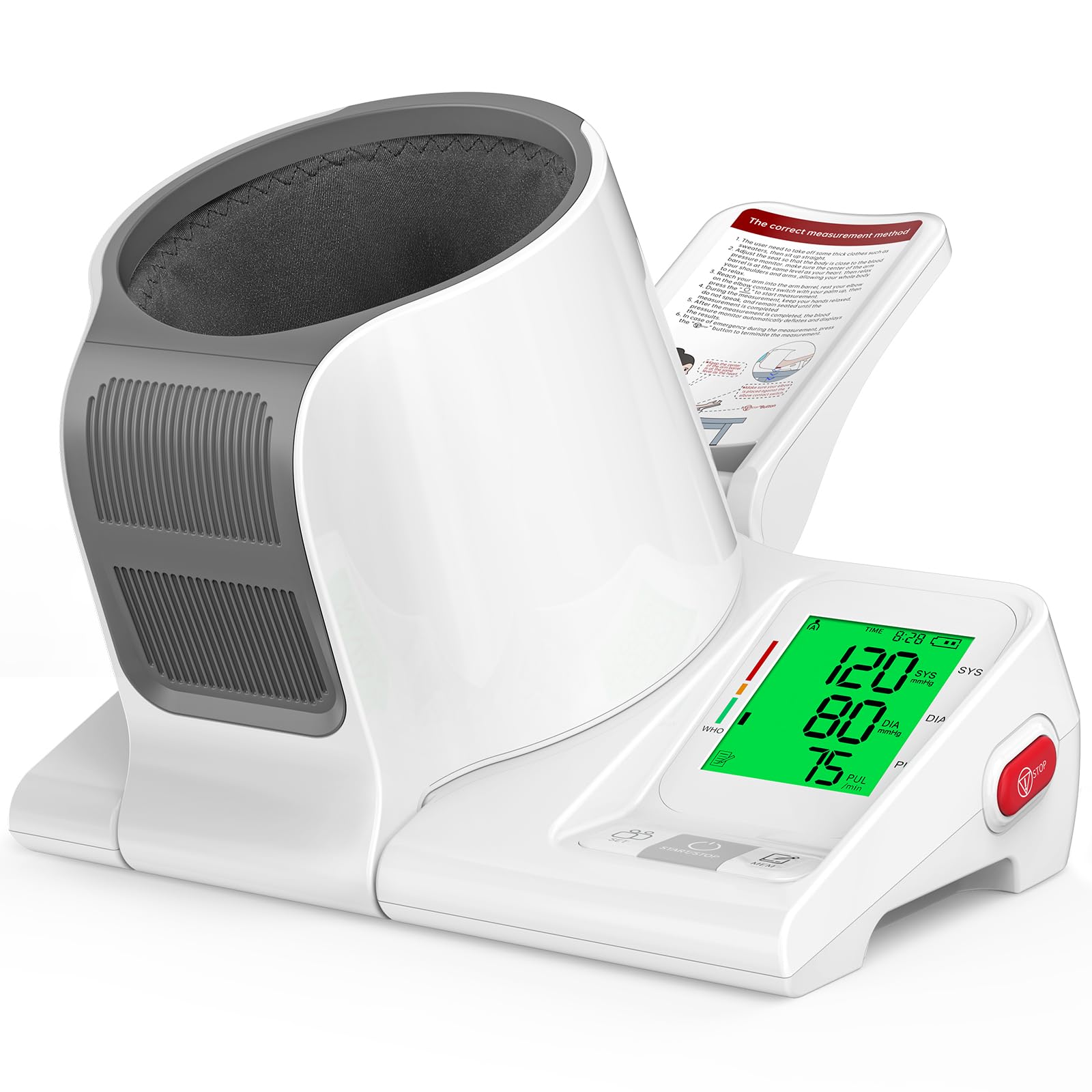
The 52HZ barrel-type monitor delivers a similar auto-fit convenience as the CAVN model but differentiates itself with a slightly faster measurement cycle — readings complete in about 30 seconds after arm insertion. The elbow pressure switch replicates the same positioning logic, and the 3-color backlight system uses green for normal, yellow for elevated, and red for stage 1 or higher, which aligns with standard hypertension classification.
The 2000mAh rechargeable battery with USB-C eliminates battery waste, and the two-user memory stores 99 readings each — enough for a month of twice-daily monitoring before export. The large LCD screen is exceptionally clear in even dim light, making this monitor suitable for nighttime use without turning on overhead lights. The barrel auto-fit range matches the CAVN at 7.1–16.5 inches, covering most adult arm sizes.
The device is FDA-cleared and claims ±3 mmHg accuracy, but its validation data is less publicly documented than Withings or Garmin offerings, which may matter for clinical settings requiring published peer-reviewed studies. The barrel design, while easy, cannot accommodate arms smaller than 7.1 inches without the cuff being too loose. Some users note the unit feels light and slightly plasticky compared to the more solid Garmin or Omron builds.
Why it’s great
- Fast 30-second reading cycle
- Clear color-coded backlight for quick interpretation
- USB-C rechargeable with long battery life
Good to know
- Less publicly documented clinical validation
- Build quality feels lighter than premium rivals
- Not suitable for arms under 7.1 inches
5. Saker U90B Blood Pressure Monitor
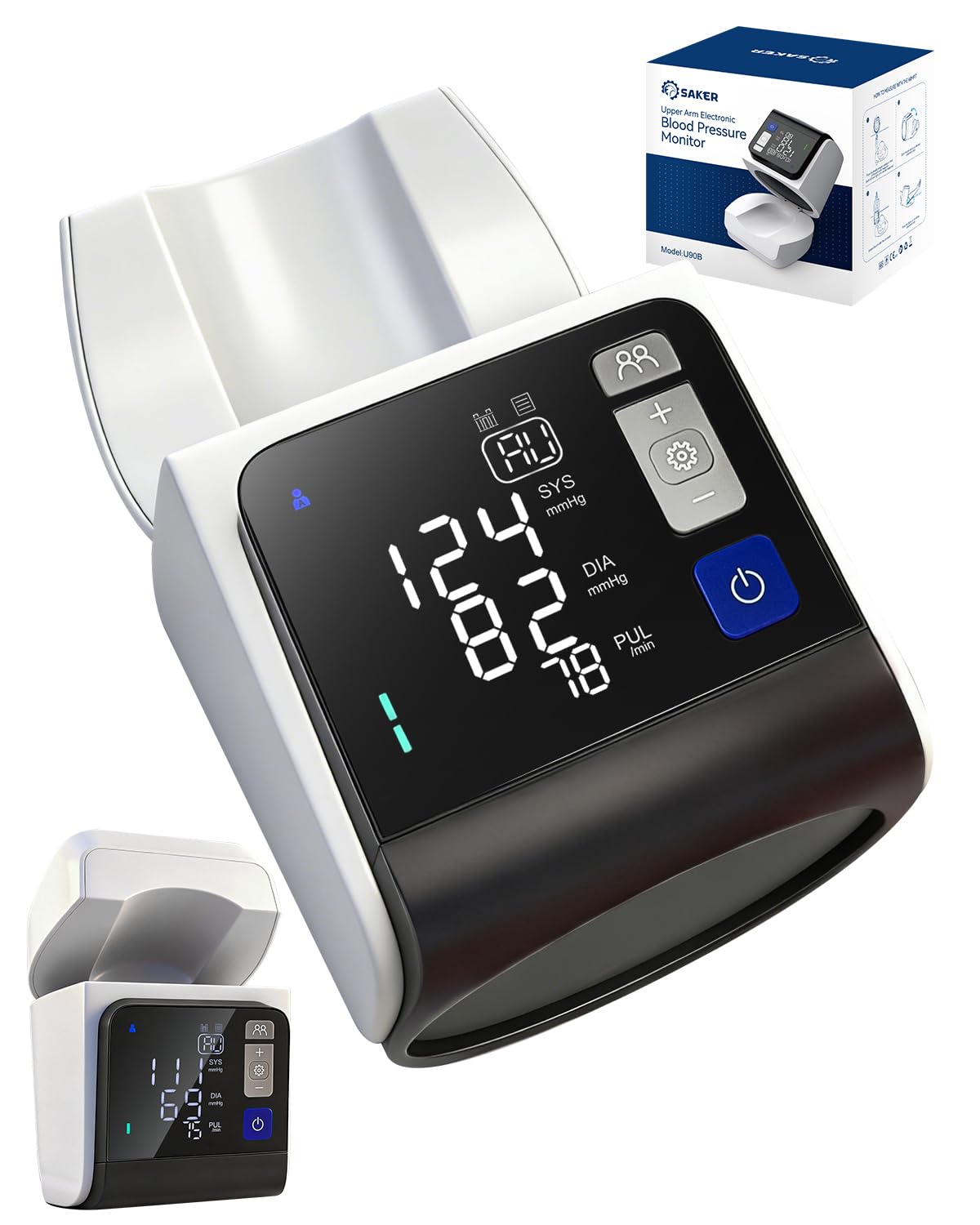
The Saker U90B stands out for its four-user profile support with 199 stored readings per user — more than double the capacity of most competitors — making it ideal for large households or small care facilities. The no-wrap auto-fit design uses a slide-in barrel that fits arm circumferences from 8.5 to 15.7 inches, and the one-touch operation starts a reading instantly. A notable inclusion is the pulse irregularity reminder feature, which alerts during measurement if an arrhythmia is detected, adding a layer of clinical insight.
The large display shows systolic, diastolic, and pulse in bold digits, and the one-button operation simplifies use for elderly individuals. The device uses reverse inflation — it inflates to a predetermined level then slowly releases, which some users find unusual but effective for consistent readings. The auto-fit mechanism is gentler than traditional velcro cuffs, reducing the pinching sensation that can artificially elevate readings.
The Saker U90B is bulkier than standard upper arm monitors — measuring 7.87 x 7.44 x 6.57 inches — which may limit portability. Its accuracy has not been verified against clinical sphygmomanometers in published studies, so while user reports indicate consistency, it lacks the documented validation of Omron or Withings. The reverse inflation method also requires a high-power USB source; using a standard low-power charger may cause incomplete inflation cycles.
Why it’s great
- Four-user memory with 199 readings each is best in class
- Pulse irregularity detection adds clinical value
- Gentle auto-fit design reduces measurement anxiety
Good to know
- Bulkier build limits portability
- Lacks published clinical validation studies
- Reverse inflation requires high-power USB source
6. SavvyBloom Auto-Fit Upper Arm Monitor
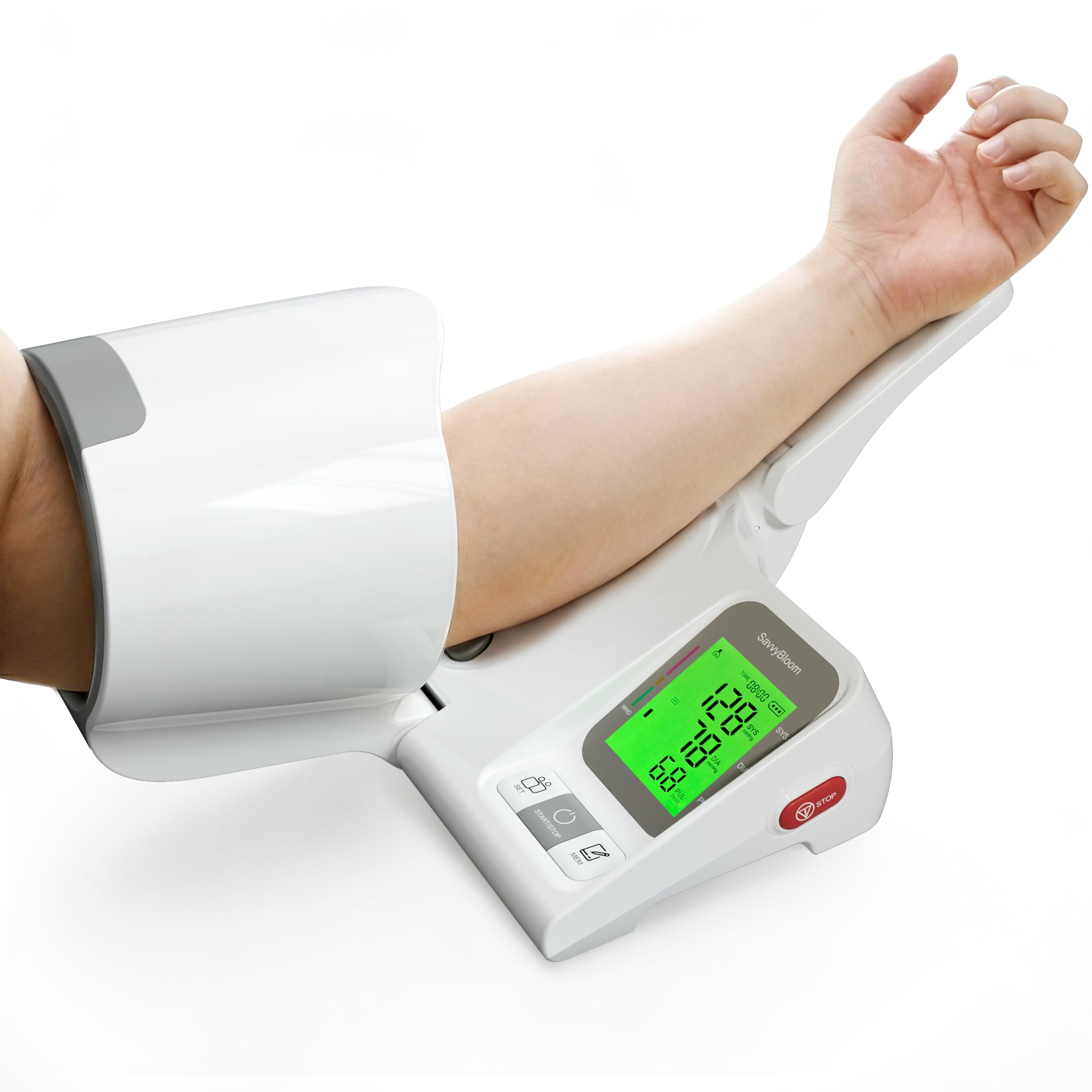
The SavvyBloom monitor uses an elbow contact switch that physically confirms correct arm depth before inflation begins — a tactile feedback mechanism that prevents the “too high” or “too low” arm position errors responsible for up to 40% of inaccurate home readings. The intelligent pressurization reaches measurement pressure in about 5 seconds, significantly faster than many competitors that take 15–20 seconds. The auto-fit barrel handles arm circumferences from 7.1 to 16.5 inches and uses a fabric-free surface that avoids the velcro degradation common over months of use.
The large LCD screen uses green, yellow, and red backlighting to indicate blood pressure category without needing to reference a chart. The two-user memory stores 99 readings per user, and an emergency stop button immediately deflates the cuff if the user experiences discomfort — a thoughtful safety feature for anxious patients. The device is FDA-certified and users have reported readings matching clinic sphygmomanometers within 1–2 mmHg after validation visits.
The unit is large at 11 x 9 x 9 inches and 5 pounds, making it a permanent home accessory rather than something you pack. Users with thin arms (under 7 inches) have reported less accurate readings as the barrel can’t contour tightly enough. The instructions note needing to hold the SET button for three seconds while the device is off to adjust time/date — a non-intuitive process that some users miss. It also lacks a wall USB plug in the box, requiring you to supply your own.
Why it’s great
- Elbow switch prevents incorrect arm positioning
- Fast 5-second pressurization cycle
- Emergency stop button for safety
Good to know
- Large footprint not travel-friendly
- May underperform on very thin arms
- No USB wall plug included
7. Graham-Field Mobile BP Monitor with Rolling Stand

The Graham-Field V223 is a professional-grade aneroid sphygmomanometer mounted on a mobile rolling stand — a completely different approach from the automated electronic monitors in this guide. The 6-inch aneroid gauge swivels 110 degrees for side-angle viewing in tight exam spaces, and its luminescent dial glows in the dark for low-light rounds. The stand adjusts in height to accommodate different patient beds or chairs, and the built-in storage basket holds extra cuff sizes for multi-patient use.
The adult large latex-free Accumax cuff connects via 8 feet of coiled tubing, providing flexibility without tangling. This is a manual device that requires a stethoscope and the clinical skill to interpret Korotkoff sounds — it is not for unsupervised home ambulatory monitoring. However, for a medical office or mobile clinic environment, the rolling stand with four smooth-glide wheels is significantly more practical than wall-mounted alternatives.
This product is a professional instrument with no Bluetooth, no app, and no data storage. For home ambulatory monitoring, you would need to manually log readings. The aneroid gauge calibration can drift over time and requires periodic professional recalibration to maintain accuracy. The gauge is also relatively small for some users — having a 6-inch face that can be difficult to read for those with less sharp vision.
Why it’s great
- Professional rolling stand with smooth-glide wheels
- 110° swivel gauge for flexible positioning
- Luminescent dial for low-light use
Good to know
- Manual operation requires stethoscope and training
- No electronic data storage or sync
- Gauge calibration can drift over time
8. Withings Scanwatch Nova Hybrid Smart Watch

While not a dedicated ambulatory blood pressure monitor, the Withings Scanwatch Nova is the most advanced wearable for continuous cardiovascular tracking in this list. It offers on-demand ECG recording, 24/7 heart rate monitoring with high/low notifications, overnight SpO2 tracking, and body temperature fluctuation detection via the TempTech24/7 module. The analog watch face with a secondary digital display provides an elegant hybrid design that looks like a traditional stainless steel watch rather than a medical device.
The 30-day battery life is exceptional for a device with continuous heart rate and SpO2 monitoring — most smartwatches in this category last 2 to 3 days. The stainless steel case and interchangeable bands make it suitable for daily wear in professional environments. The Withings app syncs data to Apple Health and Google Fit, and the watch detects over 40 activities automatically with connected GPS route tracking.
Critical limitation: this watch does not measure blood pressure. It tracks heart rate, SpO2, ECG, and temperature — but not systolic/diastolic pressure. Users expecting ambulatory blood pressure readings will need to pair it with a separate cuff-based monitor like the Withings BPM Vision. Sleep tracking accuracy has also been reported as inconsistent, sometimes misclassifying reading time as sleep, and the non-replaceable battery means the device has a limited lifespan of about 3–5 years.
Why it’s great
- 30-day battery life with continuous health tracking
- ECG + SpO2 + temperature monitoring in one device
- Premium analog design fits professional settings
Good to know
- Does NOT measure blood pressure — only heart rate/ECG
- Sleep tracking can be inaccurate
- Non-replaceable battery limits lifespan
9. Omron HEM-907XL Professional Digital BP Monitor
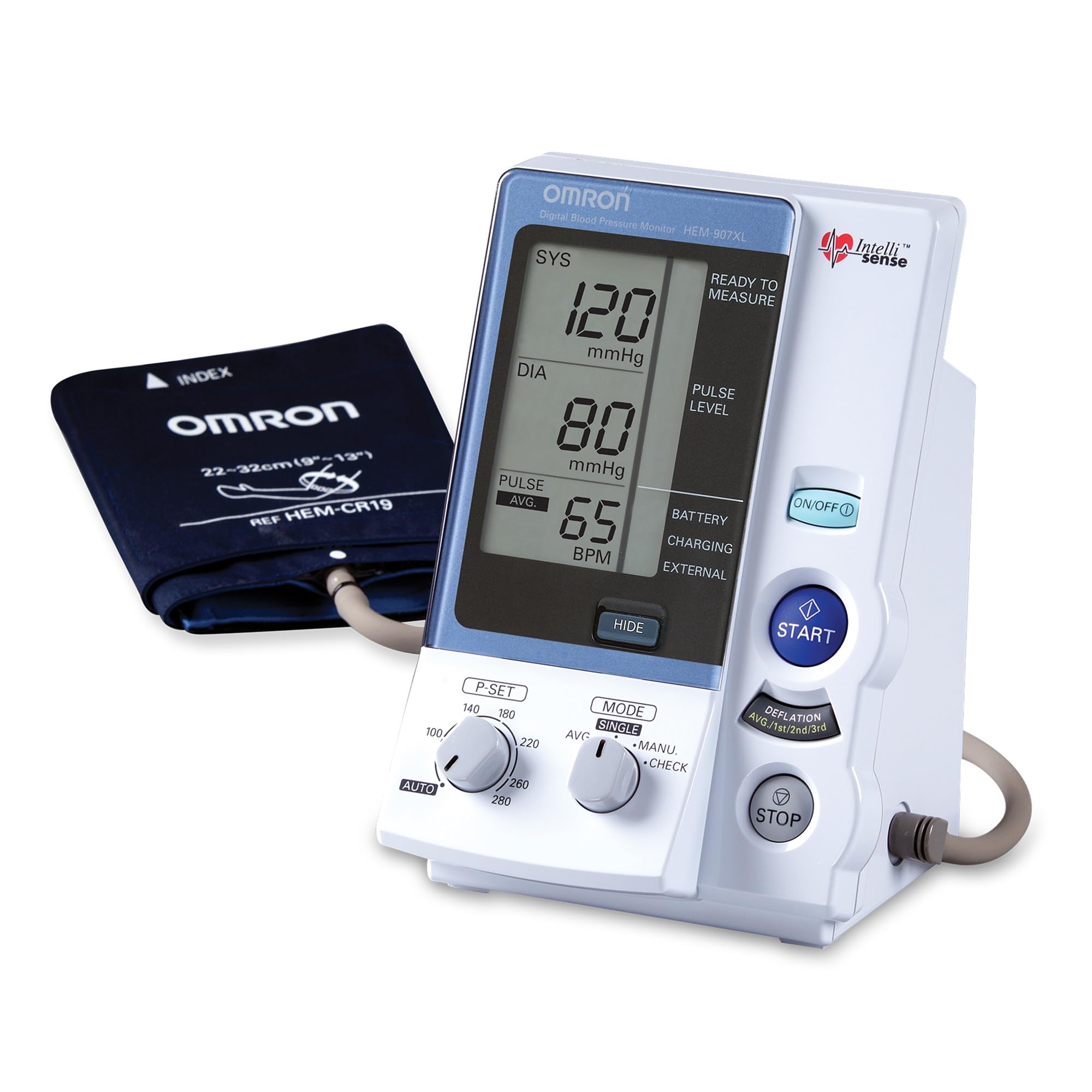
The Omron HEM-907XL is the clinical reference standard used in physician offices and hypertension research studies worldwide. It includes four cuff sizes — small (7–9 inches), medium (9–13 inches), large (13–17 inches), and extra-large (17–20 inches) — ensuring accurate readings across the widest arm circumference range in this comparison. Omron’s IntelliSense technology automatically adjusts inflation pressure to each individual, eliminating the need to preset inflation levels and reducing over-inflation discomfort.
The device offers both single-reading and averaging modes, with the latter taking up to three measurements automatically. The large backlit LCD shows systolic, diastolic, and pulse simultaneously, and the HEM-907XL can be calibrated to maintain clinical-grade accuracy — a feature no consumer home monitor offers. It also includes a talking function that announces readings aloud (note: this cannot be disabled), making it accessible for visually impaired users.
This unit is heavy and designed for desktop use — 3 pounds with dimensions of 9 x 9 x 6 inches, and it requires AC power operation (battery pack included but not practical for continuous ambulatory use). The cuff application can require two hands to position correctly, and the audible voice feature, while helpful for some, may be disruptive in quiet clinic settings. At a premium price point, the HEM-907XL is a professional investment, not a consumer convenience device.
Why it’s great
- Clinical-grade accuracy trusted by physicians globally
- Four cuff sizes cover 7–20 inch arm range
- Calibratable for maintained precision over years
Good to know
- AC-powered; not practical for ambulatory wear
- Voice function cannot be disabled
- High price targets professional buyers
FAQ
Can an ambulatory blood pressure monitor be worn during sleep?
How does the elbow pressure switch improve reading accuracy?
Final Thoughts: The Verdict
For most users, the ambulatory blood pressure monitor winner is the Withings BPM Vision because it combines clinical-grade ±3 mmHg accuracy with a large color display, Wi-Fi sync, and one-year battery life that make daily monitoring effortless. If you want an auto-fit barrel design that eliminates cuff wrapping struggles entirely, grab the CAVN Barrel-Type. And for clinical-grade accuracy trusted by physicians, nothing beats the Omron HEM-907XL.