
The smoke has barely cleared from the fields of Gettysburg and Antietam in the best reproductions of American Civil War paintings, where every brushstroke on canvas captures the grim resolve of infantry lines and the stoic gaze of commanders. The challenge for collectors and history enthusiasts is not finding art, but separating the historically accurate, museum-quality prints from the mass-produced posters that wash out details and warp the true color of a Union blue or Confederate gray.
I’m Min — the co-founder and writer behind Gadgets Feed. I’ve spent countless hours analyzing archival paper quality, giclée reproduction techniques, canvas weave density, and the licensing legitimacy of artworks from the Library of Congress to private collections so you don’t end up with a print that looks more like a watercolor than an oil-on-canvas reproduction.
This guide breaks down the seven essential factors that define the best american civil war paintings for your home, study, or library, from the thickness of a stretcher bar to the ink fade-resistance rating of a historical map.
How To Choose The Best American Civil War Paintings
Selecting a historical war print for your wall is not the same as picking a generic landscape. The reproduction medium, the archival quality of the substrate, the frame construction, and the licensing source all determine whether you get a piece that looks authentic at five feet or from across the room.
Reproduction Method: Giclée vs. Digital Print
The giclée process uses pigment-based inks sprayed at microscopic dots onto fine-art paper or canvas, producing the continuous-tone gradations that mimic the original oil painting’s brushwork. Standard inkjet prints on glossy poster paper lose shadow detail in the dark folds of a Union coat and produce visible banding in the sky. Always check whether the listing specifies “giclee” or “museum-grade inks” — if it does not, assume it is a basic wall poster that will fade in direct sunlight within two years.
Canvas Construction and Stretcher Depth
A wrapped canvas should use a minimum 1.5-inch solid wood stretcher bar — thinner bars warp under tension and cause the canvas to ripple, creating an uneven surface that reflects light poorly. The canvas weave itself should be medium-to-fine textured polycotton or artist-grade cotton; a coarse weave blurs facial details in portrait paintings like those of Mort Künstler or G.P.A. Healy, while an ultra-smooth finish looks like a photograph printed on vinyl.
Historical Source and Licensing
The most authoritative Civil War artworks come from images held by the Library of Congress, the Smithsonian Institution, or the National Park Service. Reproductions that originate from a digital restoration of these holdings preserve the correct color palette of period uniforms, the accurate topography of battle maps, and the proper rendering of camp scenes. Artwork from unverified sources often misattributes regiments or uses an anachronistic flag pattern — a deal-breaker for serious collectors.
Paper Stock and Framing Compatibility
Flat prints should be printed on at least 200 gsm matte paper with a 0.2-inch white border to allow standard frame fitting without cropping the signature or border detail. Maps, in particular, benefit from a matte finish that eliminates glare under track lighting, as the fine topographical lines of a Gettysburg battle map become unreadable behind glossy glass. Avoid any print smaller than 12 x 18 inches for wall display — the historical narrative loses its visual weight when shrunken to letter size.
Quick Comparison
On smaller screens, swipe sideways to see the full table.
| Model | Category | Best For | Key Spec | Amazon |
|---|---|---|---|---|
| DECORARTS The Peacemakers | Premium Canvas | Executive Office Display | 1.5″ solid wood frame, 36×24 inch | Amazon |
| DK The Civil War: A Visual History | Premium Book | Comprehensive Reference | 360 pages, 10.3 x 12.1 inches | Amazon |
| National Geographic Atlas of the Civil War | Premium Book | Battle Map Analysis | 256 pages, 13.9 x 10.6 inches | Amazon |
| Mort Künstler Vol. 4: Gettysburg to Appomattox | Mid-Range Book | Art Lover’s Collection | 240 pages, 8 x 8 inches | Amazon |
| CANVAS ON DEMAND Battle of Antietam | Mid-Range Canvas | Ready-to-Hang Wall Art | 18 x 12 inch, wrapped canvas | Amazon |
| HISTORIX Battle of Gettysburg Map | Mid-Range Print | Vintage Map Framing | 18 x 24 inch, archival matte paper | Amazon |
| Lentics Civil Rights Pioneers | Budget Framed Print | Decorative Wall Statement | 24 x 36 inch, textured poster | Amazon |
In‑Depth Reviews
1. DECORARTS The Peacemakers by G.P.A. Healy

This hand-stretched 36×24 inch canvas reproduction of G.P.A. Healy’s iconic White House Treaty Room painting captures Lincoln, Grant, Sherman, and Porter in a quiet moment of deliberation, and the archival polycotton canvas with a 1.5-inch solid wood frame gives it the structural heft of a real oil-on-canvas piece. Buyers consistently report that the texture fools visitors into thinking it is an original painting, not a print.
The premium archival inks resist fading and yellowing for decades, so the deep blacks of Lincoln’s suit and the warm tones of the fireplace light remain stable even on a sunlit office wall. The hand-stapling by American artisans ensures the canvas tension is uniform across the entire surface — no ripples, no sagging corners.
Some units have arrived with minor shipping damage due to inadequate internal padding, though the seller is responsive with replacements. At this price point, however, the combination of historical significance, build quality, and visual impact is unmatched among American Civil War paintings available for retail.
Why it’s great
- Museum-grade archival inks resist fading for decades
- Hand-stretched on a thick 1.5-inch solid wood frame — no warping
- Canvas texture mimics the original oil painting’s brushwork up close
Good to know
- Shipping packaging could be better — some units arrive with corner dents
- Premium price reflects the handmade USA assembly, not a mass-produced print
2. DK The Civil War: A Visual History

This 360-page Smithsonian-published volume from DK’s Definitive Visual Histories series is less a traditional book and more a massive 12 x 10 inch reference that uses high-resolution photography and period artwork to illustrate every major campaign, figure, and civilian experience of the war. The oversized format means that battlefield maps span across full spreads, and the reproductions of paintings and daguerreotypes are large enough to examine stitching on a uniform collar.
The breadth is extraordinary — the book covers causes, battles, political shifts, social changes, and the war’s aftermath, with timelines that connect events that standalone history books often isolate. Readers who use this alongside Shelby Foote’s narrative find that the visual context clarifies troop movements and terrain advantages that text alone cannot convey.
The weight of 4.4 pounds makes it impractical as a casual read-in-bed book; it is really a desk or coffee-table monograph. But for anyone wanting a single authoritative volume that combines the best American Civil War paintings with battlefield photography and cartography, this is it.
Why it’s great
- Massive 12 x 10 inch format lets artwork and maps breathe across full spreads
- Smithsonian provenance guarantees historical accuracy in every image
- Covers social and political context, not just battles — a complete narrative
Good to know
- Too heavy for comfortable field use or travel reading
- Some users report that spine can split under heavy use due to page count
3. National Geographic Atlas of the Civil War

National Geographic’s reputation for cartographic excellence is fully on display here — this 256-page atlas uses original full-color maps that trace troop movements, terrain elevations, and supply lines with the precision of a modern GIS system. The oversized 13.9 x 10.6 inch format means that the Battle of Gettysburg maps occupy a full spread, with contour lines and unit positions rendered at a scale that makes tactical analysis possible without a magnifying glass.
The accompanying text provides enough narrative context to understand why specific river crossings and ridge lines became decisive, and the chronological organization lets you follow the war from Sumter to Appomattox in a way that geography-first learners will appreciate. The photos are excellent, but the maps are the star — they are the same class of cartography you expect from a National Geographic world map, applied to Civil War terrain.
At 4.3 pounds, this is another desktop-only volume, and early printings had some binding consistency issues. But for a student of tactics or a battlefield tour planner, the detail density of the maps is unmatched by any other book in this category.
Why it’s great
- National Geographic full-color maps with elevation contours and unit positions
- Large page size allows detailed battlefield analysis without magnification
- Chronological flow makes it ideal for planning battlefield tours
Good to know
- Contains some disturbing images of casualties — not for unsupervised children
- Large format makes it awkward for shelf storage; needs a coffee table spot
4. Mort Künstler Vol. 4: Gettysburg to Appomattox
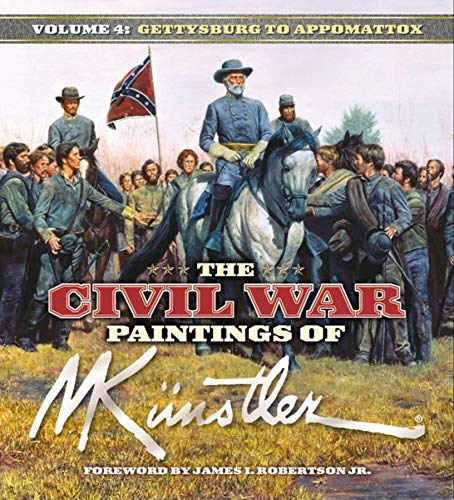
Mort Künstler is widely regarded as the dean of Civil War painting, and this fourth volume of his collected works focuses on the critical final campaigns from Gettysburg through the surrender at Appomattox. The 8 x 8 inch compact trim size makes it a lap-friendly read, and the full-page reproductions include detailed close-up crops that reveal Künstler’s signature attention to facial expressions, uniform accuracy, and period-authentic camp equipment.
The accompanying text by Künstler himself provides background on the historical moment each painting depicts, explaining which specific regiment is shown, what time of day the scene represents, and what primary sources inspired the composition. Buyers who own all four volumes report that this is the strongest entry, covering Künstler’s mature period when his oil technique reached its peak detail.
The small size is a double-edged sword — the paintings are cropped to fit, so panoramic compositions lose some of their horizontal impact. But for portability and text-to-image ratio, no other Civil War art book packs this much education per page.
Why it’s great
- Künstler’s own commentary adds historical context for each painting
- Compact size makes it easy to handle and store on any bookshelf
- Close-up details reveal brushwork and uniform accuracy not visible in larger prints
Good to know
- Limited to Eastern Theater campaigns — no Trans-Mississippi or naval scenes
- Small trim size means panoramic battle compositions lose scale impact
5. CANVAS ON DEMAND Battle of Antietam by Vernon Lewis

Vernon Lewis’s painting of the clash at Antietam captures the chaotic intensity of the Cornfield and Bloody Lane, and this 18 x 12 inch wrapped canvas from CANVAS ON DEMAND brings it to your wall fully assembled with pre-installed hanging hardware. The giclée print on artist-grade canvas reproduces the smoke, dust, and Union blue with a matte finish that eliminates glare, making it suitable for a hallway with mixed lighting.
The frame is a 1.25-inch wrapped canvas construction — slightly thinner than the premium DECORARTS piece but adequate for this size, and the hand-stapling keeps the canvas taut. Buyers consistently note that the print exceeds expectations compared to the online preview, with richer shadow detail in the foreground trees and more definition in the regimental flags.
At this moderate investment, the trade-off is the unframed wrapped canvas style — there is no float frame or outer molding, so the canvas edges are exposed. If your decor requires a traditional framed look, you will need to add a frame yourself, but for a simple, immediate hang, this is the most accessible entry point into genuine American Civil War paintings for wall display.
Why it’s great
- Arrives fully assembled with hanging hardware — no framing needed
- Giclée print quality preserves shadow detail and flag colors
- Matte finish eliminates glare under direct lighting
Good to know
- Exposed canvas edges may not suit formal decor without an additional frame
- 1.25-inch stretcher bar is adequate but not as robust as premium 1.5-inch bars
6. HISTORIX 1863 Battle of Gettysburg Map
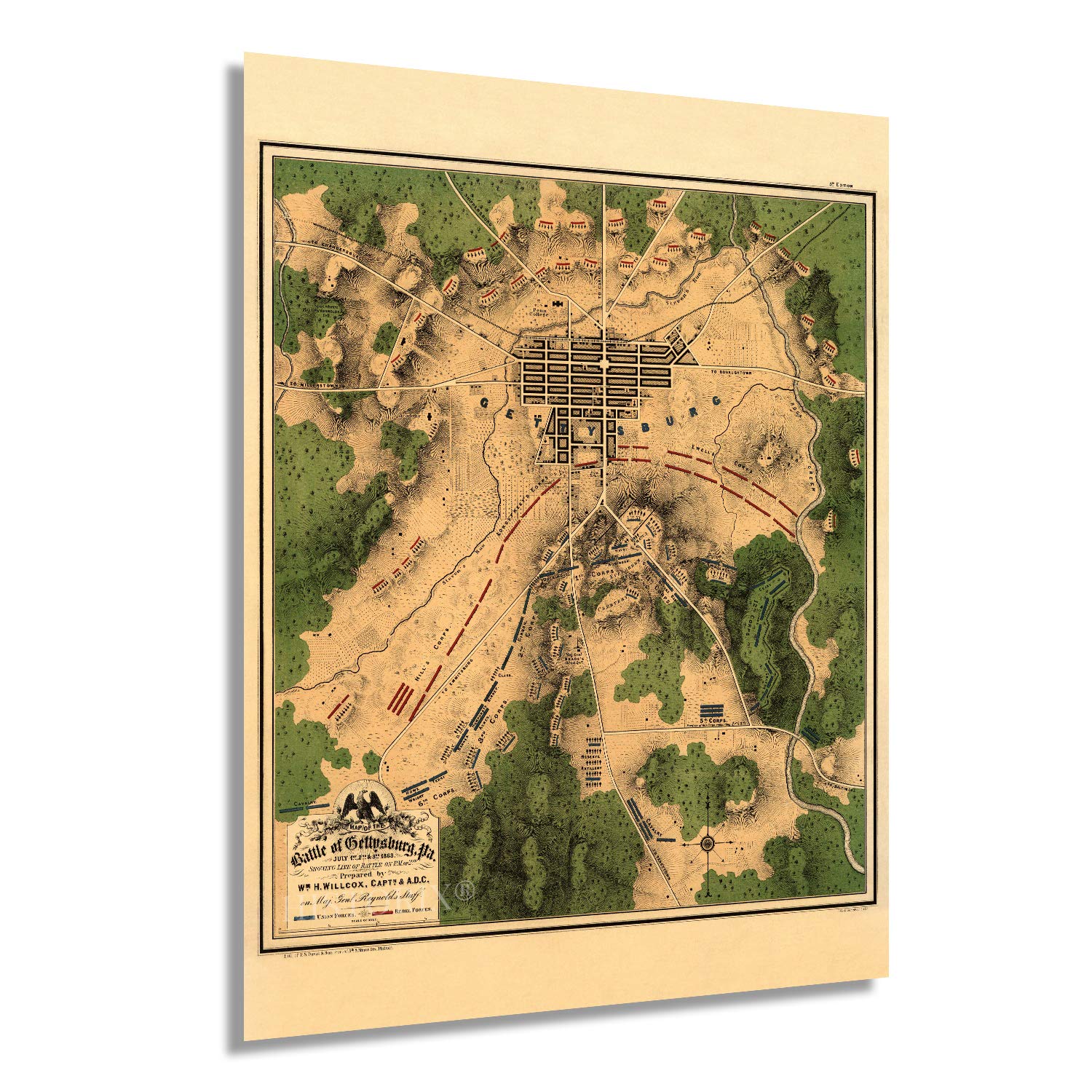
HISTORIX has digitally restored an original 1863 map of the Battle of Gettysburg from the Library of Congress, reproducing it on thick, fine-art matte paper at 18 x 24 inches with a 0.2-inch border for standard framing. The map shows the lines of battle on July 2nd, including the positions of Longstreet’s assault and the Union defenses on Cemetery Ridge, with period typography and topographical features that have been cleaned of folds and tears while retaining the vintage character.
The archival-grade paper and inks are rated for over 100 years of fade resistance — this is not a poster that will yellow in the sun. The matte finish means you can light it with track lighting or a desk lamp and still read the fine print of regimental designations at the edges.
The only catch is that the map is print-to-order, so returns are handled on a case-by-case basis, and some international buyers reported minor packaging damage. But the quality of the restoration and the paper stock makes this the best vintage Civil War map reproduction available at this level.
Why it’s great
- Library of Congress source map — authentic to the original 1863 cartography
- Thick matte paper stock eliminates glare on fine topographical lines
- Archival inks rated for fade resistance exceeding 100 years
Good to know
- Print-to-order means no free returns for preference — inspect carefully on arrival
- Shipped in a tube — buyer must supply own frame and mounting
7. Lentics Civil Rights Pioneers Framed Print
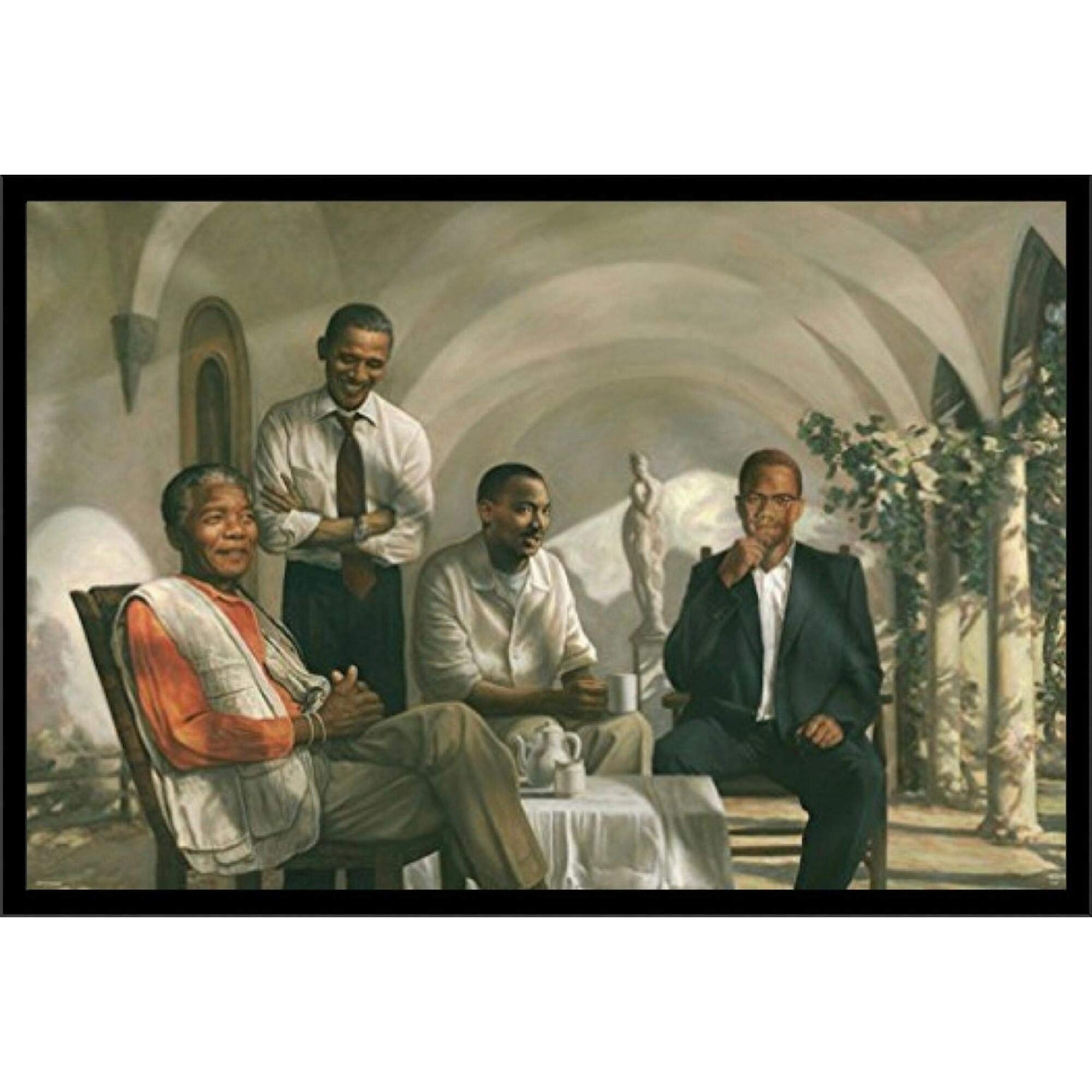
This 24 x 36 inch framed print presents a composite of Civil Rights leaders including Martin Luther King Jr., Malcolm X, Nelson Mandela, and Barack Obama in a stylized, textured poster format that gives the flat print a canvas-like surface. The textured finish is a polycotton lamination over the print substrate, creating a slight brushstroke feel under your fingers that mimics an art print at a fraction of the cost of a real canvas wrap.
The frame is a simple black wood molding that integrates smoothly with most wall decors, and the piece arrives in a custom foam insert box that protects the corners and glass. Buyers consistently praise the visual impact at this large size — the 24×36 inch presence commands a wall in a way that smaller Civil War prints cannot match.
The trade-off is that this is a decorative print, not a historical reproduction. The image style is more modern collage than period-accurate painting, and the biographical scope extends beyond the Civil War era into the 20th century. For a pure American Civil War paintings collector, this may be too broad, but for a wall piece that connects the war’s legacy to the broader fight for rights, it is a powerful visual statement.
Why it’s great
- Large 24×36 inch size provides major wall presence without custom framing
- Textured finish gives the flat print a painted-canvas feel
- Custom foam packaging protects frame and glass during shipping
Good to know
- Covers 20th-century civil rights figures — not purely a Civil War period painting
- Print quality is decorative-grade, not archival museum-grade
FAQ
What is the difference between a giclée print and a standard poster for Civil War art?
How can I verify that a Civil War map or painting is historically accurate before buying?
What size print is appropriate for a standard home study or office wall?
Can I put a wrapped canvas directly in a frame, or does it need to hang as-is?
Final Thoughts: The Verdict
For most users, the best american civil war paintings winner is the DECORARTS The Peacemakers because it combines a historically significant painting with a hand-stretched, museum-grade canvas build that genuinely fools the eye into believing it is an original oil. If you want a comprehensive reference that pairs paintings with battlefield photography and cartography, grab the DK The Civil War: A Visual History. And for a map-focused collector who values terrain analysis over portrait art, nothing beats the National Geographic Atlas of the Civil War.