
Our readers keep the lights on and my morning glass full of iced black tea. As an Amazon Associate, I earn from qualifying purchases.
Specs are compiled from manufacturer listings and verified buyer reviews and can change over time — please confirm the key details on the product page before buying.
An American-made axe is a tool you hand down, not toss out. The real difference depends on whether the steel holds an edge after fifty swings and whether the handle stays tight in the eye after a season of wet work. Most imported axes chip or loosen within months, so finding one forged in the US with domestic steel and a properly hung handle is the only way to get a tool that actually outlasts you.
I’m Min — the founder and writer behind Gadgets Feed. This guide is built by comparing the manufacturers’ published specifications and the patterns across verified customer reviews, so you get each pick’s real strengths and trade-offs instead of marketing spin.
if you need a camp axe for splitting kindling (thin, dry sticks to start a fire), a throwing hatchet for the range, or a bushcraft carver for fine woodwork, you will find the right american made axe for your work here, backed by real specs and buyer experiences.
Our Picks at a Glance

How To Choose The Best American Made Axe
Picking the right US-made axe depends on matching the steel, handle, and head shape to the job. Here are the three specs that matter most.
Steel Type & Heat Treatment
The steel determines how long the edge stays sharp and how hard it is to resharpen. Forged 4140 and 5160 alloy steels are common in premium American axes because they resist chipping and hold a working edge longer than budget carbon steels. A hand-sharpened bit from the factory usually means better geometry than a machine-ground edge.
Handle Material & Hang Quality
A loose handle makes an axe dangerous. US-made axes typically use American hickory dried below 10% moisture to prevent shrinkage, secured with a double wedge system (wood and steel wedges driven into the eye). One-piece forged steel handles, like Estwing’s full-tang construction (where the steel runs the entire length of the handle), eliminate the risk of the head flying off entirely but transfer more vibration to your hand without a shock-reducing grip.
Head Weight & Blade Length
Heavier heads (2 lbs and up) drive deeper into logs for splitting but tire your arm faster for carving. Lighter heads around 1.5 lbs are better for one-handed bushcraft and throwing. A longer blade (4 inches) gives you more edge contact for smooth cuts, while a shorter blade (2 inches) concentrates force for precision strikes.
Quick Comparison
| Model | Best For | Head Weight | Blade Length | Handle Material | Amazon |
|---|---|---|---|---|---|
| ESTWING Camper’s Axe★ Best Overall | All-steel durability | 3.5 Pounds | 4 Inches | Alloy Steel | Amazon |
| COUNCIL TOOL Wood-Craft Camp CarverAlso Great | Bushcraft & carving | 26 oz | 4 Inches | Hickory Wood | Amazon |
| ESTWING Hunter’s Axe | Backpacking & gut hook | 1.7 Pounds | — | Nylon, Steel | Amazon |
| COUNCIL TOOL Flying Fox Woodsman Hatchet | Throwing & camp use | 1.625 lbs | — | Hickory Wood | Amazon |
| BLADED Throwing Hatchet | Competition throwing | 0.5 Pounds | 3.75 Inches | Fire-Hardened Hickory | Amazon |
In‑Depth Reviews
1. ESTWING Camper’s Axe
Our pick — over 4.5★ from 6,000+ verified ratings; the strongest balance of quality and price.
The one-piece forged steel design means no handle to loosen or rot — built for hard, repetitive splitting without breaking.
If you split firewood every weekend, the Estwing Camper’s Axe is the most durable option here. The head and handle are forged from one solid piece of American steel — no welds, no handles that can rot or loosen. At 3.5 pounds versus the Hunter’s Axe’s 1.7 lbs, it carries real momentum into a log.
The patented Shock Reduction Grip is the key feature: The patented Shock Reduction Grip cuts impact vibration by 70%., so your hands and elbows feel less fatigue after an hour of swinging. The 4-inch blade is hand-sharpened and protected by a ballistic nylon sheath with a belt loop. With over 6,400 ratings averaging 4.7 stars, buyers consistently praise the build quality and lack of handle wobble even after years of use.
One trade-off: the full-steel construction makes this 26-inch-long axe heavier than any wooden-handled option here. That is a plus for splitting but a downside if you are carrying it miles into the backcountry.
Shop smart: Perfect for car camping, homestead splitting, and anyone who hates replacing loose wooden handles.
Reality check: At 3.5 lbs, this is a heavy tool — not ideal for ultralight backpacking or one-handed carving work.
Best for: campers and landowners who split firewood frequently and want a nearly indestructible tool.
skip it if: you need a lightweight hatchet for pack trips — the Estwing Hunter’s Axe (1.7 lbs) is much more portable.
2. COUNCIL TOOL Wood-Craft Camp Carver Axe
The bearded 4-inch blade and hardened poll make this the one tool for carving, splitting, and hammering — without switching axes.
This is the axe for fine woodwork and serious camp chores alike. The bearded blade offers a 4-inch cutting edge — at 4 inches versus the Hudson Bay Camp Axe’s 2-inch blade — so you get more control for carving spoons, handles, and tinder. The flat-grind bevels at 25-28° keep the cut precise without needing constant re-sharpening.
Forged from 5160 steel, the head is built for impact but the hardened poll (the flat back of the axe head) also works as a hammer for driving tent pegs — the 90-degree spine can scrape tinder or strike a ferro rod (a metal rod that sparks when scraped, used for fire-starting). The “A” grade American hickory handle is hung proud with both a wood and steel wedge, so buyers report the head stays tight even after a full season of wet camp use.
At 3.24 pounds overall, it is heavier than the BLADED throwing hatchet (1.7 lbs), but that weight translates to serious splitting power when you need it. The included welted leather sheath protects the edge during pack carry.
Carver’s choice: Best pick for bushcrafters and carvers who need one tool for both fine wood shaping and heavy camp splitting.
Not for: You if you want a lightweight thrower or a backpacking hatchet under 2 pounds — the Camp Carver is a dedicated workhorse, not a pack-it-and-forget-it companion.
Reach for it if: you are a carver, bushcrafter, or camper who values precision cutting and hammer utility in one head.
Look elsewhere if: a smaller, lighter hatchet for a day pack is your priority — the 16-inch handle and 3.24-lb heft add bulk.
3. ESTWING Hunter’s Axe

The forged-steel hatchet with a gut hook that fits in a backpack without weighing you down — and it measures 14.25 inches versus the Camper’s Axe’s 26 inches.
This is the lightest Estwing option here at 1.7 pounds and just 14.25 inches long — noticeably more compact than the Camper’s Axe at 26 inches (an 82% size difference). The one-piece forged American steel construction means no handle to rot, and the Shock Reduction Grip still cuts vibration by 70%. despite the smaller size, according to the brand.
The unique feature is the integrated gut hook on the back of the blade, designed for field dressing game (opening the belly of an animal to remove organs). The orange hi-vis nylon-steel handle makes it easy to spot in a pack or on the ground. Buyers averaging 4.5 stars across 78 reviews mention the edge stays sharp for processing small branches and kindling.
One downside: at only 1.7 lbs, it has less momentum for splitting larger logs compared to the Camper’s Axe (3.5 lbs). It is a backpacking hatchet, not a splitter.
Pack-friendly: Ideal for hunters and backpackers who need a compact hatchet with a gut hook for game prep.
Limitation: Not for heavy splitting — the light head and short handle limit swing force.
Best for: hunters and ultralight campers who need a small, packable hatchet for processing small wood and game.
Not for: anyone who needs to split large firewood — upgrade to the Camper’s Axe for real splitting power.
4. COUNCIL TOOL Flying Fox Woodsman Hatchet
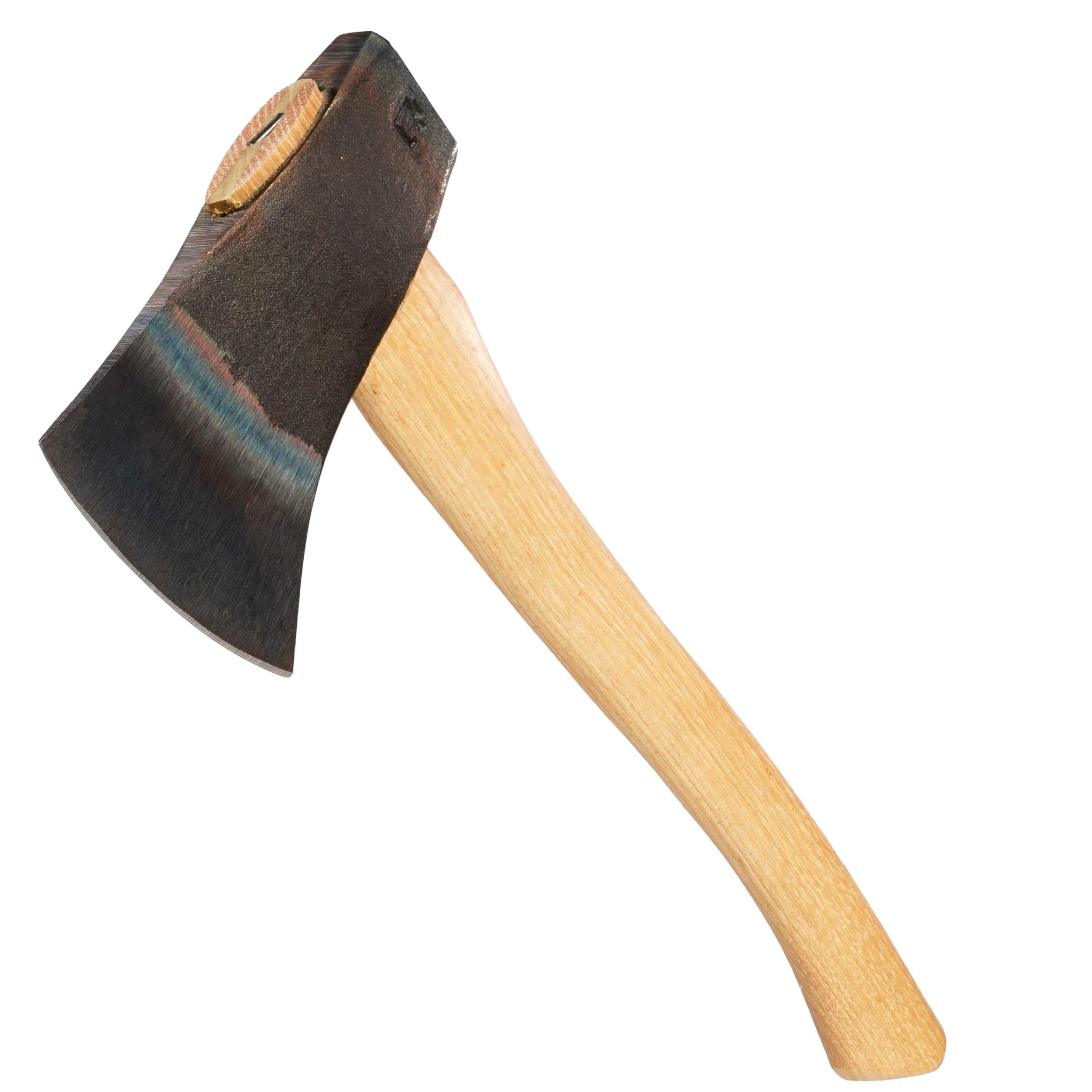
At 1.625 lbs with a 16-inch hickory handle, this hatchet is built to split kindling on Saturday and stick targets on Sunday.
At 1.625 lbs with a 16-inch hickory handle, the Flying Fox is tuned for dual duty: camp chores and competition axe throwing. The handle uses a large hatchet eye for secure hang, and the hardened poll survives the repeated impact of throwing against a target. Council Tool blends vintage design with modern heat-treating, so the forged steel head holds up to both chopping and range work.
With 214 ratings averaging 4.6 stars, buyers praise the balance and how it “sticks” consistently. The included sheath protects the edge when stored. Compared to the BLADED throwing hatchet (0.5-lb head), this has more mass for cutting wood but still throws well.
The 15.75-inch length makes it longer than the Hunter’s Axe (14.25 inches) but shorter than the Camp Carver (16 inches). It is a solid all-rounder for someone who splits wood at camp and goes to the throwing range on weekends.
Dual use: A true hybrid hatchet for woodsmen who also throw — rare to find both needs met in one tool.
Consideration: Heads up — the throwing focus means the edge geometry is not tune for fine carving like the Camp Carver.
The one to buy if: you want one hatchet that splits kindling on Saturday and hits targets on Sunday.
pass on it if: you only carve or only throw — a specialized axe does each job better.
5. BLADED Throwing Hatchet
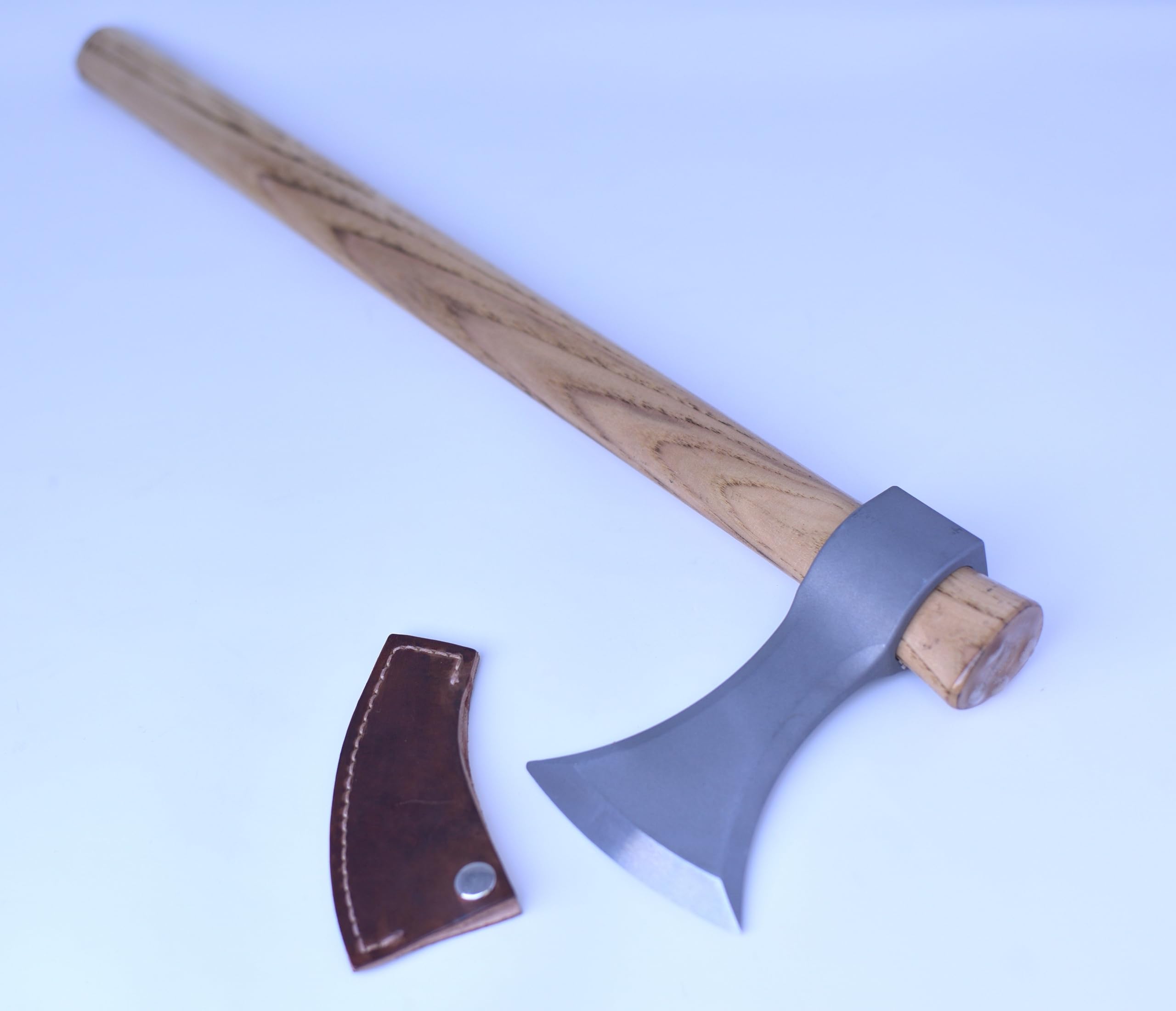
At 0.5 lbs versus the Flying Fox’s 1.625-lb head, the head is lighter — built for sticking targets, not splitting logs.
If your priority is axe throwing at a range or in the backyard, this is your pick. The head is forged from 4140 steel and weighs just 0.5 pounds — versus the Flying Fox’s 1.625-lb head. The pre-installed, hand-sharpened edge and fire-hardened hickory handle mean zero assembly or tuning needed. Owners mention the friction-fit stays tight even after a full season of competition throws.
The 3.75-inch curved blade and 19-inch overall length give a balanced feel that throwers say “friends beg to use.” The leather sheath fits the head for safe pack carry. One reviewer noted the handle is sanded and lacquered to prevent blisters and slips — a detail that matters after fifty consecutive throws.
At 1.7 pounds total weight, it matches the Hunter’s Axe but with a longer handle and a dedicated throwing profile. It can chop kindling in a pinch, but the thin edge and light head are not made for heavy splitting.
Throw-first tool: Built for competition throwing with a secondary camp use — the opposite of the Flying Fox’s 50/50 split.
Heads up: Chopping thick logs will be slow — the 0.5-lb head lacks momentum for heavy splitting.
Choose this for: pure throwing performance — competition-ready from the start with no tuning or assembly.
Pass if: you need a work axe that splits camp wood — the Flying Fox or Camp Carver will serve you much better.
Understanding the Specs
Steel Type (4140 vs 5160 vs Forged Tool Steel)
The steel alloy determines how the edge resists chipping and holds sharpness. 4140 is a chromium-molybdenum alloy (adds toughness) common in throwing axes; it is tough but not as hard as 5160, which has more carbon and is preferred for carving and bushcraft because it takes a finer edge. Forged tool steel is the broadest category — check that it is domestically sourced and heat-treated properly.
Head Weight & Handle Length
Head weight directly affects how deep the axe bites per swing. A 2-lb head is a good all-purpose weight for camp work; a 0.5-lb head is for throwing where quick recovery matters. Handle length determines leverage and control — 16-18 inches is typical for one-handed bushcraft, while 26 inches gives two-handed splitting power.
FAQ
What steel is best for an American-made axe?
How long does an American hickory handle last?
Can a throwing axe also split firewood?
What is the difference between a hatchet and an axe?
Are all American-made axes forged from one piece of steel?
How do I know if an axe handle is hung properly?
What does “hardened poll” mean on an axe?
Can I use a leather sheath for storage?
Final Thoughts: The Verdict
For most buyers, the american made axe winner is the Council Tool Wood-Craft Camp Carver because the 5160 forged steel, bearded 4-inch blade, and hardened poll give you a true multi-tool for carving, splitting, and hammering. If you want all-steel durability with zero risk of a loose handle, grab the Estwing Camper’s Axe. And for a competition-ready thrower that arrives ready to use, the BLADED Throwing Hatchet is the one that sticks.
How We Picked
We do not accept paid placement. Every pick is matched to a real buyer and a real use-case; we do not hands-on test units.
Sources & Methodology
Specifications: manufacturer listings and product documentation. Review insights: verified customer reviews, as of July 2026. Pricing: not shown on this page (it changes often); check the current price via the retailer link.
As an Amazon Associate, Gadgets Feed earns from qualifying purchases. This does not affect which products we feature.