
Our readers keep the lights on and my morning glass full of iced black tea. As an Amazon Associate, I earn from qualifying purchases.
Specs are compiled from manufacturer listings and verified buyer reviews and can change over time — please confirm the key details on the product page before buying.
Buying an American made chef knife is mostly about two things you can actually feel in your hand: how the blade holds its edge and whether the steel was forged here at home. This guide shows you which knives genuinely earn their place on the cutting board, from budget-friendly workhorses to premium handcrafted blades.
I’m Min — the founder and writer behind Gadgets Feed. This guide is built by comparing the manufacturers’ published specifications and the patterns across verified customer reviews, so you get each pick’s real strengths and trade-offs instead of marketing spin.
Every knife here is positively confirmed as made in the USA, so you are not gambling on a vague “assembled domestically” label. This breakdown covers the best American Made Chef Knives with real steel grades, blade lengths, and honest trade-offs.
Our Picks at a Glance

How To Choose The Best American Made Chef Knives
Most American made chef knives fall into two construction camps: stamped and forged. Stamped blades are cut from a sheet of steel and then ground to shape, which keeps them lighter and often more affordable. Forged blades are shaped from a single heated bar of steel, giving them a denser feel and a full tang — the metal strip that runs all the way through the handle for added balance and strength.
Blade steel grades explained
The steel in your blade determines how long it stays sharp between sharpenings. High-carbon stainless steels like 440A and 420HC balance edge retention with corrosion resistance, making them forgiving for home cooks who do not want to baby their knife. Steels like AEB-L and S35VN are powdered or high-performance alloys that hold an edge longer but often cost more. Match the steel grade to how often you cook and how willing you are to hone.
Rockwell hardness and what it means for you
Rockwell hardness (often written as HRC) is a scale that measures how hard the steel is. A knife tempered to 58 on the Rockwell scale resists rolling and dulling better than a softer blade, so it stays sharp through long chopping sessions. But it can also be more brittle if you twist it sideways, so avoid prying. For everyday kitchen work, a hardness in the high 50s is the practical balance — hard enough to hold an edge, tough enough to handle a butternut squash without chipping.
Handle material and grip
Handle material affects comfort as much as blade steel affects sharpness. Dymalux (dyed birch veneers pressed into a dense block) and G-10 (a layered fiberglass composite) resist moisture and stay grippy when your hands are wet or greasy. Traditional Rosewood and Pakkawood look warmer but need hand washing. If you want a knife you can toss in the dishwasher, look for a synthetic handle rated dishwasher safe.
Quick Comparison
| Model | Best For | Blade Length | Steel Type | Construction | Amazon |
|---|---|---|---|---|---|
| Cutco Model 1766 Santoku★ Best Overall | Carving and slicing with ease | 7 inches | 440A High-Carbon Stainless | Forged, full tang | Amazon |
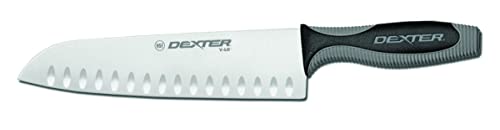
| Dexter-Russell 9″ Duo-Edge SantokuBest Value | High-volume produce prep | 9 inches | DEXSTEEL High-Carbon Stainless | Stamped | Amazon |
| Lamson Vintage 8 In Chef’s Knife | All-around everyday chopping | 8 inches | 420HC-LAM High-Carbon Stainless | Stamped, full tang | Amazon |
| Buck Knives 931 Chef’s Knife | Meat prep and carving | 8 inches | 420HC Stainless Steel | Stamped, full tang | Amazon |
| Lamson 8″ Premier Forged Chef’s Knife | Precision work with style | 8 inches | 4116 Stainless from Solingen | Forged, full tang | Amazon |
| Middleton Made Echo 8 Inch | Handcrafted artisan appeal | 8 inches | AEB-L Stainless Steel | Forged | Amazon |
| Dalstrong 8″ Spartan Ghost S35VN | Edge retention for serious cooks | 8 inches | S35VN Powdered Steel | Forged, full tang | Amazon |
In‑Depth Reviews
1. Cutco Cutlery Model 1766 Santoku Knife
Our pick — over 4.5★ from 300+ verified ratings; the strongest balance of quality and price.
The seven-inch santoku that turns carving a holiday roast into a one-hand job.
The Cutco Model 1766 is a forged santoku with a full tang running through the handle — that metal spine gives it a solid, balanced feel you notice the second you pick it up. The blade itself is 440A high-carbon stainless steel, a grade that resists rust while holding a working edge well. At 7 inches, it is shorter than the Dexter-Russell 9″ below, which makes it more nimble for detail work on a crowded board. The 5.6-inch classic brown handle is triple-riveted with nickel-silver alloy rivets, so it will not loosen or wobble over time.
What wins people over is the sharpness — the kind that slices through a ripe tomato without so much as a skin drag. Owners routinely mention they reach for it over knives that cost more. One home cook recovering from cancer surgery said the knife’s edge made carving a turkey or ham easy despite the weakness from treatment. Another owner who has cooked for nearly seventy years called it the best knife they have ever used. The CUTCO Forever Guarantee backs it with free repair and replacement for life, plus mail-in sharpening when the edge finally needs attention after years of use.
The honest catch is weight distribution: at 8 ounces, it carries more heft than the 7.2-ounce Dexter-Russell and the 5.9-ounce Middleton Echo, so cooks with smaller hands may find it a touch heavy during long prep sessions. The value equation is also split — some owners feel the price is steep for a single knife, while others point to the free lifetime service and call it a fair trade. The 7-inch blade length also means it is not the tool for breaking down a massive watermelon or a whole rib roast the way a 9-inch blade handles them.
What Earns Its Keep
- 440A high-carbon stainless steel slices with speed and ease
- Full tang and triple rivets for a rock-solid handle
- Forever Guarantee covers free repair and replacement
- 7-inch blade is nimble on a crowded board
Where It Gives Ground
- Heavier feel than lighter santokus in this list
- Value for money divides owners — some find it steep
- Shorter blade than the 9-inch Dexter-Russell for big jobs
Pick it for: A forged, lifetime-guaranteed santoku that flattens carving day and general chopping.
Reconsider if: You want a lighter knife for long sessions or a longer blade for bulk produce.
2. Dexter-Russell 9″ Duo-Edge Santoku Chef’s Knife
A pro-kitchen nine-incher built to eat hundreds of pounds of potatoes without complaint.
Dexter-Russell has been grinding blades in America for over two hundred years, and that heritage shows in the Duo-Edge Santoku. The 9-inch blade dwarfs the Cutco’s 7-inch length — that longer edge gives you more slicing real estate for big jobs like breaking down melons or romaine. It is also noticeably thinner and lighter in hand, which means you are not fighting the blade through a pile of hard root vegetables. The hollow ground edge reduces drag, so food slides off cleanly instead of clinging to the steel.
What makes this knife stand out is its workplace DNA. The V-Lo handle is soft to the touch and ergonomically shaped to cut hand fatigue during long shifts. NSF certification means the impervious seal between blade and handle meets commercial sanitation standards, so there is no gap for bacteria to hide in. The proprietary DEXSTEEL high-carbon stainless steel holds an edge well, and the whole package at its price makes it the budget-proof pick here — a genuine workhorse for a working kitchen.
One word of caution from the field: that soft V-Lo handle does not love industrial dishwashers. A commercial cook reported the gray rubber grip peeling away after about a decade of high-temp wash cycles. Hand wash it and it should serve you for years. It also takes more effort to get a freshly worn edge back — one owner resorted to a belt sander to re-profile it — though the blade does hold that edge well once it is sharp.
Pro-grade durability: The NSF rating and 200-year Dexter-Russell track record speak to a knife designed for real kitchens, not just show.
Handle watch: The soft grip wants hand washing, not a hot dishwasher cycle.
Hands down the value champion: Pros and home cooks who chop volume and want a longer blade at an entry-level price.
Steer clear if: You plan to machine-wash everything or prefer a heavier forged blade.
3. Lamson Vintage 8 In Chef’s Knife
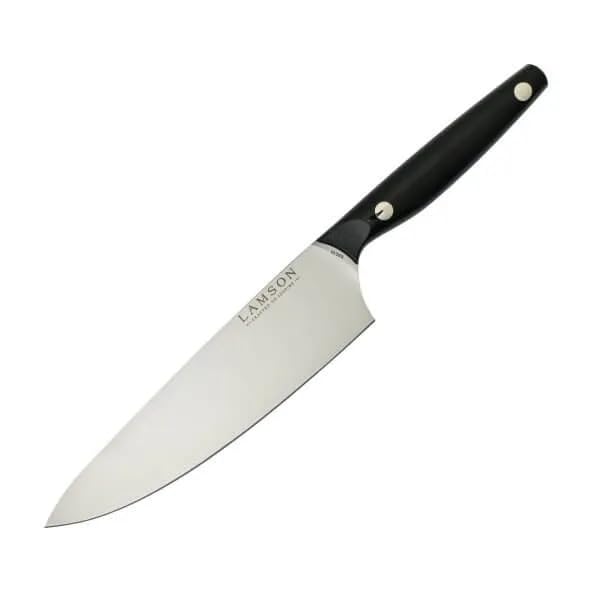
A Massachusetts hand-finished blade with a midnight handle that shrugs off the dishwasher.
What sets the Lamson Vintage 8 apart is the finishing process — every blade is cut, ground, polished, and sharpened at Lamson’s Westfield, Massachusetts facility using a combination of machine and hand work. The steel is Lamson’s proprietary 420HC-LAM high-carbon stainless, tempered to 58 on the Rockwell scale. That hardness number tells you it resists dulling better than a softer blade, which matters if you cook most nights and hate stopping to sharpen. The broad 8-inch blade has enough height to keep your knuckles clear of the board while you dice.
The Midnight G-10 handle is the practical star here. G-10 is a layered composite that stays grippy when wet, and this version is dishwasher safe — a rarity among premium American chef knives, where most handles demand careful hand washing. Lamson backs it with a lifetime guarantee against manufacturing defects and free Sharp for Life resharpening, so the edge you rely on gets maintained for the life of the knife. The blade is a full tang riveted with a nickel-silver rivet for a solid, connected feel.
The recurring gripe is the handle size — a few cooks with larger hands find it a little slim, which is worth knowing before you buy since it is a fit issue rather than a flaw. Cosmetic wear has also surfaced: on one knife the Lamson logo began rubbing off after six months of steady use, though the blade itself held up fine. Balance and sharpness from the start earn the most praise, and one owner who compared it against a Wusthof Classic felt it exceeded that knife.
Sharp from the start: The 420HC-LAM steel at 58 Rockwell arrives ready to slice and holds that edge with occasional honing.
Fit note: If you have large hands, judge the slim Midnight handle before committing.
A strong all-rounder: Buyers who want American hand-finishing, a dishwasher-safe handle, and lifetime resharpening in one knife.
Look elsewhere if: You prefer a beefier handle or need a longer blade for big-batch prep.
4. Buck Knives 931 Chef’s Knife
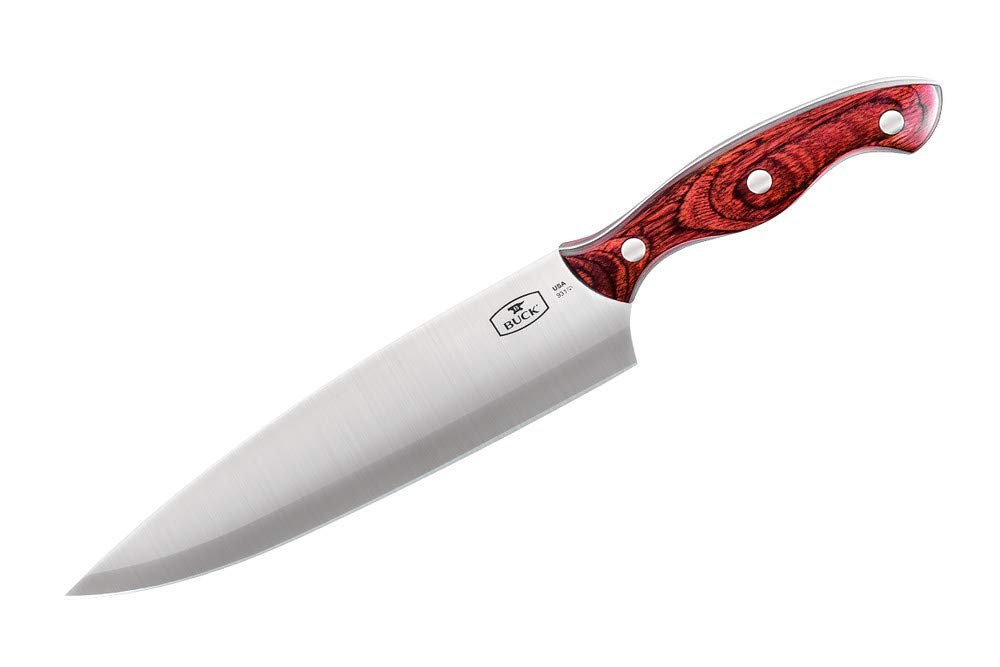
A rosewood-handled eight-incher from a brand that has been heat-treating steel since 1902.
Buck Knives built its name on hunting blades, and the 931 chef’s knife carries that DNA into the kitchen. The 8-inch hollow-grind 420HC stainless blade is heat-treated for edge retention and corrosion resistance, and the hollow grind keeps food from sticking as you slice. At 9.12 ounces it is a substantial knife — noticeably heavier than the 5.9-ounce Middleton Echo — so it plants in your hand rather than feeling twitchy. The full tang runs through polished Rosewood DymaLux handles with stainless steel rivets for a warm, classic look.
What keeps owners loyal is how long the edge lasts, especially on proteins. Long-term users report it staying razor sharp after de-boning and jointing multiple chickens, and it excels on meat even if it is less graceful on delicate vegetables. Buck backs every knife with a lifetime warranty, a big reason people keep coming back. A proud owner gifted one to a police officer friend and admitted they nearly kept it for themselves.
The one consistent gripe is the handle’s finish from the start — an owner found the routed edges a bit sharp and took a little sandpaper to them before the grip felt right. A minor note: the Rosewood handle needs hand washing, so if you refuse to baby a knife, the Dexter-Russell with its NSF handle may suit you better.
Edge that endures: The 420HC stainless blade stays razor sharp through poultry and roasts, which is what owners return to Buck for.
Finish quirk: A few buyers smooth the routed handle edges with fine sandpaper for a softer grip.
Ideal for protein lovers: Cooks who carve and joint meat regularly and want a warm rosewood handle with a lifetime warranty.
Skip if: You want a featherweight blade for delicate vegetable work or a dishwasher-safe knife.
5. Lamson 8″ Premier Forged Chef’s Knife (FIRE)
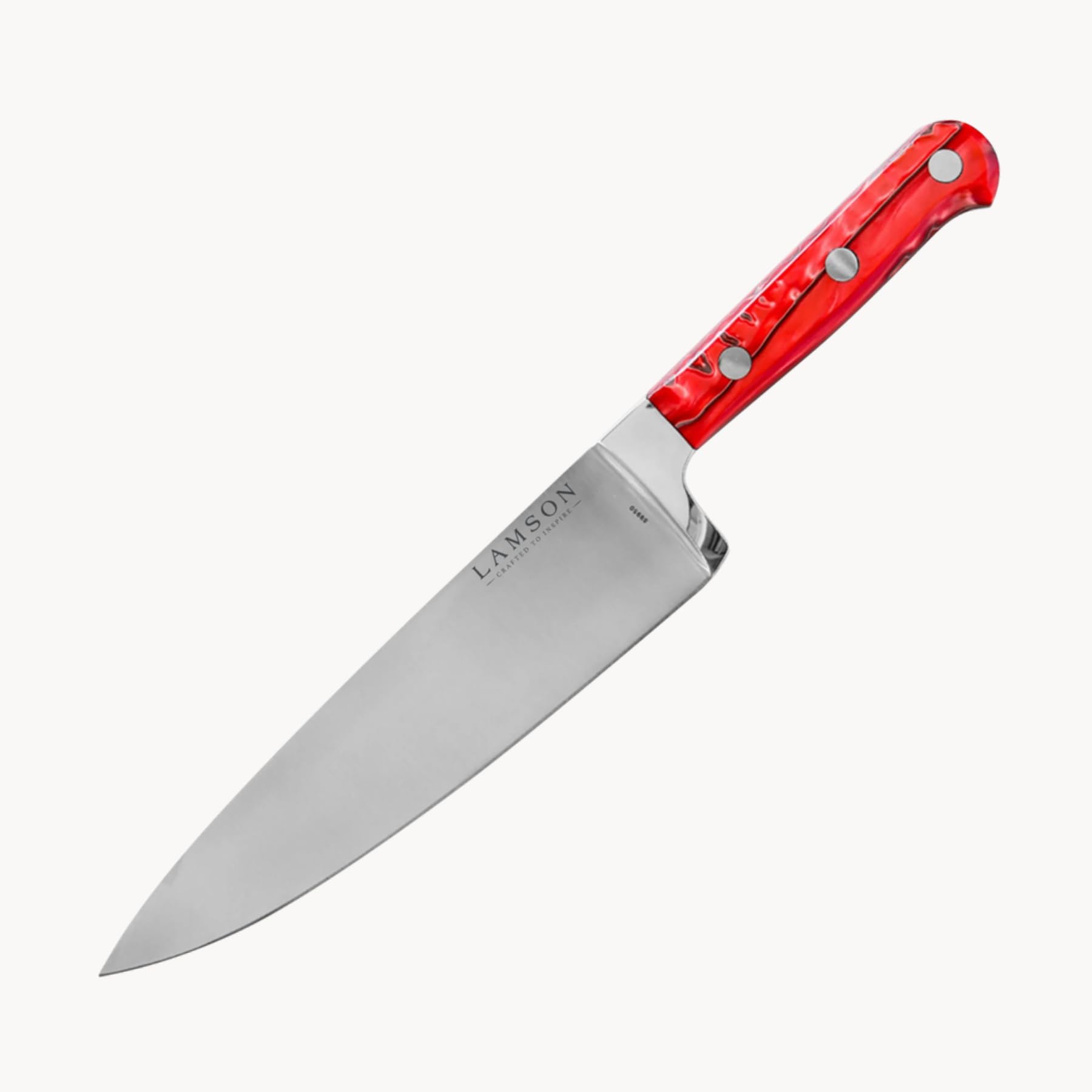
The forged, triple-riveted showpiece with a red acrylic handle that looks like jewelry in the drawer.
The Premier Forged line is Lamson’s top-tier build, and the steel tells the story: precision-forged 4116 stainless from Solingen, Germany, ice-hardened to 58 Rockwell for a sharp, corrosion-resistant edge. That is a different makeup than the Lamson Vintage above, which uses the company’s domestic 420HC-LAM steel. The forged construction and triple-riveted exotic-wood or acrylic handle give the FIRE a weighty, substantial feel that owners describe as well-balanced and non-slip. It is hand-finished in the USA, so you get American craftsmanship paired with German blade steel.
Sharpness and edge life are the headline strengths here. Buyers report the 58 Rockwell 4116 steel holding its edge longer than any knife they have owned, so you hone less often. It slices meat with a clean, easy cut. One buyer who already owned paring and chef’s knives from Lamson said the 8-inch is their go-to for chopping and slicing, and a first-time buyer was taken aback by how sharp it arrived. The vivid red acrylic handle separates it on the board, and the knife is designed to become an heirloom — one owner cheekily noted their kids can argue over it someday.
The biggest honest trade-off is food release. The blade’s geometry lets vegetables cling to the side as you cut, so you stop more often to scrape them off. A few buyers also find it on the heavy side, though most say the weight comes with the better steel. The most serious complaint came from a cook who used it a week on vegetables and found an uneven edge — but that is a rare report against an otherwise beloved knife, and worth framing as a quality-control lottery rather than the norm.
Forged and finished: Solingen 4116 steel at 58 Rockwell, hand-finished in the USA, gives you a blade that stays sharp and looks the part.
Sticking point: Wet vegetables grab the blade face, so get ready for a little extra scraping.
For the cook who wants a statement piece: A forged, heirloom-quality blade with a handle worth staring at.
Think twice if: You want a lightweight knife or quick food release on starchy vegetables.
6. Middleton Made Knives Echo 8 Inch Chef Knife

A South Carolina bladesmith’s ultra-thin eight-incher with a 12-degree edge and a striking blue handle.
The Echo is built by Quintin Middleton, a South Carolina blade smith who has been producing knives for over twenty years. The steel is AEB-L stainless, a grade known for corrosion resistance, hardness, and taking a keen edge. It is forged to 60 Rockwell — the hardest blade on this list — with a 12-degree blade angle, ground ultra-thin at 3mm at the heel tapering to just 0.18mm at the cutting edge. At 5.9 ounces it is the lightest knife here, and that slender profile makes it glide through delicate produce like strawberries without bruising them.
The handle is Dymalux, which is dyed birch veneers pressed into a dense block. That gives you a secure, controlled grip that is meant to minimize wrist tension during long chopping sessions. It ships in a gift box and has been featured in the New York Times, Forbes, and Food & Wine for its craftsmanship. The blue handle option is uncommon, and owners who display their knives on the counter do so precisely because this one looks the part as much as it performs.
This is also the most divisive knife on the list, and honesty demands flagging the risk: a couple of buyers received a blade that arrived dull and were disappointed given the artisan price. That is a meaningful inconsistency to weigh, and the reason this pick sits lower on the list despite its craftsmanship story. When the Echo lands sharp, though, it earns genuine devotion — one reviewer says these are by far the best knives they have used and that they have ditched their store-bought blades entirely.
Custom-shop specs: The 60 Rockwell AEB-L steel and 12-degree edge put it in the same conversation as boutique blades, at a lighter 5.9 ounces.
Inconsistent sharpness: Some units arrive dull, so inspect it right away and lean on the maker’s support if yours underperforms.
For the collector: Cooks who value small-batch American bladesmithing and an eye-catching blue Dymalux handle.
Hold off if: You want guaranteed sharpness from the start or prefer a heavily reviewed, mainstream brand.
7. Dalstrong 8″ Spartan Ghost Chef Knife (S35VN)
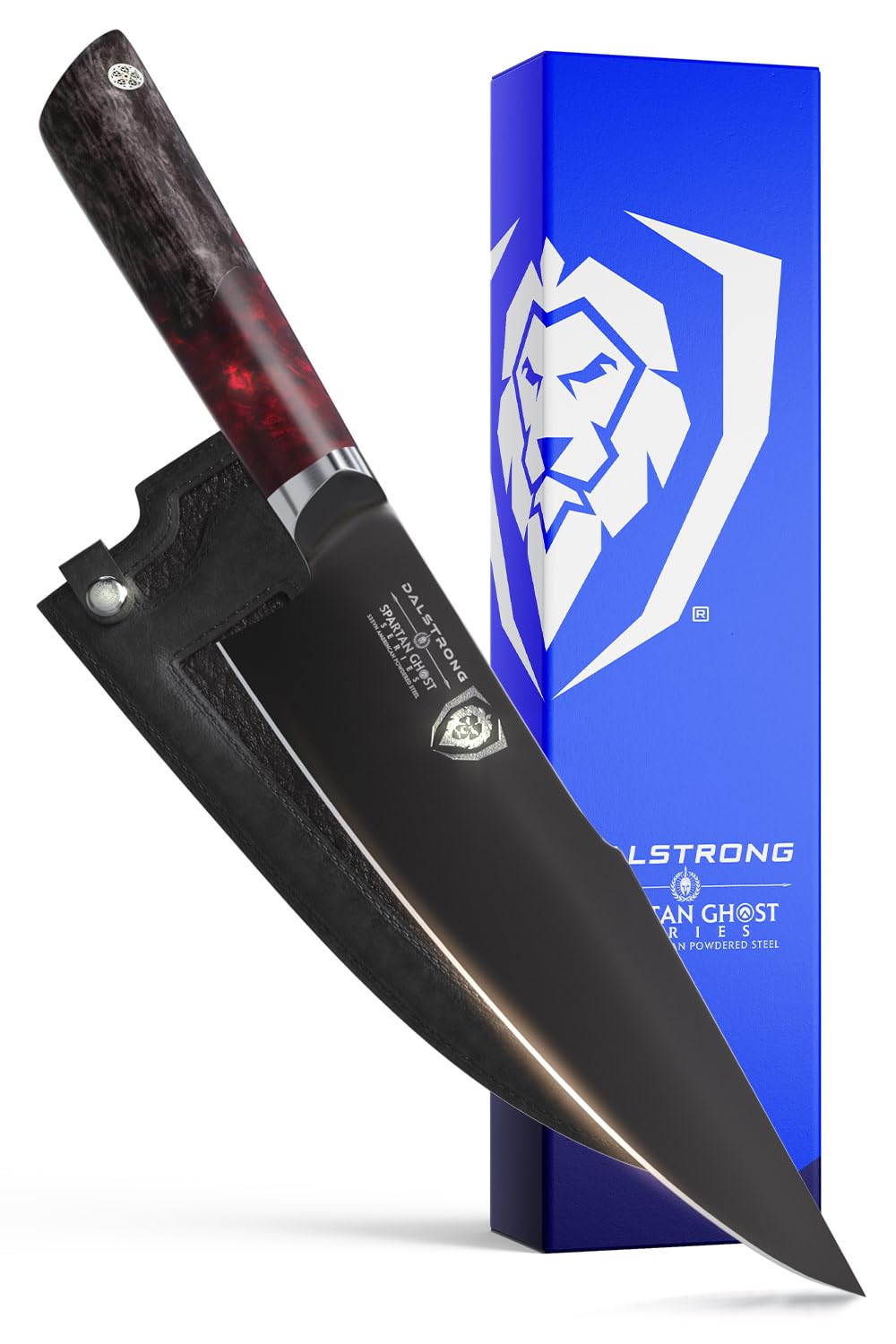
Powdered American S35VN steel for the cook who reads alloy charts before buying a blade.
The Spartan Ghost is the most steel-obsessed knife on this list. Its blade is American forged S35VN powdered steel — an alloy that shows up in high-end custom and tactical blades, and holds an edge noticeably longer than standard German or Japanese stainless. The powdered metallurgy process creates a finer, more uniform carbide structure than conventional steel, which is why the edge survives more prep sessions before it needs attention. It is the same 8-inch format you get from the Lamson Vintage, but the steel story is entirely different.
The handle is individually crafted from maple and red resin with a warm wood grain and resin fill — no two are identical. The Ghost finish on the blade face is understated compared to the busier Damascus patterns Dalstrong uses elsewhere. Owners call the maple-and-resin handle beautiful and the 8-ounce build light, and one professional chef who has used most major brands calls it the sharpest knife they have ever held. It arrives with a PerfectFit sheath and gift box, ready to give.
Here is the honest ledger: value is the friction point. S35VN is premium steel, and enough buyers feel the price outpaces the real-world gain that value-for-money is the one aspect where sentiment turns negative. A couple of owners also reported cosmetic issues — one saw stains and marks on the blade after a few months, and another noticed a very small edge roll. It is worth knowing that some cooks notice a thin bolster edge that digs into the hand when choking up on the blade for precision work.
Where It Wins
- S35VN powdered steel holds an edge longer than standard stainless
- Individually crafted maple and red resin handle — no two alike
- Ships with a PerfectFit sheath and gift box
- Weighs less than heavier forged rivals like the Buck 931
What To Weigh
- Value for money is the loudest criticism — the steel costs more
- Some units show blade staining or a small edge roll
- Thin bolster edge can dig in during precision grip work
For the steel-savvy cook: Buyers who want S35VN edge retention and a one-of-a-kind maple-resin handle.
Not for you if: You want the best value per dollar or prefer a mainstream forged blade.
Understanding the Specs
Rockwell Hardness (HRC)
Rockwell hardness is a number that tells you how hard the blade steel is — and harder usually means it holds an edge longer before it needs sharpening. The knives here run from around 58 to 60 on that scale. A blade at 60 Rockwell, like the Middleton Echo, keeps its edge longer but needs a gentler touch, since harder steel can chip if you twist it sideways. A blade at 58, like the Lamson Vintage or the Lamson Premier Forged, offers a practical middle ground for everyday cooking.
Full Tang Construction
A full tang means the steel of the blade continues in one piece all the way through the handle, rather than stopping short. You feel the difference as better balance and a more solid, connected grip — the Cutco Model 1766 and the Buck 931 both use full tangs. A knife without a full tang is not automatically bad, but it can feel lighter and less sturdy in the hand during heavy chopping.
Blade Steel Types
The steel grade decides how long the edge lasts and how well it resists rust. High-carbon stainless steels like 440A and 420HC are forgiving and corrosion-resistant, ideal for home cooks. Performance alloys like AEB-L and S35VN hold an edge longer but often cost more.
Blade Length
Blade length changes what a knife does best. A 7-inch santoku like the Cutco is nimble for detail work, while a 9-inch blade like the Dexter-Russell covers more ground on big jobs like breaking down melons. For most home cooks, an 8-inch chef knife is the all-purpose middle ground that handles dicing, slicing, and chopping without feeling unwieldy.
FAQ
How do I know a chef knife is genuinely made in the USA?
Is a santoku better than a traditional chef knife for chopping vegetables?
What does Rockwell hardness mean for a kitchen knife?
Can I put an American made chef knife in the dishwasher?
What is the difference between 420HC and S35VN steel?
How long does an American made chef knife stay sharp?
Is a forged blade better than a stamped one?
Do these American made chef knives have a warranty?
Final Thoughts: The Verdict
For most cooks, the american made chef knives winner is the Cutco Model 1766 Santoku because its forged full-tang build, sharp 440A blade, and lifetime guarantee make it the most confident all-around buy — and it earns the strongest owner sentiment of the group. If you prep produce in volume and want a longer blade for less, grab the Dexter-Russell 9″ Duo-Edge Santoku. And for the cook chasing maximum edge retention in a one-of-a-kind handle, the Dalstrong Spartan Ghost is the one to reach for — just go in knowing you are paying a premium for that S35VN steel.
How We Picked
We do not accept paid placement. Every pick is matched to a real buyer and a real use-case; we do not hands-on test units.
Sources & Methodology
Specifications: manufacturer listings and product documentation. Review insights: verified customer reviews, as of September 2026. Pricing: not shown on this page (it changes often); check the current price via the retailer link.
As an Amazon Associate, Gadgets Feed earns from qualifying purchases. This does not affect which products we feature.