
When the grid goes down, a generator isn’t just a convenience—it’s a lifeline. For those who value domestic engineering and robust construction, the search for a genuinely American made generator is about more than just a label; it’s about investing in a machine built with pride, known for its reliability and availability of replacement parts. You want a generator that starts on the first pull, handles your home’s critical loads, and keeps running through the storm, all while supporting American manufacturing.
I’m Min — the co-founder and writer behind Gadgets Feed. My approach to evaluating generators focuses on real-world engine durability, analyzing technical specs like total harmonic distortion, cast iron sleeve construction, and comparative fuel efficiency across dual and tri-fuel systems. (And Homer 🐱 inspected the control panels for optimal napping surface approval).
After digging deep into the market, I’ve compared engine displacement, surge wattage, fuel type flexibility, and real customer feedback spanning thousands of hours of use. This guide will help you sort through the contenders to find the perfect anchor for your home backup or job site needs, focusing on the best american made generator options that deliver true value and peace of mind.
How To Choose The Best American Made Generator
Selecting an American made generator means prioritizing build quality, domestic support, and long-term reliability over the lowest upfront cost. You are buying a machine designed to last a decade or more, so focus on the engine and frame rather than flashy features. Before you click ‘buy’, make sure you understand your actual power needs and the fuel infrastructure you have available at home.
Engine Construction and Displacement
The heart of any generator is its engine. Look for models with a cast iron sleeve—this component dramatically extends engine life by protecting the cylinder wall from wear. Larger displacement (measured in cubic centimeters, or cc) generally means more torque and the ability to handle sustained heavy loads without straining. A 500cc V-twin engine will outlast and outperform a smaller 200cc single-cylinder under continuous use, especially for powering well pumps or central AC units.
Matching Surge and Running Watts to Your Home
Every motor—be it in a fridge, furnace fan, or air conditioner—requires a surge of power to start, which can be 2-3 times its running wattage. You must ensure your generator’s surge capacity can handle the sum of all simultaneous starting loads. A 13,000-watt surge unit like the DuroStar can comfortably start a 1.5-ton AC while keeping the fridge running. Undersizing leads to constant overload resets and potential damage to sensitive electronics.
Fuel Flexibility and Runtime
During a multi-day outage, fuel availability is your biggest constraint. Dual-fuel generators (gasoline and propane) offer instant backup when gas stations are down or lines are long. Tri-fuel models add natural gas, providing infinite runtime if your gas supply remains online. Propane does not degrade or gum up carburetors like gasoline, making it ideal for infrequent emergency use. A generator that sips fuel—like the Honda EU7000iS with its Eco Throttle system—can run for 16 hours on a single fill, saving you trips to the gas station at 3 AM.
Total Harmonic Distortion (THD) and Inverter Technology
If you plan to power laptops, LED TVs, or a CPAP machine, you need clean power with less than 5% total harmonic distortion (THD). Inverter generators use advanced electronics to produce pure sine wave power that is safe for sensitive electronics. Open-frame conventional generators often produce THD above 6%, which can cause buzzing or permanent damage to delicate circuits. For home backup including entertainment and computers, prioritize an inverter model or one explicitly stating “less than 3% THD.”
Quick Comparison
On smaller screens, swipe sideways to see the full table.
| Model | Category | Best For | Key Spec | Amazon |
|---|---|---|---|---|
| WEN 56360i | Inverter | Lightweight Camping | 3600 Surge / 46 lbs | Amazon |
| Champion 4000-Watt | Inverter | RV & Tailgating | 4000 Surge / 64 dBA | Amazon |
| WEN 56477i | Inverter | Home Backup | 4800 Surge / 224cc | Amazon |
| Generac GP3300i | Inverter | Quiet Home Backup | 3300 Surge / 59.5 lbs | Amazon |
| DuroStar DS13000MX | Dual Fuel | Whole Home Power | 13000 Surge / 500cc | Amazon |
| Westinghouse WGen11500DFc | Dual Fuel | Large Home Backup | 14500 Surge / 550cc | Amazon |
| Generac GP9500 Tri-Fuel | Tri-Fuel | Versatile Fuel Prep | 12500 Surge / 439cc | Amazon |
| Westinghouse iGen11000DFc | Inverter/Dual Fuel | Clean Power/Heavy Loads | 11000 Surge / 457cc | Amazon |
| Honda EU3000IS | Inverter | Ultra-Quiet Camping | 3000 Surge / 59 dBA | Amazon |
| Champion 201161 Tri-Fuel | Tri-Fuel | Whole House/Jobsite | 15000 Surge / 717cc | Amazon |
| Honda EU7000iS | Inverter | Premium Home Backup | 7000 Surge / 52 dBA | Amazon |
In‑Depth Reviews
1. DuroStar DS13000MX

The DuroStar DS13000MX strikes the ideal balance between brute-force power and practical flexibility. Its 500cc engine delivers 13,000 surge watts, enough to handle a 1.5-ton central AC, a refrigerator, lights, and a microwave simultaneously without breaking a sweat. The dual-fuel capability is a real lifesaver during extended outages—if gasoline runs scarce, you switch to propane instantly via the front-facing fuel selector.
Build quality is where this unit separates itself from the competition. The all-metal construction and steel frame are built to withstand years of transport and rough weather exposure. The push-button electric start pairs with a reliable toggle switch, and the included remote start fob means you fire it up from a dry porch without stepping into the rain. The CO alert auto-shutdown adds a critical safety layer for enclosed setups.
Customer reviews highlight its ability to run stick welders on a 240V circuit and power entire homes during storm events. The 220-pound weight is substantial but manageable with the included wheel kit. For a home backup generator that offers true whole-house capability at a competitive value point, the DS13000MX is the clear leader in its class.
Why it’s great
- Dual fuel for fuel flexibility during long outages.
- 500cc engine provides reliable 13,000 surge watts.
- All-metal construction with rugged steel frame.
- Remote electric start with included key fob.
Good to know
- Weighs 220 lbs; requires a hand truck for stairs.
- Propane output slightly lower than gasoline peak.
- CO sensor may trigger in tight outdoor spaces.
2. Westinghouse WGen11500DFc
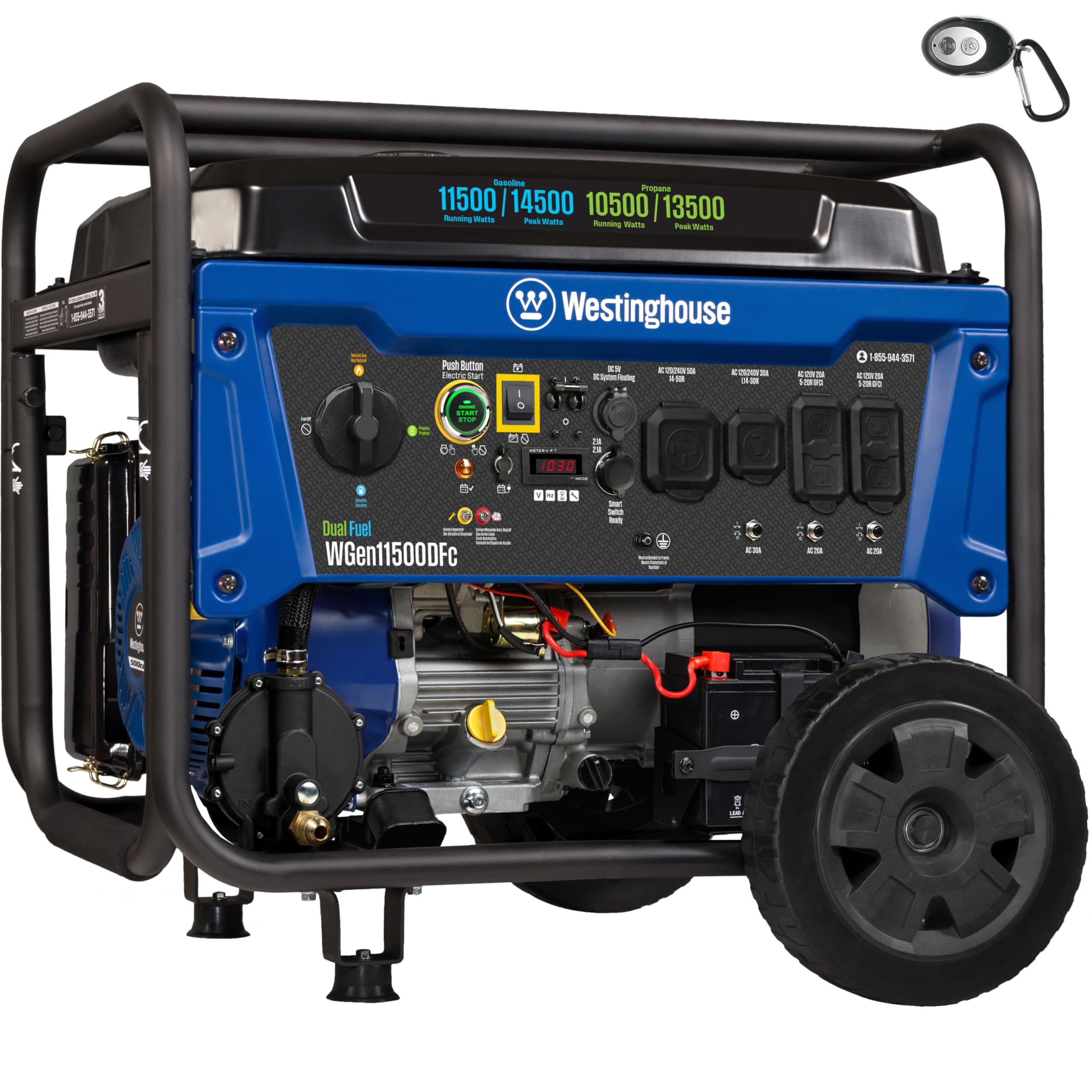
Westinghouse packs a monumental 14,500 peak watts into this dual-fuel powerhouse. The 550cc OHV engine features a durable cast iron sleeve that dramatically extends operational life—a spec serious buyers look for in a machine meant to last 5,000+ hours. On gasoline, it delivers 11,500 running watts, and on propane it still produces a robust 10,500 running watts, making it one of the strongest performers in the mid-premium price tier.
The control panel is designed for serious home integration. It includes a transfer-switch-ready 50A outlet (120/240V), an L14-30R, and two GFCI 120V household outlets with rubber covers. The remote start via key fob is a standout feature during storms—push a button from inside the garage and the generator fires up before you even step outside. Run time reaches 19 hours on a 9.5-gallon tank at 50% load.
Real-world users report this unit powers a 5-ton AC with a soft starter, two refrigerators, and a TV without voltage fluctuations. The primary drawback is noise—it is an open-frame unit, so it sits on the louder side of the spectrum. If you need clean sine wave power for electronics, consider pairing this with a separate line conditioner or opting for the inverter version below.
Why it’s great
- Massive 14,500 peak watts for whole-home coverage.
- 550cc cast iron sleeve engine for long life.
- Remote electric start with key fob convenience.
- 19-hour runtime on gasoline at half load.
Good to know
- Open frame design is louder than inverter units.
- CO sensor can shut down in still air conditions.
- 230 lbs; needs wheel kit for transport.
3. Honda EU7000iS
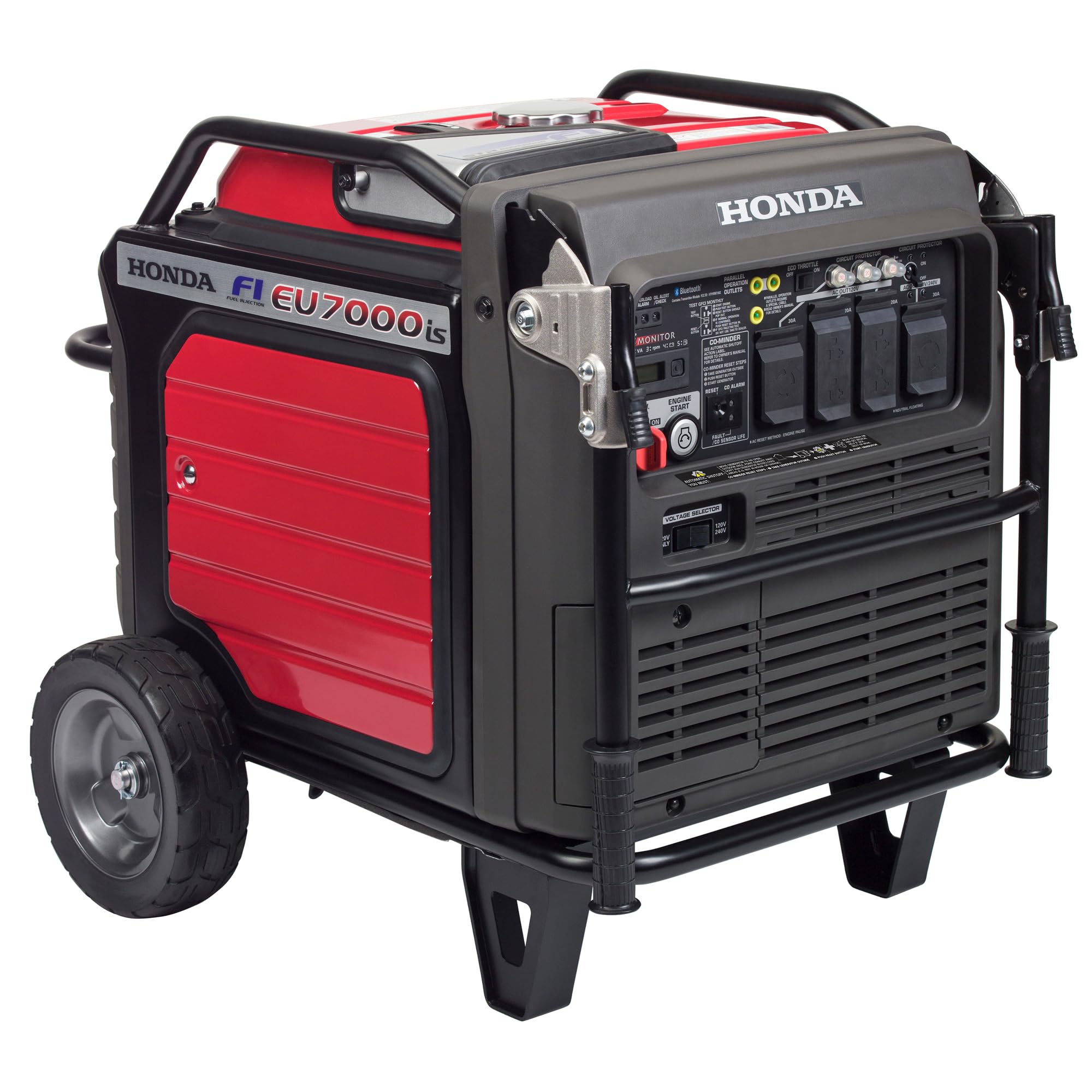
The Honda EU7000iS is the gold standard for quiet, clean power. Operating at just 52 to 58 dBA—quieter than a normal conversation—this inverter generator runs a 3-ton AC and a water heater while your neighbors barely know it’s on. The 389cc Honda engine is legendary for reliability, with an Eco Throttle system that adjusts engine speed to the load, delivering up to 16 hours of runtime on a 5.1-gallon tank.
Power quality is exceptional. The inverter technology produces pure sine wave output with less than 3% THD, safe for the most sensitive CPAP machines, laptops, and variable-speed refrigerators. The Bluetooth-enabled My Generator app lets you monitor power output, fuel level, and remaining runtime from your phone, plus it sends service reminders. The CO-MINDER system adds automatic shutdown if CO builds up.
The unit includes electric start, a wheel kit for mobility, and a 120/240V output for transfer switch compatibility. Yes, the price tag is steep, but for buyers who prioritize whisper-quiet operation, zero electronics anxiety, and Honda’s legendary resale value, the EU7000iS is the definitive investment. One reviewer summed it up: “Expensive but worth it.”
Why it’s great
- Ultra-quiet 52-58 dBA operation at full load.
- Pure sine wave inverter power safe for electronics.
- Eco Throttle for up to 16 hours runtime.
- Bluetooth app control and monitoring.
Good to know
- Premium price point—biggest investment on this list.
- Only runs on gasoline; no dual fuel option.
- Not available for sale in California.
4. Champion 201161 15,000-Watt Tri-Fuel

When you need to power an entire home on natural gas for a week straight, the Champion 201161 is the machine you want in your yard. The 717cc Milwaukee Series V-Twin engine is a torque monster, producing 15,000 starting watts and 12,000 running watts on gasoline, with proportionally strong output on propane and natural gas. Both natural gas and propane hoses are included in the box—no separate parts to hunt down.
The electric start with a simple toggle switch is reliable even in cold weather, and the Intelligauge tracks voltage, hertz, and run-time hours so you can schedule oil changes at precise intervals. At 78 dBA from 23 feet, it is audible but not deafening for its class—far quieter than a typical open-frame of similar output. The CO Shield auto-shutoff adds essential safety, though some users report it is very sensitive in outdoor locations.
During Hurricane Beryl, one reviewer ran this generator on natural gas for 90 continuous hours, powering a 3.5-ton AC, dryer, and full fridge without issue. The 331-pound weight is a two-person job to position, but the wheel kit and fold-down handle make rolling it around the garage manageable. If you want tri-fuel capability and raw, sustained output, this is the top contender.
Why it’s great
- 717cc V-Twin for massive, sustained power output.
- Tri-fuel ready with all hoses included.
- Electric start with Intelligauge for monitoring.
- Proven reliability during multi-day disaster events.
Good to know
- Weighs 331 lbs; needs two people for initial setup.
- CO sensor is sensitive and may trigger outdoors.
- Open frame design; not inverter clean power.
5. Westinghouse iGen11000DFc

The Westinghouse iGen11000DFc solves a common dilemma: how do you get high wattage without sacrificing power quality for electronics? This inverter generator produces 11,000 peak watts on gasoline and 10,000 on propane—all with less than 3% total harmonic distortion (THD). That means you can power a whole-house transfer switch with a heat pump, EV charger, fridge, and home office setup without worrying about fried circuit boards.
Engineered with a 457cc Westinghouse engine and a cast iron sleeve, this unit is built for longevity. The remote start key fob works up to 50 feet away, and the LED data center shows fuel level, power output, remaining runtime, and voltage in real time. The 50A 120/240V outlet is transfer switch ready, and the parallel capability doubles your power if you add a second unit.
Owner reviews consistently praise its build quality and quiet operation relative to its output. One reviewer noted that their pool pump drew 8.4 amps on this generator versus 9.7 amps on a conventional open-frame—a direct result of the clean sine wave output reducing motor strain. At 187 pounds with wheels, it is surprisingly portable for a unit of this capacity. The oil should be swapped to 5W-30 synthetic for cold weather operation below 23°F.
Why it’s great
- Inverter clean power at high wattage (11,000 peak).
- Remote electric start with key fob convenience.
- Dual fuel with propane hose included.
- LED data center for live power monitoring.
Good to know
- Synthetic oil needed for cold weather operation.
- Fuel efficiency drops under heavy continuous load.
- Included oil not suitable below 23°F.
6. Generac GP9500 Tri-Fuel
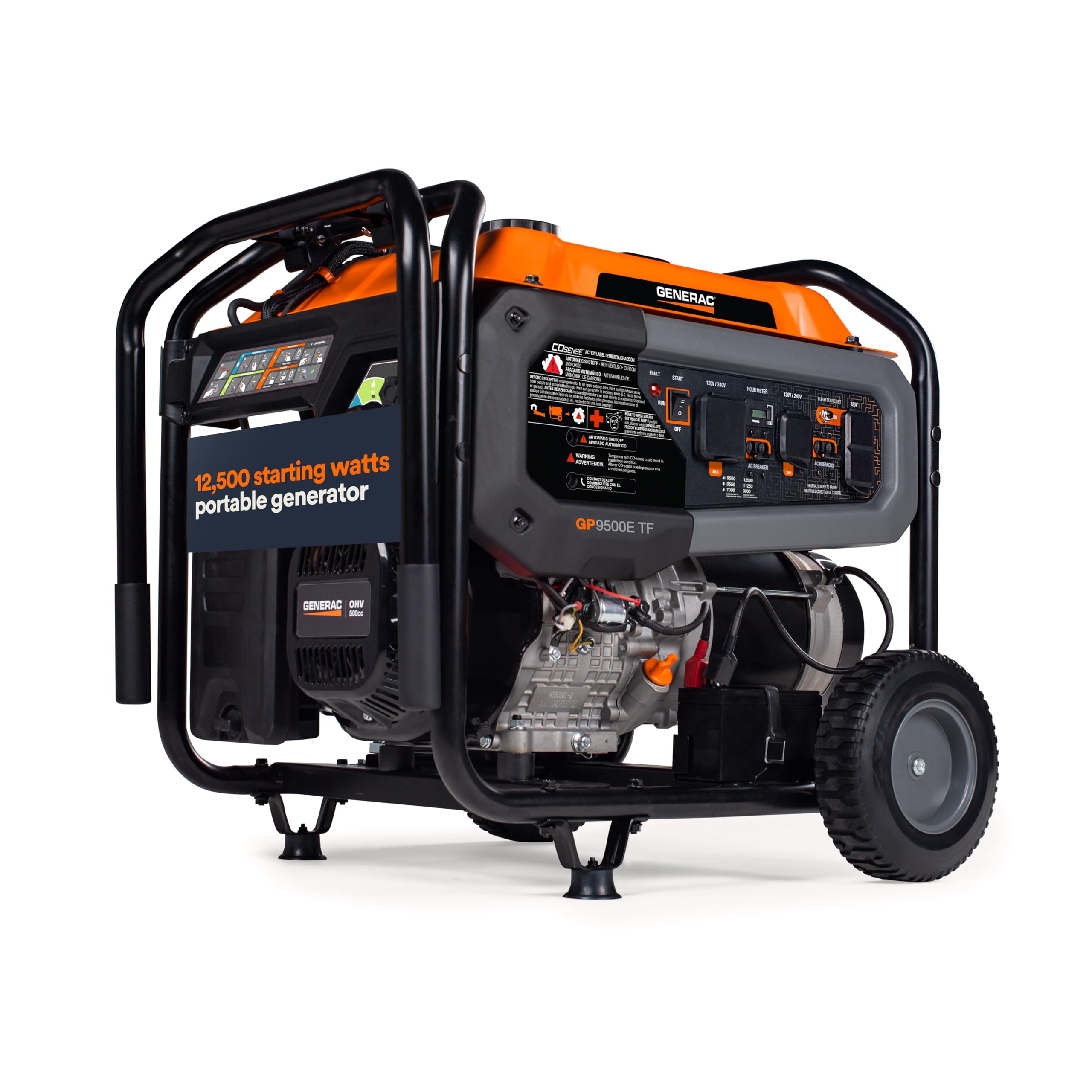
Generac brings its engineering pedigree to the tri-fuel market with the GP9500, a generator capable of seamlessly switching between gasoline, propane, and natural gas. The 439cc OHV engine delivers 12,500 starting watts, and the fuel source selector lets you swap without shutting the unit down—critical during a storm when your primary fuel runs dry and you need to switch to natural gas.
The electric start with included battery is effortless, and the rugged steel-tube cradle with never-flat wheels makes positioning easy. Covered outlets protect against rain and dust, a thoughtful touch for job site or outdoor emergency use. The COsense Technology automatically shuts the generator down if CO levels become dangerous, a standard now on all modern Generac units.
User feedback highlights its robust build and ease of assembly. One reviewer ran it for 36 hours straight during an outage without a hiccup. The trade-off is that this is an open-frame generator, so it is louder than inverter models. For buyers who want tri-fuel flexibility from a trusted American brand at a mid-premium price point, the GP9500 is a solid, no-compromise workhorse.
Why it’s great
- Seamless tri-fuel switching without shutdown.
- Electric start with included battery.
- Covered outlets for weather protection.
- Proven Generac reliability and support network.
Good to know
- Open frame design is louder than inverters.
- Weighs 227 lbs; requires careful placement.
- Not pure sine wave; use conditioner for sensitive electronics.
7. WEN 56477i

The WEN 56477i fills a sweet spot for homeowners who need enough power for a fridge, freezer, lights, and a well pump without jumping to a massive open-frame unit. Its 224cc engine produces 4,800 surge watts and 4,000 rated watts—enough to handle most home essentials during a 9-day outage, as one reviewer confirmed running their Wi-Fi, TV, fridge, and freezer on a single tank.
What sets this WEN apart is its inverter clean power delivery plus the included portability features. It comes with onboard wheels and a telescoping pull handle, making it far easier to move than similarly powered units. The fuel shutoff feature runs the carburetor dry before shutdown, significantly extending the generator’s lifespan by preventing stale gas from gumming up the system.
The Watchdog CO Shutdown Sensor automatically turns off the generator if dangerous CO levels are detected—a critical safety feature for any backup setup. With four 120V receptacles, a TT-30R RV outlet, and two USB ports, you have plenty of connectivity. The three-year warranty is solid for the price tier. Fuel efficiency is impressive, with users reporting 8 hours of run time at moderate load.
Why it’s great
- Inverter clean power safe for electronics.
- Telescoping handle and wheels for easy transport.
- Fuel shutoff extends engine longevity.
- CO shutdown sensor included.
Good to know
- 73 lbs; not as lightweight as smaller units.
- Gasoline only; no dual fuel option.
- May struggle with large AC startup surge.
8. Champion 4000-Watt Inverter

At under 49 pounds, the Champion 4000-watt inverter is one of the lightest generators in its power class, making it a top choice for RVers, tailgaters, and folks who need to lift it in and out of a truck bed. The 149cc engine produces 4,000 starting watts and 3,000 running watts—enough to run a 15,000 BTU RV AC plus lights and fridge, though not simultaneously with the microwave.
Champion includes their CO Shield carbon monoxide auto-shutoff system, which has been tested to be less sensitive than some competitors while still meeting safety standards. The parallel kit option lets you connect a second 4,000-watt Champion unit to double your output, a great upgrade path for those starting small. Noise levels hit a maximum of 64 dBA from 23 feet, which is very civilized for a generator of this size.
Customer reviews highlight the easy first-pull start and quiet operation. One user reported 5 gallons of fuel lasting 24 hours under continuous AC load—excellent efficiency. The TT-30R RV outlet and 5-20R household duplex provide standard connectivity. The three-year warranty and free lifetime technical support add peace of mind. For a lightweight, RV-focused inverter that won’t break the bank, this Champion is a standout.
Why it’s great
- Industry-leading lightweight at under 49 lbs.
- Runs RV AC and appliances with ease.
- Parallel capable for future power expansion.
- CO Shield auto shutoff for safety.
Good to know
- Can’t run AC and microwave simultaneously.
- Gasoline only; no propane option.
- Free high-altitude kit available upon request.
9. Honda EU3000IS

The Honda EU3000IS is the benchmark for quiet, efficient power in the mid-range inverter category. Operating at just 59 dBA, it is quieter than normal conversation, making it the preferred generator for campgrounds where noise restrictions are strict. The 196cc Honda engine delivers 3,000 watts of clean inverter power, and the Eco Throttle system can stretch a 3.4-gallon tank to an incredible 20 hours at light loads.
Power quality is the gold standard—less than 3% THD means you can safely charge laptops, run CPAP machines, and power sensitive electronics without any filtering needed. The electric start makes cold mornings hassle-free, and the wheel kit (sold separately) makes movement manageable for the 131-pound frame. Honda’s reputation for reliability means this generator often runs for thousands of hours with basic maintenance.
Users consistently note that it “barely makes noise” and sips fuel compared to competitors. The manual’s battery cover nut size error (10mm, not 6mm) is a minor quirk in an otherwise world-class product. For campers, tailgaters, or homeowners who need a quiet backup for essentials, the EU3000IS is the refined choice that holds resale value better than almost any other generator on the market.
Why it’s great
- Barely audible 59 dBA operation at full load.
- Up to 20 hours runtime on Eco Throttle mode.
- Honda reliability with thousands of hours of service life.
- Clean inverter power safe for all electronics.
Good to know
- Wheel kit is sold separately.
- Only available in gasoline; no propane option.
- Weighs 131 lbs; awkward to lift without dolly.
10. WEN 56360i

For the budget-conscious buyer who doesn’t want to compromise on inverter technology, the WEN 56360i delivers impressive value. At only 46 pounds and 3,600 surge watts, this 149cc unit is the lightest inverter on our list, perfect for camping, tailgating, or light home backup. The fuel shutoff feature runs the carburetor dry automatically, preventing gumming during storage—a common killer of budget generators.
Clean power delivery makes it safe for phones, tablets, and laptops, and the array of outlets includes two 120V three-prong receptacles, a TT-30R RV outlet, a 12V DC port, and two USB ports. Real-world reviews confirm it easily starts a 13,000 BTU RV air conditioner and runs it for about 4 hours on a single tank. The three-year warranty adds confidence for an entry-level investment.
Users consistently praise its quiet “gentle purr” sound profile and first-pull starting reliability, even at 14°F. The 46-pound weight means one person can carry it to the campsite without breaking a sweat. The trade-off is lower power output—it won’t run a large central AC or multiple high-draw tools simultaneously. For RVers and emergency prep on a budget, the WEN 56360i is a smart, lightweight choice.
Why it’s great
- Ultra-light 46 lbs for easy portability.
- Fuel shutoff extends engine life during storage.
- Inverter clean power for sensitive electronics.
- Quiet operation suitable for campgrounds.
Good to know
- Limited to 2,900 running watts.
- Gasoline only; no dual fuel capacity.
- Not strong enough for large power tools.
11. Generac GP3300i

The Generac GP3300i is a compact inverter generator that leverages PowerRush Advance Technology to deliver over 50% more starting capacity—meaning its 3,300-watt unit can handle the surge of a small well pump or circular saw that would stall a similar-sized competitor. The 439cc engine is overbuilt for this power class, contributing to reliable starts and stable power output.
TruePower Technology ensures less than 3% THD, making it safe for sensitive electronics. The Economy Mode automatically adjusts engine speed to reduce fuel consumption and noise, and users report running a TV, Wi-Fi, fridge, and lights for 9 hours on less than one gallon of gas. The COsense smart management system provides automatic shutdown if carbon monoxide is detected.
At 60 pounds, it is heavier than some competitors in its wattage class due to the larger engine block, but the trade-off is durability and Generac’s extensive nationwide service network. The LED indicators for low oil, overload, and ready status simplify operation. For homeowners who want a low-maintenance, quiet backup for essentials and trust the Generac brand, the GP3300i is a reliable, if slightly heavier, choice.
Why it’s great
- PowerRush tech for 50% more starting capacity.
- Extremely fuel efficient with Economy Mode.
- TruePower inverter safe for electronics.
- Generac’s nationwide service and support.
Good to know
- Heavier than some competitors at 60 lbs.
- Gasoline only; no propane option.
- Power drops significantly at high altitude.
FAQ
How many watts do I need to run a typical American home?
What does “inverter” mean and why does it matter?
Can I run a generator on natural gas without modifications?
Is it worth paying extra for a generator with a CO sensor?
How often should I change the oil in my generator?
Final Thoughts: The Verdict
For most users, the american made generator winner is the DuroStar DS13000MX because it combines a powerful 500cc engine, dual-fuel flexibility, and all-metal construction at a price that represents genuine value for whole-home backup. If you need whisper-quiet operation and pure sine wave power for sensitive electronics, grab the Honda EU7000iS. And for an extreme tri-fuel beast that runs on natural gas during week-long outages, nothing beats the Champion 201161 15,000-Watt Tri-Fuel.