
Our readers keep the lights on and my morning glass full of iced black tea. As an Amazon Associate, I earn from qualifying purchases.
Specs are compiled from manufacturer listings and verified buyer reviews and can change over time — please confirm the key details on the product page before buying.
You want a machine that strips years of grime off a driveway without a fight, and American-built or American-brand gas pressure washers are where that muscle lives. This guide sorts through the noise to find the gas-powered units that actually deliver on cleaning power, easy starts, and long-term reliability for homeowners and pros alike.
I’m Min — the founder and writer behind Gadgets Feed. This guide is built by comparing the manufacturers’ published specifications and the patterns across verified customer reviews, so you get each pick’s real strengths and trade-offs instead of marketing spin.
From the 3300 PSI workhorse to the 3600 PSI pro-level unit, here are the top-rated models for serious cleaning jobs — including the best pick in the american pressure washer category.
Our Picks at a Glance
How To Choose The Best American Pressure Washer
Before you spend money, understand that “American” here means the brand and engineering standards, not necessarily that every part is stamped in the USA. This list uses flexible matching — so not every pick is the exact search query; the nearest same-type machine serves the same purpose. Focus on what actually matters for your cleaning tasks.
The PSI and GPM Duo
PSI (pounds per square inch) is the pressure that blasts dirt, while GPM (gallons per minute) is the water volume that rinses it away. These two work together — a high PSI with low GPM cleans slowly, so look at both numbers. For stripping paint and heavy grime, you want 3200 PSI or more; for washing a car, a wider 40-degree nozzle at lower pressure protects the paint.
The Engine and Pump Heart
The engine is the heart, and the pump is the muscle. A Honda GX200 engine is the gold standard for easy first-pull starts, and a triplex plunger pump is built for the long haul and daily professional use. Cheaper axial pumps are lighter but wear out faster under constant load. Look for a thermal relief valve to prevent the pump from overheating when idling.
Hose Reach and Mobility
Your hose length limits how far you can reach without dragging the whole machine. A 35-foot hose lets you clean a two-story house from the ground without moving the unit, while a 25-foot hose keeps things compact for garages and driveways. Pneumatic tires roll over gravel and grass far more easily than hard plastic wheels.
Quick Comparison
| Model | Best For | Max Pressure | Hose Length | Weight | Amazon |
|---|---|---|---|---|---|
| Westinghouse WPX3200★ Best Overall | Homeowners wanting value and easy starts | 3200 PSI | 25 feet | 63 lbs | Amazon |
| SIMPSON PS3228 PowerShot | Pros needing triplex pump and Honda power | 3300 PSI | 25 feet | 74.8 lbs | Amazon |
| Simpson ALH3425 Aluminum Series | Contractors wanting long reach and light frame | 3600 PSI | 35 feet | 79 lbs | Amazon |
In-Depth Reviews
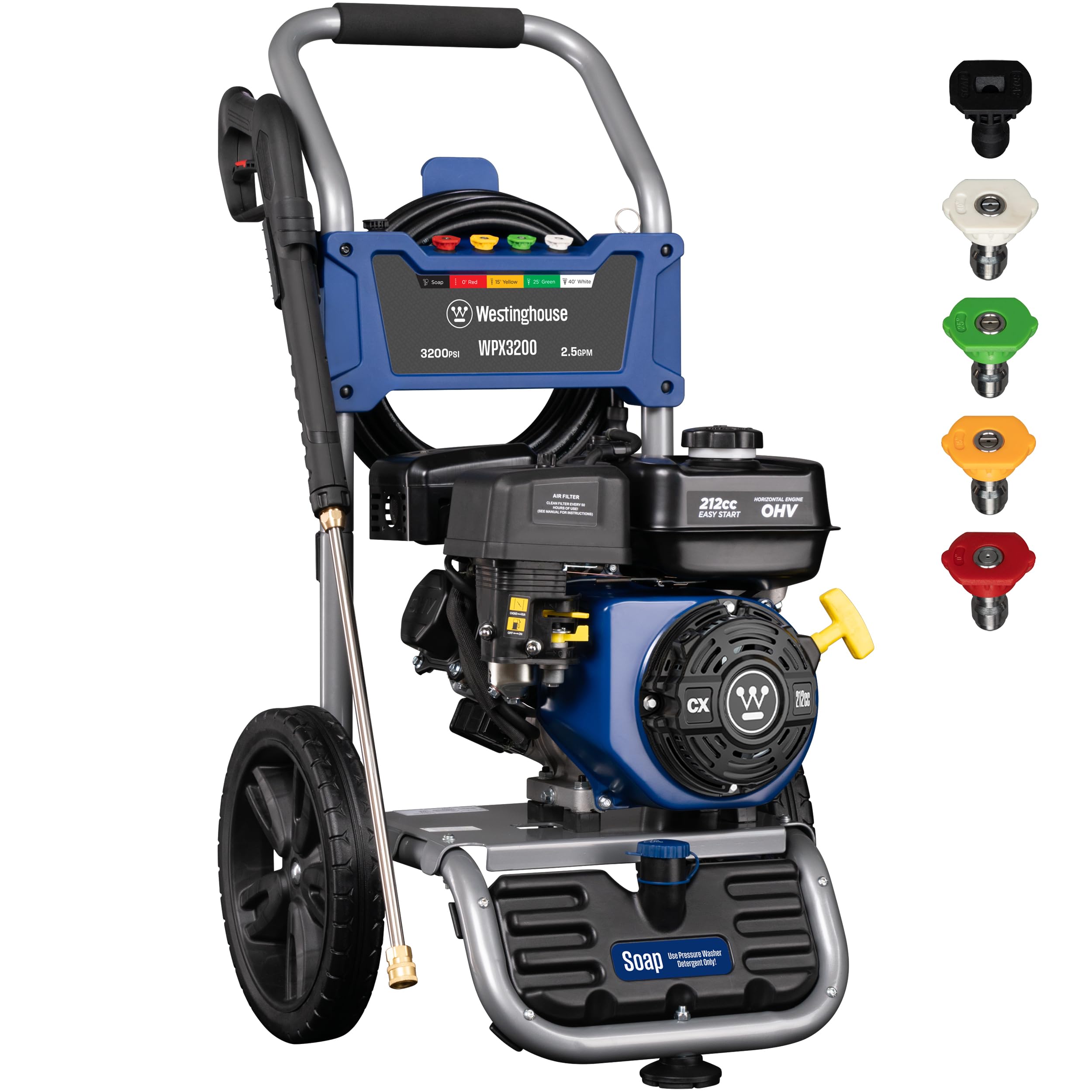
1. Westinghouse WPX3200 Gas Pressure Washer
Our pick — over 4.5★ from 11,000+ verified ratings; the strongest balance of quality and price.
The crowd favorite starts on the second pull and cleans siding like a commercial wash.
You get the most cleaning power per dollar with this Westinghouse: it delivers 3200 PSI (pounds per square inch of water pressure) and 2.5 GPM (gallons per minute of water flow), so it blasts away grime fast. Owners call it “very easy to use and very efficient.” The 212cc 4-stroke OHV (overhead valve) engine with recoil start (pull-cord) fires up reliably, and the 0.9-gallon gas tank means you refuel less often during a long driveway session.
What wins people over is the outright build quality and sheer cleaning force — the most-praised traits by a wide margin. The 5 quick-connect nozzles (0°, 15°, 25°, 40°, and soap) cover everything from blasting paint to gentle car washes, and the half-gallon onboard soap tank lets you foam without dragging a separate bucket. The 25-foot abrasion-resistant hose and 12-inch never-flat wheels make it easy to pull across rough ground.
Owners confirm it removes loose paint and mildew from siding without damage, even on the lowest nozzle setting. The recurring gripe is minor: the pump output can feel obstructed by the handle upright, which blocks quick-connect use for some. But for the price, this is the machine that does everything a homeowner needs.
The Wins
- Blast through siding, sidewalks, and garage floors with 3200 PSI of power
- easy starts make daily use painless
- 5 quick-connect nozzles cover stripping to car washing
- Onboard soap tank simplifies foam application
The Trade-Offs
- Handle upright can obstruct pump output for quick-connect use
- Oil fill cap sits at an awkward angle
Grab it for: homeowners who want a reliable, powerful machine for driveways, fences, and cars without spending pro-tier money.
Think twice if: you need the absolute longest hose reach — this one tops out at 25 feet.
2. SIMPSON Cleaning PS3228 PowerShot
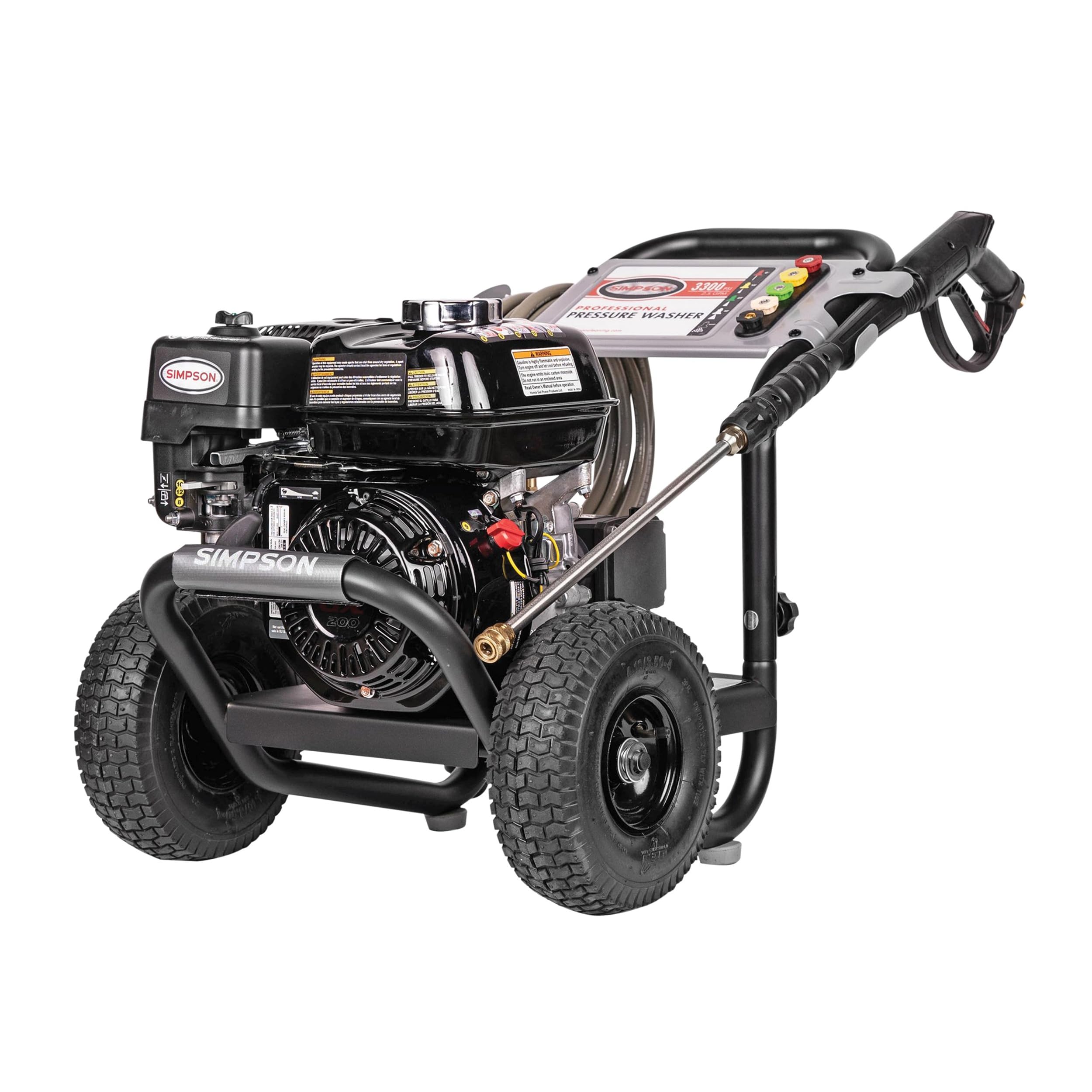
The Honda-powered workhorse pros trust to blast decades of grime off concrete.
This SIMPSON is built for professionals, and it shows in the details: a premium Honda GX200 engine that starts on the first pull and a maintenance-free 3300 PSI AAA triplex plunger pump. Unlike the Westinghouse’s axial pump, this triplex design is engineered for long service life under constant daily use — the reason contractors reach for it.
At 74.8 pounds, it’s noticeably heavier than the 63-pound Westinghouse above, but that heft comes with 10-inch pneumatic tires that roll smoothly over gravel, grass, and curbs. The welded steel frame with powder-coated finish resists corrosion and holds up to job-site abuse. The 25-foot MorFlex hose resists kinks and abrasion, and its non-marring polyurethane jacket won’t scratch finished surfaces.
Buyers report it starts “on first or second pull” with “plenty of pressure and water volume.” One owner reports reliable operation since 2013, backing the GX engine and AAA pump combo. The low handle and small wheels draw some grumbles, and a few owners found the engine nuts loosened on first use, so keep a wrench handy. If you need to strip graffiti, clean equipment, or remove old paint, this machine handles all three with equal ease.
Pro-level verdict: the Honda engine plus triplex pump makes this the most reliable long-term investment here — owners mention a decade of service with basic care.
Watch out: the handle sits low and wheels run small, which makes tight maneuvering a bit awkward.
3. Simpson Aluminum Series 3600 PSI
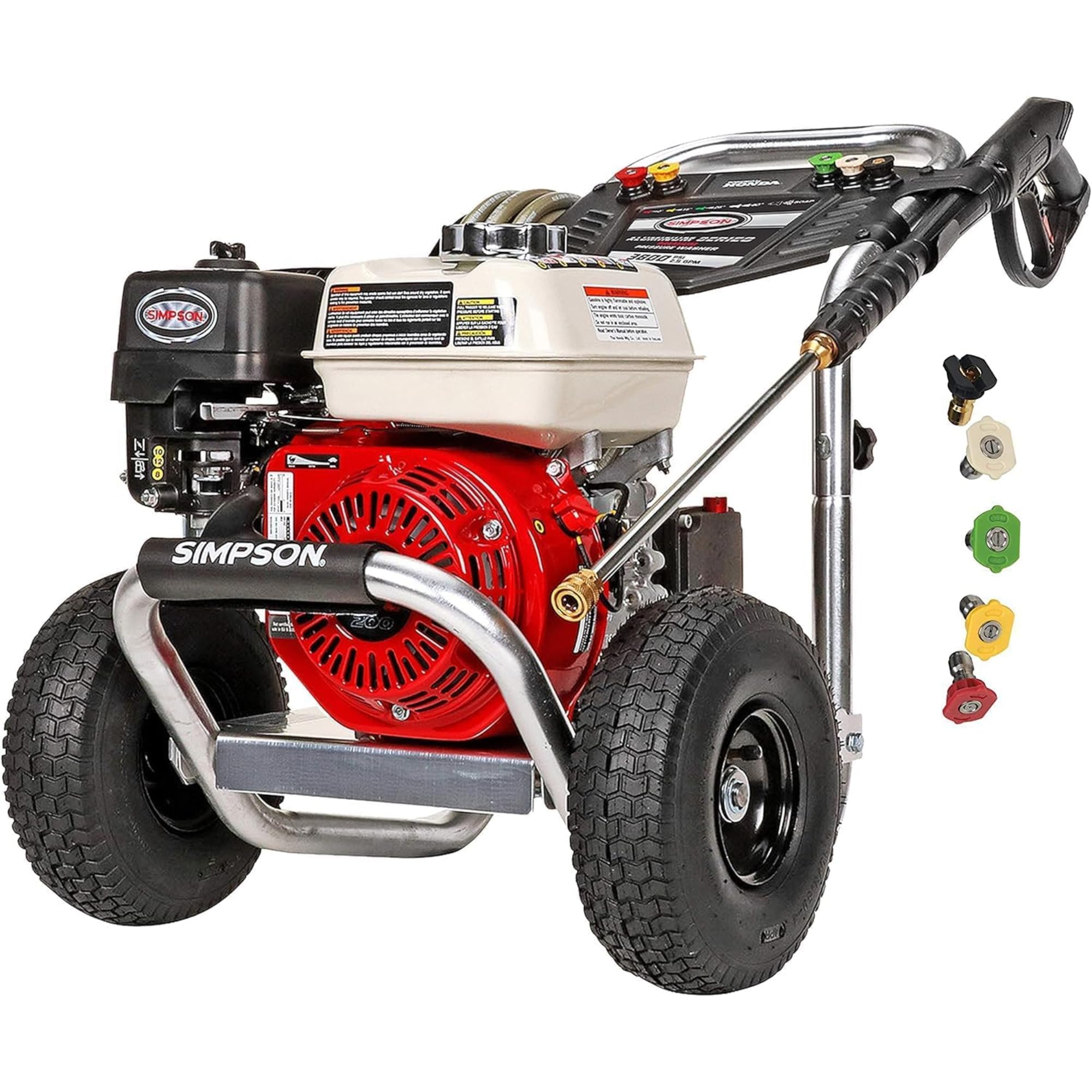
The 3600 PSI beast reaches 35 feet out while the aircraft-grade frame stays light.
This is the top-tier Simpson, and it earns the premium label with the highest pressure here at 3600 PSI. It beats the PowerShot’s 3300 PSI by a full 300 PSI, and that extra punch is what pros rely on for the toughest grease and oil removal on driveways. The Honda GX200 engine with PowerBoost Technology delivers higher pressure right at the nozzle.
The standout difference is the 35-foot MorFlex hose — a full 10 feet longer than both other picks — letting you clean a two-story house from the ground without moving the machine. The aircraft-grade aluminum frame keeps it surprisingly manageable despite the 78-pound weight, and the 10-inch pneumatic tires roll smoothly over rough terrain. The 5 quick-connect tips (0°, 15°, 25°, 40°, soap) and a professional QC spray gun with safety lock-out round out the pro kit.
The review pages sum it up: “the engine starts right away without any issues. Product works great on driveways, walls, cars, and all other stubborn dirt.” One owner calls it the best pressure washer in 30 years, citing the first-pull start without choke. The gripes are on the fittings — it lacks quick disconnects on the hose ends, so you’ll need an adapter for some surface cleaners. Durability is stellar though, with the warranty backing the engine for 3 years, pump for 5, and frame for 10.
Worth the step up: the 35-foot reach and highest PSI here make this the machine for anyone who hates dragging equipment around — it covers more ground without a move.
The small catch: hose-end fittings can frustrate — an occasional owner orders an adapter to connect surface-cleaning tools.
Understanding the Specs
PSI (Pressure)
PSI, or pounds per square inch, is the force behind the water stream — it’s what blasts paint off wood and grime off concrete. At 3200 PSI you can strip loose paint; at 3600 PSI you handle the toughest grease and oil stains. Higher is better for heavy-duty jobs, but you’ll switch to a wider nozzle for delicate tasks like car washing.
GPM (Water Flow)
GPM, or gallons per minute, is the volume of water moving through the nozzle — it’s the rinse power that washes the dirt away. A 2.5 GPM machine delivers a strong, steady stream that cuts cleaning time significantly. Together, PSI and GPM determine total cleaning power: high pressure blasts, high flow rinses.
Triplex vs Axial Pump
A triplex plunger pump uses three plungers for smoother, more consistent pressure and a longer service life — the choice for professionals who run the machine daily. Axial pumps are lighter and cheaper but wear out faster under heavy use. The SIMPSON units here all feature AAA triplex pumps, which is why they’re built for contractors.
Hose Length and Reach
Your hose length sets your cleaning radius from a stationary machine. A 35-foot hose is the balance for two-story houses and large driveways, so you cover more area without moving the unit. A 25-foot hose keeps the package compact for garages and smaller yards. Pneumatic tires (air-filled) also matter: they roll over gravel and grass far easier than plastic wheels.
FAQ
What is the difference between PSI and GPM on a pressure washer?
Which is better for a two-story house: a 25-foot or 35-foot hose?
What does a triplex pump do that an axial pump does not?
Why do the SIMPSON models use a Honda engine?
Will a 3200 PSI pressure washer damage my car paint?
What is the benefit of an onboard soap tank?
How hard is it to assemble a gas pressure washer?
When should I choose the 3600 PSI model over the 3300 PSI?
Do these pressure washers come with a warranty?
Final Thoughts: The Verdict
For most people, the winner is the Westinghouse WPX3200 because it balances power, easy starts, and price better than any other American brand machine — and it’s the crowd favorite by a landslide. If you want pro-grade durability with a Honda engine, grab the SIMPSON PS3228 PowerShot. And for the longest reach at 3600 PSI, the Simpson Aluminum Series is the one to reach for.
How We Picked
We do not accept paid placement. Every pick is matched to a real buyer and a real use-case; we do not hands-on test units.
Sources & Methodology
Specifications: manufacturer listings and product documentation. Review insights: verified customer reviews, as of August 2026. Pricing: not shown on this page (it changes often); check the current price via the retailer link.
As an Amazon Associate, Gadgets Feed earns from qualifying purchases. This does not affect which products we feature.