
Our readers keep the lights on and my morning glass full of iced black tea. As an Amazon Associate, I earn from qualifying purchases.
Specs are compiled from manufacturer listings and verified buyer reviews and can change over time — please confirm the key details on the product page before buying.
Here is the plain answer: buy a system that already pairs the amplifier with speakers voiced for it, so you skip the impedance and wattage matching that trips up most first-time buyers. A combo amp-and-speaker setup removes the guesswork — the maker has already done the watt-for-watt math. One honest note before you scroll: this list uses flexible, human-like matching for systems that include both an amplifier and at least one speaker, so not every pick is the exact model or size you had in mind — the nearest same-type pairing serves the same purpose, and every pick below genuinely includes an amp and speakers together.
I’m Min — the founder and writer behind Gadgets Feed. This guide is built by comparing the manufacturers’ published specifications and the patterns across verified customer reviews, so you get each pick’s real strengths and trade-offs instead of marketing spin.
You will see the difference between a mini hi-fi box that hides its amp inside and a passive outdoor setup that needs wiring, plus what each one actually does in a real room. The short version of this amp and speaker guide: pick for room size and input types first, then compare watts.
Our Picks at a Glance

How To Choose The Best Amp And Speaker System
The first decision is not wattage — it is whether the amplifier lives inside the speaker cabinet or sits in its own box. An active speaker (one with the amp built in) means one power cable per speaker and no separate receiver to place. A passive setup (speakers that need an external amplifier) gives you longer cable runs and the freedom to swap parts later. Decide that first, because it determines where the system can physically go in your home.
Match the watts to the room, not the spec sheet
A pair rated at 2x30W (30 watts going to each of the two speakers) is built for a bedroom or a small living room. A single 120W amplifier inside a bookshelf pair pushes enough for a larger open-plan space. Bigger wattage numbers do not automatically mean better sound — they mean the amp can drive the speakers louder before it starts to strain. If you sit close and listen at normal volume, modest wattage is plenty.
Check your inputs before anything else
Count the things you want to plug in. A TV usually wants an optical cable (a digital connection that carries the whole soundtrack in one lead). A turntable wants RCA (the red-and-white analog plugs). Your phone wants Bluetooth. If a system lacks the input your main source needs, no amount of wattage fixes it, so check that list twice before you commit.
Think about where it lives outdoors
Patio and poolside systems need an ingress rating — an IP number that says how well the cabinet keeps out dust and water. Higher is better protected; a wall-mounted outdoor speaker that carries an IP rating is designed to shrug off spray. Indoor bookshelf units have no such rating, so keep them out of the weather.
Quick Comparison
| Model | Best For | Amplifier Power | Inputs | Speaker Setup | Amazon |
|---|---|---|---|---|---|
| Denon D-M41★ Best Overall | Small rooms and CD collections | 2x30W included speakers | CD, FM/AM, Bluetooth | Receiver plus bookshelf pair | Amazon |
| STUDIOFINIX Outdoor System | Patio and poolside sound | 200W per speaker, 800W max | Bluetooth 5.0, AUX, USB, MIC, TWS | Amplifier plus 4 passive speakers | Amazon |
| Edifier R1855DB | Desk and studio listening | Built-in amplifier with sub out | Bluetooth, Optical, Coaxial, RCA, AUX | Active 2.0 bookshelf pair | Amazon |
| Fluance Ai61 | Turntables and TV in a big room | 120W integrated amplifier | Bluetooth 5, RCA, Optical, USB-C | Powered 2.0 bookshelf pair | Amazon |
In‑Depth Reviews
1. Denon D-M41 Home Theater Mini Amplifier and Bookshelf Speaker Pair
Our pick — 4.0+★ from 550+ verified ratings; the strongest balance of quality and price.
The all-in-one box that finally retires your dusty CD shelf and your phone dock at once.
You get a receiver and a matched pair of SC-M41 bookshelf speakers in one carton — the amp is already tuned to the speakers, so you never have to guess at an impedance match. Each speaker carries a 4 3/4″ woofer/mid driver and a 1″ silk dome tweeter (a soft fabric dome that keeps high notes smooth rather than harsh). Combined output is 2x30W, which is honest power for a bedroom or a mid-size living room. The frequency response runs 20 Hz – 20 kHz, the full range of human hearing on paper. What wins people over is simply how it sounds — this is the most-praised element of the system by a wide margin, and owners routinely talk about it making better bookshelf speakers sing rather than dragging them down.
The front panel takes a CD, and the built-in FM/AM tuner means radio without a separate box. Bluetooth lets you stream from your phone, and two digital inputs let you hook up a TV or set-top box. There is a dedicated headphone amplifier jack too — plug in and the room goes quiet while you keep listening. Denon’s triple noise reduction design (three stages that strip interference out of the signal path) is the engineering behind the clean sound. It weighs 14 kg, so it sits put once placed, and it arrives with remote, antennas, and both speakers in the box.
The catch worth knowing: reliability draws mixed feedback — plenty of units run right from the start for years, while some arrive faulty, so buy from a seller with a clear return window and test every input in week one. Bluetooth is the other split point; it works, but it is not the star of this system. Room for a subwoofer is not part of this package, so deep cinema rumble is not its job — it is a music-first box. At 4.0+ stars across 500+ ratings, this is a settled, widely-owned system rather than a gamble.
Where this system earns its keep
- Speakers and amp arrive matched — no impedance guesswork, no second purchase.
- CD player, FM/AM tuner, Bluetooth, and two digital inputs in one compact chassis.
- Dedicated headphone amp jack for private listening without unplugging anything.
- 20 Hz – 20 kHz frequency response with a 1″ silk dome tweeter for smooth highs.
What to weigh before buying
- Reliability is the split point — test all inputs inside the return window.
- No subwoofer output, so it stays a music system rather than a cinema rig.
- 14 kg means it is furniture, not something you move between rooms.
Made for: anyone with a CD collection and a small-to-mid room who wants one box to do the whole job.
Think twice if: you want thumping movie bass or plan to build out a subwoofer later.
2. STUDIOFINIX 6.5 Inch 800W Outdoor Bluetooth Speaker System with Amplifier

Four wall-mount speakers and one amp box built to survive a barbecue and a rain shower.
If your listening happens on a patio, under eaves, or beside a pool, this is the setup that was actually designed for it. Each 6.5″ dynamic driver speaker is rated at 200W, a pair delivers a combined 400W, and two pairs reach 800W — enough headroom to cover a yard rather than a sofa. The IP44 rating means the cabinet is dust-proof and shrugs off water sprayed from any angle, so a hose-down or a sudden shower is not a crisis. The ABS cabinet and grille are plastic rather than wood, which is exactly the right choice for something living outdoors.
The included AMP68 amplifier runs up to four speakers at once for a surround-style spread across a garden. Bluetooth 5.0 is the headline connection, and it pairs quickly in practice, but you also get AUX, USB for files from a stick, MIC for karaoke, and TWS for pairing two units. The box contains four passive speakers (meaning they draw power from the amp rather than each having their own), four 5-meter speaker cables, the amp, a power supply, and a manual. Six-ohm impedance is the load the amp expects, and it is already matched. Sound quality is what buyers talk about most, with the full-range mid and bass getting the credit.
Honest limits: volume and reliability both draw mixed feedback, so size the number of speakers to your space rather than maxing out the amp — a couple of speakers on a small patio will sound cleaner than four cranked. Setting it up means running cable to each wall position, which is a job, not a plug-in. And a plastic cabinet will not match a wood-paneled indoor system for warmth. As a mid-range outdoor package at 4.0+ stars, it does the one thing indoor boxes cannot: live outside.
The install reality: four passive speakers need four cable runs, so plan wall positions and a route back to the amp before you drill anything. The 5-meter cables give you some slack, but a large yard may need extensions.
Why it fits the job: the IP44 rating and ABS housing are the whole point here — this is the only pick on the list that belongs in the open air.
Reach for this if: you want sound spread across a garden, deck, or poolside with one amp driving multiple wall speakers.
Look elsewhere if: you want plug-and-play with no cable runs, or a wood cabinet for indoor listening.
3. Edifier R1855DB Active Bookshelf Speakers with Bluetooth and Optical Input
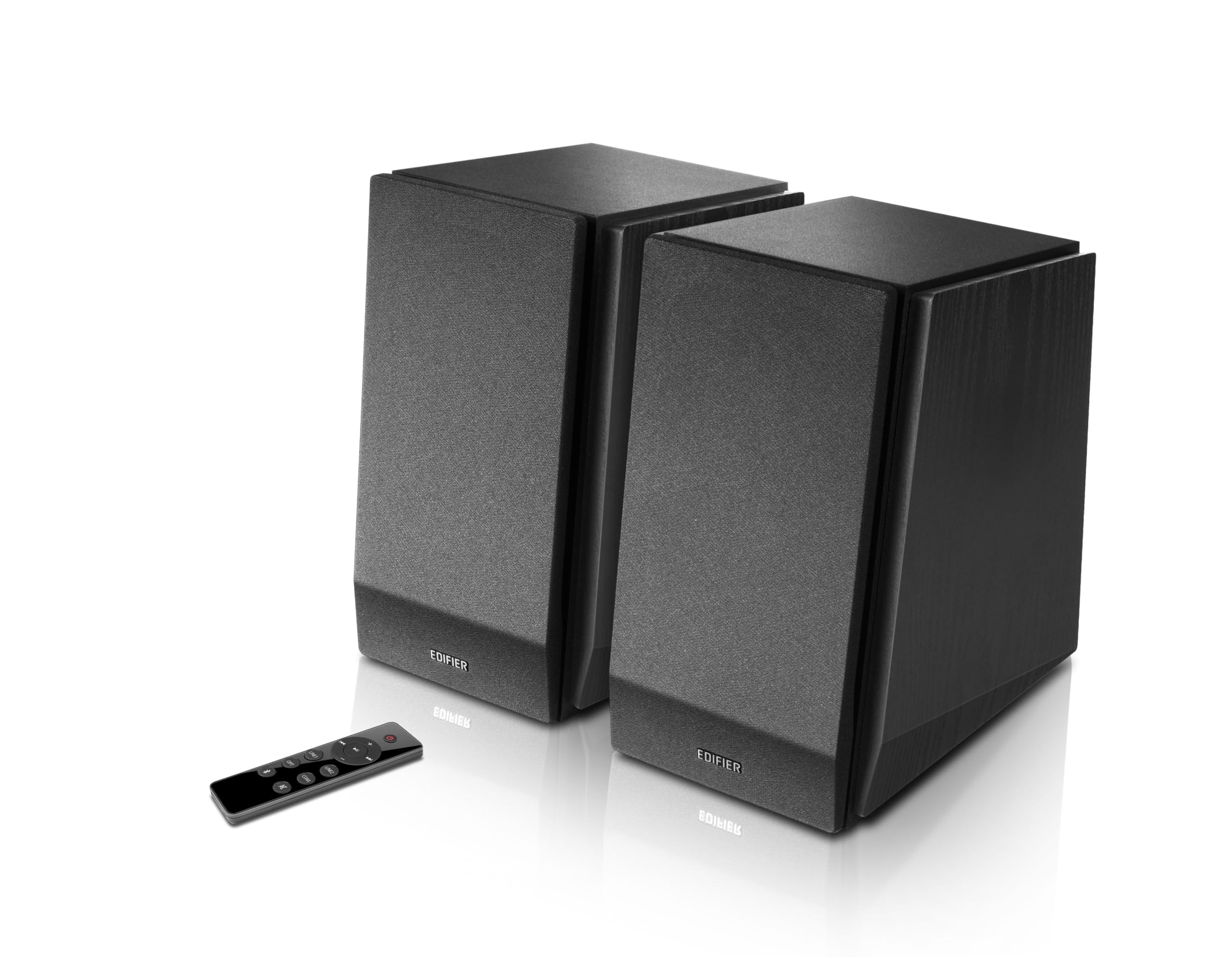
A desk pair that hides its amplifier inside and leaves room to add a subwoofer later.
Five input types is the reason this one stands apart from a simpler Bluetooth speaker: RCA and AUX for a PC or turntable, optical and coaxial for a lossless digital feed from a TV or disc player, and Bluetooth for your phone. The amplifier is built into the cabinet, so there is no receiver to place — two speakers, one power lead, done. Bass and treble are adjustable on the rear panel, and a sub-out jack lets you bolt on a subwoofer when a 2.0 setup is not enough low end. A compact wireless remote handles input selection, volume, and track control over Bluetooth.
This is the newest arrival of the group, so the live review base is still small — the rating sits high but the sample size is thin, which is worth knowing before you treat it as proven. What is not in doubt is the flexibility: coaxing a clean digital signal from a TV and a warm analog one from a turntable out of the same pair is a genuinely useful trick for a desk or a small studio corner. The dimensions put it firmly in bookshelf territory, so measure your shelf before committing.
The connectivity case: optical plus coaxial plus RCA plus AUX plus Bluetooth is the widest input menu here, which makes it the easiest pair to slide into an existing desktop setup.
The sub-out upside: you can start with the 2.0 pair and add a subwoofer through the dedicated jack later — a cheap upgrade path the Denon does not offer.
Suits you if: you sit at a desk or in a small studio and want one pair to serve a PC, a turntable, and a phone.
Hold off if: you want a long track record behind your purchase — this model is new enough that owners have not had years to weigh in.
4. Fluance Ai61 Powered 2-Way Bookshelf Speakers with 6.5″ Drivers and 120W Amplifier

120W of built-in power and real wood cabinets — this is the pair that scales with a bigger room.
The amplifier inside is rated at 120W, and that is the single number that separates it from the Denon’s 2x30W pairing: far more reserve to fill a large living room or open plan without straining. Each cabinet holds a 6.5″ woven glass fiber driver for midrange and clean bass plus a neodymium tweeter (a magnet type that keeps the high-frequency driver small and efficient). The MDF wood cabinets are internally braced to cut resonance, with a rear bass port for deeper low end. Bluetooth 5 is the wireless standard, and the wired menu covers RCA, optical, and USB Type-C. A subwoofer out gives you a path to more bass.
Where the Edifier is a desk tool, this is a room system: the 100-meter Bluetooth range figure is the spec that says it will hold a connection from the next room. Sound quality is the strength owners return to, with detail retrieval getting the praise — the kind of resolution that lets quiet background elements through. Build and setup both draw warm words, and the walnut finish is a genuine furniture choice rather than a black box. There is also a 200-millisecond audio latency figure, which matters if you pipe video through Bluetooth — that delay is why a wired optical or USB connection is the better call for TV watching.
Bluetooth is where the split shows: some find it clean, others hit connection trouble, so lean on the wired inputs for anything that needs to be reliable. Functionality feedback is similarly mixed, and the 6.5″ cabinets are not small — measure your shelf. For a turntable or a TV in a large room, the wired optical and RCA inputs do the heavy lifting, and 4.0+ stars across 250+ ratings backs the package.
The power-to-room read: 120W is the most amplifier muscle of the indoor picks here, and it is already matched to the 6.5″ drivers — the reason this holds up in a bigger space than the 2x30W Denon.
The trade-off to size: mixed Bluetooth feedback plus that 200-millisecond latency means wired optical or USB-C is how you get the cleanest, tightest sync for video.
The fit: a large room, a turntable or TV, and a buyer who wants the amp built in and the bass to reach down.
The mismatch: a small desk or a shelf that cannot take a 6.5″ cabinet — and you lose the wireless convenience if you rely on Bluetooth alone.
Understanding the Specs
Amplifier Power (Watts)
Watts measure how hard the amplifier can push the speakers before it starts to strain. A pair rated at 2x30W sends 30 watts to each of two speakers and suits a small room; a single 120W integrated amplifier carries more reserve for a large space. Higher watts do not make a system “better” — they let it play louder and cleaner in a bigger room. Match the figure to your space, and remember that an outdoor system can list huge numbers like 200W per speaker because it needs that headroom to project across a yard.
Inputs and Connectivity
The input list decides what you can actually plug in. Optical carries a digital signal from a TV in one cable; RCA is the red-and-white analog pair a turntable or older player uses; USB and USB Type-C handle files and computer audio; Bluetooth is the wireless path from a phone or tablet. Bluetooth 5 is a newer wireless version than Bluetooth 4.0, and a higher number generally means more stable range. If a system lacks the input your main source needs, keep looking — no amount of power fixes a missing jack.
Ingress Protection (IP Rating)
An IP rating is a two-digit score for how well a cabinet keeps out solids and water. IP44 means it is protected against dust and against water sprayed from any direction — the right benchmark for a patio or poolside speaker. Indoor bookshelf units carry no such rating and should stay out of the weather. If your speakers live under eaves or by a pool, check this number before anything else.
Drivers, Tweeters, and Cabinets
A driver is the cone that moves air; a tweeter handles the high notes; the cabinet holds it all. A larger driver like a 6.5″ moves more air for deeper bass than a smaller one. A woven glass fiber cone keeps the midrange detailed, while a silk dome tweeter smooths the highs. Wood cabinets braced inside resist vibration that muddies sound, and a rear bass port adds low-end warmth. Plastic ABS cabinets are the durable choice for anything living outdoors.
FAQ
Do I need a separate amplifier if I buy active bookshelf speakers?
Will the Denon D-M41 work with a turntable?
Can I add a subwoofer to these systems?
What does IP44 mean on the outdoor speakers?
Is Bluetooth good enough for watching TV on these speakers?
How much amplifier power do I need for a small room?
What is the difference between coaxial and optical inputs?
Can the outdoor amplifier run four speakers at once?
Do these systems include the speaker cables?
What is the difference between 2.0 and a system with a subwoofer out?
Final Thoughts: The Verdict
For most people, the easiest win is the Denon D-M41 — the amp and speakers arrive matched, the sound is the most-praised thing about it, and it handles CD, radio, and Bluetooth from one compact box. If your listening is outdoors, the STUDIOFINIX system is the one to reach for, because its IP44 rating lets it live where an indoor pair cannot. Want the most amplifier reserve and a real wood cabinet for a big room? Step up to the Fluance Ai61 and its 120W built-in amp. The honest nudge: buy from a seller with a clear return window and test every input in the first week — the systems here are solid, but a couple of the picks have reliability as their split point, and a week of testing settles it.
How We Picked
We do not accept paid placement. Every pick is matched to a real buyer and a real use-case; we do not hands-on test units.
Sources & Methodology
Specifications: manufacturer listings and product documentation. Review insights: verified customer reviews, as of November 2026. Pricing: not shown on this page (it changes often); check the current price via the retailer link.
As an Amazon Associate, Gadgets Feed earns from qualifying purchases. This does not affect which products we feature.