
Our readers keep the lights on and my morning glass full of iced black tea. As an Amazon Associate, I earn from qualifying purchases.
Specs are compiled from manufacturer listings and verified buyer reviews and can change over time — please confirm the key details on the product page before buying.
Choosing the right amplifier is the single biggest upgrade you can make to your home stereo. It determines whether your speakers sound flat or fully alive, shaping how every record, stream, or movie lands in your room. This guide breaks down the top contenders across every budget tier, so you can match an amp to your speakers, sources, and listening habits.
I’m Min — the founder and writer behind Gadgets Feed. This guide is built by comparing the manufacturers’ published specifications and the patterns across verified customer reviews, so you get each pick’s real strengths and trade-offs instead of marketing spin.
Whether you are upgrading from a vintage unit or building a system from scratch, finding the amp for receiver that fits your speakers and listening habits is the key to open up better sound in your home.
Our Picks at a Glance


How To Choose The Best Amp For Receiver
An amplifier takes a weak audio signal and boosts it enough to drive your speakers. A well-matched amp delivers clean, easy sound, while an underpowered one forces you to crank the volume and lose detail. Here are the three things to check first.
Match power to your speakers
Look for the wattage rating on your speakers and the ohms (a measure of electrical resistance) they present. An amp that delivers 70W at 4 ohms, like the Denon PMA-600NE, will comfortably drive most bookshelf and floorstanding speakers. A 35W amp like the Cambridge Audio AXA35 is plenty for efficient speakers in a small room, but hungry towers will want the 100W-plus output of the Yamaha A-S801.
Decide which sources you really use
Count up your sources before you commit. A vinyl collection needs a phono input, which both Cambridge Audio models and the Denon PMA-900HNE include. A TV or game console wants optical or HDMI ARC. Streaming-only listeners can lean on Bluetooth and Wi-Fi, but if you have a CD player or turntable, check the physical inputs on the back panel first.
Quick Comparison
| Model | Best For | Power (8 ohms) | Key Inputs | Weight | Amazon |
|---|---|---|---|---|---|
| Denon PMA-600NE★ Best Overall | All-round value | 45W | Bluetooth, 2 Optical, Coaxial, Phono | 18 pounds | Amazon |
| Pyle PD1000BABest Value | Karaoke and multi-input | — | Bluetooth, USB, FM, CD/DVD, 2 Mics | 20.5 pounds | Amazon |
| Cambridge Audio AXA35Pure Analog Pick | Pure analog sound | 35W | 4 RCA, Phono, 3.5mm Aux | — | Amazon |
| WiiM Amp Ultra | Streaming and smart control | 100W | HDMI ARC, Optical, RCA, LAN | 5.4 pounds | Amazon |
| Marantz MM7025 | Powering a home theater | 140W | RCA, Balanced XLR | 23.8 pounds | Amazon |
| Denon PMA-900HNE | Multi-room streaming | 85W | Wi-Fi, AirPlay 2, Bluetooth, Phono, Optical | 8.3 pounds | Amazon |
| Yamaha A-S801 | High-power detail | 100W | USB DAC, Optical, Coaxial, Phono | 26.7 pounds | Amazon |
| Cambridge Audio CXA81 MkII | Audiophile separates | 80W | Bluetooth aptX HD, XLR, USB, Optical | — | Amazon |
| Yamaha A-S1200 | Vintage-style flagship | — | Phono, Multiple Analog | 48.5 pounds | Amazon |
In‑Depth Reviews
1. Denon PMA-600NE Bluetooth Stereo Amplifier
Our pick — over 4.5★ from 550+ verified ratings; the strongest balance of quality and price.
The all-rounder that sounds like a classic receiver with modern convenience packed in
The Denon PMA-600NE is the easy recommendation for most buyers because it nails the two things that matter most: sound and flexibility. It puts out 45W into 8 ohms and 70W into 4 ohms, which means it will drive a very wide range of speakers, from sensitive bookshelves to more demanding floorstanders. Fans describe the tone as warm and tube-like, like a quality 1970s receiver, with a wider soundstage and airier treble than older amps they owned.
On the connectivity front, it covers just about everything. You get Bluetooth, 2 optical inputs, 1 coaxial input, and a phono input for a turntable, so a CD player, Blu-ray deck, or vinyl rig all have a home. A built-in DAC (a digital-to-analog converter, which turns digital audio into sound your speakers can play) handles streaming duty, and the headphone output can drive 300-ohm headphones like the HD-600 without strain. One happy buyer noted that “45W plenty for 87dB speakers” — meaning sensitive speakers barely need the amp to break a sweat.
You get a sturdy internal power supply here, hinted at by the 185W power consumption, and owners say it runs cool even after long sessions. The trade-offs are minor: several owners find the remote’s volume steps coarse and laggy, and the input LEDs are dim. At 18 pounds, it is lighter than the Pyle below (20.5 pounds), so it is easier to slide onto a shelf.
Why owners love it
- Sound quality is the standout — owners call it clean, rich, and rich
- Great value, with many calling it a big upgrade from vintage amps
- Versatile inputs cover Bluetooth, optical, coaxial, and phono
The honest caveats
- Volume control earns mixed feedback, with a laggy remote
- No Loudness or EQ customization for tone shaping
- Input LEDs are dim and hard to read across a room
Reach for this if: you want one box that handles vinyl, streaming, and TV sound with a warm, detailed signature.
Look elsewhere if: you need tone controls or a more precise remote volume — the Denon keeps things simple.
2. Pyle 4-Channel 1000W Power Amplifier with Bluetooth
A jack-of-all-trades box that adds karaoke mics and a CD player to your setup
The Pyle PD1000BA is the most feature-dense amp on this list, and it is the one to grab if your needs go beyond pure stereo. It delivers 1000W peak power over 2-8 ohms, with seven inputs that include two microphone jacks with echo for karaoke, a front-loading CD/DVD player, an FM tuner, USB-A with an MP3 player, AUX, and a headphone jack. There are also mono RCA outputs dedicated to a subwoofer, so you can build a bigger system around it.
Sound quality is the most-praised feature, with owners saying it is loud enough that you could “hear a pin drop” between notes and that the extra wattage gives a crisp sound. It will drive four speakers plus a sub without strain, which makes it a strong fit for a garage, pool area, or party room. The digital fluorescent display meter shows the active function, and the included remote handles distant adjustments.
The honest catch is reliability and polish. The highest-count aspect in the data is reliability, and it is mixed — some units work well, and others arrive with a dead CD player or a loose volume knob. Bluetooth pairing can be a chore, with owners reporting it took two hours to pair with a Samsung Tizen TV and that pairing disables the other audio inputs. The remote is cheap with sticky buttons, and an occasional unit needs the antenna epoxied after the ring nut strips. This is a budget-flexible box, not a set-and-forget one.
Ideal for the party room: if karaoke, multiple sources, and raw power matter more than polish, this is the value pick. The recurring gripe is reliability — order from a seller with easy returns.
Grab this for: karaoke nights, garage setups, or anyone who wants a CD player, FM radio, and Bluetooth in one box.
Think twice if: you expect flawless build quality or painless Bluetooth pairing — this unit demands patience.
3. Cambridge Audio AXA35 Integrated Amplifier
A no-nonsense analog amp that makes a little power sound like a lot
If you want zero digital fuss and pure musical detail, the Cambridge Audio AXA35 delivers 35 watts into 8 ohms. That number looks modest, but owners unanimously say it feels far more powerful — one called it “a little powerhouse” that drives Polk towers easily, and another noted the 35W per channel is plenty for a small apartment. The sound is described as warm, rich, and spacious, with crisp highs and punchy bass that stays controlled.
Inputs are where this amp keeps things deliberately simple: 4 RCA inputs, a phono input for a turntable, and a 3.5mm aux on the front panel. There is no Bluetooth and no built-in DAC, so this is strictly for analog sources. The built-in phono stage is a highlight, with owners praising it when paired with a vintage Stanton 500e cartridge. If you need streaming, the plan is to add an external streamer like an Arylic S50 to feed it.
Buyers praise the build quality and the satisfying volume knob, and several note the appearance is clean and professional. The one recurring complaint is the display, which is hard to read across a room. It also runs purely analog, so anyone with a TV or digital sources will need an external DAC. At its core, this is a straightforward hi-fi amp that rewards a simple, high-quality source.
The analog purist’s choice: the built-in phono stage and warm, detailed delivery make it a steal for vinyl lovers. Pair it with a streamer if you want digital.
Choose this when: your sources are a turntable, CD player, or phone on aux and you want rich, involving sound.
skip it if: you rely on Bluetooth or a TV input — you will need to add a separate streamer or DAC.
4. WiiM Amp Ultra Stereo Streaming Amplifier

A streaming powerhouse with a touchscreen that replaces a whole stack of gear
The WiiM Amp Ultra is the modern answer to the question of how to stream music without a separate DAC, streamer, and amp. It delivers 100W per channel with ultra-low distortion measured at -106 dB THD+N, which means clean, dynamic sound across a wide range of speakers. Inside, it pairs an ESS SABRE DAC with dual TI TPA3255 amps and a feature called PFFB (post-filter feedback) that keeps the sound consistent regardless of your speaker’s impedance.
Connectivity is where this box shines. It offers Wi-Fi 6, Bluetooth 5.3 with LE Audio, and HDMI ARC, so it slots into a TV setup as easily as a music system. The built-in RoomFit room correction auto-calibrates the sound to your room and speakers, and the 3.5-inch glass touchscreen shows album art and system settings. It streams Spotify, TIDAL, Qobuz, Amazon Music, and more in up to 24-bit/192kHz quality, and it syncs with WiiM, Alexa, or Google speakers for multi-room playback.
Owners are impressed with the sound quality, with one saying it reaches high 80s decibels easily and drives Emotiva T2 towers with punchy, clean output. Another called it “end-game” for an office, praising the detailed EQ and subwoofer controls in the app. The main limitations: it is not compatible with AirPlay, and Bluetooth only supports SBC and AAC codecs, so serious streaming should go over Wi-Fi. It weighs just 5.4 pounds, making it the lightest full-power amp here.
What owners rave about
- Quality and sound are the top two praised aspects, with clean power for most speakers
- The app is excellent, giving full EQ and subwoofer control
- HDMI ARC makes TV audio integration smooth
What to know going in
- No AirPlay support — iPhone users must use the app or Chromecast
- Bluetooth is limited to SBC/AAC codecs, so use Wi-Fi for best quality
- No coaxial input, only optical for digital sources
Best fit for: the modern listener who lives in streaming apps and wants one sleek box with a screen.
Not for: AirPlay loyalists or anyone with a coaxial digital source — check the input list first.
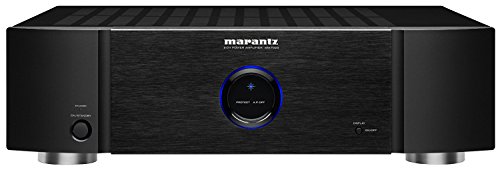
5. Marantz MM7025 Stereo Power Amplifier
The dedicated power stage that gives your home theater real headroom
The Marantz MM7025 is a power amplifier, not an integrated amp, so it has no volume knob or input selector — its only job is to take a signal from a preamp or AV receiver and make it much, much bigger. It delivers 140 watts per channel into 8 ohms, and it offers both single-ended RCA and balanced XLR inputs, so it connects cleanly to a wide range of preamps and receivers, including a Denon AVR setup.
Owners describe the sound as warm and musical, with one noting a “110% improvement in clarity and balance” when adding it to their system. It powers Klipsch RP-280F front speakers “with great might” and handles movies and music equally well. The cooling fan is silent even when it speeds up, and it runs cool at around 80°F during use. At less than 14 inches deep and 5 inches tall, it fits in most shelves or cabinets.
The power output gets mixed feedback — it is ample for most, but a few owners with very inefficient speakers find it underpowered. One unit arrived with a dead right channel, and the binding posts feel flimsy, so it is worth checking on arrival. If you drive speakers below the B&W 800 series, owners say this is excellent value against amps that cost two to three times more.
A clean two-channel muscle amp: the 140W output and balanced XLR inputs make it a serious upgrade for a home theater. Check the unit on arrival — a rare defective one slipped through.
Reach for this when: your AV receiver runs out of steam and you want dedicated, distortion-free power for your front speakers.
pass on it if: you need an all-in-one with volume control — this is purely the power stage.
6. Denon PMA-900HNE Integrated Stereo Amplifier

The Denon that adds whole-home streaming and voice control to serious stereo sound
The Denon PMA-900HNE takes everything the PMA-600NE does well and adds a full streaming platform. It delivers 85W per channel into 8 ohms, and inside it uses Denon’s Advanced High-Current single push-pull circuit, which keeps bass effective and imaging precise. The built-in HEOS system lets you stream the same song to every room or different songs to each, and it works with Spotify, Pandora, and TIDAL over Wi-Fi, AirPlay 2, or Bluetooth.
Voice control is a big differentiator here. You can adjust volume, play music, and skip tracks hands-free using Alexa, Siri, or Google Assistant. The phono input includes both MM and MC equalizer settings, so it handles high-output moving magnet and low-output moving coil cartridges. Owners pair it happily with an Ortofon 2M Blue and a DL-103 MC, praising the phono stage. There are 3 optical inputs and 1 coaxial input for CD players, Blu-ray decks, and TV audio, plus a subwoofer pre-out.
The sound is classic Denon: warm with slightly recessed highs and tight bass, and owners who chose it over the PMA-600NE say it has no hum and a better DAC. The HEOS app gets mixed feedback for being clunky and lacking Tidal Connect, though Spotify Connect works well and auto-wakes the amp. It runs hot, so give it breathing room, and a few owners note the only metal knob is the volume — the rest are plastic. At 8.3 pounds, it is surprisingly light for an 85W integrated amp.
The streamer’s Denon: voice control and HEOS multi-room make it the smartest pick for a connected home. The app is the weak link — plan to use Spotify Connect instead.
Best for: the multi-room household that wants voice control and clean 85W stereo sound.
Consider the alternative if: you live inside the TIDAL app — HEOS lacks Tidal Connect and feels clunky.
7. YAMAHA A-S801BL Natural Sound Integrated Stereo Amplifier

A 100-watt workhorse whose USB DAC rivals far pricier separates
The Yamaha A-S801 is for the buyer who wants real power and a serious built-in DAC without stepping up to separate components. It delivers 100W plus 100W into 8 ohms with an impressively low 0.019% THD (total harmonic distortion, a measure of unwanted noise), and the sound is described as natural, clear, and transparent with defined bass. Owners coming from a 35W amp report a huge jump in detail and soundstage.
The headline feature is the USB DAC input, which handles DSD up to 5.6 MHz and PCM up to 384 kHz/32 bit. One owner called the USB input “best source,” explaining the internal master clock eliminates jitter (a timing error that degrades digital audio), and another claimed it delivers CD-player-quality sound from a computer. You also get a high-quality TOSLINK optical input and a gold-plated coaxial input, both with gold-plated connectors.
Power and sound are the top praised aspects here. The A/B speaker switching lets you run two sets of speakers, and the custom power transformer with 12,000 µF block capacitors and extruded aluminum heat sinks speak to a sturdy build. At 26.7 pounds, this is a heavy, solid unit. The downsides: the phono stage is weak and harsher than a good external preamp, there is no subwoofer output (a Y-splitter works), and the stepped volume control gets mixed feedback. A few owners returned it for a pumped-up low end, calling it the Yamaha signature.
The strengths
- Sound quality and power are the top two praised aspects — clean, deep, and defined
- USB DAC is excellent for computer-based listening
- A/B speaker switching and gold-plated inputs add versatility
The trade-offs
- Phono stage is weak — plan for an external preamp if vinyl matters
- No subwoofer output without a Y-splitter
- Stepped volume control feels coarse to some
Ideal for: the computer-audio fan who wants a powerful Class AB amp with a top-tier DAC built in.
it’s not for you if: you are a vinyl purist — the phono stage will leave you wanting a separate preamp.
8. Cambridge Audio CXA81 MkII Integrated Stereo Amplifier

A reference-level integrated amp that makes every instrument feel lifelike
The Cambridge Audio CXA81 MkII is the serious audiophile’s integrated amp, delivering 80 watts per channel to drive demanding speakers. Inside, it uses an ESS ES9018K2M SABRE32 DAC for reference-level digital-to-analog conversion. The Class AB amplification is balanced and efficient, and the toroidal transformer (a ring-shaped transformer that reduces electrical noise) is credited with the amp’s incredible soundstaging. Owners describe the imaging as lifelike, with excellent representation of musical instruments and separation.
Connectivity is comprehensive. It includes TOSLINK optical, coaxial, and USB audio inputs, plus balanced XLR inputs for a premium connection to sources like the CXN100 network player. Bluetooth arrives in aptX HD form, which carries more data than standard Bluetooth for better wireless sound. It is Roon Tested, so a PC or Mac connects over USB for high-res playback. Owners driving Monitor Audio Silver 500 and KEF LS50 Meta speakers say it punches “way above its price range,” calling it more powerful than the Audiolab 6000A and similar to a Marantz Model 50 with slightly more muscle.
The honest niggles are minor but real. The Bluetooth chip is an older 4.2 spec, not the newer 5.3, and one owner found it unstable with an M2 Mac Mini. The large remote lacks CD player control, and the design is described by one owner as “basic and old fashioned,” looking like “a grandpa’s amplifier” and feeling kinda bulky. For pure two-channel listening, though, the detail and soundstage are hard to fault at this level.
For the discerning ear: the CXA81 MkII rewards good speakers with lifelike imaging and a warm-neutral tone. Pair it with a quality source to hear what it can really do.
Pick this for: a serious two-channel system where instrument separation and soundstage are the priority.
Look elsewhere if: you want a sleek modern look or the latest Bluetooth version — this is old-school inside and out.
9. Yamaha A-S1200SL Integrated Amplifier

The vintage-inspired flagship that brings raw emotion back to your music
The Yamaha A-S1200 is the statement piece, a nod to the golden era of hi-fi with its glowing VU meters and beautiful design. Beneath that retro face sits modern engineering that owners say “reveals new nuances in familiar tracks” — one noted that Led Zeppelin suddenly showed new instrumentation and PJ Harvey sounded live. Another upgraded from the A-S700 and found tighter bass, a wider soundstage, and more detailed highs even though the new amp has 10W less power.
The phono stage is a genuine highlight, with an owner saying it outperforms a dedicated Schitt Mani preamp, especially with 180-gram vinyl. The pre-amp manages a subwoofer smoothly, so it slots into a full system without extra boxes. At 48.5 pounds, this is a heavy, solid piece of equipment that feels like it will last for decades, and it is backed by a 2-year manufacturer warranty.
The caveat is the tonal balance. One owner found the A-S1200 too bright and forward compared to the A-S501 when paired with Klipsch Heresy IV speakers, calling it fatiguing at loud volumes and better suited to classical, guitar, or mid/high-range music. It is a high-end amp, but not for every taste or every speaker pairing. If you want a warm, vintage-sounding amp with serious presence and the looks to match, this is the one.
A sonic truth-teller: the A-S1200 delivers pure, detailed sound with a stunning vintage aesthetic. It is revealing, so pair it with speakers that match its forward character.
Choose this for: the listener who wants flagship build quality, VU meters, and a phono stage that rivals separate preamps.
look elsewhere if: you prefer a laid-back, smooth sound — this amp is forward and revealing by design.
Understanding the Specs
Watts and Ohms
Wattage tells you how much power an amp can deliver, and ohms measure your speaker’s resistance. An amp rated at 70W into 4 ohms will sound louder and drive harder than the same amp rated at 45W into 8 ohms. Match the amp’s rating to your speakers’ impedance — most bookshelf and floorstanding speakers sit at 4 or 8 ohms.
Phono Stage
A phono input is a built-in preamp that boosts the tiny signal from a turntable’s cartridge up to line level. If you play vinyl, you need this input or an external phono preamp. The Denon PMA-900HNE even supports both MM and MC cartridge types, which is rare at that price.
FAQ
What is the difference between an integrated amp and a power amp?
How many watts do I need for my speakers?
Will a 45W amp work with my receiver?
Do I need a phono input to play vinyl?
Is Bluetooth good enough for music streaming?
What is a DAC and why does it matter?
Can I connect a subwoofer to these amps?
What is the difference between Class AB and Class D amps?
Final Thoughts: The Verdict
For the majority of shoppers, the amp for receiver winner is the Denon PMA-600NE because it offers a warm, detailed sound and every input you need at a price that makes sense. If you want streaming and voice control, grab the WiiM Amp Ultra. And for pure analog sound from vinyl, the Cambridge Audio AXA35 is the one to reach for.
How We Picked
We do not accept paid placement. Every pick is matched to a real buyer and a real use-case; we do not hands-on test units.
Sources & Methodology
Specifications: manufacturer listings and product documentation. Review insights: verified customer reviews, as of August 2026. Pricing: not shown on this page (it changes often); check the current price via the retailer link.
As an Amazon Associate, Gadgets Feed earns from qualifying purchases. This does not affect which products we feature.