
Our readers keep the lights on and my morning glass full of iced black tea. As an Amazon Associate, I earn from qualifying purchases.
Specs are compiled from manufacturer listings and verified buyer reviews and can change over time — please confirm the key details on the product page before buying.
You want real speaker power without paying flagship money or clearing a shelf for a bulky receiver. The good news: a small Class D amp (a lightweight amplifier chip that runs cool and sips power) can drive bookshelf and tower speakers for well under a hundred dollars. The catch is sorting out which ones honestly deliver, and which ones just print big wattage numbers on the box.
I’m Min — the founder and writer behind Gadgets Feed. This guide is built by comparing the manufacturers’ published specifications and the patterns across verified customer reviews, so you get each pick’s real strengths and trade-offs instead of marketing spin.
Below you will find the compact amps that actually drive passive speakers well, sorted by what each one does best. The short answer: most people are happiest with a small, cool-running unit with clean headroom and simple controls, which is exactly what this guide to the amp under $100 focuses on.
Our Picks at a Glance


How To Choose The Best Amp Under $100
Buying a small amp is not about chasing the biggest number on the box. It is about matching a real power rating to your speakers, choosing the inputs you will actually use, and accepting that a compact chassis has to shed heat somewhere. Get those three right and a budget amp can make a bookshelf pair sing.
Read the power rating honestly
Peak power is the number manufacturers like to print, because it is the biggest. Rated, or RMS, power is what the amp can sustain into a real load (often measured into 8 or 4 ohms). A modest rated number like 50W x2 into 8 ohms is usually plenty for a bedroom or desktop. Big peak figures tell you about headroom on transients, not continuous volume.
Match your speaker impedance
Impedance is the resistance your speaker presents to the amp, measured in ohms. Most bookshelf speakers sit at 4 or 8 ohms, and every amp here is built to drive that range. Lower-impedance speakers pull more current, so check the amp’s stated supported range before you push a 4-ohm load hard.
Decide which inputs you need
Bluetooth lets you stream straight from a phone with no cable. RCA inputs suit a turntable preamp, CD player, or TV line out. A 3.5mm aux jack handles a phone or laptop directly. If you plan to add a powered sub, look for a dedicated subwoofer output rather than splitting a full-range signal.
Think about heat and size
A Class D amp runs cooler than an old receiver, but a small metal box still needs vents. Good models spread heat through the whole chassis instead of trapping it. This matters if the amp sits in a cramped shelf or runs for hours at a stretch.
Quick Comparison
| Model | Best For | Stated Power | Key Inputs | Form Factor | Amazon |
|---|---|---|---|---|---|
| Fosi Audio V3★ Best Overall | Clean desktop and small-room power | 300W x2 (600W total) | RCA + Pre-out | Compact metal chassis | Amazon |
| AK45ProBest for Karaoke | Karaoke and multi-source setups | 400W + 400W peak | Bluetooth, RCA, USB, SD, MIC | Compact desktop | Amazon |
| Pyle PDA22BT | Small spaces on a budget | 240W peak | Bluetooth + RCA | Mini receiver | Amazon |
| Fosi Audio BT20A | Beginner Bluetooth streaming | 100W x2 | Bluetooth + RCA | Compact one-piece | Amazon |
| AIYIMA A07 | 2.0 and 2.1 desktop hi-fi builds | 300W x2 (600W total) | RCA + 3.5mm Pre-out | Compact metal chassis | Amazon |
| Dayton Audio DTA-2.1BT2 | Adding a subwoofer cleanly | 2 x 50W + 100W sub | Bluetooth, RCA, 3.5mm Aux | Aluminum desktop | Amazon |
| AIYIMA A07 MAX | Flexible stereo or mono bridging | 300W x2 / 600W mono | 3.5mm Aux + Line Out | Compact metal chassis | Amazon |
In‑Depth Reviews
1. Fosi Audio V3 Stereo Amplifier
Our pick — 4.5+★ from 400+ verified ratings; the strongest balance of quality and price.
Clean headroom in a metal box small enough to sit beside your monitor.
The Fosi V3 runs on a TPA3255 Class D chip (a high-efficiency digital amplifier chip) and quotes up to 300W x2 into 4 ohms, or 600W total. That is enough to wake up passive bookshelf and tower speakers without a full-size receiver taking over your desk. It ships with a 48V power supply, so you get that headroom straight from the start.
Inside it uses Japanese NCC and ELNA capacitors and German WIMA capacitors, plus Sumida inductors. The quoted noise floor is just 140uV, which means you hear less background hiss between tracks. A quoted SNR (signal-to-noise ratio, the gap between music and background noise) of 110dB and a SINAD reading of 88dB point to a low-distortion, quiet presentation. Setup is genuinely simple — plug in the power supply, hook up your speakers, and go.
The real draw for tinkerers is the swappable op-amps (small plug-in chips that shape the tone). You can roll in alternatives like the MUSES02, OPA2134PA, or LM4562 to tune the sound to taste. This is the one area where the controls draw mixed feelings — a few find the stock chip fine and the swapping game unnecessary. Heat is handled by vents on the top and bottom and a whole-body heatsink, so the casing warms up but stays stable. For its class, it is a strong all-rounder and the pick I would hand most buyers first.
Where it earns its keep
- 300W x2 into 4 ohms of headroom from a single compact chassis.
- 140uV noise floor keeps quiet passages genuinely quiet.
- Heat spread through the body keeps it cool under long sessions.
- Swappable op-amps let you reshape the tone later.
What to weigh first
- The stock chip is fine, so op-amp swapping is a hobby, not a need.
- No built-in Bluetooth — this is a wired RCA unit.
Pick it for: anyone running passive bookshelf or tower speakers who wants clean power and a quiet floor from a desk-sized amp.
Pass if: you stream wirelessly from your phone and do not want a separate Bluetooth receiver in the chain.
2. AK45Pro Stereo Audio Amplifier
Two mic jacks, a remote, and a whole bookshelf of inputs in one tiny unit.
The AK45Pro is built for people who want to plug in everything. It lists 400W + 400W peak power with a rated 50W x2, and it takes Bluetooth, RCA, USB, SD card, and two microphone inputs. Add the remote (which needs AAA batteries you supply) and you can run a karaoke night or a garage system from the couch.
On raw output it is a step up from the Pyle here on paper — 400W versus 240W peak. That extra headroom is why owners reach for it with small speakers: it gives more than enough power for a bedroom or basement rig. Bass, treble, mic volume, and master volume all have their own knobs, so you can dial in the tone rather than live with a fixed curve.
Two things keep it honest. Bluetooth pairing works for most but not all devices — Echo speakers in particular are a known snag — and power delivery is mixed, with smaller speakers happy while larger ones can feel shortchanged. Build quality and sound quality are what keep it feeling like a good buy at this price. If you want a single box that handles mics, streaming, and a USB stick, this is the most flexible pick on the list.
Inputs galore: Bluetooth, RCA, USB, SD, and dual mic jacks mean you rarely need an adapter to connect something.
The honest catch: pairing and power are both mixed, so treat it as a great small-room amp rather than a whole-house driver.
Reach for it when: karaoke, garage tunes, or a cluttered desk of sources is the plan, and you want them all in one box.
Look elsewhere if: you expect flawless Bluetooth pairing with an Echo or plan to push big tower speakers hard.
3. Pyle 240W Mini Bluetooth Home Stereo Amplifier

A 1.81-pound mini receiver that punches well above its size for small rooms.
The Pyle PDA22BT quotes 240W of peak power into 8 ohms and weighs just 1.81 pounds, so it disappears onto a shelf. It drives a pair of 150-watt bookshelf speakers cleanly at bedroom and desktop levels, which is the job most people buy it for. RCA inputs handle a turntable or CD player, and the built-in Bluetooth handles phone streaming.
What wins people over is the sheer performance for the size. The rotary bass and treble dials and toggle switches let you shape the sound, and banana speaker terminals make hookup clean. Setup is quick, and the value for a mini amp this capable is what keeps it popular. At 1.81 pounds it fits on a garage shelf, a desk, or a dorm dresser where a full receiver never would.
Bluetooth range is the recurring gripe — pairing is quick, but some rooms stretch the connection thin, so keep your phone close. Otherwise it delivers steady sound for the money. Compared with the AK45Pro, it does not offer mic or USB inputs, so if karaoke is the goal that one wins. For straight stereo in a small space, this is the value buy to beat.
Why it stands out
- Only 1.81 pounds, so it fits almost anywhere.
- 240W peak drives bookshelf speakers with room to spare.
- Bass and treble dials let you tune to taste.
- Banana terminals keep the wiring simple.
Where it asks for patience
- Bluetooth range is shorter than ideal — keep the source close.
- No mic or USB inputs, so it is stereo only.
Best suited to: a desk, garage, or dorm where space is tight and the budget is friendly.
Not the one for: karaoke sessions or setups that need streaming from far across the room.
4. Fosi Audio BT20A Bluetooth Stereo Amplifier

The beginner-friendly workhorse that has quietly become a living-room staple.
The BT20A is proof that you do not need huge wattage to fill a room. It quotes 100W x2 and weighs 567 g, making it a compact substitute for a bulky receiver. Bluetooth and RCA inputs cover phone streaming and wired sources, and setup takes under 10 minutes to wire and connect. It fills a shop floor or a small venue without pushing past halfway on the dial.
Fosi pairs the power with smooth bass and treble controls, so you can tune to your bookshelf speakers rather than fight a flat curve. The one-piece all-black design is durable and sits neatly on a shelf. Bluetooth range is generous and sound stays clean with no distortion — this is the sort of amp that just disappears once it is wired up.
The honest trade-off is at the edges. Bluetooth is great on range but occasionally cuts out, and durability has a small mixed streak over time. Compared with the V3, it offers 100W x2 versus 300W x2 and no pre-out, but it is simpler for someone who mainly streams. For a first amp and a bookshelf pair, this is the safe, well-loved choice.
Why it is trusted: it has racked up the most ratings on this list by a wide margin, and the sound stays clean with no distortion.
Keep in mind: Bluetooth can drop out now and then, and it will not drive huge tower speakers the way the 300W units do.
Go with it if: you want a simple, well-proven amp for a bookshelf pair and mostly stream from your phone.
Hold back if: you need pre-out flexibility or the extra headroom of a 300W x2 design.
5. AIYIMA A07 Premium Stereo Amplifier

A 2.1 builder’s amp with a pre-out jack that turns two speakers into a system.
The A07 leans on a Texas Instruments TPA3255 chip and quotes up to 300W x2, or 600W total, into passive speakers. What makes it different is the 3.5mm pre-out: it sends a full-range signal to a powered subwoofer or active speakers, so you can build a 2.1 desktop rig without a separate sub crossover. It ships with a 32V 5A adapter, and the maker notes the full 300W x2 needs an upgraded 48V supply.
Inside are Japanese ELNA capacitors, 63V filter capacitors, and German WIMA capacitors, which is a serious parts list for the class. It runs cool and quiet, and it easily drives 2-8 ohm passive bookshelf speakers. The NE5532 op-amp is swappable, so you can move to OPA, LM, or MUSES chips later if you enjoy tinkering. Compared with the BT20A, it offers 300W x2 versus 100W x2 and the pre-out flexibility the Fosi lacks.
Buyers report mixed reliability, so pair it with well-matched speakers instead of pushing it past its limits. For most listeners that never comes up, and the clean, quiet output is what the praise centers on. If you plan to add a sub, this is among the most flexible ways to get there under the budget.
Worth it for: anyone building a 2.1 desktop system who wants a pre-out and swappable op-amps.
Second-guess it if: you want the simplest set-and-done amp and will never touch a sub or an op-amp.
6. Dayton Audio DTA-2.1BT2 Desktop Amp
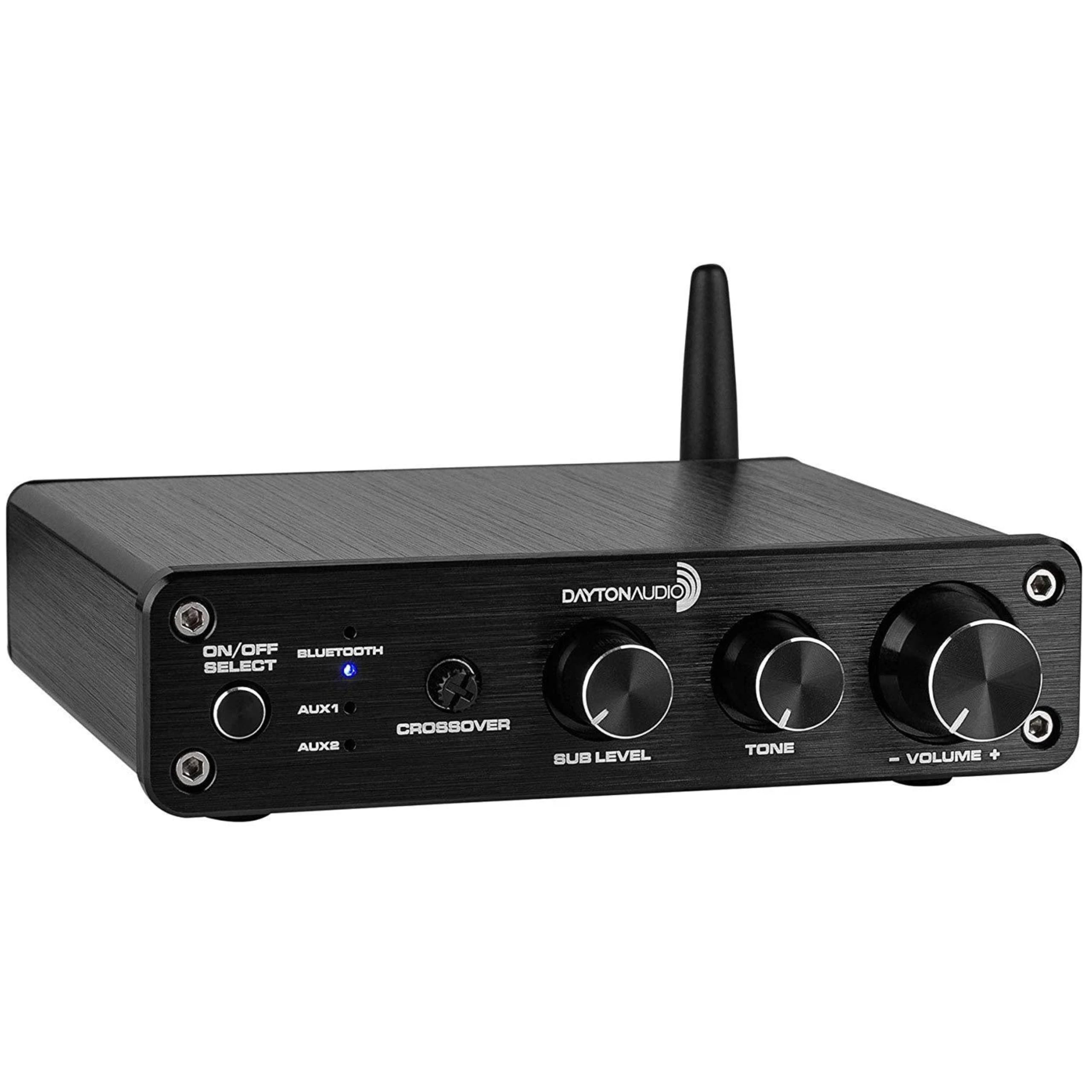
A true 2.1 amp with a dedicated 100W subwoofer channel built in.
Most amps on this list stop at two speakers. The Dayton DTA-2.1BT2 goes further with a 2 x 50W stereo output plus a separate 100W passive subwoofer output, which is the cleanest way to add bass without a second box. It handles Bluetooth, stereo RCA, and 3.5mm aux, and the front panel gives you sub crossover frequency, sub level, tone, and volume controls in one place.
The subwoofer crossover is adjustable from 50-120 Hz, so you can tune where the bass hands off to your bookshelf pair. That control over the low end is rare at this size. Its 100W sub channel drives a 12-inch passive sub alongside two bookshelf speakers without strain, and the aluminum enclosure keeps it tidy on a desk. The Class D design runs efficiently for a home-theater or small-office setup.
Two honest notes. A small number of owners pick up on background noise, so placement and cabling matter. And with fewer ratings than the big sellers here, it is a specialist’s choice rather than a crowd favorite. But if you already own a passive sub and want one amp to drive the whole 2.1 rig, this is the purpose-built pick.
The sub-friendly wins
- Dedicated 100W subwoofer output drives a passive sub directly.
- Adjustable 50-120 Hz crossover tunes the bass hand-off.
- Bluetooth, RCA, and 3.5mm aux cover most sources.
- Aluminum chassis keeps a desktop setup tidy.
Worth knowing before you buy
- A few owners notice background noise, so keep cables clean.
- Fewer total ratings than the big-name amps here.
The right call for: a passive sub plus bookshelf pair that needs one amp to run the whole 2.1 system.
skip it if: you only run two speakers and never plan to add a subwoofer channel.
7. AIYIMA A07 MAX Power Amplifier

One switch flips this amp from stereo to a 600W mono powerhouse.
The A07 MAX carries the same TPA3255 chip as its sibling but adds a mode switch underneath. In stereo it delivers 300W x2 into 4 ohms; flip the switch and it becomes a 600W mono bridged amp. Pair two of them in mono and you can build a high-power dual-channel system, with a 3.5mm line out feeding the next unit.
It ships with a 36V 6A adapter and quotes an SNR up to 110dB, so it stays clear as you push it. Heat was clearly a design focus — vents run along the sides and bottom to block dust while shedding heat, which keeps the housing comfortable even during long sessions. Japanese capacitors, ELNA and German WIMA caps round out the build, and the NE5532 op-amp is swappable.
The volume control is the one thing that draws mixed feedback, so expect to fine-tune the knob rather than lean on a remote. It also has no phono input, so a turntable needs a separate preamp. Compared with the V3, it trades simplicity for the stereo/mono flexibility — if you might run a sub in mono down the road, that switch is worth the extra outlay. For most two-speaker setups, though, the plain V3 is the easier buy.
The flexible spec: stereo-to-mono bridging plus a line out makes it the building block for a bigger system later.
The honest limit: the volume knob is the weak point for fine control, and there is no phono stage.
Choose it if: you want an amp that can grow into a bridged mono build or a two-unit system.
Steer clear if: you need a remote, a phono input, or simple one-knob control.
Understanding the Specs
Peak vs Rated Power
Peak power is the brief burst an amp can hit, while rated power is what it sustains. A 400W peak amp with a 50W x2 rating is telling you it has transient punch but a modest continuous output. For small rooms and bookshelf speakers, the rated figure matters more than the headline peak. Match it to your speaker’s handling rather than chasing the biggest number.
Impedance and Ohm Matching
Impedance is the load your speaker puts on the amp, measured in ohms. Most bookshelf speakers sit at 4 or 8 ohms, and the amps here are built to drive that range. Lower-ohm speakers pull more current, so a 4-ohm load is harder work than an 8-ohm one. Check the supported range before pushing a low-impedance pair hard.
Class D Efficiency
A Class D amp switches on and off very fast instead of running continuously like an old analog design, so it wastes less energy as heat. That is why these units stay small and cool. It also means a compact chassis can deliver serious wattage without a massive heatsink — but good venting still matters for long sessions.
The Pre-Out and Sub Output
A pre-out sends a signal to another powered device, such as a subwoofer or active speaker. Some amps control that pre-out level with the main volume knob, which keeps everything balanced. A dedicated subwoofer output with its own crossover goes a step further, letting you fine-tune where the bass hands off.
FAQ
What is the difference between peak power and RMS power on a mini amp?
Will a mini amp drive my 8-ohm bookshelf speakers?
Do I need a subwoofer output to add bass?
Can I use a mini amp with a turntable?
Why does my mini amp run warm to the touch?
Is Bluetooth good enough for serious listening on these amps?
Which mini amp is best for a 2.1 desktop system?
How much power do I need for a large room?
Do I need an external power supply upgrade?
Can I run two amps together for more power?
Final Thoughts: The Verdict
For most people the cleanest answer is the Fosi Audio V3, because it gives 300W x2, a 140uV noise floor, and heat-spreading vents in a chassis that fits beside a monitor. If you mostly stream from your phone and want a proven workhorse, the Fosi Audio BT20A is the easy, well-loved choice. And if a subwoofer is part of your plan, the Dayton DTA-2.1BT2 is the one built to run the whole 2.1 rig. Whatever you pick, match the rated power to your speakers’ impedance and sensitivity rather than the biggest number on the box.
How We Picked
We do not accept paid placement. Every pick is matched to a real buyer and a real use-case; we do not hands-on test units.
Sources & Methodology
Specifications: manufacturer listings and product documentation. Review insights: verified customer reviews, as of November 2026. Pricing: not shown on this page (it changes often); check the current price via the retailer link.
As an Amazon Associate, Gadgets Feed earns from qualifying purchases. This does not affect which products we feature.