
Our readers keep the lights on and my morning glass full of iced black tea. As an Amazon Associate, I earn from qualifying purchases.
Specs are compiled from manufacturer listings and verified buyer reviews and can change over time — please confirm the key details on the product page before buying.
You want an amp that makes your headphones sound alive, not just loud. A cheap port on a receiver can sound flat and lifeless, while a dedicated headphone circuit lets you hear every layer in a mix for the first time. This guide focuses on the amps that treat that 3.5mm or 6.35mm output as a serious feature, not an afterthought.
I’m Min — the founder and writer behind Gadgets Feed. This guide is built by comparing the manufacturers’ published specifications and the patterns across verified customer reviews, so you get each pick’s real strengths and trade-offs instead of marketing spin.
Whether you are building a desktop HiFi station or just want to enjoy lossless tracks from your phone, these nine models represent the best range of options for an amp with headphone jack available today.
Quick Picks
- HIFIMAN EF600 Desktop Balanced Headphone DAC — Best Overall
- Juson Audio JTA200 300W EL34 Tube Amplifier — Premium Pick
- Fosi Audio ZH3 DAC Headphone Amp — High-End Value
- Douk Audio TUBE-T5C Vacuum Tube Preamp — Vintage Vibe
- Fosi Audio MC331 Tube Integrated Amplifier — Top Performer
- Khadas Tea Headphone Amplifier with Bluetooth — Portable Power
- Willsenton R8 KT88 Tube Amplifier — Pure Tube
- TONALUXE 8-Channel Headphone Mixing — Studio Workhorse
- Pyle 6-Channel Bluetooth Wireless Home — Budget Champion
How To Choose The Best Amp With Headphone Jack
The headphone jack on an amplifier is not just a place to plug in. What matters is the quality of the circuitry behind it, how much clean power it delivers, and whether the amp’s main design compromises that output. Here are the deciding factors.
Power and Impedance Matching
Your headphones have an impedance rating measured in ohms (Ω), and the amp needs enough output power to drive them without distortion. A sensitive in-ear monitor might need only a few milliwatts, but a high-impedance headphone like the Sennheiser HD600 at 300Ω needs a lot more voltage swing — look for power ratings at higher impedances, not just at 32Ω.
Output Type: Single-Ended vs. Balanced
A standard single-ended output (3.5mm or 6.35mm) shares a common ground between left and right channels, which can introduce a tiny bit of crosstalk (signal bleeding from one channel to the other). A balanced output (4.4mm or XLR) doubles the amplifier circuitry per channel, canceling noise and often delivering significantly more power — useful for demanding headphones but not essential for every listener.
DAC Quality and Connectivity
If the amp includes a built-in DAC (a chip that converts digital audio from your computer or phone into an analog signal), the chipset matters. Chips like the AKM4493SEQ or the ESS ES9281AC Pro support higher bit depths and sample rates, meaning less noise and more detail. Also check whether the amp has USB, optical, or Bluetooth inputs to match your source devices.
Amplifier Topology: Tube vs. Solid-State
Tube amplifiers use vacuum tubes to add even-order harmonic distortion that many listeners describe as warm, smooth, or lush. Solid-state amps aim for a neutral, low-distortion signal. Hybrid designs combine a tube preamp stage with a solid-state output for warmth without sacrificing power and clarity. Your personal taste in sound signature is the deciding factor.
Quick Comparison
| Model | Best For | Headphone Output Power | Amplifier Topology | Bluetooth | Amazon |
|---|---|---|---|---|---|
| Khadas Tea | Ultra-portable phone DAC/amp | 165mW | Solid-State (ESS DAC) | Yes, LDAC 24-bit/96kHz | $89.99Amazon |
| TONALUXE 8-Channel | Studio multi-monitoring | High-power, 8Ω load | Solid-State (JRC op-amps) | No | $94.60Amazon |
| Douk Audio TUBE-T5C | Tube preamp with headphone out | 500mW into 16-600Ω | Hybrid Tube (ECC83) | No | $109.99Amazon |
| Pyle 6-Channel | Budget home audio and karaoke | 750W peak (speaker) | Solid-State Class AB | Yes | $128.99Amazon |
| Fosi Audio MC331 | Desktop integrated tube amp | 105W x2@4Ω (speaker) | Hybrid Tube (5725W) | Yes | $118.79$131.99Limited time dealAmazon |
| Fosi Audio ZH3 | Desktop balanced DAC/headphone amp | 2570mW@32Ω (balanced) | Solid-State (AKM4493SEQ) | No | $199.99Amazon |
| Juson Audio JTA200 | High-end hybrid tube with modern inputs | 150W RMS x2 (speaker) | Hybrid Tube (EL34) | Yes, BT 5.4 | $619.00Amazon |
| HIFIMAN EF600 | High-power desktop for planars | 5.12W per channel (balanced) | Solid-State (HYMALAYA PRO) | No | $649.00$799.00Amazon |
| Willsenton R8 | Audiophile pure tube integrated | High (tube-dependent) | Pure Tube (KT88/EL34) | No | $1,449.38Amazon |
In‑Depth Reviews
1. HIFIMAN EF600 Desktop Balanced Headphone DAC & Amplifier

The desk anchor built to open up the full potential of demanding planar magnetic headphones, with 5.12W per channel.
Your headphones can only sound as good as the power driving them, and the EF600 delivers a massive 5.12W per channel through its balanced output. That kind of headroom means even power-hungry planar drivers — which need a lot of current to move that thin diaphragm — stay tight, controlled, and distortion-free at any listening level. The internal HYMALAYA PRO DAC chip is designed for extremely low noise and low power consumption, which gives you a black background behind the music where micro-details emerge cleanly.
The Bauhaus-style industrial design is not just for looks: the center of gravity sits at the bottom for stability, and heat vents at the top keep the electronics cool during long sessions. On the back you get both XLR and RCA inputs, and the front panel offers a 6.35mm single-ended jack alongside a 4-pin XLR balanced output. One trade-off is that this unit is purely wired — there is no Bluetooth or USB input for direct phone connection, so you will need a dedicated source like a computer, streamer, or CD transport. This means it is a better fit than the Fosi Audio ZH3 if you value maximum balanced power over connectivity options; the ZH3 has more inputs but delivers only 2570mW via its balanced output.
The Powerhouse
- 5.12W per channel balanced output drives virtually any headphone
- HYMALAYA PRO DAC delivers extremely low distortion and noise
- Stable, heat-tune chassis keeps performance consistent
The Limitations
- No Bluetooth or built-in USB input — requires a separate source
- Heavier build (2.88 kg) is not portable
Reach for this if: you own high-impedance dynamic or planar headphones that need clean, high-current power to sound their best.
Look elsewhere if: you need a wireless or all-in-one solution for your phone or laptop.
2. Juson Audio JTA200 300W EL34 Tube Amplifier
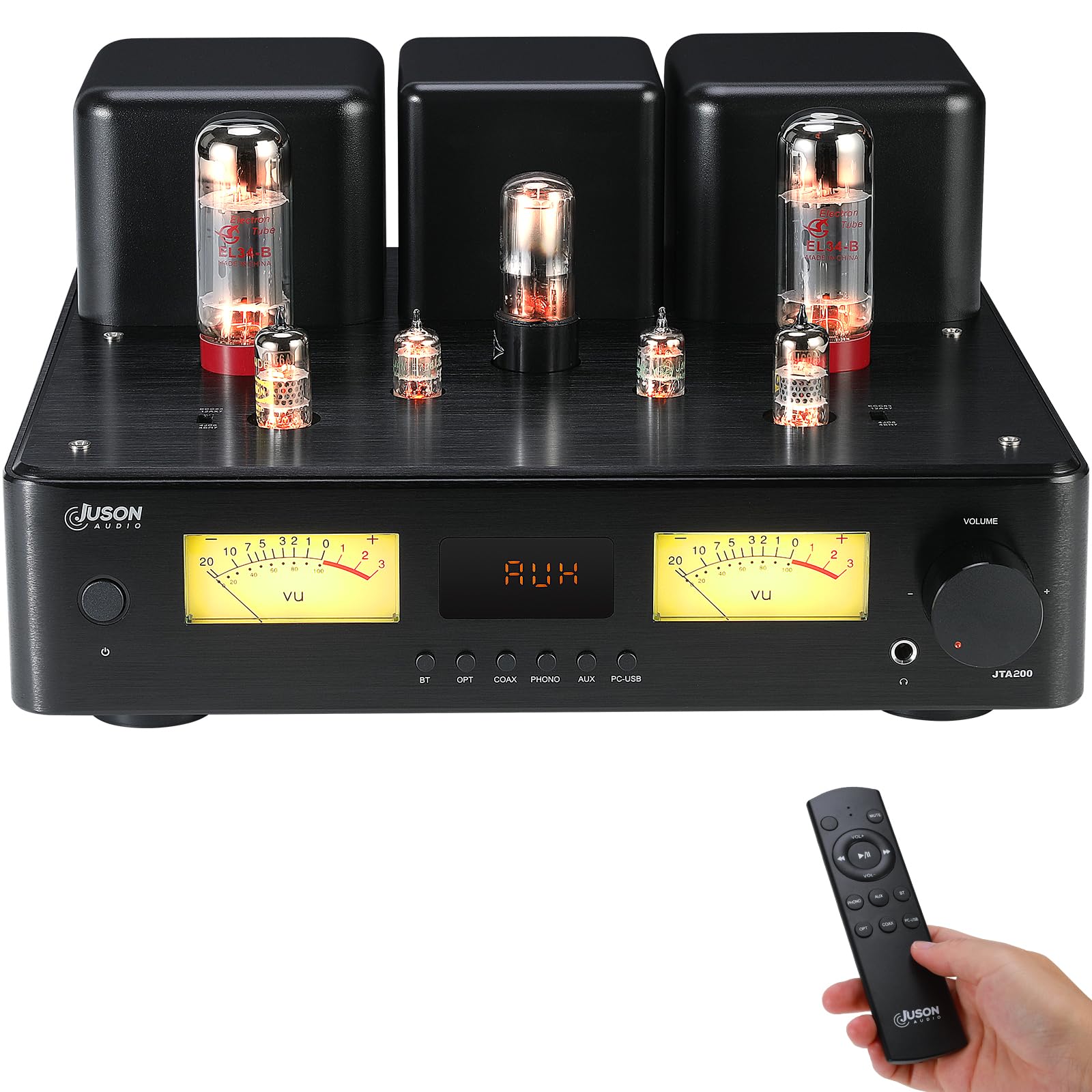
The hybrid that brings tube warmth and modern wireless convenience together in one heavy chassis, rated at 150W RMS per channel.
With a 150W RMS per channel output, the JTA200 pairs EL34 power tubes with Toshiba transistors in a Class AB hybrid design — so you get the rich harmonic texture of vacuum tubes on the front end and the clean, efficient power delivery of solid-state on the back. The headphone output includes a high-low impedance switch that the maker says can drive 16 to 600 ohm headphones easily, which means it works from sensitive IEMs all the way up to high-impedance studio cans like the Beyerdynamic DT 990 Pro.
Uniquely among premium tube amps, this one includes the QCC3095 chip supporting BT 5.4 with aptX Adaptive, aptX HD, and LDAC — giving you near-lossless wireless streaming from your phone. Inputs cover AUX, COAX, PHONO, and OPT, plus a subwoofer output for a 2.1 setup. The LED display and VU meter add a cool visual element, though the item weight of 31.9 pounds means you need a sturdy rack or table to hold it.
The sound anchor: the dual WY-4P Stabilivolt tube and 5726 rectifiers work to keep voltage stable and reduce hum, which buyers report makes the amplifier sound clean even at higher volumes.
The catch: at 31.9 pounds this is a permanent installation, not something you move between rooms.
Grab it for: a complete high-end system that streams wirelessly and drives speakers and headphones with tube character.
Pass if: you need something compact or you do not want to manage tube replacement over time.
3. Fosi Audio ZH3 DAC Headphone Amp

The fully balanced desktop hub that delivers 2570mW@32Ω, outperforming amps many times its size.
Inside the ZH3, the AKM4493SEQ DAC chip and XMOS XU316 processor handle digital conversion up to PCM 768kHz/32bit and DSD512 — numbers that mean the chipset can resolve extremely fine musical detail without introducing noise. The self-developed dual-power balanced amp circuit uses four OPA1612 op-amps and multiple ultra-low-noise LDOs to keep the noise floor at just 1.9μV, which is quiet enough that even sensitive in-ear monitors sound black and silent between tracks.
The headphone output is where things get interesting. Through the 6.35mm single-ended jack you get 640mW@32Ω, but the 4.4mm balanced output delivers 2570mW@32Ω — more than four times the power. A 3-level gain switch lets you match the output to headphones from 16Ω up to 300Ω. The front-panel screen gives you access to bass/treble EQ adjustments and six digital filter types, and the remote makes it easy to change settings from your listening chair. It has more inputs than the HIFIMAN EF600, but they compare closely in noise floor performance — both aim for black backgrounds.
The Balanced Advantage
- 2570mW@32Ω through balanced output drives demanding headphones easily
- AKM4493SEQ DAC with XMOS processor delivers superb clarity
- Bass/treble EQ and filter selection for sound customization
Small Trade-offs
- EQ only applies to headphone output, not the preamp outputs
- RCA and XLR output levels differ significantly — match to your gear
Best suited for: the desktop audiophile who wants a single box that drives both headphones and powered speakers with studio-grade precision.
Think twice if: you only listen through speakers — the EQ limitations and output-level mismatch matter more in that use case.
4. Douk Audio TUBE-T5C Vacuum Tube Preamp

The tube preamp with a glowing VU meter that lets you tweak bass and treble to your taste, rated at ≤0.06% THD+N.
The TUBE-T5C is built around a 180V tune tube circuit using a 12AX7 (ECC83) tube, which adds the classic harmonic warmth that tube fans look for. It delivers up to 500mW of power into headphones from 16Ω to 600Ω, so it can drive demanding models like the Sennheiser HD600 or Beyerdynamic DT 990 Pro without breaking a sweat. The total harmonic distortion is rated at ≤0.06% with a signal-to-noise ratio of ≥107dB, figures that put it in the clean fringes of tube audio.
On the front, a vintage-style dual-channel VU meter gives you real-time level feedback while RGB lighting under the tube adds a customizable glow. The 4-way RCA input selector means you can connect up to four sources — a CD player, a DAC, a streamer, and a turntable — and switch between them without unplugging cables. The bass and treble controls offer ±6dB of adjustment, letting you shape the sound to your room or your headphones.
The tube-swapper’s dream: the pluggable op-amp and tube sockets make upgrades easy — swap the NE5532 op-amp for a 2134 or change the ECC83 for a PSVANE 12AX7-S to tune the sound.
One note: this unit does not include Bluetooth or a built-in DAC, so it works best as a preamp in an existing HiFi system.
Perfect for: the listener who loves tube warmth and wants a preamp that also serves as a dedicated headphone amp in one box.
Not ideal if: you need an all-in-one DAC/amp or wireless streaming built in.
5. Fosi Audio MC331 Tube Integrated Amplifier
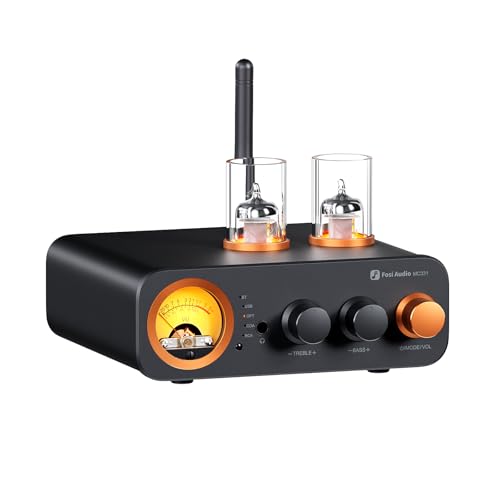
The compact all-in-one that brings tube warmth to desktop speakers and headphones alike, with 105W x2@4Ω speaker output.
Fosi Audio packs a lot into the MC331: a DAC, a preamp, a speaker amplifier, and a headphone amplifier all in a chassis that weighs 4.2 pounds. It outputs a maximum of 105W x2@4Ω for passive bookshelf speakers, which is enough to fill a medium-sized room. The 3.5mm headphone output on the front lets you switch between speakers and private listening without changing connections — making this a true desktop hub for a computer or turntable setup.
The 5725W vacuum tubes in the preamp stage add a warm and soft character to the sound, and the VU meter on the front panel provides a visual pulse that matches the music. Inputs cover Bluetooth, USB, coaxial, optical, and RCA, so you can connect a computer, a phone, a CD player, or a turntable with a built-in phono preamp. Reviewers report that after a 15-20 second tube warm-up, the soundstage opens up noticeably. One reviewer noted the included vacuum tubes failed after a few days and needed replacement, so consider that a possible early expense.
The All-Rounder
- 105W x2@4Ω for speakers plus a dedicated headphone output
- Multiple inputs including Bluetooth and USB-C for modern sources
- Replaceable tube design lets you customize the sound signature
The Drawbacks
- Some reports of low-quality stock tubes that may need early replacement
- Remote control has noticeable latency — about 2 seconds
Choose this if: you want a single compact box to power speakers, stream Bluetooth, and drive headphones with tube character.
skip it if: you need a precise remote experience or cannot tolerate the possibility of swapping tubes.
6. Khadas Tea Headphone Amplifier with Bluetooth

The MagSafe amp that slips onto your phone and upgrades its audio with a real DAC, delivering 165mW through its 3.5mm jack.
At less than 0.3 inches thick, the Khadas Tea solves a specific problem: your phone’s internal DAC is often mediocre, and this tiny box sticks to the back of an iPhone via MagSafe to deliver a much cleaner signal. Inside is the ESS ES9281AC Pro DAC chip, which processes up to 24-bit 96kHz via LDAC Bluetooth — so even wireless streaming from Apple Music or Tidal retains more of the original recording. The built-in 1160mAh battery gives you up to 8 hours of continuous playback without draining your phone battery.
The 3.5mm headphone jack delivers 165mW of power, which is modest compared to desktop amps but enough to drive medium-impedance headphones. Owners mention that it powers Sennheiser HD6xx well, which is impressive for a device this small. The aluminum and tempered glass build feels premium, and the MagSafe hold is strong. One buyer mentioned the back glass cracked from sitting on it, and the bundled USB-C cables are flimsy — so plan for an aftermarket cable.
The wireless audiophile: reviewers consistently mention that the Bluetooth sound quality is surprisingly good, even comparing it favorably to the iFi GO Blu, with better USB input performance.
The trade-off: the slim design means oversized cable terminations can cause a slight wobble, and there is no companion app for EQ or configuration.
Best for: iPhone users who want lossless music from streaming apps without being tied to a headphone cable to their phone.
Avoid if: you need high power for very demanding headphones or prefer a wired-only desktop setup.
7. Willsenton R8 KT88 Tube Amplifier

The hand-wired pure tube amplifier weighing 26 kilograms that lets you swap between KT88 and EL34 for three different sound signatures.
The Willsenton R8 is for the dedicated tube enthusiast. It is pure hand-wired with what the maker describes as scaffolding construction, and it can function as an integrated amplifier, a power amplifier, or a headphone amplifier. The default tubes are four KT88s, but the rear-panel red selection button lets you switch to use EL34 or 6550 tubes without any modification — so you effectively own three different amplifiers depending on which tube set you plug in.
You get triode and ultra-linear operating modes switchable from the front, a remote control, vacuum tube protective covers, and an English manual. The 26-kilogram weight (57 pounds) and dimensions of 15.35 by 15.75 by 7.87 inches mean this is furniture-grade audio gear that needs a dedicated audio rack. The maker recommends 100-300 hours of run-in time for the tubes to stabilize, with best sound appearing after 300 hours.
The tube roller’s paradise: this single amp can deliver three distinct sonic characters depending on whether you run KT88, EL34, or 6550 tubes — a flexibility rarely found in a single chassis.
The reality check: at 26 kilograms and requiring a lengthy burn-in period, this is for the serious hobbyist who treats tube rolling as part of the experience, not a hassle.
Perfect for: the tube aficionado who wants one amplifier that can evolve with different tube types over years.
Not for: anyone looking for a simple plug-and-play solution or needing a lightweight, compact unit.
8. TONALUXE 8-Channel Headphone Mixing Distribution Amplifier
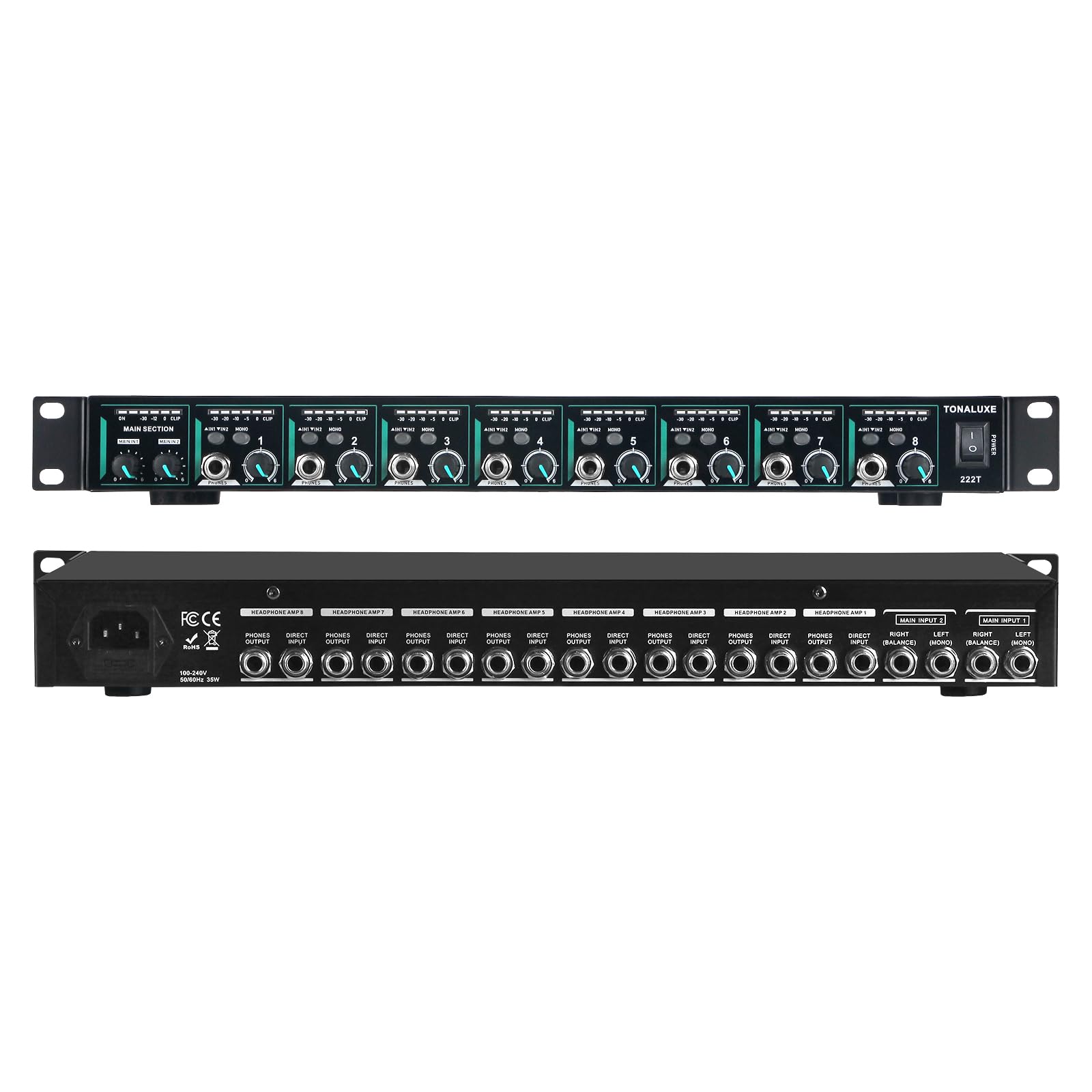
The rack-mounted distribution amp that sends eight independent stereo mixes to 16 headphones, supporting loads as low as 8Ω.
If you run a studio, a church, or a rehearsal space where multiple musicians or performers need their own headphone mix, this 1U rack-mount unit is built for exactly that scenario. It features 8 high-power amplifiers with 16 headphone outputs (front and rear 1/4″ jacks per channel), each controlled independently. The JRC operational amplifier chips keep distortion low and the signal-to-noise ratio high, and each channel supports loads as low as 8Ω — useful for driving multiple headphones from one output.
Each channel has its own dedicated rear-panel input jack, so you can route eight discrete mixes from a mixer or audio interface without summing them together. The 6-segment LED meters give you real-time level feedback per channel, and the master input volume control lets you set an overall ceiling. That said, some customers note sound bleed on all channels at zero volume, and the mono switch reportedly only works on channel 1 — a limitation if you need individual mono monitoring on every channel.
The Multi-Mix Master
- 8 independent channels with 16 headphone outputs for complex setups
- Low 8Ω load support for high-density headphone distribution
- Real-time 6-segment LED metering for each channel
The Studio Caveats
- Sound bleed on all channels at zero volume reported by buyers
- Mono switch only applies to channel 1, limiting flexible monitoring
Ideal for: recording studios, houses of worship, or rehearsal rooms needing multiple independent headphone mixes from a single rack unit.
Reconsider if: you require completely isolated channels for sensitive tracking or recording — the bleed and mono switch limitations are deal-breakers there.
9. Pyle 6-Channel Bluetooth Wireless Home Amplifier System
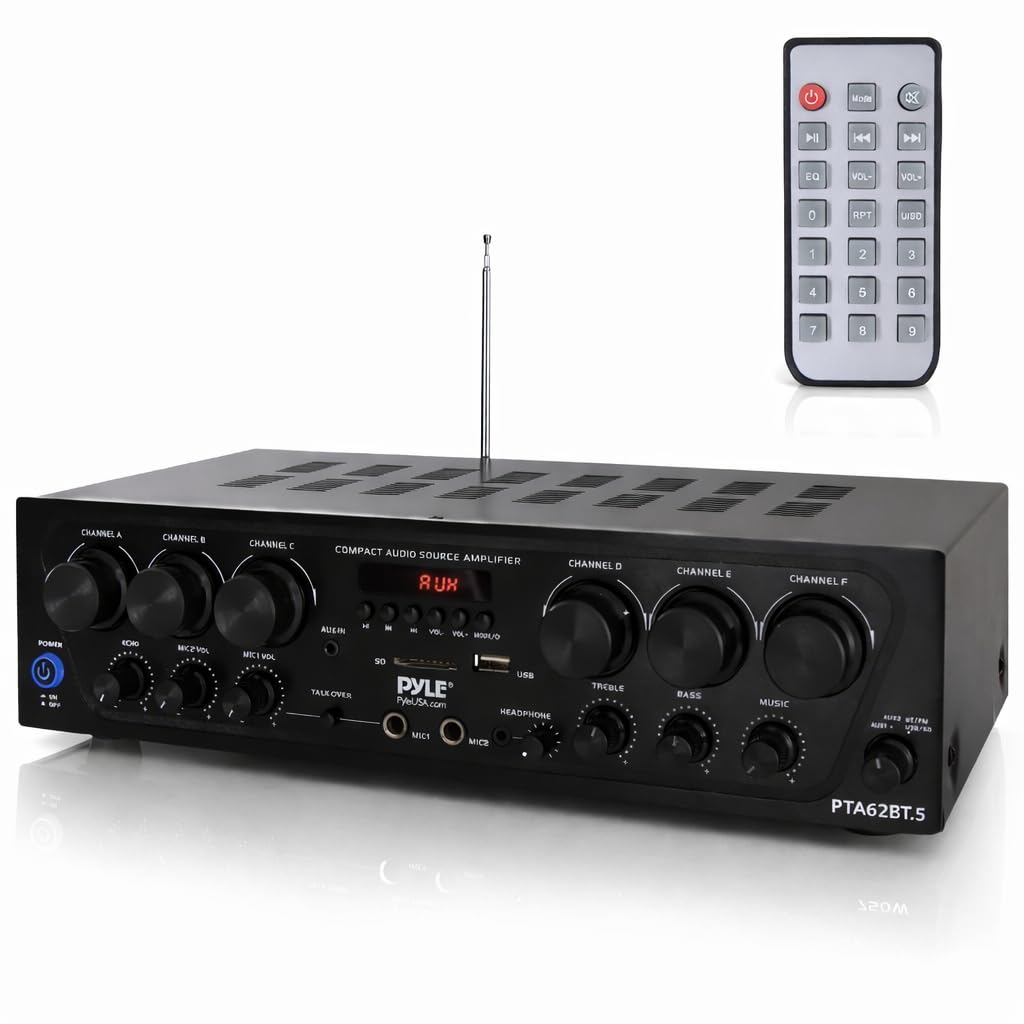
The budget-friendly home amp that adds Bluetooth, karaoke mics, and a headphone jack to any passive speaker setup, with a 750W peak power rating.
Pyle’s 6-channel amplifier is designed for versatility on a tight budget. It delivers 750W of peak power to 4-8 ohm speakers, and the front panel includes a 3.5mm headphone jack for private listening. The Bluetooth streaming works with any smartphone or tablet, and the two 1/4″ microphone inputs with echo and talkover functions make this an easy pick for karaoke nights or small PA announcements.
Input options are generous at this price: USB, micro SD, AUX, FM radio with a digital LCD display, plus RCA inputs and a subwoofer output. The integrated equalizer lets you tweak bass and treble via rotary knobs, and a remote control is included for distance adjustments. At 7.8 by 13.8 by 3.8 inches, it fits on a shelf without dominating the room. Just keep in mind that the headphone output here is a convenience feature, not a studio-grade amp — it will drive everyday headphones fine but lacks the power and clarity of the dedicated units above.
The all-in-one entertainer: for the price, you get Bluetooth streaming, microphone inputs with echo, FM radio, and a headphone jack — everything a casual home user wants in one box.
The reality: the headphone output is a basic pass-through circuit, so critical listeners or high-impedance headphone owners should look at the dedicated amps in this guide instead.
Choose this if: you need a simple, affordable amplifier for passive speakers with the occasional need to plug in headphones for quiet listening.
Look elsewhere if: you prioritize headphone audio quality or need to drive high-impedance headphones properly.
Understanding the Specs
Output Power and Impedance
This is the most critical spec for headphone amps. Output power is measured in milliwatts (mW) at a specific impedance (Ω, or ohms — a measure of electrical resistance in the headphone driver). A 32Ω headphone is considered low-impedance and needs less voltage but more current, while a 300Ω headphone needs higher voltage swing. Look for power ratings at higher impedances (e.g., 300Ω) to see how well an amp can drive demanding headphones. A mismatch means either quiet, distorted sound or wasted power.
THD+N and SNR
THD+N stands for Total Harmonic Distortion plus Noise, measured as a percentage. Lower is cleaner — 0.01% or below is excellent for solid-state amps, and tube amps can sound pleasing at slightly higher figures due to even-order harmonics. SNR, or Signal-to-Noise Ratio, is measured in decibels (dB). Higher numbers mean the music stands out more against background hiss — 107dB or above is very quiet. These two specs together tell you how black the background is between notes.
FAQ
Do I need a separate DAC with my headphone amplifier?
What is the difference between single-ended and balanced headphone outputs?
Can I use a tube headphone amp for gaming?
How much power do I need for my headphones?
What does the impedance rating on a headphone jack mean for my amp?
Will a headphone amp make my Spotify sound better?
Can I leave a tube amp on all the time?
What is the difference between a headphone amp and a headphone DAC/amp combo?
Final Thoughts: The Verdict
For most people, the amp with headphone jack winner is the HIFIMAN EF600 because it delivers massive balanced power and a clean DAC stage in a stable, heat-tune chassis that handles even the most demanding headphones. If you want modern wireless connectivity and tube warmth in a single box, grab the Juson Audio JTA200. And for a compact desktop all-in-one that powers speakers and headphones with tube character, the Fosi Audio MC331 is the best pick.
How We Picked
We do not accept paid placement. Every pick is matched to a real buyer and a real use-case; we do not hands-on test units.
Sources & Methodology
Specifications: manufacturer listings and product documentation. Review insights: verified customer reviews, as of July 2026. Pricing: not shown on this page (it changes often); check the current price via the retailer link.
As an Amazon Associate, Gadgets Feed earns from qualifying purchases. This does not affect which products we feature.
Related Guides
Product prices and availability are accurate as of the date/time indicated and are subject to change. Any price and availability information displayed on Amazon at the time of purchase will apply to the purchase of this product. As an Amazon Associate I earn from qualifying purchases.
CERTAIN CONTENT THAT APPEARS ON THIS SITE COMES FROM AMAZON. THIS CONTENT IS PROVIDED "AS IS" AND IS SUBJECT TO CHANGE OR REMOVAL AT ANY TIME.
Amazon and the Amazon logo are trademarks of Amazon.com, Inc. or its affiliates.