
Finding the right amplifier for your speakers is the single most impactful upgrade you can make to any audio system. Whether you’re trying to extract the last drop of detail from a pair of bookshelf speakers in your living room, or you’re building a car audio setup that thumps without distortion, the amplifier is the engine that dictates everything you hear. A weak match leaves your speakers starved for power, while the wrong class of amplification can introduce unwanted heat or noise into the signal path.
I’m Min — the co-founder and writer behind Gadgets Feed. I’ve spent hundreds of hours parsing amplifier datasheets, comparing real-world wattage measurements against claims, and cross-referencing customer benchmarks for everything from monoblock subwoofer amps to integrated desktop DAC-amps. This guide is the result of that deep research.
After analyzing the latest class-D and class-AB topologies across multiple price tiers, I’ve assembled a definitive list of the seven highest-performing models to help you find the best amplificador para bocinas for your specific setup.
How To Choose The Best Amplificador Para Bocinas
Choosing an amplifier isn’t just about picking the highest number on the box. The relationship between amplifier power, speaker impedance, and sensitivity determines whether your system sounds clean or muddy. Start by confirming the RMS power rating — not peak — and ensure it closely matches your speaker’s RMS handling. An amp that’s too weak will clip and damage tweeters; one that’s excessively powerful is wasteful unless you plan to upgrade speakers later.
Understand Channel Count and Configuration
A monoblock (1-channel) amplifier is purpose-built for subwoofers, delivering maximum power to a single bass driver. A 2-channel amp is ideal for a pair of full-range speakers or can be bridged to run a single sub. A 4-channel amp gives you flexibility: run front and rear speakers, or use two channels for speakers and bridge the remaining two for a sub. For home audio stereo systems, a 2-channel integrated amp with a DAC is often the cleanest path.
Class of Amplification: D vs AB
Class-D amplifiers are today’s standard for both car and home audio. They run far cooler and are dramatically more efficient — often exceeding 85% efficiency — because their output transistors switch on and off rapidly rather than dissipating heat like a resistor. Class-AB amps, like the Pioneer GM-A6704, run hotter but are prized by some listeners for their linearity and reduced switching noise. For battery-limited car installations, class-D is almost always the better choice.
Check Input Voltage and Signal Options
Car amplifiers typically operate on a 14.4V DC system, but the actual voltage from your alternator can vary. A stable power supply is critical for achieving rated output. High-level input (speaker wire input) allows you to connect the amp to a factory head unit without RCA cables, but a dedicated line-output converter (LOC) usually yields a cleaner signal. For home amplifiers, the digital-to-analog converter (DAC) quality matters — built-in USB, optical, or coaxial inputs bypass the mediocre audio stage in a computer or TV.
Quick Comparison
On smaller screens, swipe sideways to see the full table.
| Model | Category | Best For | Key Spec | Amazon |
|---|---|---|---|---|
| Fosi Audio MC331 Tube Integrated Amp with DAC | Premium Integrated | Desktop stereo & bookshelf speakers | 105W x2 @ 4Ω (tube preamp stage) | Amazon |
| Fosi Audio V3 Stereo Amplifier | Premium Class-D | Hi-fi home audio with efficient speakers | 300W x2 @ 2Ω (TPA3255, 48V PSU) | Amazon |
| Pioneer GM-A6704 4-Channel | Mid-Range Car | Full-range car audio system | 60W RMS x4 @ 4Ω (Class AB) | Amazon |
| Pyle PDA77BU Bluetooth Receiver | Versatile Home | Karaoke & multi-source home stereo | 800W peak (4-channel, Bluetooth 5.0) | Amazon |
| Taramps TS 400×4 4-Channel | Compact Car | Marine/motorcycle/car multi-channel | 100W x4 @ 2Ω (400W RMS, class-D) | Amazon |
| Rockville RPA9 Pro/DJ Amp | High-Power Pro | Live DJ sets & large venue PA | 800W RMS (2-channel, rack-mountable) | Amazon |
| Taramps Bass 400 Monoblock | Budget Car Sub | Dedicated subwoofer in a car trunk | 400W RMS @ 2Ω (monoblock) | Amazon |
In‑Depth Reviews
1. Fosi Audio MC331 Tube Integrated Amplifier with DAC
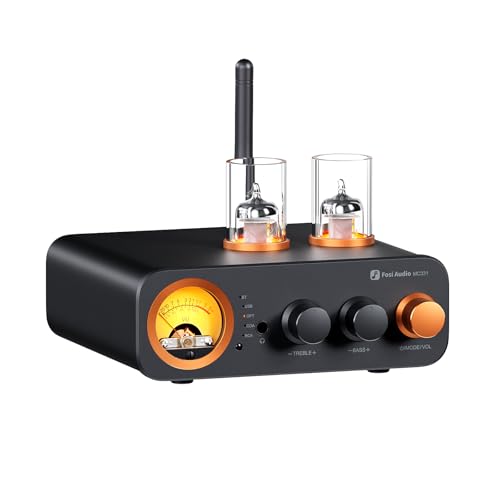
The Fosi Audio MC331 is a genuine all-in-one solution for the desktop audiophile. It combines a 5725W vacuum tube preamp stage, a built-in TI DAC, a 105W x2 @ 4Ω class-D power section, and a dedicated headphone amplifier — all in a chassis smaller than a hardcover book. The visual drama of the glowing tubes and the analog VU meter is matched by sound quality that injects warmth into digital streams without smearing detail. Bluetooth, USB, optical, coaxial, and RCA inputs cover every modern source.
In practice, the MC331 drives a pair of 86dB-sensitive bookshelf speakers to room-filling levels with an effortlessness that surprised me given its size. The bass and treble controls are genuinely usable, not just decorative, and the pre-out allows for a powered subwoofer later. That said, the remote control has noticeable latency — expect a two-second delay — and the stock vacuum tubes are inconsistent; several users report failures within days, so budget for a tube upgrade immediately.
This integrated DAC-amp eliminates the need for a separate preamp, DAC, and power amp, making it the cleanest path to high-quality stereo sound. The warm tube character and the convenience of multiple digital inputs make it the most versatile and musically satisfying unit in this lineup for home listening.
Why it’s great
- Integrated DAC, preamp, headphone amp, and power amp in one compact box
- Tube preamp stage adds audible warmth and depth to digital audio sources
- VU meter and tube glow create a visually stunning desktop centerpiece
Good to know
- Stock vacuum tubes are unreliable; plan to replace with aftermarket tubes
- Remote control suffers from high latency and requires direct line of sight
- Sound drops out at very low volume levels; not ideal for near-silent listening
2. Fosi Audio V3 Stereo Amplifier

The Fosi Audio V3 is a masterclass in what a modern class-D amplifier can be when you pair the right chipset with premium components. Built around Texas Instruments’ TPA3255 — one of the cleanest-sounding class-D controllers on the market — and loaded with Japanese NCC, ELNA, and German WIMA capacitors, this 300W x2 @ 2Ω mini amp achieves a SINAD of 88dB and a signal-to-noise ratio of 110dB. The 48V/5A power supply is mandatory to unlock the V3’s full potential; the 32V version leaves performance on the table.
Heat management is a genuine strong point. Fosi’s whole-body heatsink design with top and bottom vents keeps the chassis cool even when driving 4Ω bookshelf speakers at moderate volumes for hours. The ability to swap the stock NE5532 op-amps for units like the Sparkos SS3602 or MUSES02 means you can fine-tune the sound signature to your preference — a rare feature at this level. The pre-out with volume control is handy for daisy-chaining a powered subwoofer.
Where the V3 falls short is connectivity — there are no digital inputs, no Bluetooth, and no tone controls. It is purely an analog stereo amplifier. You will need an external preamp, DAC, or source with volume control. For users with high-efficiency speakers (90dB+), the V3 is a revelation; for low-sensitivity speakers like the 86dB ELACs, it still delivers clean power but won’t match the headroom of a larger class-AB amp.
Why it’s great
- Exceptionally low noise floor (140uV) and high SINAD for a class-D amp under
- Swappable op-amps let you customize the sound character precisely
- Whole-body heatsink design keeps the unit cool under extended listening sessions
Good to know
- No digital inputs, Bluetooth, or tone controls — purely an analog power amp
- Requires the 48V power supply for rated performance; 32V version is noticeably weaker
- Lacks the bass authority to drive low-sensitivity speakers in large rooms
3. Pioneer GM-A6704 4-Channel Car Amplifier

Pioneer’s GM-A6704 represents the mature end of class-AB car amplification. Rated at 60W RMS x4 @ 4Ω and 190W RMS x2 @ 4Ω in bridged mode, it delivers honest, low-distortion power that stays clean well past the point where cheaper class-D amps introduce switching artifacts. The variable high-pass and low-pass filters (40Hz–500Hz and 40Hz–500Hz respectively) give you precise crossover control without an external processor, and the 1,000W peak rating is a marketing figure — the real value is in the stable, heat-tolerant AB topology.
Installation is straightforward thanks to the compact 14-inch chassis. Users consistently report the amp runs cool when gains are set properly — excessive heat is nearly always a sign of gain mismatch or impedance mismatch. The ability to run in 1, 2, or 3-channel mode via the built-in bridging flexibility makes it a strong choice for a single-subwoofer-plus-mids setup. One buyer drove a Kicker Comp C 10” on bridged channel B and Pioneer Pro 6.5” mids on channel A with only mild warmth after three years of daily use.
The main trade-off is efficiency. Class-AB amps convert more power to heat than class-D, so you need adequate airflow and a solid 14.4V supply. The GM-A6704 also lacks high-level inputs, meaning you will need a line-output converter if connecting to a factory head unit without RCA pre-outs. For those prioritizing sound quality and reliability over the last watt of efficiency, this Pioneer remains a benchmark in its category.
Why it’s great
- Clean, low-distortion class-AB output with genuine 60W RMS x4 @ 4Ω
- Variable high-pass and low-pass filters offer flexible cross-over control without extras
- Bridgeable design allows 1, 2, or 3-channel operation for versatile speaker layouts
Good to know
- Class-AB topology runs hotter and is less efficient than modern class-D alternatives
- No high-level inputs; requires a line-output converter for factory head units
- Gain adjustment is critical to prevent overheating; a multimeter is recommended for setup
4. Pyle PDA77BU Bluetooth Home Stereo Receiver

The Pyle PDA77BU is less a purist’s amplifier and more of a multimedia command center. Rated at 800W peak power across four channels, this unit is built for versatility: it includes Bluetooth 5.0 streaming, dual 1/4-inch microphone jacks with independent reverb and delay controls, a USB-A port with MP3 playback, an SD card slot, and an FM tuner. The front-panel controls are intuitive, and a full-function remote is included, making it simple to adjust volume, bass, treble, and balance from across the room.
Real-world performance aligns with its price tier. Users report clean sound through four passive speakers plus a turntable connection in a home-office setup, and the karaoke functionality is genuinely fun for parties. The Bluetooth stream is stable at 30 feet, and the LED display provides clear feedback. One reviewer who defined themselves as an audiophile used an SMD Distortion Detector to set the gain and confirmed the amp produces clean, non-clipping output when properly calibrated.
The compromises are typical for an all-in-one unit at this level. The Bluetooth reconnection has a quirk — some users must unpair and repair their smart TV to avoid audio skipping. The peak power rating is optimistic and there’s no subwoofer pre-out, limiting bass extension. For a simple home stereo system that prioritizes input variety and karaoke fun over absolute sound quality, the PDA77BU delivers impressive versatility.
Why it’s great
- Dual mic inputs with independent reverb and delay for complete karaoke control
- Bluetooth 5.0, USB, SD, FM, RCA, and 3.5mm inputs cover virtually every source
- Full-function remote and front-panel controls make operation effortless
Good to know
- Bluetooth reconnection with smart TVs can be buggy; require manual repair
- Peak power rating is optimistic; use rated RMS for speaker matching
- No subwoofer pre-out limits the ability to add a powered subwoofer later
5. Taramps TS 400×4 4-Channel Amplifier
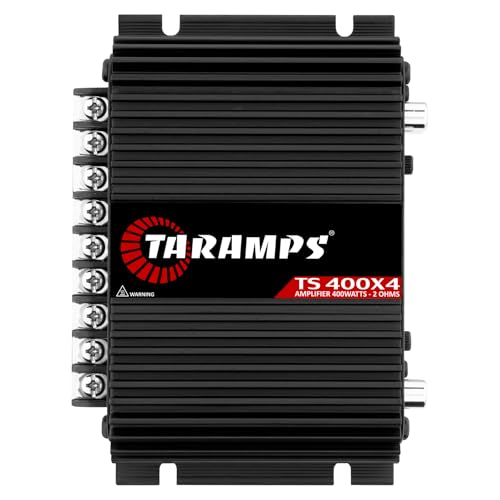
Taramps has carved a reputation for building brutally efficient, compact class-D amplifiers that punch far above their size, and the TS 400×4 is a textbook example. Delivering 100W RMS x4 @ 2Ω or 200W RMS x2 bridged @ 4Ω, this four-channel unit fits in a chassis that weighs under one pound and spans barely wider than a smartphone. It includes both traditional RCA inputs and high-level inputs with automatic activation — no separate line-output converter needed for factory head units.
The built-in crossover system is simple but effective: fixed high-pass at 90Hz, fixed low-pass at 90Hz, and a full-range option. This lets you run door speakers off the high-pass and a subwoofer off the bridged low-pass channels without external filters. Users report exceptional clarity when paired with 6×9 speakers, and one reviewer driving a pair of Polk DB 10” subs with a separate 2000W monoblock called the TS 400×4 a “beast” for its price-to-performance ratio. The 20A fuse rating is modest, confirming genuine efficiency.
The primary limitation is the fixed crossover point. If your speaker system requires a crossover frequency other than 90Hz, you will need an external DSP or line-level crossover. Additionally, the binding posts are small and may require spade connectors or thin bare wire rather than thick banana plugs. For anyone building a compact, lightweight multi-channel system for a car, motorcycle, golf cart, or marine application, the TS 400×4 is an outstanding choice.
Why it’s great
- Ultra-compact and lightweight chassis (under 1 lb) fits in tight installations
- High-level inputs with automatic activation eliminate the need for a LOC
- Exceptional price-to-performance ratio; delivers clean power reliably
Good to know
- Fixed crossover at 90Hz limits flexibility for non-standard speaker setups
- Small binding posts may not accept thick banana plugs or large-gauge wire
- No subsonic filter; not ideal for ported subwoofer enclosures
6. Rockville RPA9 3000W Peak/800W RMS 2-Channel Amplifier

The Rockville RPA9 is built for a different world than the rest of this list — the world of live sound, DJ rigs, and PA systems. Rated at 800W RMS (3000W peak) across two channels, this rack-mountable amplifier uses XLR, 1/4-inch, and RCA inputs alongside speakON and banana outputs, giving it compatibility with professional mixers and passive loudspeakers. The dual-fan cooling system with a heatsink array is designed for sustained high-output operation during gigs without thermal throttling.
User reports confirm the amp delivers clean, clear sound at volumes sufficient for small to medium venues. One reviewer drove Mach2 160W speakers in a live band setting and reported no distortion at high output, with sound carrying cleanly over a quarter mile. The front-panel LED indicators for signal and clip monitoring are genuinely useful for setting gain in a live environment. That said, the RMS rating is optimistic — experienced users with test equipment estimate real-world output closer to 200W RMS per channel rather than 400W, which is still adequate for many PA applications.
The most significant drawback is fan noise. While the fans are quiet at idle or moderate volumes, they become audible in a quiet living-room setting, making the RPA9 unsuitable for home theater use. The rear-panel layout could be more intuitive for first-time users, and some units require downloading the manual for initial setup. For a DJ, mobile entertainer, or band looking for an affordable pro-audio amplifier, the RPA9 delivers reliable power with professional connectivity.
Why it’s great
- Professional XLR and speakON connectors ensure compatibility with PA gear
- Rugged metal chassis with dual-fan cooling handles sustained high-power output
- Front-panel LED indicators simplify gain setting and signal monitoring
Good to know
- Fan noise is noticeable in quiet environments; not suited for home listening
- RMS power rating is overestimated by a significant margin per user measurements
- Rear-panel layout and labeling are not intuitive for beginners
7. Taramps Bass 400 Monoblock Amplifier

The Taramps Bass 400 is the definition of a purpose-built budget subwoofer amplifier. As a monoblock class-D amp rated at a genuine 400W RMS @ 2Ω, its entire engineering effort goes into one job: driving low frequencies from 8Hz to 250Hz deep, clean, and loud. The bass boost circuit and subsonic filter give you additional control over the character of the sub-bass, while the high-level input (speaker wire) allows connection to a factory stereo without RCA pre-outs. The aluminum chassis acts as a heatsink and keeps the unit cool during prolonged use.
Owner feedback is overwhelmingly positive for the price. Multiple users report the Bass 400 driving 10-inch and 12-inch subwoofers — including Kicker Comp VRs — with authority, describing it as a “little amp big sound” that fits easily in a trunk without consuming space. The subsonic filter is a welcome inclusion for ported enclosures, preventing the driver from overexcursing below the tuning frequency. Build quality feels solid given the cost, and the 620-gram weight makes mounting straightforward.
The clear caveat is that the high-level input performance is mediocre. Users who attempted to use the high-level inputs with a stock head unit found they needed very high gain settings and still got quiet output; a dedicated line-output converter is strongly recommended. The amplifier also lacks any crossover flexibility beyond the low-pass filter — there is no high-pass or band-pass mode for mid-bass drivers. For a dedicated subwoofer in a budget car audio build, the Taramps Bass 400 is tough to beat on pure power-per-dollar.
Why it’s great
- Genuine 400W RMS output at 2Ω in a compact, easy-to-mount chassis
- Built-in subsonic filter protects ported subwoofer enclosures from overexcursion
- Exceptional value for the sub-bass power delivered; punches far above its weight
Good to know
- High-level inputs deliver weak output; you will need a dedicated line-output converter
- Limited to low-pass filtering only — no high-pass for mid-bass speakers
- Narrow 8Hz–250Hz frequency range makes it unsuitable for full-range speakers
FAQ
Can I use a monoblock amplifier for full-range speakers?
What does bridged mode mean on a 4-channel amplifier?
Why does my amplifier get hot and shut off during use?
Final Thoughts: The Verdict
For most users, the best amplificador para bocinas winner is the Fosi Audio MC331 because it combines a tube preamp, integrated DAC, and powerful class-D output in one space-saving chassis that delivers warm, detailed sound for desktop and bookshelf systems. If you want pure, high-efficiency power for a car audio system, grab the Taramps TS 400×4 for its compact four-channel design and high-level inputs. And for professional DJ or live-sound applications, nothing beats the Rockville RPA9 for its XLR connectivity and sustained high-output capability.