
Our readers keep the lights on and my morning glass full of iced black tea. As an Amazon Associate, I earn from qualifying purchases.
Specs are compiled from manufacturer listings and verified buyer reviews and can change over time — please confirm the key details on the product page before buying.
You want audio that fills your room during a movie, makes music sound rich and layered, and lets you hear footsteps in a game — but you are probably picking between speakers that sound thin or ones that take over your whole desk. An amplified speaker system delivers clear vocals and punchy bass in a compact package, no separate receiver needed. This guide compares six self-powered computer speaker systems to match your desk, listening habits, and budget.
I’m Min — the founder and writer behind Gadgets Feed. This guide is built by comparing the manufacturers’ published specifications and the patterns across verified customer reviews, so you get each pick’s real strengths and trade-offs instead of marketing spin.
if you need a simple Bluetooth upgrade or a THX-certified powerhouse, this breakdown of the best amplified computer speakers will help you make the right choice.
Quick Picks
- Klipsch ProMedia 2.1 THX Certified Computer Speaker System — Best Overall
- Edifier R1280T Powered Bookshelf Speakers — Audiophile Choice
- Bluedee Computer Speakers with Subwoofer, 2.1 PC Speakers — RGB Desk Upgrade
- Nylavee Computer Speakers with Subwoofer, 2.1 PC Speakers System — Solid All-Rounder
- Logitech Z207 2.0 Stereo Computer Speakers with Bluetooth — Bluetooth Classic
- Creative Pebble V3 Minimalistic 2.0 USB-C Desktop Speakers — Budget Compact
How To Choose The Best Amplified Computer Speakers
Match the speaker type to your desk size, listening habits, and connection needs.
2.0 vs 2.1: Do You Need the Subwoofer?
A 2.0 system (two satellite speakers) saves desk space and simplifies setup. It handles mids and highs well but will not produce deep bass you can feel. A 2.1 system adds a subwoofer for chest-thumping bass in movies and games, but the subwoofer box needs floor or desk space.
AC-Powered vs USB-Powered: Real Volume vs Convenience
AC-powered speakers have a built-in amplifier that delivers higher volume and cleaner sound without distortion. USB-powered speakers are convenient but limited by your USB port’s power—enough for desk-level listening, not room-filling volume.
Bluetooth vs Wired: Latency and Connection Stability
Wired connections (3.5mm AUX, RCA, or USB) give you zero-lag audio, which matters for gaming or video editing where sound must match the picture frame-perfect. Bluetooth offers cable-free convenience for streaming music from your phone, but older versions (below 5.0) can introduce a slight delay. Bluetooth 5.0 and above offer better range and stability.
RMS Power vs Peak Power: The Honest Wattage
RMS (Root Mean Square) is the continuous power the speakers can handle cleanly — this is the number that tells you how loud they can play for hours. Peak power is the brief burst a speaker can handle before distorting. Always compare RMS ratings between speakers; a high peak number with a low RMS rating means it will struggle at higher volumes.
Quick Comparison
| Model | Best For | System Type | Power | Bluetooth | Amazon |
|---|---|---|---|---|---|
| Klipsch ProMedia 2.1 THX | Room-filling, cinematic audio | 2.1 (Subwoofer) | 200W Peak | None | $169.99Amazon |
| Edifier R1280T | Audiophile music listening | 2.0 | 42W RMS | None | $149.99Amazon |
| Bluedee 2.1 PC Speakers | Modern desk setup with RGB | 2.1 (Subwoofer) | 80W Peak | 5.4 | $89.99Amazon |
| Nylavee 2.1 PC Speakers | Balanced sound with a small sub | 2.1 (Subwoofer) | 30W RMS / 60W Peak | 5.4 | $76.49$89.99Limited time dealAmazon |
| Logitech Z207 | Bluetooth and wired simplicity | 2.0 | — | 4.2 | $59.99$69.99Amazon |
| Creative Pebble V3 | Ultra-compact USB-C desk | 2.0 | 8W RMS / 16W Peak | 5.0 | $42.74$44.99Amazon |
In‑Depth Reviews
1. Klipsch ProMedia 2.1 THX Certified Computer Speaker System

The thundering 2.1 system that turns your desk into a mini theater and has buyers reporting it lasts over 20 years.
This is the powerhouse that makes everything else in the list play catch-up. The Klipsch ProMedia 2.1 pairs two-way satellite speakers with Klipsch MicroTractrix Horn Technology — a specific design that focuses the sound waves straight at your ears — and a 6.5-inch side-firing, ported subwoofer. The result is a total peak power of 200 watts rated at 110dB, which is roughly as loud as live rock music (typically 108-114 dB). You get a full, punchy bass you can actually feel, while the satellites deliver crisp highs.
Buyers report that the sound stage extends well beyond the width of the satellite speakers, creating a spacious, rich experience. The plug-and-play setup uses a 3.5mm input, and the control pod gives you separate volume and subwoofer gain knobs right on your desk. Reviewers consistently call it thunderous, noting the subwoofer fills a 14×12-foot room with ease.
One verified buyer who had the same set for about 20 years before upgrading mentioned the new design uses a 9-pin connection (up from a 6-pin) which reduces electrical noise. Unlike the Bose Companion 5, the subwoofer volume control is on the right speaker, so you never have to crawl under your desk to adjust the bass. A couple of minor points: there is no on/off switch, and the power LED stays on all the time, so you may want to plug it into a power strip you can switch off.
Why It Dominates
- 200W peak power delivers sound that equals live rock music volume (110dB)
- THX certification with Klipsch MicroTractrix Horn Technology for clear, focused highs
- Separate subwoofer volume knob on the control pod — no crawling under the desk
- Owners mention units lasting 20+ years before needing replacement
Real Trade-offs
- No on/off switch — the power light stays on constantly
- No Bluetooth connectivity; strictly wired via 3.5mm input
- Satellite speaker clips use plastic tabs that can fail over time
Perfect for the power user: If you want chest-thumping bass, THX-certified clarity, and a system that owners say lasts decades, this is your pick.
One honest limitation: The lack of an on/off switch means you will need an external power strip to shut it down completely.
2. Edifier R1280T Powered Bookshelf Speakers
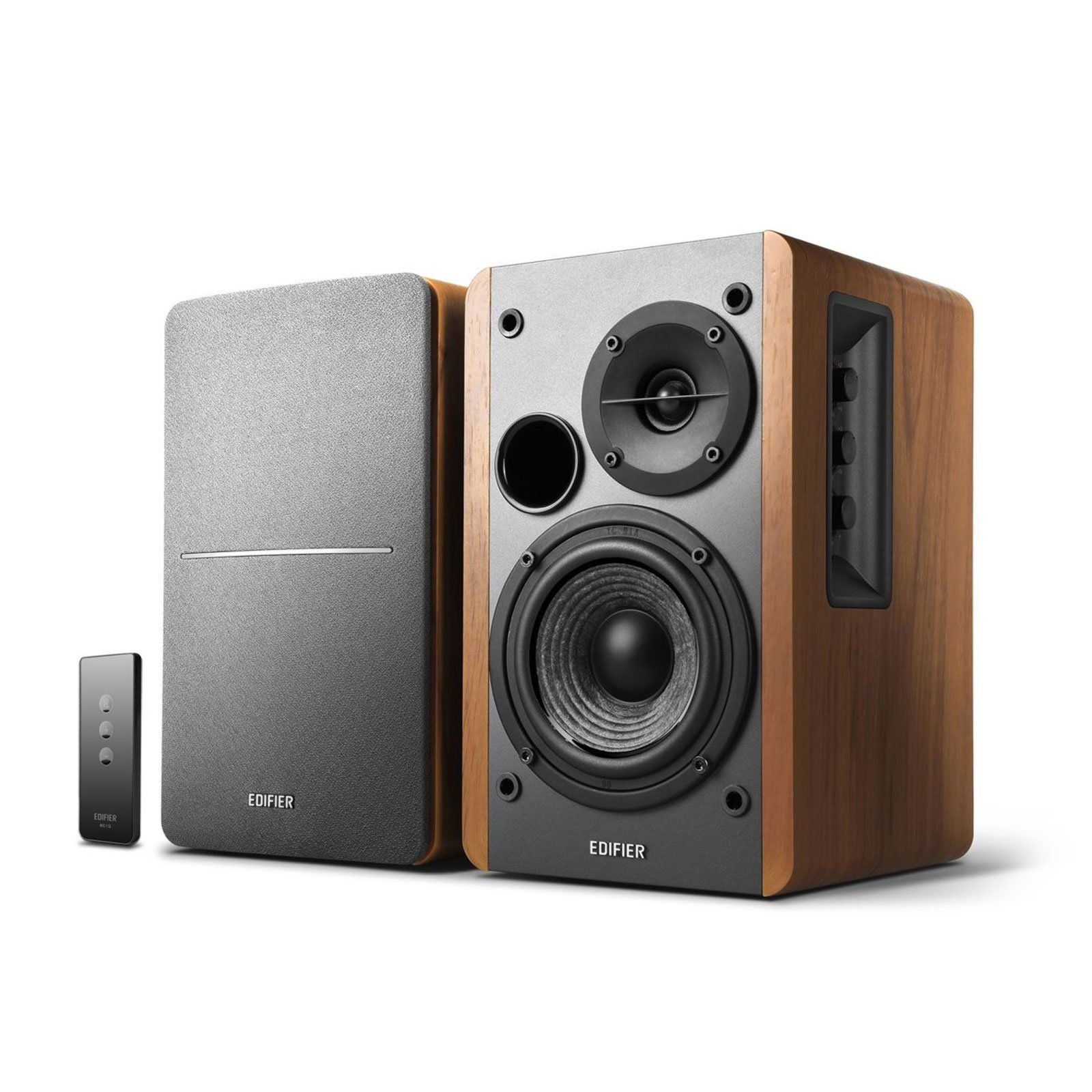
If you care more about accurate music reproduction than movie explosions, these bookshelf speakers deliver.
The Edifier R1280T is a 2.0 near-field studio monitor system built with a high-quality MDF wood enclosure finished with wood-effect vinyl. It delivers 42 watts of RMS power — that is its continuous, honest output — which is plenty for a desktop or a medium-sized room. It does not come with a subwoofer, so do not expect movie-theater thumping bass; instead, you get well-balanced sound where vocals and instruments shine without distortion.
You get two AUX inputs (one 3.5mm, one dual RCA), so you can connect your computer and a phone simultaneously without unplugging anything. The side panel has knobs for volume, bass, and treble, letting you fine-tune the equalization to your room acoustics. A remote control is included, so you can adjust volume from your chair. The connectivity is strictly wired (Auxiliary) — there is no Bluetooth built in, which keeps the signal path pure and avoids any wireless compression.
Unlike the 2.1 systems in this list, the R1280T is designed for music purists who want a flat frequency response. The room-filling capability is impressive for its size, but it notably lacks the deep bass of the Klipsch ProMedia with its 6.5-inch subwoofer. Reviewers appreciate the classic wood design that blends into home decor rather than looking like a gaming peripheral.
Why Music Lovers Choose This
- 42W RMS continuous power — honest output you can rely on at volume
- Dual AUX inputs let you connect a PC and phone without switching cables
- Remote control for volume, plus separate bass and treble knobs
- Classic MDF wood enclosure looks great in any room
Before You Buy
- No Bluetooth or wireless connectivity at all
- No subwoofer output — bass is limited by the two-way drivers
- Near-field focused; not designed to fill a large living room
Built for critical listening: If your main use is music and you want clear, accurate sound with the flexibility to fine-tune the EQ, this is your match.
skip it if: You need thunderous bass for movies or games, or you want a cable-free Bluetooth connection to stream from your phone.
3. Bluedee Computer Speakers with Subwoofer, 2.1 PC Speakers
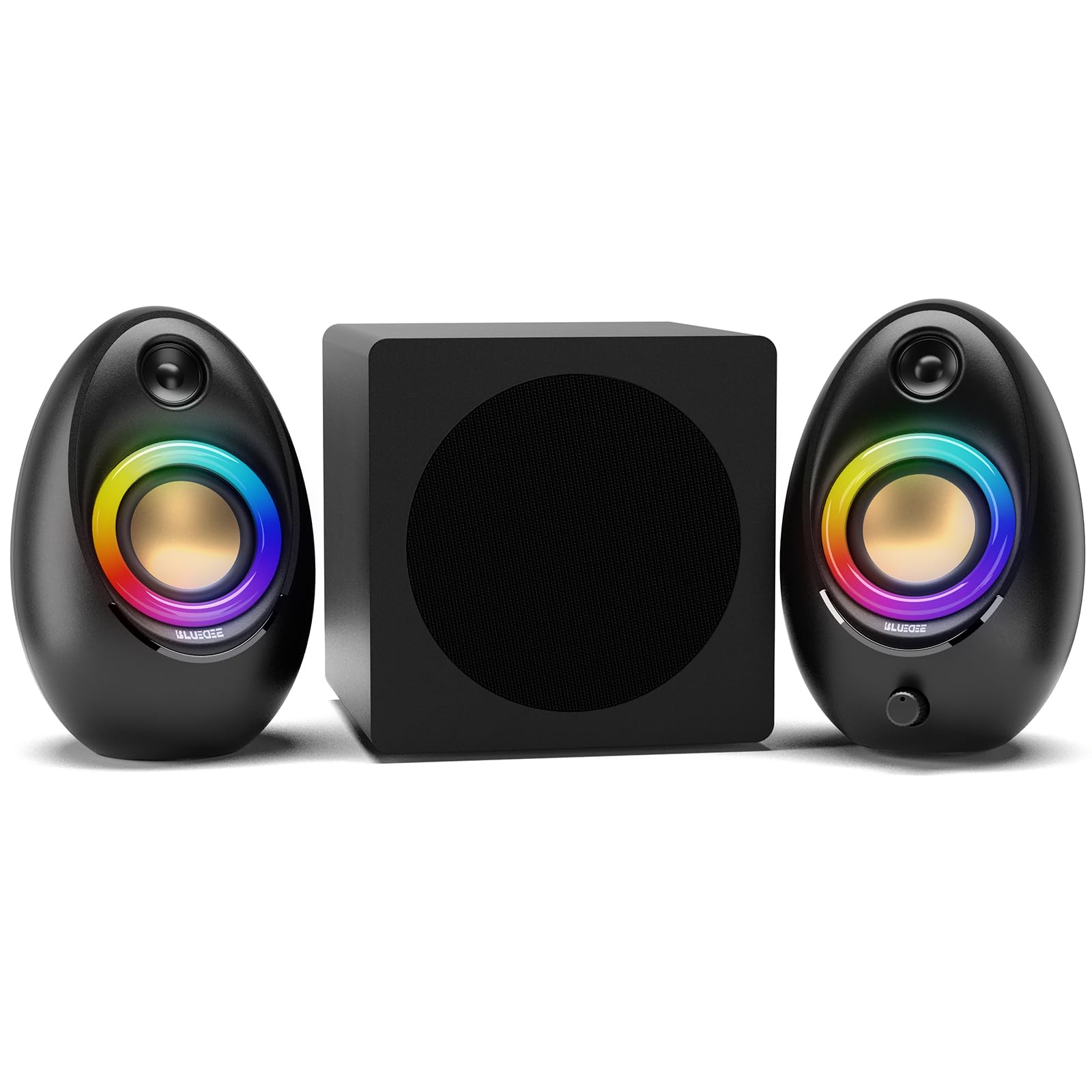
A modern 2.1 system with Bluetooth 5.4, multi-connect options, and desk-friendly RGB lighting that does not distract.
The Bluedee system uses a 2.1 setup with a dedicated subwoofer to handle low frequencies, leaving the satellite speakers free to deliver clear vocals without muddying the sound. It delivers 80W of peak power and uses built-in DSP tuning to reduce distortion and smooth out harsh highs. This means you get punchy bass without your ears tiring after long listening sessions.
Connectivity is impressively flexible — it supports Bluetooth 5.4 for wireless streaming, plus USB-A, USB-C, and 3.5mm AUX wired connections. The adapter-powered design means you plug it into the wall for full power, not your computer’s USB port. You get an all-in-one control knob on the side that handles volume, play/pause, lighting effects, and mode switching. The RGB lighting can be set to dynamic colors or a soft static glow, so it works if you want a flashy gaming setup or a subtle ambient look.
Compared to the simpler Nylavee system, the Bluedee offers DSP tuning for smoother sound and a wider range of connection types including USB-C. Buyers looking for a modern desk aesthetic will appreciate the lighting, while those who prefer a minimalist look can set the glow to static. The subwoofer is independent, which keeps the satellites compact and clean on your desk.
Modern Connectivity Stack
- Bluetooth 5.4, USB-A, USB-C, and 3.5mm AUX — the widest connection variety in this list
- DSP tuning reduces distortion for smoother, clearer sound
- RGB lighting with dynamic and static modes suits any desk style
- All-in-one control knob simplifies volume, playback, and mode switching
One Real Catch
- Plastic enclosure material may not feel as premium as the Edifier’s wood build
- Peak power rating of 80W — less than half the Klipsch ProMedia’s 200W peak
Ideal for the modern desk: If you want cable-free Bluetooth, optional RGB lighting, and the versatility of USB-C and USB-A connections, the Bluedee fits perfectly.
Consider another pick if: You want the loudest possible sound in a large room, or you prefer a traditional wood-finish aesthetic.
4. Nylavee Computer Speakers with Subwoofer, 2.1 PC Speakers System
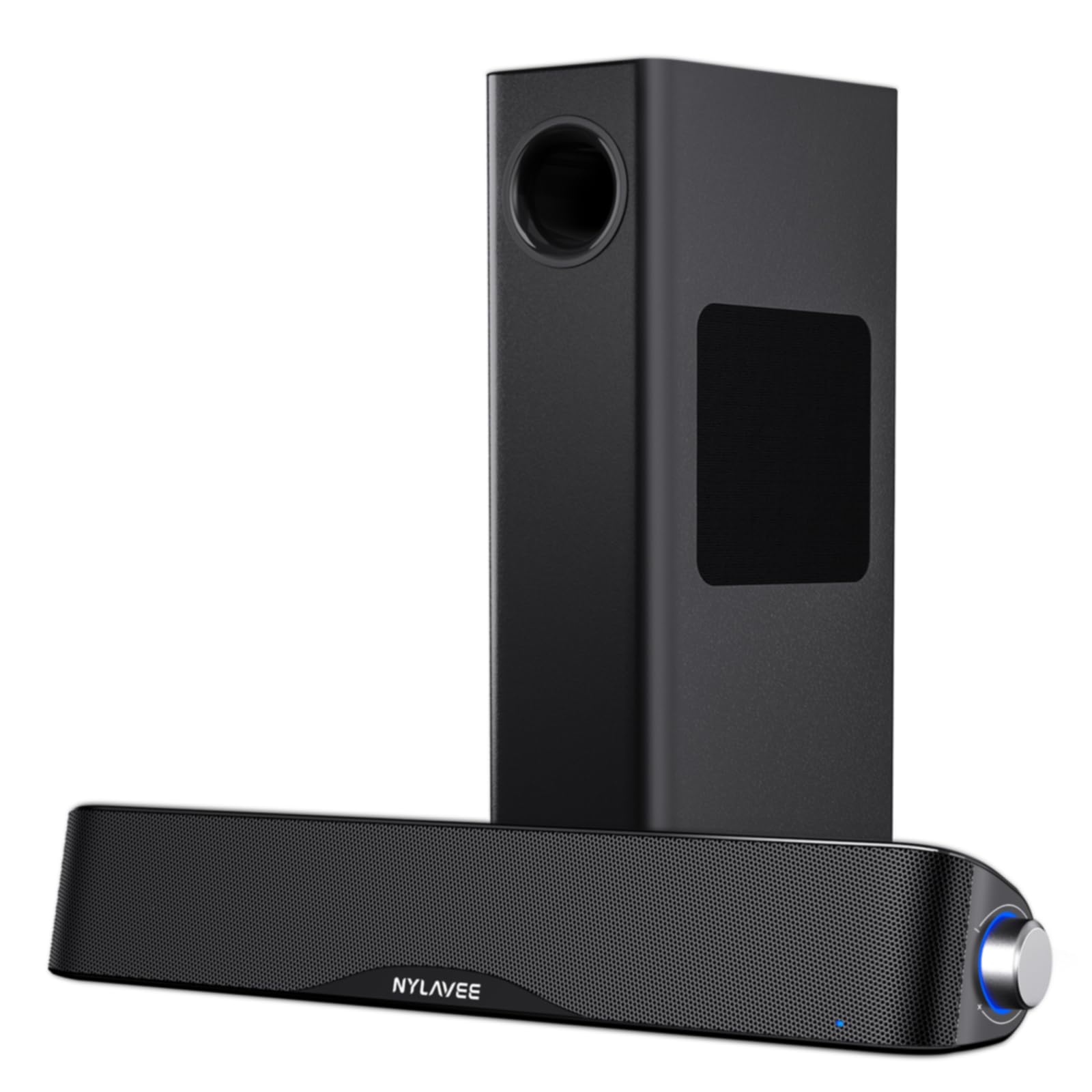
A 2.1 system that balances deep bass and clear vocals with a standalone 5.25-inch subwoofer.
The Nylavee uses a 2.1 layout with a separate 5.25-inch bass driver that pushes 60W peak power (30W RMS). It combines dual soft-dome silk tweeters and full-range drivers in the soundbar to deliver crisp highs, balanced mids, and punchy bass. The design is a cavity-tuned soundbar plus a wired subwoofer, which keeps your desk footprint smaller than a traditional two-satellite setup.
Bluetooth 5.4 handles wireless streaming, and you also get a 3.5mm AUX input for wired connections. The system is powered by an AC adapter (no battery), so you get consistent volume without relying on your computer’s USB power. All controls are on a single side-mounted knob: power, mode switching, volume, and reset. It works with desktops, laptops, Macs, Xbox, and PS5 right from the start.
Compared to the Bluedee system above, the Nylavee offers a slightly lower peak power (60W vs 80W) but uses silk tweeters for what the manufacturer describes as smoother highs. The subwoofer is a dedicated 5.25-inch driver versus the Bluedee’s 5.25-inch driver as well, so the bass performance is comparable. The Nylavee lacks RGB lighting, which makes it a cleaner choice for a professional office setup.
Clean Performance Setup
- 30W RMS / 60W peak power with a dedicated 5.25-inch subwoofer
- Dual soft-dome silk tweeters for clear highs without harshness
- Compact soundbar design saves desk space vs two-satellite systems
- Bluetooth 5.4 with stable wireless range of about 33 feet
Small Trade-offs
- No RGB lighting — a plus for some, missed by others who want the look
- Lower RMS power than the Edifier R1280T (30W vs 42W)
Best for a cleaner desk: If you want 2.1 bass depth in a compact soundbar layout without flashy lights, the Nylavee is a smart choice.
Gamers should note: You trade the RGB desk aesthetics of the Bluedee for a more office-friendly, professional look.
5. Logitech Z207 2.0 Stereo Computer Speakers with Bluetooth

A simple, reliable 2.0 speaker that customers note has lasted over 6 years with both Bluetooth and wired use.
The Logitech Z207 is a straightforward 2.0 stereo pair with one active driver and one passive radiator per speaker — the passive radiator helps produce bass extension without a subwoofer. It connects to computers via Bluetooth 4.2 or a 3.5mm cable (included). Logitech Easy-Switch technology lets you pause audio on one device and press play on another to switch smoothly between, say, your laptop and your phone.
Buyers are enthusiastic about these. One verified owner who has had the first pair for nearly 7 years calls them “my favorite speakers ever owned,” noting the bass is surprisingly good for a system without a subwoofer and that they fill a large living room without distortion. Another reviewer tested them with Dvorak, The Kinks, and Pink Floyd and says they “sound like music.”
A couple of small quirks from the reviews: the volume control dot is black on black, making it nearly impossible to see where the volume is set. The rubber strips on the bottom do not prevent the speakers from sliding if bumped. And while Bluetooth works great, some users found the Easy-Switch between two Bluetooth sources requires manually disconnecting one first. Despite these, the overwhelming sentiment is that the Z207 is a fantastic value that just works.
Why Buyers Love It
- Bluetooth 4.2 and 3.5mm AUX — play from two sources simultaneously
- Passive radiators deliver surprisingly deep bass without a subwoofer
- On-speaker headphone jack and convenient front controls
- Long-lasting build — multiple reviewers point out 6-7 years of daily use
Minor Gripes from Owners
- Volume dot is black-on-black — impossible to see the setting without a light
- Rubber feet do not grip well; speakers slide when bumped on the desk
- No USB connection; requires a 3.5mm port or Bluetooth
Set-and-forget reliability: If you want a durable, good-sounding Bluetooth speaker that just works for years, shoppers say this delivers.
Look elsewhere if: You need a subwoofer for heavy bass in movies, or you want a USB connection to avoid using a headphone jack.
6. Creative Pebble V3 Minimalistic 2.0 USB-C Desktop Speakers

The smallest, cheapest entry in this list, but its USB-C power delivery is a genuine innovation for clutter-free desks.
The Creative Pebble V3 is a 2.0 USB-C speaker system that draws both power and audio through a single cable. It uses larger custom-tuned 2.25-inch full-range drivers, delivering 8W RMS and 16W peak power. A built-in gain switch can boost the audio further if you plug into a 10W USB-C or USB-A port. The 45-degree improve drivers aim the sound directly at your ears.
It supports Bluetooth 5.0 for wireless streaming, plus you can use the 3.5mm AUX input for analog devices. Clear Dialog audio processing boosts spoken words in movies and YouTube without cranking the overall volume, which is a unique feature in this price range. The setup is genuinely one-cable: just the USB-C cable to your computer, no separate power brick needed.
At its price point, the Pebble V3 is fantastic value, but you are getting a 2.0 system with only 8W RMS. Compared to the Logitech Z207, the Pebble V3 is more compact but produces less bass extension because it lacks a passive radiator. Buyers who prioritize a clean, minimalist desk will love the single-cable USB-C connection, but those wanting room-filling volume should look at the AC-powered options above.
Ultra-Minimalist Appeal
- Single USB-C cable for power and audio — truly one-cable setup
- Bluetooth 5.0 wireless for streaming from phone or tablet
- Clear Dialog processing boosts vocals in movies/talk shows
- 45-degree angled drivers direct sound right to your ears
Size Limitations
- 8W RMS is entry-level power — not enough to fill a large room
- No passive radiator or subwoofer, so bass is limited
- Requires a USB-C port for peak performance; USB-A via included converter
A no-brainer for a clutter-free desk: If your desk space is tight and you want decent sound from one clean cable, the Pebble V3 is the pick.
Move up the list if: You want any bass at all for movies or music — the 2.1 systems and the Logitech Z207 all outperform it on low-end sound.
Understanding the Specs
RMS vs Peak Power
RMS (Root Mean Square) is the continuous wattage a speaker can output without distorting over time — think of it as the honest power figure. Peak power is the absolute maximum burst it can handle for a split second. When comparing speakers, focus on RMS: 8W RMS (Creative Pebble V3) is fine for close-up desktop use, while 42W RMS (Edifier R1280T) fills a medium room.
2.0 vs 2.1 Systems
A 2.0 system has two satellite speakers (left and right). It produces good stereo sound and is simple to set up, but bass is limited. A 2.1 system adds a third component, a subwoofer, which is a dedicated box for low-frequency bass. This gives you that punchy, feel-it-in-your-chest thump for movies and games, but the subwoofer box needs floor or desk space.
Bluetooth Version
Bluetooth version matters for range, stability, and audio quality. Bluetooth 5.0 and above (Creative Pebble V3, Bluedee 2.1, Nylavee 2.1) offer longer range (up to 10 meters or about 33 feet) and more stable connections. Bluetooth 4.2 (Logitech Z207) is older but still works well for short-range desktop use — just expect slightly less battery efficiency and range.
Active vs Passive Speakers
Active (or powered) speakers have a built-in amplifier, so you plug them directly into a power outlet and your audio source — no separate receiver or amplifier needed. All six products in this guide are active speakers. Passive speakers require an external amplifier or AV receiver, which adds cost and complexity to your setup.
FAQ
Do amplified computer speakers need a separate amplifier?
Will USB-powered speakers be loud enough for my desktop?
What is the difference between 2.0 and 2.1 speakers?
Can I connect amplified speakers to a laptop or a desktop?
Do these speakers work with a TV or a gaming console?
Do I need a sound card for amplified computer speakers?
How long do amplified computer speakers last?
What does THX certification mean for computer speakers?
Final Thoughts: The Verdict
Across the board, the best amplified computer speakers are the Klipsch ProMedia 2.1 THX because it delivers thunderous, THX-certified sound with a 200W peak and a 6.5-inch subwoofer that customers note lasts over 20 years. If you want audiophile-grade music clarity with a classic wood cabinet and remote control, grab the Edifier R1280T. And for a minimal desk setup with one-cable USB-C convenience, the Creative Pebble V3 is the budget compact winner.
How We Picked
We do not accept paid placement. Every pick is matched to a real buyer and a real use-case; we do not hands-on test units.
Sources & Methodology
Specifications: manufacturer listings and product documentation. Review insights: verified customer reviews, as of July 2026. Pricing: not shown on this page (it changes often); check the current price via the retailer link.
As an Amazon Associate, Gadgets Feed earns from qualifying purchases. This does not affect which products we feature.
Related Guides
Product prices and availability are accurate as of the date/time indicated and are subject to change. Any price and availability information displayed on Amazon at the time of purchase will apply to the purchase of this product. As an Amazon Associate I earn from qualifying purchases.
CERTAIN CONTENT THAT APPEARS ON THIS SITE COMES FROM AMAZON. THIS CONTENT IS PROVIDED "AS IS" AND IS SUBJECT TO CHANGE OR REMOVAL AT ANY TIME.
Amazon and the Amazon logo are trademarks of Amazon.com, Inc. or its affiliates.