
Our readers keep the lights on and my morning glass full of iced black tea. As an Amazon Associate, I earn from qualifying purchases.
Specs are compiled from manufacturer listings and verified buyer reviews and can change over time — please confirm the key details on the product page before buying.
The biggest frustration with an ordinary home phone isn’t the dialing — it’s straining to hear the person on the other end. For seniors with hearing loss, that struggle turns every call into a chore. The right amplified cordless phone boosts the caller’s voice, blasts the ringer, and adds visual alerts, making calls easy again. This guide breaks down the top amplified cordless phones for seniors, comparing volume boosts, button sizes, and extra features like answering machines and photo speed dials.
I’m Min — the founder and writer behind Gadgets Feed. This guide is built by comparing the manufacturers’ published specifications and the patterns across verified customer reviews, so you get each pick’s real strengths and trade-offs instead of marketing spin.
The best amplified cordless phones for seniors combine a loud, adjustable handset volume with an extra-loud ringer, so calls are both heard and understood. We’ve matched each pick to a specific need — from maximum volume boost to the simplest big-button layout.
Our Picks at a Glance


How To Choose The Best Amplified Cordless Phones For Seniors
You need an amplified cordless phone that matches your hearing loss level, not just any loud model. A phone that works for mild loss may not boost enough for severe deafness. Start with the measurable specs, then check the daily usability features that make calls easy.
Volume Boost and Ringer Loudness
The core of any amplified phone is how much it can boost the caller’s voice and how loud the ringer can get. Boost levels are measured in decibels (dB); a 40 dB boost is a significant increase over a standard phone, while a ringer at 90 or 100 dB is loud enough to be heard across the house. A one-touch boost button on the side of the handset is a huge plus — it lets the user instantly amplify a call without navigating menus.
Button Size and Screen Readability
For seniors with vision challenges, the size of the buttons and the clarity of the display matter just as much as the sound. Look for large, high-contrast, backlit keys that are easy to see and press. An oversized, backlit screen that shows the caller ID clearly makes a big difference, especially for those who find small text hard to read.
Comfort and Communication Features
Beyond pure volume, features like Slow Talk — which slows down the speed of speech — help with comprehension. Noise reduction cuts out background hiss so the caller’s voice stays clear. For those who wear hearing aids, a phone that’s hearing aid compatible prevents that annoying buzzing interference. Think about whether an answering machine, call blocking, and photo speed dials will make life easier for the specific senior using the phone.
Quick Comparison
| Model | Best For | Volume Boost | Ringer Loudness | Answering Machine | Amazon |
|---|---|---|---|---|---|
| Panasonic KX-TGM420W★ Best Overall | Overall Best | 40 dB | 100 dB | Yes | Amazon |
| Clarity D703Best Value | Vision-Friendly Value | Amplified | 10 Melodies | No | Amazon |
| Gigaset E560ASafety Pick | SOS Safety Feature | Extra Loud Button | Amplified | Yes | Amazon |
| VTech SN5127 | Photo Speed Dial | 50 dB | 90 dB | Yes | Amazon |
| SWISSVOICE Premium 3355 | Two-Handset Setup | 26-30 dB | 90 dB | Yes | Amazon |
| Clarity E814CC | Corded + Cordless Combo | Amplified | Amplified | Yes | Amazon |
| VTech SN5127+SN5107 Bundle | Multi-Handset Coverage | 50 dB | 90 dB | Yes | Amazon |
| Clarity XLC3.4+ | Severe Hearing Loss | Sound Booster | Extra-Loud | No | Amazon |
| Panasonic KX-TGM420W+2 Extras | Whole-Home System | 40 dB | Loud Base Ringer | Yes | Amazon |
In‑Depth Reviews
1. Panasonic KX-TGM420W
Our pick — over 4★ from 2,500+ verified ratings; the strongest balance of quality and price.
The complete hearing solution with a 40 dB boost and a 100 dB ringer.
The Panasonic KX-TGM420W earns the top spot because it attacks the two biggest problems at once: hearing the caller and hearing the ring. It boosts incoming call volume by up to 40 decibels (dB) and fires off a base unit ringer that hits up to 100 dB — loud enough to notice from another room. For anyone who has ever missed a call because they didn’t hear it, that combination is transformative.
What sets this Panasonic apart is how it helps you actually understand the conversation. The Slow Talk button slows down the speed of speech, both in real time and on voice messages, making it easier to catch every word. Buyers report an elderly user adapted in just 2 days, praising the sound and volume. The large, backlit 1.8-inch display and backlit buttons make dialing and reading the caller ID easy, even in low light.
It’s not just about volume — it’s about control. You get six voice tone settings to tailor the sound to your ear, a Talking Caller ID that announces who’s calling, and a Noise Reduction feature to cut background hiss. The handset is expandable to 6 total units, and a backlit keypad means fumbling in the dark is a thing of the past. With 4.3 stars across 2,700+ owners, it’s the most dependable all-around choice.
What wins people over
- Powerful 40 dB volume boost with a loud, clear sound.
- Slow Talk feature slows speech to aid comprehension.
- 100-number call block keeps robocalls away.
- Rechargeable backup battery keeps the phone working during a power outage.
Worth knowing
- Some owners find the many features a bit complex to navigate.
- You’ll want the written instructions handy, as they’re not always senior-friendly.
The best all-rounder: This is the phone to get if you want the strongest combination of volume boost, ringer loudness, and clarity features for daily use.
Reach for this if: You want a dependable phone that helps with both hearing the ring and understanding the conversation, while staying affordable.
2. Clarity Dect 6.0 D703
The low-vision specialist with contoured keys that are a joy to press.
If clear vision is the bigger challenge than hearing, the Clarity D703 is a standout. Its defining feature is the high-contrast numbers on contoured keys that use a soft-touch material for comfort. That makes each button easy to find by sight and by feel, which is a huge help for unsteady hands. The phone is designed for amplified sound, so it’s a solid hearing aid too, but its true strength is the visual layout.
Ten dedicated speed dial buttons sit right on the handset, letting you store important numbers for one-touch calling. The belt clip adds hands-free mobility around the house. The “Hear-It-Ring” clarity ringer offers ten loud, clear melodies with six levels of volume control. The thing everyone raves about is the readability — the large, easy-to-see buttons are the clear winner here.
This model is notably more compact than the Panasonic, with item dimensions of 7.8 x 4.7 x 4 inches compared to the Gigaset’s much slimmer profile. It runs on standard AA batteries, which are included, so you won’t be hunting for a proprietary pack. A headset jack is built in, making it a smart pick for someone who wants to use a comfortable headset for longer calls.
Vision-first design: The best choice for anyone whose primary need is seeing and pressing the right button easily, with amplified sound as a welcome bonus.
The honest check: Owners mention the sound is clear — “for a cordless it works well and is clearer than most we have had” — but the volume boost isn’t as extreme as some dedicated amplifiers. If you have profound hearing loss, this may not be enough.
Pick this for: A senior who struggles with button size and screen readability more than pure volume, and who wants a simple, affordable amplified phone.
Look elsewhere if: You need the absolute maximum volume boost; the sound here is clear rather than ear-splittingly loud.
3. Gigaset E560A
A dedicated SOS key (an emergency button that calls preset numbers) gives you and your family confidence, backed by a German build focused on safety.
The Gigaset E560A is the pick for families who want an added layer of safety. Its headline feature is a dedicated emergency call key that can be programmed to dial up to 4 SOS contact numbers at the press of a button. That’s a powerful feature for a senior living alone, turning the phone into a lifeline. For quick volume adjustments, an extra loud button on the side of the handset doubles the volume in seconds — no menu digging required.
The build quality reflects its German manufacturing heritage, and it comes in a remarkably slim package at just 4.93 ounces. The handset and base station offer good acoustics in hands-free mode, and the phone is compatible with hearing aids. The ECO DECT technology is a thoughtful addition, designed to reduce power consumption and extend battery life while still delivering that “brilliant sound quality” it’s known for.
However, it’s a bit of a mixed bag on the ease-of-use front. That slim profile translates to large keys that some find lack push feedback. The instructions are frequently called out as confusing, and while basic dialing is straightforward, the advanced functions are complex.
The safety argument: The SOS key and emergency contacts make this the most reassuring choice for independent living.
The trade-off: The confusing manual and occasional reliability complaints mean it’s best for someone patient with setup, not for someone who needs simplicity above all.
Best for: You if you live alone and want the SOS emergency button to give your family a direct lifeline in case of a fall or urgent need.
Think twice if: You want a phone that’s easy to program; the complex instructions are a known hurdle here.
4. VTech SN5127

The photo dialing specialist that makes calling loved ones a one-touch event.
Forgetting a phone number shouldn’t be a barrier to calling family. The VTech SN5127 solves this with 4 photo speed dial slots, where you can attach a picture of the person to their button. Dialing becomes as simple as pressing the photo of your daughter. That’s a genuinely thoughtful feature for seniors with memory challenges or vision issues who rely on recognition rather than recall.
Under the hood, it’s a serious amplifier. The ringer hits a loud 90 decibels (dB), and the one-touch Audio Assist boosts the caller’s voice by up to 50 dB for clearer hearing. The oversized, high-contrast backlit buttons make dialing easy. A full-duplex speakerphone allows for natural hands-free calls, and the built-in answering machine records up to 22 minutes of messages with slow playback and remote access.
The Smart Call Blocker is a practical defense against the robocall epidemic, letting you block up to 1,000 unwanted numbers. It’s expandable to 4 handsets total, making it easy to cover multiple rooms. Customers note that the large keys are easy to see and that the speaker is plenty loud, though the many features can be a bit overwhelming for the most non-tech-savvy users.
Why it stands out
- Photo speed dials make calling family easy.
- Powerful 50 dB Audio Assist for clear conversations.
- Blocks up to 1,000 nuisance calls.
- 22-minute digital answering machine with slow playback.
The catch
- The feature set can feel complicated for the least tech-savvy seniors.
- The photo dial buttons are easy to hit accidentally when using the call block feature.
Reach for this if: The photo dialing feature sounds like it would make a real difference for your loved one’s independence.
A fair warning: The volume boost is impressive, but the complexity of the interface is a real consideration for absolute beginners.
5. SWISSVOICE Premium 3355
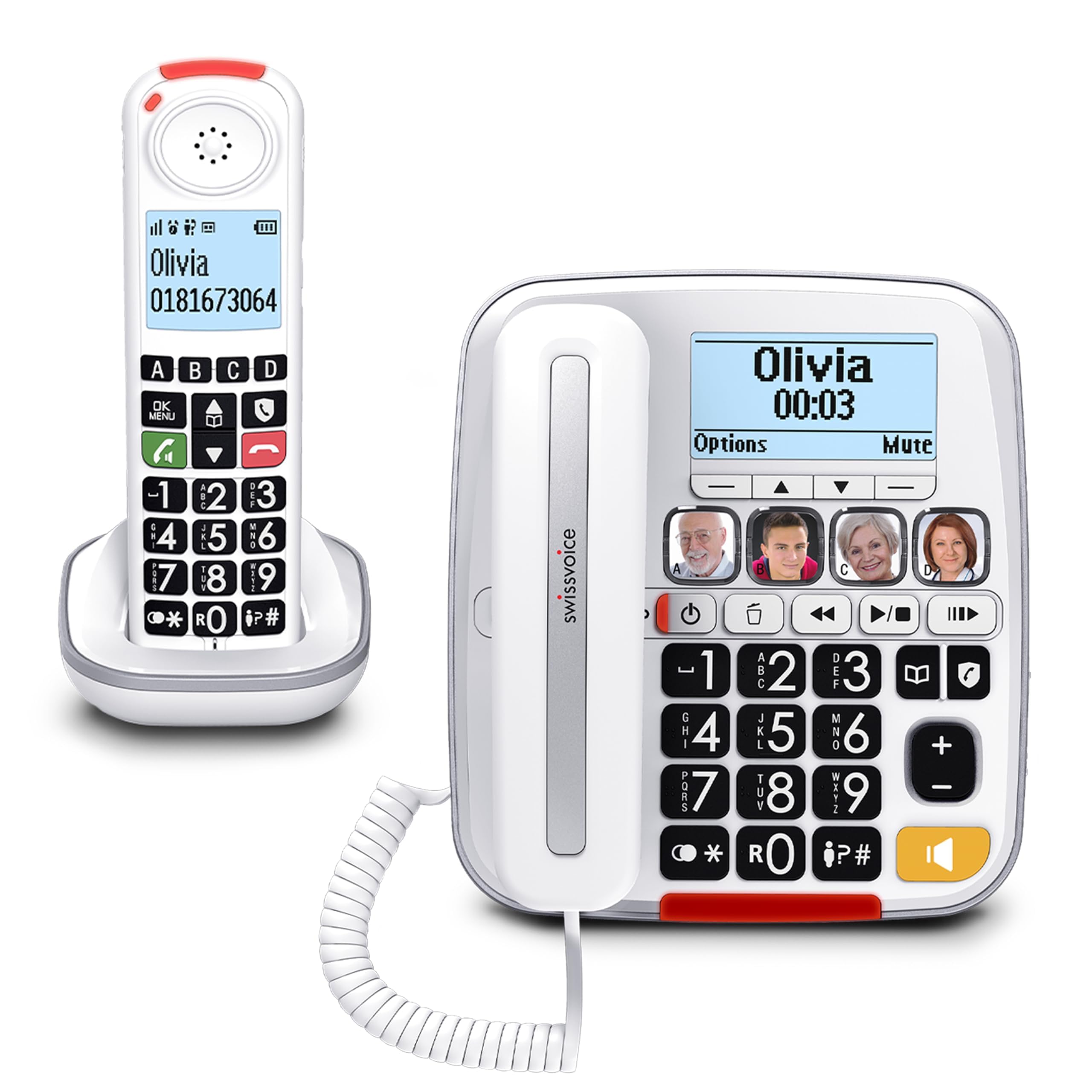
The dual-handset setup that puts one phone in two rooms for total coverage.
The SWISSVOICE Premium 3355 is a great choice for a senior who needs phone access in multiple rooms without buying a separate system. It includes 2 handsets: one corded on the base unit and an additional cordless handset. That means one phone can live in the living room while the other roams to the bedroom or kitchen, and each base unit is compatible with up to 3 additional handsets if you want to expand further.
It carries the loud, big-button features you’d expect. The ringer volume is adjustable up to 90 decibels (dB) — the equivalent of a car wash or electric blender, so it’s hard to miss. There are 4 large photo memory buttons including an SOS button, making it easy to see exactly who you’re calling. The dialing keys are extra large, ideal for the visually impaired or those with unsteady hands. With up to 26-30 dB of amplification, callers’ voices are boosted to a comfortable level.
The dual-handset design is its biggest draw, but the feedback is mixed on usability. The large, clear buttons and loud, clear sound are praised, yet some find the setup complicated and the button layout counterintuitive. It’s a strong option for families who value having a reliable phone in two locations, but it may require a patient teacher during the initial setup.
Coverage-focused: The two-in-one setup is ideal for a senior who spends time in different parts of the home.
The honest trade-off: Buyers are split — some found it “perfect for elderly loved ones” while others called the control layout frustrating, so trial and error may be needed.
Best for: Families wanting an immediate two-room phone solution with loud volume and photo dialing for a senior.
Look elsewhere if: A senior needs the absolute simplest layout; the interface here has a learning curve.
6. Clarity E814CC

The powerful combo for those who want the reliability of a corded base.
The Clarity E814CC takes a different approach by pairing a corded base unit with a cordless handset. This is a smart choice for a senior who wants the absolute reliability of never dealing with a dead battery on the main phone, while having a cordless handset to move around. Weighing 3 pounds, the base unit feels substantial and stable on a desk or table.
Sound quality is this model’s strongest suit, delivering clear, loud volume that makes a real difference for hearing loss. Reviewers point out a 90-year-old user heard clearly and loudly, better than on any previous phone. The cordless handset features large dials, and the phone itself is built for amplified sound. The core clarity is the thing everyone raves about here.
The catch is the complexity. The instructions are frequently described as confusing and overly detailed, and the interface has multiple steps for basic tasks like erasing missed calls. Some find the volume boost button can be too loud and interfere with hearing aids. It’s a powerful tool that requires a bit of patience to master.
The strongest assets
- Excellent sound clarity and loud volume for the hearing impaired.
- Corded base means the main phone always works, even if the handset battery dies.
- Dual keypads let more than one person call from the same system.
Where it gets tricky
- Programming and navigating the menus is complex and non-intuitive.
- The message alert is an audible beep rather than a visual light, which doesn’t help those with hearing loss.
Reach for this if: You prioritize the clearest possible sound quality and want a corded base for reliability, and you’re willing to help with setup.
A gentler option: If the senior is non-tech-savvy, the complexity here might be more than they need.
7. VTech SN5127 + SN5107 Bundle
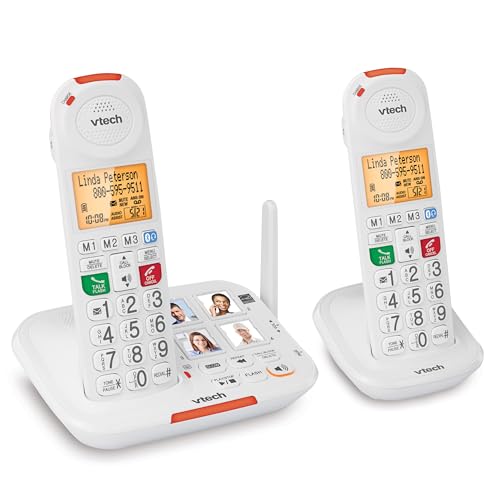
The bundle that gives you two amplified handsets from day one.
Starting with a two-handset system right from the start solves the “I can’t hear it from the other room” problem immediately. This bundle combines the VTech SN5127 base with an additional SN5107 handset, giving you two amplified phones that share the same phone line. You can keep one in the living room and one in the bedroom, which is a flexible setup for a senior who’s active around the house.
Each handset comes with the defining VTech amplified features: a 90 dB extra-loud ringer with a flashing visual indicator, and a one-touch Audio Assist that boosts the caller’s voice by up to 50 dB. The oversized, high-contrast keys and large display make dialing and reading Caller ID easy. The battery backup mode is a thoughtful touch — placing a charged handset in the base provides backup power to the telephone during an outage.
The bundle also carries over the photo speed dial keys, allowing you to attach a photo to 4 frequently dialed numbers. Shoppers say the volume is adjustable and loud enough for a hard-of-hearing user to actually hear who they’re talking to — even without wearing hearing aids. The trade-off mirrors the single-handset model: the interface can be a challenge for the least tech-savvy, but the sound itself is consistently praised.
Two rooms, one system: This is the most practical way to get amplified coverage in the two most-used rooms of the house.
The fit note: The sound wins people over, but the complexity is the recurring gripe — it’s great for a senior who’s comfortable with gadgets, less so for a complete tech newbie.
Best for: Families who know they’ll need a second handset eventually and want to save effort by getting it bundled from the start.
Who should skip: A senior who lives in a small space where one handset covers everything and values simplicity above all.
8. Clarity XLC3.4+

The dedicated sound booster built for profoundly deaf users.
When standard amplification isn’t enough, the Clarity XLC3.4+ is the specialist. It’s designed for those with profound hearing loss, and its defining feature is the sound booster — a dedicated button that dramatically amplifies the caller’s voice. Buyers report a severely deaf 97-year-old father could finally hear his family clearly with the booster pressed. That’s the level of performance this phone is built for.
It uses DECT 6.0 technology at 1.9GHz for an interference-free connection and wide range throughout the home. Its Digital Clarity Power Technology extends battery life by 30%, reducing the need for frequent charging. The ringer is rated as extra-loud, and the big buttons are designed for easy dialing. It also works with handsets, PSTN, and VoIP lines, adding flexibility.
The catch is that it doesn’t include an answering machine. And while the volume boost is powerful, some buyers with severe hearing loss still found it not loud enough — a reminder that no phone can overcome every degree of deafness. The sound booster is the clear highlight, but one owner found it also amplifies static, which can be a distraction.
The decibel-focused pick: The single most powerful sound-boosting feature is the key reason to choose this Clarity model.
The honest limits: The lack of an answering machine and a button layout that isn’t the most intuitive for elderly users are the main drawbacks to weigh.
Reach for this if: The user has profound hearing loss and needs the most powerful volume boost available, with a simple “press to boost” solution.
Look elsewhere if: You need an answering machine, or if the user is easily frustrated by less-than-obvious button labels.
9. Panasonic KX-TGM420W + 2 Extras

The ultimate whole-home system with three handsets right from the start.
For a larger home or a senior who wants a phone within arm’s reach no matter where they are, this Panasonic bundle is the definitive solution. It comes with the KX-TGM420W base and two additional KX-TGMA44W handsets, giving you three amplified phones on day one. And since the system is expandable to 6 handsets total, you can add more later without changing the base. A 9-day standby time means you won’t need to charge it daily.
It inherits all the strengths of the Best Overall pick: a volume boost control that amplifies the caller’s voice by up to 40 dB, six voice tone settings, and a loud base unit ringer. The big white backlit LCD and enlarged touch dial keys make it easy to see and dial. Bright red LED visual ringers on both the base and handset provide a flashing light alert, which is a godsend for those who can’t hear the ring at all. A Noise Reduction feature suppresses background noise for clearer, more comfortable conversations.
The bundle also includes the full suite of Panasonic’s senior-friendly features: Slow Talk to slow speech in real time and on messages, a 250-number call block, Talking Caller ID, and a speakerphone. Owners mention it’s “great for seniors” with a very loud volume and flashing red lights on incoming calls. The three-handset setup in a 3.8-pound package is heavy on features but light on setup hassle.
The whole-home advantage
- Three handsets included, expandable to six, cover a large house.
- 40 dB volume boost plus visual LED ringers on every unit.
- 9-day standby time means less frequent charging.
- Blocks up to 250 call numbers to cut down on spam.
The trade-off
- This is the premium end of the spectrum, so you’re paying for the whole system.
- Some owners note the handset is heavier than standard models.
Best for: You if you live in a larger home and need a phone in multiple rooms, plus the reassurance of a top-tier system that won’t let you down.
Consider this: If you only need a phone in one room, the single-handset version delivers the same core sound features for less.
Understanding the Specs
Decibels (dB) of Boost
The “40 dB” or “50 dB” you see in the specs is a measure of how much the phone can amplify the caller’s voice. A higher number means a louder, more powerful boost. A 40 dB boost is a substantial increase that helps those with moderate hearing loss, while a dedicated “sound booster” on specialized models is designed to help with profound loss. Think of it as the maximum “loudness” setting the phone can reach.
Ringer Volume and Visual Alerts
An extra-loud ringer is useless if the user can’t hear high frequencies. That’s why amplified phones also include visual alerts. A flashing LED light on the base and handset lets a deaf or hard-of-hearing senior know a call is coming in. Look for a ringer rated around 90-100 dB, which is loud enough to be clearly audible through most of the house, paired with a bright flashing indicator.
FAQ
What does “40 dB volume boost” actually mean for my parent?
Are these phones compatible with hearing aids?
What is the Slow Talk feature and why is it important?
Can I block robocalls on an amplified cordless phone?
What are photo speed dial buttons?
Do I need a landline service for these phones to work?
How long do the batteries last on a single charge?
What’s the difference between amplified and just a “loud” phone?
Which phone is best for someone with severe vision loss?
Final Thoughts: The Verdict
For the majority of shoppers, the amplified cordless phones for seniors winner is the Panasonic KX-TGM420W because it delivers the strongest, most complete solution for hearing the ring and understanding the conversation. If you want the simplicity of photo dialing and a powerful one-touch boost, grab the VTech SN5127. And for a senior living independently who needs a safety net, the Gigaset E560A with its dedicated SOS key is the one to reach for.
How We Picked
We do not accept paid placement. Every pick is matched to a real buyer and a real use-case; we do not hands-on test units.
Sources & Methodology
Specifications: manufacturer listings and product documentation. Review insights: verified customer reviews, as of August 2026. Pricing: not shown on this page (it changes often); check the current price via the retailer link.
As an Amazon Associate, Gadgets Feed earns from qualifying purchases. This does not affect which products we feature.