
Our readers keep the lights on and my morning glass full of iced black tea. As an Amazon Associate, I earn from qualifying purchases.
Specs are compiled from manufacturer listings and verified buyer reviews and can change over time — please confirm the key details on the product page before buying.
If your parent keeps guessing at what the caller said, the phone is usually the problem, not the hearing. An amplified corded phone pushes the voice on the other end up in plain volume so a call stops being a strain. The picks below are the ones that actually deliver on that promise, sorted by what each does best.
I’m Min — the founder and writer behind Gadgets Feed. This guide is built by comparing the manufacturers’ published specifications and the patterns across verified customer reviews, so you get each pick’s real strengths and trade-offs instead of marketing spin.
Amplified sets range from simple one-button dialers to full systems with answering machines, so the right one depends on your setup. This breakdown of amplified landline phones covers boost levels, picture dialing, and ringer loudness side by side.
Our Picks at a Glance


How To Choose The Best Amplified Landline Phones
Two numbers decide whether an amplified phone helps your parent or sits unused in a drawer. One is how much the handset boosts the incoming voice, measured in decibels (dB) — a bigger number means a louder earpiece. The other is how loud the ringer gets, which is a separate setting entirely.
Handset gain versus ringer loudness
Handset amplification is the boost your parent hears in their ear during the call. Ringer loudness is how far across the house the phone carries when it rings in the first place. A phone can be strong at one and weak at the other, so check both before you commit.
Hearing-aid compatibility and T-Coil
A T-Coil is a small coil inside some hearing aids that picks up a phone’s magnetic signal directly. If your parent wears an aid equipped with one, a T-Coil-compatible phone can be the difference between muddled and clear. Not every amplified phone here confirms that spec.
Power, wiring and power cuts
A corded phone that draws its power from the phone line keeps working when the electricity goes out. That matters for anyone who relies on the landline as their emergency line. Wireless sets with an AC adapter generally do not have that advantage.
Quick Comparison
| Model | Best For | Amplification | Ringer Volume | Speed Dial | Amazon |
|---|---|---|---|---|---|
| ClearSounds CSC500★ Best Overall | All-round home line | Up to 30dB | 85dB | 8 photo keys | Amazon |
| Sacumea Amplified 100dBBudget Champion | Budget hearing help | 80dB receiver gain | 100dB | 3 photo keys | Amazon |
| HePesTer Big ButtonMost Versatile | Wall or desk mounting | Up to 40dB | — | 3 picture keys | Amazon |
| JeKaVis J-P02 | Low-vision dialing | Up to 40dB | — | 2-touch on 0-9 | Amazon |
| Med-Pat T4-R | Slim desks and hotels | 27.5dB boost | Adjustable | — | Amazon |
| Clarity P300 | Fine-tuned ringer pitch | Up to 26dB | Adjustable pitch/volume | Photo keys | Amazon |
| VTech SN1127 | Answering machine included | 40dB booster | 90dB | 8 photo keys | Amazon |
| SMPL photoDIAL 56011 | Landline or VoIP homes | Up to 75dB | — | 6 photo keys | Amazon |
| Serene Innovations HD40P | Dementia and memory support | 26dB | 85dB | 9 photo keys | Amazon |
In‑Depth Reviews
1. ClearSounds CSC500 Amplified Landline Phone
Our pick — over 4★ from 800+ verified ratings; the strongest balance of quality and price.
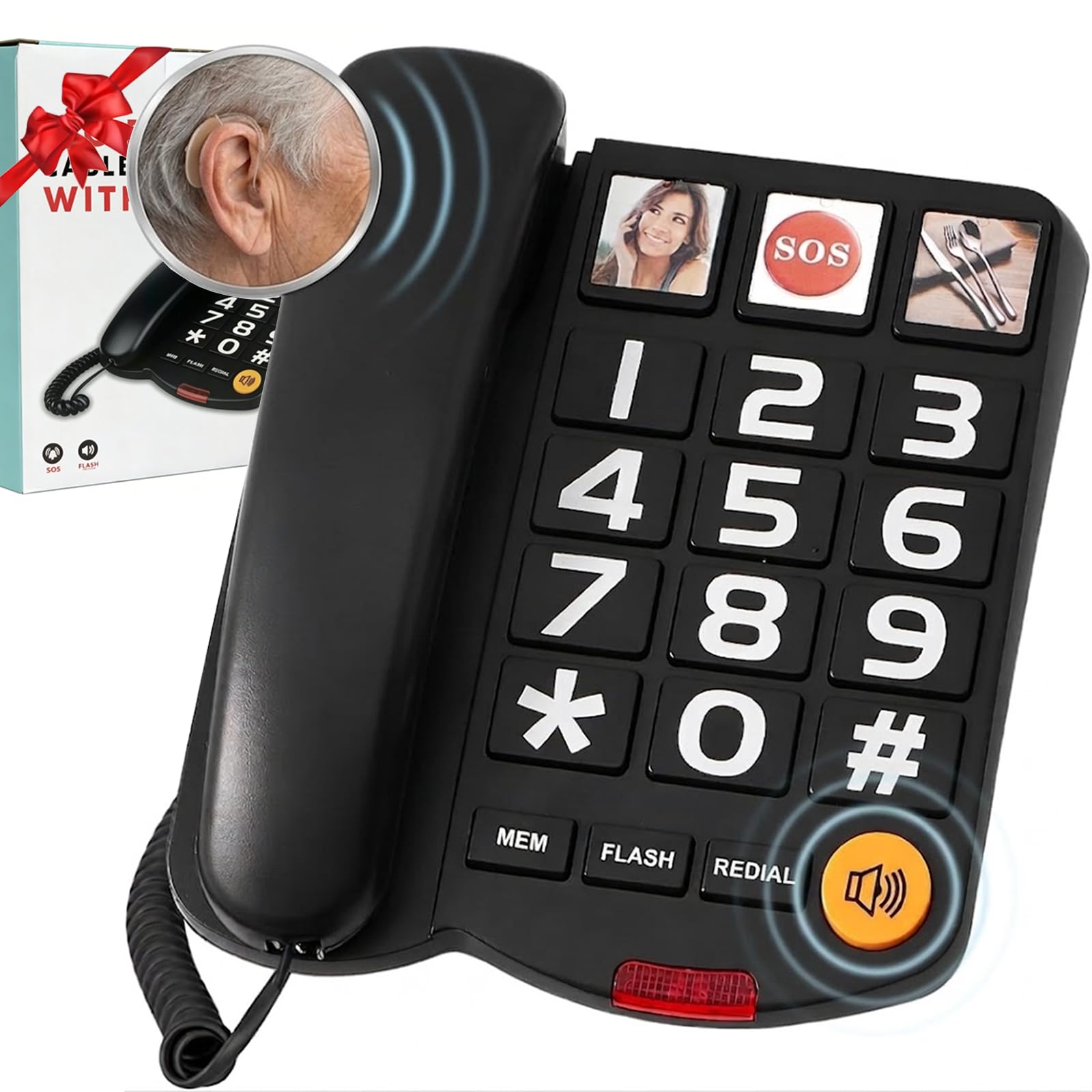
The desk phone that pairs a 30dB handset boost with eight photo dial keys
The CSC500 takes the top spot because it handles the most jobs well. It boosts incoming voices up to 30dB (decibels, the standard measure of loudness), which is enough for a mild to moderate hearing gap. It also meets FCC standards for hearing aid compatibility, so it works with T-Coil hearing aids and cochlear implants — a small coil inside those devices picks up the phone’s signal directly, letting your parent hear the call inside their aid instead of through the earpiece.
What wins people over is the build. It is the most-cited strength across the review pages, and the large buttons rank just behind it — a hard-of-hearing 93-year-old can dial independently once family numbers are loaded onto the eight photo-frame keys. Each of those keys holds a 32-digit number, plenty for long-distance codes. The ringer climbs to 85dB, and there is a visual flasher that lights up so a call is never missed in a quiet room. Solid construction shows up in the notes too: one unit survived a drop without issue.
Understand what you are buying, though. The amplification is strong, not extreme, and some owners say it still is not loud enough for a profound loss. The recurring gripe is reliability — a handset speaker that gave out after six months of light use is the kind of report that shows up more than once. Keep the receipt. There is also only one color, so white is the white you get.
Where it pulls ahead
- 30dB handset boost with an 85dB ringer, both adjustable
- T-Coil hearing aid and cochlear implant compatible per FCC standards
- Eight photo-frame memory keys, each storing 32 digits
- Handset or hands-free speakerphone, plus a ring flasher
Where it asks patience
- Sound quality draws mixed feedback — boosted, but not the loudest option here
- A recurring durability complaint centers on the handset speaker
- One color only, and programming the memory keys takes some fiddling
Reach for this if: you want one desk phone that handles amplification, photo dialing, and a loud ringer without a separate answering machine.
Look elsewhere if: the hearing loss is profound — the CSC500 boosts up to 30dB, while the VTech SN1127 pushes to 40dB.
2. Sacumea Amplified (100dB) Landline Phone for Seniors
The budget pick whose 100dB ringer is the loudest alert here
If the goal is simply to hear the phone ring from the next room, this one is hard to argue with. Its incoming ringer reaches 100dB, and that is 15dB above the ClearSounds CSC500’s 85dB ring — a real step up in the loudness of the alert itself. The receiver carries up to 80dB of gain, so the handset voice climbs too. There are three one-touch photo buttons and 10 two-touch number memories for dialing family without reading a keypad.
Owners who connect it to an existing building system tend to be the happiest — it worked with an assisted-living phone system, and the buttons could be programmed for the four-digit extensions the resident needed. The wired design gives it a sturdy feel, and the flashing LED catches the eye in low light. What the reviews keep circling back to is the dialing: the three speed-dial buttons make calling a named person a single press.
The honest note here is loudness in the ear. The phone has no T-Coil compatibility listed, and the receiver gain tops out at 80dB — high, but behind the 40dB booster on the VTech. It is also, in the maker’s own words, not built for profound hearing loss. If your parent wears a hearing aid and needs the sound routed through it, this is not the pick.
The case for it: a 100dB ringer plus 80dB receiver gain and three photo keys, all aimed at the same job — making a familiar voice reachable in one press.
What to know first: it suits mild to moderate loss, not a profound one; the maker steers extreme-volume needs to a dedicated amplified phone.
Good match when: the priority is a phone that rings like a fire alarm and dials family in one touch on a tight budget.
Not the one if: the sound has to run through a hearing aid — there is no T-Coil support listed here.
3. HePesTer Big Button Phone for Elderly
A 40dB big-button phone that mounts on a wall or sits on a desk
The HePesTer’s adjustable volume climbs past 40dB, putting it in the same amplification territory as the VTech SN1127 and well above the 26dB Clarity P300. That boost is the headline. But what makes this one stand out is placement: the base mounts on a wall or rests on a desk, and four nonskid pads on the bottom keep it from sliding off a tabletop when someone pulls the handset.
Owners with easily confused relatives lean on the no-frills layout — the numbers are big and easy to push, and there are three replaceable picture buttons for family photos. One of the more useful details is memory protection: unplug the line and the stored numbers stay put. A replacement unit here ran two and a half years before a mute switch failed, and an 89-year-old with dementia learned it without trouble.
Set expectations on sound quality. Volume and functionality both land in mixed territory on the review pages — some find it plenty loud, others wish for more. In the ear it is not a match for the ClearSounds’ hearing-aid path, but it is a solid belt-and-braces choice for someone who wants the flexibility of wall or desk mounting.
The strong point: 40dB+ adjustable volume paired with both wall and desktop mounting plus nonskid feet.
The reality check: volume draws mixed feedback, and the emergency button sits next to speed dial — some owners made accidental calls during setup.
Best fit for: a parent whose hearing loss sits in the moderate range and who needs a phone they can mount where they can reach it.
Step past if: you want the strongest possible boost — the 40dB+ here is matched but not exceeded.
4. JeKaVis J-P02 Amplified Corded Phone

The low-vision pick with 1-inch keys that runs on line power alone
Where this one earns its place is legibility. The number keys measure roughly one inch square, and for someone with fading sight, that size can be the whole difference between dialing alone and asking for help. The keypad is the primary draw. Amplification reaches up to 40dB on the handset, speakerphone, and ringer, and it is compatible with hearing aids.
Because it draws power from the phone line rather than a wall outlet, it keeps working during an outage — a genuine advantage for a household that treats the landline as the emergency backup. The ringer can be turned off entirely for anyone who needs quiet at night, and one-touch programming lets two presses reach a relative or emergency contact.
The catch is durability. Functionality here is the most-mixed aspect on the review pages, with reports of units that failed from the box and a handset replaced after a first unit arrived broken. A unit that arrived dead was made right by customer service, and another replacement phone in the same review resolves the story. If you buy this one, test it before the return window closes. The light plastic base also slides on a slick tabletop when the handset is pulled.
What earns its keep
- 40dB amplification on handset, speakerphone, and ringer
- Approximately 1-inch square number keys for low vision
- Line-powered so it works through a power cut, no batteries to swap
- Wall-mountable base with a hook to keep the handset in place
What to watch for
- Reliability draws consistent mixed feedback across owners
- Some units arrive broken and need replacing during the warranty window
- Light build slides on smooth tabletops when the handset is pulled
Worth it when: eyesight is the bigger obstacle than hearing and you want a phone that runs without a battery or wall power.
Pass if: the priority is bulletproof reliability — this one shows more variability than the ClearSounds or VTech.
5. Med-Pat T4-R Trimline Telephone
The 3.25-inch-deep trimline that fits a nightstand corner
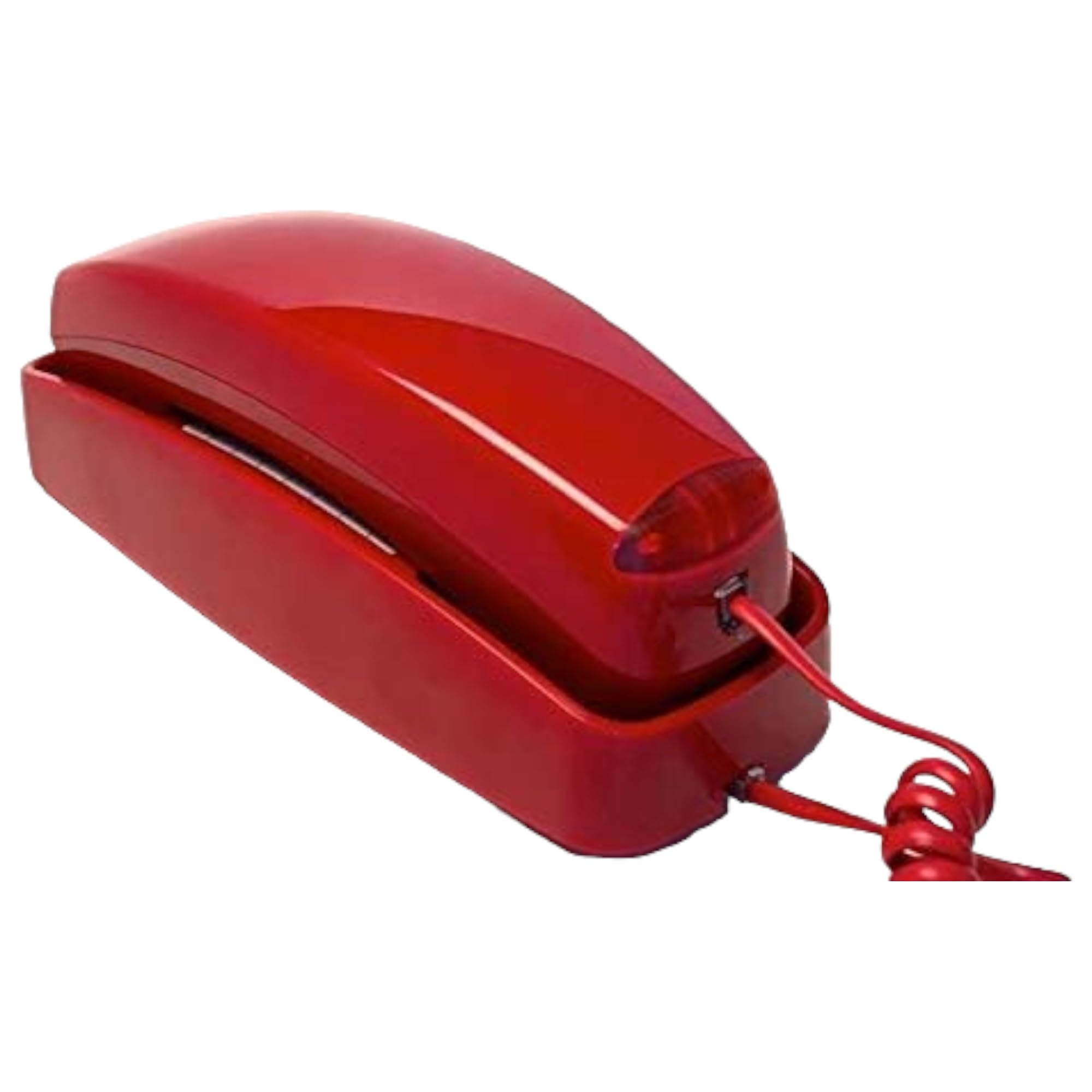
Not everyone wants a chunky desk phone, and this trimline’s footprint is the point. It measures 8.5 x 3.25 x 3.25 inches, so it tucks into a corner far more easily than the ClearSounds CSC500, which runs 9.25 x 6 x 2.25 inches. The Boost Button lifts volume up to 27.5dB, a modest jump aimed at high-frequency hearing loss rather than heavy amplification.
Owners gravitate to the appearance first — the red finish is the aspect mentioned most across the review pages, and its durability holds up in the feedback, with one unit reported to have survived being dropped. The oversized ring indicator light flashes when a call comes in, and the Lite Touch keys carry non-rub-off lettering, so the numbers do not fade over years of pressing. It works for hearing aid users and a hard-of-hearing parent found the numbers clear and loud.
The caveat sits in the sound. Functionality is the most-mixed area across the review pages, and static is the recurring complaint — one wall unit finally gave out after four months, with a repairman calling the phone dead. For a slim phone this price, that is worth knowing. The ring light also describes itself as super bright; owners note it flashes well, but the brightness itself did not impress everyone.
The one thing to remember: 27.5dB boost and a slim 3.25-inch-deep profile that suits a nightstand or a hotel-style desk.
What may disappoint: static on the line shows up in the feedback more than once, and a wall unit was reported dead at four months.
Pick this if: you want a bright, compact trimline with a flashing ring light and a modest boost for high-frequency loss.
Look at the CSC500 instead if: you need heavy amplification or a hands-free speakerphone — the Med-Pat covers neither to the same degree.
6. Clarity P300 Landline Phone with Sound Amplification
The pick with adjustable ringer pitch and volume for a softer ring
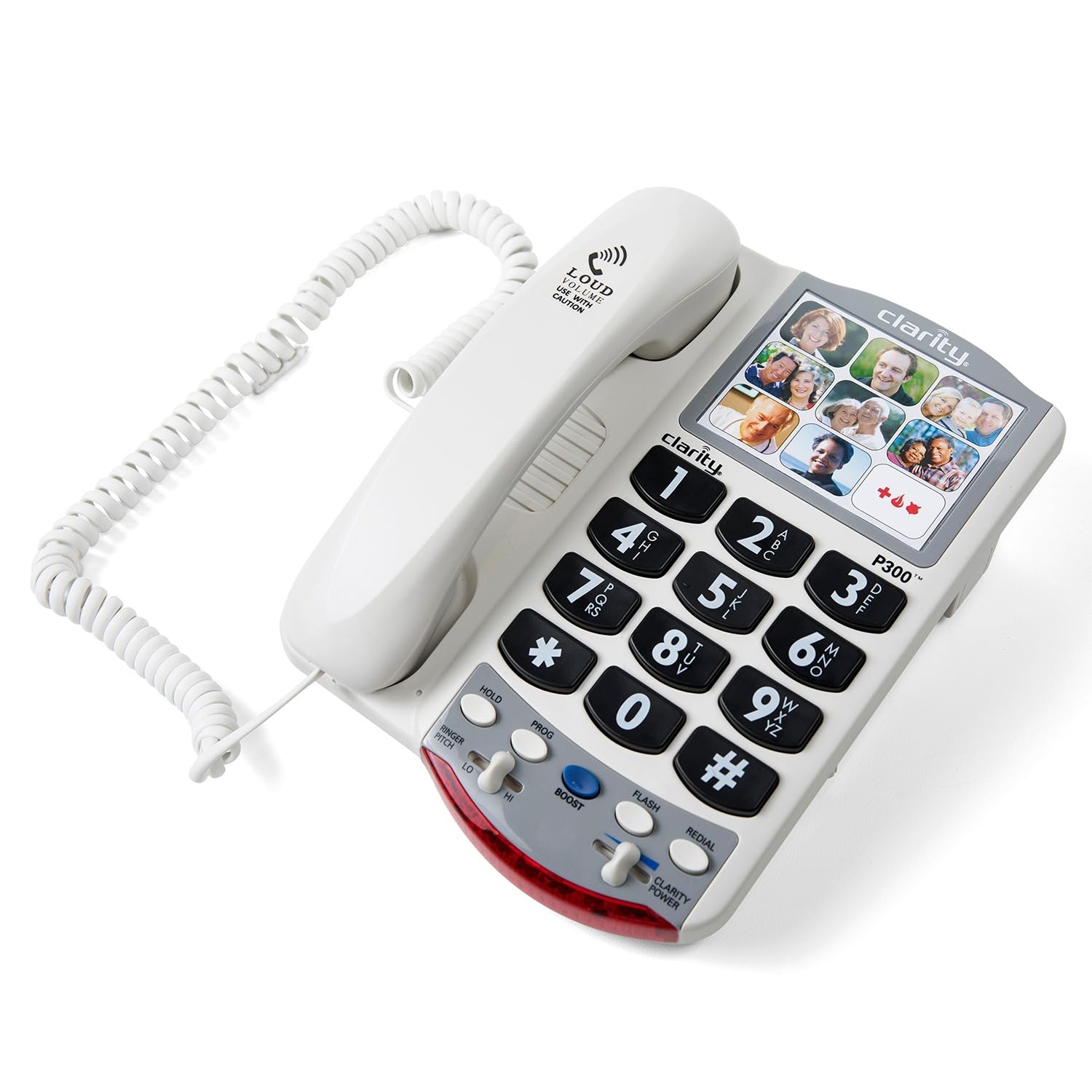
The P300’s twist is that you tune the ring, not just its volume. Incoming calls are amplified up to 26dB, and both ring pitch and ring volume adjust to suit the listener — useful when the standard tone is the sound that hurts. It runs off the phone line, so no batteries are ever needed, and the bundle includes a 25-foot line cord so you can move the phone without hunting for an extension cord.
For dementia support, the one-touch picture dialing is the part that clicks. It lets a 90-year-old with Alzheimer’s reach nine numbers with a single press, and family can slip portraits into the slots for recognition. The buttons are large and generous for stiff or shaky fingers, and there is an external speaker jack and an LED ring light for anyone who wants a visual cue.
The honest trade-offs here are real. There is no speakerphone, and the amplifier has to be pressed on again for each call rather than staying on. The picture-memory buttons require a firm press to register, which some owners with arthritis found difficult. With 286 quality mentions and 109 for button size, it is a well-liked phone, but the amplification does not climb as high as the 40dB VTech.
The strongest spec: 26dB incoming amplification with separate adjustable ringer pitch and volume, so the ring tone is soft as well as loud.
What you sacrifice: no speakerphone, and the amplifier resets after every call.
Suited to you if: the ringer feels too harsh and you want photo dialing plus a phone you can move on a 25-foot cord.
Consider the HePesTer if: the priority is a louder ring — that one reaches the same 40dB on the handset without the Clarity’s tuning controls.
7. VTech SN1127 Amplified Corded Senior Phone

The 40dB pick with a built-in digital answering machine
The built-in digital answering machine is what separates this from the CSC500. With call screening and spoken Caller ID, the phone announces who is calling so a hard-of-hearing parent can decide to pick up, and the caller can leave a message if they do not. That removes the frustration of a missed call from a doctor’s office. The one-touch audio booster lifts incoming volume up to 40dB, and the ringer reaches 90dB with a flashing visual alert.
Eight photo speed-dial keys keep the layout familiar, and each can carry a photo of a family member for one-press calling. A programmable red emergency button handles a 911 call — tested successfully on one owner’s MagicJack setup. Because the phone is fully corded, it draws power from the line and keeps working without an outlet. There is a full-duplex speakerphone and hearing aid compatibility for hands-free calls.
One thing the SN1127 does not include is a visible caller ID display, despite what some product listings claim. Owners who wanted to see who was calling before answering noted the absence clearly. The ringer at maximum is also a very loud tone, which is the point for a hard-of-hearing user but can be a shock for anyone else — a mother who refuses hearing aids gets the benefit, while a light sleeper would want to lower it.
what separates it
- 40dB one-touch audio booster plus a 90dB ringing ringer
- Integrated digital answering machine with call screening
- Eight photo speed-dial keys for one-touch family calling
- Corded design that keeps working through a power cut
What to weigh
- No visible caller ID display despite the listing claiming otherwise
- Ringer volume is high at maximum — not adjustable low enough for some
- Answering machine on/off button is easy to misplace in the dark
Choose it for: a home that wants a loud, amplified phone with a built-in answering machine and programmable emergency dialing.
Pick the CSC500 instead if: you need caller ID on screen — the VTech leaves it out.
8. SMPL photoDIAL Big Button Phone (Model 56011)
The photo phone with a VoIP adapter for internet-based phone service
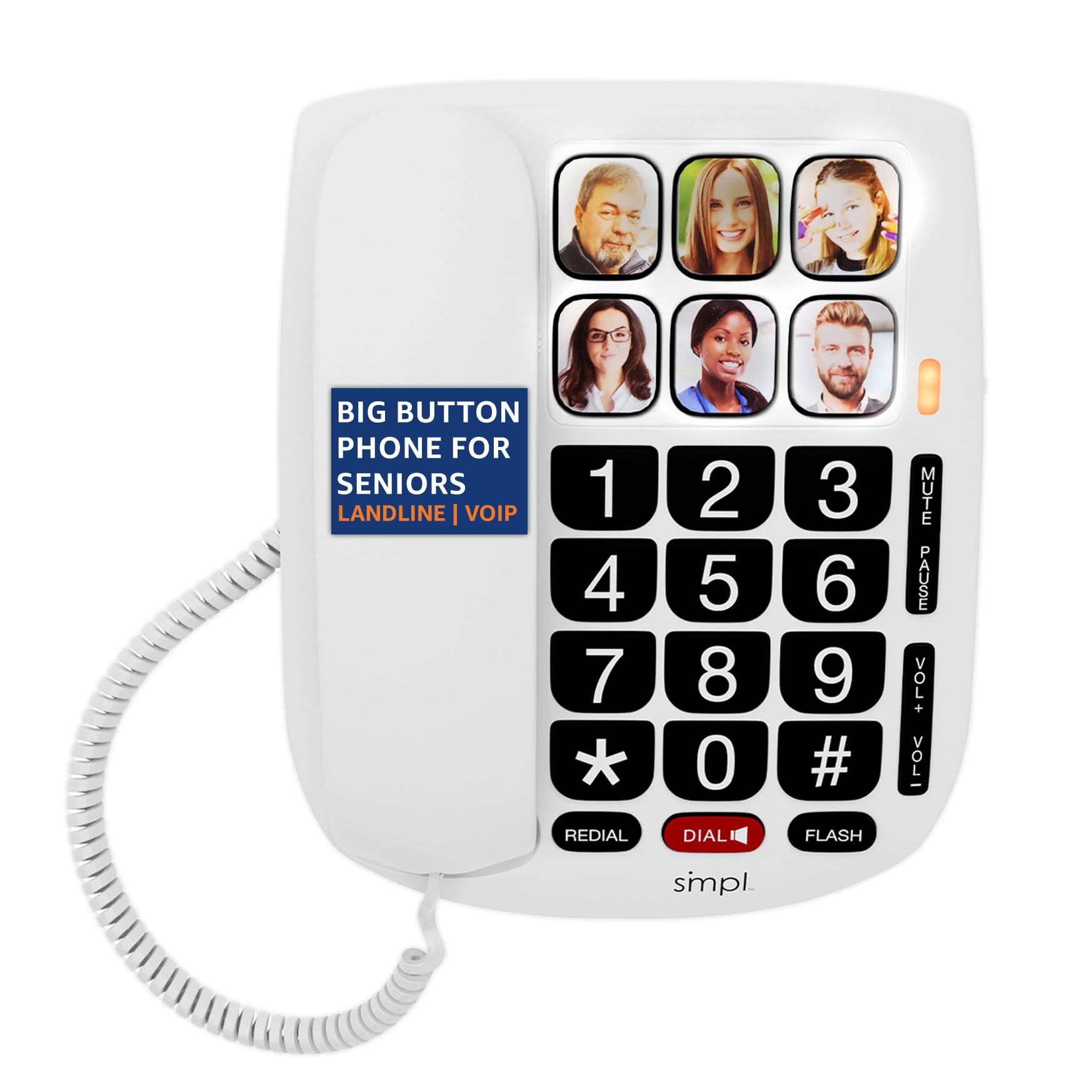
Most phones here assume a standard phone jack, but the SMPL 56011 works with landline or VoIP service, and includes the plug-in adapter VoIP needs. That matters if your parent’s building uses internet calling rather than a copper line. Amplification is the permanent-switch type, selecting from three levels up to 75dB — the highest handset figure on this list, well clear of the 40dB on the JeKaVis and HePesTer.
Six large photo memory buttons carry the load of daily calling. Each holds a portrait of a family member, so pressing the picture dials the number and lifts the handset out of the equation. The glossy white body is drop-tested to six feet, and the manual is written for a first-time reader, with two owners reporting it set up in minutes. A red light on the receiver signals when the line is still off-hook — a quiet fix for the common “phone left off the cradle” problem.
The reviews on this one are the most divided of the group. Functionality lands in mixed territory, with the speed-dial buttons doing exactly what they should for most, but not working at all for some units. That is a programming failure that would leave an elderly parent unable to dial, so test every button after setup. Sound quality is also mixed, with a loud buzzing on some calls.
The reason to buy: up to 75dB permanent amplification and six photo keys on a phone that handles VoIP as well as a standard line.
The risk to manage: speed-dial buttons have failed to program for some owners — verify operation before the return window closes.
Made for: a home on VoIP or a mixed landline-and-internet service that wants the loudest handset on this list.
Not for: a buyer who needs rock-solid consistency from the box — a small number of units have non-working memory buttons.
9. Serene Innovations HD40P Amplified Big Button Phone

The picture-button phone built for a parent who can no longer remember a number
Nine photo memory buttons — the most of any phone on this list — are the reason the HD40P exists. Each holds a portrait photo, and a single press dials that person. For a 90-year-old with Alzheimer’s who kept hanging up or muting a cordless handset, this one stays put on a table and answers with the familiar motion of lifting a receiver. Amplification reaches 26dB, and the ringer rings at 85dB.
Everything runs off the phone line, so the phone keeps working when the power goes out and there is no battery to keep replacing. The button size is the most-mentioned positive aspect across the review pages, and owners of vision-impaired relatives use the size itself to dial by touch, even using large-print labels in place of photos where that works better. There is a ring and status light, plus mute, hold, and redial buttons on the base.
The recurring caution is reliability. Quality draws mixed feedback, and one unit’s volume control quit in under two years, leaving the call too quiet for a parent with dementia — and because she could not learn a new phone, the household had to buy the same model again. Battery life and caller ID round out the weaker aspects, and there is no visible caller ID. Treat the durability of any single unit as uncertain, and keep the receipt.
The standout spec: nine photo speed-dial buttons and 26dB amplification on a phone that never needs an outlet.
The honest trade-off: durability varies — a volume control that failed inside two years is the kind of report that keeps resurfacing.
Right for: a household where the goal is one-touch calling and memory support, and the phone can stay on a table beside a chair.
Think twice if: you want the strongest amplification — the 26dB here trails the 40dB VTech and 75dB SMPL.
Understanding the Specs
Handset Amplification (dB)
Amplification is the boost applied to the voice coming through the earpiece, measured in decibels. A higher number means a louder handset. The picks here span 26dB on the Clarity P300 up to 75dB on the SMPL 56011. Match the number to the severity of the hearing loss — the makers themselves note that mild and moderate loss calls for a different level than a profound loss.
Ringer Volume (dB)
Ringer volume is a separate spec from handset amplification. It decides how far across the house the ring carries, not how loud the voice is in the ear. The Sacumea 100dB ringer is the loudest alert on this list — which is why it wins the budget slot despite its 80dB handset gain. A visual flasher is a useful extra when the ring needs a silent backup.
Hearing-Aid Compatibility and T-Coil
A T-Coil is a small coil inside some hearing aids and cochlear implants that picks up the phone’s magnetic signal directly. Confirming this spec matters if your parent wears an aid that has one. The ClearSounds CSC500 explicitly confirms FCC-standard hearing aid compatibility; several picks here list only “hearing aid compatible,” which is a broader claim.
Corded Power and Reliability
A corded phone that runs off the phone line keeps working when the electricity is out — a real advantage for an emergency line. That is true of the ClearSounds, the JeKaVis, and the Serene Innovations HD40P, among others. No batteries and no wall power means fewer failure points, though the phone is still only as reliable as its internal speaker and handset.
FAQ
How much amplification do I need for my parent’s hearing loss?
Will an amplified landline phone work with VoIP service like MagicJack?
Do I need a phone with a T-Coil to use a hearing aid?
Photo speed dial sounds confusing to program — how hard is it to set up?
What is the difference between handset amplification and ringer volume?
Will a corded landline phone keep working during a power outage?
My parent has dementia — which phone feature helps most?
Should I buy a wall-mountable or desktop model?
My phone line goes through a router — will these phones work?
Do amplified phones need batteries?
Final Thoughts: The Verdict
The winner among amplified landline phones is still the ClearSounds CSC500 — its 30dB boost, T-Coil compatibility, and eight photo dial keys cover the widest range of needs without a separate answering machine. If a ringing phone is the main concern, the Sacumea 100dB rings louder than anything else here for budget-conscious shoppers.
For a household that wants the phone to answer itself, the VTech SN1127 brings 40dB of boost and a digital machine. And if memory support is the priority, the SMPL 56011 pairs six photo buttons with up to 75dB amplification and works on VoIP. Whichever you choose, test every button before the return window closes — the one honest nudge that matters most with this category is verifying the unit yourself, because a phone that dials in one press is worth the two minutes of checking.
How We Picked
We do not accept paid placement. Every pick is matched to a real buyer and a real use-case; we do not hands-on test units.
Sources & Methodology
Specifications: manufacturer listings and product documentation. Review insights: verified customer reviews, as of September 2026. Pricing: not shown on this page (it changes often); check the current price via the retailer link.
As an Amazon Associate, Gadgets Feed earns from qualifying purchases. This does not affect which products we feature.