
Our readers keep the lights on and my morning glass full of iced black tea. As an Amazon Associate, I earn from qualifying purchases.
Specs are compiled from manufacturer listings and verified buyer reviews and can change over time — please confirm the key details on the product page before buying.
The search for an amplified phone usually starts when a parent or grandparent can’t hear the ringer, squints at tiny numbers, or fumbles with a smartphone. The fix is a landline with extra-loud volume, oversized keys, and often a speed-dial button that calls family with one press. This guide sorts the real solutions from the ones that just look helpful, using the specs and owner feedback that actually matter.
I’m Min — the founder and writer behind Gadgets Feed. This guide is built by comparing the manufacturers’ published specifications and the patterns across verified customer reviews, so you get each pick’s real strengths and trade-offs instead of marketing spin.
You’ll see exactly which features matter, from decibel boosts to button sizes, so choosing makes sense. Read on for a clear breakdown of the best amplified phones for seniors that genuinely help you stay connected.
Our Picks at a Glance


How To Choose The Best Amplified Phones For Seniors
Picking an amplified phone is less about the brand and more about matching the device to the user’s specific hearing loss, vision, and daily habits. Here are the three core filters to use before you commit to a model.
Volume Boost and Ringer Loudness
The single most important spec is the amplification level, measured in decibels (dB), which tells you how much the incoming voice is boosted beyond a normal phone. A 30dB boost helps with mild loss, while 40dB is for more profound hearing impairment. The ringer’s loudness matters just as much — a 90dB ringer is essentially a fire-alarm level, great for someone who needs that, while a visual flashing light is a good backup for those who can’t hear any tone.
Button Size and Vision Support
For someone with low vision, the physical button size is a deciding factor. Many senior-focused phones have keys around 1 inch square, and some even have a tilt-up display to reduce glare. Photo speed-dial buttons let you attach a real picture to a key that calls that person with one press — perfect for memory support. The question is whether the user needs just large numbers or also high-contrast, color-coded keys.
Corded vs. Cordless and Power Outage Use
Choose between a corded base that stays on a desk or a cordless handset that can be carried around the house. A corded phone powered by the phone line keeps working during a power outage — a true safety feature for emergencies. Cordless models offer mobility but rely on AC power and rechargeable batteries, so they won’t help in a blackout. Weigh the user’s mobility needs against the need for reliability in an emergency.
Quick Comparison
| Model | Best For | Max Amplification | Speed Dial Keys | Ringer Level | Amazon |
|---|---|---|---|---|---|
| AT&T CL2940★ Best Overall | Overall value with a large display | Audio Assist Boost | — | Extra-Loud | Amazon |
| KerLiTar K-P045WPower-Outage Pick | Power-outage reliability | Amplified Volume | 3 One-Touch | Hi/Low/Off | Amazon |
| JeKaVis J-P02Wall-Mount Value | Wall-mounting in a tight space | Up to 40dB | Two-Touch | Adjustable | Amazon |
| HePesTer P-46 | Sturdiness with nonskid feet | Up to 40dB | 3 One-Touch | Adjustable | Amazon |
| HePesTer HP-45 | Photo dialing for memory support | Up to 40dB+ | 3 Picture Buttons | Adjustable | Amazon |
| ClearSounds CSC500 | Hearing aid (T-Coil) users | Up to 30dB | 8 One-Touch | Up to 85dB | Amazon |
| Clarity P300 | Adjustable ringer pitch | Up to 26dB | Photo Icons | Adjustable | Amazon |
| Clarity D714 | Cordless freedom for home | Up to 40dB | — | Adjustable | Amazon |
| VTech SN1127 | Top pick for loud ringer | Up to 40dB | 8 Photo Keys | 90dB | Amazon |
In‑Depth Reviews
1. AT&T CL2940
Our pick — over 4★ from 10,500+ verified ratings; the strongest balance of quality and price.
The trusted crowd-pleaser with a tilting screen and Audio Assist for hard-of-hearing users.
Value is what wins people over here — it’s the single trait buyers praise most, and it’s easy to see why. The CL2940 gives you extra-large buttons and a tiltable display that fights glare, so dialing and reading caller ID don’t require squinting. It works fine as a plain corded phone during outages, though Caller ID needs 4 AA batteries (not included) to keep the display alive.
The Audio Assist Volume Boost amplifies incoming sound for clearer listening, and the ringer is adjustable and extra-loud. Buyers report: “It was a awesome phone for my nearly deaf 96 year old daddy the ringer is loud enough for him to hear it.” The 50-name/number call history makes screening calls simple, and it’s wall-mountable or desktop-friendly.
The biggest trade-off is the speakerphone — the review pages sum it up: it’s clear for some, but echo issues pop up for others. The screen isn’t backlit either, so it’s best in a well-lit room. For a straightforward, reliable amplified line with a huge following, this is the one most families land on.
The Wins
- Tilt display cuts glare for easier reading
- 50-name caller ID history for screening
- Wall-mountable with trusted AT&T durability
The Watch-Outs
- Speakerphone audio gets mixed reviews
- Caller ID needs 4 AA batteries, not included
Pick it for: a dependable, budget-friendly desk phone with big buttons and a readable display that most seniors adapt to quickly.
Think twice: if you rely heavily on speakerphone for every call, since echo issues are the most common complaint.
2. KerLiTar K-P045W
A light, line-powered phone that keeps dialing even when the power goes out.
This one shines in an emergency, since it needs no batteries and no DC power — the phone line itself keeps it running during outages. For a 95-year-old user, the setup for speed dialing is simple and fast, and the built-in memory IC stores numbers permanently, so you never lose a contact if the line is unplugged. It’s significantly lighter than the Clarity P300, which makes wall-mounting easier but also means the receiver lacks heft when hanging up.
You get 3 one-touch speed dial buttons where you can drop in photos of family, plus 10 two-touch buttons for more contacts. The ringer volume switches between Hi/Low/Off, and the handset and speakerphone have their own Hi/Low switches. Owners mention the phone arrived in perfect condition and “is working as described,” with the big letters proving useful for both elderly and younger users.
The honest catch is mixed reliability — some units ring with only a short buzz, and sound quality complaints do exist. Its light plastic body is also a fit note for people with grip challenges. If emergency readiness matters more than premium feel, this is a strong contender at a budget-friendly point.
Emergency-ready: the line-powering design and permanent memory make this the pick for outage-prone homes, at a budget-friendly price.
The trade-off: its light plastic build and occasional sound-quality reports mean it’s not the most premium-feeling option here.
3. JeKaVis J-P02
Big 1-inch keys and hearing-aid-friendly 40dB boost in a wall-mountable shell.
Ease of use is the thing people praise most here, and the giant 1×1.1-inch buttons make that a reality for low-vision users. The amplification reaches up to 40dB and is hearing aid compatible, which is a strong spec at this level. It’s powered by the phone line, so it works in outages without batteries — a recurring theme among senior-focused corded phones.
The J-P02 lets you store two-touch speed dial numbers on the 0-9 keys, and the ringer can be switched off entirely to avoid disturbing sleep. Setup is simple enough that even users with limited dexterity get the hang of it. The base is wall-mountable with a hook to keep the handset in place.
Quality is the most-discussed trait here, and it’s genuinely mixed — some units arrive broken, and sound quality gets called “poor” by a few buyers who feel you get what you pay for. The base is also light enough to tip over on a desk. This is a budget-tier pick best suited to a wall installation where its value really shows.
Wall-mount special: the 40dB boost and huge keys shine when this is mounted out of the way, and the price is entry-level.
Fit note: the light base tips easily on a desk, and a few units arrive with defects, so check it right from the start.
4. HePesTer P-46

A stable desk phone with nonskid feet and up to 40dB of volume boost.
Quality is what earns the most praise here, and the build reflects it — four enhanced nonskid plastic feet keep the phone from sliding, a small detail that matters for unsteady hands. The big buttons measure W 1.0 inch x L 1.0 inch, easy to see and press for low-vision users. It’s the rare amplified phone with 3-way conference capability, letting a caregiver join a call.
The built-in speaker IC pushes volume up to 40dB, with separate adjustable controls for receiver, speakerphone, and ringer — and you can turn the ringer off entirely. The 3 one-touch and 10 two-touch speed dial memories survive even unplugging the line, so stored numbers never vanish. Setup takes minutes, and the handset jack sits on the side rather than the back.
The most-mentioned aspect is functionality, and it’s mixed: some units don’t ring, and loudness gets called inconsistent. As a fit note, this is aimed squarely at users with hearing impairment, low vision, or dementia — not as a general family phone. For a stable, desk-bound amplified line with good build quality, this holds its own.
What Works
- Nonskid feet keep it planted on the desk
- Memories survive unplugging the line
- 3-way conference for caregiver calls
Watch For
- Occasional units don’t ring properly
- Loudness is inconsistent for some users
Best for: caregivers who want a stable desk phone with 3-way calling and durable stored memories.
Look elsewhere: if you need guaranteed maximum loudness, since mixed reports suggest it varies by unit.
5. HePesTer HP-45

Photo buttons put a face on speed dial for seniors with memory challenges.
Phone quality is the most-praised trait here, and customers note the ringers are genuinely loud. The 3 replaceable picture buttons let you attach a photo of a favorite person and store their number behind it — one press calls them, which is ideal for memory support. Its 40dB+ amplification covers varying degrees of hearing loss.
Stored numbers stay put even when the phone line is unplugged, so you don’t have to reprogram after a move or a clean. Four nonskid plastic pieces keep it from slipping, and it’s wall-mountable or desktop-ready. Reviewers point out the numbers are easy to see and the handset clarity is good.
Functionality is the most-discussed aspect and it’s mixed — specifically, the memory buttons can fail to hold programmed numbers, which is frustrating when you rely on them. The handset is also light enough to fall off the cradle. This is a good fit for a low-vision senior who wants photo dialing and doesn’t mind a bit of plastic build.
Memory-friendly: the photo buttons and permanent storage make this the pick for dementia or memory support, at a mid-range price.
Honest limit: a few shoppers say the photo memory buttons losing their programming, so verify them after setup.
6. ClearSounds CSC500

The T-Coil specialist that pairs with hearing aids and cochlear implants.
Quality is the most-praised trait here, and the CSC500 stands out for one specific reason: it works with hearing aids and cochlear implants equipped with a T-Coil, complying with FCC Hearing Aid Compatibility standards. That’s a deciding factor for profound hearing loss. The 30dB amplification boosts volume and tone, though not as high as some 40dB rivals.
It provides 8 one-touch photo memory dial keys, each storing up to 32-digit numbers, so a single press reaches family. The ringer adjusts up to 85dB, and a visual flasher lights up when the unit rings — perfect for those who can’t hear any tone. A speakerphone lets you talk without holding the handset, and the weighted base keeps it sturdy on the desk.
Reliability is the recurring gripe — several buyers report the handset speaker failing after about 6 months of use. The amplifier can also distort at maximum volume. For hearing aid users who need T-Coil pairing and photo dialing, this is a premium-minded choice with a small reliability asterisk.
Standout Features
- T-Coil works with hearing aids and implants
- Visual flasher for silent ringing alerts
- Sturdy weighted base resists tipping
The Risks
- Handset speaker failures reported around 6 months
- Amplifier distorts at maximum volume
Reach for this: if a T-Coil hearing aid or cochlear implant is in the picture — this is the most compatibility-focused pick.
Think twice: if you need the loudest possible boost (30dB here versus 40dB elsewhere) or rock-solid longevity.
7. Clarity P300
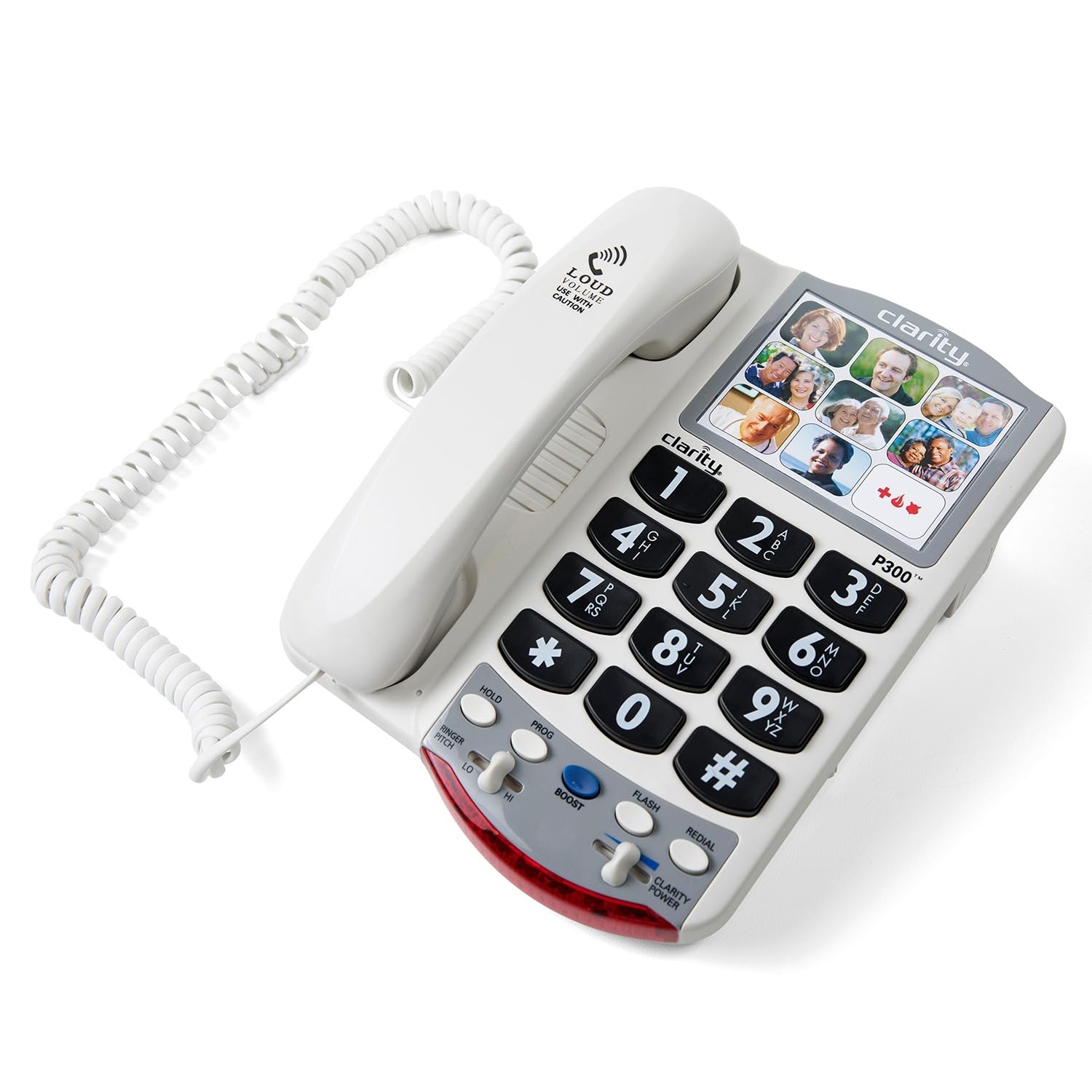
A quality-first corded phone with adjustable ringer pitch for mild to moderate loss.
You get clearer conversations because the P300 boosts incoming sound up to 26dB (a decibel is a unit of loudness), which suits mild to moderate hearing loss, not profound impairment. You can also adjust the ringer pitch to a tone your ear still catches, so you actually hear incoming calls—a feature most budget phones lack. Owners mention that build quality is the most-praised trait here, and it shows in the details.
It comes as a value-packed bundle that includes a 25-feet telephone line cord and user guide, so setup is immediate. The large buttons and handset are easy to operate for limited dexterity or vision challenges, and it runs off the standard phone jack with no batteries or wireless signals. It’s heavier than the KerLiTar K-P045W at 1 kg, giving it a sturdier desk presence.
The most-cited downside is a ringer that’s jarring — one buyer describes it going from startling to fire-alarm level with no gentle middle setting. There’s also no speakerphone, and amplification is capped at 26dB compared to the 40dB crowd. For a quality corded line with pitch control, it’s a solid mid-range pick with a sharp ringer.
Fine-tuned ringer: pitch and volume control make this the pick for someone whose hearing loss is tied to specific frequencies.
The catch: the ringer lacks a moderate level and there’s no speakerphone, so it suits quiet homes and handset users.
8. Clarity D714

The cordless route to 40dB amplification with a digital answering machine built in.
Functionality is the most-praised trait here, and it earns that with a full feature set: a digital answering machine, a big contact directory, a headset jack, and a speakerphone. The DECT 6.0 technology keeps the signal interference-free, and the amplification reaches up to 40dB — matching the loudest corded options while letting you roam the house. The handset buttons and numbers are large and readable.
Four tone settings let you customize the listening experience to your ear, and the adjustable tone control helps tune out background noise. For a 90-year-old user, it’s simple to use compared to smartphones, and customers note the “boost voice” makes callers clearly audible. It works with VoIP services and PSTN networks, adding flexibility.
The most-discussed aspect is sound quality, and it’s mixed — some find the volume not as loud as they hoped despite the 40dB spec. Reliability is also a watchpoint, with a few owners reporting handsets failing after repeated use. This is a good fit for someone who wants cordless freedom and doesn’t need outage-proof operation.
Why It Wins
- Wander freely with cordless DECT 6.0 signal
- Built-in digital answering machine
- 4 tone settings to customize listening
Where It Loses
- Volume may fall short of the 40dB promise
- Some handsets fail after months of use
Best for: seniors who want to carry the phone from room to room without cords, with a built-in answering machine.
Not for: anyone who needs a phone that works in a power outage — cordless means AC-dependent.
9. VTech SN1127

The 90dB ringer and 8 photo keys make this the loudest, most memory-friendly corded pick.
Quality is the most-praised trait here, and the headline spec is the 90dB extra-loud ringer — a fire-alarm level that hearing aid users confirm works. The 40dB audio booster amplifies incoming voices clearly, and oversized high-contrast buttons with a large display make dialing easy for low vision. It’s fully corded, so it works during power outages and stays reliable.
The 8 photo speed dial keys accept a 0.76″ x 0.83″ label or picture, giving one-touch calling to family for memory support. A full-duplex speakerphone enables natural hands-free conversation, and spoken Caller ID announces who’s calling. The integrated digital answering machine adds security for screening calls. Some setups even include a red 911 button for emergencies.
Volume is the most-discussed aspect and it’s mixed — while the ringer is supremely loud, a few owners say the handset volume can still be hard to hear clearly. This is the premium pick for anyone who needs maximum ringer power, photo dialing, and an answering machine in one package.
Maximum alert: the 90dB ringer is the loudest in this lineup, ideal for profound hearing loss or noisy homes.
Fit note: most users love the volume, but a few find handset clarity lacking despite the 40dB boost.
Understanding the Specs
Amplification in Decibels
The decibel (dB) figure tells you how much the incoming voice is boosted above a standard phone. A 26dB boost suits mild to moderate loss, while 30dB helps moderate loss, and 40dB is for more profound impairment. Higher is louder, but very high amplification can sometimes distort sound at maximum settings — worth testing before committing.
Ringer Volume and Visual Alerts
Ringer loudness is measured separately from voice amplification, with 85dB to 90dB being extremely loud. For anyone who can’t hear a tone at all, a visual flasher that lights up when the phone rings is a critical backup feature. Check whether the ringer pitch is adjustable too — some ears catch certain frequencies better than others.
Hearing Aid Compatibility
A T-Coil is a small copper coil inside a hearing aid or cochlear implant that picks up sound directly from a phone’s magnetic field, cutting background noise. Phones labeled “T-Coil compatible” or compliant with FCC Hearing Aid Compatibility standards can pair with these devices. If the user wears hearing aids, this spec matters as much as raw volume.
Speed Dial and Memory Support
One-touch speed dial buttons store a family member’s number behind a single key, often with a photo attached. Two-touch dialing needs two presses, usually a memory key plus a number. Some phones preserve these stored numbers even when unplugged, which matters if you ever move the phone or clean the line — no reprogramming needed.
FAQ
How loud should an amplified phone be for someone with severe hearing loss?
Will an amplified phone work with hearing aids or cochlear implants?
Do these phones work during a power outage?
What is the difference between one-touch and two-touch speed dial?
Can I wall-mount an amplified senior phone?
How many photo speed dial buttons do I need?
Will a 40dB boost cause echo or distortion?
Is a corded phone better than a cordless one for seniors?
Do I need batteries for these amplified phones?
How do I program a photo speed dial button?
Final Thoughts: The Verdict
Across the board, the amplified phones for seniors winner is the AT&T CL2940 because it pairs a tilting high-visibility display with Audio Assist volume boost and a huge following that vouches for its value. If you want hearing aid T-Coil compatibility, grab the ClearSounds CSC500 — it’s the most hearing-tech-friendly option. And for the absolute loudest ringer plus photo dialing, the VTech SN1127 is the one to reach for. Trust the crowd’s verdict here — the AT&T’s massive owner base and consistently strong value make it the safest first pick for most families.
How We Picked
We do not accept paid placement. Every pick is matched to a real buyer and a real use-case; we do not hands-on test units.
Sources & Methodology
Specifications: manufacturer listings and product documentation. Review insights: verified customer reviews, as of August 2026. Pricing: not shown on this page (it changes often); check the current price via the retailer link.
As an Amazon Associate, Gadgets Feed earns from qualifying purchases. This does not affect which products we feature.