
Our readers keep the lights on and my morning glass full of iced black tea. As an Amazon Associate, I earn from qualifying purchases.
Specs are compiled from manufacturer listings and verified buyer reviews and can change over time — please confirm the key details on the product page before buying.
An amplifier that also gives you an equalizer means you are not locked into one sound — you can shape the bass, the mids, the treble, and everything in between to match your room, your speakers, or just your mood that day. This guide cuts through the noise to show you the best amplifier and equalizer combos that let you tune the music exactly how you want it, from a practice room to a full home theater. You will find options that work for a bass guitar in a small gig, for a car audio build, for a living room karaoke setup, and for a professional recording studio.
I’m Min — the founder and writer behind Gadgets Feed. This guide is built by comparing the manufacturers’ published specifications and the patterns across verified customer reviews, so you get each pick’s real strengths and trade-offs instead of marketing spin.
Whether you are a musician looking for a combo amp with a graphic EQ or a home audio enthusiast who wants to dial in the perfect frequency curve, the best amplifier and equalizer is the one that gives you control without making you work for it.
Our Picks at a Glance

How To Choose The Best Amplifier And Equalizer
An amplifier with a built-in equalizer is a one-box solution for shaping sound, but not all EQ circuits are created equal. The wrong choice can leave you with a noisy hiss or controls that do not actually change the tone in a useful way.
Know your EQ type: Graphic versus Parametric
A graphic equalizer uses fixed sliders for specific frequency bands (like a 7-band or 30-band EQ). This is intuitive — push up a slider to boost that frequency, pull it down to cut it. A parametric equalizer lets you choose which frequency to adjust and how wide the range is, giving you surgical precision. For beginners, a graphic EQ is easier to use right away.
Match the power to the job
Wattage dictates how loud the amplifier can go before distortion kicks in. A 150-watt bass combo is different from a 2000W peak home theater amp. You need to consider the sensitivity of your speakers (measured in dB) and the size of your room. More power is not always better — driving a sensitive speaker with too much wattage can cause clipping, which damages both the amp and the speaker.
Check the inputs and outputs for your gear
Look at what you are plugging in: a bass guitar needs a 1/4-inch instrument input, a turntable needs a phono preamp (some amps like the Denon have a built-in MM/MC equalizer for this), while a TV or computer works with optical, coaxial, or RCA inputs. If you want to add a subwoofer later, make sure the amp has a dedicated subwoofer pre-out.
Build quality and cooling matter for longevity
Class D amplifiers run cooler and are more efficient, but they can still generate heat in a cramped space. Look for units with a built-in cooling fan (like the Rockville RPM45) or a chassis that is designed to vent heat. A heavy transformer and a metal chassis are usually signs of a more durable build.
Quick Comparison
| Model | Best For | Power Output | EQ Type | Weight | Amazon |
|---|---|---|---|---|---|
| Hartke HD150 Bass Combo★ Best Overall | Bass guitar practice & small gigs | 150W | 7-band Graphic EQ | 55.9 lbs | Amazon |
| 2000W Stereo AmplifierParty Starter | Karaoke & home party | 400W RMS (2000W peak) | 5-band EQ Mixer | 7 lbs | Amazon |
| Arylic B50SEApp Maestro | Compact app-controlled stereo | 50W x 2 | App-based EQ (Go Control) | 7 oz | Amazon |
| Viprh 3000W 5.1-Channel | Surround sound & subwoofer | 1500W | Equalizer (tone controls) | 8.6 lbs | Amazon |
| Rockville RPM45 | Live band PA system | 1800W peak (225W x 2 RMS @ 8Ω) | Per-channel EQ + echo | 19 lbs | Amazon |
| LOXJIE A30 | Desktop hi-fi & headphones | 211.6W | 7 preset EQ modes + custom | 7 oz | Amazon |
| Pyle PD1000BA | All-in-one CD/DVD karaoke | 1000W peak | Bass / treble controls | 20.5 lbs | Amazon |
| Pyle PT6060CHAE | Large home theater setup | 2000W peak | Dual 10-band EQ | — | Amazon |
| AudioControl D-6.1200 | Car audio DSP tuning | 1200W (6 x 200W @ 2Ω) | 30-band Graphic + 10-band Parametric | 5 lbs | Amazon |
| Denon PMA-900HNE | Hi-fi stereo & whole-home streaming | 85W x 2 | MC/MM Phono EQ | — | Amazon |
| Neve 1073SPX | Professional recording studio | 80dB gain | 3-band EQ | 15.8 lbs | Amazon |
In‑Depth Reviews
1. Hartke HD150 Bass Combo
Our pick — over 4.5★ from 350+ verified ratings; the strongest balance of quality and price.
This bass combo delivers warm, articulate tone with a 7-band EQ that covers everything from jazz to heavy crunch.
At 150 watts through a 15-inch hybrid cone driver and a 2-inch tweeter, this amp gives you a full, rich sound that works for small gigs and rehearsals. The top-mounted controls include Volume, Bass, Mid, and Treble controls plus a dedicated 7-band EQ with a switch. That EQ is the star — it lets you dial in a tight high end for jazz or funk, or a heavy low-end crunch. Buyers report the 50W version is loud enough for drums and portable.
Build quality is solid, with a stainless steel enclosure and casters for moving it around the studio or stage. The two 1/4-inch inputs handle both active and passive bass guitars. The crowd favorite praises its crisp, warm tone at any volume, with one owner calling it “TONE TO THE BONE.”
What wins people over
- Sound quality is the most-discussed feature — the full, warm tone at bedroom volumes and small gigs separates it
- Strong power delivery without distortion, even when pushed
- Versatile enough for baritone and electric guitar in addition to bass
The honest trade-offs
- At 55.9 pounds, it is significantly heavier than other options — a full 48.9 lbs more than the 2000W stereo amp
- Some owners mention the low end can feel weak below standard E tuning (drop D or 5-string)
Reach for this if: you are a bassist who needs a combo amp with a graphic EQ that sounds great for practice, rehearsal, and small-venue gigs.
Think twice if: you need extreme low-end extension for drop-tuned metal or extended-range basses — the kickback series may suit you better.
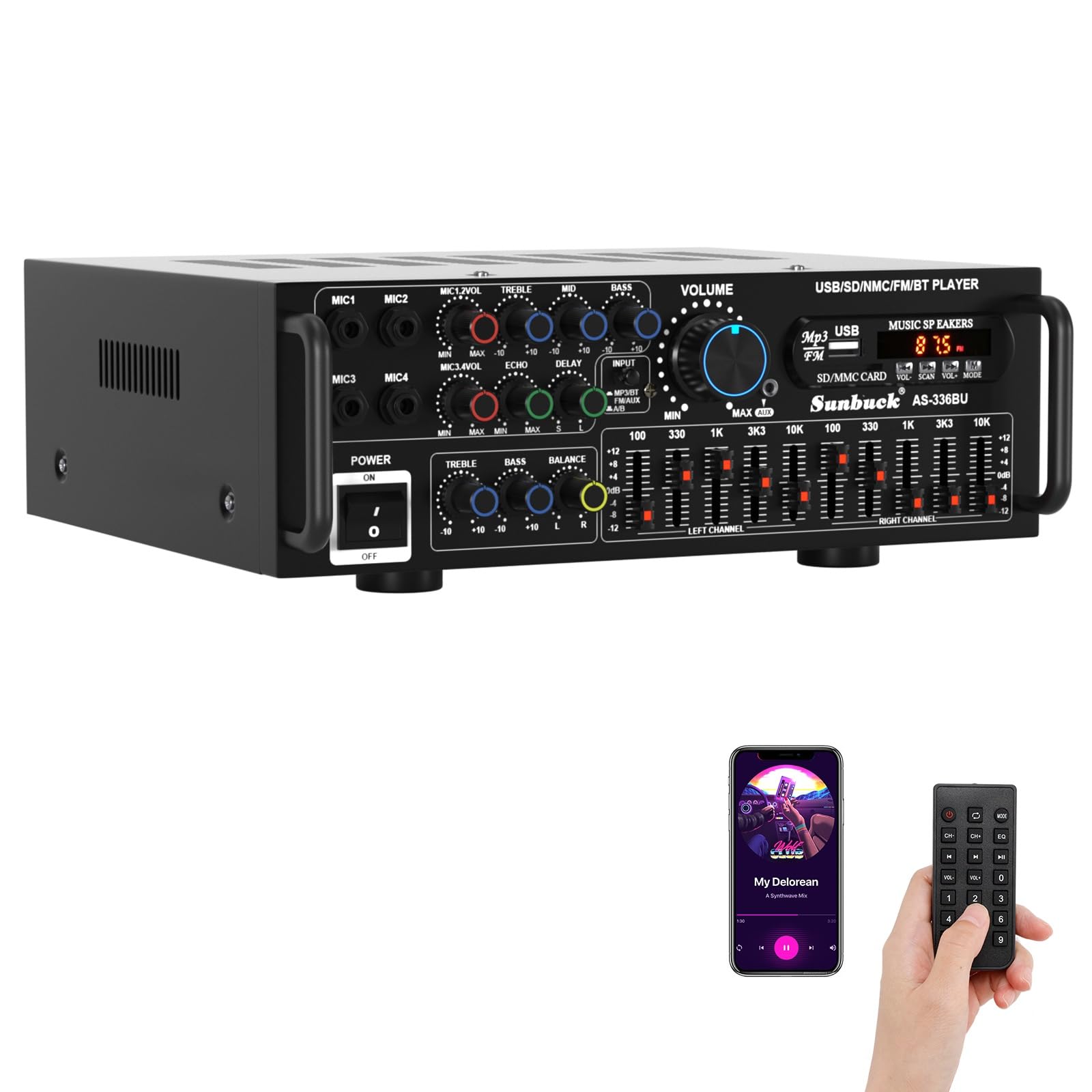
2. 2000W Stereo Audio Amplifier for Home Theater, Car Audio, Karaoke, Party, Outdoor Camping
Four mic inputs, a 5-band EQ, and enough power to fill a room make this the karaoke commander.
This compact amp (13.78 x 12.99 x 6.3 inches) delivers 400W rated power with a 2000W peak, and it supports 4-16Ω speakers. The five-band equalizer lets you tune the vocals and music independently. It has four microphone inputs with individual reverb and delay controls — perfect for a family that loves to sing. The built-in Bluetooth works flawlessly, and customers note it pushes two 1600-watt speakers with no problem.
It runs on AC 110V at home or DC 12V in a car, so you can take it camping. At just 7 pounds, it is the lightweight hero of the list compared to the Hartke HD150 at 55.9 pounds. The sound quality gets consistent praise — reviewers point out there is “no white noise,” which is rare at this level.
One-caveat reality: the FM antenna and tuner are not the clearest, and an occasional unit arrives damaged in shipping. For the price, the bang-for-the-buck is exceptional.
Best for: families, party hosts, and karaoke singers who want a multi-mic amp with EQ control that is easy to move.
Look elsewhere if: you need audiophile-grade fidelity or a built-in phono preamp for a turntable.
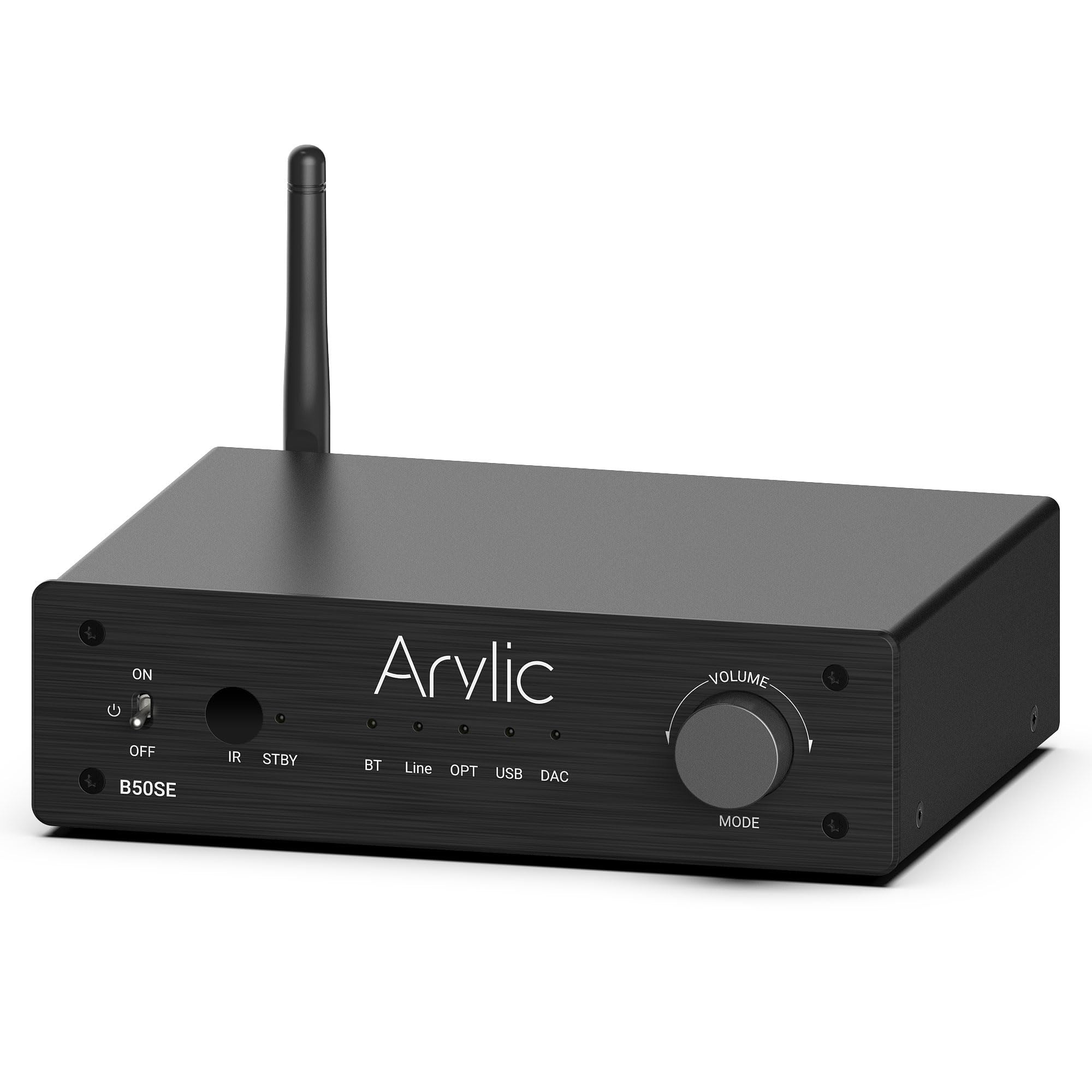
3. Arylic B50SE Bluetooth 5.1 Stereo Receiver 2.1 Channels Mini Class D Integrated Home Speaker Amplifier
This tiny amp gives you app-based EQ control over your whole setup from your phone — no knobs needed.
The Arylic B50SE is a compact Class D amplifier (14.57 x 9.06 x 2.56 inches) that puts out 50W x 2 via an advanced TPA3116D2 chip. The defining feature here is the Go Control app for iOS and Android, which lets you adjust equalizer settings, balance, bass, and volume from your phone. Owners say this solved patio volume control for non-Bluetooth sources and speakers.
Connections include Bluetooth 5.0 with a range over 10 meters, plus optical and RCA inputs. The subwoofer output works well, and the IR remote has excellent range. It is a perfect match for bookshelf speakers like the Micca MB42X. The main trade-off: the sound is described as detailed but slightly flat with a recessed vocal stage — not for critical audiophile listening, but perfect for a kitchen, bedroom, or patio system.
Reach for this if: you want to control EQ from your couch or backyard using an app on your phone.
Not for you if: you expect a warm, rich soundstage — this leans clean and analytical rather than lush.
4. 3000W Peak 5.1-Channel Home Audio Power Amplifier

This 5.1-channel powerhouse breathes new life into old speakers with a dedicated subwoofer channel and EQ control.
Built for home theaters and living rooms, this Viprh amp delivers 1500W of output and features an equalizer for fine-tuning your surround experience. It has three microphone inputs for karaoke, plus standard audio inputs for TVs, computers, and CD players. The independent subwoofer channel with its own knob lets you dial in deep bass without cranking the overall volume — one owner says their 15-year-old speakers and subwoofer sound revitalized.
It uses eight dual-tube amplifier modules with built-in protection circuitry. Bluetooth, FM radio, USB, and auxiliary inputs give you plenty of source options. The sound is powerful enough that one reviewer joked about neighbor complaints, and the dedicated sub out is a standout feature for bass lovers.
Best for: anyone reviving an old surround-sound speaker system or setting up a budget-friendly home theater with karaoke.
Keep in mind: the passive subwoofer output means you need an active sub or powered speakers to complete the setup.
5. Rockville RPM45 1800w Powered 4-Channel Mixer Amplifier

A rugged 4-channel PA mixer with built-in effects and individual channel EQ — built for bands that need to sound good fast.
The Rockville RPM45 packs 1800W peak power (225W x 2 RMS @ 8 ohms) into a wooden enclosure that can take a beating. Each channel has its own bass, treble, and volume controls, plus adjustable echo, delay, and reverb effects. It has four XLR and 1/4-inch TRS inputs, a USB input, RCA AUX input, and even a dedicated effect loop. The +15V phantom power means it handles condenser microphones for professional vocal mics.
At 19 pounds, it is portable enough for gigs, and the built-in cooling fan keeps it running during long events. Performance is the most-praised aspect — shoppers say it works great for a 5-piece small band and runs for 6 hours without getting warm. It replaced a dead Peavy mixer amp and exceeded that unit’s features, according to repeat buyers.
The honest catch: the fan noise is a notable trade-off for some users, and sound quality gets mixed reviews depending on the speakers you pair it with.
Perfect for: small bands, church fellowship halls, and DJs who need a powered mixer with per-channel EQ and effects.
Maybe skip if: you need silent operation for recording — the fan is audible in quiet settings.
6. LOXJIE A30 Desktop Stereo HiFi Audio Power Amplifier & Headphone Amplifier

A compact all-in-one desktop amp with seven built-in EQ presets and a custom mode for dialing in your exact taste.
The LOXJIE A30 uses an Infineon MA12070 Class D chip and an ES9023 DAC to deliver clean, detailed sound from USB, optical, coaxial, RCA, or Bluetooth 5.0 inputs. It includes seven types of EQ mode presets — direct, tone, bass, super bass, rock, soft, and clear — plus a custom mode for your own settings. This makes it a versatile partner for different speaker pairs and musical genres.
It also has a 6.35mm headphone output that turns off speaker output via the remote control, making it a true desktop hub. Sound quality is the biggest praise, with owners noting improved detail and smooth bass with efficient speakers like vintage Klipsch or Kef Q100s. The crowd favorite calls it “excellent bang-for-the-buck” with a high build quality and a Muse volume control.
One buyer’s reality: the power delivery is mixed over time — some units develop issues after two years, including LCD display failure and channel shorts. The analog RCA inputs may also introduce a hiss.
Reach for this if: you want a small desktop amp with a DAC, multiple EQ presets, and the ability to switch between speakers and headphones easily.
Think twice if: you need a unit built for constant daily use for years — reliability is a noted weak point in some reviews.
7. Pyle 4-Channel 1000W Power Amplifier with Bluetooth – PD1000BA

Front-loading CD and DVD playback plus a full amplifier with bass and treble controls — all in one box.
The Pyle PD1000BA is an integrated amplifier that includes a front-loading CD and DVD player, FM tuner, USB-A input, and two microphone inputs with echo for karaoke. It delivers 1000W peak power over 2-8 ohms and has separate bass and treble rotary controls plus a digital selector for input switching. The built-in Bluetooth lets you stream from a phone or tablet.
Sound quality gets consistently positive marks — owners say it is powerful and loud enough to “hear a pin drop,” and it drives four speakers plus a subwoofer well. The value for money is strong given the all-in-one convenience. However, the CD player is a common complaint: some units arrive with a non-working disc drive.
The catch: Bluetooth has limited range, and there is a small buzzing noise when the amp is idle at zero volume. The remote control is cheap and has small, sticky buttons. The IR sensor is easily blocked on the front panel.
Best for: someone who wants a single component that plays everything — CDs, DVDs, radio, Bluetooth, and karaoke — without buying separate boxes.
Not ideal for: pure sound quality seekers — the hiss and Bluetooth quirks might frustrate you.
8. Pyle Bluetooth Hybrid Home Amplifier – 6-Channel 2000W Rack Mount – PT6060CHAE
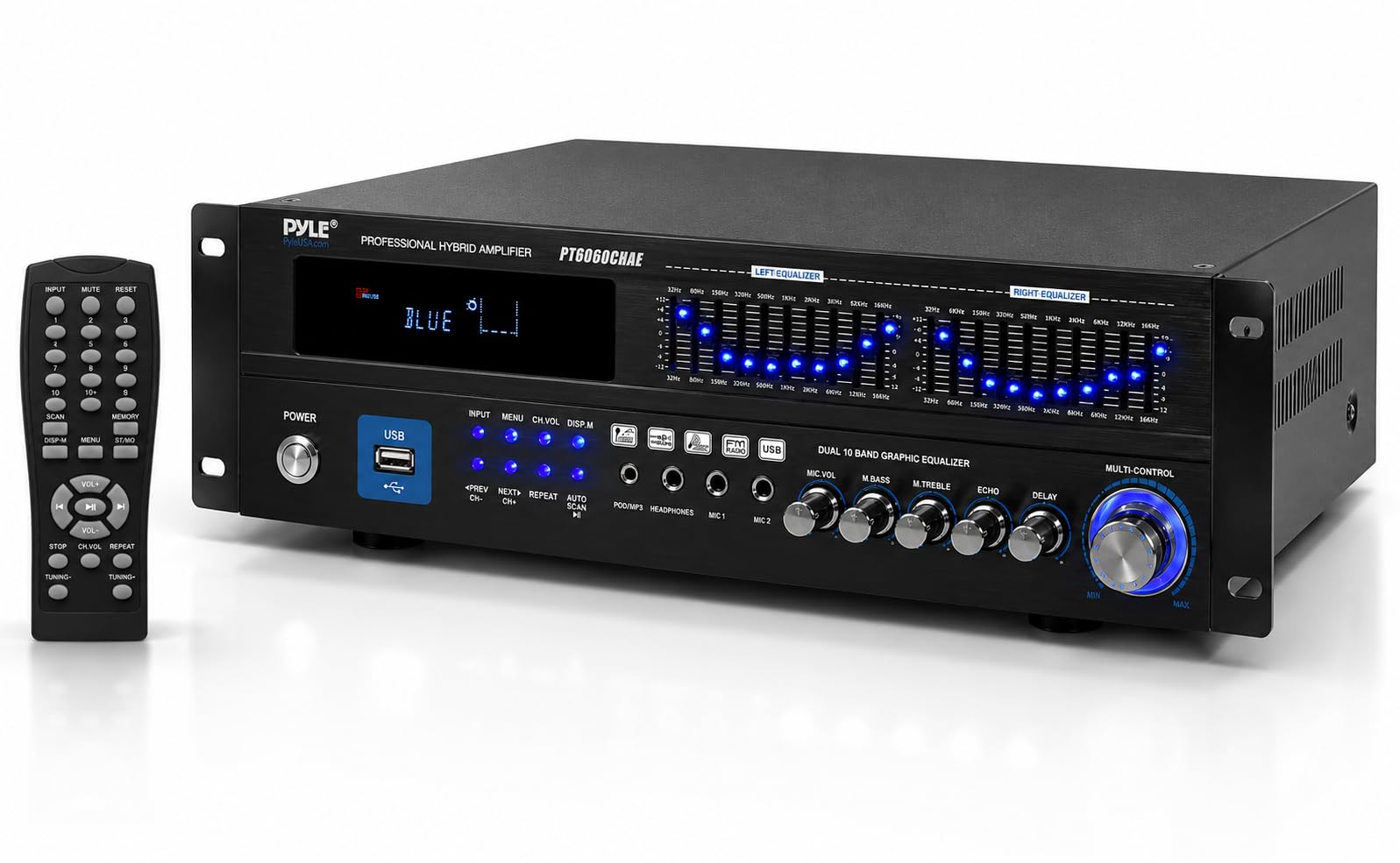
A 6-channel rack-mount beast with dual 10-band equalizers for granular control over a multi-speaker home theater.
This hybrid home amplifier gives you 2000W peak power across 6 channels, making it ideal for a full house of speakers. The front panel has a dual 10-band equalizer — that is 20 sliders to fine-tune every frequency range in your room. It also includes two microphone inputs with echo controls, a VFD display, and a built-in FM radio. Connectivity covers HDMI, optical, coaxial, USB, RCA, and Bluetooth.
The rack-mount design includes a built-in cooling fan and handles for transport. The build quality is praised, with buyers calling it “high quality” and “easy to install.” The Bluetooth range is long and the remote control works well. The crowd favorite says it is “perfect for our home entertainment system” and “definitely worth the money.”
The honest trade-off: the cooling fan is loud during operation, and reliability is the most common negative — some units fail after a year with a burnt electronic smell. The sound quality is MIXED in reviews (rated 109 mentions), so treat it as a feature-rich unit rather than a high-fidelity reference.
Reach for this if: you need to power a complex multi-speaker setup and want dual 10-band EQs for room tuning.
Better options exist if: long-term reliability is your top priority — some buyers report failure within a year.
9. AudioControl D-6.1200 Matrix DSP 3/4/5/6-Channel Car Audio Amplifier
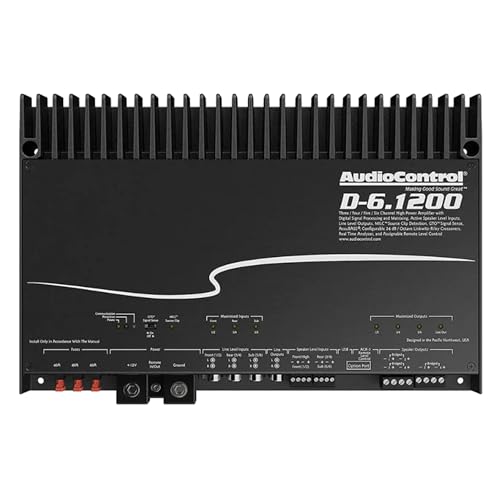
A 6-channel car amplifier with a 30-band graphic EQ and a 10-band parametric EQ per channel — surgical tuning for your vehicle.
The AudioControl D-6.1200 is a Class D multichannel amp designed for OEM and aftermarket car systems. It delivers up to 1200W total (6 x 200W @ 2Ω, 6 x 125W @ 4Ω, 3 x 400W @ 4Ω bridged). The DSP capabilities are extraordinary: a 30-band graphic equalizer and a 10-band parametric equalizer per output channel, plus selectable crossovers (high-pass, low-pass, and band-pass at 12, 18, and 24 dB/octave). The AccuBASS feature restores bass roll-off caused by factory head units.
It has eight speaker-level inputs and six balanced RCA inputs for smooth integration with factory systems. The DM Smart App gives you control over every setting. Owners praise the sound quality — one says it reveals new details in music and outperforms top brands like Kicker, Fosgate, and JL. Sound quality is the highest-praised aspect, with owners calling it “powerful, clean” with “numerous DSP options.”
Reality check: tuning this unit took about 6 hours for one owner and is challenging for DIYers. It lacks a microphone input for auto-tuning, so you need to know how to use a DSP or get professional calibration. Value for money is MIXED — some find it expensive for what it does.
Best for: serious car audio enthusiasts who want professional-grade DSP tuning with a graphic and parametric EQ.
Not for you if: you are a novice installer — the complexity is real and you may need professional tuning.
10. Denon PMA-900HNE Integrated Stereo Amplifier

An integrated stereo amp with a built-in phono equalizer for both moving magnet and moving coil cartridges.
The Denon PMA-900HNE puts out 85W x 2 using an Advanced High-Current (AHC) single push-pull circuit. The built-in phono input has both MM and MC equalizer settings, so you can connect a turntable without an external preamp. It also features HEOS for whole-home wireless streaming, supporting services like Spotify, TIDAL, and Pandora via Wi-Fi, AirPlay 2, or Bluetooth. Voice control works with Alexa, Siri, and Google Assistant.
Connections include three optical and one coaxial input for digital sources, a subwoofer pre-out, and a USB port for playing high-res audio formats like FLAC HD and DSD. The build quality gets strong praise — buyers describe the knobs as smooth and the matte finish as elegant. One owner says the sound is “warm with tight controlled bass” and that it improved over the previous PMA-600NE model.
The honest downsides: the subwoofer crossover is fixed at 100Hz, the HEOS app is described as clunky by some, and the unit runs hot during operation. The plastic control knobs (except the metal volume knob) feel less premium than the rest of the build.
Reach for this if: you want a refined stereo amplifier for a hi-fi system with vinyl playback and multi-room streaming.
Look elsewhere if: you need flexible crossover controls or a dedicated home theater processor — this is a stereo music amp first.
11. Neve 1073SPX Microphone Preamp and EQ

The iconic British preamp and EQ that makes any microphone sound better — 80dB of pure, transformer-balanced Class A gain.
The Neve 1073SPX is a single-channel mic/line/DI preamp module with a built-in 3-band EQ. This is the sound that defined generations of hit records. The circuit is transformer-balanced Class A, delivering 80dB of gain with a smooth, musical EQ section. It includes polarity reverse and a stainless steel enclosure. The three bands cover the essential frequency ranges that producers use daily: a high shelf, a mid-band sweepable, and a low shelf.
Owners are emphatic: “makes any microphone sound better” and “one of the best to ever do it” are common sentiments. One owner compares it indistinguishably to vintage 80-series modules. The sound quality is described as “noiseless, versatile, and easy.” The EQ is the star — it is not a surgical tool but a musical one that adds weight, air, and character to any source.
The reality check: at 15.8 pounds, it is a rackmount unit, not a portable pedal. It requires factory repair if it fails (unlike hand-wired units). And it is expensive. But as one owner puts it: “it’s expensive for what it does, but it does it well like no other.”
Reach for this if: you run a recording studio and want the definitive preamp/EQ combo for tracking vocals, guitars, bass, and drums.
Not for you if: you need a stereo amp for home listening or live sound — this is a single-channel studio tool.
Understanding the Specs
Graphic vs Parametric EQ
A graphic equalizer shows you preset frequency bands (like 7 bands or 30 bands) as sliders. You push each slider up to boost that frequency or pull it down to cut it — very visual and easy to learn. A parametric equalizer lets you choose the exact frequency you want to adjust, how wide the range (Q) should be, and how much to boost or cut. Parametric is more powerful but has a steeper learning curve. Most home audio and instrument amps use graphic EQs because they are intuitive. Car audio DSPs and studio gear often use parametric for surgical precision.
Power Rating: RMS vs Peak
RMS (Root Mean Square) is the continuous power an amplifier can deliver without distortion. This is the number that matters for real-world listening. Peak (or PMPO) is the maximum burst it can handle for a split second — it sounds bigger on paper but tells you little about daily use. Compare RMS numbers between amps when you are choosing. Matching the amplifier RMS to your speaker’s RMS handling prevents clipping, which can damage both components.
FAQ
Can I use a bass amplifier like the Hartke HD150 as a home theater amp?
How many bands do I need on a graphic equalizer?
What is the difference between a combo amp and a separate amplifier?
Can I connect a turntable to these amplifiers?
What does a 5.1-channel amplifier do that a 2-channel cannot?
How do I set up the EQ on my amp for the first time?
Will a 2000W peak amplifier blow my speakers?
What is DSP and why does it matter for car audio?
Should I buy an amp with Bluetooth or with app control?
What is phantom power and why does this amp need it?
Final Thoughts: The Verdict
For the majority of shoppers, the amplifier and equalizer that earns the top spot is the Hartke HD150 Bass Combo because its sound quality and 7-band EQ give bassists the warm, articulate tone they chase in practice and small gigs — and the massive owner loyalty (4.6 stars across hundreds of ratings) backs it up. If you want a home theater with karaoke and subwoofer control, grab the Viprh 3000W 5.1-Channel. And for car audio enthusiasts who need surgical DSP tuning with a 30-band graphic EQ and 10-band parametric EQ per channel, the AudioControl D-6.1200 is the one to reach for.
How We Picked
We do not accept paid placement. Every pick is matched to a real buyer and a real use-case; we do not hands-on test units.
Sources & Methodology
Specifications: manufacturer listings and product documentation. Review insights: verified customer reviews, as of July 2026. Pricing: not shown on this page (it changes often); check the current price via the retailer link.
As an Amazon Associate, Gadgets Feed earns from qualifying purchases. This does not affect which products we feature.