
Wiring a house for ceiling speakers often means committing to a clunky, oversized receiver that was never designed to disappear into a cabinet or a closet. The real challenge isn’t the speaker itself — it’s finding a compact amplifier with enough clean power per channel, the right impedance match for flush-mount drivers, and the connectivity modern streaming demands. A mismatch there turns a whole-house audio dream into a constant battle with hum, distortion, or limited zone control.
I’m Min — the co-founder and writer behind Gadgets Feed. I’ve spent years analyzing power ratings, SINAD measurements, and multi-zone architecture to separate the amplifiers that genuinely drive ceiling speakers from those that just look good on a spec sheet. (And Homer 🐱 supervised from atop the subwoofer box, giving every candidate an approving chin-tap.
This guide walks through the amplifiers that deliver reliable, clear, and flexible power for in-ceiling speakers without forcing you into a full rack of unnecessary gear. After comparing channel counts, wattage ratings, impedance support, and real-world user feedback across multiple price tiers, the best amplifier for ceiling speakers is the one that pairs effortless installation with the headroom to fill a room without distortion.
How To Choose The Best Amplifier For Ceiling Speakers
Ceiling speakers present a unique load to an amplifier: they are often lower-sensitivity (86–89 dB), placed in large open spaces, and frequently wired in parallel pairs that drop the total impedance to 4 ohms or below. An amplifier that looks fine on paper with a bookshelf speaker may strain, clip, or overheat when asked to drive two 8-ohm ceiling speakers wired together. The right choice depends on matching three critical specs to your actual installation.
Channel Count and Zone Architecture
The number of individual audio zones you want determines the channel requirement. A single stereo zone needs two channels. Four zones (kitchen, living room, patio, office) require eight channels or a multi-zone amplifier with independent volume per zone. Choose an amplifier with at least twice the number of channels as zones if you plan to run stereo pairs per zone. Multi-zone amplifiers like the OSD Nero Max8 or Juke-6 simplify the wiring by handling source selection and volume internally.
Power Output and Impedance Support
Look for an amplifier that lists its power rating at 4 ohms, not just 8 ohms. A good ceiling speaker amplifier should deliver at least 40–60 watts per channel into 4 ohms to provide clean headroom in a medium-sized room. Class D topology is ideal here: it runs cooler, wastes less energy as heat, and can be packed into a smaller chassis that fits inside a cabinet or behind a wall plate without ventilation concerns.
Streaming Inputs and Remote Control
Ceiling speakers are permanent fixtures, so the amplifier needs to accept wireless streams without adding a separate source box. Bluetooth 5.0 is the minimum bar, but Wi-Fi streaming platforms (AirPlay 2, Google Cast, Spotify Connect) offer better range and multi-room synchronization. Look for HDMI ARC if you intend to send TV audio to ceiling speakers. An app or physical remote with zone-level volume control is a necessity once the amplifier is hidden away in a closet or rack.
Quick Comparison
On smaller screens, swipe sideways to see the full table.
| Model | Category | Best For | Key Spec | Amazon |
|---|---|---|---|---|
| Fosi Audio V3 | Stereo Amplifier | Small to mid rooms | 300W x2 at 4Ω (TPA3255) | Amazon |
| Herdio HCS418 Bundle | All-in-One Bundle | First-time installers | 320W peak, 4 speakers + amp | Amazon |
| Fosi Audio HT4S | 4-Channel Amp | Outdoor or multi-speaker | 4.1 / 5.0 ch, 50W x4 at 4Ω | Amazon |
| Rockville RCS350-6 | Commercial Zone Amp | Restaurants and offices | 350W, 6-zone 70V output | Amazon |
| WiiM Amp | Streaming Amp | Smart multi-room audio | 60W x2 at 8Ω, HDMI ARC | Amazon |
| Pyle PT8000CH | Multi-Zone Power Amp | High-power 4-zone setups | 8 channels, 100W x8 (claimed) | Amazon |
| Sonos In-Ceiling by Sonance | Speaker + Amp System | Trueplay-tuned rooms | 36Hz–20kHz with Sonos Amp | Amazon |
| OSD Audio Nero Max8 | 4-Zone Smart Amp | Whole-home app control | 80W x8 at 4Ω, RS-232 | Amazon |
| Juke-6 | 6-Zone Streaming Amp | AirPlay 2 whole-house | 40W x12 at 8Ω, 6 zones | Amazon |
In‑Depth Reviews
1. WiiM Amp

The WiiM Amp delivers 60 watts per channel at 8 ohms and an impressive 120 watts per channel at 4 ohms, making it a natural fit for ceiling speaker pairs that dip to 4 ohms. Its TPA3255-based Class D architecture runs cool enough to tuck into a cabinet without active ventilation, and the HDMI ARC input lets you pull TV audio directly into the ceiling speakers for a clean home theater setup.
Streaming is the WiiM’s strongest suit: support for AirPlay 2, Google Cast, Spotify Connect, and Alexa voice control means every major platform is covered without an extra dongle. The companion app includes parametric EQ and room correction that can be tuned specifically for the ceiling-mounted driver position. The included voice remote simplifies daily zone switching and volume adjustment.
Where the WiiM Amp really stands apart is in its integration flexibility — it can be grouped with other WiiM devices, Echo speakers, or Google Home units into a unified multi-room system. The only missing piece is a dedicated phono input or USB DAC functionality, but for a streaming-optimized ceiling speaker amplifier, this is the cleanest all-in-one option available today.
Why it’s great
- 120W x2 at 4Ω handles parallel ceiling pairs easily
- HDMI ARC connects TV audio without separate switch
- Room correction and PEQ tailor sound to ceiling placement
Good to know
- No headphone jack or phono preamp
- App required for full feature access
- Subwoofer output is line-level, not powered
2. Fosi Audio V3 Stereo Amplifier

The Fosi V3 punches far above its compact frame. Powered by the TPA3255 chip and a 48V/5A supply, it outputs 300 watts per channel into 4 ohms — enough to drive four 8-ohm ceiling speakers wired as two parallel pairs without breaking a sweat. The SINAD rating of 88dB and noise floor of only 140µV mean the background hiss that plagues cheap amplifiers is effectively absent, even with sensitive ceiling tweeters.
Its whole-body aluminum heatsink with top and bottom venting allows continuous operation at higher volumes without thermal throttling. The ability to swap the stock NE5532 op-amps for units like Sparkos SS3602 or MUSES02 gives advanced users a way to tune the sonic signature — a feature typically reserved for far more expensive desktop amps. The pre-out with variable volume control adds the option to integrate a powered subwoofer into the ceiling speaker system.
For a single stereo zone powering ceiling speakers in a living room, bedroom, or open-plan kitchen, the V3 delivers audiophile-grade clarity at a budget-friendly price. The compact footprint means it can sit on a shelf or inside a media cabinet with ease. This is a pure power amplifier with no built-in streaming, so plan to pair it with a separate Bluetooth receiver or streamer if wireless input is required.
Why it’s great
- 300W x2 at 4Ω delivers headroom for low-sensitivity ceiling speakers
- Ultra-low noise floor eliminates hiss through ceiling tweeters
- Swappable op-amps let you customize the sound signature
Good to know
- No Bluetooth or Wi-Fi built in
- Best with speakers rated 90dB+ sensitivity for maximum loudness
- Small form factor limits binding post size for thick speaker wire
3. Herdio HCS418 4-Channel Bundle
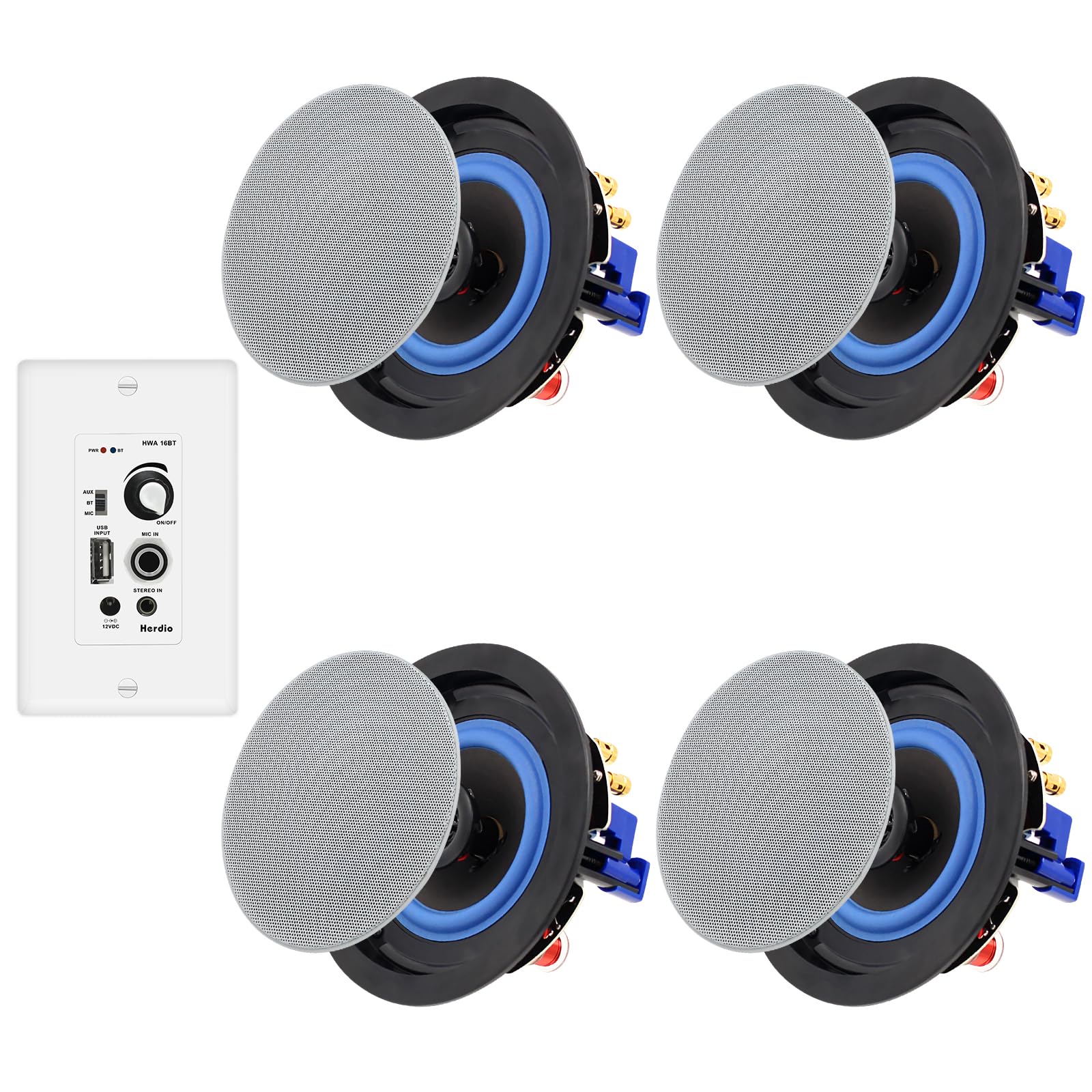
The Herdio HCS418 takes the guesswork out of matching speakers to amplifier by packaging four 4-inch 2-way ceiling speakers with a wall-mounted Bluetooth amplifier in one box. Each speaker handles 320 watts peak power and uses polypropylene cones with rubber surrounds for long-term durability. The amplifier wall plate connects via Bluetooth 5.0 with a 60-foot range, making installation as simple as running speaker wire through the ceiling.
The included 4-channel amplifier delivers stereo sound to all four speakers without needing a separate receiver. The flush-mount speakers have a cut-out diameter of 5.7 inches and a mounting depth of just 2.6 inches, fitting standard ceiling joist bays. This system works well for open-concept spaces, garages, or patio areas where consistent background music is the goal and audiophile critical listening is secondary.
The biggest limitation is that only one Bluetooth device can connect at a time, and there is no individual volume control per speaker pair — all four speakers share the same level. Upgrading the included speaker wire to 16-gauge is recommended to preserve signal integrity over longer runs. For a first-time installer who wants a complete ceiling speaker system out of one box, this bundle simplifies the entire process.
Why it’s great
- Complete package with four speakers and wall amplifier
- Bluetooth 5.0 with 60-foot range reaches across most homes
- Shallow 2.6-inch mounting depth fits tight ceilings
Good to know
- No individual speaker zone volume control
- Included wire is thin; 16-gauge upgrade improves clarity
- Single Bluetooth source at a time limits multi-user streaming
4. Fosi Audio HT4S Bluetooth Amplifier

The Fosi HT4S is a compact 4-channel amplifier that can be configured as a 4.1 or 5.0 channel system, making it uniquely suited for ceiling speakers in open-plan spaces or outdoor patios. Each channel delivers 50 watts into 4 ohms, and the amplifier integrates Bluetooth, AUX, and optical digital inputs. The inclusion of bass and treble tone controls via the included remote gives direct sonic tailoring without opening an app.
The all-aluminum chassis is built to the same standard as Fosi’s desktop amps, and the pre-out allows connection to a powered subwoofer for a 4.1 setup — a rare feature at this tier. Users report reliable Bluetooth pairing, and the optical input provides a noise-free digital path for TV or game console audio. The HT4S does not support Dolby or DTS surround decoding; it remains a stereo amplifier with multiple channel outputs.
Where the HT4S truly shines is in its ability to power up to five ceiling or outdoor speakers from a single compact unit. The 5.0 mode works well for distributed mono-compatible audio across multiple zones, while 4.1 mode adds impactful low-end for music. The remote control’s input selection has been noted as slightly oversensitive, but the core audio performance and connectivity density make this an excellent mid-range option for a multi-speaker installation.
Why it’s great
- Switchable 4.1 and 5.0 channel modes increase installation flexibility
- Optical input adds a noise-free digital connection for TV sources
- Bass and treble tone controls with included remote
Good to know
- Not a true surround sound decoder; outputs stereo only
- Remote can change inputs unintentionally when adjusting volume
- 50W x4 is adequate but not generous for very large rooms
5. Rockville RCS350-6 6-Zone Amplifier
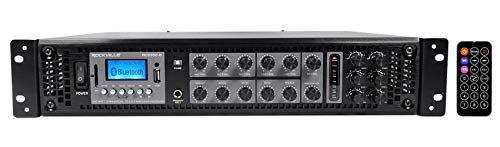
The Rockville RCS350-6 is a 350-watt, 6-zone commercial amplifier built for restaurants, offices, and retail spaces — but it also solves whole-house ceiling speaker distribution in a residential setting. Each of the six zones has independent volume control, allowing different rooms to play at different levels from the same source. The 70-volt output standard makes it compatible with long speaker wire runs typical of multi-room commercial installations.
Bluetooth streaming, USB MP3 playback, and optical input provide flexible source options, while three microphone inputs with echo control make it suitable for paging or karaoke. The rack-mountable 19-inch form factor fits standard equipment racks or can sit on a shelf with adequate ventilation. Users report that this amplifier revitalized aging ceiling speaker systems in community halls and large homes with noticeably cleaner sound than the previous mixer-amps.
The key trade-off is that the RCS350-6 does not offer individual zone on/off switches — you set a zone’s volume to zero to mute it. The speaker wire connectors are slightly flimsy and may require careful handling during installation. For a budget-friendly entry into multi-zone ceiling speaker control with commercial reliability, this amplifier delivers consistent performance that outpaces its price tier.
Why it’s great
- Six independent zones with dedicated volume controls
- 70V output supports long wire runs without signal loss
- Three mic inputs with echo for announcements or karaoke
Good to know
- No individual zone power on/off switch
- Speaker connectors are less robust than preferred
- Bright front LEDs may need dimming in home theater settings
6. Pyle PT8000CH 4-Zone Amplifier

The Pyle PT8000CH is a 4-zone, 8-channel amplifier that delivers 100 watts per channel (manufacturer-rated) with bridgeable switches for higher power to specific zones. Its 5-way binding posts accept banana plugs for clean connections, and the pass-through output allows daisy-chaining additional amplifiers for expanded systems. The LED audio level display gives visual feedback on each channel’s output, useful when balancing volume across multiple rooms.
Built-in low impedance protection shuts down faulty channels without interrupting the rest of the system — a practical safety net when driving ceiling speakers across a large house. Each of the four zones has a dedicated volume knob on the front panel, though the gain controls for individual channels are located on the back panel, which may require rear-mounting the amplifier for easy access. The unit is heavy at 22.9 kilograms, indicating substantial internal transformer and heatsink mass.
The 8000-watt peak rating is a marketing figure that does not reflect continuous RMS output, but real-world performance still impresses: owners report powering eight ceiling speakers across four zones with effortless fill music and no distortion at moderate levels. This amplifier is best suited to whole-home distributed audio rather than critical listening, and its robust build handles 24/7 operation that would stress lighter Class D designs.
Why it’s great
- Eight channels cover four stereo zones in one chassis
- Bridgeable channels allow higher power to demanding zones
- Low impedance protection prevents full-system failure
Good to know
- Gain knobs on rear panel are inconvenient to reach
- Extremely heavy at 22.9 kg; two-person installation
- Peak power rating is misleading; real RMS is lower
7. Sonos In-Ceiling by Sonance (Speaker Only)

The Sonos In-Ceiling by Sonance speaker is purpose-engineered to pair exclusively with the Sonos Amp. It is not a complete amplifier solution on its own, but it represents the ceiling speaker itself — and its performance is tightly integrated with Sonos’s Trueplay room-tuning technology. The 165mm woofer and 25mm tweeter produce a frequency response of 36Hz to 20kHz with DSP correction from the amp, and the maximum output reaches 110dB at 1 meter.
Installation depth is 120mm, which is deeper than typical shallow-mount ceiling speakers, so check ceiling cavity clearance before purchasing. The round grilles can be painted to match the ceiling, and optional square grilles are available for a more architectural look. A single Sonos Amp can power up to three pairs of these speakers, enabling multi-room streaming with Sonos’s industry-leading multi-room synchronization.
This system is the easiest path to whole-home ceiling audio with a unified user interface — every speaker appears as a Sonos room in the app. The trade-off is that you are locked into the Sonos ecosystem and the cost of the Amp adds significantly to the overall investment. For homeowners who prioritize a seamless streaming experience and already use Sonos in other rooms, this is the most polished ceiling speaker solution available.
Why it’s great
- Trueplay DSP automatically optimizes sound for room acoustics
- Painted grilles blend invisibly into the ceiling
- Pairs up to three sets from one Sonos Amp for whole-home audio
Good to know
- Requires Sonos Amp separately — adds significant total cost
- 120mm mounting depth may not fit shallow ceiling cavities
- Locks you into the Sonos ecosystem for future expansion
8. OSD Audio Nero Max8 Amplifier

The OSD Nero Max8 is an 8-channel, 4-zone amplifier that delivers a genuine 80 watts per channel into 4 ohms, making it one of the few amplifiers at this tier that can comfortably drive multiple ceiling speaker pairs per zone. Each zone can select from four stereo RCA inputs, one auxiliary input, or one optical input, allowing different content in each room simultaneously. The RS-232 port supports integration with Control4 and other smart home automation systems.
The companion OSD Control App handles zone volume, source selection, and speaker grouping, and optional in-wall keypads (sold separately) provide local physical control without needing a phone. The audio sense feature automatically powers on when a signal is detected, which is convenient for systems triggered by a streamer or TV. The amp runs cool thanks to efficient Class D amplification and fits into a standard 19-inch rack space.
Some users report that initial network discovery via the app can be tricky — using a fixed IP address resolves most issues. The lack of Wi-Fi (Ethernet only) means you need a wired network drop at the amplifier location. Once configured, the Nero Max8 delivers clean, detailed sound to ceiling speakers across multiple rooms with reliable control and expandability up to 12 zones by chaining additional units.
Why it’s great
- True 80W x8 at 4Ω handles parallel ceiling speaker loads
- RS-232 for professional smart home system integration
- Each zone can play independent audio sources
Good to know
- Ethernet-only network connection; no built-in Wi-Fi
- App discovery may require manual IP configuration
- In-wall keypads sold separately
9. Juke-6 6-Zone Streaming Amplifier
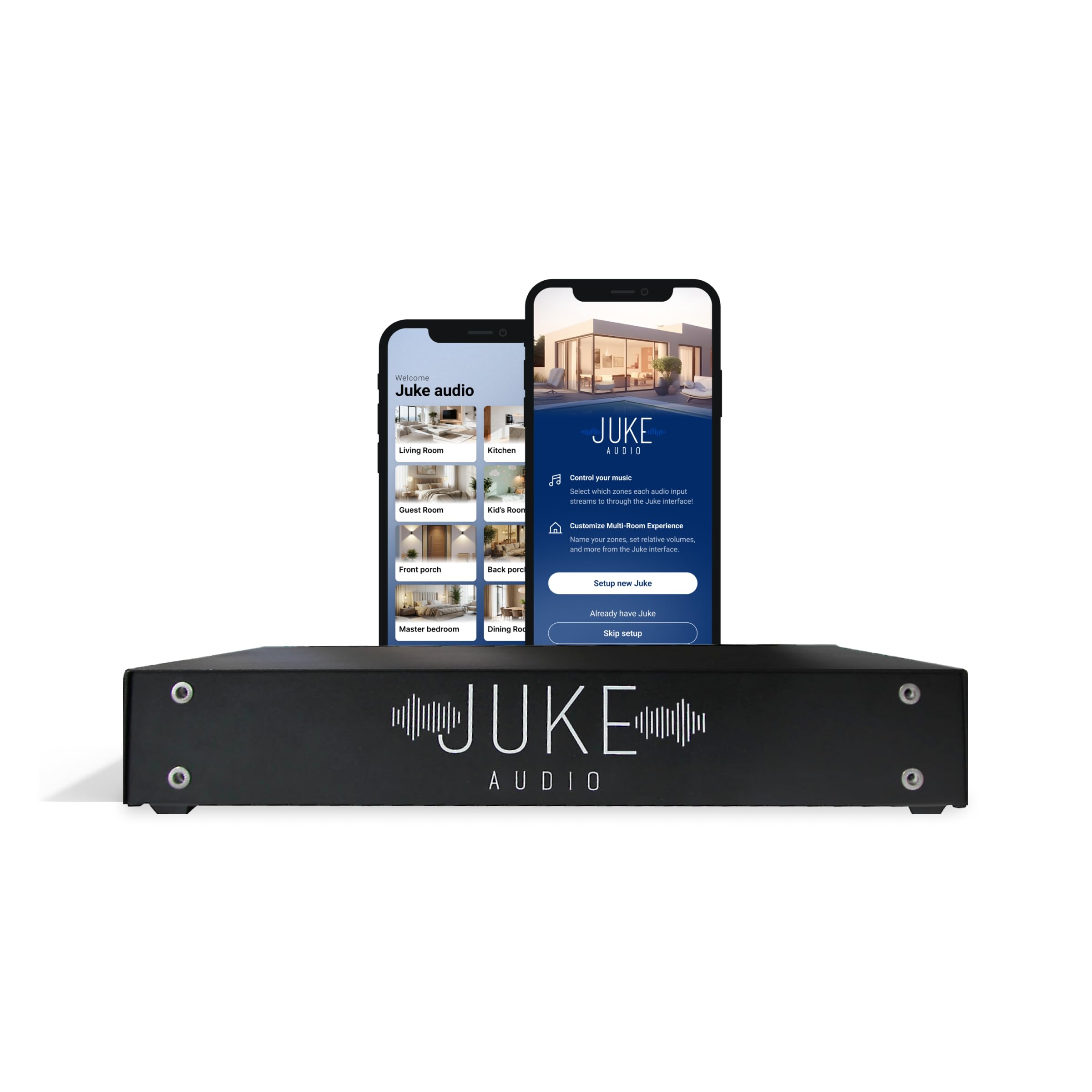
The Juke-6 is a 6-zone, 12-channel streaming amplifier that outputs 40 watts per channel into 8 ohms and remains stable down to 2 ohms per channel — a rare spec that allows wiring multiple ceiling speakers in parallel without worrying about impedance collapse. Each of the six zones appears as an individual AirPlay 2 target, meaning any Apple device can stream directly to any combination of rooms without opening a separate app. Spotify Connect and DLNA support ensure Android users have equal streaming flexibility.
Multiple users can simultaneously stream different audio to different zones — one person can play a podcast in the kitchen while another listens to music in the living room. The Party mode sends a single source to all zones with tight synchronization. Need more than six zones? Connect a second Juke-6 on the same network and the system expands seamlessly. The compact 15x8x3-inch metal chassis fits a shelf or a shallow rack space.
The Juke-6 replaces the need for multiple Sonos Amps in a wired whole-home system, reducing hardware complexity and cost. Setup is straightforward: connect the speaker wires, plug in Ethernet or Wi-Fi, and the amp appears as AirPlay targets. Some users note that maximum volume is moderate compared to high-power commercial amps, but for comfortable listening across a house — not concert-level SPL — the Juke-6 delivers clean, reliable, and user-friendly whole-home audio.
Why it’s great
- 6 individual AirPlay 2 zones without needing multiple Amps
- 2-ohm stable per channel supports heavy parallel wiring
- Simultaneous multi-user streaming to different zones
Good to know
- Maximum volume may be insufficient for very large rooms
- No HDMI or optical input for TV audio
- Rack-mount hardware not included with initial units
FAQ
Can I use a regular stereo amplifier for ceiling speakers?
How many ceiling speakers can one amplifier channel drive?
What is the difference between 70V and low-impedance ceiling speaker amplifiers?
Final Thoughts: The Verdict
For most users, the best amplifier for ceiling speakers winner is the WiiM Amp because it combines HDMI ARC, AirPlay 2, Google Cast, room correction, and genuine 120W at 4 ohms into a compact, cool-running package that fits any cabinet. If you want a pure high-power stereo amp for a single zone with audiophile-grade components, grab the Fosi Audio V3. And for a true whole-home streaming solution with independent AirPlay zones across six rooms, nothing beats the Juke-6.