
Our readers keep the lights on and my morning glass full of iced black tea. As an Amazon Associate, I earn from qualifying purchases.
Specs are compiled from manufacturer listings and verified buyer reviews and can change over time — please confirm the key details on the product page before buying.
Dropped calls in your basement, a metal-roofed shop, or a highway stretch where your phone gives up—a signal booster grabs the weak signal outside your building or vehicle and rebroadcasts it stronger inside. You need to know whether a home system that blankets several rooms or a vehicle unit that keeps one cabin connected fits your dead zone. Here’s how to match the right tool to your specific situation.
I’m Min — the founder and writer behind Gadgets Feed. This guide is built by comparing the manufacturers’ published specifications and the patterns across verified customer reviews, so you get each pick’s real strengths and trade-offs instead of marketing spin.
The right amplifier for cell phone reception turns a frustrating home or road dead zone into reliable bars for calls, texts, and streaming.
Our Picks at a Glance

How To Choose The Best Amplifier For Cell Phone Reception
Not every dead zone is the same, and neither is every booster. First, decide if you need a home system that covers several rooms or a vehicle unit that keeps one cabin connected. Then, focus on gain (how much the booster amplifies the signal, measured in dB), carrier bands (the specific frequencies your carrier uses), and your outdoor signal strength.
Match the coverage to your space
Home boosters quote a square-foot coverage figure, like 3,000–5,000 sq ft or up to 8,000 sq ft. That number assumes a decent outdoor signal and ideal antenna separation, so treat it as a best-case ceiling. For a small home or single room, a 2,000 sq ft unit is plenty; for a large house or a metal building, you want the higher coverage ratings and possibly two indoor antennas.
Check your carrier and band before you buy
Boosters are built around specific frequency bands, and different carriers use different ones. Verizon leans on Band 13, AT&T and T-Mobile often use Band 12/17, and most carriers use Band 2/25 and Band 4/66 for 4G and 5G. A booster that covers 12/13/17 plus 2/25/4/66 will handle the vast majority of U.S. phones. If a unit only covers Band 13, it may not help an AT&T or T-Mobile subscriber.
Gain and the reality of “boosting”
Gain, measured in dB, tells you how much the booster amplifies the captured signal — common figures are 65dB, 70dB, and 72dB. Higher gain can mean more bars indoors, but every booster needs at least 1–2 bars of signal outside to work with. A complete dead zone with zero outdoor reception is a situation no booster can fix.
Quick Comparison
| Model | Best For | Max Gain | Coverage | Carrier Support | Amazon |
|---|---|---|---|---|---|
| HiBoost Home & Multi Room★ Best Overall | Large homes & offices | 70 dB | 8,000 sq ft | All US carriers | Amazon |
| weBoost Drive Reach OTRLong-Haul Pick | Long-haul trucks | 50 dB | Inside vehicle | All US carriers | Amazon |
| SureCall Fusion2Go UltraTop Performer | Cars & SUVs | 50 dB | Inside vehicle | All US carriers | Amazon |
| weBoost Drive 4G-X OTR | Trucks & fleets | — | Inside vehicle | All US carriers | Amazon |
| ZORIDA Ace 5S | Small homes & cabins | 72 dB | 2,000 sq ft | All US carriers | Amazon |
| PRACOA RV Booster | RVs & campers | 65 dB | Inside vehicle | All US carriers | Amazon |
| JACOOL Vehicle Booster | SUVs & off-road | — | Inside vehicle | All US carriers | Amazon |
| GAGBK Car Booster | Cars & trucks | 65 dB | Inside vehicle | All US carriers | Amazon |
| GAGBK Verizon Booster | Verizon homes | 65 dB | 5,000 sq ft | Verizon & Straight Talk | Amazon |
| JACOOL Home Booster | Budget home use | — | 3,000–5,000 sq ft | Verizon & AT&T | Amazon |
In‑Depth Reviews
1. HiBoost Cell Phone Signal Booster for Home Office and Multi Room
Our pick — 4.5★ from 650+ verified ratings; the strongest balance of quality and price.
The whole-house workhorse that turned one basement from SOS to steady 5G.
For homes, offices, and metal buildings spanning 5–6 rooms, the HiBoost Home and Multi Room sets the standard. It pushes up to 70 dB of gain (the amount it amplifies the signal) and covers up to 8,000 sq ft, using two indoor antennas—one built into the main unit, one separate—so the signal spreads more evenly than a single-antenna design. Buyers report a dramatic result: a home in a remote area went from no data at all to 50+ Mbps 5G on Verizon, and T-Mobile jumped from 1 to 15+ Mbps 5G indoors.
It works across all the major U.S. carriers — Verizon, AT&T, T-Mobile, Sprint, and US Cellular — and supports 2G, 3G, 4G, and 5G across bands 2, 4, 5, 12, 13, 17, and 25. The HiBoost app and built-in LCD display show real-time signal strength and gain, which makes installation far less guesswork; the Automatic Gain Control (AGC) adjusts performance on its own. In practical terms, owners describe going from 1 bar to 3–4 bars in most of a 5,000 sq ft home, with the far end of the house still a little weak.
The honest limitation buyers flag: a few note the coverage area feels smaller than the 8,000 sq ft claim suggests, especially in antenna rooms, and the unit lacks band 71 (a low-frequency band T-Mobile uses for rural coverage), so some T-Mobile users in far-rural areas may see less benefit. It also carries a premium price. But the trade-off buys you a 3-year warranty, a 3-month free return window, and lifetime technical support from a U.S.-based team—and signal quality is the most-praised aspect among hundreds of owners by a wide margin.
The stuff that wins people over
- Signal quality is the single most-talked-about strength — hundreds of owners single it out
- Easy, well-guided installation with clear instructions and app-based antenna alignment
- Multi-carrier support in one box, so it works no matter who your carrier is
Where it asks for compromise
- Premium price positions it above most home boosters
- No band 71, which limits some far-rural T-Mobile coverage
- Indoor-to-indoor cable length could be longer for sprawling layouts
Reach for this if: you need to cover a large home, office, or metal building and want the strongest, best-supported whole-house fix available. Think twice if: your budget is tight or your only carrier relies on band 71.
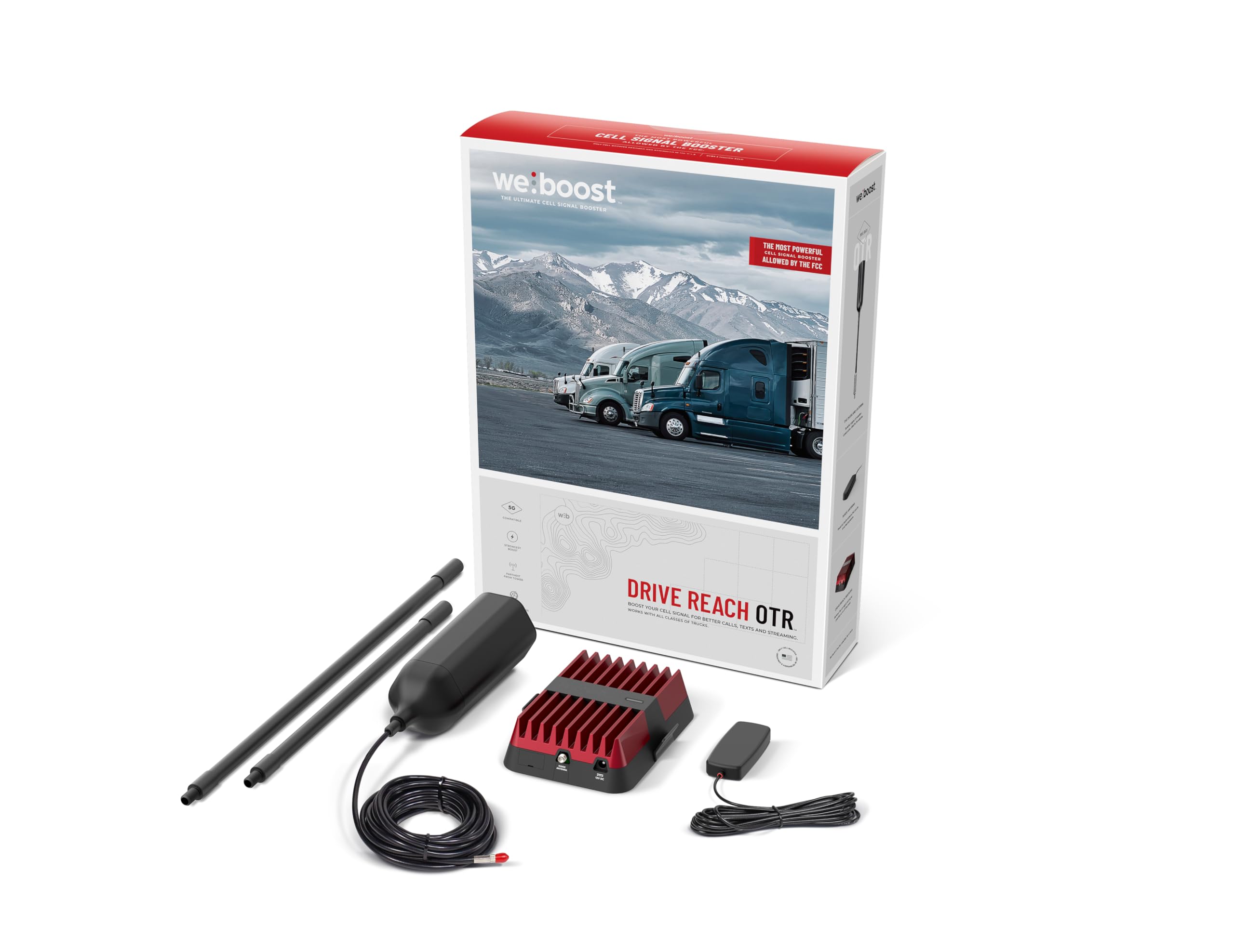
2. weBoost Drive Reach OTR
The trucker’s favorite that keeps a whole cab connected across empty states.
If your office is a semi cab rolling through West Texas and New Mexico, this is the booster the fleets order in multiples. It reaches the farthest cell towers with 50 dB max gain, supports the latest 5G, and works with every U.S. carrier, including Verizon, AT&T, T-Mobile, and US Cellular. Owners running coast-to-coast report maintaining signal for calls, Netflix, YouTube, and Spotify, losing service only once on a mountain stretch of I-10.
It handles multiple devices at once, so the driver’s phone, a passenger’s tablet, and a hotspot can all stay connected. The kit includes the Drive Reach booster, a Drive RV antenna, a slim low-profile antenna, coax cable, mast extensions, and an antenna spring. Installation is rated easy, with no app required and a simple on/off switch — and weBoost backs it with a two-year warranty and U.S.-based support.
The honest trade-offs are real. The most-discussed aspect is functionality, and it is genuinely mixed: some owners say the signal range feels short and the phone needs to sit close to the interior antenna, while others call it life-changing for rural trucking. A few report the antenna assembly lacks durability and mounting parts were missing. One owner who ordered four for work trucks summed it up plainly: “they do what the say they do. no more dropped calls while on the road in west tx and new mexico.”
Who it beats: for pure long-haul truck range across multiple devices, this leads the weBoost family, though the cheaper Drive 4G-X OTR covers the same basic mission with less reach. Keep in mind: the box runs hot, so mount it somewhere with airflow, and plan for extra spend if the kit arrives short on mounting hardware.
3. SureCall Fusion2Go Ultra
The vehicle booster with the strongest uplink push on the market.
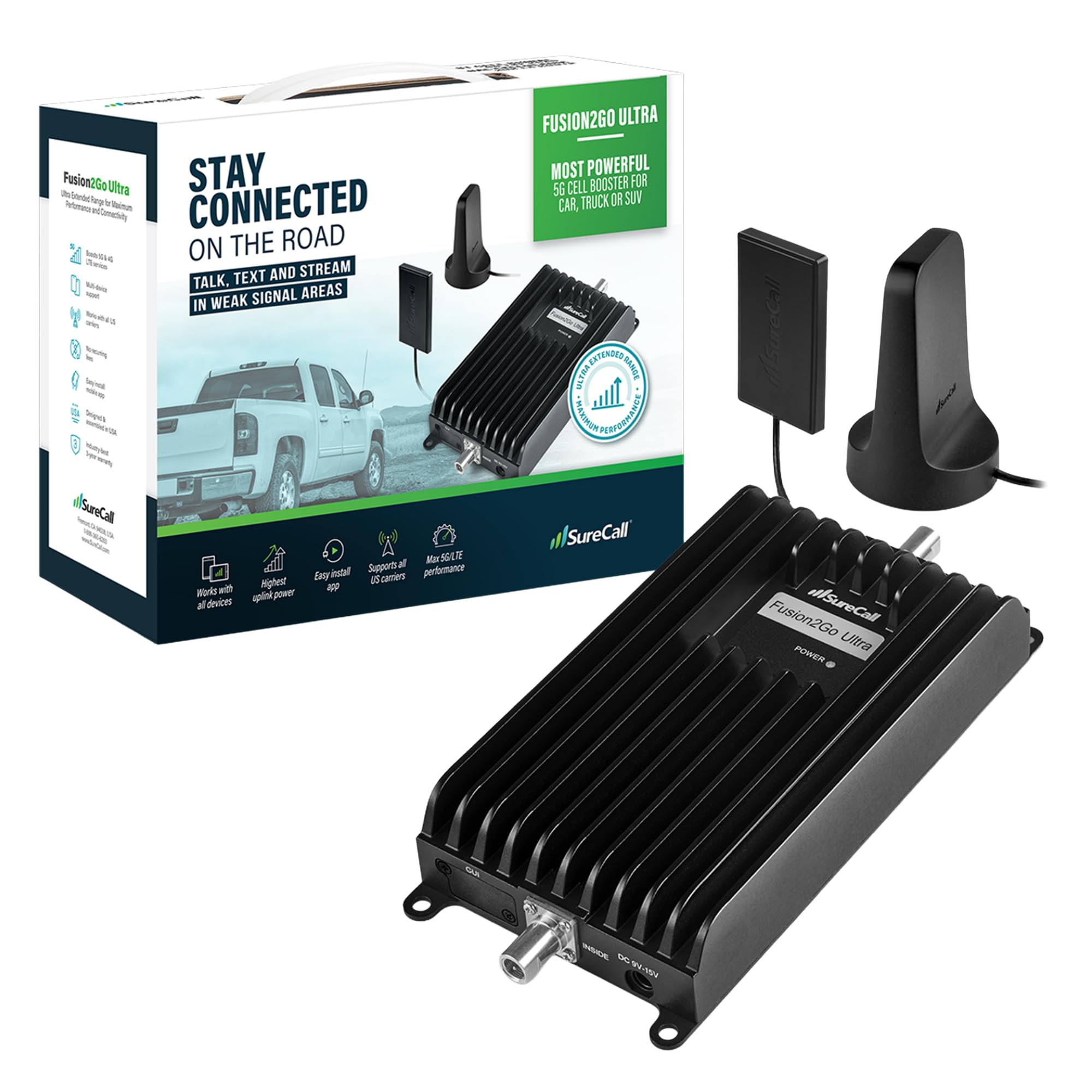
For drivers who work in weak-signal zones, the stat that matters most is uplink power — how loudly your phone can “shout” back to a distant tower. This unit delivers up to 50 dB gain and the highest uplink power on the market at up to 30 dBi, which is exactly why owners mention such dramatic before-and-afters. One measured upload speed climbing from 1.23 to 20.6 Mbps — a 17x jump — with download going from 66.5 to 77.1 Mbps and ping dropping from 2000 ms to 344 ms.
It works in cars, trucks, and SUVs, supports every major U.S. carrier including Google Fi, Mint Mobile, and Boost Mobile, and keeps multiple phones, tablets, and hotspots connected at once. The free SureCall app helps you find the best antenna placement, and the magnet-mount exterior antenna with a 12.5 ft low-loss cable makes setup straightforward. It’s FCC certified, built in the USA, and comes with a 3-year warranty.
The catches are mostly about the physical install. The interior and power cords run short, and the antennas realistically need 3–5 ft of separation — tough in a small car. A few owners also note the missing hardwire kit and sub-average customer service. But on raw signal performance, this is the unit that eliminated dead zones on a 55-mile commute and boosted 5G where others struggled.
Best for: commuters on long rural routes who need the strongest possible connection to distant towers. The catch: plan your antenna placement carefully in small vehicles and budget for extra cabling.
4. weBoost Drive 4G-X OTR

The big-antenna truck booster built for the mirror mount and the open road.
The weBoost Drive Reach OTR comes with serious hardware: a weather-resistant 17-inch omnidirectional antenna (picks up signals from all directions), a 3-way CB antenna mount, a mast extension, and a side-exit adapter. Built for trucks, the big antenna is the whole point—customers note pulling 4G from “no signal” areas like Teton Canyon and Mesa Verde, and one measured a weak -115 dB signal improve 10x in speed. Every passenger gets stronger service, since it supports all U.S. networks with multi-user functionality.
An interesting bonus: the stronger signal actually consumes less battery power, earning up to 2 hours of additional talk time. Setup is the usual weBoost mix of straightforward and finicky — the mirror mount is the only mounting option included, and antenna placement is critical because metal separation matters for performance. FCC approved with ID PWO460021.
The review picture is honestly split. Quality and easy installation draw consistent praise, and portability is a plus since it moves between vehicles. But functionality and signal strength come back mixed — some owners say it works great in remote areas, others report little change, and a few flag durability concerns. One owner’s summary captures the nuance: “It works — it’s not a miracle, but it works,” noting data speeds climbed from 0.99 Mbps download to 4.38 Mbps.
Who it suits: truckers who want the proven big-antenna design and don’t mind a fiddly install. Who it doesn’t: anyone expecting a dramatic boost without at least some existing outdoor signal.
5. ZORIDA Ace 5S

The small-home specialist with the highest gain of any pick here.
For a small house, studio, cabin, or single room, this unit packs the strongest amplifier muscle in the lineup — 72 dB max gain — while staying genuinely budget-friendly. It covers up to 2,000 sq ft and supports all U.S. carriers on bands 12/17, 13, 5, 4, and 2/25, which means it handles Verizon, AT&T, T-Mobile, and US Cellular in one box. No carrier registration is needed, and there are no subscriptions or hidden fees.
What wins people over is raw functionality — the most-praised aspect by a wide margin — and the concrete results. Owners describe going from 1–2 unreliable bars to a full 5 solid bars in a rural home, with HD streaming working again. Another measured an improvement from barely usable 4G to 5G at 45 Mbps. The compact design uses a simple indoor whip antenna that attaches straight to the booster, then sits on a table or wall.
The app-based support is a real differentiator: registering gives you 1-on-1 technical guidance, step-by-step videos, and before-and-after signal data. The honest caveats are the coverage — it’s “one room only” for several owners, so don’t expect whole-house reach — and the instructions, which more than one buyer found confusing enough to need outside help. It requires at least one bar of outdoor signal to work, like every booster here. FCC and IC certified, with a 3-year warranty.
The highlights
- Highest gain in this guide at 72 dB
- Strong app support with 1-on-1 installation help
- One-time purchase, no subscriptions
The limits
- Coverage tops out around a single room for several buyers
- Instructions rated poor by multiple owners
Pick this for: a small space needing maximum boost with app-guided setup. Look elsewhere if: you need to cover multiple rooms or a whole floor.
6. PRACOA RV Cell Phone Signal Booster
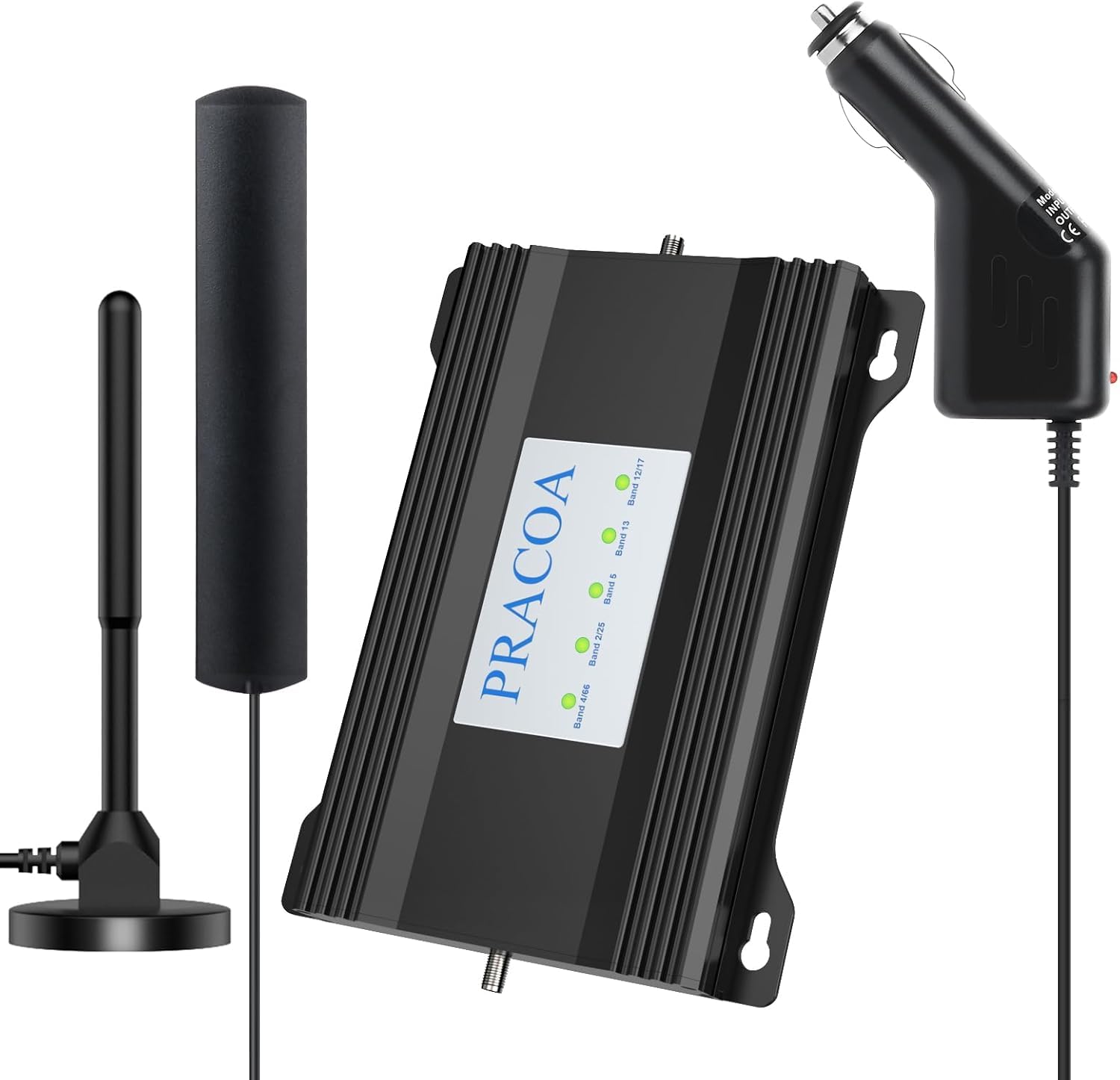
The camper’s companion that reaches towers up to 5–8 miles away.
This is a rare find: a vehicle booster with a perfect 5.0 rating, even if the review count is still small. It’s built for RVs, cars, trucks, vans, SUVs, travel trailers, boats, and motorhomes, supporting all major U.S. carriers across bands 2/4/5/12/13/17/25/66 with 65 dB high gain. The stated maximum communication distance reaches 5–8 miles, which explains how reviewers point out greatly increased cell service and smoother video streaming at home and on the road.
It boosts 2G, 3G, 4G LTE, and 5G signals up to 100X stronger, handles multiple users and devices, and includes Automatic Gain Control (self-adjusts to prevent interference), Inactivity Mode (saves power when idle), and Oscillation Elimination (stops feedback loops)—all letting it self-adjust as signal conditions change. Setup is plug-and-play, with the kit including a 12V 3A power adapter, an indoor patch antenna with a 10-foot cable, an outdoor magnetic antenna with a 16-foot cable, and a user manual. One owner even mounted it in a hunting stand on a 12V battery with a solar panel.
The trade-off is that this rating reflects a small sample — just 17 owners so far — so the long-term durability picture is thinner than the weBoost units with hundreds of reviews. What’s there is uniformly enthusiastic: better reception throughout the house, clearer calls with no static, and multiple devices staying connected without dropping off. A two-year warranty backs it.
Ideal for: RVers and campers who want a self-adjusting booster with long tower reach. Note: the small review base means the durability story is still being written.
7. JACOOL Vehicle Cell Phone Booster
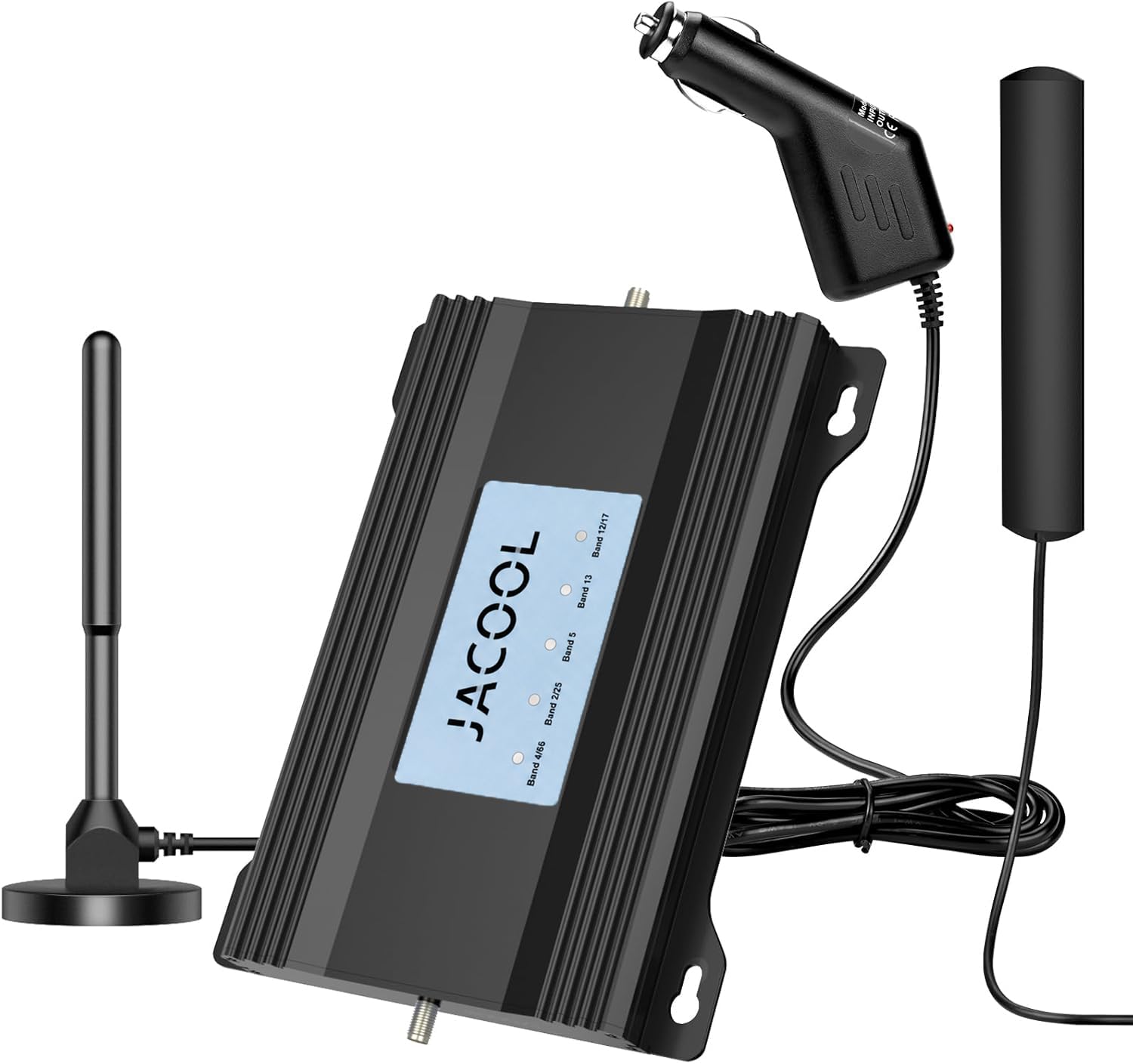
The no-alignment vehicle booster that grabs signal from any angle.
If you’d rather not fiddle with pointing an antenna at a distant tower, this is the vehicle booster for you. Its high-gain omnidirectional outdoor antenna receives signals from any direction, so there’s no precise alignment to chase — a real convenience on winding roads. It’s engineered for trucks, RVs, campers, SUVs, and off-road vehicles, supporting Verizon, AT&T, and T-Mobile plus other U.S. carriers across bands 2/4/5/12/13/17/25/66.
It boosts 5G and 4G LTE for multiple devices at once, and the suction-cup mounting design keeps the antenna secure on your truck or RV. FCC certified with smart automatic gain control, it amplifies the carrier-deployed 5G that rides on LTE bands. Like every booster, it needs at least 1–2 bars of existing outdoor signal to work.
The one setup rule that matters: don’t attach the patch antenna to metal parts inside the vehicle, because that kills performance. And a bigger note — while this is a legitimate home-and-vehicle booster listing, several of its review pages read like they belong to a different product entirely, so the social proof here is thin and unreliable. If you value a huge owner base to lean on, the weBoost units offer far more of it.
Choose this for: a low-maintenance omnidirectional install in a truck or RV. Proceed with: modest expectations, since buyer feedback is hard to verify for this specific unit.
8. GAGBK Car Cell Phone Booster

The entry-level car booster that keeps trips connected without breaking the budget.
For a car, truck, RV, SUV, van, or camper on a budget, this unit delivers the essentials at a friendly price point. It works with all U.S. carriers — Verizon, AT&T, T-Mobile, Sprint, Straight Talk, Cricket, US Cellular, and more — focusing on 4G LTE and 5G on bands 12/13/17. With 65 dB max gain and automatic gain control, it adjusts itself to eliminate self-oscillation and goes into sleep mode to save power when not in use.
The kit is genuinely complete: a 12V 2A power adapter with a 3-foot cable, an inside patch antenna with a 10-foot cable, and an outside magnetic whip antenna with a 16-foot cable. No drilling is required, and installation runs about 10–20 minutes. The aluminum alloy body keeps it compact and helps heat dissipation, which extends the device’s life. FCC approved, with a 30-day money-back guarantee and a 3-year manufacturer warranty.
The honest caveats: the outdoor antenna needs to be near the phone for maximum power, and the entire system only amplifies existing signal — it cannot create signal. Several of the listed reviews appear to describe a charging block rather than this booster, so take the social proof with a grain of salt. One owner did report a unit that quit after about a week, which is note at this price tier.
Best for: first-time buyers wanting a low-cost multi-carrier car booster with all accessories included. Keep in mind: antenna placement near your phone is essential for the full effect.
9. GAGBK Verizon Signal Booster

The Verizon-only home fix that’s also among the most-reviewed budget options.
If you’re a Verizon or Straight Talk customer and that’s the whole decision, this is a respectable budget home boost with a large owner base behind it. It’s built specifically for 4G LTE and 5G on 700 MHz Band 13, covering up to 5,000 square feet or roughly 2–5 rooms. With 65 dB high gain, it takes weak 1–2 bar signal and pushes it to 4–5 bars or full bars — the maker claims up to 100X boost.
The ZORIDA Ace 5S is portable and small, supports multiple users and devices, and uses Automatic Gain Control (self-adjusts to signal strength) with an LED indicator showing its working status. The kit includes an indoor omni whip antenna and an outdoor directional antenna, plus a 12V 2A power supply. FCC approved, with a 30-day money-back guarantee and a 3-year warranty. Shoppers say real results: one went from about 1 bar of 4G to an average of 4 bars, often 3 bars of 5G, and another noted that where they once had to step outside to make calls, the phones now work indoors.
The trade-offs are clear. It only supports Band 13, so AT&T and T-Mobile subscribers should look elsewhere — this is a Verizon play through and through. And the review pages are messy: several read like they describe a wall charger, not a booster, so some of the social proof is untrustworthy. Coverage in the listed range assumes good outdoor signal and proper mounting height, which owners emphasize matters.
Buy it if: you’re on Verizon or Straight Talk and want an affordable home booster with strong Band 13 support. skip it if: you need multi-carrier coverage.
10. JACOOL Home Signal Booster
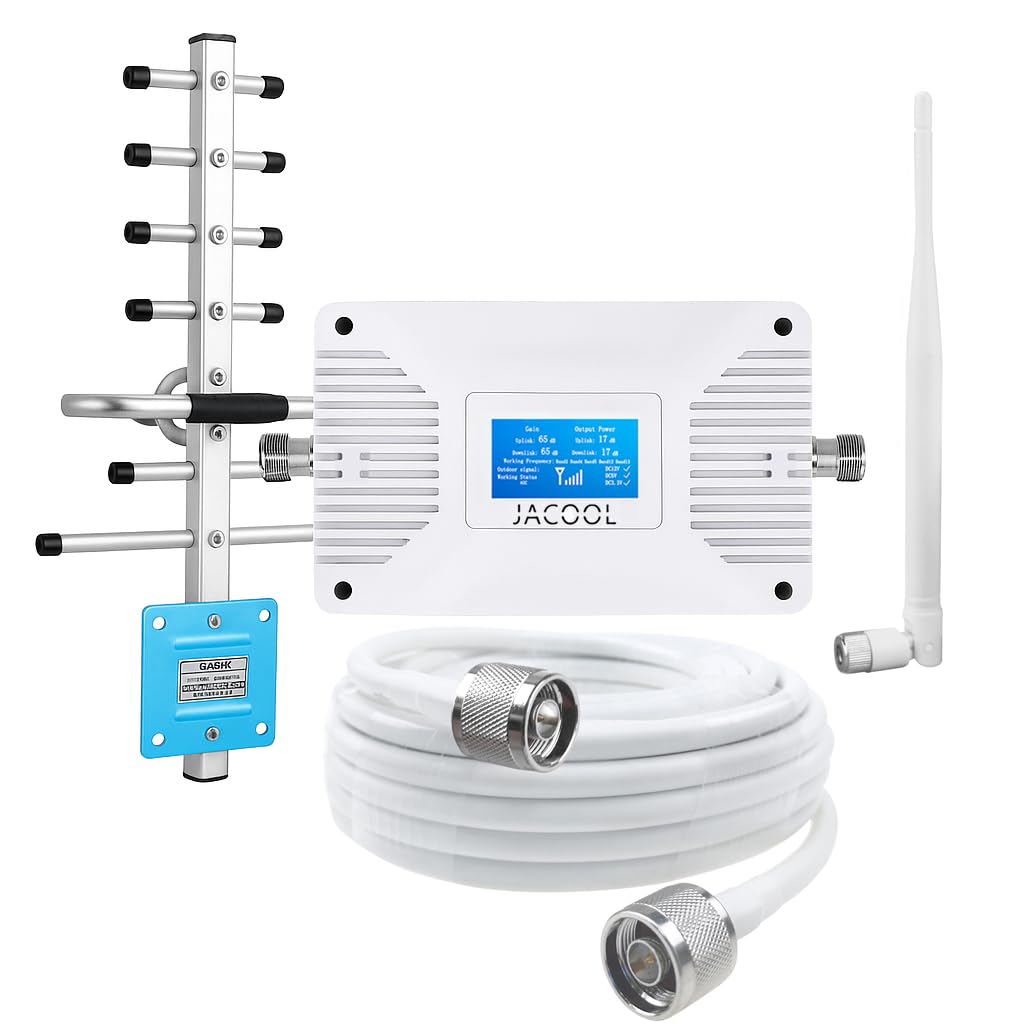
The entry-level home booster that tames metal roofs and remote cabins.
When a completely metal-clad building with a metal roof is your reality, this is the budget booster that owners say handles it — a real differentiator in a category where metal buildings swallow cellular signals. It’s built for Verizon and AT&T on 4G LTE and 5G Band 12/13/17, turning weak 1–2 bars into reliable indoor coverage for calls, texting, and streaming across 3,000–5,000 sq ft. A high-gain outdoor Yagi antenna does the heavy lifting of capturing the distant signal.
It supports multiple users at once—iPhones, Android phones, tablets, and hotspot devices—without interruption, and the AGC (automatic gain control) adjusts signal strength to prevent interference and oscillation, which also lowers power consumption and extends device life. Everything needed for installation is in the box, and the maker claims setup in under 30 minutes. FCC approved and compliant with U.S. regulations, backed by a 2-year warranty.
The honest reality: coverage claims depend heavily on your outdoor signal, and while several buyers report genuine improvements, the review data for this specific listing is unreliable—much of it reads like reviews for a completely different product. One honest owner described the boost as modest, “like one bar signal,” while another confirmed it works in a fully metal-clad structure. At this entry price, expect a practical fix rather than a dramatic transformation.
Reach for it if: you need an affordable Verizon/AT&T home booster and have at least a sliver of outdoor signal to work with. Set expectations: the boost can be modest, and the review base is mixed.
Understanding the Specs
Gain (dB) and What It Really Does
Gain, measured in decibels, is the amplifier’s power rating — how strongly it boosts the weak signal it captures from outside. A 70 dB unit like the HiBoost will push a single weak bar much further than a 50 dB unit like the weBoost Drive Reach, which is why gain is the first number serious buyers compare. But remember: gain amplifies what’s already there. If there’s zero signal outside, no amount of gain can manufacture one.
Carrier Bands and Compatibility
Your carrier talks to towers on specific frequency bands, and a booster only helps if it covers the bands your carrier actually uses. Band 12 and 17 are the backbone for AT&T and T-Mobile rural coverage, Band 13 is Verizon’s core, and Bands 2/25 and 4/66 handle most 4G and 5G city traffic. A multi-band booster covering 12/13/17/25/4/66 is the safe universal choice. A Band-13-only unit like the GAGBK Verizon booster is a bargain for Verizon customers but useless for anyone else.
FAQ
Will a cell signal booster work for my specific carrier?
How much outdoor signal do I need for a booster to work?
What is the difference between a home booster and a vehicle booster?
Does a higher dB gain always mean better performance?
Can I use a home booster in a metal building or a metal-roofed house?
Why does antenna placement matter so much?
Are these boosters legal and approved for use in the U.S.?
How long does installation actually take?
Final Thoughts: The Verdict
For the majority of shoppers, the amplifier for cell phone reception winner is the HiBoost Home and Multi Room because its 70 dB gain, 8,000 sq ft coverage, and dual indoor antennas deliver the most complete whole-house fix—and the crowd agrees, with hundreds of owners making signal quality the most-praised aspect by far. If you live on the road, grab the weBoost Drive Reach OTR for long-haul truck range. And for a small home or cabin on a budget, the ZORIDA Ace 5S offers the highest gain in the lineup at a friendly price.
How We Picked
We do not accept paid placement. Every pick is matched to a real buyer and a real use-case; we do not hands-on test units.
Sources & Methodology
Specifications: manufacturer listings and product documentation. Review insights: verified customer reviews, as of August 2026. Pricing: not shown on this page (it changes often); check the current price via the retailer link.
As an Amazon Associate, Gadgets Feed earns from qualifying purchases. This does not affect which products we feature.