
Our readers keep the lights on and my morning glass full of iced black tea. As an Amazon Associate, I earn from qualifying purchases.
Specs are compiled from manufacturer listings and verified buyer reviews and can change over time — please confirm the key details on the product page before buying.
If your TV’s soundbar is struggling to fill a room or you’ve outgrown its thin sound, the fix isn’t a bigger bar—it’s a real amplifier driving real speakers. This guide covers the best compact stereo amps that turn passive bookshelf or tower speakers into a proper home theater, with the exact inputs you need to connect your TV, phone, and turntable.
I’m Min — the founder and writer behind Gadgets Feed. This guide is built by comparing the manufacturers’ published specifications and the patterns across verified customer reviews, so you get each pick’s real strengths and trade-offs instead of marketing spin.
You want your soundbar to fill the room with clear, powerful audio, but the built-in amp often falls short. These amplifier for soundbar upgrades fix that, giving you everything from streaming smarts to raw watts for a party, or even a retro tube glow.
Our Picks at a Glance
How To Choose The Best Amplifier For Soundbar Upgrade
Match the amp’s power output to your speakers’ ohm rating to avoid straining either component. Start by checking the ohm rating on your passive speakers—most bookshelf and tower models run at 4 to 8 ohms—and make sure the amp delivers enough clean power per channel for that load.
Start With Your TV Connection
Your TV’s audio output dictates which amp will work best for you. If your TV has an HDMI ARC or eARC port, an amp with that same jack lets you control volume with your existing TV remote and gives you the best sound from movies. If your TV only has optical or a headphone jack, you’ll want an amp that includes those inputs so you’re not stuck with muffled audio from a basic adapter.
Consider How You’ll Play Music
Think about your daily listening habits. If you primarily stream from your phone, a reliable Bluetooth connection is your core need. If you use apps like Spotify or TIDAL, a Wi-Fi streaming amp with its own app gives you better sound quality than Bluetooth and keeps the music playing even when your phone rings. Don’t overlook a phono input if you own a turntable—it saves you from buying a separate preamp.
Quick Comparison
| Model | Best For | Power Output | Key Inputs | Wireless | Amazon |
|---|---|---|---|---|---|
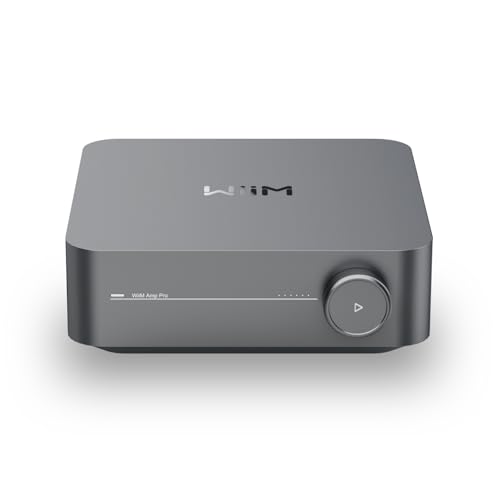
| WiiM Amp Pro★ Best Overall | Streaming & home theater | 60W x 2 (8Ω) | HDMI ARC, Optical, Sub | Wi-Fi 6, BT 5.3 | Amazon |
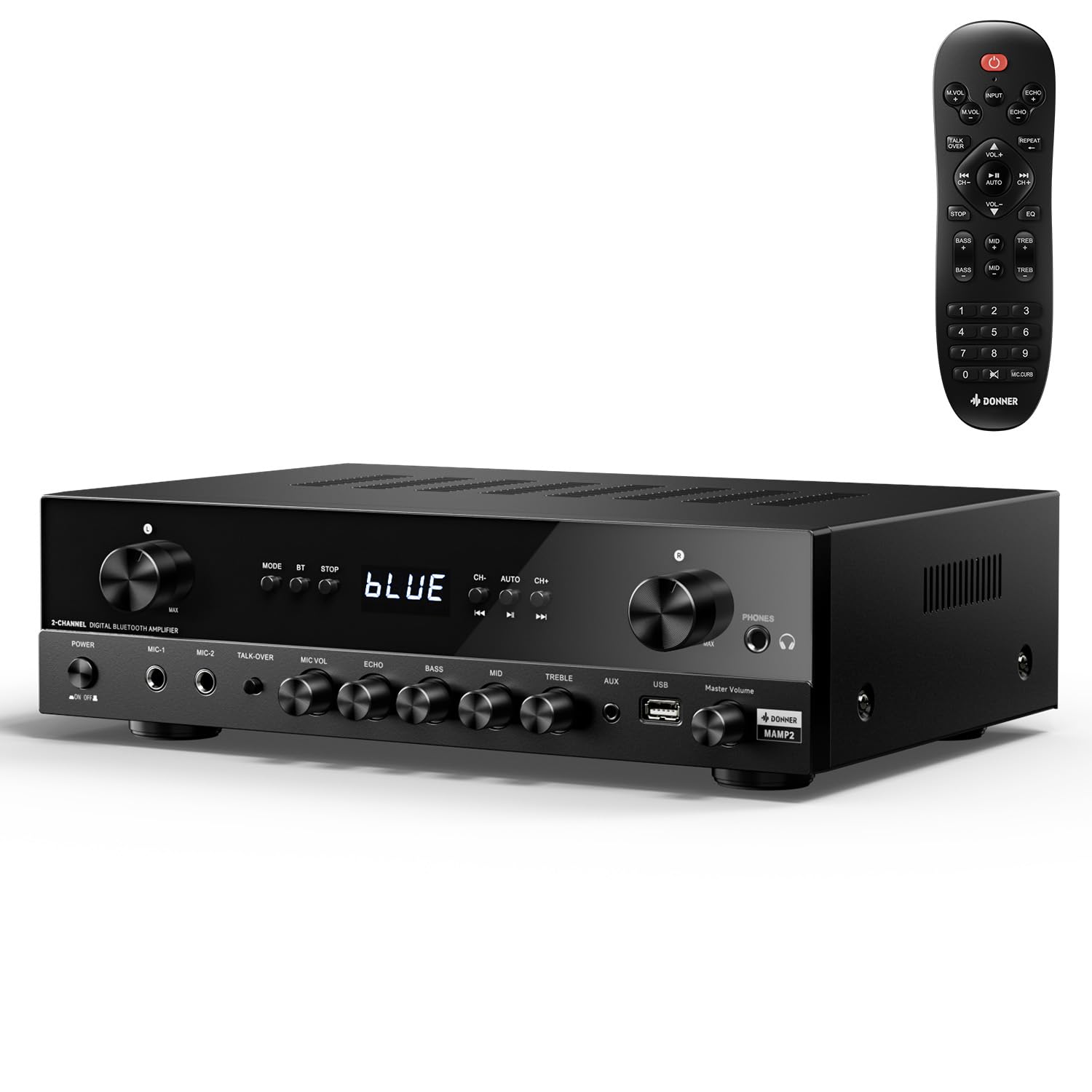
| Donner Stereo AmpBest Value | Karaoke & versatile inputs | 60W x 2 RMS | Optical, Coax, Phono, USB | Bluetooth 5.3 | Amazon |
| Fosi Audio V3 | Purist sound quality | 300W x 2 (peak) | RCA, Pre-out | None | Amazon |
| Donner 4-Channel | Multi-zone & karaoke | 25W x 4 RMS | Optical, Coax, USB, 2 Mic | Bluetooth 5.3 | Amazon |
| Pyle Receiver | Whole-home ceiling speakers | 800W Peak | USB, RCA, 3.5mm, Mic | Bluetooth 5.0 | Amazon |
| Fosi Audio MC331 | Tube warmth on a desktop | 105W x 2 (4Ω) | USB, Opt, Coax, RCA, Pre-out | Bluetooth | Amazon |
| WiiM Amp Ultra | Premium all-in-one system | 100W x 2 | HDMI ARC, LAN, Optical | Wi-Fi 6, BT 5.3 | Amazon |
In‑Depth Reviews
1. WiiM Amp Pro Streaming Amplifier
Our pick — over 4.5★ from 2,000+ verified ratings; the strongest balance of quality and price.
The streaming brain that turns your TV and speakers into a smart, room-filling system.
For most people, this is the amp to beat because it does almost everything. It delivers 60W per channel at 8 ohms and doubles to 120W per channel at 4 ohms, which powers most bookshelf and tower speakers with ease. The HDMI ARC port plugs straight into your TV for rich stereo sound from shows and games, and you can add a powered subwoofer for extra cinematic punch.
The WiiM Home App streams from Spotify, TIDAL, and Qobuz at up to 24-bit/192 kHz. You can sync speakers across rooms, adjust volume, and tweak EQ settings all from your phone. Wi-Fi 6 and Bluetooth 5.3 with dual antennas ensure stable streaming, and the voice remote supports Alexa or Google Assistant.
A 4.6-star rating from 2,300+ owners highlights its clear sound and compact size. It’s budget-friendly and easy to set up, but connectivity feedback is mixed. It lacks HDMI ports for multiple sources, so you’ll need a simple HDMI switch to connect everything.
streaming plus power
- Outstanding build quality and amp quality
- Powered bookshelf speakers and subwoofers effectively
- Compact design fits anywhere
pricey for watts
- Connectivity can be hit-or-miss for some owners
- Only one HDMI input, so a switch may be needed
- Not an AirPlay receiver
streaming muscle: you want one box that streams, hooks to your TV, and powers great speakers with minimal fuss.
budget buyers: multi-source setups need an external HDMI switch, and Bluetooth can be finicky for a few owners.
2. Donner Stereo Audio Amplifier
The jack-of-all-trades receiver with a mic input for impromptu karaoke nights.
If your needs go beyond just TV sound, this Donner is the most flexible pick here. It packs a 600W peak (60W × 2 RMS) punch and supports up to two groups of four speakers with 4–8 ohm loads, plus a subwoofer. The standout is the input lineup: Bluetooth 5.3, USB up to 64 GB, RCA, two 1/4-inch mic jacks, AUX, FM radio, plus digital optical and coaxial for smart TVs, and a phono input for a turntable.
Owners get solid value for the price. The review pages sum it up: “Amazing receiver for the price, everything I needed.” It drives pairs of Jamo and JBL monitors cleanly, and the separate bass, midrange, and treble controls let you dial in the sound. The multifunction remote adds echo and Talkover, which lowers background music so voices stay clear during speeches.
Owners praise performance and value, especially easy Bluetooth pairing. The trade-offs to know: there’s no HDMI input, and sound quality gets mixed feedback—some buyers report higher noise levels. Pair it with 8-ohm speakers, and it beats far pricier receivers for basic home and garage use.
tight budget: you want a full-featured receiver with karaoke mics, a phono stage, and FM radio for one low price.
power seekers: you need HDMI switching or expect deep, thumping bass that shakes the room.
3. Fosi Audio V3 Stereo Amplifier

The audiophile’s secret weapon: clean, powerful Class D sound in a tiny case.
If you prioritize sound purity over convenience, the Fosi V3 is your pick. It uses the TPA3255 Class D chip (a digital amplifier chip that runs cool and efficient) with premium Japanese NCC and ELNA capacitors and German WIMA caps, delivering a SINAD of up to 88dB (a signal-to-noise ratio measure), an SNR up to 110dB (signal-to-noise ratio), and a low noise floor of just 140uV (microvolts). For you, that means exceptional clarity with almost no hiss or distortion, even at high volumes.
It drives 2–8 ohm speakers with up to 600W peak output, and owners mention it powers power-hungry Magnepan LRS speakers and Polk Atrium outdoor models with ease. The whole-body heatsink design with top and bottom vents keeps it cool even during long sessions. As owners put it: “There’s so much more clean power to recreate bass frequencies that I almost don’t think I need a subwoofer.”
Owners rave about sound quality, particularly for EDM and hip-hop. The catch is simplicity: there are no tone controls, no DAC, and just a single analog input. You can swap the stock NE5532 op-amps for Sparkos SS3602 or MUSES02 to tweak the sound, but the core appeal is clean amplification, nothing more.
compact and clean: If you already have a streamer or DAC and just want the cleanest power for your money, this beats amps twice its size—just pair it with high-efficiency 90dB+ speakers.
needs extras: No bass or treble knobs means you’ll want an inline EQ or a preamp with controls.
4. Donner Stereo Receivers Home Audio Amplifier

Four independent channels to fill a workshop, patio, or whole home with sound.
This Donner is built for spreading sound across multiple zones. It pumps 1000W peak power (25W × 4 RMS) across four independently controlled channels, supporting up to four groups of eight speakers with 4–8 ohm loads. If you have a big shop, a covered patio, and a living room, you can wire them all and adjust each zone’s volume separately from the front panel or remote.
The input list is generous for the price: Bluetooth 5.3, USB up to 64 GB, two pairs of RCA, two 1/4-inch mic jacks, AUX, FM radio, plus optical and coaxial for smart TVs. Owners like the dual speaker volume controls and find it “nice sound for a 3000 sq ft shop.” The remote handles treble, midrange, and bass plus echo and Talkover in any input mode.
The thing owners mention most is sound quality, and it’s a genuinely mixed bag—some get clear, powerful sound while others report popping noises and weak bass even with EQ maxed. The 8 speaker terminals (4L/4R) and per-channel knobs can feel confusing. This is best for secondary rooms and casual listening, not your critical home theater.
basic hookups: covering large areas like workshops or patios where you need independent volume per speaker pair.
multi-device: you expect tight, room-shaking bass or an intuitive control layout—this one has a learning curve.
5. Pyle Home Stereo Receiver

Simple, powerful, and ready to drive eight speakers for a whole-home setup.
The Pyle receiver is the workhorse for people wiring sound through multiple rooms. It delivers 800W peak power and handles four channels, so owners use it to power ceiling speakers throughout a 3,300 sq ft home and four garage speakers plus an Echo for a smart garage. The front panel digital LED display and push-button controls keep operation straightforward.
You get Bluetooth 5.0 with a 30+ foot range, USB-A for MP3 players, an SD card slot, and FM radio. For wired sources, it includes AUX, RCA, and 3.5mm inputs, plus dual 1/4-inch mic jacks with independent volume, reverb, and delay controls for karaoke. Owners love the flexibility to adjust volume in different areas and call it “big sound and capability” for the price.
Sound quality and power are what win people over, with comments on it running cool even at max volume for 1.5 hours. The truth to know: reliability is the most-discussed aspect, and it’s mixed—some units quit working or have weak Bluetooth range. A few owners also note the actual output is closer to 500W than the marketed 800W peak, so set expectations accordingly.
affordable amp: A capable budget receiver for whole-home speaker systems if you’re OK with the occasional quality gamble.
dated design: Fixed EQ presets lack depth, so you can’t fine-tune bass and treble to your taste.
6. Fosi Audio MC331 Tube Amplifier
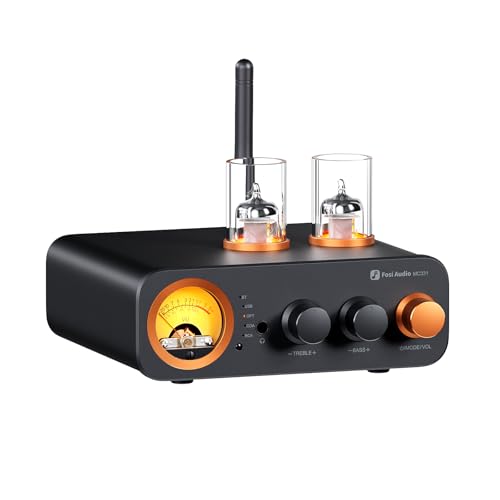
Vintage tube warmth and a dancing VU meter for listeners who want their gear to look as good as it sounds.
The MC331 is for the person who treats their audio setup as part of the room’s decor. It combines a DAC, amplifier, preamp, and headphone amp into one compact chassis, with glowing vacuum tubes and a VU meter that adds a warm, retro feel. It pushes 105W x 2 at 4 ohms, which drives bookshelf speakers easily, and includes a pre-out and 3.5mm headphone output.
Input coverage is complete: Bluetooth, USB, coaxial, optical, and RCA, so you can run a computer, CD player, phone, or turntable with a built-in phono preamp. Owners love the replaceable tube design, which lets you customize the sound signature, and the all-metal build feels sturdy. The tube warmth is audible, and the amber glow is a genuine conversation piece.
Quality and sound are what people rave about, with many calling it excellent value that exceeds expectations. The honest flaws: the remote has noticeable latency and needs direct line-of-sight, and the tubes’ glow isn’t visible from the front because they’re recessed. Reliability is mixed, with a few owners reporting tubes failing within three days—treat the tubes gently and it’s a joy.
vinyl lovers: you want tube sound and retro aesthetics on a desktop without spending big money.
loud rooms: The remote is sluggish, and a rare unit ships with a faulty tube—check it early.
7. WiiM Amp Ultra Streaming Amplifier

The end-game all-in-one with a touchscreen, room correction, and enough power for serious floor standers.
The WiiM Amp Ultra is the culmination of everything WiiM learned, and it shows. It delivers 100W Hi-Fi power with ultra-low distortion of -106 dB THD+N, using an ESS SABRE DAC and dual TI TPA3255 amps. That’s enough to drive KEF floor standers rated at 100/200 watts “with ease,” as customers note. The sleek unibody aluminum case with a 3.5-inch glass-covered touchscreen shows album art and system settings.
Connectivity here is next-gen: Wi-Fi 6 (the latest wireless standard for faster, stable streaming), Bluetooth 5.3 with LE Audio (low-energy audio for better battery life), and HDMI ARC (Audio Return Channel) for smooth TV integration. Built-in RoomFit correction auto-calibrates the sound based on your room and speakers, and it supports streaming up to 24-bit/192 kHz (high-resolution audio) from Spotify, TIDAL, Qobuz, and more. Owners call it “studio-perfect clarity” and note it beats much pricier separates.
Quality and sound are the things everyone raves about, with owners powering B&W 706 S2 speakers and Emotiva T2 towers cleanly. It’s the heaviest pick at 5.4 pounds, and there’s no AirPlay support, so iPhone users should rely on the app or Chromecast. For the money, it’s the best all-in-one streamer amp you can buy, with a caveat that Bluetooth only uses SBC/AAC codecs.
premium build: If you want one box that does everything—streaming, room correction, and serious power—this is the one to beat.
high price: Heavy shipping and no AirPlay, plus Bluetooth is capped at standard codecs rather than aptX or LDAC.
Understanding the Specs
Power: Watts and Ohms
Amplifier power is measured in watts per channel, and how that power translates to volume depends on your speakers’ impedance, measured in ohms. An amp that delivers 60W per channel at 8 ohms will typically double to 120W per channel at 4 ohms, but you want to match the amp to your speakers’ rating so neither runs hot. A higher wattage gives you more headroom, meaning cleaner sound at louder volumes without distortion.
HDMI ARC vs. Optical vs. Bluetooth
HDMI ARC (Audio Return Channel) is the best way to connect a TV to an amp because it carries high-quality audio both ways and lets your TV remote control volume. Optical and coaxial digital inputs also carry full-quality audio but often require a separate remote for volume. Bluetooth is the easiest for phone music but compresses the signal, so it’s a step below wired connections for critical listening.
FAQ
How do I connect my TV to a stereo amplifier?
Will a 60-watt amplifier be loud enough for my room?
Can I use a streaming amplifier without the app?
What’s the difference between a receiver and an integrated amplifier?
Do I need a subwoofer with my amplifier?
Can I connect a turntable to these amplifiers?
Are Class D amplifiers as good as traditional Class A/B?
How many speakers can I connect to a stereo amplifier?
Final Thoughts: The Verdict
For most buyers, the amplifier for soundbar upgrade winner is the WiiM Amp Pro because it combines streaming smarts, HDMI ARC for your TV, and enough power for real speakers in one compact box. If you want karaoke mics and a phono input on a budget, grab the Donner Stereo Amp. And for the person who wants one premium box with a touchscreen and room correction, the WiiM Amp Ultra is the one to reach for.
How We Picked
We do not accept paid placement. Every pick is matched to a real buyer and a real use-case; we do not hands-on test units.
Sources & Methodology
Specifications: manufacturer listings and product documentation. Review insights: verified customer reviews, as of August 2026. Pricing: not shown on this page (it changes often); check the current price via the retailer link.
As an Amazon Associate, Gadgets Feed earns from qualifying purchases. This does not affect which products we feature.