
Our readers keep the lights on and my morning glass full of iced black tea. As an Amazon Associate, I earn from qualifying purchases.
Specs are compiled from manufacturer listings and verified buyer reviews and can change over time — please confirm the key details on the product page before buying.
The biggest mistake in buying an amplifier for speakers is picking one by wattage alone. A high-wattage amp can sound thin and harsh if it doesn’t match your speakers’ impedance, and a lower-wattage amp can be plenty if your speakers are efficient. This guide cuts through the spec-sheet noise so you can match the right amp to your actual speakers and listening habits.
I’m Min — the founder and writer behind Gadgets Feed. This guide is built by comparing the manufacturers’ published specifications and the patterns across verified customer reviews, so you get each pick’s real strengths and trade-offs instead of marketing spin.
Whether you’re upgrading a bookshelf stereo or building a home theater, the right amplifier for speakers boils down to power, inputs, and the speakers you already own.
Our Picks at a Glance


How To Choose The Best Amplifier For Speakers
Start with your speakers, not the amp. Check the impedance rating (measured in ohms, usually 4, 6, or 8) and sensitivity (measured in decibels). Efficient speakers with high sensitivity, like 90dB or more, need far less power to get loud than low-sensitivity ones.
Match the Power to Your Room and Speaker
You don’t need a massive amp for a small or mid-size room with typical bookshelf speakers — around 45 to 80 watts per channel is usually plenty. For larger rooms or speakers that demand more power, check the wattage rating at both 4 ohms and 8 ohms, because a speaker’s impedance (its electrical resistance) drops as volume rises, and the amp must handle that load without straining.
Decide on Connectivity First
Count your sources. If you stream from your phone, Bluetooth is a must. If you have a turntable, you may need a phono input. If you’re building a home theater, HDMI ARC lets the TV remote control the amp and sends audio from the TV. Digital inputs like optical and coaxial are useful for connecting a TV or CD player with a clean signal.
Quick Comparison
| Model | Best For | Power | Channels | Key Inputs | Amazon |
|---|---|---|---|---|---|
| Denon PMA-600NE★ Best Overall | Warm 2-channel sound with phono | 70W at 4 ohms | 2 | Bluetooth, Optical, Coaxial, Phono | Amazon |
| AIYIMA A07 MAXBest Value | Budget-friendly desktop power | 107W x2 at 4 ohms | 2 (bridgeable to mono) | RCA, 3.5mm Aux Out | Amazon |
| Fosi Audio V3Top Performer | Clean power for bookshelf and towers | 300W x2 max | 2 | RCA, Pre-out | Amazon |
| Pyle PDA77BU | Karaoke and multi-source home use | 800W peak | 4 | Bluetooth 5.0, USB, SD, FM, 2 Mic | Amazon |
| Fosi Audio MC331 | Tube warmth on a desktop | 105W x2 at 4 ohms | 2 | Bluetooth, USB, Optical, Coax, RCA | Amazon |
| MUSYSIC SYS-2000 | Professional PA and live sound | 2000W peak | 2 | XLR, 0.77V sensitivity | Amazon |
| Crown XLi800 | Reliable installs and quiet operation | 300W continuous at 4 ohms | 2 | RCA, XLR, binding posts | Amazon |
| WiiM Amp Ultra | Streaming and room correction | 100W Hi-Fi | 2 (up to 4 speakers) | HDMI ARC, Wi-Fi 6, Bluetooth 5.3 | Amazon |
| Denon AVR-X1700H | Full home theater with surround | 80W per channel | 7.2 | 6 HDMI, eARC, Phono, Wi-Fi | Amazon |
| Yamaha A-S801 | High-end 2-channel with USB DAC | 100W + 100W | 2 | USB DAC, Optical, Coax, Phono | Amazon |
| Cambridge Audio CXA81 MkII | Audiophile detail and soundstage | 80W per channel | 2 | Bluetooth aptX HD, XLR, USB, Optical | Amazon |
In-Depth Reviews
1. Denon PMA-600NE Bluetooth Stereo Amplifier
Our pick — over 4.5★ from 550+ verified ratings; the strongest balance of quality and price.
The Denon PMA-600NE delivers warm, vintage-style sound with 70W at 4 ohms and a built-in phono input.
This integrated amp powers the widest range of speakers with 70W at 4 ohms, and it’s the one that owners consistently describe as a major sound upgrade over vintage Marantz, Fisher, and Kenwood units. The built-in DAC and Bluetooth pair with your smartphone, while you can dial in an undivided analog experience by disengaging the digital circuits when you want pure signal path.
Reviewers consistently report that 45W is enough for speakers rated around 87dB sensitivity (a measure of how loud they play per watt), so this amp suits most bookshelf speakers. You get 2 optical and 1 coaxial input plus a phono input for a turntable, making it a flexible hub for a stereo system. The appeal is the balance of power and musical detail, which buyers report delivers clean, rich, rich audio.
The recurring gripe is the volume control, which several owners find awful — it’s a clunky relay-based feel rather than a silky smooth knob. It also lacks any EQ or loudness customization, so if you want to tweak tone you’ll need a source with its own EQ.
warm analog heart
- Warm, tube-like sound that rivals vintage receivers
- Solid build quality and sleek, compact design
- Flexible inputs: Bluetooth, optical, coaxial, and phono
- Runs cool even with demanding speakers
modest power ceiling
- No tone or EQ controls for customizing the sound
- Remote volume adjustment is laggy and coarse
- The input LEDs are dim and relays are loud
for vinyl lovers: you want a reliable, great-sounding 2-channel amp that handles both modern streaming via Bluetooth and a turntable.
for huge rooms: you need tone controls or a remote that gives you fine-grained volume steps.
2. AIYIMA A07 MAX TPA3255 HiFi Power Amplifier
The AIYIMA A07 MAX delivers 107W x2 at 4 ohms in a compact, budget-friendly Class D design.
This mini amp uses the TI TPA3255 chip and NE5532 op-amp to deliver a maximum output of 600W, and you can switch between stereo and mono modes with a bottom switch. In stereo mode you get measured numbers of 107W x2 at 4 ohms and 94W x2 at 8 ohms, which is plenty for most bookshelf speakers. Flip it to mono mode and it pushes 190W x1 at 4 ohms, so a single unit can drive tower speakers with ease.
Reviewers consistently praise the sound quality and bass output, noting it exceeds expectations for the price. The compact size makes it easy to set up on a desktop or in a home theater rack, and the build quality feels solid. There’s no Bluetooth built in, so you’ll need a separate source like a WiiM Ultra connected via RCA.
The volume knob doubles as the power switch, and it uses a log taper — expect to turn it past 12 o’clock to get into the useful range. The front panel feels a bit cheap, and there’s no balanced input, but at this price the trade-offs are easy to live with.
fiery chip value: Stereo versus mono matters here — stereo delivers punchier bass while mono mode offers better separation and midrange, so pick based on your setup.
bare-bones build: the op-amps are replaceable, so you can swap in Sparkos or MUSES chips later to expand soundstage and depth.
3. Fosi Audio V3 Stereo Amplifier
The Fosi V3 provides clean, powerful Class D sound with 300W x2 peak and a low noise floor.
With the TPA3255 chip and Japanese NCC, ELNA, and German WIMA capacitors, this amp delivers up to 600W total power, translating to 300W x2 in stereo. A standout here is the low noise floor of only 140uV and an SNR of up to 110dB, so you get clarity and low distortion. The 48V power supply is included, which is what open up the full performance.
What wins people over is the sound quality — it drives power-hungry Magnepan LRS speakers surprisingly well, and owners note it’s a better job than their old late-80s Onkyo receiver. The “Pre-out” is volume-controlled, so you can connect a subwoofer or powered speakers and adjust levels from the amplifier. There are no tone controls or DAC built in, so it’s a pure power amp that relies on your source.
One owner found the power claims overstated, noting the 240W PSU can’t deliver 300W per channel into any impedance. It’s a fair point — treat the 300W figure as a peak, not continuous. The op-amp upgrade requires risers if you want to swap in SparkOS chips, which adds a small hassle.
crowd-pleasing punch
- Crisp, neutral sound that rivals much pricier amps
- Whole-body heatsink design keeps it cool
- Volume-controlled pre-out for flexible subwoofer setup
- Great with EDM and hip-hop per owners
quirky dial feel
- No tone controls or DAC built in
- Larger than expected, with a big power brick
- Power claims are peak, not continuous
for bass heads: anyone with efficient bookshelf or tower speakers who wants a simple, powerful amp with a clean signal path.
for purists: you want tone shaping or a built-in DAC — you’ll need a separate source for those.
4. Pyle Home Stereo Receiver with Bluetooth

The Pyle receiver offers 800W peak power, dual mic inputs, and Bluetooth for versatile karaoke and party use.
This 4-channel amplifier delivers up to 800W peak power and handles a wide range of sources, making it a versatile hub for any room. Bluetooth 5.0 connectivity lets you stream from your phone up to 30+ feet away, while USB, SD card, and FM radio inputs mean you’re never short on music options. You also get dual 1/4-inch microphone jacks with independent controls for karaoke nights, so you can adjust mic volume, reverb, and delay separately.
Owners find it easy to hook up and operate, and it powers 6 speakers without issue — one satisfied buyer runs 4 garage speakers off it and connected an old Echo for a smart garage setup. The sound quality is described as crisp, and it drives 400-watt high-output speakers without complaint. A receiver that works across 3,300 sq ft of home via Bluetooth is a nice perk for whole-home audio.
The Bluetooth pairing can be sticky — one owner in an apartment noted the unit remembers the last pairing and won’t forget it, which can be annoying if it latches onto a neighbor’s device. Some owners also mention the 800W peak figure feels overstated, with real continuous output more like 500W. The fixed EQ presets lack finesse for critical listening.
budget all-rounder: the dual mics and volume-controlled pre-outs make this a clear winner for karaoke or events, not critical 2-channel listening.
muddy midrange: it runs cool at max volume and handles diverse genres well, so it’s a reliable workhorse.
5. Fosi Audio MC331 Tube Integrated Amplifier
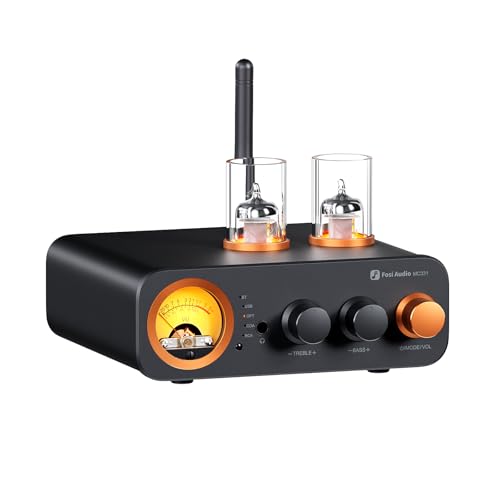
The Fosi MC331 combines tube warmth, a VU meter, and 105W x2 at 4 ohms in a compact desktop amp.
This all-in-one unit packs a DAC, amplifier, preamplifier, and headphone amplifier into one chassis, so it’s a complete system in a small footprint. With a maximum power output of 105W x2 at 4 ohms, it effectively drives bookshelf speakers, and the 3.5mm headphone output means you can switch between speakers and cans. The vacuum tubes are replaceable, letting you customize the sound signature to taste.
Owners say it exceeds expectations, delivering clean sound with no distortion and plenty of power for bookshelf speakers. The build quality is shockingly good for the price, with an all-metal chassis and a minimalist aesthetic that looks great on a desk. The VU meter adds a fun, retro touch, and the included remote lets you adjust bass and treble from your chair.
The remote has terrible latency and needs direct line-of-sight to work, which gets old fast. You must use the remote to power the unit on, so losing it is a problem. Some owners note low volume drops certain frequencies, so it’s best at moderate to higher volumes.
for nearfield: desktop setups and bookshelf speakers where you want tube warmth and visual flair without a full-size amp.
for loud parties: you can’t stand a fiddly remote or plan to listen at very low volumes.
6. MUSYSIC Power Amplifier 2000 Watts
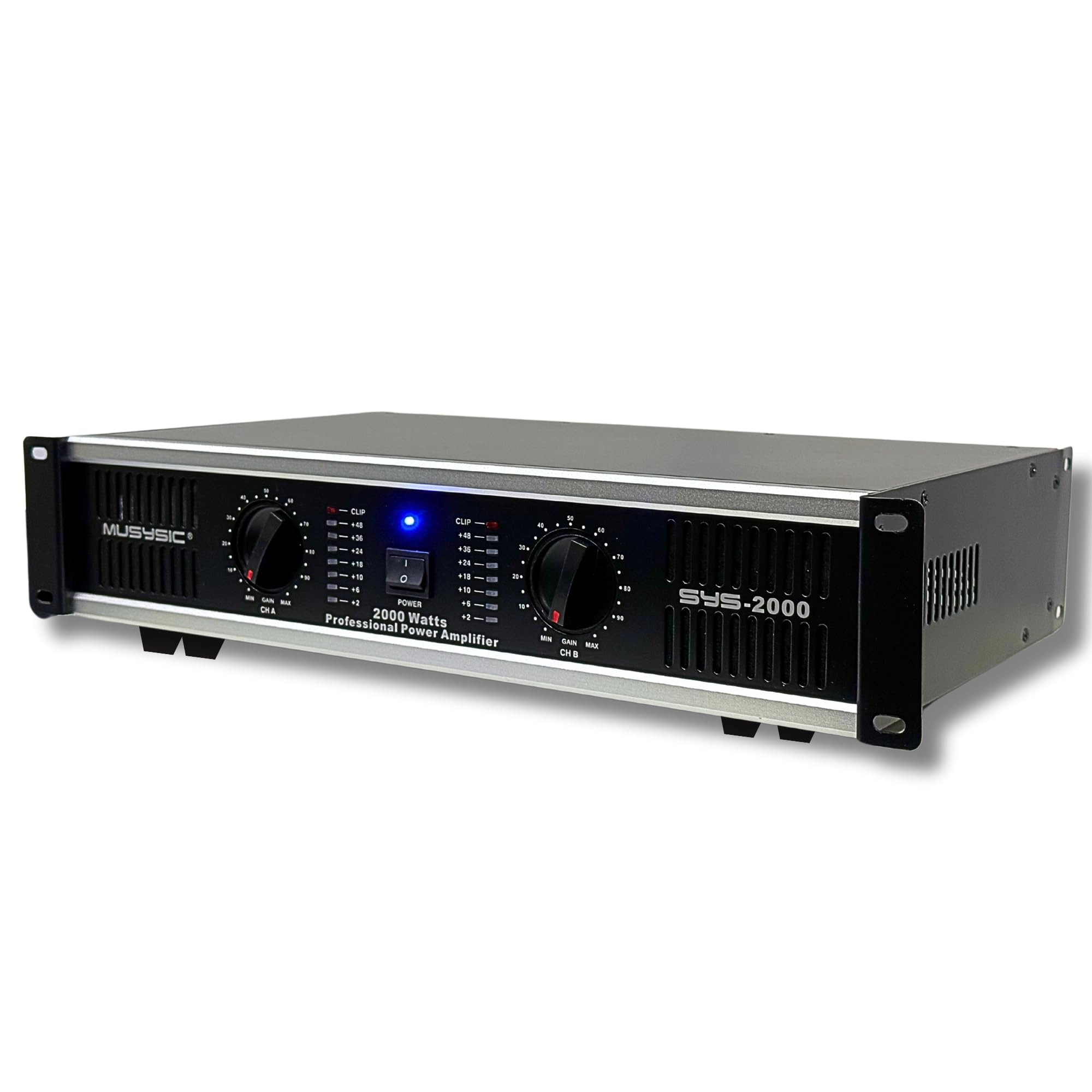
The MUSYSIC SYS-2000 brings concert-level power and clean sound to DJs, live performers, and serious listeners.
This professional 2-channel amplifier delivers 2000W peak power with an extended 10Hz–50kHz frequency response and ultra-low THD under 0.1%, so you get punchy dynamics and clarity at any volume. ATR Technology responds instantly to demanding bass transients, making it ideal for music with heavy low-end. The 0.77V input sensitivity means it transforms weak signals into powerful, high-fidelity sound.
Owners find it performs like a far pricier unit, with one install in a church sanctuary for over 100 seats delivering clear, crisp sound. It pairs well with mixers and handles being pushed with clean output, and the rack-mountable design fits professional setups. The fans are the main point of contention — some praise the low fan noise while others find them too loud for quiet listening rooms.
The 2000W figure is peak, not continuous, so some owners note it doesn’t actually deliver 2,000 watts of sustained power. For critical domestic listening, the fan noise might be a dealbreaker, but for parties, events, or live sound, it’s a solid workhorse.
for PA rigs: musicians, DJs, and anyone needing serious SPL for live events or large rooms.
for home stereo: quiet home listening — the fans are audible and the power claim is peak-rated.
7. Crown XLi800 Two-Channel Power Amplifier

The Crown XLi800 is the quiet, dependable pro amp that halls and auditoriums keep buying for a reason.
This professional power amplifier delivers 300W continuous per channel at 4 ohms, which is plenty for outdoor speakers and home theater systems alike. The forced air cooling keeps it running reliably even under load, and the selectable input voltage plus flexible I/O mean it adapts to different setups. Owners repeatedly call it one of the best in its class, with great sound quality and clear television voices.
The fans are remarkably quiet, which is a rare trait in pro amps — one owner uses it for mixing and notes the fan’s low hum is masked by content and off during recording. The stainless steel build is tough and durable, and it’s been bought repeatedly for halls and auditoriums with excellent results. At 25.1 pounds, it feels substantial and built to last.
There’s no 12V trigger and the power switch is hard, so you’ll want a smart power strip for remote turn-on. It’s also a Class I device, which can cause a ground loop hum in some setups — one owner resolved it with RCA-XLR cables. The side mounts look a bit ugly outside a rack.
pro-grade reliability: the low fan noise and clean headroom make it a favorite for home theater and install work.
bare inputs: pair it with a smart power strip so you can turn it on without the hard switch.
8. WiiM Amp Ultra Stereo Streaming Amplifier

The WiiM Amp Ultra pairs a 100W amp with smart streaming and room correction in a sleek touchscreen package.
This streaming amplifier powers up to four speakers with ultra-low distortion of -106 dB THD+N, making it a strong choice for music lovers and home theater fans. Inside you get an ESS SABRE DAC and dual TI TPA3255 amps with PFFB tech for precise, load-independent sound. The built-in RoomFit room correction auto-calibrates sound based on your room and speakers, so you get a balanced listening experience without manual tuning.
Streaming is easy with Wi-Fi 6 (the latest Wi-Fi standard for faster, more stable connections), Bluetooth 5.3 with LE Audio (a low-energy mode that improves sound quality), and HDMI ARC (a port that lets your TV send audio back to the amp with one cable). You can play from Spotify, TIDAL, Qobuz, Amazon Music, Roon, and Chromecast in up to 24-bit/192kHz quality (high-resolution audio that preserves studio detail). The 3.5-inch glass-covered display shows album art and system settings, and the included voice remote works with Alexa and Google.
Owners are blown away — it drives Emotiva T2 speakers with punchy, clean sound and beats a NAD amp in one comparison. The app works very well, and the brushed-aluminum design looks premium. Note that it’s incompatible with AirPlay and lacks aptX/LDAC Bluetooth codecs, so iPhone users will use Wi-Fi streaming instead.
for smart homes: anyone who wants a single box that streams, corrects room acoustics, and connects to a TV via HDMI ARC.
for separates: you’re an Apple devotee needing AirPlay or a Bluetooth purist wanting aptX HD.
9. Denon AVR-X1700H 7.2 Channel AV Receiver

The Denon AVR-X1700H turns your living room into a 7.2-channel theater with Dolby Atmos and 8K-ready video.
This 7-channel receiver delivers 80W per channel and supports full 3D audio with Dolby Atmos, DTS:X, and DTS Virtual:X. It also adds Dolby Atmos Height Virtualization, which creates virtual height effects even if you don’t have height speakers installed. The advanced 8K HDMI section includes 3 dedicated 8K inputs and 1 output with 8K/60Hz and 4K/120Hz pass-through, plus 8K upscaling on all 6 inputs.
Owners love the theater-like experience, noting how the surround and height speakers create an rich environment. Setup is straightforward with color-coded connections and an on-screen guide, though auto-calibration is poor and manually adjusting all 7 speakers gives better results. Multi-room, multi-source streaming works via Wi-Fi, AirPlay 2, or Bluetooth, so you can watch a movie in one room while someone streams music in another.
The HEOS app is a bit clunky and text-based, and there are no RCA AUX inputs — just digital, analog, and phono. The setup wizard is hard to navigate without a TV connected, and the mic wire is short. You’ll also want a wired Ethernet connection for the most stable streaming.
for movie nights: building a full home theater with surround sound, height channels, and 4K/8K video switching.
for stereo purists: you only need 2-channel stereo and don’t want to manage a more complex setup.
10. YAMAHA A-S801BL Natural Sound Integrated Stereo Amplifier

The Yamaha A-S801 delivers 100W of clean Class AB power with a built-in USB DAC that rivals high-end players.
This integrated stereo amplifier outputs 100W plus 100W into 8 ohms with an extremely low 0.019% THD, so it powers a wide range of speakers with clarity and depth. The USB DAC handles DSD at 2.8 MHz and 5.6 MHz, plus PCM at 384 kHz / 32 bit, making it a superb computer audio hub. Gold-plated digital coax and TOSLINK optical inputs, plus gold-plated analog inputs including phono, give you plenty of connection options.
Owners describe the sound as natural, transparent, and detailed, with defined bass that doesn’t overpower. The USB DAC is a standout — one owner says it eliminates jitter and rivals a k CD player when fed from a computer. The variable loudness control is useful for low-volume listening, and the custom power transformer with 12,000 µF block capacitors delivers clean, stable power.
There’s no sub out, so you’ll need a Y-splitter if you want to add a subwoofer, and the phono stage is a bit weak — one owner found it harsh and prefers an external preamp. The volume control is stepped, which some find clunky, and the knobs feel like plastic despite the premium price.
transparent detail: the Pure Direct mode bypasses extra circuitry for the most transparent sound path.
heavy footprint: it’s a 2-channel purist’s amp — no sub out and a weak phono stage mean planning your system around those limits.
11. Cambridge Audio CXA81 MkII Integrated Stereo Amplifier

The Cambridge CXA81 MkII delivers 80W of detailed Class AB power with reference-level DAC and balanced XLR inputs.
This integrated amplifier outputs 80 watts per channel, enough to drive demanding speakers, and uses the ESS ES9018K2M SABRE32 DAC for reference-level digital conversion. The Class AB amplification and toroidal transformer deliver balanced, efficient performance with incredible sound-staging. Digital inputs include TOSLINK, coaxial, and USB audio, plus balanced XLR inputs for premium connections to gear like the CXN100.
Bluetooth aptX HD lets you connect wirelessly to devices, and it’s Roon Tested for PC or Mac USB streaming. Owners rave about the detail and soundstage — one listener says piano imaging is lifelike, calling it a massive upgrade from their 1980s NAD amp. It drives Monitor Audio Silver 500 and KEF LS50 Metas with ease, and one owner finds it richer and more present than an Audiolab 6000A.
The Bluetooth chip is only 4.2, not the newer 5.3, which causes weak connections in 2.4GHz traffic and frequent drops with M2 Mac Mini. The large remote lacks CD player control, and the design is basic and old-fashioned — one owner calls it bulky and grandpa-like. But for pure audio performance, it’s hard to fault.
for serious hifi: if you want reference detail, deep soundstage, and premium connections like XLR, this is the one.
for budget builds: you rely heavily on Bluetooth streaming or want a sleek, modern aesthetic.
Understanding the Specs
Power Output (Watts)
This tells you how loud and clean an amp can drive your speakers. Look for wattage at both 4 ohms and 8 ohms, because your speakers’ impedance changes with volume. A 45W amp can be plenty for efficient 87dB speakers, while power-hungry speakers might need 100W or more.
Class D vs Class AB
Class D amps (a type that switches power on and off rapidly) are small, run cool, and are very efficient — great for compact setups and desktop use. Class AB amps (a traditional design that blends two output stages) are heavier and run warmer but often deliver a smoother, more natural sound that purists prefer. Both can sound excellent; it depends on your priorities.
FAQ
How many watts do I need to drive my speakers?
What is impedance and why does it matter?
Do I need a receiver or just an amplifier?
Can I use a Class D amp for a home theater?
What is a phono input and do I need one?
What does a DAC do in an amplifier?
Is it better to get a stereo amp or a multi-channel receiver?
Can I connect a subwoofer to a stereo amplifier?
What is the difference between peak and continuous power?
How long should a good amplifier last?
Final Thoughts: The Verdict
The crowd favorite for most buyers is the Denon PMA-600NE — it holds the highest rating in this lineup at 4.7 stars from 500+ owners, and its warm, tube-like sound with flexible inputs makes it the safest all-around pick. If you want streaming plus room correction in one sleek box, grab the WiiM Amp Ultra. And for a full home theater with Dolby Atmos (a surround sound format that adds height channels), the Denon AVR-X1700H is the one to reach for.
How We Picked
We do not accept paid placement. Every pick is matched to a real buyer and a real use-case; we do not hands-on test units.
Sources & Methodology
Specifications: manufacturer listings and product documentation. Review insights: verified customer reviews, as of August 2026. Pricing: not shown on this page (it changes often); check the current price via the retailer link.
As an Amazon Associate, Gadgets Feed earns from qualifying purchases. This does not affect which products we feature.