
Our readers keep the lights on and my morning glass full of iced black tea. As an Amazon Associate, I earn from qualifying purchases.
Specs are compiled from manufacturer listings and verified buyer reviews and can change over time — please confirm the key details on the product page before buying.
Dropped calls, frozen maps, and buffering video are the real cost of a weak cell signal — and you do not need to live with them. A phone amplifier grabs the faint signal outside your home, truck, or RV and rebroadcasts it inside as strong, usable bars. If you see even one bar outside, the right booster can turn that into solid indoor coverage.
I’m Min — the founder and writer behind Gadgets Feed. This guide is built by comparing the manufacturers’ published specifications and the patterns across verified customer reviews, so you get each pick’s real strengths and trade-offs instead of marketing spin.
The amplifier mobile phone category splits into two very different jobs: whole-home powerhouses that cover large indoor spaces, and travel-ready rigs built for trucks and RVs. The table below maps out which booster fits your situation, from a 70dB home unit to a 50dB truck model.
Our Picks at a Glance

How To Choose The Best Amplifier Mobile Phone
Before you buy any amplifier, you need to understand one hard truth: a booster cannot invent a signal. If you have zero bars outside your home or vehicle, no amplifier on the market will help you. If you have even one bar outdoors, a booster can turn that into a solid three or four bars inside. Because of this, your first step is always checking your outdoor signal strength with your phone’s field test mode.
Match the coverage to your actual space
Manufacturers list coverage in square feet, but that number assumes a strong outdoor signal. A booster rated for 8,000 square feet will only cover a fraction of that if your outdoor signal is a single bar. Think about your real situation: a small apartment, a sprawling ranch house with metal siding, or a truck cab each demand a different amplifier design. For homes, you want an indoor antenna that radiates outward; for vehicles, you need a compact cradle or dome that covers the cabin.
Gain, frequency bands, and carrier support
Gain, measured in decibels (dB), tells you how much the amplifier boosts the outside signal — think of it as the volume knob for your cell reception. Higher gain, like 70dB or 72dB, generally means a stronger rebroadcast, but it also requires careful antenna separation to avoid feedback. You also need to check that the booster supports the frequency bands your carrier uses in your area — most modern units cover bands 12, 13, 5, 4, and 2/25, which spans Verizon, AT&T, and T-Mobile. And always look for FCC certification, which confirms the device is legally approved for use in the U.S. and will not interfere with carrier networks.
Quick Comparison
| Model | Best For | Max Gain | Coverage Area | Indoor Antennas | Amazon |
|---|---|---|---|---|---|
| HiBoost Home Office★ Best Overall | Large homes & offices | 70dB | 8000 Sq Ft | 2 | Amazon |
| JACOOL Verizon/AT&TBudget Champion | Budget home coverage | — | 3000–5000 Sq Ft | Yes | Amazon |
| ZORIDA Ace 5S | Small homes & rooms | 72dB | 2000 Sq Ft | 1 | Amazon |
| Metarepeater MT1 | Trucks & RVs | — | 5–8 miles | LCD Display | Amazon |
| SureCall Flare | Easy-install small homes | 72dB | 2500 Sq Ft | 1 (built-in) | Amazon |
| weBoost Drive 4G-X OTR | Semi-trucks & heavy rigs | — | In-vehicle | Slim antenna | Amazon |
| weBoost Drive Reach OTR | Trucks & SUVs (max reach) | 50dB | In-vehicle | Slim antenna | Amazon |
In‑Depth Reviews
1. HiBoost Cell Phone Signal Booster
Our pick — 4.5★ from 650+ verified ratings; the strongest balance of quality and price.
With 70dB gain and 8000 square feet of reach, this is the one to beat for whole-home coverage.
The HiBoost is the amplifier you choose when a single dead room is not the problem — the entire house is. It covers up to 8,000 square feet, which spans 5-6 rooms, and its 70dB gain (the boost power for your outside signal) lifts a 1-bar signal to a dependable 3-4 bars, so calls stay clear and video streams without stalling. It handles multiple phones, tablets, and devices at once, which makes it a natural fit for a family or a small team working from home.
Installation surprises people in the best way. Buyers report the setup is straightforward, and the included dual indoor antennas — one built into the main unit, one separate — spread coverage evenly instead of concentrating it in one room. Owners consistently report going from zero or one bar to full-house coverage with no dropped calls, aided by the HiBoost app and built-in LCD for real-time signal monitoring.
The trade-off is the bulky cabinet and cable management. Some owners note the indoor cable could be longer, and one reported needing to disable the AWS2100 band after support realigned his antenna to jump a basement signal from 1-2 to 4-5 bars — a reminder that the included U.S.-based support team does the heavy lifting if you get stuck.
What Wins People Over
- Effectiveness is the standout — 221 owners single out how well it actually boosts signal
- Signal quality earns 145 mentions, with reports of zero dropped calls
- Easy setup praised by 137 buyers, aided by the phone app and LCD
What to Plan For
- Indoor cable length leaves some wanting more reach
- Far-end rooms may still run weak on the largest properties
Grab it for: whole-home or office coverage where multiple people need reliable 5G/4G LTE at once.
Think twice if: you are in a small apartment where a 2000 sq ft unit would be overkill and easier to place.
2. JACOOL Cell Phone Signal Booster
A 3000–5000 square foot claim and a low price make this the least risky way to test if a booster helps your home.
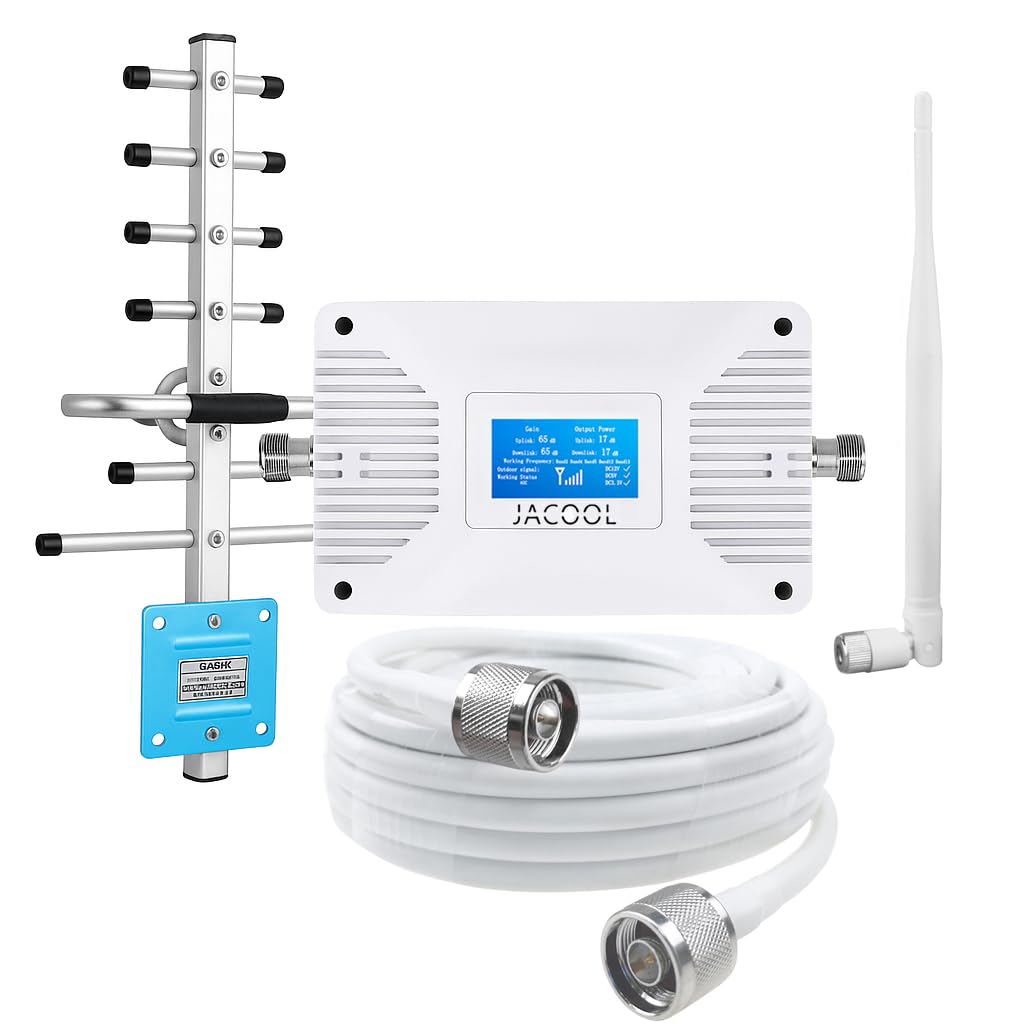
If your signal drops the moment you step inside, this is the budget pick that gets the basics right without the premium cost of the HiBoost. It targets Verizon and AT&T on 4G LTE and 5G band 12/13/17, using a high-gain outdoor Yagi antenna (a directional antenna that pulls from a specific tower) to take a weak 1–2 bar outdoor signal and turn it into stronger indoor coverage for calls, texts, and streaming. At its price, it is the most accessible way to test whether an amplifier solves your home’s connectivity problem.
Coverage is rated for 3000–5000 square feet, which suits a home office, basement, garage, or a metal-roof house where signals struggle. The AGC (Automatic Gain Control) adjusts the boost to prevent interference and oscillation, which keeps performance stable and extends the device’s lifespan. Owners mention it works even in a completely metal-clad building with a metal roof — a harsh test most boosters fail — and that installation takes under 30 minutes with the included accessories.
Keep expectations in check on the boost amount. The honest feedback is “boost a little bit like one bar signal,” so this is a stabilizer rather than a miracle worker. Reliability also gets mixed feedback, with some units stopping work within days; the 2-year warranty is your safety net there.
Best for: the budget buyer with a mild indoor signal dip who wants a quick, inexpensive fix.
The catch: boost is modest, and a few owners hit reliability issues that the 2-year warranty covers.
3. ZORIDA Cell Phone Signal Booster

This unit’s 72dB gain is the highest on the list, but it concentrates that power into a focused 2000 square feet.
Where the HiBoost casts a wider net, the ZORIDA concentrates its power into a tighter space. It supports all major U.S. carriers (Verizon, AT&T, T-Mobile, US Cellular) and works on bands 12/17, 13, 5, 4, and 2/25 for 3G, 4G LTE, and 5G. This makes it ideal for small homes, studios, or a single room where you need a serious punch rather than sprawling reach.
Setup leans on the ZORIDA app, which offers 1-on-1 technical support, step-by-step videos, and before-and-after signal data. The compact indoor whip antenna mounts on a wall or sits on a table, and the 49.2ft cables give you flexibility to run the outdoor directional antenna to your best signal spot. Customers note dramatic jumps — a common story is 1–2 bars outside turning into 4–5 bars inside with HD streaming that finally works. Signal quality is the top praise at 298 mentions, and the build quality follows close behind at 283.
The trade-off is the ambitious installation. Installation demands roof mounting, drilling, and antenna aiming that can take hours and two people, plus careful separation of outdoor and indoor antennas. Coverage is also rated lower than its gain suggests, so it is meant for focused spaces, not sprawling layouts.
Where It Shines
- Signal quality is the most-praised aspect — 298 reviewers point out real improvement
- Quality construction earns 283 mentions from buyers
- Easy setup praised by 177, with app support guiding the way
Where It Asks More
- Coverage gets mixed reviews — some find 2000 sq ft optimistic
- Instructions draw mixed feedback; antenna aiming takes trial-and-error
Reach for this if: you want max gain for a single room or small home and enjoy a hands-on install.
Look elsewhere if: you need whole-house reach without climbing a ladder to mount an antenna.
4. Metarepeater Cell Phone Booster for RV Truck
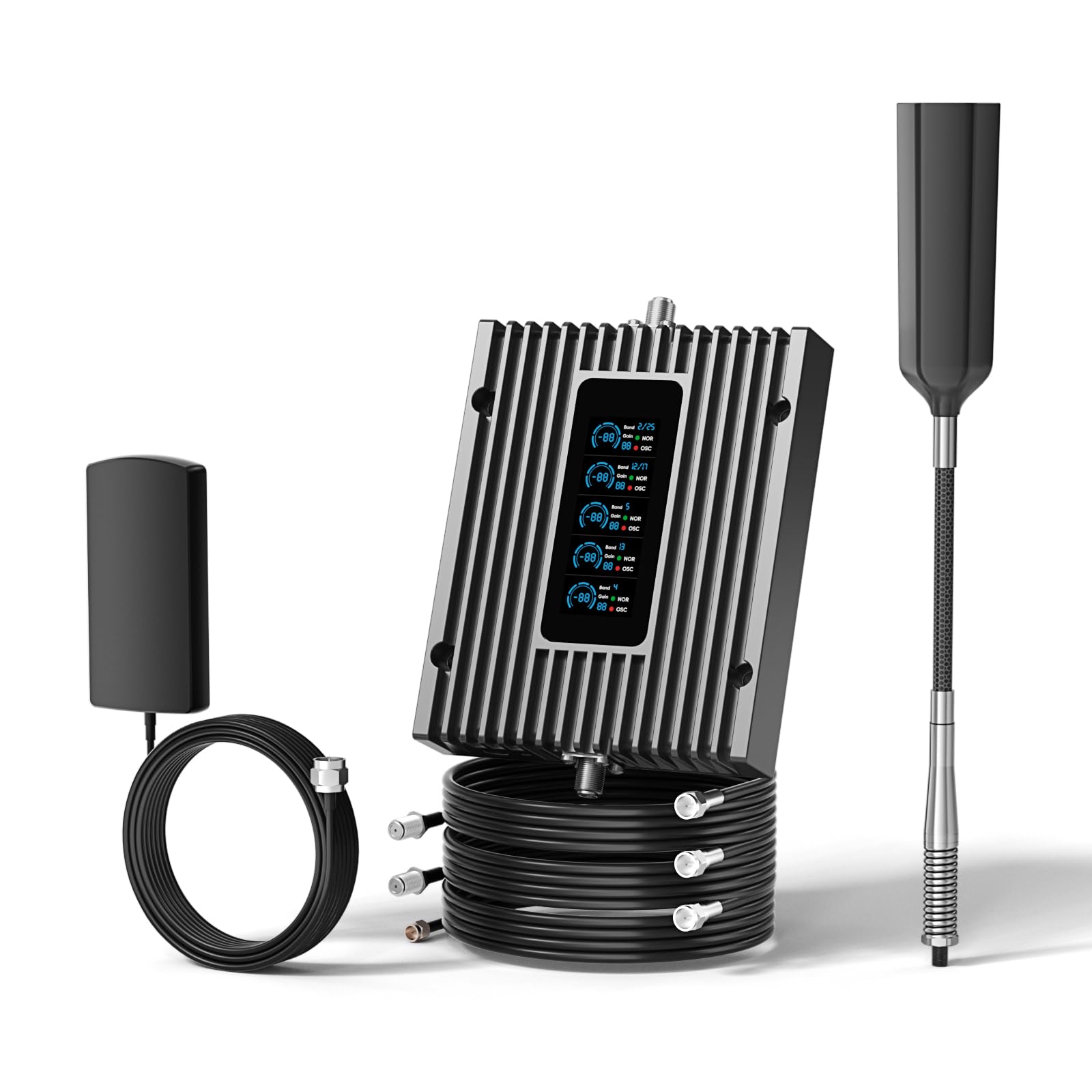
This is the only amplifier here with a live LCD readout, so you can see which band is pulling in signal instead of guessing.
This is built for life on the move — trucks, RVs, and long-haul routes where cell coverage comes and goes with every mile. Its defining feature is a large color LCD display that shows the booster’s working status and the gain on all five frequency bands in real time. The omnidirectional antenna (one that captures signal from every direction) matters when your vehicle is rolling past towers at highway speed, unlike the fixed directional antennas on home units.
On the road, owners say it transforms weak, unreliable service into usable coverage. Long-haul truckers report keeping navigation, calls, and connection in areas where they used to lose service completely; others describe a “big difference” outside the city, noting it strengthens an existing weak signal rather than creating one from nothing. The spring-mounted, weatherproof outdoor antenna shrugs off dust, oil, and rough-road vibration, and the whole kit is FCC certified (ID 2BR4W-TY70M5) with a 3-year warranty.
Range claims run to 5–8 miles and 100x signal enhancement, but the honest reality from owners is clear: this booster needs a weak signal to grab hold of. It will not rescue you in a true dead zone, and one buyer dismissed it outright as not worth the cost. Treat it as the tool that squeezes usable bars out of a faint signal, not a signal generator.
Ideal for: truckers and RVers who want a visible readout and a rugged antenna for rough roads.
Not for: anyone expecting coverage in areas with zero outdoor signal — no amplifier can fix that.
5. SureCall Flare Cell Signal Booster

A 72dB gain with a built-in indoor antenna means no drilling holes and no second cable run.
Most home boosters force you to run cables and drill holes for an indoor antenna — the SureCall Flare sidesteps that entirely. The indoor antenna is built directly into the amplifier unit, which looks like a stylish speaker and sits anywhere in the room. With 72dB max gain and coverage up to 2500 square feet (depending on your outside signal), it is positioned as one of the easiest 4G/5G boosters to install, with all components — including 50ft of RG-6 cable — in the box for a quick DIY setup.
Installation is genuinely the highlight, taking about 30 minutes per owners. It is a popular choice for cabins and rural homesteads: one owner in an 860 sq ft cabin saw LTE jump from 0 to 3–4 bars with proper antenna separation, and another at a remote camp could finally make calls and texts from a previously signal-less location. The flip side is that functionality draws genuinely mixed feedback — some find it boosts reception by 2+ bars, while others report it does not help at all, especially when the incoming signal is extremely weak.
The real limitation is range consistency. Owners note the strongest boost happens within 18 inches to 15 feet of the base unit, and the square-footage claim depends heavily on having 1–2 bars outside. One owner saw download speeds actually worsen on a hotspot after install. This is a “best-case-scenario” coverage tool that shines in small, open spaces rather than multi-room layouts.
Perfect if: you want the simplest possible install for a small home or cabin and have at least a bar or two outside.
Skip if: you need reliable signal across multiple rooms or your outdoor signal is near zero.
6. weBoost Drive 4G-X OTR (470210)

Built for semi-trucks, this unit’s multi-user design keeps the whole cab connected on the road.
This weBoost unit is designed to keep every passenger connected on the road, not just the driver. It boosts signal across all U.S. networks — Verizon, AT&T, Sprint, T-Mobile, US Cellular and more — with a weather-resistant 17″ omnidirectional antenna, a 3-way CB antenna mount, and a mast extension included. Its reputation is earned in the harshest conditions: owners describe getting 4–5 bars in poor-service Missouri and pulling usable signal in remote areas like Teton Canyon where the phone otherwise shows nothing.
The real-world stories are striking. One owner reports the OTR version boosted signal by 20dB, enabling GasBuddy in a no-signal stretch of Wyoming and streaming Netflix through a hotspot. Another measured a 10x speed improvement on a weak signal, going from 12MB to 30MB down after install. This makes it a stronger performer in remote areas than the Metarepeater, which needs a visible signal to grab. The multi-user design means the whole cab benefits, and the added battery efficiency grants up to 2 hours of extra talk time by drawing less power.
This is not a set-and-forget device. Owners stress that the internal antenna must be close to your phone — within 2 feet — and orientation matters; laying the phone directly on it works best. Setup takes about 45 minutes, and you may need an adapter for newer trucks. Signal boost gets mixed feedback in the data, so results depend heavily on your antenna placement and existing signal.
Built for the Road
- Installation praised by 29 owners as simple with basic tools
- Service quality earns 29 positive mentions, with no reported interruptions
- Portability highlighted by 11 — easy to move between vehicles
Demands Attention
- Signal boost is mixed — the phone often must touch the internal antenna
- Value for money gets mixed reviews given the premium price
Choose it if: you haul long distances and need reliable calls, data, and hotspot in remote states.
Pass it by if: you want a zero-fuss install — this one rewards careful antenna placement.
7. weBoost Drive Reach OTR (477154)
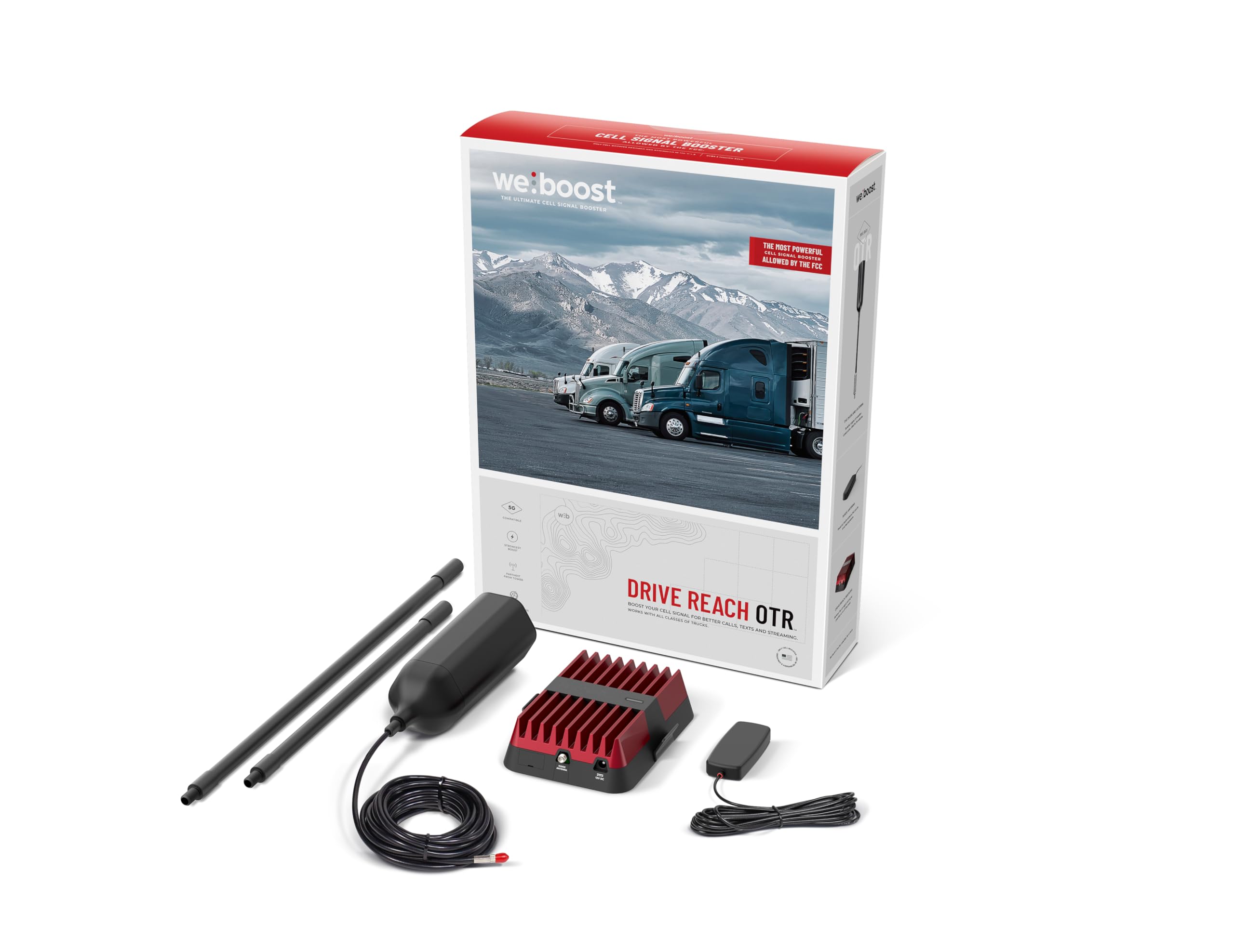
Despite a modest-looking 50dB gain, this unit reaches farther towers than the Drive 4G-X because of its tune antenna design.
This is the top-tier weBoost model, designed to reach the farthest cell towers and boost signal for multiple devices in both trucks and SUVs. It supports all U.S. carriers including Verizon, AT&T, T-Mobile, and US Cellular, and its 50dB max gain works with the latest 5G technology for the best possible speed on modern smartphones. It is also made in the U.S. and FCC approved (ID PWO460061), backed by a two-year warranty and U.S.-based customer support.
Real-world use shows why it commands a premium over the Drive 4G-X. An oil-field worker reports he “haven’t dropped a call since I installed the phone booster” — working great in his big truck. Another ran Dallas to Sedona and Big Bend with no signal or VPN drops along I-40 in New Mexico. The kit is thorough: the Drive Reach booster, an RV antenna, mounting bracket, power supply, slim low-profile antenna, coax cable, side-exit adapter, mast extensions (13-inch and 18-inch), antenna spring, thread lock packets, and a cable adapter.
Owners caution that the internal antenna must be within 18-36 inches of your device, with the external antenna 5-8 feet away, and toggling airplane mode can reset a stuck connection. Durability gets negative feedback from a few, with one claiming the antenna assembly lacks sturdiness and missing mounting parts. It is a precision tool that requires proper setup to deliver its impressive reach.
Worth it for: remote workers and serious overlanders who need absolute reliability where signals are distant.
Hold off if: you want a set-and-forget option — this requires careful placement and occasional troubleshooting.
Understanding the Specs
Gain (dB) — The Volume Knob
Gain, measured in decibels (dB), is the amplifier’s volume control for your outside signal. A 70dB unit like the HiBoost or SureCall Flare can lift a whisper-quiet 1-bar signal into a loud, clear 3-4 bars indoors. Higher gain means a stronger rebroadcast, but it also demands careful separation between the outdoor and indoor antennas — if they are too close, the system can oscillate and actually reduce performance.
Coverage Area vs. Real-World Signal
The square-footage rating on a booster assumes you have a strong outdoor signal to amplify. A unit rated for 8000 square feet will only cover a small room if your outside signal is a single bar. Think of the rated area as a ceiling, not a guarantee. The ZORIDA covers 2000 sq ft, the SureCall Flare reaches 2500 sq ft, and the JACOOL claims 3000-5000 sq ft — but your actual coverage depends on what your antenna can pull in from outside.
FAQ
Will an amplifier work if I have zero bars outside my home?
Is a 72dB booster always better than a 50dB one?
Do these boosters work with 5G phones and networks?
Why do some installs take 30 minutes and others take hours?
How important is the FCC approval on a signal booster?
Can I use a home booster in my truck or RV instead?
Why does my phone still show low bars right next to the indoor antenna?
What is Automatic Gain Control and why does it matter?
How do I know which frequency bands my carrier uses?
What warranty and support come with these boosters?
Final Thoughts: The Verdict
The amplifier mobile phone winner for most households is the HiBoost Home Office — its 70dB gain and 8000 sq ft reach make it the most complete whole-home solution, and the effectiveness feedback from owners backs that up strongly. If you want max punch for a single room, the ZORIDA Ace 5S delivers 72dB and app-guided setup. And for life on the road, the weBoost Drive Reach OTR is the one to reach for when you need to stay connected in the most remote stretches.
How We Picked
We do not accept paid placement. Every pick is matched to a real buyer and a real use-case; we do not hands-on test units.
Sources & Methodology
Specifications: manufacturer listings and product documentation. Review insights: verified customer reviews, as of August 2026. Pricing: not shown on this page (it changes often); check the current price via the retailer link.
As an Amazon Associate, Gadgets Feed earns from qualifying purchases. This does not affect which products we feature.