
Our readers keep the lights on and my morning glass full of iced black tea. As an Amazon Associate, I earn from qualifying purchases.
Specs are compiled from manufacturer listings and verified buyer reviews and can change over time — please confirm the key details on the product page before buying.
You can get cleaner sound without adding a separate processor by choosing an amplifier with a built-in crossover. A built-in crossover splits the audio signal so tweeters handle highs, midrange drivers handle mids, and the subwoofer handles only deep bass. Here are eleven amps that handle this job in different ways, from compact car amps to professional rack units, so you can match one to your actual system.
I’m Min — the founder and writer behind Gadgets Feed. This guide is built by comparing the manufacturers’ published specifications and the patterns across verified customer reviews, so you get each pick’s real strengths and trade-offs instead of marketing spin.
Whether you’re upgrading a car stereo or building a home 2.1 setup, the amplifier with crossover you choose determines how well your speakers and subwoofer blend together into one cohesive soundstage.
Our Picks at a Glance


How To Choose The Best Amplifier With Crossover
Before you look at wattage numbers, figure out what speakers you need to power. A 4-channel amp gives you flexibility for front and rear speakers, while a monoblock is strictly for a subwoofer. A 5-channel amp does both from one chassis. Your choice of channels dictates which of these amps suits your build.
Understand Channel Count and Your System
Count your speakers first. If you have four door speakers and a subwoofer, a 5-channel amp like the Rockville dB55 powers everything from one unit, saving space and wiring complexity. If you only need to drive a sub, a 1-channel monoblock like the Stinger MT15001 is the focused, compact choice. A 2-channel amp, like the Crown XLS series, is ideal for stereo pairs or bridging into a single powerful subwoofer channel.
Match the Crossover Type to Your Speakers
Every amp here has a High-Pass Filter (HPF, which blocks deep bass from your main speakers) and a Low-Pass Filter (LPF, which keeps high frequencies out of your subwoofer). Some, like the Kicker 46CXA3604, give you a variable 12dB crossover so you can dial in the exact frequency where your speakers hand off to the sub. Others, like the Soundfy SA 400.4, offer fixed LPF and HPF switches that are simpler but less precise. Think about if you want fine-tuned control or set-and-forget simplicity.
Consider the Power Delivery and Efficiency
Class D amplifiers run cooler and draw less current from your vehicle’s electrical system than traditional Class A/B amps. This matters if you’re installing in a car with a factory alternator. The Crown XLS1002, for example, weighs less than 11 lb and uses efficient switching power, making it a strong choice for home or mobile PA use. Match the amp’s RMS wattage to your speakers’ RMS rating — you want headroom, not a mismatch that forces you to crank the gain and risk distortion.
Quick Comparison
| Model | Best For | Channels | Max Power | Amplifier Class | Amazon |
|---|---|---|---|---|---|
| Kicker 46CXA3604★ Best Overall | Balanced 4-channel car audio | 4 | 360 watts | Class A/B | Amazon |
| Soundfy SA 400.4Best Value | Tight spaces, budget builds | 4 | 400 watts | Class D | Amazon |
| S.M.S.L A50 PROHome 2.1 Pick | Home 2.1 desktop systems | 2 | 100 watts | Class D | Amazon |
| Pyle PLA4278 | High-power budget car builds | 4 | 2000 watts | MOSFET | Amazon |
| Taramps TS 1200 | OEM radio integration | 4 | 1200 watts | Class D | Amazon |
| Taramps HD 3000 | Subwoofer-heavy builds | 1 | 3000 watts | Class D | Amazon |
| Stinger MT15001 | Compact subwoofer power | 1 | 1500 watts | Class D | Amazon |
| AudioControl EPICFOUR | High-end 4-channel clarity | 4 | 800 watts | Class D | Amazon |
| Rockville dB55 | Full system, single amp | 5 | 4000 watts | MOSFET | Amazon |
| Crown XLS1002 | Live sound and home theater | 2 | 350 watts | Class D | Amazon |
| Crown XLS2502 | High-power professional setups | 2 | 775 watts | Class D | Amazon |
In‑Depth Reviews
1. Kicker 46CXA3604
Our pick — over 4.5★ from 350+ verified ratings; the strongest balance of quality and price.
The 4-channel workhorse that marries a variable crossover with trusted Kicker reliability.
This amp gives you the tuning control that serious listeners want. Its variable 12dB crossover lets you set the exact frequency handoff between your main speakers and sub, while the KickEQ 6dB variable bass boost adds punch when you need it. The 24dB subsonic filter on mono amps is a bonus that protects your sub from damaging ultra-low frequencies you can’t even hear. With 360 watts of maximum output, it delivers the clean, crisp sound that owners consistently praise for staying clear even over wind and road noise.
It accepts 9–40V speaker-level inputs for broad head-unit compatibility. It runs on as little as nine volts from your battery and can handle up to 40 volts of speaker-level input signal, which means it plays nicely with a wide range of factory or aftermarket head units. At 16 x 9 x 4 inches, it’s a larger footprint than the compact Soundfy SA 400.4 below, so plan your mounting spot accordingly, but it includes both vertical and horizontal mounting hardware to fit your install style. The crowd favorite here has earned a solid 4.7-star rating from over 350 verified buyers, making it the most trusted pick in this lineup.
The “when reliability counts” sentiment you see in the reviews isn’t just marketing.
What Wins People Over
- Variable 12dB crossover for precise tuning
- KickEQ 6dB bass boost for extra punch
- Rugged, proven Kicker build quality
- Works with speaker-level inputs up to 40 volts
The Trade-offs
- Larger footprint than compact Class D rivals
- Class A/B runs warmer than efficient Class D
- Occasional reliability complaints after months of use
Reach for this if: you want a proven, powerful 4-channel amp with genuine crossover adjustability and the confidence of a well-known brand.
Look elsewhere if: you need the absolute smallest footprint or plan to mount it in a tight space where the 16-inch length won’t fit.
2. Soundfy SA 400.4
A deck-of-cards sized amp that sneaks 400 watts into spaces others can’t reach.
Its 2.2 x 4.37 x 5.67-inch chassis fits under seats and in tight trunk corners. At just 2.2 x 4.37 x 5.67 inches, this compact Class D amp is roughly the size of two stacked decks of cards. That makes it a 7.3x smaller footprint than the Kicker 46CXA3604 above, meaning it slides under seats or into tight trunk corners where traditional amps simply won’t go. Owners mention fitting it inside a 1997 Del Sol console with room to spare, and it runs cool enough that you don’t need a bulky heatsink.
The built-in LPF and HPF crossover is exactly what you need for a clean install without a separate crossover unit. It’s 2-ohm stable on all four channels, so you can run front and rear speakers while still having headroom for a subwoofer setup. With 400 watts of output power, it’s a 4.0x power gap compared to the S.M.S.L A50 PRO’s 100 watts, making it the stronger choice for car audio. One owner sums up the value: “I’m shocked at how much better my Orion speakers sound now!”
The honest trade-off is in the details. Some users report a slight initial pop because it lacks a soft-start circuit, and the sound quality gets mixed feedback — loud and clear for some, less impressive for others. The wiring diagram has confused a few installers, and one owner noted that an 8-gauge wire can strip the set screw, recommending 10-gauge instead. It runs hot after extended use, though no overheating failures were reported.
Compact winner: the size is the standout feature, earning the most praise from owners who needed to fit power into a tiny space.
Fit note: sound quality is genuinely mixed — some find it loud and clear, others call the audio performance terrible, so audition it with your speakers if you can.
Best for: budget-minded car audio builders who prioritize a tiny footprint and clean installation over audiophile-grade sound.
Think twice if: you demand reference-level audio quality or want a soft start-up without any initial pop.
3. S.M.S.L A50 PRO
The desktop 2.1 system builder with ten crossover points and HDMI ARC for TV audio.
It pairs bookshelf speakers with a passive subwoofer to form a complete 2.1 home system. Its standout feature is the ten adjustable crossover frequency points for both High-pass and Low-pass filters, so you can fine-tune exactly where your main speakers hand off to the sub. The subwoofer volume is independently adjustable from S00 to S99, which means you can balance a mismatched speaker and sub combo without changing your main volume. With 100 watts of passive bass output power, it comfortably drives a range of home speakers.
Connectivity is where this little box shines. It has HDMI (ARC) that works from the start with most TVs — customers note it pairing instantly with a Hisense TV set to ARC/PCM — plus USB-C for driver-free computer use, optical, AUX, and Bluetooth 5.0. Multiple EQ presets and a customizable bass and treble range of ±9 levels let you shape the sound across music styles. It’s a compact Class D amp that fits neatly on a desktop or media console.
The caveat is the subwoofer output. Some reviewers point out significant subwoofer output issues, and the sub input is speaker-level only — there’s no RCA sub out, so you can only use passive subwoofers with this amp, not powered ones. While the overall quality is praised, especially for tweeters and mid-range, the power output is a mixed bag. One long-term owner reported freezes requiring an unplug-reset cycle, though this appears to be a minority experience.
Feature-rich: HDMI ARC, Bluetooth, USB, optical, and AUX inputs make this the most versatile home amp in the lineup.
Know the limit: passive subs only — if you own a powered subwoofer, this amp won’t drive it, and sub output levels have drawn mixed feedback.
Ideal for: home users building a TV or desktop 2.1 system with passive speakers and a passive sub.
skip it if: you need to drive a powered subwoofer or want a more powerful 100+ watt output.
4. Pyle PLA4278

A bridgeable MOSFET beast that brings up to 2000 watts to budget car builds.
It offers 2000 watts of bridgeable output at a budget price. Its 2000-watt bridgeable output can be configured to drive everything from a pair of powerful subs to a full set of speakers. The configurable electronic crossover network lets you set the frequency split, while the switchable bass boost and variable gain control give you the tuning basics. The subsonic filter cuts low-end interference so your speakers deliver cleaner audio without wasting energy on frequencies they can’t reproduce.
Build quality is a step up from typical budget amps. The silver-plated RCA ports reduce signal loss, and the MOSFET pulse width modulation power supply provides a clean, distortion-free signal. Thermal, overload, and short-circuit protection keep both the amp and your car’s electrical system safe, which is a critical feature at this power level. The slim size — 14.58 x 10.24 x 2.21 inches — makes installation easier than you’d expect for a 2000-watt unit.
The honest downside is reliability. Durability gets negative feedback from some owners, with multiple reports of fuses popping. Value for money is also mixed — some find it excellent for the price, others say it’s not worth the cost. That said, one owner reports it “improved the sound of my Bass massively” running two 6x9s and a sub, and another runs four 6.5 Pyle subs with four 3-way speakers and four dome tweeters in a Chevy Crew Cab with great results.
Bass machine: owners aiming for maximum bass output at a budget price will find this amp delivers the boom.
Durability check: fuse-popping issues appear in multiple reviews, so ensure your wiring and ground are solid before installation.
Suits: budget builders who want maximum wattage and a configurable crossover without spending premium money.
Not for: those who prioritize long-term reliability above raw power output.
5. Taramps TS 1200

Factory radio ready, this 1200W RMS 4-channel amp adds power without extra adapters.
The headline feature here is how easily it connects to your stock stereo. High-level speaker inputs with automatic turn-on connect directly to OEM head units without needing a separate line output converter or adapter. That’s a genuine convenience for anyone upgrading a factory system. It delivers 1200W RMS — 4 x 300W RMS at 2 Ohms or 2 x 600W bridged at 4 Ohms — giving you serious power for demanding audio systems.
Tuning flexibility comes from the HPF, LPF, and Full modes on both RCA and High-Level inputs. Whether you’re running speakers, subwoofers, tweeters, or components in cars, trucks, or SUVs, the fixed crossover modes let you set the right configuration. The heavy-duty design includes reinforced terminals and bridgeable channels, packaged in a compact Class D unit that weighs just 1340 grams. It’s backed by a 1-year warranty.
Build quality is the most-praised aspect, with over 60 owners singling it out. Multiple buyers have run three of these in a Jeep for two years without a single problem, and installers report it’s a reliable, clean amplifier. However, sound quality is a genuine mixed bag — some report perfect sound while others hear static and engine whine. Durability is a concern for a few, with rare reports of units failing within a month. One buyer warns to inspect for used or refurbished units and test within the return window.
OEM simplicity: the auto-turn-on high-level inputs make this the easiest upgrade path from a factory stereo.
Mixed audio: while build quality shines, expect variable sound quality with some owners reporting noise issues.
Grab this if: you’re upgrading a factory stereo and want a powerful, compact amp that connects without adapters.
Be cautious if: you’re sensitive to potential engine whine or static — it’s a recurring theme in some reviews.
6. Taramps HD 3000
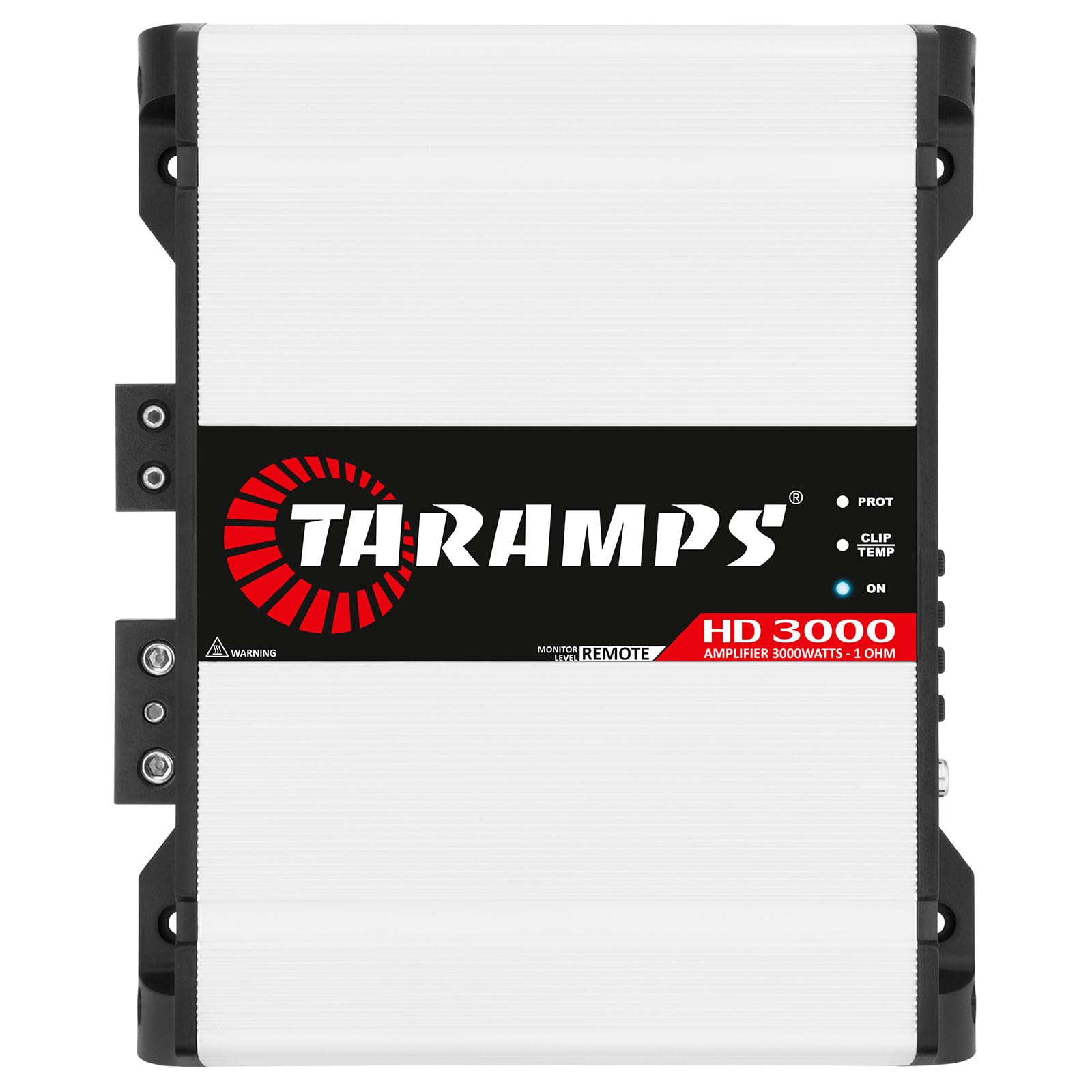
A 3000-watt monoblock with a 10Hz-20KHz response for serious bass systems.
It delivers 3000 watts RMS to a single subwoofer channel. The HD 3000 delivers 3000 watts RMS as a monoblock, and it’s a true full-range digital amplifier that operates at 1, 2, or 4 Ohms. That flexibility means you can wire it to subwoofers, mid-bass drivers, 6x9s, or tweeters, though its natural home is pounding a subwoofer. The frequency response of 10Hz – 20KHz is wide enough to handle deep bass and high frequencies with equal ease.
It’s built for serious installs. The positive/negative power cable requires 4 AWG wire, the output cables use 9 AWG, and you’ll need a 150A circuit breaker or fuse. The aluminum chassis keeps weight manageable at 5 pounds with dimensions of 7 x 9 x 3 inches. It comes with crossovers, input settings, and gain adjustment, plus an LED monitor indicator. The included Monitor Level Remote compatibility is a nice touch for adjusting levels from the driver’s seat.
Quality is the most-praised attribute, with over 60 owners noting the solid construction and powerful output. One owner upgraded from a Hifonics 1200 mono and called it “a big difference,” while another says it outperforms a 6k watt amp from another brand. The realistic downsides: reliability gets mixed feedback, with some reports of the amp turning off randomly or failing within three months, and it can trigger protection mode during heavy electrical loads like diesel glow plug startup.
The Big Wins
- 3000 watts RMS of pure subwoofer power
- Full-range operation at 1, 2, or 4 Ohms
- Rugged aluminum build, praised for quality
- Wide 10Hz-20KHz frequency response
Heavy Considerations
- Requires 4 AWG power wire and 150A fuse
- Reliability mixed in some owner reports
- May enter protection mode on high electrical loads
Built for: bassheads running a dedicated subwoofer system who want monoblock muscle at a competitive price.
Not ideal for: those needing to power multiple speaker types or who want a lower-demand electrical footprint.
7. Stinger MT15001

Compact 1500W RMS Class D power with a remote bass knob for driver-seat control.
This digital Class D monoblock packs serious subwoofer power into a chassis that measures just 6.10 inches long, 10.16 inches wide, and 2.09 inches high. That compact footprint makes it a favorite for tight installs — one owner fit it in the tight space behind a Ram 2500’s rear seat with room to spare. It’s designed for aftermarket sound systems with one set of RCA line-level inputs for upgraded head units.
The included remote bass knob is a genuinely useful feature. You can control your sub volume from the driver’s seat without reaching for the amp, and it mounts with the included dash bracket or flushes directly into the dash or console. Bass Boost Q lets you boost selected frequencies from 0dB to 12dB, and the Low-Pass Crossover plus Subsonic Filter ensure only the right frequencies reach your subwoofer. The advanced HEXFET power MOSFET technology delivers efficient, reliable power delivery.
Quality is the most-praised aspect, with over 60 owners calling it one of the best amps they’ve bought. Power efficiency is a standout at 80%, and buyers can feel the bass in their chests. One owner powers two Kicker L7 12s in a G37 trunk with clear, punchy bass at low gain, replacing a 2000W RMS amp from another brand. The realistic trade-offs include a protection-mode issue that some owners hit even with proper tuning, and some mixed feedback on overheating.
Space saver: the 10.16-inch width and low profile make this the go-to sub amp for tight vehicle spaces.
Watch the protect mode: a minority of shoppers say it tripping into protection mode, though it sounds great when running normally.
Perfect for: truck owners and anyone with limited install space who still wants 1500W of subwoofer authority.
Consider alternatives if: you’ve heard mixed reports about protection mode and want maximum reliability above all else.
8. AudioControl EPICFOUR

A compact 4-channel with Linkwitz-Riley crossovers and legendary AudioControl tuning heritage.
Crossovers are the heart of this amp, and they’re implemented with an audiophile-grade approach. The 12dB/octave Linkwitz-Riley crossovers (a filter type that rolls off frequencies smoothly) ensure only the correct frequencies reach your car speakers, providing a smoother transition between drivers than simpler filter designs. This is the kind of tuning precision that AudioControl is known for, and it makes a real difference in how smoothly your speakers and subwoofer blend. The 800W RMS output is delivered through a compact digital Class D design measuring just 6.1 inches wide and 9.41 inches long.
It’s engineered for clean, reliable power. The ultra-efficient idle draw prevents battery drain, and multiple built-in protection modes guard against low/high voltage, short circuits, and thermal hazards. Direct wire terminals with hex screws accept 4GA power and 8GA speaker wire for solid connections. The EPICENTER Link port is a standout feature — it provides +12V power, ground, and remote turn-on with built-in fuse protection for AudioControl’s bass restoration processor, sold separately.
Build quality earns the most praise from owners, with many calling it a great value for the price. One owner runs it with Alpine Type R 6×8 coaxials in a Ford F150 and reports it “sounds really good” with amazing control. Another notes that even with poor wiring, it made the car “much louder and cleaner sounding than before.” The honest caveat is that sound quality is a mixed bag — while many praise it, a few describe the audio as horrendous, and one owner reported a failed front channel crossover after a few months.
Precision filters: the Linkwitz-Riley crossover design delivers smoother frequency transitions than typical budget amps.
Build vs. sound: build quality is universally praised, but sound quality reviews are split, so component matching matters.
Choose this if: you value precision crossover tuning and premium build quality in a compact 4-channel package.
Look past it if: you want guaranteed sonic perfection or need to avoid any risk of channel failure.
9. Rockville dB55

One 5-channel amp powers your whole car audio system, speakers and sub alike.
Its 5-channel design powers four speakers and a sub from one chassis. With 5 channels — 120W x 4 for your speakers plus 500W x 1 for your sub, all at 2 ohms — it replaces the need for separate amps. That’s 4000 watts of peak power in a single chassis, with the flexibility to run 80W x 4 plus 300W x 1 at 4 ohms if your speakers aren’t 2-ohm rated. It’s the simplest way to power a full car audio setup from one box.
Tuning control is comprehensive. The fully adjustable 12dB/octave crossover lets you set the frequency split between your main speakers and the subwoofer channel. A subsonic filter cuts ultra-low frequencies your speakers can’t reproduce, and the 12dB bass equalizer adds punch when you want it. The remote dashboard subwoofer control lets you adjust bass from the driver’s seat, and the LED-illuminated logo adds a visual touch. IC-controlled protection circuitry guards against overheating, voltage fluctuations, and short circuits.
Owner enthusiasm here is remarkable. Quality is the single most-praised aspect, with over 150 owners noting the solid build, and value for money is a close second with over 100 mentions. Multiple buyers call it superior to Rockford Fosgate and Kicker at a lower cost, with one noting it “delivers true 1000W RMS” with clear, powerful sound for speakers and a 12″ sub. It runs cool when wired correctly, though a minority report some overheating and reliability concerns.
One-Box Convenience
- 5 channels power speakers and sub from one amp
- Fully adjustable 12dB/octave crossover
- Remote subwoofer control included
- Massive owner approval on quality and value
Watch For
- Heavier unit at 10.8 pounds
- Requires proper installation to run cool
- Minor reports of overheating and reliability issues
Ideal system solution: one amp for the entire car audio setup, with adjustable crossover and sub control built in.
Plan the install: at 10.8 pounds, it’s not a small unit — ensure you have proper mounting space and wiring for the power demands.
10. Crown XLS1002

A professional Class D amp with DSP and PureBand crossovers for studio and stage.
It brings professional DSP and PureBand crossovers to home and live sound setups. The Crown XLS1002 delivers 350W at 4 Ohm dual (or 1100W at 4 Ohm bridged) and weighs less than 11 pounds thanks to efficient DriveCore technology. The integrated PureBand Crossover System provides precise frequency splitting, while band-pass filters and Peakx Limiters protect your speakers while maximizing output. It’s a rack-mountable unit at 7.7 x 19 x 3.5 inches.
Flexibility is exceptional. The selectable input sensitivity of 1.4VRMS and.775VRMS lets you drive it at full power regardless of your source’s output level — a feature that matters if you’re connecting a home AVR or a professional mixer. Inputs include balanced XLR, ¼” TRS, and RCA jacks, covering almost any source. The auto sleep mode conserves energy after inactivity, and system reset restores factory settings with ease. Forced-air fans maintain optimal cooling.
Performance is the most-praised aspect, with over 100 owners highlighting its power and versatility. One owner drives four 10-inch subs in bridged mode, and another uses it for home theater, noting it handles 6-ohm speakers well. The built-in configurable crossover is a recurring highlight. The honest caveat: some owners found they needed a pre-amp line driver to get sufficient bass from AVRs, as the gain knob maxing out risks distortion. Fan noise is quiet but audible up close.
Versatile power: from live PA to home HiFi to home theater, this amp adapts with DSP and configurable crossovers.
Source note: with some AVRs you may need a line driver for full bass output — plan your signal chain accordingly.
Built for: musicians, home theater enthusiasts, and anyone needing professional-grade DSP and crossover control.
Weigh this: if your source has low output voltage, budget for a pre-amp line driver to reach full potential.
11. Crown XLS2502

Higher DSP muscle with 775W at 4 Ohm for the most demanding professional systems.
If the XLS1002 isn’t enough power, this is the step up. The XLS2502 delivers 775W at 4 Ohm (1200W at 2Ω and 440W at 8Ω) while weighing under 11 pounds, thanks to the same ultra-efficient DriveCore Class D technology. The higher DSP capabilities give you more control, including a band-pass filter per channel for precise sound tailoring. It’s a 2-channel amp at 10.7 x 19 x 3.5 inches, built for rack mounting.
Professional features abound. Selectable input sensitivity of 1.4Vrms and.775Vrms lets you drive it at full power regardless of source level. Sleep mode activates automatically to conserve energy, and a secure menu lock prevents unintended changes — a thoughtful touch for professional setups where settings must stay put. Peakx Limiters deliver maximum output while protecting your speakers. Inputs cover balanced XLR, ¼” TRS, and RCA jacks, with ¼” speakON outputs.
Performance is the most-praised aspect, with owners highlighting clean sound with no hiss. One owner reports receiving over 2000W of clean power when bridged. The lightweight design and excellent temperature management are also noted, with the unit “never getting very warm” even in tropical heat. One owner powers Cerwin Vega DX9s with “plenty of clean power” paired with a Dayton Audio DSP. The trade-offs: some owners note European banana plugs are hard to remove, and it needs a high source voltage to reach full output — a regular home AVR may not be sufficient.
Clean flagship power: the lack of hiss and cool operation make this a top choice for critical listening.
Source matching: this amp needs a high source voltage — pair it with a proper preamp or mixer for best results.
For the serious: live sound engineers and home audiophiles who demand maximum headroom and DSP control.
Think about: your source gear — a weak preamp won’t drive this amp to its full potential.
Understanding the Specs
Crossover Filters (LPF & HPF)
A crossover divides the audio signal into frequency bands. The High-Pass Filter (HPF) lets high frequencies through to your speakers while blocking deep bass they can’t handle. The Low-Pass Filter (LPF) does the reverse, sending only bass to your subwoofer. A variable crossover, like the 12dB/octave one on the Kicker, lets you dial in the exact frequency where the handoff happens. A fixed crossover, like on the Soundfy, offers simple switch selection instead.
RMS vs. Peak Power
RMS (Root Mean Square) is the continuous power an amp can deliver, and it’s the honest spec to match against your speakers. Peak power is the maximum burst an amp can handle momentarily. The Pyle PLA4278 claims 2000 watts peak, but for real-world matching, you should focus on the RMS ratings. More RMS power means more headroom before distortion, but it also demands more from your car’s electrical system.
FAQ
What is the difference between a High-Pass Filter and a Low-Pass Filter?
Do I need a separate crossover unit if my amp has one built in?
How many channels do I actually need for my car audio system?
Will a Class D amp sound as good as a Class A/B amp?
What does bridging channels mean and should I do it?
Can I connect a factory radio to an aftermarket amplifier?
What size power wire do I need for a high-powered amp?
Is a monoblock amp only for subwoofers?
What does 2-ohm stable mean and why does it matter?
Can a home amp with crossover work for both TV and music?
What is a subsonic filter and do I need it?
Final Thoughts: The Verdict
Across the board, the amplifier with crossover winner is the Kicker 46CXA3604 because it combines a variable 12dB crossover, proven reliability, and the flexibility to handle both speaker-level and RCA inputs. If you want a compact 5-channel system that powers everything from one amp, grab the Rockville dB55. And for a professional-grade home or live sound setup with DSP, the Crown XLS1002 is the one to reach for.
How We Picked
We do not accept paid placement. Every pick is matched to a real buyer and a real use-case; we do not hands-on test units.
Sources & Methodology
Specifications: manufacturer listings and product documentation. Review insights: verified customer reviews, as of August 2026. Pricing: not shown on this page (it changes often); check the current price via the retailer link.
As an Amazon Associate, Gadgets Feed earns from qualifying purchases. This does not affect which products we feature.