
Whether you are pairing high-impedance planars or compact bookshelf speakers, a dedicated headphone output with a clean signal path and sufficient current delivery separates a true dual-purpose component from a token afterthought.
I’m Min — the co-founder and writer behind Gadgets Feed. I’ve spent hundreds of hours analyzing amplifier topologies, DAC implementations, and output stage designs to find the units that genuinely deliver on both speaker and headphone fronts without compromise.
If you need an all-in-one solution that drives passive speakers and premium headphones with equal authority, the best amplifier with headphone jack should offer clean gain staging, a transparent DAC, and ample power across both outputs.
How To Choose The Best Amplifier With Headphone Jack
A headphone jack may look the same on every amplifier, but the circuitry behind it varies wildly. A token 3.5mm output tapped from the speaker terminals introduces noise and impedance mismatch. A properly designed headphone amplifier section uses a dedicated gain stage, low-noise voltage regulation, and sufficient current to drive both sensitive IEMs and high-impedance over-ears. Here is what separates the serious contenders from the pretenders.
Output Power Measured in Milliwatts
The headline spec is how much power the headphone output delivers at a given impedance. Look for at least 100mW into 32Ω for efficient IEMs or easy headphones. Planar magnetic headphones often need 500mW or more at 32Ω to reach their dynamic potential. High-impedance dynamic headphones (300Ω) require higher voltage swing, typically 50mW to 100mW at 300Ω. The amplifiers in this guide range from 100mW per channel to over 5000mW balanced, so match the power tier to your headphone collection.
Output Impedance and Damping Factor
The output impedance of the headphone jack should be at least eight times lower than your headphone’s impedance to avoid frequency response coloration. A low output impedance (under 2Ω) is ideal for balanced armature IEMs which are sensitive to impedance mismatches. High output impedance (above 10Ω) can shift the frequency curve of multi-driver headphones, muddying bass and altering treble.
DAC Integration and Signal Path
An amplifier with a built-in DAC (digital-to-analog converter) eliminates the need for an external source, but the quality of the DAC chipset directly determines the noise floor and detail retrieval. Look for modern AKM or ESS Sabre chips with THD+N below 0.001%. Units that use a discrete headphone amplifier circuit with JFET or transistor gain stages separate from the speaker amp section will always outperform a simple resistor-tapped headphone output.
Quick Comparison
On smaller screens, swipe sideways to see the full table.
| Model | Category | Best For | Key Spec | Amazon |
|---|---|---|---|---|
| WiiM Amp Ultra | Streaming Amp | All-in-one streaming with room correction | 100W x2 (speakers), ESS ES9039Q2M DAC, Wi-Fi 6 | Amazon |
| FiiO K17 | Desktop DAC/Amp | High-power headphone and desktop preamp | 4000mW x2 (balanced), AK4191+AK4499EX*2, 31-band PEQ | Amazon |
| Denon D-M41 | Mini System | Compact CD/Bluetooth system with speakers | 2x30W (speakers), dedicated headphone amp, FM/AM tuner | Amazon |
| Fosi Audio MC331 | Tube Integrated Amp | Warm tube sound with compact desktop footprint | 105W x2@4Ω speakers, 3.5mm headphone out, VU meter | Amazon |
| HIFIMAN EF600 | Balanced DAC/Amp | Drive demanding planars with balanced output | 5.12W balanced (headphones), HYMALAYA PRO R2R DAC, XLR/RCA | Amazon |
| aune S9c Pro | Reference DAC/Amp | Ultra-low noise reference with 10MHz clock input | 5700mW@32Ω (balanced), dual ES9068 DAC, 50W toroidal | Amazon |
| Willsenton R8 | Pure Tube Amp | High-end tube sound with headphone and speaker outs | 45W x2 (UL), KT88/EL34/6550 tube rolling, headphone out | Amazon |
In‑Depth Reviews
1. WiiM Amp Ultra

The WiiM Amp Ultra is the most complete all-in-one streaming amplifier in this guide. It puts out a clean 100 watts per channel into 4Ω speakers, but the headphone section benefits from the same premium ESS SABRE ES9039Q2M DAC and dual TI TPA3255 amplifiers that drive the speaker terminals. The result is a noise floor of -106 dB THD+N, which means quiet passages remain black even with high-sensitivity IEMs plugged into the 3.5mm jack. The built-in RoomFit room correction auto-calibrates the speaker output based on your room geometry, and the 3.5-inch touchscreen makes input switching and EQ adjustments feel natural.
Connectivity is genuinely next-generation with Wi-Fi 6 and Bluetooth 5.3 supporting LE Audio and LDAC. The HDMI ARC input lets your TV become a source without a separate DAC. The aluminum unibody case acts as a heatsink, keeping the unit cool during extended listening sessions. The included voice remote controls both volume and source selection, and the unit flows cleanly into a pre-out or the headphone jack without the speaker output bleeding through.
For multi-room setups, the WiiM Amp Ultra syncs with other WiiM, Alexa, or Google speakers and supports streaming from TIDAL, Qobuz, Spotify, Amazon Music, and Roon. The only gap is the lack of AirPlay support, but if you are in the Android or desktop ecosystem, this is a non-issue. The headphone output is not the most powerful in this list, but for efficient headphones under 150Ω, it delivers more than enough headroom.
Why it’s great
- Wi-Fi 6 and Bluetooth 5.3 with LDAC for high-res wireless streaming
- RoomFit auto-calibration tailors speaker EQ to your room acoustics
- ESS flagship DAC chip ensures ultra-low distortion across both outputs
Good to know
- No AirPlay support limits Apple ecosystem integration
- Headphone output power is adequate but not sufficient for very high-impedance planars
2. FiiO K17

The FiiO K17 is a desktop powerhouse that prioritizes headphone performance. Its balanced 4.4mm output pumps 4000mW into 32Ω loads — enough to drive the most demanding planar magnetic headphones like the Hifiman Susvara or Audeze LCD series with authority. The discrete headphone amplifier stage uses On Semiconductor MJE243G/253G transistors in a current-drive configuration. This topology delivers low-impedance output with high current, which is exactly what orthodynamic drivers need to maintain composure during complex transients.
The DAC section uses the flagship AKM chipset: one AK4191 delta-sigma modulator driving two AK4499EX DAC chips in a dual-mono configuration. Each AK4499EX handles one channel, and the 8-channel to 4-channel LPF design reduces common-mode interference for wider channel separation. The 31-band professional-grade PEQ operates across all inputs — USB, Bluetooth, coaxial, and optical — with lossless processing. The 3.93-inch LCD touchscreen provides intuitive control over gain, output mode, and EQ profiles, and the IR remote lets you switch settings from your listening position.
The K17 supports Bluetooth 5.1 with the QCC5125 chip, handling LDAC, aptX HD, and aptX Adaptive. Roon Ready and AirPlay are built in for network streaming. A few early units reported left-channel popping on input switching, but FiiO’s firmware updates have largely resolved the behavior. At under , the K17 delivers balanced output power and DAC performance that competes with separates costing twice as much.
Why it’s great
- 4000mW balanced output drives virtually any headphone to reference levels
- Dual AK4499EX DAC chips in mono mode deliver exceptional channel separation
- 31-band lossless PEQ across all inputs allows precise frequency response tailoring
Good to know
- Early production units had left-channel pop issues on input switching
- Heavy and occupies significant desktop real estate
3. Denon D-M41

The Denon D-M41 is a complete compact hi-fi system that includes a CD player, FM/AM tuner, Bluetooth receiver, and a pair of SC-M41 bookshelf speakers. What sets it apart is the inclusion of a dedicated headphone amplifier circuit. The headphone jack on the D-M41 is not a cheap tap from the speaker output — it has its own low-noise gain stage that provides clean volume control without the background hiss typical of budget mini systems. The speakers use a 4.75-inch woofer and 1-inch silk dome tweeter, producing a smooth frequency response that works well in small to medium rooms.
The Triple Noise Reduction Design isolates the power supply, digital circuitry, and amplifier section to keep hum and switching noise out of the signal path. This clean power benefits both the speaker output and the headphone jack. Two digital inputs (optical and coaxial) let you hook up a TV or set-top box, and the Bluetooth module streams from any phone or tablet. The remote control handles all functions including CD track skip and tuner presets.
The 30 watts per channel into 6Ω will fill a living room without strain, but the included speakers benefit from placement against a wall for deeper bass. The headphone output drives standard 32Ω to 80Ω headphones cleanly but lacks the current to power high-impedance or planar headphones to satisfying levels. For its size, the D-M41 offers an exceptional value proposition for someone who wants a full system with a quiet headphone output.
Why it’s great
- Includes CD player, FM/AM tuner, Bluetooth, and speakers in one box
- Dedicated headphone amplifier stage avoids speaker-output noise
- Triple Noise Reduction Design keeps the signal path clean
Good to know
- Headphone output limited to 30-80Ω headphones; struggles with high-impedance loads
- No USB input or digital audio input for modern streaming sources
4. Fosi Audio MC331
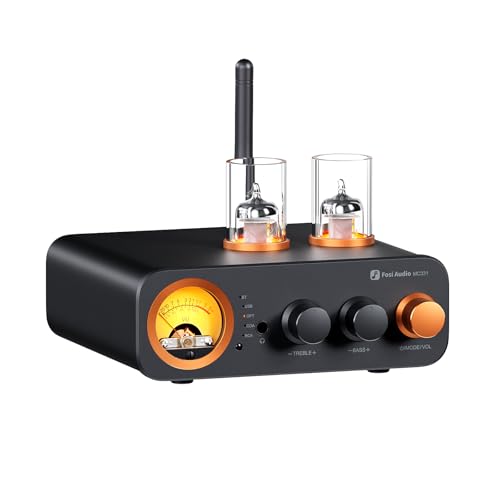
The Fosi Audio MC331 is a compact integrated tube amplifier that demonstrates budget-friendly audio does not have to sound cheap. It pairs a pair of 5725W vacuum tubes (preamp stage) with a class D power amplifier that delivers 105 watts per channel into 4Ω. The headphone output is a 3.5mm jack fed from the tube preamp stage, which gives closed-back headphones a gentle warmth and improved harmonic texture compared to pure solid-state designs. The front-facing VU meter adds a retro visual element, and the brushed aluminum chassis keeps vibrations low.
Input options are versatile: Bluetooth 5.0, USB-C, optical, coaxial, and RCA. This makes the MC331 compatible with phones, computers, CD players, and turntables with built-in phono preamps. The remote control adjusts bass and treble from your listening position, and the tube cage protects the glass bottles. The replaceable tube design lets you experiment with 6J1 or 5725W tubes to tweak the sound signature. Some early units shipped with tubes that failed within days, but Fosi Audio’s 24-month warranty covers replacements.
The headphone output does mute the speakers when a plug is inserted, which is a good implementation for late-night listening. However, the power output for headphones is limited — about 100mW into 32Ω — so it pairs best with efficient IEMs or dynamic headphones. The speaker posts only accept banana plugs or thin bare wire, which is a minor inconvenience. For the price, the MC331 offers a warm tube character with real headphone integration that far exceeds any budget receiver.
Why it’s great
- Real tube preamp stage adds warmth to both speakers and headphones
- Versatile inputs including USB-C and Bluetooth for all source types
- Compact desktop footprint with retro VU meter and aluminum construction
Good to know
- Stock tubes in some units have failure rates requiring early replacement
- Headphone output power is low (under 100mW) and may not drive high-impedance cans
5. HIFIMAN EF600

The HIFIMAN EF600 is a desktop balanced DAC/amplifier built around the company’s proprietary HYMALAYA PRO R2R DAC module. This resistor-ladder DAC architecture provides lower distortion, lower noise, and extremely low power consumption compared to delta-sigma DACs. The balanced headphone output delivers 5.12 watts per channel, which is enough to drive the Susvara, HE6se, and other notoriously power-hungry planar headphones to their full excursion without a separate power amp.
The EF600 provides both NOS (non-oversampling) and OS (oversampling) modes. NOS mode creates a warm, tube-like signature with extended harmonic structure, while OS mode is sharp and analytical — excellent for critical monitoring. The balanced XLR output uses four-pin XLR and 4.4mm Pentaconn connectors, with a 6.35mm single-ended jack for conventional headphones. Volume adjustment is implemented via a relay-ladder resistor network that maintains perfect channel balance across the entire range, unlike cheaper potentiometers that unbalance at low levels.
Bluetooth connectivity supports LDAC, aptX HD, and AAC codecs. Some users report a loose volume knob and a lack of included manual documentation. The EF600’s mechanical design places the center of gravity at the bottom for stability, but the sliding case can scratch surfaces. The overall sound quality, however, is genuinely transformative for any listener stepping up from wireless or entry-level DAC/amps. The EF600 justifies its position as a specialized tool for headphone enthusiasts who own demanding planars.
Why it’s great
- 5.12W balanced output powers extreme-planar headphones to reference levels
- HYMALAYA PRO R2R DAC offers two distinct sound signatures (NOS and OS modes)
- Relay-ladder volume control maintains perfect channel matching at any level
Good to know
- Volume knob has a loose feel and the aluminum case slides on smooth surfaces
- No optical or 4.4mm input; limited connectivity compared to competitors
6. aune S9c Pro
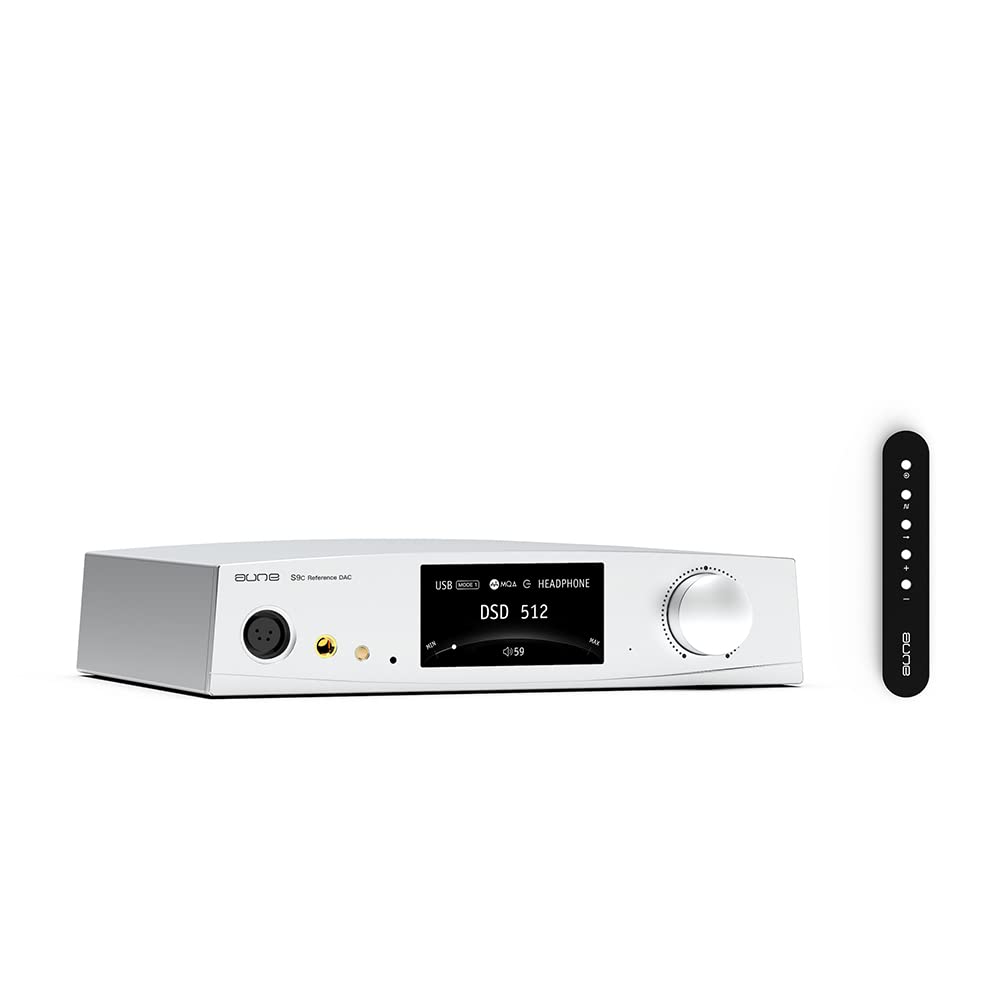
The aune S9c Pro is a no-compromise reference DAC/headphone amplifier that pushes into esoteric territory with its 10MHz clock input. The second-generation PLL core took four years to develop and re-clocks the USB XMOS signal using the same ultra-low-jitter clock source as the DAC chip, resulting in jitter levels that approach laboratory-grade measurement. The dual ES9068 DAC chips operate in clock-synchronized dual-mono mode, and the 50W toroidal linear transformer paired with 23900 µF of capacitance provides a bottomless power reservoir for transient peaks.
The fully discrete headphone amplifier uses twin JFETs per channel with high input impedance and a mellow, natural-sounding character. Output options include a 6.35mm single-ended, a balanced 4.4mm Pentaconn, and a four-pin XLR. The line output has a noise floor of just 2.04 µV, and the headphone output registers 7.71 µV. This means even the most sensitive IEMs will have a black background with zero audible hiss. Two tuning modes — Standard and Pure — let you toggle between a more forgiving presentation and a more transparent, analytical one.
Build quality is exceptional with a metal chassis that weighs over 10 pounds, and the panel-mounted components feel precision-machined. The infrared remote has a short effective range of about 4 feet, and the volume knob on the unit itself can feel slightly wobbly. The 110V voltage requirement means international users need a step-down transformer. As an all-in-one for the obsessive headphone enthusiast who also wants a digital preamp for powered speakers, the S9c Pro offers a level of refinement rare under .
Why it’s great
- 5700mW balanced output with a noise floor of 7.71 µV for dead-silent background
- 10MHz clock input allows connection to an external master clock for ultra-low jitter
- Dual ES9068 DAC chips with two tuning modes provide versatile sound characters
Good to know
- Remote control range is limited to approximately 4 feet
- Requires 110V mains voltage; international buyers need a step-down transformer
7. Willsenton R8

The Willsenton R8 is a heavyweight pure tube integrated amplifier that weighs over 70 pounds and ships in a triple-boxed crate. It uses four KT88 output tubes (included) that can be swapped for EL34 or 6550 tubes via a rear switch, giving you access to three distinct tube sound signatures from a single amplifier. The headphone output is a 6.35mm jack driven from the tube output stage — not a resistor tap — delivering the harmonic richness and spatial bloom that only a Class A tube amplifier can provide.
The R8 offers triode and ultra-linear switchable modes. Triode mode (25W per channel) offers the most detailed, intimate tube sound with lower distortion. Ultra-linear mode (45W per channel) provides more power and headroom for dynamic swings, with slightly tighter bass control. The relay-based volume control provides excellent channel balance. The amplifier can be used as an integrated amp, a power amp (bypassing the preamp), or purely as a headphone amplifier. The soft-start circuit gradually ramps up the high voltage over 30 seconds, increasing tube life.
Build quality is exceptional for the price point. The powder-coated steel chassis houses potted output transformers that handle magnetic interference. Early remote controls had reliability issues, but Willsenton has since revised the part. The amplifier needs 100-300 hours of break-in time for the tubes to stabilize fully. For the headphone enthusiast who also wants a world-class speaker amplifier, the R8 offers a tube soundstage that is remarkably three-dimensional, with bass weight, clear highs, and lush midrange that few solid-state designs can match.
Why it’s great
- Quad KT88 tubes deliver 45Wpc ultra-linear with genuine tube harmonic warmth
- Triode/UL switching and tube rolling (EL34, 6550) provide three sound signatures
- Dedicated headphone output driven by the full tube preamp stage for rich spatial sound
Good to know
- Weighs over 70 pounds and requires significant shelf space and ventilation
- Early remote control units had reliability issues; contact support for revisions
FAQ
Can I use a headphone amplifier as my only speaker amplifier?
Why does my headphone amplifier sound different for IEMs versus over-ear headphones?
How much power do I need for my headphones to sound their best?
Final Thoughts: The Verdict
For most users, the amplifier with headphone jack winner is the WiiM Amp Ultra because it combines a class-leading streaming platform, room correction, and a clean ESS DAC with a usable headphone output — all in a compact, modern chassis that fits any living room. If you need massive balanced headphone power for planar headphones, grab the FiiO K17. And for pure tube warmth that elevates both speakers and headphones with a three-dimensional soundstage, nothing beats the Willsenton R8.