
An optical input means your amplifier accepts a pure digital audio stream—no analog hiss, no ground-loop hum—directly from a modern TV, game console, or CD transport. The difference between feeding an RCA cable from a TV’s headphone jack versus sending a clean, bit-perfect optical signal is the difference between hearing background static and hearing the actual recording.
I’m Min — the co-founder and writer behind Gadgets Feed. I’ve spent weeks cross-referencing DAC chip specifications, listening to SNR and THD measurements, and comparing the real-world connectivity options of every amplifier here to separate genuine performance from marketing hype.
Choosing the right amplifier with optical input means balancing DAC quality, your speaker’s sensitivity, and the features that actually improve your listening experience. You’ll find the best amplifier with optical input for your specific system on this list.
How To Choose The Best Amplifier With Optical Input
Adding an optical input to your stereo system isn’t just about plugging a cable in. It’s about ensuring the amplifier can decode the digital signal without adding noise or losing detail. Here is what separates a good amplifier from a frustrating one.
DAC Quality and Decoding
The amplifier’s DAC converts the optical signal into sound. Look for a dedicated chip from ESS, Cirrus Logic, or Texas Instruments. A higher sampling rate support, like 24-bit/192kHz, ensures it can handle lossless audio streams from your TV or computer without downsampling.
Real Power vs. Peak Power
Ignore the peak wattage number on the front of the box. An amplifier’s continuous RMS power at your speaker’s impedance (usually 4 or 8 ohms) is the number that matters. A unit delivering a clean 50W RMS per channel into 8 ohms will sound far more authoritative than one claiming 500W peak but clipping at moderate volume.
Input Versatility for Your Setup
An optical input is great, but an amplifier is only as flexible as its other connections. If you have a turntable, you will need a phono input. For a modern TV, HDMI ARC is more convenient than optical alone. Bluetooth 5.x is non-negotiable for phone streaming without extra dongles.
Quick Comparison
On smaller screens, swipe sideways to see the full table.
| Model | Category | Best For | Key Spec | Amazon |
|---|---|---|---|---|
| WiiM Amp Ultra | Streaming | Wireless multi-room & room correction | ESS ES9039Q2M DAC | Amazon |
| Denon PMA-600NE | Integrated | Warm analog sound with separate DAC | 70W x 2 into 4 Ohms | Amazon |
| AIYIMA A80 | Desktop | High-res PC audio with digital VU | ES9038Q2M + TPA3255 | Amazon |
| Dayton Audio HTA100 | Hybrid Tube | Classic tube warmth with modern features | 50W RMS x 2 | Amazon |
| Fosi Audio MC331 | Compact Tube | Small desktop tube DAC/amp | 105W x 2 @ 4 Ohms | Amazon |
| FiiO K11 | DAC/Amp | High-end headphone & desktop DAC | 1400mW Balanced Output | Amazon |
| AIYIMA T9 PRO | Compact Tube | Budget tube preamp with VU meter | 200W Peak Output | Amazon |
| Donner MAMP2 | Value Receiver | Karaoke & multi-speaker setups | 60W RMS x 2 | Amazon |
| Donner 1000W | Budget Receiver | Basic TV audio with karaoke | 25W RMS x 4 | Amazon |
In‑Depth Reviews
1. WiiM Amp Ultra with Voice Remote 2

The WiiM Amp Ultra is the most forward-looking amplifier on this list, packing an ESS ES9039Q2M DAC and dual TI TPA3255 amplifiers into a chassis that just isn’t much larger than a paperback. It delivers clean 100W per channel into 4 ohms with a THD+N that is virtually inaudible, and it is the only unit here to include built-in RoomFit room correction, allowing the amplifier to adapt its EQ to your specific room’s acoustics automatically.
Its connectivity is near-perfect for a modern setup: you get an HDMI ARC port for seamless TV control, a dedicated optical input, Wi-Fi 6, and Bluetooth 5.3 with LE Audio. The 3.5-inch touchscreen display shows album art and system settings, making navigation feel premium. This is the amplifier to buy if you want a single box that handles streaming, room correction, and your entire home theater without compromise.
Some purists might want a coaxial input, but the optical and HDMI ARC coverage is complete for 99% of users. The app-based control is superb, and the addition of a physical voice remote with the package means you don’t need your phone for simple volume changes. It runs remarkably cool for its power output, which is a testament to the efficiency of the dual TPA3255 design.
Why it’s great
- RoomFit software corrects for speaker placement and room reflections automatically.
- HDMI ARC makes it a true TV audio hub, not just a stereo component.
- Dual TPA3255 chips provide plenty of headroom for demanding speakers.
Good to know
- No coaxial input: if you need one, you will need an adapter.
- The premium price reflects the streaming and room correction features.
2. Denon PMA-600NE Bluetooth Stereo Amplifier

The Denon PMA-600NE is a genuine full-sized integrated amplifier from a company with a legendary 100-year heritage. It features a high-current discrete amplifier section rated at 70W per channel into 4 ohms, but the real headline is the inclusion of both a high-quality internal DAC and a dedicated phono preamp. The two optical inputs connect directly to the internal DAC, allowing you to bypass the analog stage and feed a clean digital signal directly into the amplifier.
The “Analog Mode” switch physically disconnects the digital circuitry from the amplifier board, eliminating any possibility of digital noise bleeding into the analog path if you are listening to a turntable or another analog source. The sound signature is warm and slightly rolled-off, reminiscent of classic 70s receivers, which makes it incredibly forgiving of poor recordings. The headphone output is powerful enough to drive 300-ohm Sennheiser HD 600 series at just the 9 o’clock position.
It is a heavy unit at 18 pounds, sporting a vibration-resistant chassis that is common on far more expensive gear. The remote is adequate but the volume relay clicks are audible, which some find nostalgic and others find noisy. If you want a traditional, full-sized amplifier that will last a decade and handle a turntable, TV, and digital sources with equal grace, this is the obvious choice.
Why it’s great
- Dedicated phono input saves you the cost of an external preamp.
- Analog Mode physically separates digital noise from the analog stage.
- Can drive low-sensitivity speakers like KEF or Q Acoustics with authority.
Good to know
- Heavy and deep: not ideal for cramped desk or shelf setups.
- LED indicators are dim, and the remote has a slight delay.
3. AIYIMA A80 Bluetooth Stereo Amplifier DAC
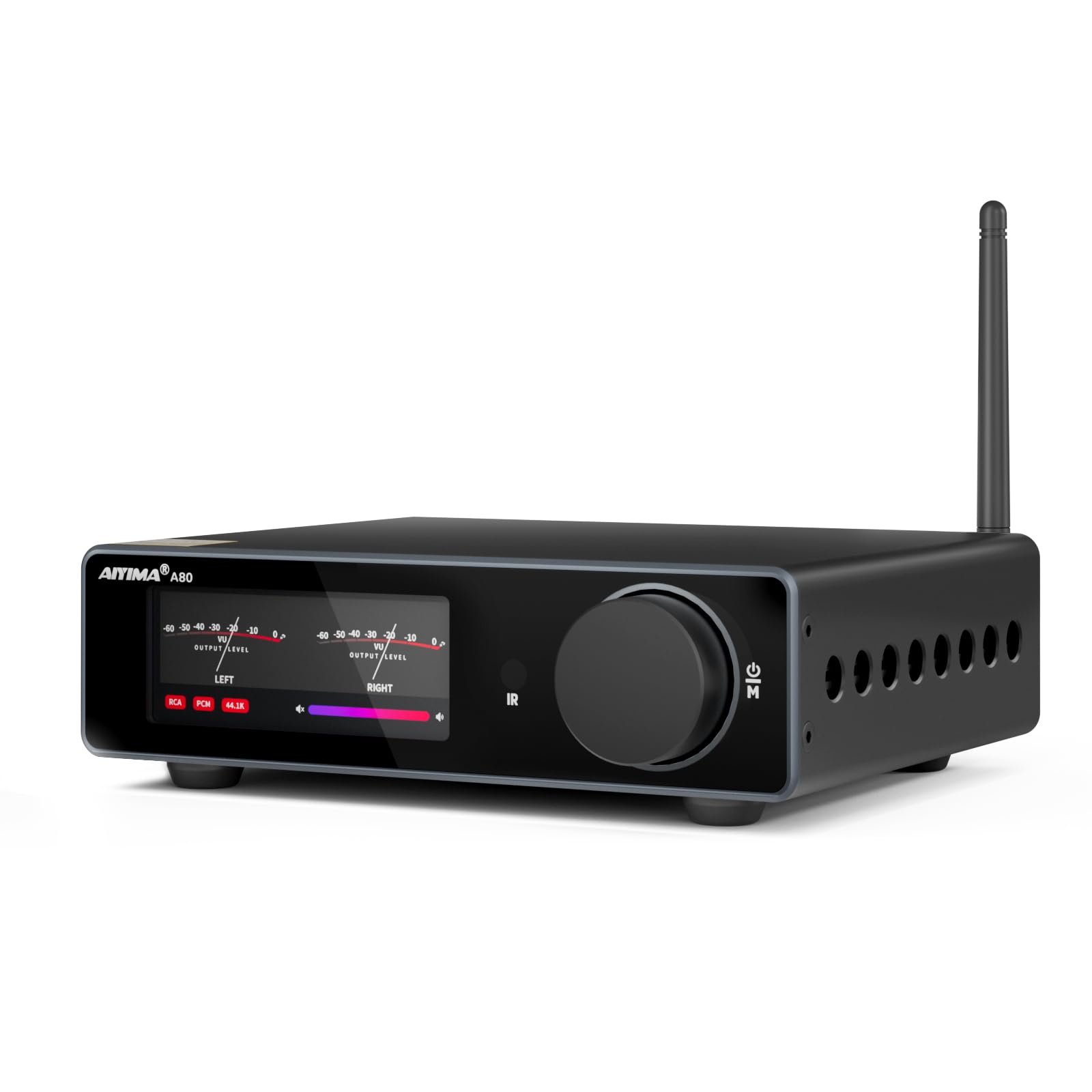
The AIYIMA A80 packs an ES9038Q2M DAC chip, the same silicon found in far more expensive desktop DACs, into a compact unit alongside a TPA3255 class-D amplifier. This combination yields a signal-to-noise ratio of 109dB and a total harmonic distortion of just 0.006%, making it one of the cleanest sounding amplifiers here when fed via the optical input. It supports DSD512 and PCM up to 768kHz, which is overkill for most TV setups but future-proof for hi-res PC audio.
Beyond its digital prowess, the A80 includes a TRS balanced input, a subwoofer pre-out, and a 12V trigger input for automation. The digital VU display is crisp and offers multiple modes, including a spectrum analyzer that is genuinely fun for music listening. The PFFB (Post Filter Feedback) technology from Texas Instruments ensures the amplifier maintains its low distortion across a wide range of speaker loads, from 4 ohms to 8 ohms.
It runs hot during extended high-power sessions—an inherent trait of the TPA3255 in a small chassis—so ensure it gets some ventilation. The compact dimensions (just over 1.5 inches tall) make it perfect for a desk setup, and the included 48V GaN power supply runs cool. This is the amp for the desktop audiophile who wants a tiny footprint with giant-killer DAC performance.
Why it’s great
- ES9038Q2M DAC decodes high-res audio without downsampling.
- TRS balanced input provides a noise-free path for professional sources.
- PFFB technology ensures consistent performance across different speakers.
Good to know
- Chassis runs noticeably warm during extended listening sessions.
- Not powerful enough for very low-sensitivity speakers like some KEF models.
4. Dayton Audio HTA100 Integrated Stereo Hybrid Tube Amplifier

The Dayton Audio HTA100 is a hybrid design that uses a vacuum tube preamp to add harmonic warmth and a Class A/B power section to deliver 50 clean watts per channel RMS. It is one of the few amplifiers in this price range that genuinely looks like a classic hi-fi component, with its exposed tubes, glowing dials, and two large VU meters on the front panel. The optical input feeds a built-in DAC, which is a welcome addition for a unit that is primarily analog in spirit.
The tube preamp isn’t just for show—it imparts a subtle “roundness” to the sound, making harsh digital recordings from streaming services feel more natural and less fatiguing. It comes with a Bluetooth 5.0 input for phone streaming, a USB DAC input for computer audio, and a phono preamp for turntables. The amplifier can easily drive bookshelf speakers like the Sony SSCS5 or larger floorstanders like the Focal Aria, providing a wide soundstage with plenty of dynamic range.
The remote is plastic and slightly sluggish, and the amplifier runs warm due to the Class A/B architecture. The front panel headphone jack is a nice touch for private listening, and the banana speaker jacks are high-quality. If you want an amplifier that looks like it belongs in a vintage audio cabinet but has the modern convenience of an optical input and Bluetooth, the HTA100 is the clear choice.
Why it’s great
- Tube preamp adds a natural, non-fatiguing warmth to digital sources.
- Class A/B design provides more headroom and dynamic punch than Class D.
- Phono input, Bluetooth, and optical input make it a versatile all-in-one.
Good to know
- Runs warm and requires adequate ventilation to avoid heat build-up.
- The plastic remote feels cheap compared to the premium build of the amp.
5. Fosi Audio MC331 Tube Integrated Amplifier with DAC
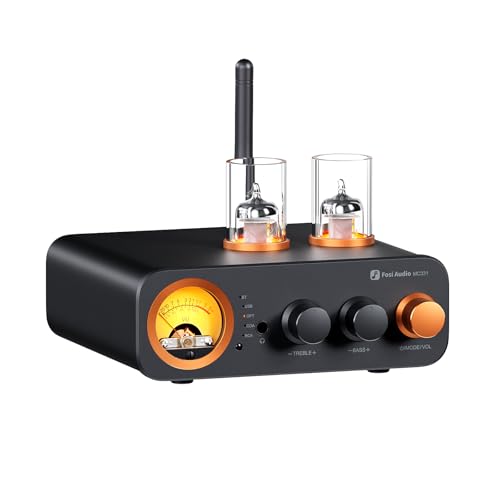
The Fosi Audio MC331 is a compact hybrid tube amplifier that brings a surprising amount of power, 105W per channel into 4 ohms, from a Class D amplifier mated to a pair of 5725W vacuum tubes in the preamp stage. The tube circuit is designed to add second-order harmonic distortion, which gives the sound a warm, musical character that is especially pleasant for vocals and acoustic music. The built-in DAC supports USB, coaxial, and optical inputs, making it a genuine all-in-one desktop solution.
The visual appeal is significant: the tubes are visible through a cutout on the top panel, and the front VU meter bounces along to the music. The build quality is all metal, and the knobs have a satisfying weight to them. The unit acts as a headphone amplifier too, with a 3.5mm front output that disables the speakers when plugged in. It runs cool for a tube amp, which is a testament to its efficient Class D power stage.
Some users report the included 5725W tubes can fail within days, so budget an extra for a replacement set of quality tubes from a brand like GE or JAN. The remote has a noticeable 2-second latency, which is a minor annoyance when changing volume quickly. Overall, the MC331 offers class-leading power and tube warmth in a footprint that fits on any desk.
Why it’s great
- Replaceable tube preamp lets you change the sound character easily.
- Headphone jack mutes speakers automatically for private listening.
- Optical and USB inputs make it a natural hub for a desktop setup.
Good to know
- Stock tubes can be unreliable; many users replace them immediately.
- Remote control has a noticeable delay compared to amplifier controls.
6. FiiO K11 DAC and Headphone Amplifier

The FiiO K11 is fundamentally a headphone amplifier and DAC first, with line-level RCA outputs that let it function as a pure DAC for a separate amplifier. Its optical input feeds a high-performance DAC that samples up to 384kHz/24-bit and DSD256, and the amplifier section delivers up to 1400mW of power into a 32-ohm load via its balanced 4.4mm output. That is enough juice to drive demanding planar magnetic headphones like the Hifiman Sundara or Audeze LCD-1.
The aluminum alloy chassis is a compact footprint, just over 5 inches square, with a high-definition VA display that shows the current sampling rate, volume, gain, and output mode. The volume knob is smooth and serves as a combined selector and power switch. The K11 offers three digital filters that subtly alter the roll-off of the high frequencies, allowing you to tailor the sound to your headphones.
While the K11 has an optical input, it is not a speaker amplifier itself—you will need to connect its RCA output to a separate power amplifier to drive passive speakers. This makes it a specialized component rather than a complete system. It is the perfect choice for a headphone listener who also wants clean optical input for occasional desktop speaker use, but not the full solution for a living room setup.
Why it’s great
- Powerful balanced output drives demanding headphones with authority.
- VA display gives real-time feedback on sample rate and volume.
- Multiple digital filters let you tune the sound for different headphones.
Good to know
- Only a DAC/preamp: requires a separate power amp for passive speakers.
- Some users find the default filter (Filter 4) overly compressed.
7. AIYIMA T9 PRO 200W Bluetooth Amplifier

The AIYIMA T9 PRO is a budget-oriented tube hybrid amplifier that achieves a genuinely pleasant sound signature through the inclusion of two JAN 5725 vacuum tubes in the preamp stage. The class D power section delivers about 200W peak, which translates to roughly 50W RMS per channel into 4 ohms. The optical and coaxial inputs feed a DAC that uses chips from Texas Instruments and Cirrus Logic, lending the unit a surprisingly detailed and smooth digital performance for its price.
The new dial layout is simplified and the front VU meter adds a touch of retro appeal, though the VU meter is relatively insensitive—it barely moves at low listening levels. The unit comes with a remote that allows you to adjust the bass, treble, and volume from across the room. The sound is warm and sweet, effectively filtering out the digital harshness that can plague cheap Class D amplifiers.
It clips audibly around 85% volume, so it is best paired with efficient speakers with sensitivity above 88dB. The Bluetooth relay clicks audibly when idle, which can be annoying in a quiet room. The build quality is decent but plastic-feeling compared to the all-metal Fosi MC331. This is a great entry point for someone wanting to dip their toes into tube sound without spending a lot of money.
Why it’s great
- JAN 5725 tubes add tangible warmth and smoothness to digital audio.
- Multiple inputs: Bluetooth 5.2, USB, Coax, Optical, and RCA.
- Compact size fits easily on a desktop or sideboard.
Good to know
- VU meter is not very responsive, especially at low to moderate volume.
- Clipping distortion appears earlier than more powerful amplifiers.
8. Donner Stereo Audio Amplifier (MAMP2)
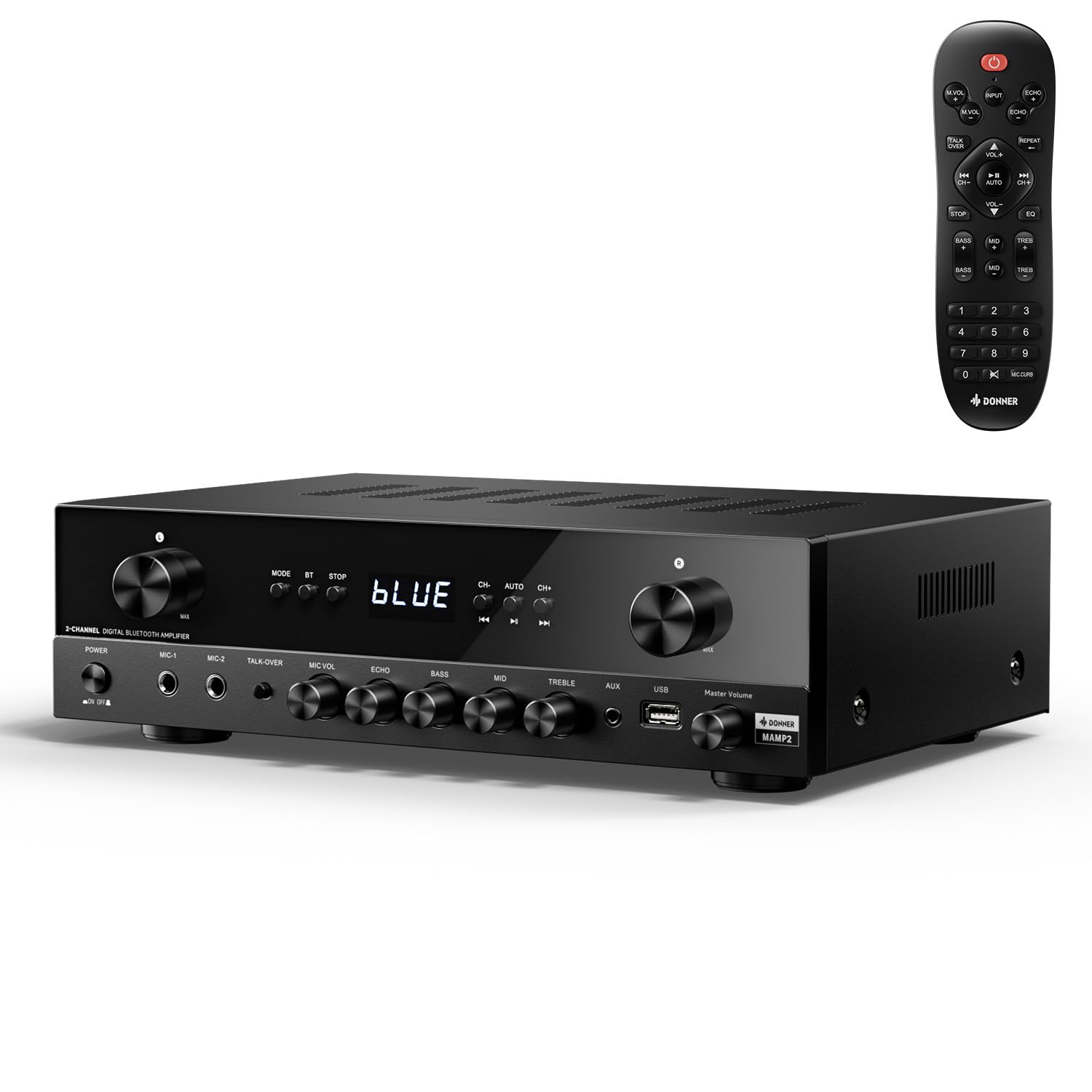
The Donner MAMP2 is a feature-packed stereo receiver that includes an optical and coaxial input alongside a phono input, Bluetooth 5.3, and dual 1/4-inch microphone jacks with independent volume controls. It delivers a genuine 60W RMS per channel into 8 ohms, which is enough to drive a pair of bookshelf speakers to satisfyingly loud levels in a medium-sized room. The optical input works well with modern TVs, and the unit includes a dedicated subwoofer output.
The standout feature for parties and events is the Talk Over function, which automatically lowers the background music volume when you speak into a microphone. The remote control offers full access to the treble, midrange, and bass EQ controls, and the amplifier remembers these settings after power-off. The FM tuner is functional, though it requires the included wire antenna. The build is solid for its price bracket, and the unit can support up to four speakers in a 2-channel configuration.
Some users report that the banana plugs on their speaker wires did not fit the binding posts, requiring bare wire or pin connectors. The optical input worked perfectly for most users, but one report noted it was non-functional out of the box. The sound quality is excellent for its price, with crisp highs, clear mids, and surprisingly authoritative bass for a class AB design in this budget bracket.
Why it’s great
- Dual mic inputs with Talk Over function are perfect for karaoke and events.
- Optical, coaxial, and phono inputs offer tremendous value at this price.
- Independent bass, treble, and midrange controls for detailed sound tuning.
Good to know
- Banana plugs may not fit due to tight binding posts.
- Some units may have a defective optical input; test on arrival.
9. Donner 1000W Peak 4 Channel Amplifier

The Donner 1000W Peak 4 Channel Amplifier is a budget-friendly receiver that prioritizes input versatility over raw power. Its 25W RMS per channel into 4 channels is sufficient for background music in a kitchen or office, especially when paired with efficient speakers. The optical input connects cleanly to a TV, and the unit also includes coaxial, Bluetooth 5.0, USB, and dual microphone inputs for karaoke use. The four independent channels allow you to pair up to eight speakers in a distributed audio setup.
The front panel is laid out with separate volume knobs for each channel, plus dedicated bass, treble, and echo controls. The Talk Over function again lowers music volume when a microphone is active, which is useful for announcements or karaoke. The FM tuner is functional but the supplied antenna can be weak indoors. The unit runs cool even during extended operation, which is a benefit of its efficient Class D topology.
Sound quality is acceptable for the budget, but the 25W RMS per channel is not enough to drive demanding tower speakers like some Jamo or Sony reference models—reviewers who tried reported a thin, bass-light sound. It is a good amplifier for a background music system or a budget TV audio setup where efficiency and input flexibility are the priorities, not seismic bass or loud party volumes.
Why it’s great
- Four independent channels enable a 4.1 or multi-zone speaker setup.
- Optical and coaxial inputs for a clean, no-hiss connection from a TV.
- Compact, cool-running Class D design fits in tight shelves.
Good to know
- Low 25W RMS per channel limits speaker choice to high-sensitivity models.
- Not powerful enough to drive demanding tower or low-sensitivity speakers.
FAQ
Does an optical cable sound better than an RCA cable for an amplifier?
Can I connect a turntable to an amplifier that only has an optical input?
What is the difference between a tube preamp and a pure Class D amplifier for optical input?
Final Thoughts: The Verdict
For most users, the amplifier with optical input winner is the WiiM Amp Ultra because it combines computational room correction, HDMI ARC simplicity, and a premium ESS DAC in a single box. If you want a traditional component with a warm sound and a built-in phono preamp, grab the Denon PMA-600NE. And for a compact desktop setup with high-res DAC capability and digital VU aesthetics, nothing beats the AIYIMA A80.