
Our readers keep the lights on and my morning glass full of iced black tea. As an Amazon Associate, I earn from qualifying purchases.
Specs are compiled from manufacturer listings and verified buyer reviews and can change over time — please confirm the key details on the product page before buying.
Adding a subwoofer to your stereo should be simple, but too many amps make you choose between clean mids and actual low-end punch. The key is finding an amplifier with a true subwoofer output (a dedicated jack that sends only the deep bass to your sub) so your main speakers stay clear and your room shakes. We’ve dug through the specs and owner experiences across ten very different amps, from tiny desktop boxes to a rack-mounted brute, to find the ones that nail that balance.
I’m Min — the founder and writer behind Gadgets Feed. This guide is built by comparing the manufacturers’ published specifications and the patterns across verified customer reviews, so you get each pick’s real strengths and trade-offs instead of marketing spin.
Whether it’s a 2.1 desktop rig or a full karaoke setup, this guide ranks the best amplifier with subwoofer output options, pairing honest feedback with hard specs so you can buy with serious confidence.
Our Picks at a Glance


How To Choose The Best Amplifier With Subwoofer Output
Before you click buy, there’s one question that decides everything: where does your subwoofer live? If it’s a powered subwoofer with its own built-in amplifier, you need an amp with a “pre-out” or “sub-out” RCA jack. If it’s a passive sub with no amplifier, you need either a subwoofer amplifier or a channel on a multi-channel amp. Mixing these up is the number one mistake people make.
Channel Count: 2.1 vs 5-Channel vs Dedicated
A 2.1 amp powers your left and right speakers and sends a signal to one sub — perfect for music and TV. A 5-channel amp (usually for cars) powers four speakers plus one sub, all from a single box. A dedicated subwoofer amp is different: it only powers the sub itself, and you feed it the signal from your main stereo receiver. Knowing which you need narrows your search instantly.
Match the Power to Your Speakers and Room
Watts matter, but only in the right proportion. A desktop amp with 320W peak can fill a small office with clarity, while a 1000W rack-mount unit is built to move serious air in a home theater. Pay attention to the load (measured in ohms) your speakers and sub present. A 4-ohm load demands more current from the amp than an 8-ohm load, so the power rating at your specific ohm rating is the one that matters.
Inputs Decide Your Ecosystem
Think about every device you’ll connect. If you spin vinyl, you want a phono input. If you stream from a phone, Bluetooth 5.0 or newer with codecs like aptX will sound better. If you’re plugging into a modern TV, look for optical or coaxial digital inputs, since most new TVs lack analog RCA jacks. The right input spread—phono, optical, or Bluetooth—determines whether your amp can connect to every source you own.
Quick Comparison
| Model | Best For | Power Output | Channels | Sub Output | Amazon |
|---|---|---|---|---|---|
| Fosi Audio BL20C★ Best Overall | 2.1 Desktop Hi-Fi | 320W MAX | 2.1 | RCA | Amazon |
| Donner MAMP2Karaoke King | Karaoke & Multi-Source | 600W Peak | 2 | RCA | Amazon |
| AIYIMA A07 ProTunable Hi-Fi | Flexible 2.1 Pre-Out | 300W x 2 | 2.1 | Pre-Out | Amazon |
| Fosi Audio ZP3 | Preamp Control Hub | Preamp | 3 | RCA / XLR | Amazon |
| AIYIMA A80 | DAC + VU Meter | 300W x 2 | 2.1 | 3.5mm Pre-Out | Amazon |
| SMSL A300 | Clean 2.1 Power | 165W x 2 | 2.1 | RCA | Amazon |
| ORION CEA1000.5D | Car 5-Channel Builds | 1000W RMS | 5 | Speaker-Level | Amazon |
| Pyle 3000W | Rack-Mount Value | 3000W Peak | 4 | RCA | Amazon |
| Dayton Audio SA1000 | Dedicated Sub Amp | 1000W | 1 | Input | Amazon |
| Juson Audio JTA200 | Hybrid Tube Power | 150W x 2 | 2.1 | RCA | Amazon |
In-Depth Reviews
1. Fosi Audio BL20C
Our pick — 4.5★ from 900+ verified ratings; the strongest balance of quality and price.
The tiny desktop amp that punches far above its 2.3-pound weight class.
This is the easiest recommendation for anyone building a 2.1 system with bare-wire speakers and a powered sub. The BL20C is a 2.1 channel stereo amp rated at 320W max, built on the TDA7498E chip (a Class D amplifier that runs cool and efficient by design). It’s one of the rare amps that features both Bluetooth 5.0 and a U-disk player, so you can stream from your phone or play MP3, WMA, APE, FLAC, and WAV files straight from a USB stick.
What wins people over is the sound quality — buyers report it powers their Bose 901s effectively and works flawlessly with 2x6ohm 120w speakers plus a 130w sub. There’s a catch: the bass and treble knobs are sensitive, and dialing in the wrong settings can drastically change the sound. Owners suggest maxing out your source device’s output and using the amp’s knobs sparingly to avoid distortion on bass-heavy tracks.
The build is solid metal with smooth notched knobs that control bass, treble, volume, and input mode. One practical note: the speaker wire holes are small (16 gauge max), so banana plugs are the better choice for a clean, frustration-free connection.
What Owners Rave About
- Sound quality tops the list — over 150 owners single it out as the defining trait
- Compact metal chassis that stays cool under load
- Includes bass, treble, and volume knobs for fine-tuning
The Honest Trade-Offs
- Bass/treble dials are sensitive — small adjustments go a long way
- Speaker terminals are tight; budget for banana plugs
Reach for this if: you want a small, surprisingly powerful 2.1 hub for a desk or small room, and you don’t want to spend a fortune.
Look elsewhere if: your main speakers need more than 16-gauge wire or you need digital optical inputs — this amp is strictly Bluetooth, USB, and RCA.
2. Donner Stereo Audio Amplifier (MAMP2)
The everything-but-the-kitchen-sink receiver that turns a living room into a stage.
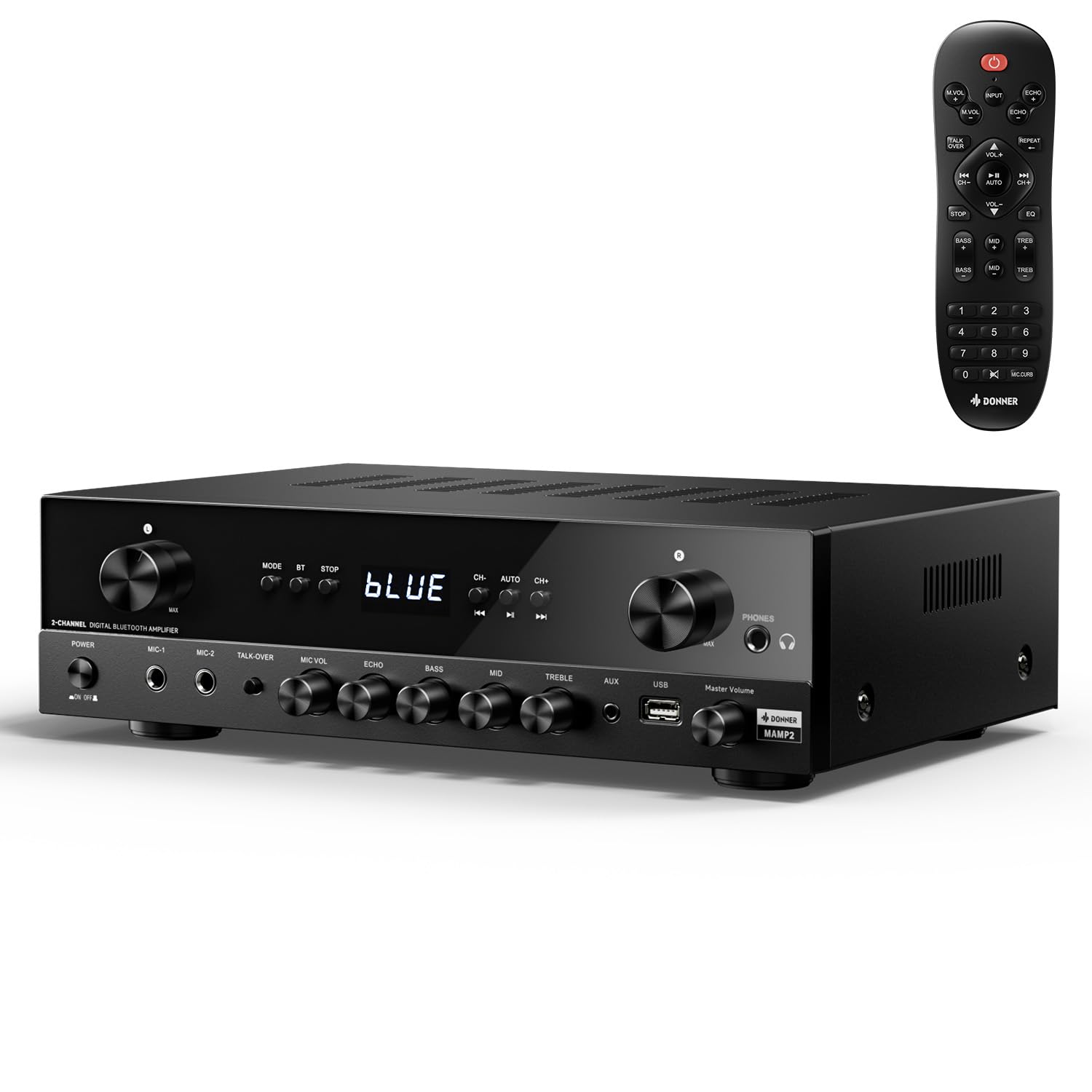
Double the peak power of the Fosi at 600W peak (60W x 2 RMS), the Donner MAMP2 is built for versatility over sheer minimalism. It’s a 2-channel receiver that supports up to 2 groups of 4 speakers with 4-8 ohms, plus 1 subwoofer, making it a genuine multi-speaker hub rather than a simple desktop amp.
The input list is staggering: Bluetooth 5.3, USB (up to 64 GB), RCA, 2 mic inputs, AUX IN, FM radio, plus digital Optical and coaxial for modern smart TVs, and a dedicated Phono input for turntables. There’s no HDMI, so don’t plan on video passthrough. Owners mention this budget 2-channel amp drives Klipsch KLF-10S towers plus a sub with solid power, and even powers two 15-inch speakers without breaking a sweat.
Sound quality is where opinions split — some call it excellent, but others report high noise levels. If you’re a purist after whisper-quiet operation, this isn’t it. But if you want a karaoke machine with dual 1/4-inch mic jacks, echo control, and a Talk Over function to lower music volume when you speak, it’s a phenomenal party starter.
The Feature-Stack Wins
- Phono input, optical, coaxial, and dual mics in one box
- Separate volume controls for left and right channels
- Full-featured remote for treble, midrange, bass, and echo
Buyer Fit Notes
- Sound quality is a mixed bag among owners — some love it, some hear noise
- Cooling fan noise is noticeable; keep it out of a closed cabinet
Grab it when: karaoke, vinyl, FM radio, and a rack of speakers all need to live in one system.
Skip it when: ultra-quiet critical listening is your top priority — this amp prioritizes features over dead silence.
3. AIYIMA A07 Pro
An audiophile upgrade path hiding inside a 6.6-inch aluminum box.
The A07 Pro is the enthusiast’s choice, powered by the renowned TPA3255 Class D chip delivering 300W x 2 (600W total) under 48V. What makes it special is the flexibility: a 2.1 channel pre-out lets you add an active subwoofer, and the package includes a DC36V 6A power adapter. Customers note driving 175w acoustic research speakers without issue, and even filling a living room with clear music at modest volume settings.
Where this amp shines is customization. It features two socketed, swappable NE5532 op-amps, letting you upgrade to premium options like LME49720, MUSES02, or OPA2604 to change the sound signature from warm to analytical. That’s a feature you simply don’t find on most budget amps, and it offers a real upgrade path (plus a 48V supply open up) without buying a new amplifier.
There are quirks. The speaker connections are too close together for spade connectors — banana plugs are essentially required. And the Bluetooth gain runs lower than the RCA inputs, which run about 15dB louder. But with independent bass and treble knobs and one of the widest soundstages in its class, it’s an excellent Hi-Fi entry point for bookshelf speakers and a sub.
The Audiophile Angle: swappable op-amps and a clear, transparent soundstage make this the tinkerer’s favorite, with sound quality and performance counting as the top two praises from owners.
The Practical Recoil: the tone control knobs aren’t detented and the Bluetooth LED blinks constantly — minor annoyances once you hear how clean it plays.
Best for: hi-fi enthusiasts who want to tailor the sound of their bookshelf speakers and sub without swapping entire amps.
Not for: anyone who needs to use spade connectors or wants a single knob for all controls — this is a hands-on amp.
4. Fosi Audio ZP3 Balanced Preamp
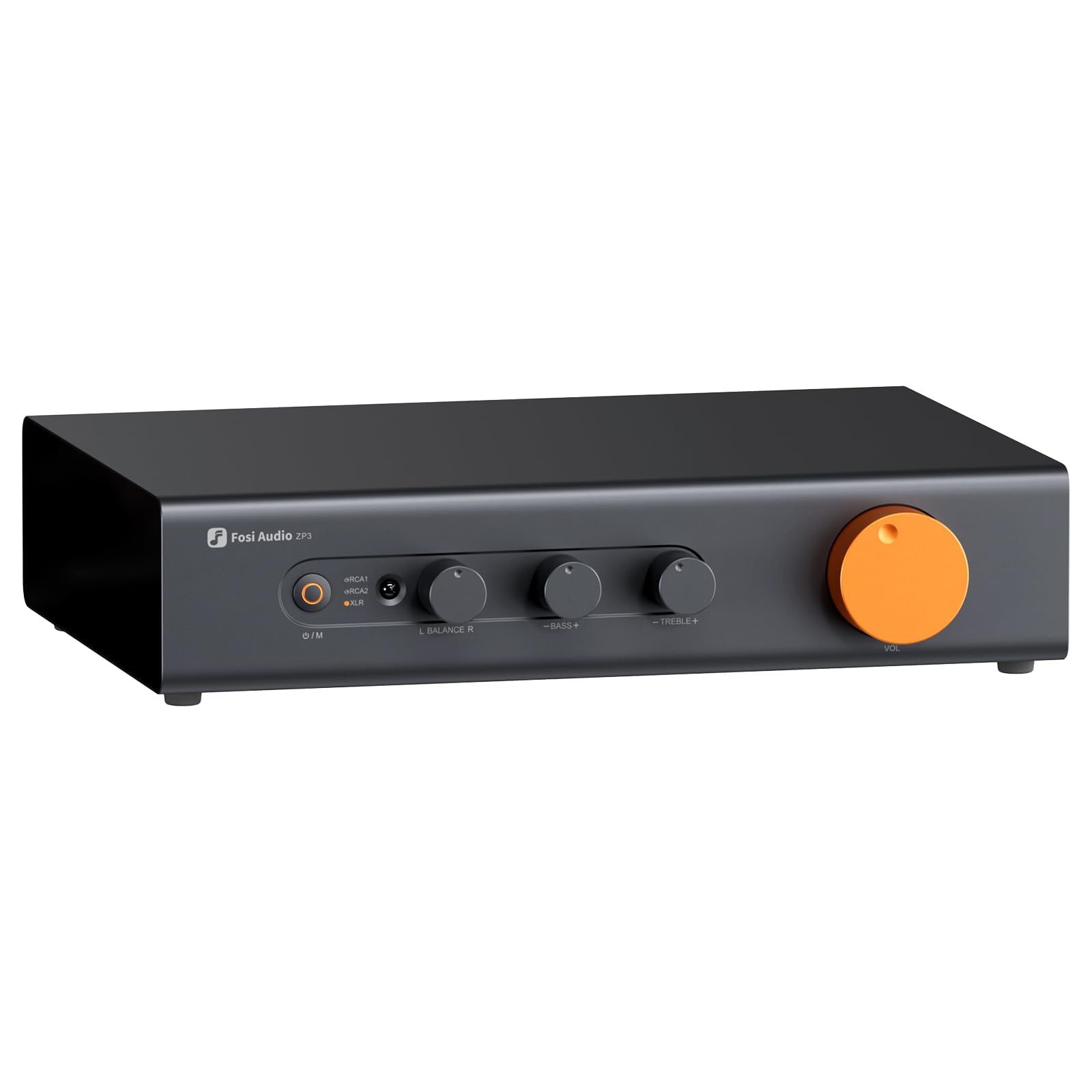
The sleek brain of a 2.1 system that routes bass exactly where it belongs.
This isn’t a power amp — it’s a preamp (the control hub that selects your sources and adjusts volume before the power amp steps in). The ZP3 features 3 inputs (RCA1, RCA2, and XLR) and 3 outputs (RCA, XLR, and dedicated Sub-Out). Its main draw is the adjustable High-Pass Filter (HPF), which filters low-frequency signals from the main outputs and sends them to the Sub-Out instead — so your satellites don’t strain on deep bass while your sub handles the heavy lifting.
Built with audiophile-grade parts like ELNA capacitors and gold-plated RCA jacks, it delivers clean, detailed sound. The remote control offers one-touch input switching and volume adjustment, plus bass/treble controls with a bypass function. Owners praise its dead-quiet operation and transparent sound, especially when tone controls are bypassed.
The honest caveat: the volume knob has no level markings and spins freely, which feels risky on power-up. The manual warns you to turn it 3-4 full turns counterclockwise on first connection to avoid a loud surprise. It also remembers volume per input — a smart feature once you get used to it.
The Big Draw: the 80Hz HPF and XLR connectivity let you build a clean 2.1 system with main speakers and a sub, without an AV receiver.
The Fine Print: the volume knob’s lack of an indicator is the most-cited gripe — manageable, but worth knowing before you buy.
Who it’s for: listeners running a turntable or multi-source setup who want precise sub integration through a remote-controlled hub.
Who should pass: anyone with only a digital source and no sub — you’re paying for routing you won’t use.
5. AIYIMA A80
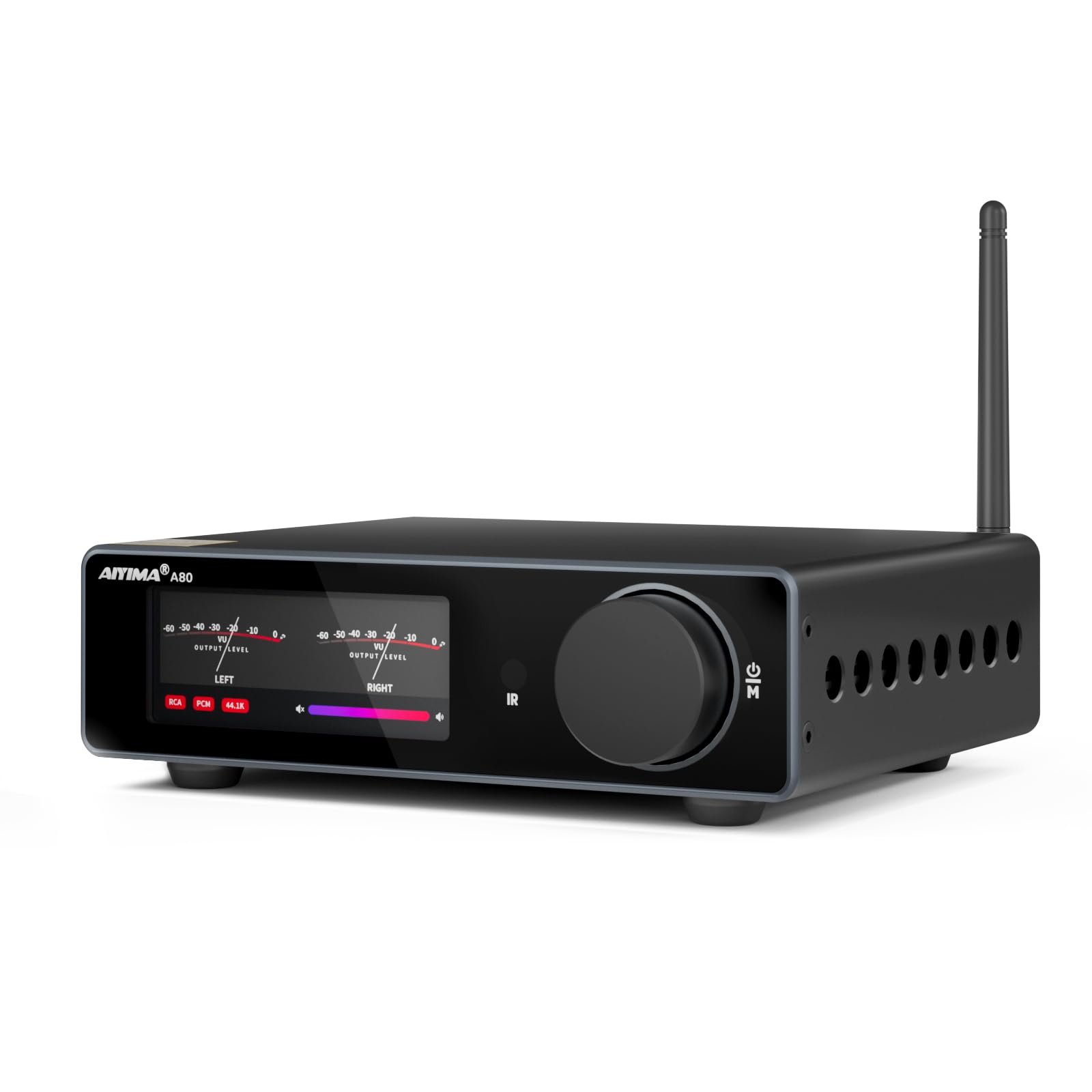
A studio-grade DAC and a glowing VU meter in one compact Class D box.
The A80 is an all-in-one DAC amplifier (a unit that converts digital audio to analog and then powers your speakers). It’s built around the ESS9038Q2M decoding chip and the TPA3255 amplifier, supporting DSD256 and PCM high-resolution audio. With a total harmonic distortion (THD) as low as 0.006% and a signal-to-noise ratio (SINAD) of 109dB, it delivers exceptionally clean sound that owners describe as audiophile-level.
Inputs are generous: Bluetooth, USB, optical, coaxial, and professional TRS balanced inputs (which isolate electrical interference and eliminate hiss). The retro digital VU meter display adds a fun, dynamic visual element that reacts to your music. It includes a remote control and a DC48V 5A power adapter.
The one big catch: the subwoofer output is a 3.5mm jack, not a standard RCA. Owners note you’ll need an adapter to connect a typical sub, and the output runs a bit lower than dedicated RCA sub-outs. The VU meters also barely move at normal listening volumes, which irks some owners who bought it for the visual spectacle.
The Sonic Strengths
- Zero white noise and crisp sound even with vintage speakers
- Balanced TRS inputs wipe out speaker hiss entirely
- Gallium nitride (GaN) power supply runs cool
The Setup Realities
- Subwoofer out is 3.5mm — you’ll likely need an adapter
- No auto-on function; you’ll switch it on manually
Pick this up for: a compact, high-resolution music system where the DAC quality matters as much as the amp power.
Think twice if: you need a simple plug-and-play RCA sub connection — the 3.5mm out adds friction.
6. SMSL A300

A precision-engineered desktop amp with a dedicated subwoofer path that sounds clean at any volume.
The SMSL A300 brings high-end engineering to the desktop. It uses German Infineon’s MA5332MS chip with BTL (Bridge-Tied Load) technology, delivering 165W per channel into a 4-ohm load, or 85W into 8 ohms. With a total harmonic distortion of just 0.004%, it produces a clean, neutral sound with tight bass that owners call “phenomenal” for the price.
Connectivity spans RCA, USB, and Bluetooth 5.0. The dedicated subwoofer signal pre-output makes building a 2.1 system easy, and 8 preset EQ options plus treble/bass adjustment let you match a wide variety of speakers. The CNC-machined aluminum alloy chassis feels premium and runs cool — a common theme across Class D amps.
Compared to the Fosi BL20C, the A300 offers a cleaner high-frequency response and more raw power into low-impedance loads, but it costs meaningfully more. Owners replacing the AIYIMA A07 report more power, cleaner sound, and the welcome addition of a sub out. The most-cited downside is the limited tone controls — presets or simple bass/treble, with no parametric EQ for fine-tuning.
Why It Stands Out: the BTL design and 0.004% THD mean your music stays clean and undistorted even when you push the volume.
The Fine Print: it’s a well-regarded unit, but a small number of reviewers point out reliability concerns — pair it with a good surge protector.
Choose this when: you want a premium-feeling, low-distortion 2.1 amp for desktop hi-fi or a minimalist living room system.
skip it if: you need granular parametric EQ — the preset-based tone controls feel limited to some owners.
7. ORION CEA1000.5D Cobalt Elite
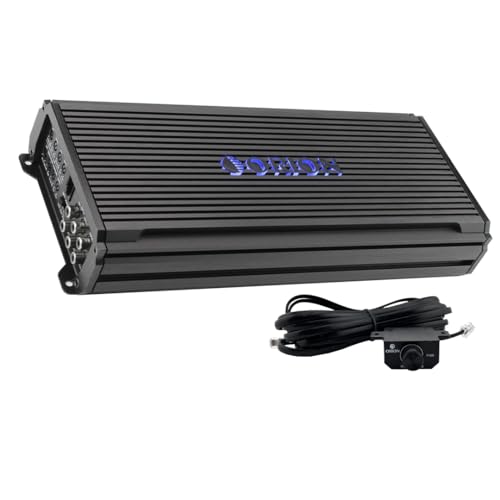
A single chassis that powers your whole car audio system, including a dedicated sub channel.
For car audio, the ORION CEA1000.5D is a complete solution. This 5-channel Class D amp delivers up to 1000W RMS total, splitting power between full-range speakers and a dedicated subwoofer channel. It provides 75W RMS x 4 at 4 ohms and 125W RMS x 4 at 2 ohms for mids and highs, plus 300W RMS x 1 at 4 ohms and 500W RMS x 1 at 2 ohms for the sub. That’s a full front + rear + sub setup from one amp.
It features dedicated high-pass and low-pass filters (crossovers that direct frequencies to the right speakers) for the 4-channel section, and a variable low-pass filter for the sub channel. This gives you precise system tuning without external processors. The compact Class D design runs cooler and draws less current than traditional amps, which matters in a car.
Shoppers say it works great for door speakers and a 10″ sub, with one noting it ran a full 2.5-hour drive without issues. Power output is a mixed bag in reviews though — some owners say their sub “could hit harder” and one called the stereo deck more powerful. It’s a solid all-rounder for daily drivers, not an SPL competition monster.
The Big Win: independent crossovers and a bass knob included in the box make system tuning genuinely easy.
The Reality: if you run a power-hungry sub, some owners find the sub channel underwhelming for heavy bass.
Ideal for: a clean, simple 4-speaker-plus-sub car build where one amp does everything.
Not for: bassheads who need the sub channel to hit hard — consider a separate mono amp for that.
8. Pyle 3000W 4-Channel Amplifier

The rack-mounted multimedia workhorse with a CD player and room-filling peak power.
The Pyle is a different beast — a 19-inch rack-mount receiver packing 3000W of peak power, a front-loading CD/DVD player, FM radio, and Bluetooth. It’s designed for fixed installations like a home theater rack, a school PA system, or a dedicated media room where you want everything in one 22.8-pound box. It supports 2-8 ohm speakers and includes a subwoofer out for deep bass.
Connectivity is expansive: HDMI input, RCA inputs, USB readers, optical audio output, and dual 1/4-inch microphone inputs with echo control. The microphone mixing makes it a candidate for karaoke or public address duties, and buyers report it sounds great once set up. However, some found the included instructions confusing when connecting a TV, with one buyer needing a digital-to-analog converter to get sound from their TV.
The honest downside is quality control. Owners mention a mix of “works great” and “stopped working” experiences, with some noting sticky residue on the CD slot upon arrival. If you buy this, test everything immediately and keep the box — a working unit is excellent value, but the QC lottery is real.
The Appeal: a full multimedia hub — CD, DVD, Bluetooth, FM, HDMI, and mics — for a fraction of what separates components cost.
The Risk: reliability and quality control draw mixed feedback, so test thoroughly on arrival and use a return-friendly seller.
Go for it if: you need a rack-mount all-in-one for a venue, garage, or home theater with lots of source devices.
Be cautious if: you expect dead-on reliability from the start every single time.
9. Dayton Audio SA1000

The 27.7-pound tank that turns any passive subwoofer into a room-shaking force.
This is not a stereo amplifier — it’s a dedicated subwoofer amplifier, designed to power a passive subwoofer that has no built-in amp. The Dayton SA1000 delivers up to 1000W of clean Class-AB amplification for deep, controlled low frequencies. It’s an installation-ready unit with manual, auto, or 12V triggered on/off, backed by a 5-year warranty.
What separates it from cheaper sub amps is the built-in parametric EQ (equalization that lets you fine-tune specific frequency bands), adjustable subsonic filtering (to remove inaudible rumble that wastes power), and bass boost. These tools let you tailor the low-end response to your specific room and subwoofer driver, which is crucial for flat, accurate bass.
The patented tracking down-converter power supply works with the Class-AB output stage to increase efficiency and reduce heat. Customers note it drives a 21″ subwoofer and a Stereo Integrity SQL-15 down to around 10Hz, hitting that “chest thump” range throughout the house. The build is heavy and rugged — owners equate the weight with quality. The recurring complaint is a loud turn-on thump when powering up, plus a blindingly bright blue power LED.
The Standout Feature: parametric EQ plus subsonic filtering gives you pro-level control over your room’s bass response.
The Trade-Off: it’s heavy, has a turn-on thump, and the blue LED is too bright — all fair prices for the sheer power on tap.
Buy it for: powering a large passive subwoofer in a home theater where deep, tunable bass is non-negotiable.
Don’t buy it if: your sub is already powered or you need to drive full-range speakers — this amp does one job, gloriously.
10. Juson Audio JTA200
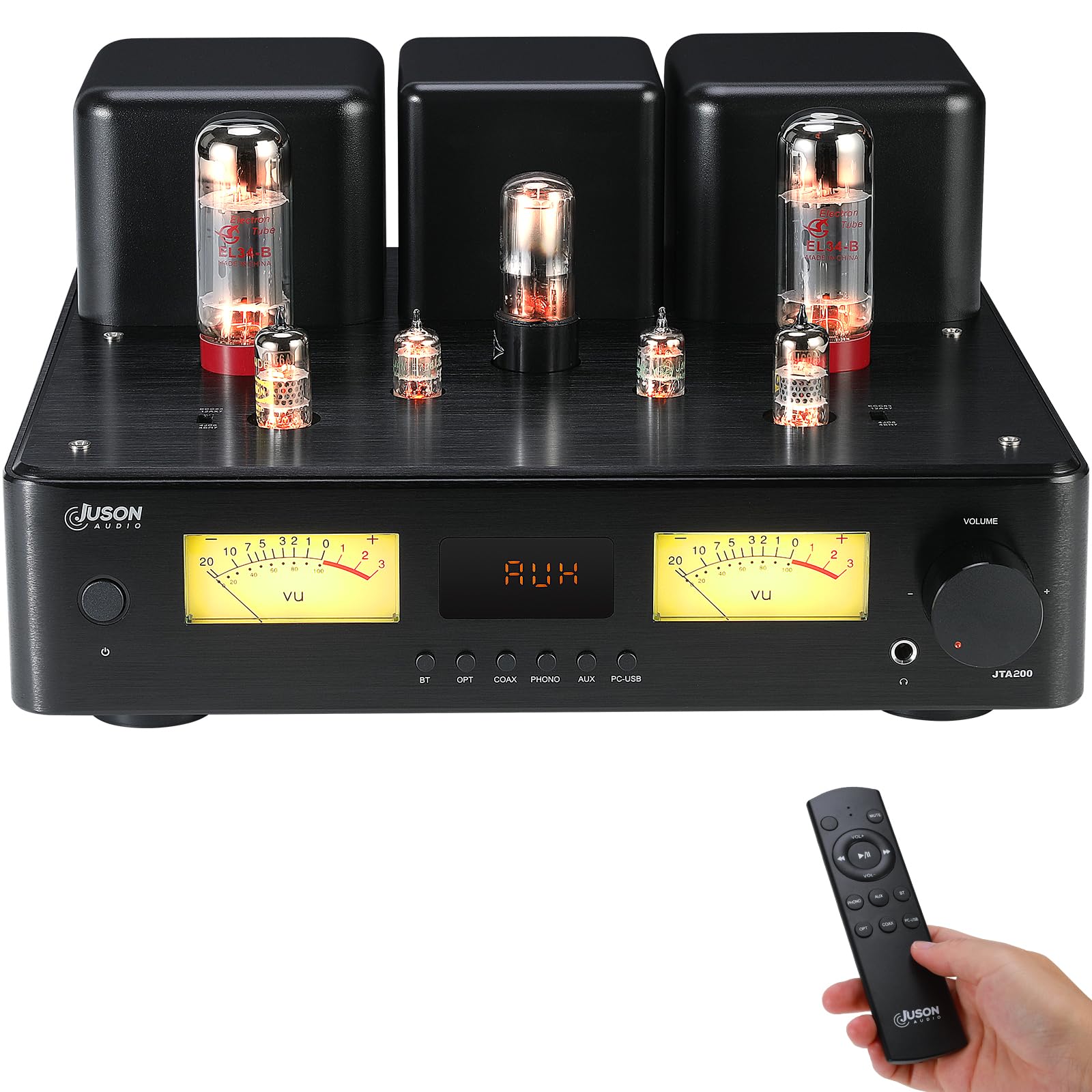
Vacuum-tube warmth meets solid-state muscle at 31.9 pounds of high-end hybrid audio.
Saving the most unique for last: the Juson JTA200 is a hybrid tube amplifier, blending 2x EL34 tubes (the classic sound of warm, rich audio) with 4x 2SA1943 and 4x 2SC5200 transistors for solid-state power. It pushes 150W RMS per channel, delivering that coveted “tube warmth” without sacrificing the clean power of a modern amp. It also includes a subwoofer output and a headphone output.
The input selection is remarkably modern for a tube amp: Bluetooth 5.4 with aptX Adaptive, aptX HD, LDAC, and AAC support, plus AUX, COAX, optical, phono, and PC-USB. The QCC3095 chip handles the Bluetooth. A stylish LED display and VU meter add to the audiophile aesthetic, and the included remote handles volume and source control.
Owners are impressed with the phono preamp, the dead-quiet operation, and the ability to swap the 4JC6 preamp tubes for 12AX7 tubes to tweak the treble response. The weaknesses are clear: Bluetooth can be unstable (skipping), the built-in DAC is only 16-bit, and there are only 2 analog inputs. It’s a specialist’s piece — gorgeous and sonically rich, but with quirks.
The Magic: EL34 tubes feeding transistors gives you warm, detailed sound with real control — a rare combo at this level.
The Reality Check: Bluetooth stability and a basic DAC mean you’ll want a wired source to get the best from those tubes.
Choose it for: a dedicated hi-fi listening room where vinyl and high-quality analog sources feed warm, detailed speakers and a sub.
Pass on it if: you primarily stream over Bluetooth or need a fuss-free, all-digital system.
Understanding the Specs
Class D vs Class AB
Class D amplifiers (like the Fosi BL20C and AIYIMA A07 Pro) run cool and efficient, making them great for compact boxes and cars. They use switching technology to minimize wasted energy as heat. Class AB amps (like the Dayton SA1000) deliver incredibly clean, analog-sounding power but run hotter and heavier. For a sub-out amp, you’ll mostly see Class D for its efficiency — but don’t ignore Class AB when pure fidelity is the goal.
Subwoofer Output Signals
A sub-out is a low-level RCA jack that sends a full-range or low-passed signal to a powered subwoofer. A pre-out is similar but is affected by your volume knob — this is what the AIYIMA A07 Pro uses. A high-level output (speaker wire) is common on car amps to connect a passive sub. Knowing which your sub needs is the single most important spec to check before buying.
FAQ
What is the difference between a subwoofer output and a regular line output?
Can I connect a passive subwoofer to an RCA sub-out?
Does a 2.1 amplifier have a built-in subwoofer crossover?
Will a 100W stereo amp be enough for a subwoofer?
Can I use a car amplifier like the ORION in my house?
What is a phono input and why would I need one?
Is Bluetooth on an amplifier any good for music quality?
What does “Class D” mean for my energy bill?
Why do I need a low-pass filter on subwoofer output?
Can I connect my TV to a stereo amplifier with a sub output?
Final Thoughts: The Verdict
If you want one dependable pick, the amplifier with subwoofer output winner is the Fosi Audio BL20C because it pairs a genuinely clean 320W of Class D power with a true 2.1 channel layout, Bluetooth 5.0, and a build quality that belies its price. If you want maximum input flexibility for karaoke and vinyl, grab the Donner MAMP2. And for a dedicated, rack-mounted subwoofer power plant with pro-level tuning, the Dayton Audio SA1000 is the one to reach for. Start with the Fosi if you want the simplest route to a clean 2.1 desktop setup with Bluetooth and RCA inputs.
How We Picked
We do not accept paid placement. Every pick is matched to a real buyer and a real use-case; we do not hands-on test units.
Sources & Methodology
Specifications: manufacturer listings and product documentation. Review insights: verified customer reviews, as of August 2026. Pricing: not shown on this page (it changes often); check the current price via the retailer link.
As an Amazon Associate, Gadgets Feed earns from qualifying purchases. This does not affect which products we feature.