
Straining to catch dialogue during a movie or leaning in during a conversation is exhausting, not just for you but for everyone around you. The right pair of amplifying headphones can deliver clear, volume-controlled audio directly to your ears without raising the TV or forcing others to speak louder, restoring both independence and connection.
I’m Min — the co-founder and writer behind Gadgets Feed. I’ve spent countless hours analyzing technical specifications, customer feedback, and clinical research to identify which personal sound amplification products (PSAPs) and TV headphones genuinely solve the core problem of hearing loss without introducing new frustrations like feedback, poor build quality, or confusing setup.
This guide breaks down the key specs — gain in dB, battery life, microphone type, and connectivity — so you can confidently choose the best amplifying headphones for hard of hearing that fit your lifestyle and hearing needs.
How To Choose The Best Amplifying Headphones For Hard Of Hearing
Selecting the right amplifying headphones goes beyond just picking the loudest option. You need to consider how the device amplifies sound, how it connects to your audio source, and how comfortable it is for extended wear. The wrong choice can lead to frustrating feedback, poor sound clarity, or a device that simply doesn’t provide enough volume for your specific level of hearing loss.
Gain and Maximum Output
The primary metric for any personal sound amplifier (PSAP) is its gain, measured in decibels (dB). Gain represents how much the device boosts incoming sound. Most quality amplifiers offer between 30dB and 50dB of gain. For mild hearing loss, 30dB may suffice, but moderate to severe loss typically requires 40dB or more. The maximum output — often around 108dB to 120dB — determines the loudest possible sound the device can produce. Be cautious: too much gain without proper noise management can create painful feedback or distortion.
Microphone Type and Placement
The microphone is the ear of the system. Built-in microphones on the body of the amplifier are convenient and good for one-on-one conversations, but they also pick up rustling noises from clothing. Remote microphones — connected by a long cable — allow you to place the mic near the sound source (like a TV or conversation partner), drastically improving signal-to-noise ratio. Multi-microphone systems offer flexibility across different environments, from quiet living rooms to bustling restaurants.
Connectivity: Wired vs. Wireless
Wired systems are simple and offer zero latency, making them ideal for TV watching where lip-sync is critical. Wireless systems, particularly those using a dedicated base station, offer freedom of movement with latencies under 40ms — generally imperceptible. Bluetooth-only options are less suitable for TV due to higher latency. For seniors, a plug-and-play system with a charging dock removes the hassle of pairing and battery management.
Quick Comparison
On smaller screens, swipe sideways to see the full table.
| Model | Category | Best For | Key Spec | Amazon |
|---|---|---|---|---|
| SuperEar SE9000HP | PSAP | All-around personal amplification | 50dB gain, 107dB max output | Amazon |
| Joanbro IR2 | PSAP | Versatile mic options | 50dB gain, 3 mic types | Amazon |
| Avantree Ensemble | Wireless TV | Plug-and-play TV listening | 35H battery, 40ms latency | Amazon |
| Mutbam TV Headphones | Wireless TV | Extended battery life | 65H playtime, 40ms latency | Amazon |
| Koss QZ-99 | Wired Headphone | Passive noise isolation | Passive noise reduction | Amazon |
| Reizen Mighty Loud Ear | PSAP | Budget-friendly amplification | 120dB sensitivity, 100ft range | Amazon |
| Britzgo BHA-220S | Hearing Amplifier | Discreet behind-the-ear use | Behind-the-ear fit, 4 freq settings | Amazon |
In‑Depth Reviews
1. SuperEar Model SE9000HP
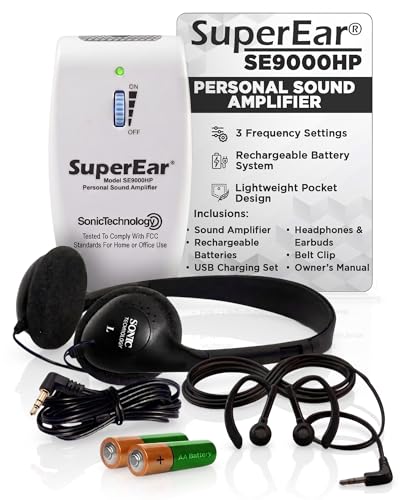
The SuperEar SE9000HP is a dedicated personal sound amplifier designed for those who need substantial gain — up to 50dB — without the prescription cost. Its pocket-sized body houses a three-position frequency selector (High, Medium, Low) that lets you tailor the tonal response to your specific hearing profile. This is especially useful for cutting through background noise in restaurants or focusing on dialogue during a lecture.
It comes with two rechargeable Ni-MH AA batteries and a charging cube, offering over 40 hours of use per charge. The included ergonomic hook-style earbuds and full-sized headphones give you flexibility depending on comfort preference and ambient noise levels. The tactile volume wheel and 3.5mm jack make it compatible with nearly any wired headset you already own.
Customer feedback consistently highlights its effectiveness for severe hearing loss — many users report it outperforms hearing aids costing forty times more in specific scenarios like doctor visits or quiet conversations. The belt clip keeps it hands-free, and the ability to swap between rechargeable and disposable batteries adds a layer of reliability for travel or emergencies.
Why it’s great
- 50dB of adjustable gain with frequency-specific tuning
- Rechargeable batteries last over 40 hours with a backup disposable option
- Affordable alternative to prescription hearing aids for moderate-to-severe loss
Good to know
- Wired system may feel restrictive during active movement
- Picks up ambient noise from the device microphone unless the remote mic is used
2. Joanbro IR2 Personal Sound Amplifier

The Joanbro IR2 differentiates itself with a clever interchangeable microphone system. It ships with three distinct microphone modules: a standard built-in mic for daily use, a detachable lapel mic with a 6.6-foot cable for clearer conversations in noisy environments, and a specialized TV mic with a 19-foot cable and nylon fastener for long-distance watching. This makes it arguably the most adaptable PSAP for varying home scenarios.
It delivers up to 50dB of gain with a total output of 108dB, and the separate tone control wheel allows fine adjustment of frequency response. The volume knob doubles as an on-off switch, simplifying operation. The package includes a belt clip, an anti-dropping headphone with memory foam ear tips, a single earbud, and two AAA batteries rated for around 40 hours of moderate use.
Real-world users praise its ability to handle one-sided deafness — placing the remote microphone near a conversation partner while the user wears the headphone on their good ear. The compact design and lightweight build make it easy to clip onto a pocket during poker games, car rides, or church services without drawing attention.
Why it’s great
- Three interchangeable microphones cover close talk, room, and TV listening
- Separate tone and volume controls offer precise sound shaping
- Lightweight and portable with a strong belt clip
Good to know
- Uses standard AAA batteries rather than a rechargeable internal cell
- Some users report the headphone jack connection can be fragile over time
3. Avantree Ensemble Wireless TV Headphones

The Avantree Ensemble is a purpose-built wireless TV headphone system that prioritizes simplicity and dialogue clarity. It uses a combined transmitter and charging dock — just connect the base to your TV via the included Optical or AUX cable, place the headphones on the dock to pair and charge, and you’re ready. There is no Bluetooth pairing, no app setup, and no confusing menus.
Latency is rated at under 40ms, which is imperceptible for TV watching, ensuring lip-sync remains accurate. The 35-hour battery life means you can go weeks between charges with normal daily use. The over-ear design features plush foam padding and a comfortable headband, making it suitable for extended viewing sessions. While it boosts dialogue volume, Avantree explicitly notes it is not intended for severe hearing loss — it’s designed for mild to moderate difficulty.
Long-term users report durability exceeding four years with daily use, a testament to its build quality. The dock charging eliminates the frustration of micro-USB cables, and the automatic power-off when placed on the dock saves battery life. It works with any TV that has an Optical output or a 3.5mm AUX jack, covering the vast majority of modern televisions.
Why it’s great
- Zero-latency wireless with simple dock-based charging and pairing
- 35-hour battery life with automatic power management
- High dialogue clarity for mild-to-moderate hearing difficulty
Good to know
- Requires Optical or AUX output from TV (HDMI-only TVs are not compatible)
- Not designed for severe hearing loss — gain is limited compared to dedicated PSAPs
4. Mutbam Wireless TV Headphones

The Mutbam TV headphones stand out with an exceptional 65-hour battery life on a single charge — nearly double the industry average for wireless TV headphones. This is a game-changer for seniors who may forget to charge devices regularly, or for users who watch several hours of television daily and don’t want to deal with a dead headset mid-show.
The system includes a transmitter charging dock that acts as both the pairing base and power station. Factory-paired out of the box, it supports Optical, RCA, AUX, and even Bluetooth TV connections. Latency is kept below 40ms, so audio stays in sync with on-screen action. The 40mm hybrid drivers produce a full spectrum sound that enhances dialogue without making voices sound hollow or tinny.
Users consistently mention the ease of use — the self-guiding dock makes it simple to set down for charging, and the lightweight over-ear design with soft cushions allows comfortable wear over hearing aids. The mute button on the earcup is a thoughtful addition for quick interruptions. Customer reviews note that this headset replaces multiple failed pairs from other brands, calling it the best in six years.
Why it’s great
- 65-hour battery life — best in class for wireless TV headphones
- Factory-paired dock system requires zero technical setup
- Works with Optical, RCA, AUX, and Bluetooth TVs
Good to know
- Audio is clear and full-range but not tuned for severe hearing amplification
- Dock charging alignment can be finicky for some users initially
5. Koss QZ-99 Noise Reduction Stereophone

The Koss QZ-99 takes a different approach — rather than actively amplifying sound, it uses industrial-grade passive noise reduction to block out ambient noise. This is the same technology found in shooting earmuffs, and it’s highly effective at isolating the listener from room sounds. For users with mild hearing loss, this alone can make dialogue much easier to understand without needing electronic amplification.
It features a volume control on the earcup and a stereo/mono switch for added flexibility. The 8-foot coiled cord extends for comfortable movement and retracts to avoid tangles. The build is heavy-duty with a padded headband and snug ear cups, delivering flat, vibrant sound reproduction that reviewers describe as “outstanding” for critical listening tasks like transcription.
User feedback notes that the QZ-99 is superior to many dedicated personal sound amplifiers for specific use cases — such as using a racing scanner or metal detector — because its passive isolation prevents external noise from drowning out the target audio. The main tradeoff is weight and clamping force; it’s physically substantial and can cause sweating or discomfort during sessions exceeding one hour.
Why it’s great
- Excellent passive noise isolation comparable to professional ear protection
- Flat, vibrant sound reproduction ideal for dialogue and transcription
- Built-in volume control and stereo/mono selector
Good to know
- Heavy and snug — not ideal for extended wear over an hour
- Does not actively amplify sound; best for those with mild hearing needs
6. Reizen Mighty Loud Ear 120dB Amplifier

The Reizen Mighty Loud Ear is a straightforward, no-frills personal sound amplifier that delivers up to 120dB of sensitivity — enough to pick up whispers from 100 feet away. It uses a built-in microphone and simple adjustable volume control to boost ambient sound, making it functional for one-on-one conversations, TV watching, or hearing nature sounds outdoors.
It includes a dual earphone and two AAA batteries to get started. The compact body weighs only 2.4 ounces and clips easily to a pocket or belt. A mono/stereo switch provides basic compatibility with different audio sources. The 3.5mm jack means you can swap in better headphones or earbuds if the stock ones are uncomfortable.
Customer experiences are mixed but revealing: many users with severe hearing loss report it works “night and day” better than expensive hearing aids for simple tasks like conversing with an elderly parent with Alzheimer’s. However, the included earbuds produce a tinny sound, and the on/off volume wheel may not stay in position reliably. The plastic clip is fragile. It’s best thought of as a functional, low-cost entry point into amplification.
Why it’s great
- High 120dB sensitivity picks up quiet sounds from long distances
- Extremely affordable entry point for personal sound amplification
- Lightweight and pocketable with a belt clip
Good to know
- Stock earbuds produce thin, tinny audio — upgrade recommended
- Volume/on-off wheel is not lockable and may shift during use
7. Britzgo BHA-220S Hearing Amplifier
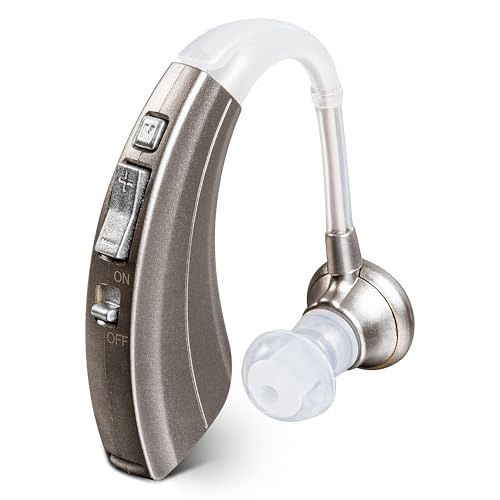
The Britzgo BHA-220S is a behind-the-ear (BTE) hearing amplifier that emulates the form factor of prescription hearing aids at a fraction of the cost. It uses a digitally designed circuit for multi-frequency sound processing, and the adjustable tube can be swapped to fit either ear. Four frequency settings allow the user to dial in the appropriate response for quiet rooms, noisy environments, or TV watching.
It runs on a standard 13-size battery, which lasts about a week with typical daily use. Volume and frequency buttons on the body emit a beep to confirm adjustments, making it usable without needing to see the device. The design is light (0.2 pounds) and relatively discreet compared to over-ear headphones, though the plastic housing and visible tubing are clearly less premium than medical-grade aids.
Long-term users have purchased this unit repeatedly over six years, noting it improves a 78% hearing loss. The main weaknesses are build quality — the earpiece cable can fail if pulled, and physical bumps can accidentally change settings. Several customers report failure after the return window, so an extended warranty or careful handling is recommended. It’s a value-driven option for those who want BTE form without the audiology markup.
Why it’s great
- Behind-the-ear design is more discreet than pocket amplifiers
- Four frequency modes adapt to different listening environments
- Affordable alternative to prescription hearing aids for moderate loss
Good to know
- Build quality is inconsistent — some units fail within months
- Settings can be accidentally changed when adjusting the device
FAQ
Is a personal sound amplifier (PSAP) the same as a hearing aid?
How much gain do I need for moderate hearing loss?
Will wireless TV headphones work with my TV?
Can I use amplifying headphones with hearing aids?
Final Thoughts: The Verdict
For most users, the amplifying headphones for hard of hearing winner is the SuperEar SE9000HP because it combines high 50dB gain with frequency tuning and rechargeable batteries at a reasonable price. If you want the best TV-specific experience, grab the Avantree Ensemble for its simple dock system and clear dialogue. And for maximum versatility across rooms and devices, nothing beats the Joanbro IR2 with its three interchangeable microphones.