
Rechargeable batteries only save you money if you have a charger that actually finishes the job. Most basic chargers stop too early, cook your cells, or can’t revive the ones you thought were dead. An analog-spec smart charger changes that — it gives you per-cell control, real data, and the power to restore batteries your old charger tossed in the trash.
I’m Min — the co-founder and writer behind Gadgets Feed. I’ve spent months analyzing charge curves, voltage cutoffs, and internal resistance thresholds across dozens of battery charger models to find the units that deliver genuine diagnostics without breaking the bank.
Whether you need to refresh a set of NiMH AAs or maintain a deep-cycle marine battery, this guide breaks down the specs that actually matter so you can pick the best analog battery charger for your specific setup.
How To Choose The Best Battery Charger
Match the charger to your chemistry, your capacity, and your need for data. A charger that works for 2000 mAh NiMH AAs will not properly handle a 100 Ah AGM automotive battery — and vice versa. Focus on per-slot independence, refresh/analysis modes, and charge current adjustability.
Per-Slot Independence vs. Series Charging
Cheap chargers wire batteries in series, meaning the whole string stops when one cell reaches full voltage. That leaves weaker cells undercharged and strong cells overcharged over repeated cycles. A charger with individually controlled channels — each with its own cutoff circuit — charges each battery to its actual full capacity and extends overall pack life significantly.
Refresh, Test, and Desulfation Modes
Beyond simple charging, look for a discharge-charge cycle that measures real capacity in mAh. This lets you identify the weak link in a set. For NiMH cells, refresh mode runs multiple discharge-charge cycles to break down crystal formations that cause “dead” cells to return to usable capacity. For lead-acid, a desulfation mode applies high-frequency pulses to dissolve sulfate crystals that reduce battery life.
Charge Current and Battery Chemistry Match
Charging a 2000 mAh AAA cell at 2000 mA will overheat and damage it. A good charger lets you select current per slot — typically 200, 500, 700, or 1000 mA for NiMH. For automotive batteries, you want a unit that can switch between 2-amp maintenance and 10-15 amp rapid charging, with a chemistry selector for standard lead-acid, AGM, gel, or lithium.
Quick Comparison
On smaller screens, swipe sideways to see the full table.
| Model | Category | Best For | Key Spec | Amazon |
|---|---|---|---|---|
| Opus BT-C2400 | NiMH Analyzer | Restoring dead NiMH cells | 20,000 mAh per-slot limit | Amazon |
| Panasonic BQ-CC65 | NiMH LCD | Eneloop battery diagnostics | 4-slot LCD with voltage display | Amazon |
| CRAFTSMAN CMXCESM258 | Auto Maintainer | Multi-battery car charging | 12A charge / 6V-12V | Amazon |
| Battery Tender 022-0234-DL-WH | Auto Smart LCD | Premium multi-step charging | 15 / 8 / 2A selectable | Amazon |
| EBL 16-Bay LCD | NiMH Multi-Bay | Large AA/AAA batch charging | 16 slots / 2000 mA per slot | Amazon |
| Schumacher SC1446 | Auto Manual Timer | Manual control for dead batteries | 200A engine start / 10A charge | Amazon |
| Associated US20 | Heavy-Duty Manual | Professional shop use | 40A charge / 200A crank assist | Amazon |
In‑Depth Reviews
1. Opus BT-C2400 Battery Charger Analyzer

The Opus BT-C2400 is the benchmark for NiMH analysis chargers. Each of its four channels runs independently with adjustable currents up to 1400 mA (outer slots) and a 20,000 mAh capacity ceiling — enough for even the highest-capacity AA cells on the market. The backlit LCD cycles through voltage, elapsed time, charge current, and measured mAh capacity, giving you lab-grade data for matching cells.
Where this charger truly earns its reputation is in recovery. The refresh mode runs a 3-cycle discharge-charge loop that dissolves crystal formations in old NiCd and NiMH batteries, often restoring cells that other chargers label as dead. Users report reviving 8-year-old cells and batteries that showed “Null” on competitors’ displays. The internal resistance test provides a quick health check, though the manual lacks reference values for normal versus bad readings.
On the downside, the interface is functional but not intuitive — the manual is sparse, and once you lock a mode, you can’t switch without unplugging the battery. Still, for the price, you get restoration capability that rivals units costing twice as much. It is the clear choice for anyone managing a large fleet of rechargeable AA and AAA cells.
Why it’s great
- Refreshes cells other chargers reject outright
- Per-slot current adjustment for precise charging
- Measures mAh capacity for battery matching
Good to know
- Interface is basic and requires manual monitoring during cycles
- Outer slots limited to 1400 mA, inner slots to 1000 mA
- Small mAh reading variations between different units
2. Panasonic BQ-CC65 Advanced Eneloop Charger

Panasonic engineered the BQ-CC65 specifically for its own Eneloop and Eneloop Pro cells, and the integration shows. The LCD panel displays real-time voltage, discharge mAh, and charge time for each of the four slots independently. It also includes a USB-A 5V/1A output port on the front, turning the charger into a backup power source for phones or earbuds — a useful convenience for travel.
Charge times are genuinely fast: a full set of four Eneloop Pro cells reaches capacity in about four hours, while two cells cut that to two hours. The refresh discharge mode runs a controlled drain before recharging, breaking down voltage depression in older cells. Multiple users confirm it revived batteries that had been sitting unused for years, restoring them to near-rated capacity.
The main limitation is chemistry lock-in — it supports only NiMH cells and does not work with NiCd, lithium, or any other chemistry. The build quality is top-tier, with a solid feel and a cool blue backlight that is easy to read in dim light. For Eneloop users who want diagnostics without the complexity of a full analyzer, this is the optimal match.
Why it’s great
- Individual LCD indicators show voltage and mAh per slot
- USB output port adds device charging capability
- Refresh mode restores old Eneloop cells effectively
Good to know
- Works with NiMH Eneloop cells only — no NiCd support
- Premium price point for a dedicated NiMH charger
- Requires at least two batteries to initiate charging in some slots
3. Battery Tender 15 AMP LCD Charger

The Battery Tender 022-0234-DL-WH is a multi-step smart charger that handles everything from lithium (LiFePO4) to AGM, gel, and standard flooded lead-acid batteries. It offers three selectable amperage levels — 15A for rapid charging, 8A for standard charging, and 2A for maintenance — and automatically switches to float mode once the battery reaches full voltage. The interactive LCD shows charging rate, battery type, percentage charged, and error messages.
This unit earned R&T’s “Best of the Best” designation thanks to its ISM adaptive charging, which monitors voltage drop under load and adjusts output to prevent overcharging. The spark-proof connection and reverse polarity detection add a layer of safety when working in tight engine bays. Users report fully charging deeply discharged car batteries (including AGM H9s) in just a few hours and maintaining them indefinitely without cooking the cells.
The one trade-off is the lack of a remote status LED — you need to walk over to the unit to check its display. It also needs a minimum residual voltage to detect the battery; a completely dead battery may require a separate jump start before the charger engages. For anyone maintaining multiple vehicles with different battery types, the chemistry flexibility and 5-year warranty make this a long-term investment.
Why it’s great
- Chemistry selectable for lithium, AGM, gel, and lead-acid
- ISM adaptive charging prevents overcharge on sensitive batteries
- Spark-proof clamps and reverse polarity protection
Good to know
- No external LED — must read LCD at the unit
- Will not charge a battery at zero voltage without a boost
- Heavier and bulkier than basic maintainers
4. CRAFTSMAN CMXCESM258 Battery Charger
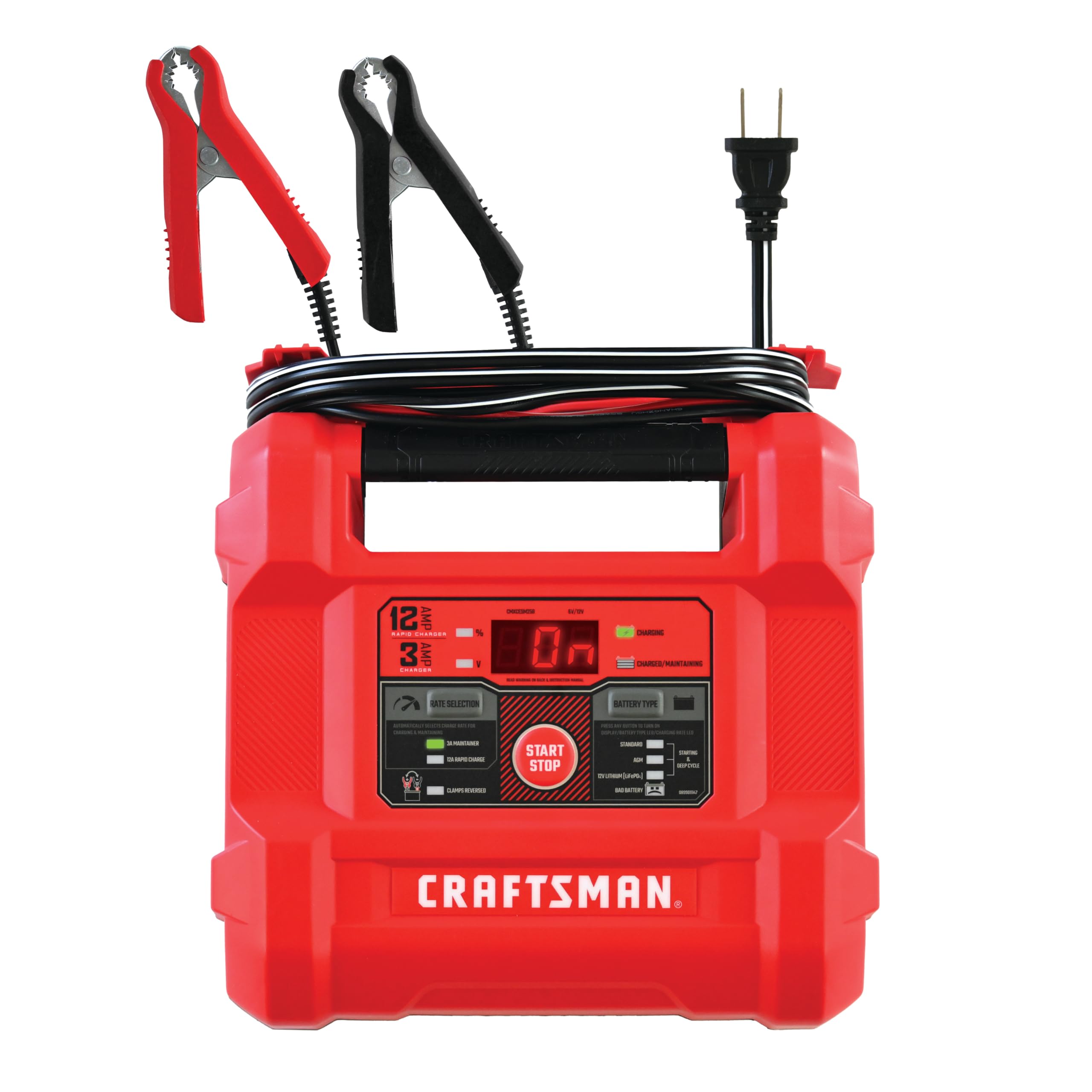
The CRAFTSMAN CMXCESM258 packs four functions into one box: charging, maintaining, testing, and reconditioning. It delivers 12 amps on 12V mode for rapid charging, 3 amps for maintenance, and 2 amps for 6V batteries. The built-in battery tester runs a quick health diagnostic, while the desulfation mode applies high-frequency pulses to break down sulfate crystals that slowly kill lead-acid batteries over time.
Compatibility is broad — it supports standard flooded lead-acid, AGM, lithium (LiFePO4), and deep-cycle batteries, making it a single-tool solution for cars, trucks, motorcycles, ATVs, and marine applications. The smart trickle charge switches to float mode automatically once the battery reaches full voltage, preventing damage from prolonged connection. Users report it brings a completely dead car battery back to 100% in about five hours and maintains a winter-stored vehicle without issues, even in -20°F temperatures.
Some users note that the clamps could be sturdier and the overall casing feels more consumer-grade than pro-shop tough. But at this price point, the combination of a tester, desulfator, and multi-chemistry smart charger is hard to beat. It is the most versatile mid-range automotive charger available.
Why it’s great
- 4-in-1: charge, maintain, test, recondition
- Desulfation mode extends battery life significantly
- Works with standard, AGM, lithium, and deep-cycle batteries
Good to know
- Clamps feel smaller than professional-grade alternatives
- Casing is mostly plastic — less durable in heavy shop use
- AC powered only — not a portable boost pack
5. EBL 16-Bay AA/AAA LCD Charger

The EBL 16-bay charger solves a specific problem: charging a large number of AA and AAA cells simultaneously without sacrificing per-slot intelligence. Each of the 16 slots operates independently, meaning you can mix AA and AAA batteries from different brands and at different charge levels — no pairing required. The iQuick technology delivers up to 2000 mA per slot, charging a set of 2800 mAh AA batteries in roughly two hours, or 1100 mAh AAA cells in under an hour.
A green LCD screen displays a 5-bar status indicator for each slot, along with automatic detection of bad or non-rechargeable cells, which it skips to prevent damage. The built-in MCU control system provides protection against overcharging, overheating, short-circuiting, over-current, and reverse-polarity. The included AC power cable means there is no external wall wart to lose, and the 100-240V input range works worldwide.
The only practical drawback is that the top 20 percent of the LED bar does not visually change to indicate the trickle charge phase, so you cannot tell at a glance when a battery is in maintenance mode versus still charging. Also, removing AAA batteries requires a small tool or fingernail because the plastic slots hold them tightly. For anyone managing a household with dozens of rechargeable AA and AAA cells, this is the most space-efficient high-capacity option.
Why it’s great
- 16 independent slots charge any mix of AA/AAA cells
- Fast 2000 mA per-slot charging for quick turnaround
- Detects and skips bad or non-rechargeable batteries
Good to know
- AAA batteries are tight and require effort to remove
- LCD bars do not indicate trickle charge vs. active charge
- Best performance with EBL branded cells
6. Schumacher SC1446 Wheeled Charger

The Schumacher SC1446 is a manual timer-controlled charger and engine starter built for deeply discharged batteries that confuse automatic chargers. It delivers 200 amps for engine starting, 40 amps for a rapid boost charge, 20 amps in 6V or 12V boost mode, and 10 amps for standard charging. The 135-minute timer gives you precise control over how long the battery receives current — critical when charging a dead battery that needs a sustained push rather than a smart charger’s cautious ramp-up.
The analog ammeter provides a visual indication of charge rate, though it is more approximate than a digital readout. The wheeled design with a retractable handle makes it easy to roll around a garage or shop, and the heavy-duty steel case and clamps feel built for abuse. Users report successfully starting twin-battery diesel trucks and charging deeply discharged lawn mower and car batteries that automatic chargers could not detect.
The manual timer is both the key feature and a limitation — it requires you to stay present or set the timer and check back, as there is no automatic shutoff at full charge. The clamps are adequate but not huge, and some users found them barely fitting over thick battery terminal posts. For hobbyists working with older lead-acid batteries or vehicles that sit long enough to fully drain, the manual control is an advantage. For daily maintenance, a smart charger is easier to live with.
Why it’s great
- 200-amp engine start for deeply dead batteries
- Manual timer gives full control over charge duration
- Wheeled and compact for easy garage movement
Good to know
- No automatic shutoff — requires manual timer supervision
- Analog gauge provides vague current readout
- Not suitable for lithium or sensitive AGM batteries
7. Associated Equipment US20 Charger

The Associated Equipment US20 is a no-compromise industrial-grade charger built in the USA for daily professional use. It delivers 40 amps on both 6V and 12V settings, with a separate 10-amp low-rate mode for maintenance charging. The 200-amp cranking assist provides enough current to turn over most car and light truck engines, even with a heavily discharged battery. The analog dial-type controls are simple and intuitive — set voltage, set rate, and let the timer handle the rest.
Build quality is the standout feature here. The steel case, heavy-duty transformer, and robust wheels are designed to survive decades in a shop environment — one user confirmed the unit survived being run over by a vehicle and still worked. The manual includes a desulfation function that applies pulses to break down sulfate buildup, though the main dials lack any digital readout for voltage or current. Charging is fast: a deeply discharged car battery reaches full charge in roughly 90 minutes on the 40-amp high setting.
The US20 is not for casual homeowners — it is large (30 inches tall, 37 pounds), expensive, and lacks the automated safety features of modern smart chargers. There is no reverse polarity alarm or automatic shutoff when the battery is full. But for a shop charging multiple heavy batteries daily, the long-term reliability and raw power justify the investment. Expect 20-plus years of service.
Why it’s great
- 40-amp charging for rapid turn-around of large batteries
- American-made with 20+ year expected lifespan
- Simple dial controls — no complex menus or programming
Good to know
- No automatic multi-stage charging — manual operation only
- Very heavy and large — not portable for roadside use
- Does not support lithium or sensitive AGM chemistries
FAQ
Can I charge different brand NiMH batteries in the same charger at the same time?
What does the “mAh” reading on a charger tell me about my battery health?
Is a manual timer charger better than an automatic smart charger for car batteries?
Final Thoughts: The Verdict
For most users, the best analog battery charger winner is the CRAFTSMAN CMXCESM258 because it combines a 12-amp charge rate, a built-in tester, desulfation mode, and support for standard, AGM, lithium, and deep-cycle batteries in one package. If you need deep NiMH diagnostics and cell revival, grab the Opus BT-C2400. And for a no-maintenance automotive charger that handles multiple vehicles and battery chemistries, nothing beats the Battery Tender 022-0234-DL-WH.