
Our readers keep the lights on and my morning glass full of iced black tea. As an Amazon Associate, I earn from qualifying purchases.
Specs are compiled from manufacturer listings and verified buyer reviews and can change over time — please confirm the key details on the product page before buying.
A dead battery on a cold morning is never really the battery’s fault — it’s usually the fact that nobody checked it until it was too late. An analog battery tester fixes that by putting a real load on your 6V or 12V battery and showing you, on a physical needle gauge, whether it can actually deliver the cranking amps your starter demands. You do not need to be a mechanic to use one, and you do not need a laptop or an app — just two clamps, a few seconds, and a reading you can trust.
I’m Min — the founder and writer behind Gadgets Feed. This guide is built by comparing the manufacturers’ published specifications and the patterns across verified customer reviews, so you get each pick’s real strengths and trade-offs instead of marketing spin.
Here is the honest bottom line: analog battery tester choices come down to load amperage, CCA range, and build quality — all covered in plain terms below.
Our Picks at a Glance


How To Choose The Best Analog Battery Tester
Choosing an analog battery tester means matching the tool to the batteries you actually own. The most important number is the load amperage — the amount of current the tester pulls from the battery to simulate what your starter motor needs on a cold morning.
Match the load test to your battery size
Most home units pull a 100-amp load on 12V batteries and a 50-amp load on 6V batteries. That is plenty for cars, trucks, SUVs, motorcycles, boats, and RVs. If you work on heavy equipment or large commercial batteries, you may want a carbon pile tester with variable load capability up to 500 amps, like the Clore Automotive Solar 1874.
Check the CCA range
CCA, or Cold Cranking Amps, measures how much current a battery can deliver at freezing temperatures. A tester rated for 1,000 CCA covers nearly every car and light truck battery sold today. If you only test small batteries like motorcycle or lawn tractor units, a lower range is fine.
Look at the clamps and case
Heavy-duty, color-coded clamps (red for positive, black for negative) make a real difference when you are reaching into a tight engine bay. A shock-resistant steel case protects the meter if you drop it on concrete. Rubber-insulated handles keep your hands safe while the tester is under load.
Quick Comparison
| Model | Best For | Load Test | CCA Range | Battery Types | Amazon |
|---|---|---|---|---|---|
| Schumacher BT-100★ Best Overall | Best Overall – full diagnosis | 100A (12V) / 50A (6V) | Up to 1,000 CCA | 6V & 12V | Amazon |
| Clore Solar 1874Pro-Grade Pick | Pro-level variable load | Variable to 500A | Up to 1,000 CCA | 12V | Amazon |
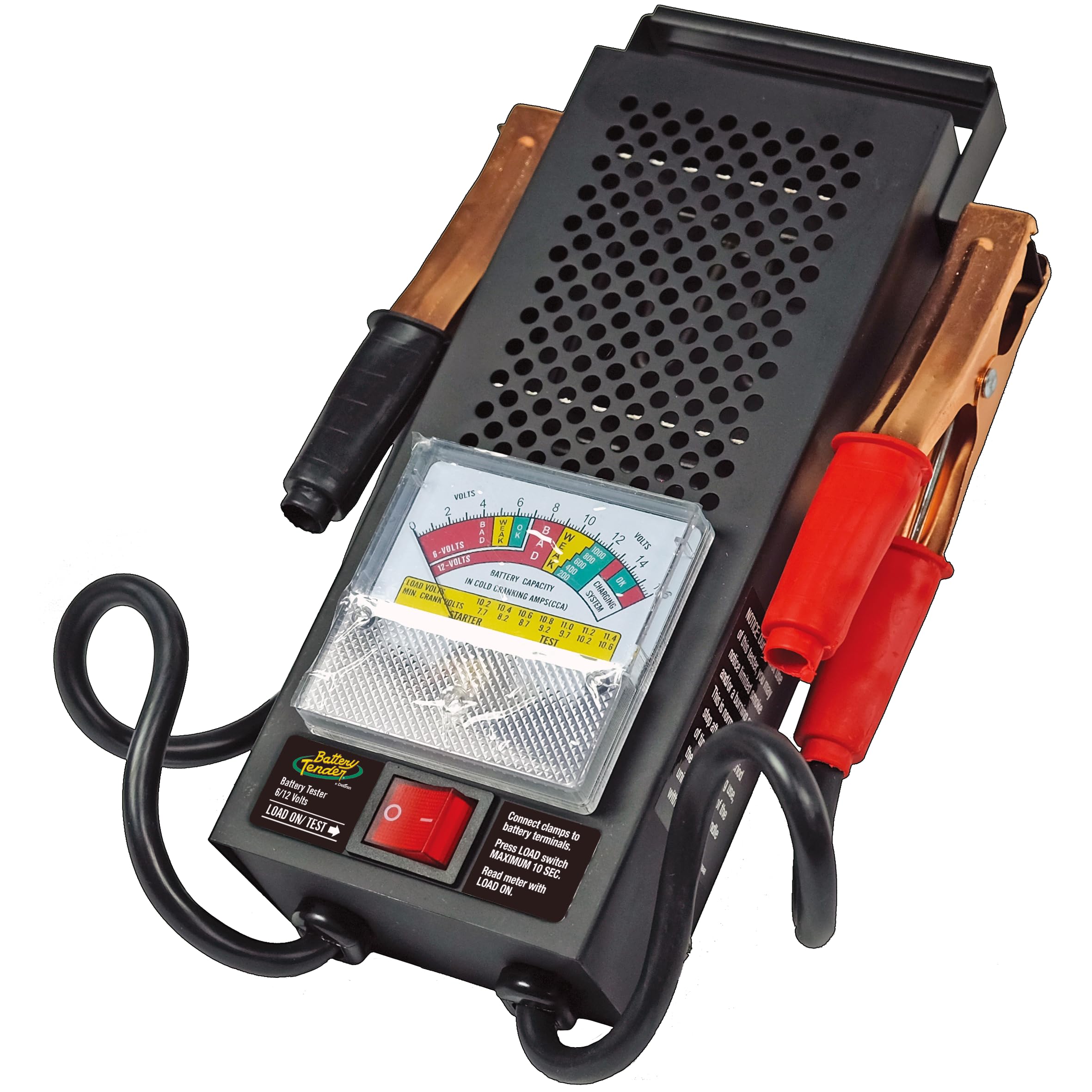
| Battery Tender 026-0020Shop Favorite | Everyday reliability | 100A (12V) / 50A (6V) | Up to 1,000 cranking amps | 6V & 12V | Amazon |
| Milton 1260M | Chrome, simple operation | 120A (12V) | 1,000 CCA | 6V & 12V | Amazon |
| Milton 1260 | Budget-friendly classic | 100A (12V) | 1,000 CCA | 6V & 12V | Amazon |
| TOPDC TD-BLT100A | Ventilated heavy-duty use | 100A (12V) / 50A (6V) | 100–1,000 CCA | 6V & 12V | Amazon |
| Weishuo HL-BATTERYTESTER | Quick 5-second checks | 100A (12V) / 50A (6V) | — | 6V & 12V | Amazon |
| Yaegoo 243-S | Value with ventilation | 100A (12V) / 50A (6V) | Up to 1,000 CCA | 6V & 12V | Amazon |
| QWORK 24338 | Entry-level pricing | 100A (12V) | Up to 1,000 CCA | 6V & 12V | Amazon |
In-Depth Reviews
1. Schumacher Electric BT-100
Our pick — over 4.5★ from 4,000+ verified ratings; the strongest balance of quality and price.
The shop-grade classic that tests battery, alternator, and starter in one unit
Service facilities reach for the Schumacher BT-100 because it runs three separate checks with one device. You get battery analysis to judge capacity and state of charge, a charging system test to spot a failing alternator, and a starter motor test that flags excessive current draw — the hidden reason some cars crank slow and wear out batteries early. That triple-duty approach makes it the most complete tool in this lineup.
It is built for serious use, with a durable steel case, a baked enamel shell, heavy-duty clamps that work on both top- and side-terminal batteries, and a rubber-insulated carrying handle. It handles 6V and 12V batteries up to 1,000 cranking amps, with a 50-amp load test for 6V and a 100-amp load test for 12V. A top-mounted rocker switch and a highly visible meter face keep operation simple.
What wins people over is the sheer quality — it is the most-praised aspect by a wide margin. One long-term owner notes it replaced a previous BT-100 that lasted roughly 20 years, and that it quickly identifies whether a problem is the battery or something else. Buyers report the first use produces a little smoke and a burning smell, which the maker says is a normal burn-in and stops quickly. The meter also runs hot during testing, so treat it with care.
top pick power
- Three tests in one: battery, charging system, and starter motor
- Steel case with baked enamel shell for real durability
- Clamps fit both top- and side-terminal batteries
- Rocker switch and large meter make it fool-proof to use
basic extras
- Gets hot during operation, so work quickly
- First-use smoke is normal but can be alarming
- Some units report durability issues after two years
best overall: you want one tool that checks the whole starting system — battery, alternator, and starter — rather than just the battery alone.
skip for pros: you only need a quick pass-fail on a single car battery and want to spend less on a simpler tester.
2. Clore Automotive Solar 1874
The variable-load carbon pile unit that catches what plain voltage tests miss
The Clore Solar 1874 is a different breed of tester. Instead of a fixed 100-amp load, it uses a carbon pile with variable load capability up to 500 amps, letting you dial in exactly how much stress to put on a battery. Owners mention it caught a battery that showed 13+ volts but collapsed at a 100A load — a failure a simple voltmeter would have missed — while new batteries passed a 450A test. That is the real value of a load tester: voltage alone is misleading.
It tests batteries up to 1,000 CCA and enables both starter and alternator assessment, all read on large, easy-to-read gauges. The heavy-duty clamps are designed to penetrate corrosion on battery terminals, which is a common source of false readings in cheaper units. The amp meter has been verified as accurate against a high-end Klein clamp meter across a 50A to 400A range.
The honest trade-offs are worth knowing. The load knob needs 4-5 full turns before the load engages, and it ships in the on position — you must turn the knob left to the hard stop before connecting. The clamps draw some criticism for feeling flimsy, and an occasional unit reports a melting lead on the battery post, so watch for overheating. But owners who run shops say it works as well as the units at parts stores.
heavy duty muscle
- Variable load up to 500 amps for professional testing
- Caught a battery that failed at 100A despite showing 13+V
- Large, easy-to-read gauges for quick results
- Clamps cut through terminal corrosion for reliable contact
setup fuss
- Knob needs 4-5 full turns before load engages
- Ships in the on position — must turn to hard stop first
- Clamps feel flimsy to some owners
- An occasional unit reports a melting battery-post lead
for big loads: anyone testing heavy batteries or commercial equipment who needs a load beyond the standard 100 amps — this is the only pick here with a 500A ceiling.
not for novices: casual home users who want a simple clamp-and-read tool without learning the knob procedure.
3. Battery Tender 026-0020
The dependable workhorse with a color-coded gauge that makes results obvious
The Battery Tender 026-0020 tests battery condition and load, checks starter motor draw, and assists with charging system diagnosis — all through a single toggle switch. what separates it is the color-coded display that quickly points you to the health zone, so you do not need to interpret a needle position. It handles starter and deep cycle batteries for cars, pickup trucks, SUVs, motorcycles, RVs, boats, and ATVs with up to 1,000 cranking amps.
It performs a 100-amp load test on 12V batteries and a 50-amp load test on 6V batteries, covering automotive, marine, power sport, and RV applications. The rubber-insulated carrying handle and color-coded heavy-duty alligator clamps are built for safety and reliability, and the 2.1-pound weight makes it easy to carry between vehicles. It is clearly marked, so first-time users can read results without a manual.
The thing everyone raves about is how well it works across both 12V and 6V batteries while staying simple to use. A rental company employee who uses one almost daily says it holds up and lasts longer than a previous tester. The known quirks: it gets hot in a hurry during a load test, and the first use produces smoke that smells like burning tires — normal for this style, but worth expecting. Some owners also note the clamp handle can bend with heavy use.
daily driver: This is the tester that keeps working when you test batteries every single day — a rental fleet owner confirms it outlasts its predecessor under near-daily load.
pricey habit: It runs hot fast and smells like burning rubber on first use, so keep load times short and let it cool between tests.
4. Milton 1260M 120 AMP

A chrome-finished 120-amp tester that fans of old-school analog gear prefer
That extra margin is useful if you regularly test larger batteries or just want a tougher test. The chrome finish gives it a classic shop look, and the analog display is easy to read at a glance. It tests 6V and 12V batteries with a 1,000 CCA rating.
Buyers who prefer analog over digital are drawn to this one. A crane operator who tests batteries on job-site equipment says it works better than an older model and is easy to use. Another owner simply states a strong preference for this over a digital tester, calling it great and inexpensive. The Milton name itself carries trust, with one buyer noting it is “a name you can trust.”
The honest note is that the leads are not as heavy-duty as older Milton testers, so they deserve gentle handling. It also runs hot during the load test — the 12-second cut-off is there for a reason, so respect the duty cycle. No digital failsafes exist here, meaning you can burn out the coils if you hold the load too long.
quick boost: you like the feel of a classic analog tool and want a slightly higher 120-amp load for larger 12V batteries.
tight spaces: you expect heavy-duty leads like older Milton units — these are lighter and need care.
5. Milton 1260 100 AMP
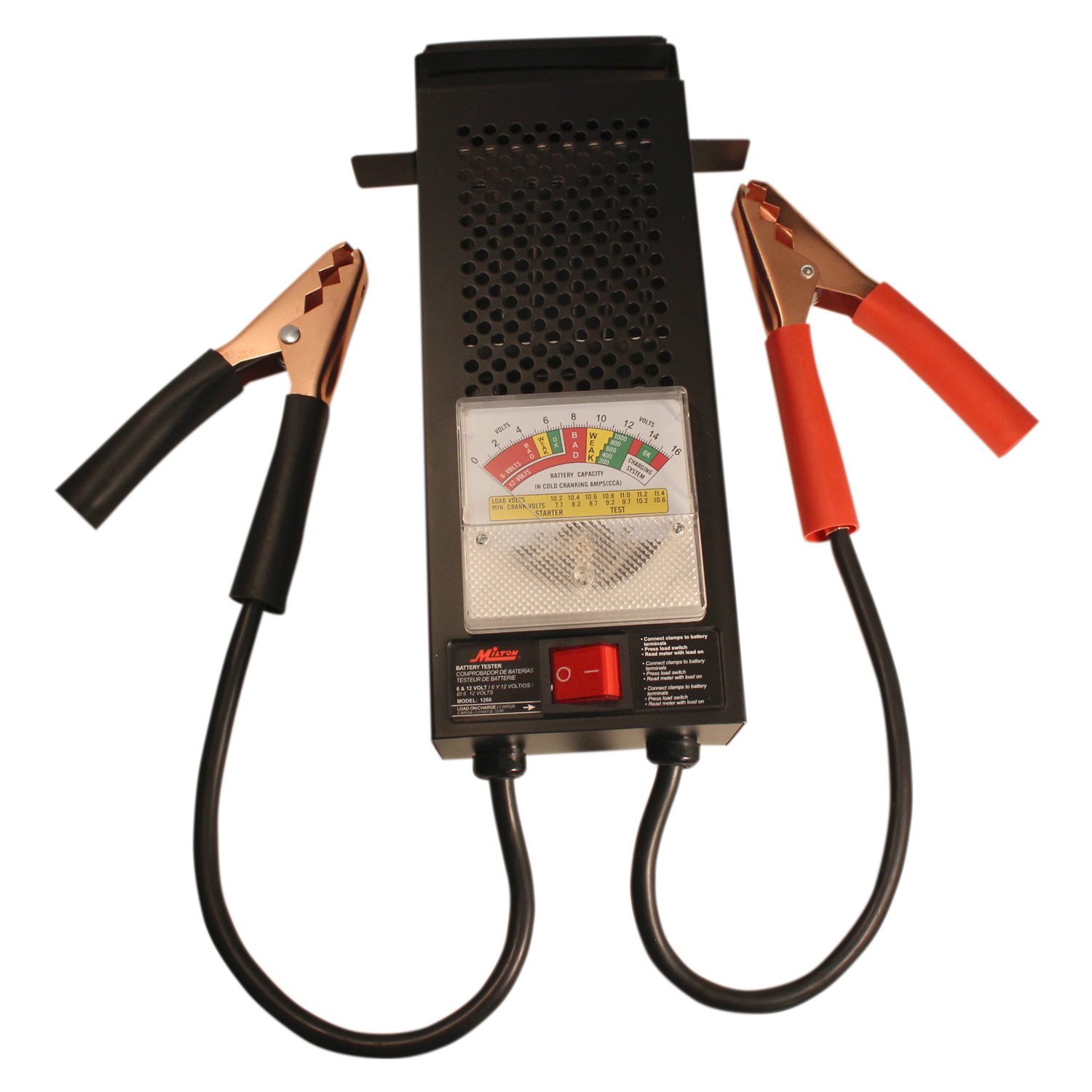
The no-frills 100-amp tester that proves simple tools still get the job done
The Milton 1260 is the straightforward option: it tests 6V and 12V batteries, uses an analog display that is easy to read, and is rated for 1,000 Cold Cranking Amps. There is no chrome, no extra features — just a dependable 100-amp load tester that does exactly what it says. It has been used on a 1941 Farmall tractor and a 2007 Toyota, proving its range across old and new machines alike.
What wins people over is the quality you get for the price, and the simple operation. An owner of vintage equipment says it is very good for the price and works well as per the instructions. The main suggestion from buyers is that slightly longer leads would make it more comfortable to use on some vehicles, so expect to work a bit closer to the battery than you might with a pro unit.
honest performer: This is the test-the-battery-without-any-fuss choice — clamp on, read the needle, done, with a 1,000-CCA range that covers most vehicles.
minor flaws: Leads could be longer, and reliability gets mixed feedback — some owners swear by it, others report occasional inconsistent results.
6. TOPDC TD-BLT100A
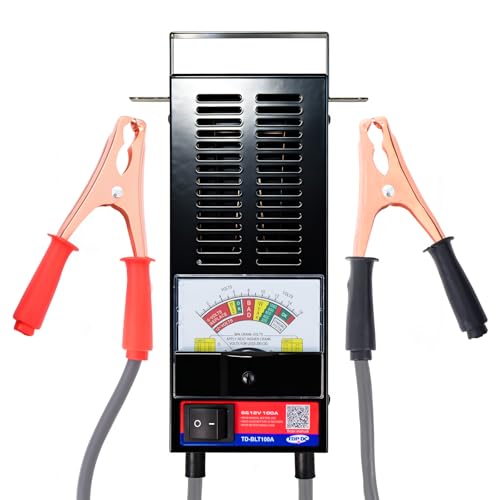
A 100-amp tester with ventilation holes built in to keep the heat down
The TOPDC TD-BLT100A measures Cold Cranking Amps from 100 to 1,000, giving you accurate battery health checks on cars, motorcycles, RVs, boats, and ATVs. Its defining feature is the perforated, ventilated design with circular cooling holes — a practical answer to the heat that plagues load testers. It uses a 100-amp load on 12V batteries and a 50-amp load on 6V batteries for precision testing.
The color-coded clips (red and black) with heavy-duty alligator ends make connections clear and reliable, while the rubber grips on the insulated carrying handle keep it comfortable to transport. A shock-resistant meter and clear-view display round out a design that is compact enough for easy storage. It is built for convenience, whether you are in a home garage or testing on the go.
Buyers describe it simply as a good deal that works great for the price, with functionality being the standout quality. The single toggle switch keeps operation straightforward. There is no known recurring complaint beyond the normal heat that comes with any load test, and the ventilation is a thoughtful step toward managing it.
budget pick: the cooling holes — a real advantage if you test multiple batteries in a row and want the tester to shed heat faster.
pro demands: you need extra tests like alternator or starter diagnosis, since this one focuses on battery health and cranking power.
7. Weishuo HL-BATTERYTESTER
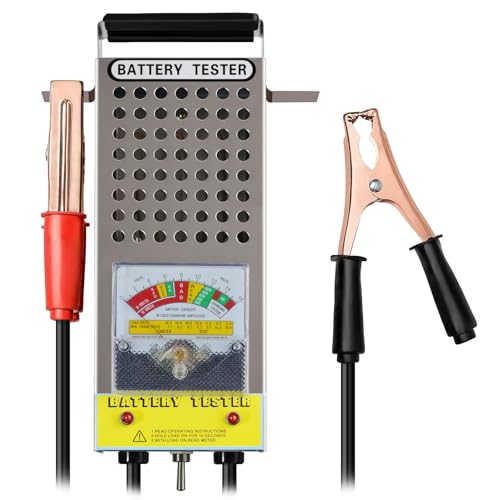
A 5-second load check with a built-in tungsten filament that glows under load
The Weishuo battery tester is designed for speed, claiming a 5-second check that tells you whether a battery is good. It uses a tungsten filament load to simulate the working voltage of the battery, and you judge the result by reading the voltage meter display. A reliable sign is the built-in load element glowing red within 10-12 seconds on a decent battery — a simple visual cue while the needle moves.
It is compatible with 6V and 12V batteries in cars, vans, trucks, SUVs, RVs, motorcycles, ATVs, boats, and lawn tractors. The portable handle on top and insulated copper clips with grooved teeth make it easy to latch onto different battery types anywhere. It comes with an English manual and a CE specification mark, so you know it meets a recognized standard.
Buyers call it simple, reliable, and good value — one owner says it is “more reliable than the digital version” they compared it against. It helped a driver find a weak car battery just before a cold wave hit, which is exactly the use case this tool exists for. One unit arrived with a loose piece of solder inside that needed removal, and a sticker has a misspelled word, so quality control is not flawless.
fast and light
- 5-second check for quick pass-fail results
- Tungsten filament glows red on a decent battery
- CE specification mark for recognized safety
- Compact all-in-one design with carry handle
quality lottery
- One unit arrived with loose solder inside
- Misspelled word on the toggle switch sticker
- Lower temperature rated at 50 °C, so avoid extreme heat
portable tests: quick roadside checks and helping neighbors diagnose a weak battery without driving to a shop first.
critical work: minor cosmetic and assembly flaws appear on some units, so inspect yours when it arrives.
8. Yaegoo 243-S

A value-priced tester whose perforated surface stops the overheating problem
The Yaegoo 243-S works on 6V and 12V batteries up to 1,000 CCA, with a 50-amp load test for 6V batteries and a 100-amp load test for 12V batteries. What makes it interesting is the voltage accuracy of ±0.2V, a spec that gives you confidence in the needle reading. The perforated, ventilative surface on the case is designed to avoid overheating during heavy-duty use.
An insulated carry handle at the top makes it safe and comfortable to carry, and the copper clips come with red positive and black negative rubber grips so you never guess which clamp goes where. It tests battery condition, load, starter motor draw, and complete charging system diagnosis — the same range of checks as more expensive units. Customers note it takes the guesswork out of determining battery condition and works just as well as pricier options they used as auto techs.
The quality and value are the standout points, with one owner noting it performs like a more expensive shop version at a fraction of the price. The recurring gripe is the meter — it is poorly attached, and one owner glued it back on with GE Silicone. That is the one spot to check when yours arrives.
home garage: you want the full battery-plus-charging-system diagnosis at a value price, with ventilation to manage heat.
shop floor: you buy this one — the meter attachment has been the one consistent quality note in owner feedback.
9. QWORK 24338

The budget tester that replaced a unit with no noticeable difference in quality
The QWORK 24338 is the entry-level pick that punches above its price. It checks battery and voltage on cars, trucks, RVs, and golf carts — including both 6V and 12V batteries — with a maximum Cold Cranking Amps rating of 1,000. An alternator testing function lets you assess charging performance too, which is a lot of capability in a compact tool.
The shock-resistant steel case and heavy-duty copper-plated clamps are built for rigorous use, and the compact size with a handle makes it easy to store and carry. One buyer replaced an old tester that would have cost to replace and found no difference in quality at a third of the price. Another says it is a must-have, especially for the moment you get stuck on the road.
The honest caveat is durability: multiple reviewers point out it breaking after three months of use, and accuracy gets mixed feedback. The quality and ease of use earn consistent praise, but this is a tool for light, occasional use rather than daily shop work. The 10-second load time makes the tester run hot, so it needs a break-in period and caution.
first tester: you need a cheap, easy-to-read tester for the occasional battery check on your own vehicles.
advanced needs: you test batteries daily for a living — the durability record points to light-duty use only.
Understanding the Specs
Load Test Amperage
The load test is the heart of an analog battery tester. It pulls a fixed amount of current, usually 100 amps on a 12V battery and 50 amps on a 6V battery, to simulate what your starter motor demands. A battery that holds voltage under this load is healthy; one that drops into the red zone needs replacement. Some units, like the Clore Solar, offer a variable load up to 500 amps for heavier testing.
Cold Cranking Amps (CCA)
CCA measures how much current a battery can deliver at freezing temperatures. A tester rated for 1,000 CCA covers nearly every car and light truck battery sold today. If you only test small batteries like motorcycles or lawn tractors, a lower range works fine. Matching the tester’s CCA range to your battery’s rating gives you the most accurate health reading.
FAQ
What is the difference between an analog and digital battery tester?
How long should I hold the load test on the battery?
Why does my new battery tester smoke and smell on first use?
Can I test a 6V battery with a 12V tester?
What does CCA mean and why does it matter?
How does a load test catch a bad battery that a voltmeter misses?
What vehicles can I test with an analog battery tester?
How do I avoid overheating my battery tester during use?
Final Thoughts: The Verdict
For most buyers, the analog battery tester winner is the Schumacher BT-100 because it runs three complete checks — battery, alternator, and starter — in one rugged steel unit, and its quality is the most-praised aspect by a wide margin. If you want a color-coded gauge for instant, fool-proof results, grab the Battery Tender 026-0020. And for professional variable-load testing up to 500 amps, the Clore Solar 1874 is the one to reach for. The choice really depends on how much of the starting system you want to diagnose: a single battery check, or the whole cranking circuit.
How We Picked
We do not accept paid placement. Every pick is matched to a real buyer and a real use-case; we do not hands-on test units.
Sources & Methodology
Specifications: manufacturer listings and product documentation. Review insights: verified customer reviews, as of August 2026. Pricing: not shown on this page (it changes often); check the current price via the retailer link.
As an Amazon Associate, Gadgets Feed earns from qualifying purchases. This does not affect which products we feature.