
Our readers keep the lights on and my morning glass full of iced black tea. As an Amazon Associate, I earn from qualifying purchases.
Specs are compiled from manufacturer listings and verified buyer reviews and can change over time — please confirm the key details on the product page before buying.
An analog bike speedometer gives you that classic needle-on-dial look and a readout that works without Bluetooth pairing, app setup, or charging cables. The catch is that “mechanical” means the speed comes from a spinning gear against your wheel, so fit and installation decide whether you get a reliable needle or a frustrating paperweight. This guide focuses on which mechanical units actually work on modern bikes, what the MPH versus KPH difference means for you, and where the installation traps hide.
I’m Min — the founder and writer behind Gadgets Feed. This guide is built by comparing the manufacturers’ published specifications and the patterns across verified customer reviews, so you get each pick’s real strengths and trade-offs instead of marketing spin.
Your wheel type and setup tolerance decide which analog bike speedometer you should buy—a retro needle for a cruiser or a simple wired unit for a commuter.
Our Picks at a Glance

How To Choose The Best Analog Bike Speedometer
The biggest mistake buyers make is assuming every mechanical speedometer bolts onto any bike. Most of these units need a gear pressed against the front tire’s sidewall, driven by a small wheel that rubs the tire or a cable that connects to the axle. If your front wheel uses a quick-release skewer, the mechanism often cannot sit flush, which is why several units explicitly warn about this.
Know your wheel size and axle type first
Most mechanical units list a wheel-size range like 26, 27.5, 28, and 29 inches. If your bike falls outside that, the gear may not reach the tire. Quick-release front wheels are the most common failure point because the hub drive mechanism needs a solid axle to grip; check your axle before ordering rather than after.
Decide between MPH and KPH before you commit
Several analog speedometers are factory-set to KPH only, with a needle that tops out around 30-40 KPH. If you live where road signs read in miles, a KPH-only dial means constant mental math. Some units show both km and mph, but the cheap mechanical ones rarely give you a switchable unit.
Weigh the setup effort honestly
Mechanical units need a cable routed from the wheel gear to the handlebar head, plus a magnet aligned with a sensor if the unit is wireless. Buyers report that sensor alignment is fiddly and that picture-only instructions make the first install take longer than expected. If you want zero setup fuss, a wireless unit with a simple mount may save you an afternoon.
Quick Comparison
| Model | Best For | Display Type | Measurement | Mount Style | Amazon |
|---|---|---|---|---|---|
| CATEYE Padrone★ Best Overall | Wireless simplicity with big numbers | LCD | MPH/KM | FlexTight Tool-Free | Amazon |
| Alomejor MechanicalBudget Champion | Old-school look on gas bikes | LCD/LED | KPH | Handlebar Mount | Amazon |
| VGEBY Mechanical | Simple aluminum build | Mechanical | KPH | Handlebar Mount | Amazon |
| Dilwe Analog | Budget retro dials | Analog | MPH + KM | Handlebar Mount | Amazon |
| Tiiyee Mechanical | Classic aluminum look | Analog | KPH | Handlebar Mount | Amazon |
| Yosoo Retro | Vintage cruiser aesthetics | Analog | KPH | Handlebar Mount | Amazon |
| 4into1 Mini | Motorcycle custom builds | Analog | MPH (0-160) | 12mm Thread Cable | Amazon |
In‑Depth Reviews
1. CATEYE Padrone Wireless Bike Computer
Our pick — over 4★ from 2,000+ verified ratings; the strongest balance of quality and price.
The oversized display that ends the squint-and-guess game on every ride.
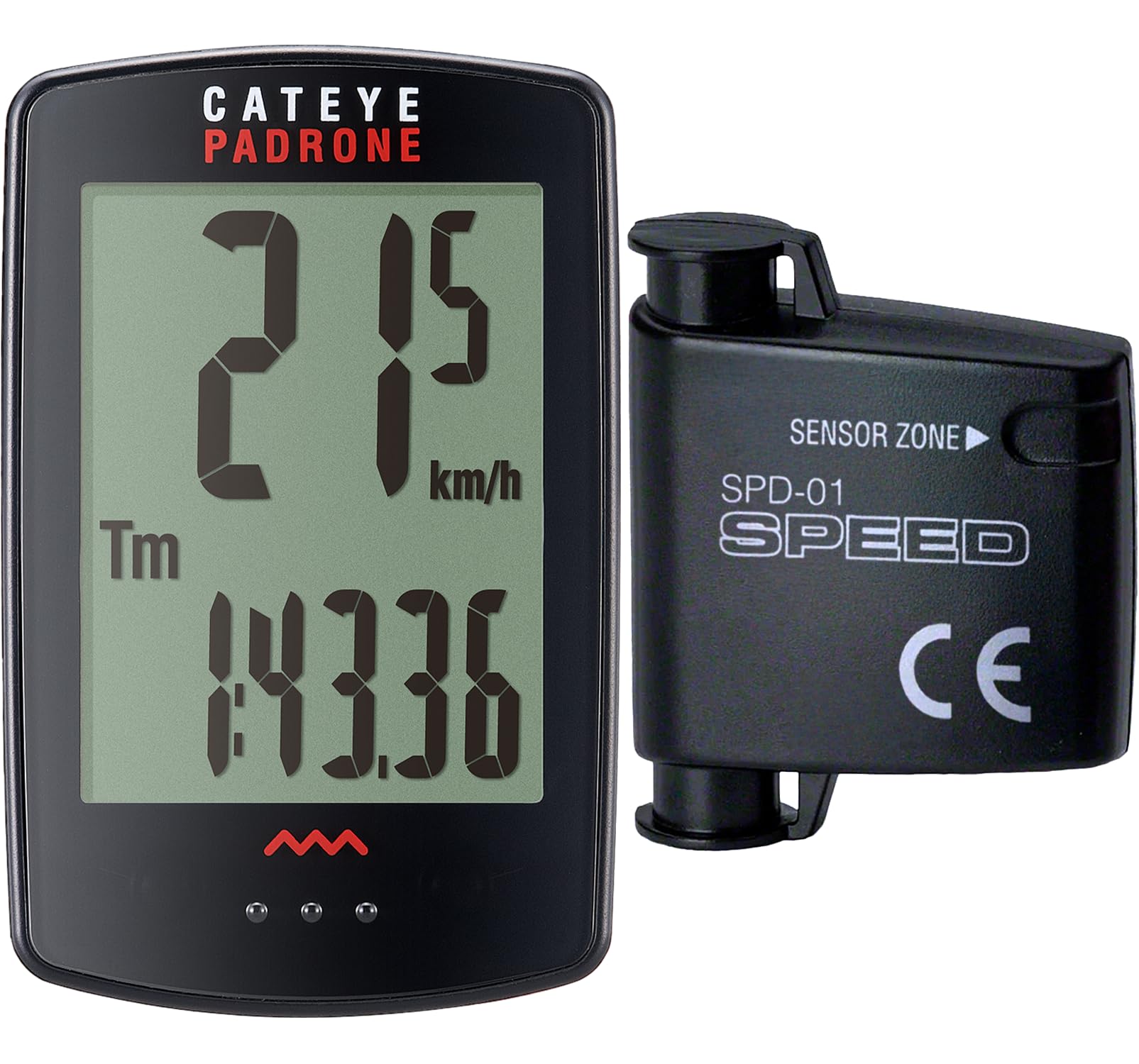
What wins people over is the display — the 5.5-centimeter screen is the most-praised feature, and it stays readable in direct sun, which is the make-or-break test for any bike computer. It shows current, max, and average speed, plus total distance, trip distance, elapsed time, and clock, all without GPS or heart-rate complexity. Just the core figures you want to measure a ride with confidence.
You can mount this without tools—the FlexTight mount adjusts by hand, and the wireless sensor sends data over a 70cm range (about 27.5 inches) for front-wheel use, no pairing needed. Owners mention accuracy holds up: one reviewer noted “Accurate vs phone app (0.02mi diff/20mi).” The auto start/stop pauses the timer when you stop at a light, so your average speed reflects actual riding time.
The recurring gripe is the sensor alignment, which several owners describe as fiddly and needing a specific inward angle. The picture-only instructions also frustrate some, and the unit is not compatible with an indoor trainer. But once aligned, the clean display and one-button ClickTec toggle make daily rides easy.
What Riders Rave About
- Sunlight-readable 5.5cm screen with big digits
- Tool-free FlexTight mount, installs by hand
- Auto stop/start keeps average speed honest
Where It Tests Patience
- Sensor alignment is tricky to get right
- Picture-only instructions frustrate first-timers
- No indoor trainer compatibility
Reach for it if: you want the easiest wireless setup with a screen you can actually read at speed.
Look elsewhere if: you plan to train on a stationary trainer — this one will not log those miles.
2. Alomejor Mechanical Speedometer
The old-school needle for gas bikes that still nails the retro vibe.
This aluminum alloy unit is the crowd-pleaser for motorized two-wheelers, with buyers who run gas bikes reporting they grab three at a time because they all work and look sharp. It is a pure mechanical computer, meaning no battery, no wireless pairing, just a gear-driven needle that reads your speed straight off the wheel.
Before you order, check your wheel: it works for 26, 27.5, 28, and 29-inch bikes only, and it needs a quick-release lever or large front-wheel clearance to mount. The handlebar mount keeps the install simple, and the included mounting base and sensor cover the basics. One happy owner summed it up plainly: “Good price, I have a 26 inch mountain E-bike so far so good!”
The honest catch: the needle reads in KPH, so riders in MPH regions do constant math. More importantly, a couple of units arrived without the washers needed to keep the mechanism turning smoothly, which led to scratching on the outside and stiff rotation. Check for complete hardware before you install.
Best for gas bikes: if you want a mechanical needle that matches a motorized cruiser’s aesthetic, this is the pick.
Think twice if: you ride a modern mountain bike with a standard quick-release front wheel — verify the clearance first.
3. VGEBY Mechanical Speedometer
A featherweight aluminum dial that claims mountain, road, and hybrid coverage.
At 0.33 kg, this mechanical cyclocomputer keeps the handlebar load light while offering odometer, speedometer, and trip meter functions in one dial. The aluminum alloy body is built for daily use, and the simple mounting system claims easy installation across various handlebars. For a rider who wants the retro needle without heavy hardware, the weight is a real selling point.
Owner reviews split on accuracy: some say it works and fits great, others question distance traveled, and one bluntly stated the speed diameter “does not work.” The key warning is specific: “The hub drive mechanism will not work on modern mountain bikes with quick change front wheels, regardless of wheel diameter.” If your front wheel has a quick-release skewer, this likely won’t spin properly—skip it for that setup.
The trade-off is that this is a niche tool. It shines on vintage bikes and solid-axle builds, but for anyone with a modern mountain bike, the fit risk is real and the review pattern reflects that split.
Get this for: a classic solid-axle bike where the gear can actually seat against the tire.
Skip it for: any modern mountain bike with quick-change front wheels.
4. Dilwe Mechanical Odometer Speedometer

The waterproof analog dial that tracks both MPH and kilometers in one glance.
Unlike several competitors locked to KPH only, this Dilwe unit shows both km and mph, which makes it the safer pick for riders who bounce between measurement systems. The high-grade plastic housing is waterproof for all-weather riding, and the reset knob swivels left or right to clear trip data and is reconfigurable. It covers 26, 27.5, 28, and 29-inch bikes plus general and sports bikes.
Owners describe the install as easy once you figure out the rotary conversion hookup — one rider noted you may need to bend a tab to fit the spokes on certain wheels. The unit is RPM-style like vintage bicycles, with no battery needed for the speed readout. Most buyers simply say “Works great” and “easy to install.”
The downside shows up in the details: some units arrived with a cracked lens or with no instructions included, and the box occasionally looks like a returned item. Without instructions, the tire-size adjustment is not obvious, which can leave the reading inaccurate. Check the unit on arrival and confirm you can adjust it before hitting the road.
The Strong Points
- Shows both MPH and km on one dial
- Waterproof plastic for all-weather rides
- Reset knob works left or right
The Weak Points
- Some units arrive with no instructions
- Cracked lens reported on first deliveries
- Spoke tab may need bending to fit
Choose it if: you ride in rain and want a dial that speaks both MPH and km.
Be ready for: a possible missing manual and a fiddly spoke hookup on first install.
5. Tiiyee Mechanical Analog Odometer

A big, easy-to-read classic dial with a crystal acrylic face that looks the part.
Quality is the thing everyone raves about here, and the aluminum alloy body with crystal acrylic face gives it a substantial, old-school look that stands out on a cruiser or road bike. It is big in size and easy to read, and it measures speed, distance, and riding time. The install is simple: mount the reader on the handlebar, attach the gear to the front wheel axle, and link them with the cable.
Install takes only a few minutes, per owners, with one noting it was “Very easy to install.” It fits 26, 27.5, 28, and 29-inch road bikes, mountain bikes, folding bikes, and old-style exercise bikes. If you want the retro needle without a technical project, this low-friction setup is your pick.
The limitations are clear: the mileage cannot be reset after use, and the instructions are supposedly on the box — though one buyer found that claim false and had to install by intuition. It also may not fit kids’ bikes due to its width, and it may not be compatible with some electric-assist bikes. For a solid commuter or cruiser, these are minor; for a family fitting kids’ bikes, they matter.
The classic look, done right: aluminum and acrylic give it a premium feel at a budget-friendly price.
The one limitation: the odometer locks in its mileage permanently once you start riding.
6. Yosoo Retro Analog Speedometer
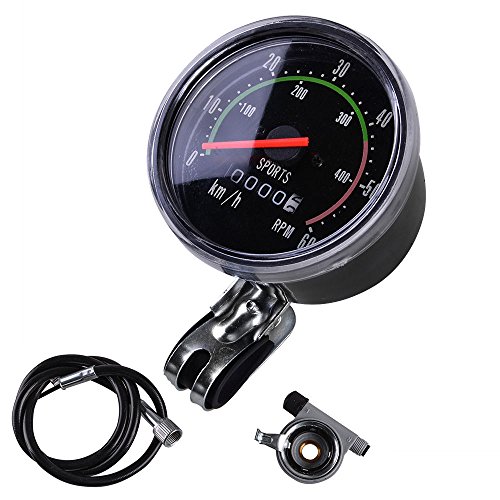
A retro acrylic dial with an auto-reset odometer that needs no battery at all.
This Yosoo unit leans fully into the old-school retro look with a crystal acrylic face that is big and easy to read. The mechanical design means no batteries and no adjustment setting — mount the reader on the handlebar, attach the gear to the front wheel axle, and link them by cable. When the odometer reaches 9999.9, it rolls over to zero automatically with no reset button needed.
It is built for 24 to 27.5-inch wheels, covering 26-27 inch road bikes, mountain bikes, folding bikes, and old exercise bikes. One owner called it “Easy to install” with “good accuracy,” while another noted the heavy plastic build feels reasonably durable for a motorized bicycle project. The simplicity is the real draw — a needle that just works without a smart setup.
The biggest trade-off is the measurement system: it reads in KPH, and the manual helpfully notes a kilometer is 0.62 mile, so 30 KPH is about 18.6 mph. The wheel mechanism is plastic, and one owner found the cable cheap and not the smoothest, which is the main durability concern. It also may not work with some electric-assist bikes or with quick-release wheels at higher speeds.
Perfect for: a vintage cruiser or motorized build where the retro look matters more than GPS data.
Check before buying: make sure you are comfortable reading KPH, not MPH.
7. 4into1 Motorcycle Mini Speedometer
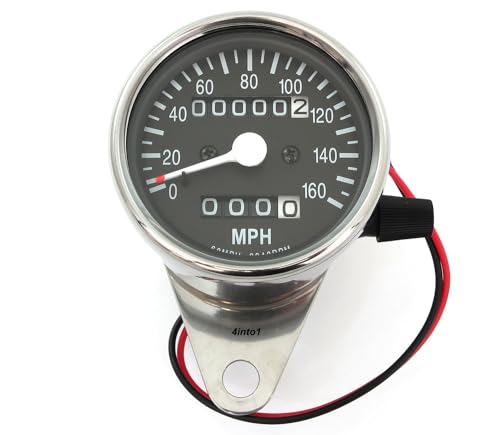
The machined-metal dial for café racers that reads true MPH from 0 to 160.
This is a different beast: a chrome and black mini speedometer engineered for custom motorcycle builds and café bikes, not pedal bikes. The 2.5-inch dial with a 2-inch depth reads MPH from 0 to 160, and the 2240:60 ratio matches most Japanese motorcycles including Honda, Kawasaki, Suzuki, and Yamaha. The mechanically driven unit uses a 12mm thread that works with most speedometer cables.
Accuracy earns strong praise: one owner clocked it against a speed app and called it “right on the correct speed,” while another rode off-road through dust, dirt, and water and it still worked. The clean, minimalist look suits custom builders, and the metal construction feels sturdier than plastic units—a standout for durability-focused buyers.
The known weak spot is the backlight bulb, which customers note burns out quickly; the fix is a standard #74 bulb from any auto parts store. Some also noted they had to reuse rubber bushings from their stock odometer to get a secure fit. For a serious motorcycle project, this is the premium route; for a pedal bike, it is the wrong tool entirely.
Built for Builders
- MPH dial reads 0-160 for real speed work
- 2240:60 ratio fits major Japanese bikes
- Metal build shrugs off dirt and water
Builder’s Caveats
- Stick bulb burns out fast — swap in a #74
- May need stock bushings for a snug fit
Built for: custom motorcycle builds and café racers that need a dial in true MPH.
Not for: bicycle riders — this is a motorcycle component, not a bike accessory.
Understanding the Specs
Mechanical Drive vs. Wireless Sensor
A mechanical speedometer uses a spinning gear against your tire to turn the needle, with no battery and no pairing. A wireless unit like the CATEYE uses a separate sensor on the front wheel that transmits over a 70cm range to the head unit. If you want zero maintenance, go mechanical; if you want easy mounting and accuracy, wireless wins.
MPH vs. KPH and Wheel Size
Analog units are often factory-locked to one unit. The Yosoo and Alomejor read KPH, while the 4into1 reads MPH from 0-160. Wheel size matters because the gear must reach the tire — most list a 26/27.5/28/29-inch range. Quick-release front wheels are the most common incompatibility, so check your axle before buying.
FAQ
Will an analog speedometer work on a bike with quick-release front wheels?
What is the difference between MPH and KPH analog speedometers?
Do analog bike speedometers need batteries?
Which wheel sizes do mechanical speedometers fit?
How hard is it to install an analog speedometer?
Are analog speedometers accurate?
Does an analog speedometer work on an electric bike?
Can I reset the odometer on a mechanical speedometer?
Final Thoughts: The Verdict
For the majority of shoppers, the analog bike speedometer winner is the CATEYE Padrone because it pairs a sunlight-readable 5.5cm display with a wireless sensor that avoids the axle-fit headaches of pure mechanical units. If you want a true retro needle on a solid-axle cruiser, the Alomejor delivers the old-school look at a budget-friendly price. And for motorcycle builders chasing a café-racer aesthetic, the 4into1 Mini is the premium metal dial that reads true MPH from 0 to 160.
How We Picked
We do not accept paid placement. Every pick is matched to a real buyer and a real use-case; we do not hands-on test units.
Sources & Methodology
Specifications: manufacturer listings and product documentation. Review insights: verified customer reviews, as of August 2026. Pricing: not shown on this page (it changes often); check the current price via the retailer link.
As an Amazon Associate, Gadgets Feed earns from qualifying purchases. This does not affect which products we feature.