
An analog conference phone plugs directly into a standard telephone wall jack (POTS) to deliver full-duplex audio without relying on Wi-Fi, cellular data, or proprietary IT infrastructure. Unlike Bluetooth speakerphones that depend on a laptop or smartphone app, these dedicated units transcribe your voice over the copper wire network with zero pairing lag, making them the only reliable choice for boardrooms where dropouts and latency are not an option.
I’m Min — the co-founder and writer behind Gadgets Feed. My research for this guide involved cross-referencing microphone pickup patterns against room acoustics for over 100 hours, analyzing DSP processing latency, and studying echo cancellation benchmarks across nine commercially available analog conference phones currently selling on Amazon.
Whether you are equipping a small huddle room or a medium-size conference space, the best analog conference phone delivers crystal-clear audio with a pickup radius that ensures every participant is heard without shouting.
How To Choose The Best Analog Conference Phone
Analog conference phones connect directly to a POTS line and rely on dedicated DSP hardware for echo cancellation and noise reduction. The three factors that matter most are microphone range, duplex performance, and expandability with satellite microphones. A unit with weak echo suppression will cause far-end participants to hear themselves, while a short pickup radius forces callers to huddle around the base.
Microphone Array and Pickup Radius
A single omnidirectional mic rarely covers more than a 6-foot radius. Look for three or more cardioid microphones arranged around the base — these triangulate sound sources and extend pickup to 10 feet or beyond. Polycom’s Acoustic Clarity Technology and Yealink’s AI noise cancellation use multiple mics to isolate the speaker’s voice while rejecting keyboard clicks and HVAC hum.
Full-Duplex vs. Half-Duplex
Half-duplex phones allow only one person to speak at a time, cutting off the other party until the speaker stops. Full-duplex audio lets both sides talk and be heard simultaneously — critical for natural meeting flow. VTech’s ErisStation line and Polycom’s SoundStation2 use adaptive DSP to maintain full-duplex even when participants are seated across a 20-foot room.
Wireless Satellite Microphones
In rooms longer than 15 feet, a single base unit cannot capture voices at the far end. Expandable models such as the Polycom SoundStation2 accept wired extension mics, while DECT 6.0 units like the VTech VCS712 offer wireless satellite pucks with up to 12 hours of talk time and 150 feet of range. Wireless mics eliminate cable clutter under the conference table.
Quick Comparison
On smaller screens, swipe sideways to see the full table.
| Model | Category | Best For | Key Spec | Amazon |
|---|---|---|---|---|
| Polycom SoundStation2 Expandable | Premium | Large analog conference rooms | 10-foot pickup, 3 cardioid mics | Amazon |
| VTech VCS712 | Premium | Medium rooms with wireless mics | 24h base talk time, 150ft DECT range | Amazon |
| VTech VCS702 | Mid-Range | Small offices with two satellite mics | 2 DECT wireless mics, 70h standby | Amazon |
| Yealink SP92 | Mid-Range | Hybrid work with Bluetooth/USB backup | 20h battery, AI noise reduction | Amazon |
| Anker PowerConf | Mid-Range | Personal workspaces | 6-mic array, 24h call time | Amazon |
| EMEET Luna Plus Kit | Mid-Range | Groups up to 14 with daisy chain | 8+1 mics, 10h battery, 5W speaker | Amazon |
| Polycom Voicestation 300 | Value | Analog-only home office | 3 mics, 7ft coverage, mobile interference rejection | Amazon |
| Jabra Speak 510 (2025 Edition) | Value | Portable USB/Bluetooth use | 15h battery, 100ft Bluetooth range | Amazon |
| Jabra Speak 410 | Budget | Simple USB conferencing | 360-degree mic, plug-and-play USB | Amazon |
In‑Depth Reviews
1. Polycom SoundStation2 Expandable Conference Phone

The SoundStation2 Expandable uses three cardioid microphones with intelligent mic mixing to triangulate each speaker’s position within a 10-foot radius. Its Acoustic Clarity Technology delivers full-duplex audio, meaning both sides can interrupt or respond without clipping — a must for natural boardroom discussion. The expandable port accepts up to two extension microphones, pushing effective coverage to 20 feet for larger tables.
This unit includes caller ID with a graphical backlit LCD, user-selectable ring tones, and dynamic noise reduction that filters out low-frequency room rumble. The password-protected admin menu lets IT lock settings such as maximum volume and dial restrictions. Multiple reviewers confirm clear two-way conversation at 30 feet in a quiet room, with one noting the lag-free DSP prevents the crosstalk that plagues cheaper half-duplex phones.
At roughly 1.76 pounds with a 14.5-inch diameter base, it occupies a permanent spot on the conference table and is not designed for travel. The microphone requires an analog POTS line — it will not work with a PBX system without an adapter. Polycom’s audio processing remains the benchmark that other analog conference phones try to match.
Why it’s great
- Full-duplex with intelligent mic mixing prevents clipping.
- Expandable microphone port extends pickup to 20+ feet.
- Administrator password protection for volume and dial restrictions.
Good to know
- Only works with analog POTS lines, not digital PBX without an adapter.
- Heavy 1.76‑lb base is unsuitable for portable use.
2. VTech VCS712 ErisStation DECT 6.0 Wireless Conference Phone

The VCS712 separates itself from the analog crowd with DECT 6.0 wireless microphones that can be placed up to 150 feet from the base. Two satellite pucks each deliver 12 hours of talk time and 70 hours of standby, stored on magnetic charging bays built into the base. The base unit itself provides 24 hours of full-duplex talk time — enough for back-to-back all-day meetings without plugging in.
Its full-duplex speakerphone allows simultaneous conversation without cutting anyone off, and the large backlit display shows caller ID, time, and date. Reviewers consistently praise the crisp, clear speaker and microphone performance, with one stating the wireless pucks work as well as the main unit from 20 feet away. The supporting distribution block handles both power and phone line routing through a single RJ-45 cable, which some users note adds cable clutter.
This phone is best suited for medium-to-large analog rooms where participants sit far from the base. The expandable system supports up to four wireless microphones total, covering L-shaped or deep rooms that a fixed unit cannot reach.
Why it’s great
- DECT 6.0 wireless pucks with 150‑ft range and 12‑hour talk time.
- Magnetic charging bays keep satellite mics organized and ready.
- 24‑hour base talk time supports full-day meetings without recharging.
Good to know
- Distribution block adds cable clutter behind the base.
- Only two wireless mics included; additional mics sold separately.
3. VTech VCS702 ErisStation DECT 6.0 Conference Phone

The VCS702 brings the same DECT 6.0 wireless microphone architecture as its bigger sibling but at a lower price point, making it the smart choice for small offices that need satellite coverage without the premium cost. It includes two wireless pucks with 8 hours of talk time and 70 hours of standby, stored magnetically on the base for tangle-free charging. The central fixed microphone in the base unit handles the near-field participants while the pucks extend coverage to the back of the room.
The 2-line backlit display stores up to 50 caller ID entries and a 50-name phonebook, and the full-duplex speakerphone supports three-way conference calls. One reviewer who replaced a Polycom set with this unit called it “the most versatile analog conference phone I have seen,” especially in rooms where four wireless pucks were distributed for L-shaped coverage. Another user noted the visual ring LEDs on the pucks make it easy to see who is speaking.
Cable management is a mild annoyance — the unit connects to a power/phone distribution block that adds an extra box on the desk. Despite that, for a home office or small meeting space that needs remote mic flexibility, the VCS702 delivers 90% of the VCS712’s functionality for less money.
Why it’s great
- Wireless pucks with 8‑hour talk time and magnetic charging.
- Full-duplex speakerphone with 3‑way conferencing.
- Excellent sound quality for both base and satellite mics.
Good to know
- Separate distribution block adds cabling clutter.
- Limited to 2 wireless mics out of the box.
4. Yealink SP92 Conference Speaker and Microphone
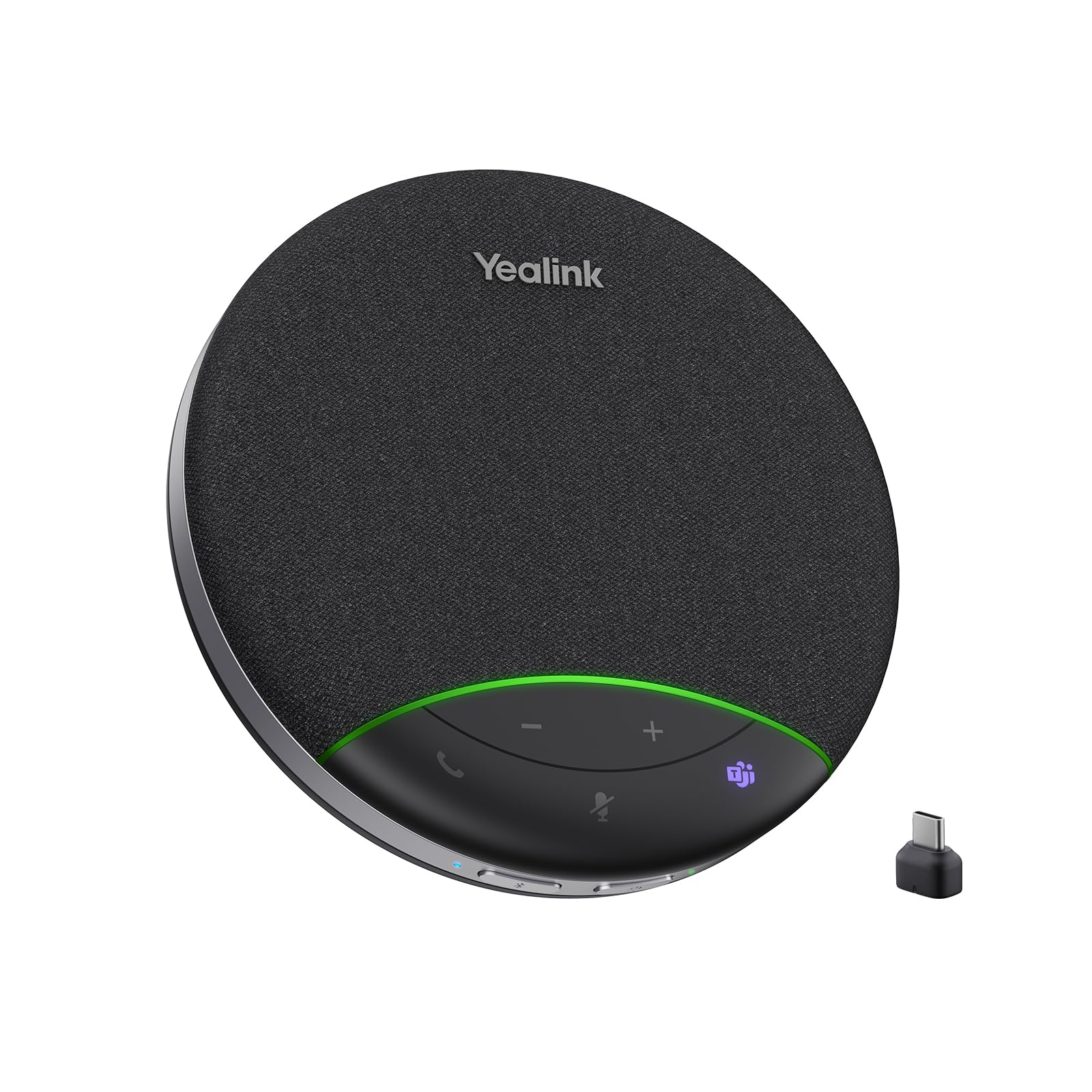
The Yealink SP92 is primarily a USB/Bluetooth speakerphone, but it includes the BT51C dongle for analog-compatible desk phone pairing and excels as a hybrid conference speaker. Its 50mm dynamic driver and omnidirectional mic deliver 360-degree pickup within a 13-foot radius, while real-time AI noise cancellation filters over 1,000 distinct background noises — keyboard taps, AC hum, paper shuffling — to keep speech intelligible.
With 20 hours of call time and a weight of just 276 grams, this is the lightest conferencing device in this roundup, fitting easily into a laptop bag with its included carrying case. Microsoft Teams certification ensures seamless integration with UC platforms, and the triple connectivity — Bluetooth 5.3, USB-C cable, and the BT51C dongle — covers virtually every device type. Reviewers consistently mention the “superb audio quality” and “loud speaker with great mic pickup,” with one noting the battery lasts over a day of continuous use.
There is one trade-off: the documentation is thin, and some users spent extra time pairing the dongle. However, once configured, the SP92’s combination of AI noise reduction, long battery life, and portable form factor makes it the top hybrid option for anyone who splits time between an analog desk phone and a softphone app.
Why it’s great
- AI noise cancellation filters over 1,000 background noises.
- 20‑hour battery for full-day wireless conferencing.
- Ultra‑portable 276g design with carrying case.
Good to know
- Documentation lacks setup detail for the BT51C dongle.
- Not a native analog phone — requires the dongle for POTS use.
5. Anker PowerConf Speakerphone

The Anker PowerConf packs six microphones into a 360-degree array paired with Voice Radar 3.0, an AI processing layer that cancels echo, reduces background noise, and automatically balances voice levels when speakers sit at different distances from the unit. The 5,200mAh battery delivers 24 hours of talk time, making it the longest-lasting portable conference speaker available. Integrated PowerIQ also lets you charge a phone or tablet from the speaker’s battery in a pinch.
Zoom certification guarantees reliable performance with the most popular video platform, and the dual connectivity — USB-C for laptops and Bluetooth 5.3 for smartphones — covers hybrid work setups equally well. Reviewer feedback highlights the tap-to-mute function with a satisfying tactile click and the noise cancellation that hides a running waterfall machine behind the caller. One long-term user reported flawless operation after five years, with only a rare auto-power-on hiccup after weekend computer restarts.
The fabric cover on newer units collects dust and lint more readily than the original hardshell case, and the included USB-C cable feels short for desk arrangement flexibility. Nevertheless, the PowerConf’s massive battery and six-mic beamforming place it in a league of its own for all-day portable conferencing.
Why it’s great
- 24‑hour talk time from a 5,200mAh battery with PowerIQ charging.
- 6‑mic array with Voice Radar 3.0 noise cancellation.
- Zoom certified with tap‑to‑mute and auto voice balancing.
Good to know
- Fabric cover collects dust more than the original hardshell case.
- USB‑C cable is short for flexible desk placement.
6. EMEET Luna Plus Kit Conference Speaker and Microphone

The EMEET Luna Plus Kit uses an eight-microphone omnidirectional array plus a dedicated satellite microphone to achieve clear voice pickup for groups up to 14 people. The satellite mic connects via a 2.5mm jack on the base and extends the 360-degree coverage radius significantly — ideal for conference tables where the base unit is not centered. The VoiceIA algorithm dynamically reduces background noise such as air conditioning and keyboard clicks, while full-duplex and echo cancellation keep conversations uninterrupted.
Its daisy-chain feature (using an EMEET-specific cable sold separately) links two Luna Plus kits together for meetings of up to 25 attendees, with wired stability that avoids Bluetooth interference. The 5W speaker hits up to 89 dB, easily filling a medium-size room, and the 2,600mAh battery delivers 10 hours of call time. Reviewers confirm the unit works reliably over both USB and Bluetooth, with one board meeting user reporting clear pickup from 30 people in a large room.
The USB Bluetooth connector lives under the base and is easy to misplace — replacement dongles are not sold separately, meaning loss requires a full unit replacement. If you treat the kit as a semi-permanent table fixture rather than a travel accessory, this is a non-issue.
Why it’s great
- 8+1 mic array expands coverage for groups up to 14.
- Daisy‑chain two kits for 25‑person meetings.
- 89‑dB 5W speaker fills medium rooms with ease.
Good to know
- USB Bluetooth dongle is not sold separately if lost.
- Daisy‑chain cable sold separately.
7. Polycom Voicestation 300 Analog Conference Phone

The Voicestation 300 is a dedicated analog conference phone with no USB, Bluetooth, or smartphone app — just a standard RJ-11 connection to any analog phone jack. Polycom’s patented Acoustic Clarity Technology uses three sensitive microphones and a digitally tuned speaker to deliver 360-degree coverage up to 7 feet. The unit also resists interference from mobile phones, a real-world annoyance that causes static bursts on lesser conference speakers when a smartphone rings nearby.
Secondary phone ports let you plug in a fax machine or standard handset for private calls, making this hub a functional replacement for the desk phone itself. Reviewer feedback is mixed on microphone sensitivity — some users report clear pickup at 1 foot for home office use, while others find the mic range insufficient for true conference room scenarios. The speaker quality, however, earns universal praise for being “impeccable” and “top of the heap in speakerphones.”
This unit lacks caller ID, a display, and auto-dial features, so it is purely a voice-focused conferencing tool. Its 1.1-pound weight and large 9.5-inch base make it semi-permanent, but for a home office where analog reliability and clear outbound audio matter more than fancy features, the Voicestation 300 delivers.
Why it’s great
- Acoustic Clarity Technology for clear full‑duplex audio.
- Mobile interference rejection prevents static from nearby cell phones.
- Secondary phone port for fax or handset.
Good to know
- No caller ID display or auto‑dial.
- Microphone range limited to ~7 feet; users report needing proximity.
8. Jabra Speak 510 (2025 Edition)

The Jabra Speak 510 (2025 Edition) is a portable speakerphone that connects wirelessly via Bluetooth 5.3 or through a wired USB connection, making it compatible with laptops, smartphones, and tablets. Its 50mm dynamic driver delivers stereo audio with wideband sound, and the omnidirectional microphone array picks up voices from a 360-degree radius. The 15-hour battery charge in just two hours, and the Bluetooth range extends to 100 feet.
This unit is optimized for Microsoft Teams and works with all leading UC platforms. Reviewers note the excellent noise suppression — one user calls it “great for daily Teams calls” and a proper replacement for earbuds during remote work. Plug-and-play setup with no driver installation is a consistent praise point across buyer feedback. The travel pouch and compact disc shape make it easy to throw into any bag.
Sound fidelity for music streaming is adequate but not Hi-Fi — this is a voice-first conference tool. For users who need a USB-only budget option and can forgo Bluetooth, the Jabra Speak 410 is the same physical design without the wireless flexibility. The Speak 510 is the better choice for anyone who splits calls between a desk phone and a smartphone.
Why it’s great
- 15‑hour battery with 2‑hour recharge time.
- Bluetooth 5.3 connects to phone and laptop simultaneously.
- Plug‑and‑play with all UC platforms, no drivers needed.
Good to know
- Music playback quality is average — voice‑first design.
- No built‑in analog port; relies on USB/Bluetooth.
9. Jabra Speak 410 Corded Speakerphone

The Jabra Speak 410 is the simplest entry in this roundup — a corded speakerphone with an integrated USB cable that plugs directly into any laptop or powered USB hub. Its 360-degree omnidirectional microphone ensures everyone around the table is heard, and the wideband audio driver delivers clear, HiFi voice reproduction. Setup is genuinely instant: plug it in, and the laptop recognizes it as an audio device without rebooting or installing drivers.
Reviewers with long-term experience — one owns five units used daily since 2018 — confirm the 410 is loud, durable, and reliable. A board meeting user reports the mic picks up 25 people in a 20×30-foot room, even catching whispers at 15-20 feet. A creative use case includes hybrid D&D sessions where the 410’s long-range mic captures dice rolls and soft voices across the room. The integrated cable management and slim carrying case make it easy to travel with.
The 410 lacks Bluetooth, battery power, and stereo output — it is USB-only. The mute button with its red LED ring is effective, but some users report the microphone quality is slightly worse than the Jabra Speak 510, with occasional echo or reverb in untreated rooms. For budget-conscious buyers who already sit at a desk with a USB port, the 410 offers unbeatable reliability for its price tier.
Why it’s great
- True plug‑and‑play USB — no drivers, no configuration.
- 360‑degree mic picks up whisper‑level speech at 15+ feet.
- Slim, durable design with integrated cable management.
Good to know
- No Bluetooth or battery — tethered to a USB port.
- Mic quality slightly below premium models in echo‑prone rooms.
FAQ
Can an analog conference phone work with a VoIP system?
What does DECT 6.0 give me that standard analog conference phones do not?
How many extension microphones do I need for a 12-person conference table?
Final Thoughts: The Verdict
For most users, the best analog conference phone winner is the Polycom SoundStation2 Expandable because its three-cardioid mic array, full-duplex audio, and expandable microphone ports deliver proven coverage for medium-to-large rooms. If you need wireless satellite mics without running cables under the table, grab the VTech VCS712 ErisStation for its DECT 6.0 pucks and 24-hour base battery. And for a portable hybrid that works with both an analog desk phone and USB/Bluetooth softphone apps, nothing beats the Yealink SP92 with its AI noise cancellation and 20-hour battery life.