
A corded phone doesn’t need charging, won’t drop a signal mid-sentence, and works when the power goes out. But the market is flooded with cheap plastic shells that deliver tinny audio, confusing controls, and a ringer so faint you’ll miss every call. Choosing the right one means dissecting a few specific specs that actually matter.
I’m Min — the co-founder and writer behind Gadgets Feed. This guide was built after cross-referencing technical data sheets and hundreds of real user reports to isolate the features that separate a reliable communication tool from a frustrating desk ornament.
Whether you need oversize buttons for a senior relative, a retro rotary look for a restaurant, or a dual-line unit for a home office, the following analysis of the best analog corded phone models will help you match the right hardware to your specific use case.
How To Choose The Best Analog Corded Phone
The right corded phone for you depends on your primary use case: supporting an elderly family member, managing calls in a busy office, or adding a decorative piece that still works. Start by focusing on the features that solve the specific frustration you experience today.
Audio Quality and Ringer Volume
Handset volume and ringer loudness are the two most common pain points. A phone that sounds muffled or rings too quietly defeats its purpose. Look for models that offer adjustable handset volume and a ringer with a high setting — at least 80 dB — so you don’t miss calls in a noisy kitchen or workshop.
Visual Indicators for Hearing Impairment
Many corded phones now include a flashing LED that synchronizes with the ring. This is critical for users with hearing damage or for environments where the phone might be out of earshot. A backlit Caller ID display also helps seniors who struggle with small, dim screens common on budget units.
Power Source Reliability
The core advantage of a corded phone is that it can draw power directly from the phone line. Any model that requires batteries or a wall adapter for basic dialing and ringing loses that advantage. Confirm that the phone operates in line-power mode for emergency use during blackouts.
Button Size and Ease of Use
Large, high-contrast keys reduce dialing errors for users with arthritis or low vision. Some phones offer one-touch memory dialing with photo slots — ideal for dementia patients. For standard office use, a clean layout with tactile feedback is sufficient.
Extra Features vs. Simplicity
Caller ID, speakerphone, answering machine, and dual-line support add convenience but also complexity. If the user is a senior who only needs to make and receive calls, a simple line-powered phone with big buttons is best. For a home office, a model with a digital answering system and backlit display saves time.
Quick Comparison
On smaller screens, swipe sideways to see the full table.
| Model | Category | Best For | Key Spec | Amazon |
|---|---|---|---|---|
| AT&T CD4930 | Premium | Seniors & home offices | 25-min digital answering system | Amazon |
| Panasonic KX-TSC11B | Mid-Range | Reliable daily desk phone | 50-number Caller ID memory | Amazon |
| AT&T Trimline 210 | Mid-Range | Emergency / backup line | 13 speed-dial keys | Amazon |
| Ornin 2-Line OR6400 | Premium | Small business dual-line | 3-way conferencing | Amazon |
| TelPal Retro 302-Rotary | Mid-Range | Decorative / themed spaces | Rotary dial / cloth cord | Amazon |
| HTMengt 2500 Red | Budget | Vintage look / restaurant | Twice-injected large buttons | Amazon |
| Excelltel EX-LD-858HF | Budget | Seniors / dementia patients | Photo one-touch dialing | Amazon |
In‑Depth Reviews
1. AT&T CD4930 Black Corded Phone

The AT&T CD4930 packs a 25-minute digital answering system, an extra-large backlit display that tilts for optimal viewing, and oversize buttons that are genuinely easy to press — even for users with arthritis. The orange backlit Caller ID screen is readable from across a desk, which eliminates squinting at tiny grey LCD digits.
Audio Assist boosts handset volume and clarity temporarily, and the ringer includes a visual flashing indicator so you never miss a call. The speakerphone works well for brief hands-free conversations, and the base feels substantial at 2.4 pounds, staying planted on the desk during dialing.
Set-up is immediate out of the box: connect the phone line and power adapter, and the answering machine activates with default settings. Users consistently praise the audio clarity and the convenience of the tilt screen. The only minor trade-off is that it requires a power outlet for the display and answering machine, though basic dialing still works on line power.
Why it’s great
- Extra-large backlit tilt display makes Caller ID highly visible
- Built-in 25-minute digital answering system with remote access
- Audio Assist boosts clarity for hearing-impaired users
Good to know
- Requires AC power for display and answering machine
- Plastic body feels durable but not premium
2. Panasonic KX-TSC11B

The Panasonic KX-TSC11B is a straightforward single-line corded phone that brings dependable Caller ID functionality to any desk or wall. It stores up to 50 names and numbers in its memory and logs missed calls, so you don’t have to guess who tried to reach you. The LCD screen displays the caller’s name and number, though it is not backlit, so reading it in dim light requires a nearby lamp.
Buttons are tactile and well-spaced, and the handset delivers clear, crisp audio typical of Panasonic’s Japanese-engineered telecom hardware. The unit supports wall mounting out of the box, which saves desk space in a kitchen or workshop. A mute button and flash key add basic call management without complicating the interface.
Some users note the handset rest can let the phone slip off the hook during a busy motion, and the screen contrast is faint with fresh batteries. Still, for a mid-range price, it offers the most reliable Caller ID capture and call log in this comparison.
Why it’s great
- Reliable Caller ID with 50-number memory and call log
- Wall-mountable design saves counter space
- Clear, consistent audio quality for everyday calls
Good to know
- LCD display is not backlit, hard to see in low light
- Handset can fall off the hook if bumped
3. AT&T Trimline 210
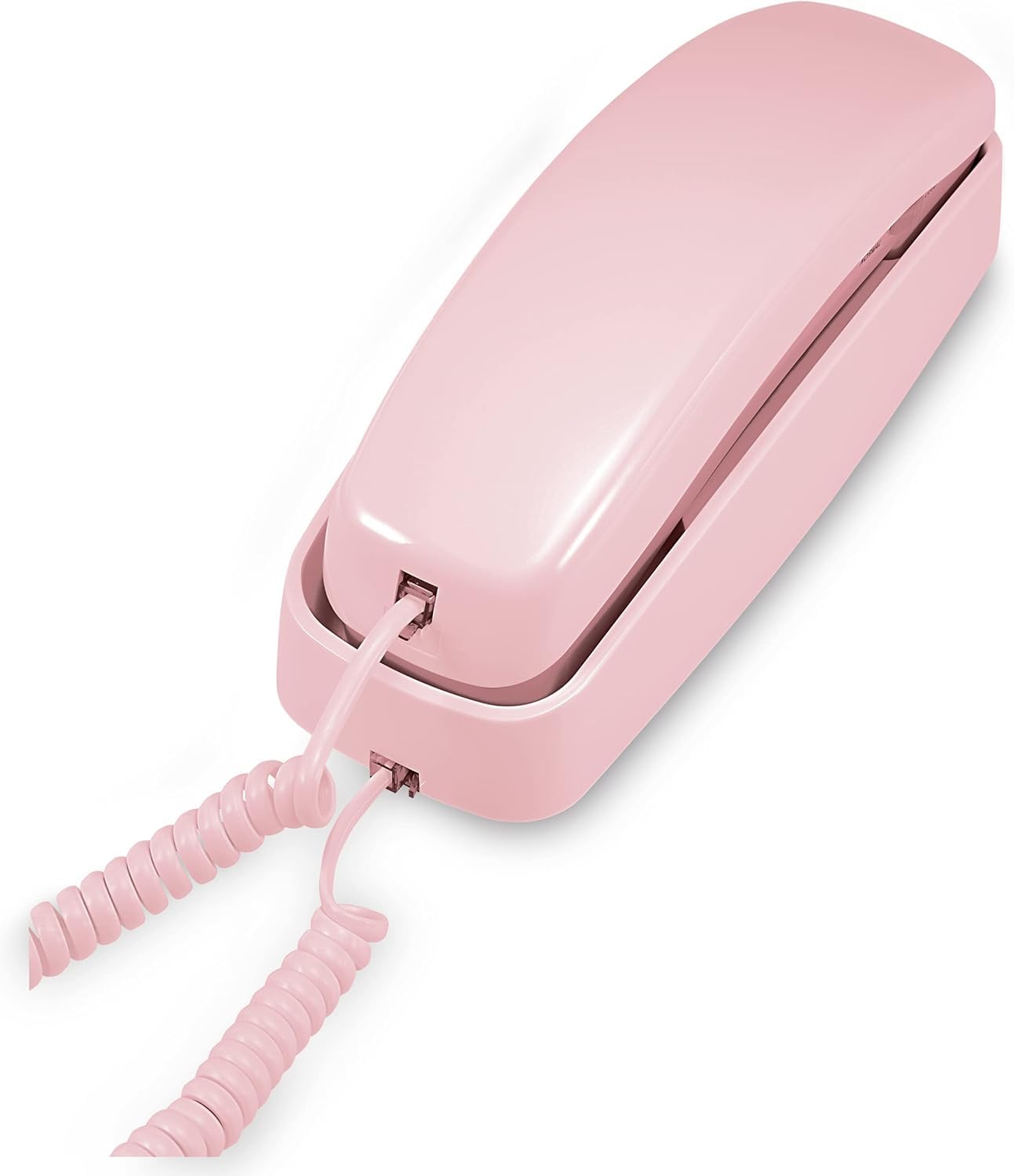
The AT&T Trimline 210 revives the iconic Princess phone silhouette from 1968, offering a slim, lightweight handset that fits in tight spaces — bedside tables, kitchen walls, or small office corners. It runs entirely on line power, meaning it works during a blackout with zero dependency on batteries or a wall adapter.
Thirteen speed-dial keys make one-touch calling to frequent contacts easy, and the last-number redial button saves time on missed connections. The lighted keypad is helpful in dark rooms, though the base is notably light at just over one pound, which can cause the phone to slide or tip during aggressive dialing.
Audio quality is generally clear, though some users report a constant low hum on certain VoIP adapters. The ringer volume slider allows adjustment, but the lowest setting effectively mutes the phone. It lacks Caller ID and a speakerphone, keeping the interface pure for users who just want to dial and talk.
Why it’s great
- Line-powered operation works during power outages
- Compact space-saving footprint with wall-mount option
- 13 one-touch speed-dial keys for frequent contacts
Good to know
- Lightweight base slides easily on a smooth surface
- No Caller ID display or speakerphone
4. Ornin 2-Line Corded Phone OR6400

The Ornin OR6400 is designed for small business environments that need two separate phone lines on a single desktop unit. It supports a 3-way conference call combining both lines and the speakerphone, which is useful for quick coordination without a dedicated conferencing system. Five one-touch quick-dial keys and ten two-touch keys handle up to 16-digit numbers each.
The built-in speakerphone enables hands-free conversations, though user feedback points out that the microphone sensitivity is low — remote parties often struggle to hear the speaker clearly. The phone requires AA batteries to operate the second line and Caller ID, which reduces the “always on” reliability some buyers expect from a corded device.
The plastic chassis feels adequate for desk duty, but it is not wall-mountable and lacks a headset jack. For a home office or small business that needs two-line visibility without a complex phone system, the OR6400 provides functional dual-line Caller ID and conference capability in one clean package.
Why it’s great
- Dual-line operation with 3-way conferencing
- Programmable one-touch and two-touch speed dial
- Clear handset audio on both lines
Good to know
- Batteries needed for Line 2 and Caller ID
- Speakerphone microphone is weak for the remote caller
5. TelPal Retro 302-Rotary Black

The TelPal Retro 302-Rotary replicates the classic 1930s candlestick telephone with a cloth braided cord and a rotary dial that provides a genuinely tactile dialing experience. The body is molded from thick plastic with rubber foot pads that keep it stable on a desk. It requires no batteries or AC power, drawing everything from the phone line, so it remains functional during outages.
Audio quality improves if you replace a long, low-gauge wall cable with a shorter run, but the handset delivers adequate volume for normal conversations. The ringer is a soft mechanical bell — authentic to the period — but it is quiet. If you place this phone in a busy restaurant or a large room, the ring is easily missed.
This is primarily a decorative functional phone. It works as a real landline, but the rotary dial may confuse younger users, and the handset cradle requires a deliberate motion to seat correctly. It excels as a conversation piece in a retro-themed home, hotel lobby, or movie set.
Why it’s great
- Authentic 1930s rotary design with cloth cord
- Fully line-powered, no batteries or adapters
- Heavy base keeps the phone planted on the desk
Good to know
- Mechanical ringer is quiet and easily missed
- Rotary dial is slow and may not work with all VoIP services
6. HTMengt 2500 Red Analog Desk Phone

The HTMengt 2500 Red is a modern recreation of the classic Western Electric 2500 desk phone, built with a metal base and ABS plastic shell. The twice-injected large buttons provide a firm tactile click that is satisfying and easy to register for older users. The red indicator flashes in sync with the ring, providing a visual cue that is helpful in noisy environments.
The handset cord is 144 inches and the telephone line cord is 180 inches, giving generous reach across a large desk or counter. The phone is line-powered, so it needs no external adapter. The handset is hearing-aid compatible, which is a genuine plus for seniors with hearing aids.
Audio volume on the received end is a consistent complaint: several users report that the earpiece is too quiet for a busy restaurant or for someone with mild hearing loss, requiring a third-party loudness amplifier. The ringer, while genuinely loud and clear, is the standout feature for commercial spaces like restaurant front counters.
Why it’s great
- True 2500 form factor with metal base for stability
- Extra-long handset and line cords for desk reach
- Loud, clear ringer with red visual indicator
Good to know
- Handset audio volume is low for noisy rooms
- Plastic handset feels lighter than original Western Electric models
7. Excelltel EX-LD-858HF Big Button Phone

The Excelltel EX-LD-858HF is built specifically for seniors and individuals with vision or hearing impairments. It features nine one-touch photo speed-dial slots — you slide a printed photo under the clear button cover so the user can dial loved ones by face, not by number. An emergency SOS button is also clearly marked for immediate dialing of a pre-programmed contact.
The handset volume is adjustable, and the LED flash indicator pulses with incoming calls, which is essential for users with hearing loss. The phone operates on line power only — no batteries required — which simplifies maintenance for caregivers. The 3-way conference call capability allows a caregiver to join a call remotely to assist.
Build quality is lightweight at 600 grams, and the ABS body feels simple but functional. The speakerphone has a slightly tinny echo according to some reviews, and the ringer cannot be fully turned off — only adjusted between loud settings. For assisted living facilities or home care, the photo-dialing feature alone justifies the purchase.
Why it’s great
- Photo one-touch dialing is intuitive for dementia patients
- LED flash indicator for hearing-impaired users
- Line-powered with zero battery requirements
Good to know
- Speakerphone audio has a slight tinny quality
- Ringer cannot be completely silenced
FAQ
Can I use an analog corded phone with a VoIP adapter?
Why does my new corded phone sound quiet on the handset?
Do I need batteries for basic dialing and ringing?
What does hearing aid compatible (HAC) mean for a corded phone?
Final Thoughts: The Verdict
For most users, the best analog corded phone winner is the AT&T CD4930 because it combines a bright backlit display, a 25-minute answering system, and extra-loud audio assist in one desk-ready unit. If you prioritize a compact line-powered design for emergency use, grab the AT&T Trimline 210. And for a senior relative who needs photo-based speed dialing, nothing beats the Excelltel EX-LD-858HF.