
Our readers keep the lights on and my morning glass full of iced black tea. As an Amazon Associate, I earn from qualifying purchases.
Specs are compiled from manufacturer listings and verified buyer reviews and can change over time — please confirm the key details on the product page before buying.
If you want one answer before you scroll: buy the Casio Duro if you want a tough, dark-dial diver for everyday wear, and step up to the Orient Kamasu II if you want a sapphire crystal and an automatic movement that never needs a battery. Everything else on this list is a variation on that trade-off. A quick note on how this list was built: we matched on water resistance rated for diving — at least 200m, or 20 ATM, which is the pressure rating a real dive watch has to clear — so not every pick is the exact model number you may have searched. The nearest same-type watch serves the same purpose, and each pick below is a genuine analog dial with dive-grade sealing.
I’m Min — the founder and writer behind Gadgets Feed. This guide is built by comparing the manufacturers’ published specifications and the patterns across verified customer reviews, so you get each pick’s real strengths and trade-offs instead of marketing spin.
You don’t need to understand movements or bezel detents to pick well — you need to know which specs actually change how the watch feels on your wrist. That is the whole job of this best analog diving watch roundup, from the quartz workhorses to the Swiss-made tool watches.
Our Picks at a Glance


How To Choose The Best Analog Diving Watch
Most buyers walk in thinking a dive watch is a dive watch. Then they get it home and find the bracelet pulls their arm hair, the lume fades by midnight, or the crown is so small they need a fingernail to work it. The three choices below are the ones that actually change your daily life with the thing.
Water resistance: 200m is the floor, not the flex
Every watch on this list is rated to 200m (about 660 feet), and a handful go further. That rating is a static pressure test, not a promise you’ll be diving that deep. What matters is what it enables in normal life — swimming, snorkeling, showering, and saltwater without worry. Below 200m you are looking at a fashion watch, not a diver.
Movement: quartz, automatic, or light-powered
A quartz movement is a battery-driven circuit and is the most accurate and least fussy option — low-maintenance for years. An automatic winds itself from the motion of your wrist and never needs a battery, which appeals to buyers who like the mechanical feel and the sweeping second hand. A light-powered movement charges from any light source and sits between the two — no battery swap, no winding. None of these is “better”; they just match different routines.
Bezel, crown, and crystal — the three parts you touch most
The bezel is the rotating ring you turn to track elapsed time, and a good one clicks firmly through its detents so it cannot drift off the mark. A screw-down crown threads into the case to seal it, and the good ones have smooth threads and enough grip to turn dry-handed. The crystal — sapphire or mineral glass — is what sits over the dial, and sapphire resists scratching far better than mineral. Those three details show up in nearly every owner review, which tells you where the real-world satisfaction lives.
Quick Comparison
| Model | Best For | Water Resistance | Movement | Crystal | Amazon |
|---|---|---|---|---|---|
| Casio Classic Diver MDV-106DD-1A1VCF★ Best Overall | Everyday wear and value | 200m | Quartz (SR626SW, up to 3 years) | Mineral glass | Amazon |
| Casio MDV107D-1A3VBudget Quartz | Pepsi-bezel quartz on a budget | 200m | Quartz (battery lasts 3-4 yrs) | Mineral glass | Amazon |
| RATIO FreeDiver RTF049Sapphire Automatic | Automatic with sapphire for less | 200m | Automatic NH35 (40-hour reserve) | Sapphire crystal | Amazon |
| Smith & Wesson 357 Series SWW-357 | Total-darkness legibility | 200m (660 feet) | Quartz, Swiss parts | Hardened glass | Amazon |
| ADDIESDIVE MY-H8 | Seiko-turtle homage with ceramic bezel | 200m | Automatic NH35A | Sapphire crystal | Amazon |
| Citizen Promaster Dive BN0151-09L | Grab-and-go, no battery ever | 200m | Eco-Drive light-powered (E168) | Anti-reflective mineral | Amazon |
| Orient RA-AA08 (Kamasu II) | Daily-wear automatic with sapphire | 200m | Automatic F6922 (hand-wind/hack) | Sapphire crystal | Amazon |
| Orient Men’s Kamasu | Blue-dial automatic | 200m | Automatic (self-winding) | Sapphire crystal | Amazon |
| Spinnaker Dumas SP-5081 | Heavyweight case design | 300m | Automatic | — | Amazon |
| Luminox Original Navy SEAL XS.3051.F | Low-light readability and light weight | 200m | Swiss quartz, self-illuminating | — | Amazon |
| Seiko Prospex Automatic SRPE05 | Enthusiast-grade in-house automatic | 200m | Automatic 4R (self-winding) | Sapphire crystal | Amazon |
In‑Depth Reviews
1. Casio Classic Diver Stainless Steel Watch MDV-106DD-1A1VCF
Our pick — over 4.5★ from 600+ verified ratings; the strongest balance of quality and price.
The black-dial quartz diver that looks nothing like its price tag on the wrist.
The Casio Duro is the pick that keeps landing on the wrists of people who could easily wear something fancier. What wins people over first is the appearance — the classic dive-watch look with bold hour markers, luminous hands, and a black dial that reads a glance. Casio pairs that with a stainless steel case and band and a rotating bezel that clicks firmly into place so you can mark elapsed time without it drifting. The three-hand analog display puts the date at the 3 o’clock position, which means you check the day without scrolling a phone.
Under the dial sits a quartz movement rated to keep time within ±20 seconds per month, run off an SR626SW battery rated for up to 3 years. In plain terms: you set it a couple of times a year and otherwise forget it. It is rated to 200m of water resistance and seals with a screw-down crown and caseback, so pool laps, saltwater, and showers are all fair game. Owners describe a solid, hefty feel in the hand that does not match up with the price, and that satisfaction is a big part of why this one holds the top spot.
The honest catch is the band. It adjusts with a flathead driver rather than a quick-release, and there are only two micro-adjust holes, so a handful of owners find the fit fussy at first. An occasional buyer also finds the size smaller than they pictured. Neither is a deal-breaker; both are worth knowing before it arrives. If your wrist is between sizes, budget a few minutes at a jeweler or pick up a spare strap. For a first analog diver, this is as low-risk as the category gets.
What Earns It The Crown
- 200m water resistance with screw-down crown and caseback
- Quartz movement rated ±20 seconds per month — near-zero maintenance
- Satisfying bezel click and solid, weighted case feel
- SR626SW battery rated up to 3 years per swap
Where It Asks For Patience
- Only two micro-adjust holes on the bracelet — fit takes trial and error
- Adjusting links needs a flathead tool or a jeweler trip
- Some buyers find the case smaller than expected
Buy this one if: you want a set-and-forget analog diver for daily wear, travel, and the occasional swim, without learning any watch-craft.
Think twice if: a fiddly bracelet fit drives you up the wall, or you specifically want an automatic movement instead of a battery quartz.
2. Casio MDV107D-1A3V 200M Red/Blue Bezel Dive Watch
The full-metal quartz diver with the two-tone bezel that turns heads at the pool deck.
If you want the diver look with a splash of color instead of the all-black dial, this is the Casio to pick. The red-and-blue bezel is a classic dive palette, and the watch backs it up with 200 meters of water resistance, a unidirectional rotating bezel for marking elapsed time, and a screw-lock case back that seals the movement from water. A date display sits at the 3 o’clock position for everyday convenience, and the quartz movement means no winding and no solar charging — just a battery swap every few years.
Weighing in at 5.08 ounces, this is the lighter of the two Casio divers in this roundup and sits noticeably lighter on the wrist than the RATIO FreeDiver, which tips the scale at 10.23 ounces — more than double the weight. If you plan to wear it all day, that difference is real. The bracelet fits wrists of about 6.5 inches and up, so it runs out of room on very slim wrists before it runs out of room on larger ones.
The recurring gripe is link removal — the pins take real effort, and some owners hand the job to a jeweler. A smoother option is a replacement double-deployant bracelet, which a number of owners fit instead of fighting the stock one. Otherwise this is a straightforward, well-liked quartz diver that does exactly what a dive watch should.
Who it suits: Buyers who want a quartz diver with color and a genuine screw-lock back, and who are fine having links removed once and forgetting the bracelet ever existed.
The trade-off: Link removal is difficult, and the bracelet does not fit wrists below about 6.5 inches — check your size before buying.
Reach for this if: you want that red-and-blue dive aesthetic without an automatic movement to wind.
Look elsewhere if: your wrist runs narrow, or you dread the process of sizing a bracelet yourself.
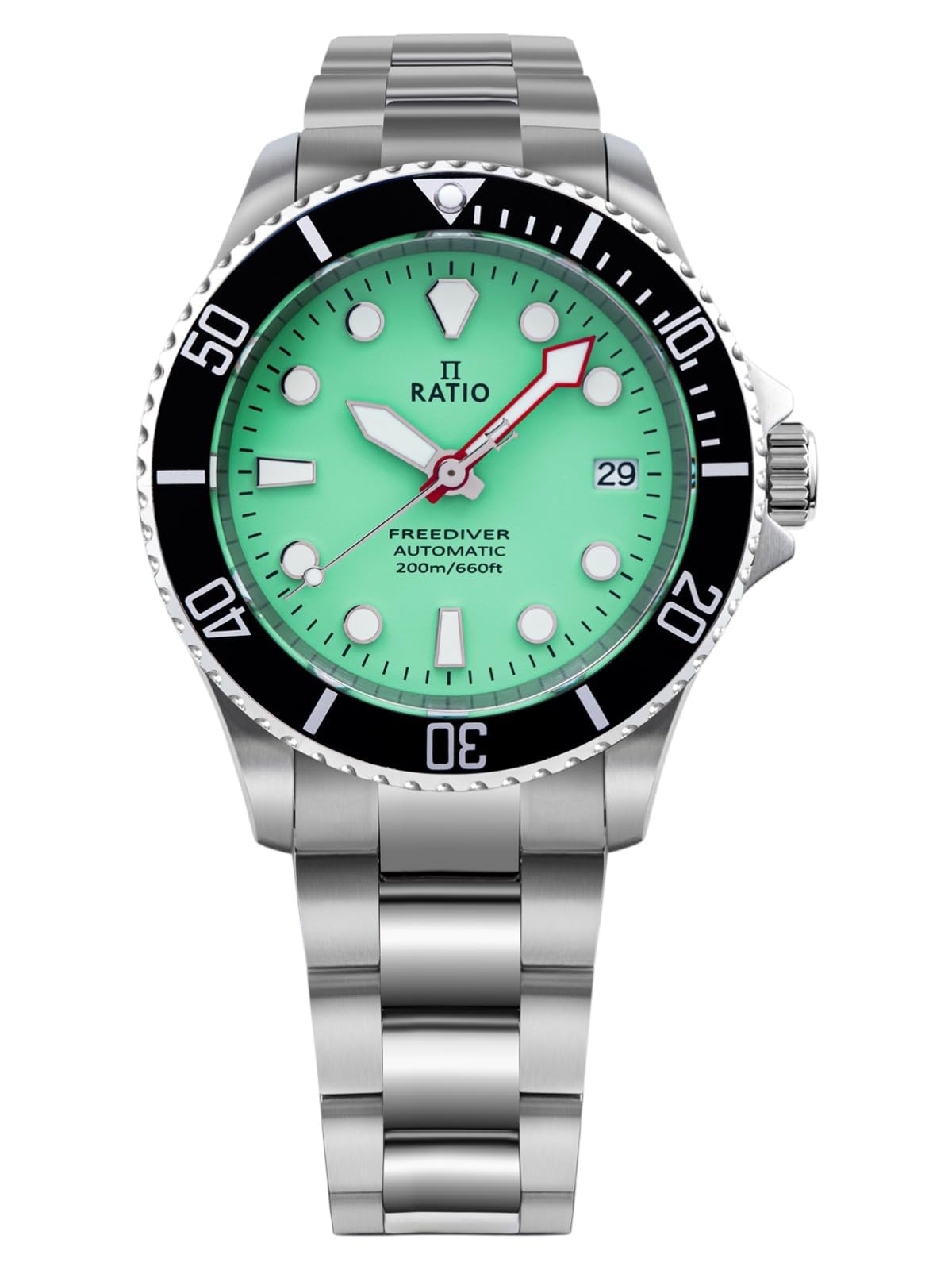
3. RATIO FreeDiver Sapphire Crystal Japanese Automatic Dive Watch
An automatic with a sapphire crystal and a 40-hour reserve, built to feel far above its price.
What sets the RATIO FreeDiver apart is the combination of an automatic movement and a sapphire crystal in a case that measures roughly 40mm across and 13mm thick. The NH35 movement is a self-winding mechanism — the motion of your wrist keeps it running — and it carries a 40-hour power reserve, so it is still ticking when you take it off Friday night and pick it up Sunday. The sapphire crystal (a very hard glass that resists scratching) is paired with an anti-reflective coating so the dial stays readable in bright sun. There is a date window at 3 o’clock and a unidirectional bezel with a firm click for tracking dive times.
Owners consistently rate quality and appearance above price, and the lume — the glow on the hands and markers after dark — gets singled out as some of the best in the value tier. The case back is engraved with the image of a free diver, and the 316L stainless steel construction resists corrosion and scratches. At 10.23 ounces, this is one of the heavier watches here, and that weight shows up as a solid, substantial presence on the wrist rather than a featherlight one.
Two things to weigh honestly. The case is 13mm thick, and on smaller wrists it wears tall — a few owners with narrow wrists mention it sits high off the arm. And bezel bite under water is a real consideration: the bezel is slick enough that it can be tricky to turn with wet fingers, which matters if you actually dive rather than wear it to the pool. Neither makes it a bad watch — it just points you toward your use case.
Why owners gravitate: the movement runs quietly and reliably, the sapphire resists scratches better than the mineral glass on cheaper divers, and the finishing reads more expensive than it is.
Where it stumbles: the bezel can be hard to grip when wet, and the 13mm case height wears tall on smaller wrists.
This is your pick if: you want an automatic diver with real sapphire protection and do not need the bezel to survive serious open-water diving.
Look elsewhere if: you have a narrow wrist and prefer a low-profile case, or you dive deep enough that a slick bezel becomes a safety issue.
4. Smith & Wesson 357 Series Swiss Tritium H3 Tactical Dive Watch
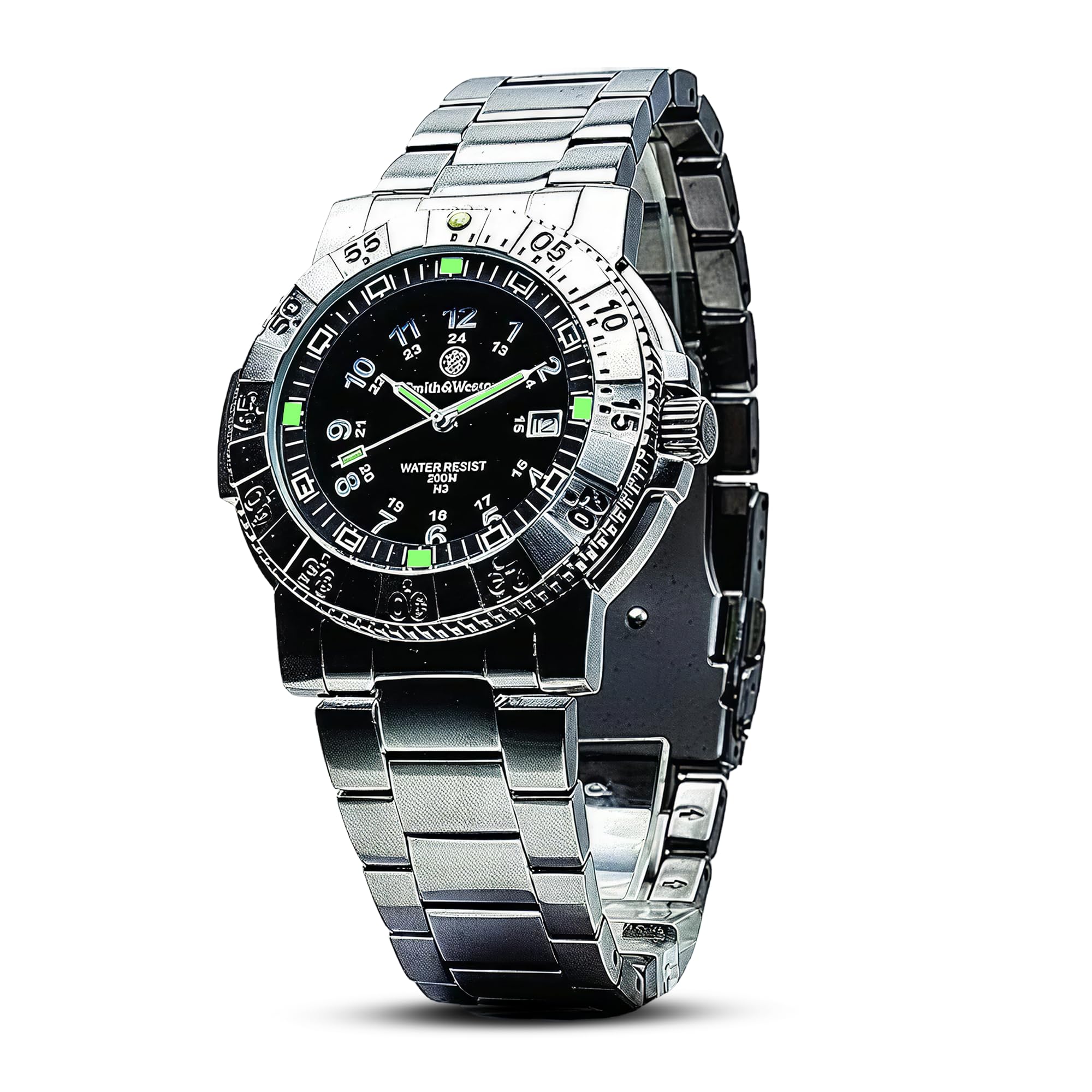
Tritium tubes that glow for years without ever seeing a light source.
Most dive watches glow because their paint charged up in the sun. This one glows because it carries tritium light sources — tiny sealed vials of glowing gas, present at the hour markers and the hour and minute hands — that emit light on their own, no charging required. The manufacturer rates that glow for 20 years of consistent output, so the markers stay readable at 3 a.m. without any charging. It sits in a titanium case with a screw-down crown, a rotating bezel for elapsed time, and a hardened glass that resists scratching, rated to 200 meters (660 feet) of water resistance.
Brightness is what buyers talk about most, and it makes this watch a favorite for anyone who needs a dark-room time check — travelers, campers, night-shift workers. It reads comfortably without reaching for glasses, and it has picked up steady praise for the finish and the value for money it offers. The 200m rating covers recreational scuba diving and marine sports.
Two honest caveats. First, the second hand and the bezel marker use standard glow paint rather than tritium, so they fade after a few minutes in the dark — the tritium lives on the hours and the hour and minute hands. Second, tritium vials are dimmer than fresh lume at full charge; they win on longevity, not peak brightness. If you want a blinding first-minute glow, this is not the setup. If you want the glow to still be there in a decade, it is.
The Tritium Advantage
- Self-illuminating tritium vials — no charging, ever
- 20-year rated glow output per the manufacturer
- 200m (660 feet) water resistance with screw-down crown
- Titanium case keeps the wear light for its size
The Fine Print
- Second hand and bezel marker use standard glow paint and fade quickly
- Tritium is dimmer than freshly-charged lume at its peak
- Battery replacement and link adjustments may need a jeweler
Choose this if: you need consistent low-light readability over years, not a bright flash on the first minute after sundown.
Skip if: you want every marker and hand lit the same way, or you are looking for lume that blazes for the first hour.
5. ADDIESDIVE Automatic Watch Diver 200M NH35 A

A 43.8mm dial with ceramic bezel and bright green-and-blue lume that reads clear at depth.
The ADDIESDIVE MY-H8 is a 43.8mm dial with a 316L stainless steel case and a ceramic unidirectional timer bezel — ceramic resists scratching far better than the aluminum inserts on cheaper divers. It runs on the NH35A automatic movement, which self-winds from the motion of your wrist and needs no battery. A screw-down crown seals it to 200 meters (about 656 feet), and the synthetic sapphire crystal sits over the dial with enough clarity that the date window is easy to read at a glance. The whole watch measures about 6.56 ounces, so it wears substantial without dragging.
The lume is where it earns its reputation: hours glow green and the bezel timer indexes glow blue, so the dial stays legible during a dive and in the dark on land. Owners describe it as nearly indistinguishable from a much pricier Seiko turtle from across the room, which is a compliment this watch has done nothing to dodge — the case, dial, hands, and bezel all earned solid marks from buyers who own the originals.
The recurring complaint is the bracelet. The band feels cheap next to the watch head and tends to pull hair, and the caseback etching is rougher than the rest of the finish. Neither spoils the watch; both are the usual first upgrade — a strap swap fixes the bracelet in seconds. If you want the Seiko look without the Seiko bill, this gets you most of the way there.
Best match for: buyers who want the Seiko turtle aesthetic — case, dial, ceramic bezel, bright lume — without paying Seiko prices.
Consider a pass if: the bracelet on your wrist matters as much as the watch head, or you want a hand-wind option, which this one does not offer.
6. CITIZEN Promaster Dive Eco-Drive BN0151-09L
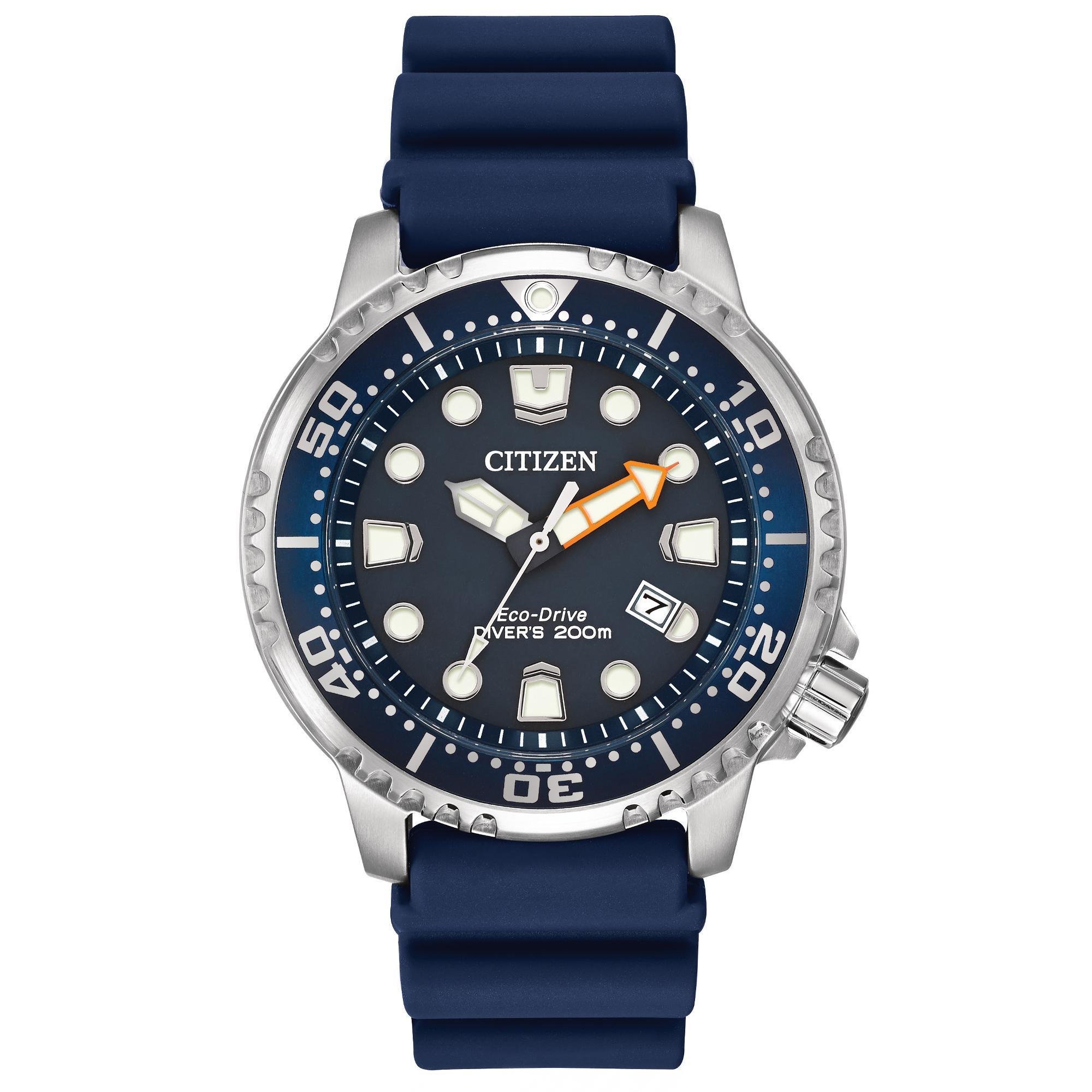
A light-powered dive watch that never needs a battery, worn daily by pool techs for years.
The Citizen Promaster Dive runs on Eco-Drive — a light-powered system that charges from any light source, sunlight or indoor, so the watch never needs a battery replacement or a wind. That is the single biggest practical difference between this and every quartz diver on this list: you cannot kill it by leaving it in a drawer, and you cannot forget to have the battery swapped. Citizen pairs that movement with an ISO-certified dive rating, a 44mm stainless steel case, and a blue polyurethane strap that resists water and chemicals. Water resistance is rated to 200 meters.
A pool technician wore one daily for five years in chlorine, salt, and pool chemicals: the crystal picked up minor scratches but never cracked, the lume stayed strong, and the watch never needed a battery. That is the kind of track record that quiet quartz accuracy buys you. The three-hand dial with a date sits under an anti-reflective mineral crystal, and the rotating bezel tracks elapsed time.
Two things to know going in. The mineral crystal is a deliberate choice over sapphire — one owner who preferred it noted that mineral glass is more impact-forgiving, though it will scratch where sapphire would not. Second, some owners find the 44mm case reads smaller on the wrist than the number suggests, so try the sizing before assuming it will feel large. Neither is a fault; both are worth knowing.
The case for it: a light-powered diver that runs for years with zero maintenance, ISO-certified for diving, and built to shrug off chemical and saltwater exposure.
The honest trade: mineral glass picks up scratches more readily than the sapphire options above, and the 44mm case wears smaller than expected on some wrists.
Point at this one if: you want zero battery swaps, ISO dive certification, and a watch that shrugs off pool chemicals and saltwater for years at a time.
Consider a sapphire alternative if: you cannot stand crystal scratches, since mineral glass picks them up far more easily.
7. Orient RA-AA08 Automatic 41.8mm Sapphire Diver

The 41.8mm automatic that owners call their one-watch solution — sapphire, day/date, and all.
What makes the Orient RA-AA08 (known as the Kamasu II) stand out is the value it packs into a 41.8mm stainless case: a sapphire crystal, a screw-down crown, 200m water resistance, and an F6922 automatic movement that both hand-winds and hacks, meaning you can set the second hand precisely. The day/date window shows both English and Spanish, and the bracelet comes with a secure clasp that offers four micro-adjust positions so you can dial in the fit. Its sapphire crystal at this price point is the single spec that raises eyebrows — most watches here that cost more still run mineral glass.
Owners who also own Rolex, Hamilton, and Seiko divers often call this their favorite daily wearer. The case and band show off brushed finishing without polished links, which means scratches hide well; the bezel clicks positively with a coin-edge grip that turns easily even with wet fingers. On accuracy, buyers report the F6922 running around +7 seconds per day, and one long-term owner self-regulated theirs to -1 second per day after a year. The lacquer gradient dial and the framed day/date give it a look that clearly punches above its class.
The one honest catch: the screw-down crown is a bit small, so owners with larger fingers sometimes find it fiddly to seat. The bracelet is also rated lower than the watch head by some buyers — the 13 mention category is negative there. Neither spoils a watch this well-reviewed. If you want the automatic experience with sapphire protection at a sane price, this is where a lot of buyers land and stay.
What Makes It A Keeper
- Sapphire crystal and screw-down crown at a mid-range price
- F6922 automatic movement — hand-winds and hacks
- Four micro-adjust positions on the clasp for a precise fit
- Independent day/date in English and Spanish
What To Expect Going In
- The screw-down crown is on the small side and takes a bit of care
- The bracelet quality draws more complaints than the watch head
- Some buyers find the 41.8mm case smaller than pictured
This one is for you if: you want a genuine sapphire-crystal automatic diver that works as your everyday watch and does not need a battery swap.
Keep looking if: you want a large, chunky case presence or a bezel-heavy dive aesthetic — this one wears refined, not brutish.
8. Orient Men’s Kamasu Stainless Steel Automatic Diving Watch

The original Kamasu with the deep blue dial that looks better in person than in photos.
The Orient Kamasu (this is the earlier model, named after the Japanese word for barracuda) is the automatic dive watch that popularized the term “Kamasu” in the first place. It runs an automatic movement, needs no battery, and seals to 200 meters of water resistance. The stainless steel bracelet is brushed and polished, the dial is a deep blue that catches light from every angle, and a sapphire crystal sits over it for scratch resistance. The design is deliberate — triangular hour markers and arrow hands that echo the barracuda teeth the watch is named for.
Buyers rate the value and design higher than almost anything else on the watch, and the blue dial specifically draws repeat praise for how it looks against the steel. It is a legitimate desk-to-dinner watch: at home with a suit, at home with a t-shirt. The solid bracelet and clear day/date display round out the everyday package.
What to watch for: accuracy gets mixed feedback — one owner reported a gain of about 5 minutes per month, which is unusual but real — and the winding knob is noted as firm to unscrew. Orient has built mechanical movements for over 75 years, so the underlying reliability is solid; individual regulation still varies. If you want tight, predictable accuracy, plan on having it adjusted.
Why buyers keep it: a deep blue dial that wins compliments, an automatic movement that never sees a battery, and a sapphire crystal that shrugs off daily knocks.
Honest caveat: the winding knob is stiff to unscrew, and accuracy varies enough between units that some owners see a noticeable monthly gain.
Buy it when: the deep blue dial is exactly what you are after, and you want a dressy automatic dive watch for around-the-office wear.
Look up the RA-AA08 instead if: you want the day/date complication and the newer bracelet hardware in the same Kamasu family.
9. Spinnaker Dumas 44mm Automatic Dive Watch SP-5081

A 44mm automatic with 300m of water resistance in an octagonal Royal Oak–style case.
The Spinnaker Dumas pushes past the 200m line that defines most dive watches here. It is rated to 300 meters (about 1,000 feet) of water resistance, which is a meaningful step up for anyone who actually gets wet — and the automatic movement is a self-winding one, so no battery swaps. The case is 44mm and finished in brushed steel with polished edges, and the bracelet alternates brushed links with polished sections between them. The octagonal case design reads distinctive in the hand, and the whole watch weighs about 7.05 ounces.
Owners describe the Dumas as weighty and well-built, which is the design intent. The brushed steel band and the case finishing hold up visually, and the movement runs spot-on reliable in buyers’ reports. That is a preference, not a problem.
Two things to know: the crown is smooth and a bit hard to screw back in, which is a genuine fussiness owners call out. And durability gets mixed feedback, with some buyers reporting the glass bezel cracking — a real risk on a watch that will live on a wrist and get knocked against doorframes. It is a beautiful, well-made diver if you like the look and can live with the crown.
Try this if: you want a heavyweight automatic diver rated to 300m and a case design that stands apart from every other round dive watch here.
Pass if: you want a low-effort crown, or you bang your wrist around a lot and want the most low-maintenance bezel on the market.
10. Luminox Original Navy SEAL 3000 Series Swiss Dive Watch XS.3051.F

A lightweight Swiss tool watch that stays lit all night without charging or pressing a button.
The Luminox Navy SEAL 3000 Series is built for people who need to read the time without thinking about it. The self-illuminating markers glow automatically — no charging, no push-button backlight — so the numerals, hour hand, and minute hand are visible in total darkness, all night, and that self-illuminating system is rated by the manufacturer for years of consistent output. The case measures 43mm and is made of CARBONOX, a lightweight carbon-composite material. Water resistance is rated to 200 meters, there is a date function, and the whole watch weighs about 2.26 ounces, which makes it the lightest on this list by a wide margin. The Swiss quartz movement keeps time without the faff of an automatic wind.
What buyers love is the readability. The large face with clear numerals reads in every light condition, the weight disappears on the wrist, and the glow draws the most praise of any feature. A 12-year Army Infantry veteran and construction worker called it a purpose-built tool watch — lightweight, clean-looking, and built for people who use one on the job. It works for hunting, diving, travel, and daily wear, and the bezel tracks elapsed time for navigation and dive timing alike.
The honest catch: durability gets mixed feedback overall, and the rubber strap wears out faster than owners expect, with some reporting pins loosening over time. One long-term owner reported water reaching the case at 19 months despite the 200m rating. That is the exception rather than the rule, but it is the kind of honest note you want before buying on looks alone.
The draw: automatic nighttime illumination, a 43mm CARBONOX case, and a weight light enough to forget you are wearing it — a Swiss-made tool watch for people who use one on the job.
The honest note: the rubber strap wears out faster than expected on some units, and durability ratings come with mixed feedback overall.
This is your watch if: you want a lightweight Swiss dive watch with self-illuminating markers that work every night without fail.
Consider an alternative if: you want a watch that shrugs off the strap and pins for years without maintenance, or you need heavier built-in durability.
11. SEIKO Prospex Automatic Diver SRPE05 (King Turtle)

The King Turtle — Seiko’s in-house automatic diver, upgraded with ceramic bezel and sapphire crystal.
The Seiko Prospex SRPE05, known to enthusiasts as the King Turtle, is the top-end pick here and backs it up with the specs buyers at this price expect: a sapphire crystal, a ceramic bezel insert, a cyclops magnifier over the date window, and a 4R automatic movement that winds from the motion of your wrist. Water resistance is rated to 200 meters, and the watch uses an in-house Seiko movement rather than a purchased one — an authenticity point that matters to collectors. The green waffle-pattern dial gives the watch its nickname and its distinctive look.
Owners describe it as the ideal mid-tier Seiko diver. The ceramic bezel is a real upgrade over aluminum — it resists scratching almost entirely — and the sapphire crystal keeps the dial clear under bright sun. On accuracy, owners mention the 4R movement running around +5 seconds per day, with one unit dead-on accurate in a winder for a full week. The supple silicone strap is meant for all-day wear, and the case shape allows the watch to wear smaller than its dimensions suggest.
Two honest caveats. Initial accuracy varies between units — one owner tracked theirs at -25 to -30 seconds per day from the start before having it regulated. Bezel alignment gets mixed feedback too, with some units arriving slightly off from the 12 o’clock position. Seiko’s spec tolerance allows for this; if precision from the start is non-negotiable, plan to have it adjusted or checked. For everyone else, this is the enthusiast’s endgame.
Why Enthusiasts Rate It
- In-house Seiko 4R automatic movement — no outsourced parts
- Ceramic bezel insert resists scratching far better than aluminum
- Sapphire crystal with cyclops date magnifier
- 200m water resistance for real diving
The Enthusiast Caveats
- Regulation varies unit to unit — some arrive running slow from the start
- Bezel alignment gets mixed feedback, with some units slightly off at 12 o’clock
- Higher price tier than the value diesels above
Land here if: you want a genuine in-house Seiko automatic with ceramic bezel and sapphire crystal, and you accept that regulation varies unit to unit.
Step down if: out-of-the-box precision matters more than the Seiko name, or you want to spend less while still getting sapphire.
Understanding the Specs
Water Resistance Ratings Explained
The number on the dial — 200m, 300m, or 20 ATM — is a static pressure rating from a lab test. It is not a promise that you can dive to that depth and back; it means the case, gaskets, crown, and caseback are engineered to hold up under that kind of pressure without leaking. For real life, 200m (20 ATM) is the entry point that separates a true dive watch from a “water resistant” fashion piece: it means swimming, snorkeling, showering, and saltwater are all safe. Above 200m you are buying more margin, useful if you are a diver or just want extra headroom. Below 200m, treat the watch as splash-resistant at best. Every watch on this list clears the 200m line.
Movement Types and What They Change
A quartz movement is driven by a battery and an electronic oscillator — accurate to within a handful of seconds a month and effectively maintenance-free beyond battery swaps every few years. An automatic movement is mechanical: a rotor inside winds the mainspring as your wrist moves, so it needs no battery and produces a smooth sweeping second hand. An Eco-Drive or light-powered movement sits between the two — it charges a capacitor from any light source, so it never needs a battery but stays as practical as quartz. None is objectively better. Quartz suits buyers who want zero fuss. Automatic suits buyers who want a mechanical experience. Light-powered suits buyers who want neither a battery swap nor a wind.
FAQ
What does 200m water resistance actually mean on a dive watch?
Is an automatic dive watch better than a quartz dive watch?
How do I know which dive watch will fit my wrist?
What is the difference between tritium and standard luminous paint?
Does a rotating bezel really matter if I never dive?
How often does a dive watch need maintenance?
Can I swim and shower with a 200m dive watch?
Sapphire crystal versus mineral glass — which should I choose?
Do automatic dive watches need to be worn daily to keep time?
What size wrists do these dive watches fit?
Final Thoughts: The Verdict
For most people, the best analog diving watch winner is the Casio MDV-106DD-1A1VCF — it delivers the classic diver look, a 200m rating with a screw-down crown, and quartz reliability without a hint of fuss. If you want a sapphire crystal and an automatic movement that never touches a battery, the Orient RA-AA08 is the smart step up. And if you want real dive certification, zero maintenance, and a watch that shrugs off a pool-chemicals job for years, the Citizen Promaster Dive is the one to reach for.
A last honest nudge: the Casio Duro is the crowd favorite for good reason, and it is the one most buyers will be happy with as their first real diver. Buy it, wear it hard, and let it teach you what you actually care about — then come back for the automatic.
How We Picked
We do not accept paid placement. Every pick is matched to a real buyer and a real use-case; we do not hands-on test units.
Sources & Methodology
Specifications: manufacturer listings and product documentation. Review insights: verified customer reviews, as of September 2026. Pricing: not shown on this page (it changes often); check the current price via the retailer link.
As an Amazon Associate, Gadgets Feed earns from qualifying purchases. This does not affect which products we feature.