
Our readers keep the lights on and my morning glass full of iced black tea. As an Amazon Associate, I earn from qualifying purchases.
Specs are compiled from manufacturer listings and verified buyer reviews and can change over time — please confirm the key details on the product page before buying.
You want a needle meter that reads fast and does not cost much. The short answer: buy the Gardner Bender GMT-312 for cheap, simple everyday checks, and step up to the Hioki 3030-10 if you work on higher voltages and need a meter you can trust. Everything in between depends on how many functions you want, how big you want the dial, and whether a swinging needle or a settling needle suits how you diagnose a circuit.
I’m Min — the founder and writer behind Gadgets Feed. This guide is built by comparing the manufacturers’ published specifications and the patterns across verified customer reviews, so you get each pick’s real strengths and trade-offs instead of marketing spin.
An analog meter shows you a moving pointer instead of a number, which is exactly why technicians still reach for one when a reading is drifting or pulsing. Below you will find the honest differences between nine needle meters, from budget bench tools to Japanese-made instruments, so you can pick the one that matches your bench. This breakdown of the analog electronic multimeter covers range counts, voltage ceilings, and what owners actually notice.
Our Picks at a Glance

How To Choose The Best Analog Electronic Multimeter
The single biggest mistake first-time buyers make is reading an analog needle as if it were a settled digital number. A digital meter gives you a settled number; an analog meter gives you a needle that moves, and that movement is the whole point. You read the trend, the flicker, and the slow drift of the pointer — signal behavior a frozen digit count never shows you.
Start with the voltage ceiling, not the function list
Your meter’s maximum voltage rating is the number that decides whether it belongs on your bench at all. A meter rated to 300V AC/DC like the Gardner Bender GMT-312 is fine for household wiring, low-voltage electronics, and automotive testing. A meter rated to 2500V, like the Aicevoos AS-7199A, opens up industrial and high-voltage diagnostic work. Match the ceiling to the highest voltage you will realistically probe, and never exceed it.
Range counts versus function counts
Function count tells you how many kinds of measurement the meter can make — DC volts, AC volts, DC current, resistance, continuity. Range count tells you how finely it can slice each of those. A 5-function, 12-range meter is a simple bench companion. An 11-function, 24-range meter is a diagnostic tool for someone chasing a fault through a whole panel. Buy the function and range counts that fit your work, not the biggest number on the box.
Readability on a small dial is a real trade-off
Analog scales are printed small and read by eye. A mirrored scale cuts down the parallax error you get when your line of sight sits off-center. A color-coded dial helps you find the right row fast. Compact meters are easier to carry but harder to read at arm’s length — that is the honest trade you are making when you buy small.
Quick Comparison
| Model | Best For | Functions / Ranges | Max Voltage | Weight | Amazon |
|---|---|---|---|---|---|
| Gardner Bender GMT-312★ Best Overall | Simple everyday bench checks | 5 functions / 12 ranges | 300V AC/DC | — | Amazon |
| Tekpower YX360-TRE-BBest Big Scale | Big readable scale on a budget | 8 functions / 19 ranges | — | 7.04 ounces | Amazon |
| Gardner Bender GMT-318Best All-Rounder | Compact carry-along meter | 6 functions / 14 ranges | 500V AC/DC | 4.96 ounces | Amazon |
| NJTY S471 | Transistor, capacitor, and dB work | 8-in-1 functions | — | — | Amazon |
| Aicevoos AS-7199A | High-voltage and remote-control work | 11 functions / 24 ranges | 2500V AC/DC | — | Amazon |
| Tekpower TP7040 | Tube electronics and precise bench reads | 20 ranges | — | 16 ounces | Amazon |
| Sanwa YX-360TRF | Clean linear scale, classic layout | — | — | 450 g | Amazon |
| Hioki 3030-10 | Trusted readings on Category III work | Manual ranging | 600V | 150 g | Amazon |
| Sanwa YX-361TR | Industrial-grade brand-name tester | — | — | 0.29 kg | Amazon |
In‑Depth Reviews
1. Gardner Bender GMT-312 Analog Multimeter
Our pick — 4.5+★ from 750+ verified ratings; the strongest balance of quality and price.
A cheap needle meter that does five jobs and one of them with an actual zero dial
You get trustworthy resistance readings thanks to the zero ohms adjustment dial. On an analog meter you must zero the resistance scale before you trust an ohm reading, and a dedicated dial for it — instead of jabbing a screwdriver into the case — is the difference between a meter you actually use and one you put in a drawer. That dial, plus a 13-position rotary select, is why this 5-function 12-range unit is the default pick for a simple bench checker. Owners lean on it for the boring daily jobs: DC/AC volts, DC current, resistance, and battery tests.
What owners like best is the no-nonsense range of jobs it handles — it is the most-praised thing about this meter, and the price point comes up nearly as often. That tracks with what you get: color-coded displays you can read without translating anything, and test lead input icons that tell you where each probe goes so you do not cross your leads by accident. The 300V AC/DC ceiling covers household wiring and low-voltage electronics comfortably. The rotary dial gives you manual range selection, which is the honest analog way — you pick the range, not the meter.
Now the honest part. Accuracy here is genuinely mixed, and this is not the meter to buy if you need laboratory precision from the start. Some owners find it more accurate than the digital meters they own; others find it less. The scale is small and compact, and that compactness is what makes the reading harder in poor light. If you are buying for calibrating equipment or for tracking a value to the last digit, this is not that tool. If you want a reliable second opinion on a circuit, it is priced right and earns its place. The fuse overload protection circuitry is also a genuine safety feature for a meter this cheap.
What this meter gets right
- The zero ohms adjustment dial makes resistance readings trustworthy without fiddling inside the case
- 13-position rotary dial and 12 ranges let you pick the right scale for the job
- 300V AC/DC ceiling handles household and low-voltage work
- Agency-approved fuse overload protection built in
Where it shows its price point
- Accuracy itself is mixed versus premium meters — enough for checking, not calibrating
- The compact scale is a strain to read in low light
- No transparency about battery type in the listing — expect to check before first use
Ideal for: the home electrician or hobbyist who wants one honest, low-cost meter for checking circuits and batteries.
Think twice if: your work demands lab-grade accuracy or you need a meter that reads clearly across a dimms room — a larger scale serves you better.
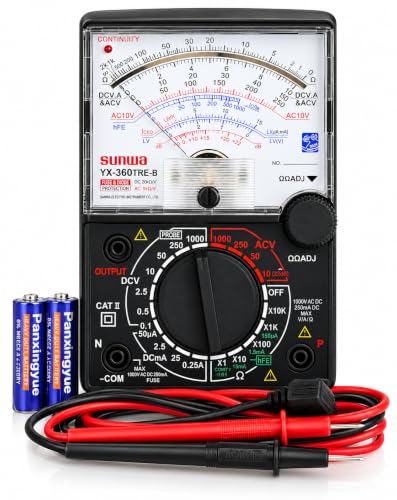
2. Tekpower 8-Function 19-Range Analog Multimeter, YX360-TRE-B
The one you can read from across the bench without squinting
If you’ve ever tried to read a needle on a tiny dial while holding two probes in place, you will understand why size is the headline here. The YX360-TRE-B is a genuinely large unit — and owners say so more than anything else about it. At 7.04 ounces versus the Gardner Bender GMT-318 at 4.96 ounces, that extra mass buys you a dial scaled up for legibility. The mirrored scale is the second piece: it lets you line the needle up against its reflection so your reading does not shift when you move your head.
This is an 8-function unit covering AC/DC voltage, DC current, resistance, diode check, continuity, dB levels, and transistor leak current, across 19 ranges. DC sensitivity like that puts it closer to a real service instrument than to a pocket checker. The dB coverage runs from -10 dB to 22 dB for audio work.
You pay for that in bulk. It measures 6.75 x 1 x 4.75 inches, so it will not slip into a shirt pocket — though at 7.04 ounces it still carries without effort. Some owners also mention the needle can be a touch slow to settle. And unlike the compact Gardner Bender meters, the listing shows no fuse-blown indicator (a light that tells you a fuse has blown). Set against that, the 1-year warranty is real confidence, and buyers consistently praise the accuracy. For a bench meter that stays on the bench, the size is a feature, not a flaw.
Best-for read: bench use, electronics hobby work, and anything where you want to watch a needle without leaning in. The mirrored scale and the large unit are the whole reason to pick it over the GMT-312.
Honest limit: it is heavier and chunkier than a compact meter, and the needle takes a beat to settle. If you need portability, look at the GMT-318 instead.
Choose this one if: you work at a bench and want a big, responsive dial with a mirrored scale that stays readable at a glance.
Otherwise: if your meter lives in a toolbox and comes out on job sites, the extra size here becomes a nuisance.
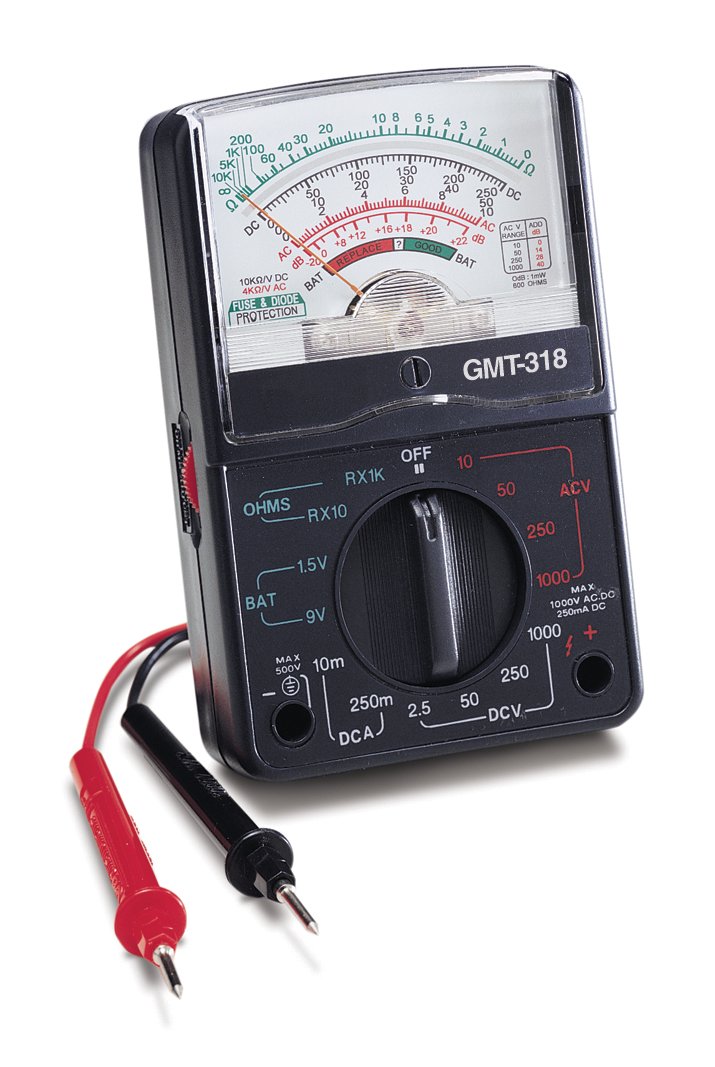
3. Gardner Bender GMT-318 Analog Multimeter
The truck-stop-proof little meter that keeps coming back for more
There is a story in this meter’s reviews that says more than any spec sheet: the same GMT-318 still doing its job two decades after purchase. That is the promise of a 4.96-ounce meter in a casing this small — it survives. The compact footprint is 2.75 inches wide and 4.25 tall, small enough for a glovebox or a side pocket on a tool bag. Owners describe it as a great little meter that works well. Where it wins is quality and functionality, not glamour.
The numbers tell you who it’s for. Six functions and 14 ranges cover AC/DC volts, DC current, resistance, and continuity — a longer reach than the GMT-312’s 5 functions and 12 ranges. The 500V AC/DC ceiling sits above that GMT-312’s 300V, which means a little more headroom for household and light-industrial checks. Manual range selection, color-coded analog displays, and a 15-position rotary dial make it easy to drive. It also comes with replaceable test leads found in the box — a small thing, but it means you can swap a damaged lead rather than replace the meter. Overload protection is built in and agency approved.
The caveats are real but narrow. The same compact size that makes it pocketable makes the gauge small to read, and this comes up more than once. Battery compatibility is the one area where a few buyers have had trouble, so double-check which cell this unit wants before you assume it matches a battery you already have. A few find the accuracy short of a high-end instrument. None of that stops it from being the best value in this group — closer to the middle of the price range than the budget end, but you feel it in the build.
What earns it a spot
- 6 functions and 14 ranges — a step up from the 5-function GMT-312
- 500V AC/DC ceiling beats the GMT-312’s 300V for larger jobs
- Replaceable test leads included so a bad probe does not kill the meter
- Survives the long haul — one owner’s example is still running after 20 years
What you give up
- The small gauge is seriously hard to read for anyone farsighted
- Battery compatibility is the one recurring snag — verify the cell type first
- Accuracy trails the premium Japanese meters in this guide
The right call for: the toolbox meter you grab for cars, outlets, and continuity checks and need to survive being grabbed.
Skip if: you need a large dial or single-digit accuracy — that is the Tekpower and Hioki territory.
4. NJTY S471 Analog Multimeter

A needle meter for people who also need to test transistors and listen for continuity
Most needle meters stop at volts, current, and resistance. This one keeps going. The S471 packs eight measurement jobs into one casing: DC and AC voltage, DC current, resistance, transistor hFE gain, battery condition, load voltage and current, and dB audio levels. If you are chasing a fault through a stereo receiver or checking a transistor in a small circuit, that hFE function is why this pick is on the list at all. It is the kind of coverage that starts to feel like a service instrument rather than a basic checker.
You see a moving trend in real time, because the needle shows it. A digital readout gives you a number, but a needle shows you the flicker while it happens — exactly what you want when you monitor a fluctuating signal or watch a capacitor charge. This meter adds an audible continuity beep (a tone that confirms a closed circuit) so you do not have to look up from your probes. It also has a clear color-coded dial and a compact body owners like to use, and buyers commonly praise its accurate AC and DC voltage measurement.
Here’s where the S471 asks you to be careful. Three internal fuse tubes ship inside, two of them as spares, and that only matters because analog meters do blow fuses when you range wrongly. Two spares buys you two mistakes. The real limit is the dial — in bright daylight, the pointer and scale can wash out and become genuinely hard to see. Work indoors or under shade, and that is a non-issue. It is a busy meter with more going on than a five-function unit, but owners find it easy enough to drive.
what separates it: you can test transistors (hFE, a gain reading for transistors), test capacitance (how much charge a capacitor holds), and read a dB meter (a sound-level scale) in an analog body — capability beyond a basic checker without abandoning the needle.
The catch: the scale disappears in direct sun. This is a bench and workshop meter, not a field meter for outdoor jobs.
Pair it with: a bench, a component drawer, and any repair work that includes transistors or audio gear.
Leave it if: you do outdoor or bright-direct-sun testing where the scale is unreadable.
5. Aicevoos AS-7199A Analog Multimeter
The only meter here rated to measure 2500 volts without flinching
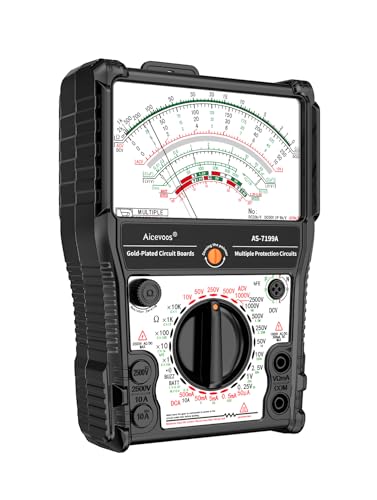
For most household work, a 300V meter is plenty. For industrial and high-voltage troubleshooting, the ceiling becomes the entire buying decision. This one measures AC and DC voltage up to 2500V, DC current to 10A, and resistance up to Rx 100K. That voltage ceiling is 2500V versus the Gardner Bender GMT-312’s 300V max — and in fairness the comparison numbers tell the story: the AS-7199A lists 11 functions and 24 ranges against the GMT-312’s 5 functions and 12 ranges. It is simply a much wider instrument.
Where does 11 functions and 24 ranges land in practice? Beyond volts, current, and resistance, you get a standard resistor box function, on/off beeping, transistor testing, LV detection, regulator and LED detection, battery testing, and remote control detection. That last one is useful if you repair TV remotes and want to confirm if the emitter is firing. Owners find it works well for monitoring capacitor charge and discharge. It also measures high voltage without complaint. The battery tester rounds out the useful everyday modes.
You will appreciate the mounting hardware on a bench. There is a rear stand for propping it on a workbench, magnets for sticking it to a metal surface, and hanging holes for clipping it up — small touches that mean you are not chasing the meter across the bench while holding probes. Build quality is the mixed spot; this is a plastic-bodied meter with more functions than premium finish. The included 1.5V batteries mean you can start reading from the start. Unlike the compact Gardner Bender, you trade premium build for a range an ordinary meter cannot touch.
Range champion: you can measure up to 2500V AC/DC (alternating and direct voltage) — the highest ceiling in this guide by a wide margin — with 11 functions and 24 ranges that cover remote controls and LEDs.
Build honesty: quality is the weaker half of the equation here. The features are broad; the finish is not premium.
Reach for this if: your work involves high voltage, industrial panels, or component-level diagnostics that demand more reach than a 300V meter provides.
Look elsewhere if: you only do low-voltage bench work and want the fit and finish of a premium Japanese instrument.
6. Tekpower TP7040 20-Range Analog Multimeter

The one old-guard tube amp repairers keep reaching for
If you restore tube electronics — guitar amps, old radios, test gear — this meter is a name that comes up in that world. The TP7040 spreads its coverage across 20 ranges, with a coded and mirrored scale plate to keep parallax error out of the reading. Its fused protective holster means it can survive a drop and keep going. It is rated to the EN61010-1 standard, which is the published safety benchmark for measuring instruments in Europe, and it carries a 1-year limited warranty plus a 90-day money-back guarantee. That backing matters if you intend to keep a meter for a decade.
The headline number here is accuracy, which is the most-praised quality in the reviews. High sensitivity means it does not load down the circuit it is measuring, so the reading reflects the circuit’s real behavior rather than the meter drawing it down. That is especially important in tube gear, where you are often reading high impedance points. The scale is readable and the size scale is praised, which answers the complaint that compact analog meters are hard to read over a period of time. The mid-priced tier is where this sits, and owners feel it’s good value.
The known rough edge is the zero adjust knob and needle movement — a small number of units arrive with a sticky zero adjust, which affects but does not ruin the reading. If you are careful about setting zero on the resistance scale, this is manageable. It is a 16-ounce meter with a holster, so it is denser than most — the trade for that protective shell. It is not the most refined unit in this group, but for the repair bench it has earned its following through accuracy rather than slick styling.
Why tube repairers pick it
- 20 ranges give you resolution at the high-impedance points tube gear has plenty of
- High sensitivity means you are not loading the circuit while measuring
- Fused protective holster and EN61010-1 compliance for safety on the bench
- The accuracy is what buyers talk about — and the warranty is 1 year
Where it needs care
- The zero adjust knob and needle movement are occasionally part of the purchase and need handling
- The 16-ounce body with a holster is heavier than a compact meter
- No dB or transistor functions like the NJTY S471 — this is a range-focused instrument
Meant for: tube amp, old radio, and vintage electronics repair where you need range resolution and high sensitivity.
Pass on it if: you want modern extras like a dB meter or transistor gain — the S471 covers more ground there.
7. Sanwa YX-360TRF Linear Analog Multimeter
The genuine Japanese classic with the cleanest linear scale in the lineup
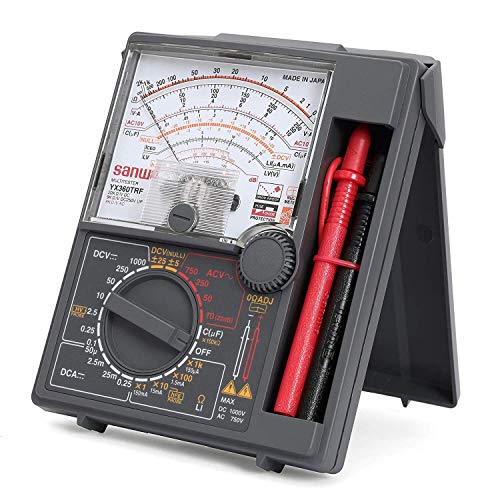
The YX-360TRF is one of two Sanwa meters here, and what you are paying for is heritage and a clean, linear scale layout. The name still means something to technicians who grew up with analog gear. At 450 grams it sits in the middle of the road for weight — heavier than the compact Gardner Benders but portable enough to move around a bench. There is no published customer data for this unit in this listing, so treat this as a spec-and-lineage read rather than a crowd-driven one. That puts the burden of proof firmly on the basics.
What you get is a legitimate analog multitester built to Sanwa’s spec. The linear scale is the reason engineers still choose these meters: readings that move evenly across the dial, so a swing you watch is a real swing, not a correction for a non-linear scale. The 6.28 x 5.08 x 1.63 inch body holds a dial bordered by a clean analog face. It is a manual-range meter — you pick the setting, then read the needle, just as you would with any serious analog tester. The form factor is upright, with a face raised off the bench so the needle stays visible from a working angle.
Here is the honest read on this pick. It is sold as an electronic measuring instrument, not a solved-expectations product. There is no customer-review history published for this listing, so you have no neighbor’s experience to lean on. The Japanese Sanwa brand is the draw. If you are the kind of buyer who knows you want a Sanwa and knows why, this is the classic. If you are still deciding, the reviews cannot vote for this one compared to the catalog-documented picks.
For anyone set on: a true Sanwa analog linear-scale tester — established brand, clean face, straightforward manual ranging.
Think twice if: you need published owner history before you buy — this listing carries no review data to lean on.
8. Hioki 3030-10 HiTester Analog Multimeter
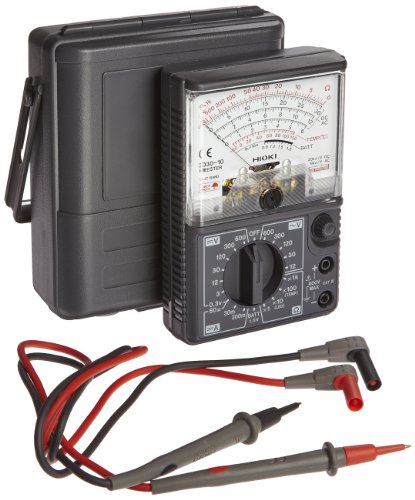
The Japanese instrument trusted for readings that hold on Category III work
This is the meter to buy when the reading itself must be defensible. It meets IEC safety standard 61010 and is certified for Category III installations up to 600V. That Category III rating is the distinction that matters on service panels and industrial cabinets — it certifies the meter can tolerate the transient surges those locations produce. The 150-gram body keeps it light in hand, and at 6.2 x 6.1 x 2.3 inches it is a bench-friendly shape that sits flat and reads cleanly. Owners describe it as a great-quality analog meter made in Japan.
The reason buyers trust the reading here is the average-sensing movement. This meter gives accurate readings on linear loads where the voltage or current has an undistorted waveform — which is precisely the ordinary household and industrial load most meters face. It measures voltage, resistance, and current, and packs a battery tester that tells you how much charge is left in a 1.5V cell. There is also a temperature function via a thermistor probe sold separately. Accuracy is a consistent strength: buyers report its measurements track well against far more expensive digital meters.
The two honest notes: the mirrored scale — the parallax-correcting design the precise technicians swear by — draws mixed reactions, and the thermistor probe for temperature work is bought separately. If you need temperature readings, factor that extra piece in. The 150-gram weight might feel insubstantial after using a heavier holstered meter, though owners have no complaints about durability. High is the right word for what this is: a premium meter built for people who need the reading to be right the first time.
Why it earns its spot: a Category III safety rating up to 600V and average-sensing accuracy that owners say matches more expensive digital meters.
What to plan for: the thermistor temperature probe is sold separately, and the mirrored scale is a matter of preference.
Best matched to: electricians on service panels, technicians in industrial cabinets, and anyone who needs a certified-safe analog meter at 600V.
Not the pick if: your work stays low-voltage and you would rather not spend for a Category III rating you will not use.
9. Sanwa YX-361TR Analog Multitester

A red-cased industrial Sanwa for the buyer who already knows the name
You get a bench meter that sits still, because the YX-361TR is the second Sanwa here and adjusts the recipe. This unit is listed as an industrial-style multitester rather than a modern-style one, and it carries IEC 61010-1 (a safety standard for electrical test gear) and CE compliance (a European safety mark). The red casing gives it a more distinctive look than the typical black-case meter. At 0.29 kg it is the heavier of the two Sanwa options and sits in the upper range of analog meter weights in this guide — the kind of heft that stays put on a bench. No customer-review data is published here either, so this is a spec-first read.
What the specs tell you is a meter built for the shop floor. The international standards compliance — IEC 61010-1 for safety and CE for electrical goods in Europe — is the paperwork that matters in industrial settings. The dimensions put it in an upright, front-facing case about 5.91 inches tall and 3.94 wide. Minimum operating voltage is 3V, so it needs a proper battery fitted before use. The measurement family — voltage, current, resistance — is what you get from a classic analog tester, and the manual range selection means you control how the needle is calibrated to what you are testing. If you already respect how Sanwa builds analog instruments, the YX-361TR is the fresh industrial trim on that same formula.
Be honest with yourself about what the lack of review data means. You will not find owner testimonials to reassure you on the listing for this exact trim. That is not the same as saying the meter is unproven — the Sanwa name and the international standard compliance carry weight on their own. But if published owner experience is part of how you make a buying decision, this isn’t the listing to lean on. For buyers who want a Sanwa in an industrial-focused finish and are happy to choose on spec, it delivers.
Worth considering when: you specifically want Sanwa’s industrial-style analog tester with IEC 61010-1 and CE compliance.
The limitation to know: no review history published on this listing, and it is the heaviest Sanwa here at 0.29 kg.
Understanding the Specs
Function and range counts
A function count tells you how many kinds of measurement a meter can make. A range count tells you how many calibration settings each function has. A 5-function, 12-range meter handles the basics — volts, current, resistance, continuity. An 11-function, 24-range unit like the Aicevoos AS-7199A adds transistor, LED, and remote-control testing on top, with finer slices of each. Neither number is better in isolation; pick the counts that match the work you actually do.
Voltage ceiling
Maximum voltage is the highest reading the meter is rated to take, and it is the first spec to check for safety. A 300V AC/DC meter like the Gardner Bender GMT-312 covers household circuits and low-voltage electronics. A 2500V-rated unit like the AS-7199A is built for industrial and high-voltage work. The Hioki 3030-10 sits at 600V with a Category III certification, which specifically addresses the transient surges service panels can create. Never probe above your meter’s ceiling.
DC sensitivity and loading
Sensitivity, often written as ohms-per-volt like 20,000 ohm/V on the Tekpower YX360-TRE-B, describes how much the meter draws from the circuit it measures. Higher numbers mean less disturbance — useful when you are testing high-impedance points and cannot afford to change the circuit just by measuring it. Lower-sensitivity meters can drag the reading down. If you work on sensitive or high-impedance gear, the sensitivity figure matters as much as the range count.
Scale readability and safety build
An analog meter is only as good as its scale is readable. A mirrored scale cuts parallax error so the needle reads the same wherever your head is. A color-coded face speeds range selection. Safety build matters too — look for fuse overload protection (the Gardner Benders and the NJTY S471 list it) and standards compliance like EN61010-1 or IEC 61010-1. Those details tell you the meter is meant to survive a mistake, not just avoid one.
FAQ
What is the advantage of an analog multimeter over a digital one?
What does 2500V on the Aicevoos AS-7199A actually mean for safety?
Why do I need a mirror on the scale of an analog meter?
Can an analog meter test transistors and capacitors?
How does the zero ohms adjustment work on the Gardner Bender GMT-312?
Is a Category III 600V rating important for home use?
What battery does an analog multimeter use?
Does the Hioki temperature feature need an extra accessory?
Why do analog meters need a fuse and how many spares should I have?
Is a heavier analog meter better than a lighter one?
Final Thoughts: The Verdict
For most people shopping for the analog electronic multimeter, the winner is the Gardner Bender GMT-312 — it does the five everyday jobs, it has the zero ohms dial that makes resistance readings trustworthy, and it earns 4.5+ stars from 750+ verified ratings. The needle-reading habit it teaches carries over to every analog meter you own after it.
If you want a bigger dial you can read from across the bench, take the Tekpower YX360-TRE-B with its mirrored scale. If you need a certified Category III meter for service panels, the Hioki 3030-10 is the one to hand your money to. And if high voltage is your daily reality, the Aicevoos AS-7199A reaches 2500V where nothing else in this lineup does.
One last nudge worth taking seriously: the Gardner Bender GMT-318 is the best value in the middle of this group, and it pairs a longer 14-range reach with the compact, pocketable body so many buyers want. If you are torn between the top three picks, start with the one whose scale you can read at arm’s length — the meter you actually use beats the one with the longest spec sheet.
How We Picked
We do not accept paid placement. Every pick is matched to a real buyer and a real use-case; we do not hands-on test units.
Sources & Methodology
Specifications: manufacturer listings and product documentation. Review insights: verified customer reviews, as of November 2026. Pricing: not shown on this page (it changes often); check the current price via the retailer link.
As an Amazon Associate, Gadgets Feed earns from qualifying purchases. This does not affect which products we feature.