
Our readers keep the lights on and my morning glass full of iced black tea. As an Amazon Associate, I earn from qualifying purchases.
Specs are compiled from manufacturer listings and verified buyer reviews and can change over time — please confirm the key details on the product page before buying.
You never have to worry about a dead battery or a fogged-up screen with an analog meat thermometer—just a needle and a dial that show when dinner is done. The catch is that reading the dial takes a moment of focus, and accuracy can drift if you pick the wrong build, so the real question is which dial size and probe length deserve a spot in your drawer.
I’m Min — the founder and writer behind Gadgets Feed. This guide is built by comparing the manufacturers’ published specifications and the patterns across verified customer reviews, so you get each pick’s real strengths and trade-offs instead of marketing spin.
Whether you are roasting a turkey, frying candy, or grilling steaks, selecting the right analog meat thermometer boils down to dial readability, probe length, and temperature range, which we break down for nine proven picks.
Our Picks at a Glance


How To Choose The Best Analog Meat Thermometer
Match the thermometer to what you cook most. A short-probe instant-read model suits steaks and chops, but a long 12-inch stem is the only safe way to check oil temperature in a deep pot without burning your arm.
Match the Probe to the Job
The immersion depth—how far the stem reaches into the food or liquid—dictates what the thermometer can accurately handle. For a turkey breast or a pot of frying oil, you need several inches of reach, while a 1-inch probe is better suited for thin cuts or quick checks.
Read the Dial Before You Buy
Dial size directly affects how quickly you can glance at a temperature. A larger 2.5-inch face with bold markings is easier to read in the dim light of a grill, while a 1-inch dial is compact but might have you squinting. Look for models that print target meat temperatures right on the face.
Know Your Temperature Range
Different cooking tasks need different ranges. A dial that tops out at 220°F covers roasting and baking, while a deep-fry thermometer needs to reach 550°F to handle hot oil and candy stages. Check the face markings so you do not buy a thermometer that stops short of your needs.
Quick Comparison
| Model | Best For | Dial Size | Probe Length | Temp Range | Amazon |
|---|---|---|---|---|---|
| Reotemp K82P-3★ Best Overall | HVAC & Food Spot Checks | 2″ | 5″ | 0–220°F | Amazon |
| Escali AH1 2-PackBest Value | Leave-In Oven Roasts | 2.5″ | 4.75″ | 140–190°F | Amazon |
| defull MT003Deep Fry Pick | Deep Frying & Oven Checks | 2.2″ | 12″ | 50–550°F | Amazon |
| BOMATA 2-Pack | Roasting with Doneness Guides | 2.5″ | 1.9″ | 120–220°F | Amazon |
| efengcook 2-Pack | Turkey & Candy Making | 2″ | 12″ | 50–550°F | Amazon |
| OXO Instant Read | Quick Steak & Roast Checks | — | 3″ | — | Amazon |
| Taylor 3621 | Commercial & AC Testing | 1″ | 1″ | 0–220°F | Amazon |
| OXO Leave-In | Oven-Safe Roasting | Large | 5.25″ | — | Amazon |
| Taylor 8215N | Yogurt & Precise Batch Work | 1.75″ | 7.75″ | 0–220°F | Amazon |
In‑Depth Reviews
1. Reotemp Large Dial Easy Read Pocket Thermometer
Our pick — over 4.5★ from 150+ verified ratings; the strongest balance of quality and price.
The rugged 2-inch dial that refuses to fog up, even when you rinse it off.
Built for more than just the kitchen, this pocket thermometer earns its keep checking air conditioning output, lab work, and food inspection alike—a hermetically sealed dial means you can rinse it clean without the face fogging. The 304 stainless steel and glass construction explains why it holds up long term, and the sensitive bimetal coil is factory-calibrated to ±3 degrees Fahrenheit.
Owners consistently land on the same verdict: it is the most legible dial they have used, with the larger face making temperature measurement feel more precise than the smaller pocket models they owned before. What wins people over is the accuracy—the readings hold up in ice water and against digital references, making it dependable beyond the stovetop.
It is not a leave-in oven thermometer, so treat it as a spot-check tool you pull out, read, and put away. A few owners note the plastic pocket protector feels flimsy even though the metal body is solid, and some suggest calibrating once before first use despite the factory setting.
Legibility first: the oversized dial with bold markings is the whole reason to pick this over a slimmer probe—the face stays readable at a glance.
Dual-purpose reach: with a 5-inch stem that is 2.5x shorter than the deep-fry pick below, this suits spot checks and HVAC work, not tall pots of oil.
Reach for it if: you want one reliable, easy-to-read thermometer that moves between the kitchen, the workshop, and the test bench without missing a beat.
Look elsewhere if: your cooking centers on deep frying—the 5-inch stem will not safely reach the bottom of a tall pot.
2. Escali AH1 2 Pack Oven Safe Meat Thermometers
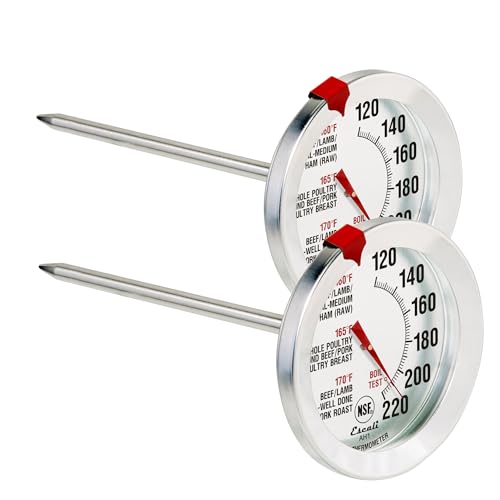
A two-pack of leave-in thermometers with a 2.5-inch dial that prints dinner temps right on the face.
This set shines for the classic roast-and-forget cook, since the stainless steel build is safe to leave in your turkey or casserole while the oven does its work—no opening the door and losing heat. The extra-large 2.5-inch dial is 25% bigger than the Reotemp’s 2-inch face, and it prints target cooking temperatures for beef, poultry, pork, veal, and lamb directly on the dial in both Fahrenheit and Celsius.
The design covers 140 to 190°F with a 4.75-inch probe, and the whole thing is dishwasher safe with an NSF-certified food safety rating. Owners sum it up plainly: “These meat thermometers work great! They give quick, accurate readings and are very easy to use.” The movable red arrow for setting a target temp is a hit, though a few note the slider drifts and is not really needed anyway.
The honest trade-off is durability, with some owners reporting the needle sticking or the unit failing after heavy use. That mixed feedback sits alongside the praise, so treat these as dependable everyday tools rather than lifetime heirlooms—especially at a two-pack value price.
What the dial does for you
- Large 2.5-inch face with bold meat-doneness markings for instant reference
- Oven-safe leave-in design means you never open the door to check
- Dishwasher safe stainless steel keeps cleanup to a single cycle
Where it falls short
- Recurring reports of needle movement issues in some units
- Durability concerns surface under frequent heavy roasting
Best for: anyone roasting whole birds or large cuts who wants two reliable leave-in thermometers for the price of one premium model.
Not for: deep-fry cooks who need a 12-inch stem to reach oil in a tall pot safely.
3. defull 12″ Deep Fry Thermometer with Clip
The 12-inch stem that reaches the bottom of a tall pot without your hand near the oil.
When oil depth becomes a safety concern, this thermometer’s 12-inch stainless steel stem is the difference between a controlled fry and a dangerous reach—the adjustable pot clip secures it to the pan wall so your hands stay free. The 2.2-inch dial with a laboratory glass lens reads from 50 to 550°F, covering everything from candy stages to high-heat frying.
The long probe makes it a genuine multi-tasker, handling scalding milk, frosting, and any deep-fried food, and the 12-inch immersion depth gives it 2.5x the reach of the Escali’s 4.75-inch probe. Buyers report it was “a real life saver” when an oven was not reaching its set temperature, and that the large, easy-to-read display helps them bake with confidence.
Because it is a mechanical dial, there is nothing to charge or replace, and the red color makes it easy to spot on a busy counter. The trade-off is that it is purpose-built for pots and ovens rather than quick steak checks—you would not use this for a thin cut on a grill.
Reach and range: the 12-inch stem plus a 550°F ceiling is exactly what you need for turkey frying and candy work that short probes cannot touch.
Hands-free clip: the adjustable pot clamp holds the thermometer upright so you read the dial while both hands stay busy.
Choose this for: deep frying, candy work, or oven calibration checks where a long, heat-safe probe is non-negotiable.
skip it if: you only grill thin steaks—the long stem is overkill for quick surface checks.
4. BOMATA 2 Pack Meat Thermometer Oven Safe
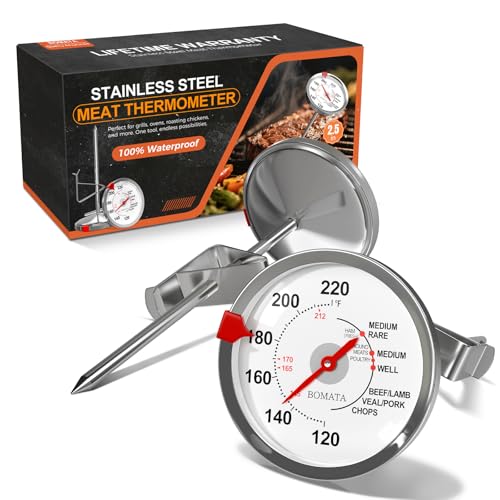
A 2.5-inch dial with built-in doneness guides, sealed against water, oil, and grease.
This two-pack leans hard on legibility and cleanup, pairing an oversized 2.5-inch dial with built-in meat doneness guides for steak, chicken, pork, turkey, and lamb so you skip the guesswork entirely. The IPX8 waterproof seal means you can rinse it, immerse it briefly, or run it through the dishwasher’s top rack without fogging the lens.
Measuring 120 to 220°F, it covers rare through well-done and poultry-safe temperatures, with a recommendation to insert the probe at least 1.9 inches into the thickest part of the meat. Food-grade 304 stainless steel and tempered glass construction meet NSF certification standards, and a lifetime warranty backs the purchase.
Owner feedback splits predictably: the big display and simple operation draw steady praise, but this is a leave-in slow-roast tool, not an instant-read for fast steak checks. One critical review flagged a misprinted “WEEL” marking on the dial, so inspect your units on arrival, though the warranty covers genuine defects.
Waterproof confidence: the fully sealed IPX8 dial is the reason you can clean this without coddling it—a real advantage over unprotected dials.
Slow-roast fit: the 1.9-inch insertion depth suits roasts and poultry better than thin grilling cuts that need instant feedback.
Reach for it if: you want a low-maintenance, dishwasher-safe leave-in thermometer with doneness guides printed right on the face.
Consider another if: you need an instant read for quick grilling—this one responds slowly by design.
5. efengcook Deep Fry Turkey Candy Thermometer 2 Pack
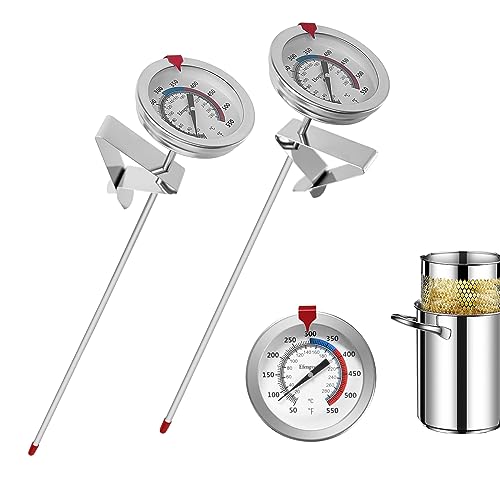
Two 12-inch probes for under the cost of one specialty candy thermometer.
If you split your time between deep-frying turkeys and tempering chocolate, this two-pack gives you a backup without a second purchase—each 12-inch 18/8 stainless steel probe reads from 50 to 550°F with ±5°F accuracy. The adjustable clip slides along the stem to secure it to any pot, and the rotating bezel pointer lets you mark a target temperature before you start.
The 2-inch dial is built for glancing from across the kitchen, with confectionary temperatures printed for candy stages and high-heat applications. Owners confirm it shines for candy making, with one noting the candy “turned out great” as the real proof of accuracy, and another using it as a replacement and backup for turkey frying.
The main caution is care: dropping one into hot liquid can throw off the reading significantly, so keep the clip engaged and avoid full immersion in boiling oil. The included instructions are poorly translated, but the mechanical dial itself needs nothing but a good wipe-down.
Why the long stem wins
- 12-inch probe reaches deep pots without your hand near the heat
- Rotating bezel pointer marks your target temp before cooking
- Two units in the pack give you a dedicated candy and fry thermometer
The care it demands
- Dropping the probe into hot liquid can skew accuracy by a wide margin
- Graduation lines are fine and take a moment to read
Pick this for: households that regularly deep fry and make candy, where a backup 12-inch probe earns its keep.
Look past it if: you want a single premium unit—this is a budget two-pack, and the build shows it in the details.
6. OXO Good Grips Analog Instant Read Thermometer
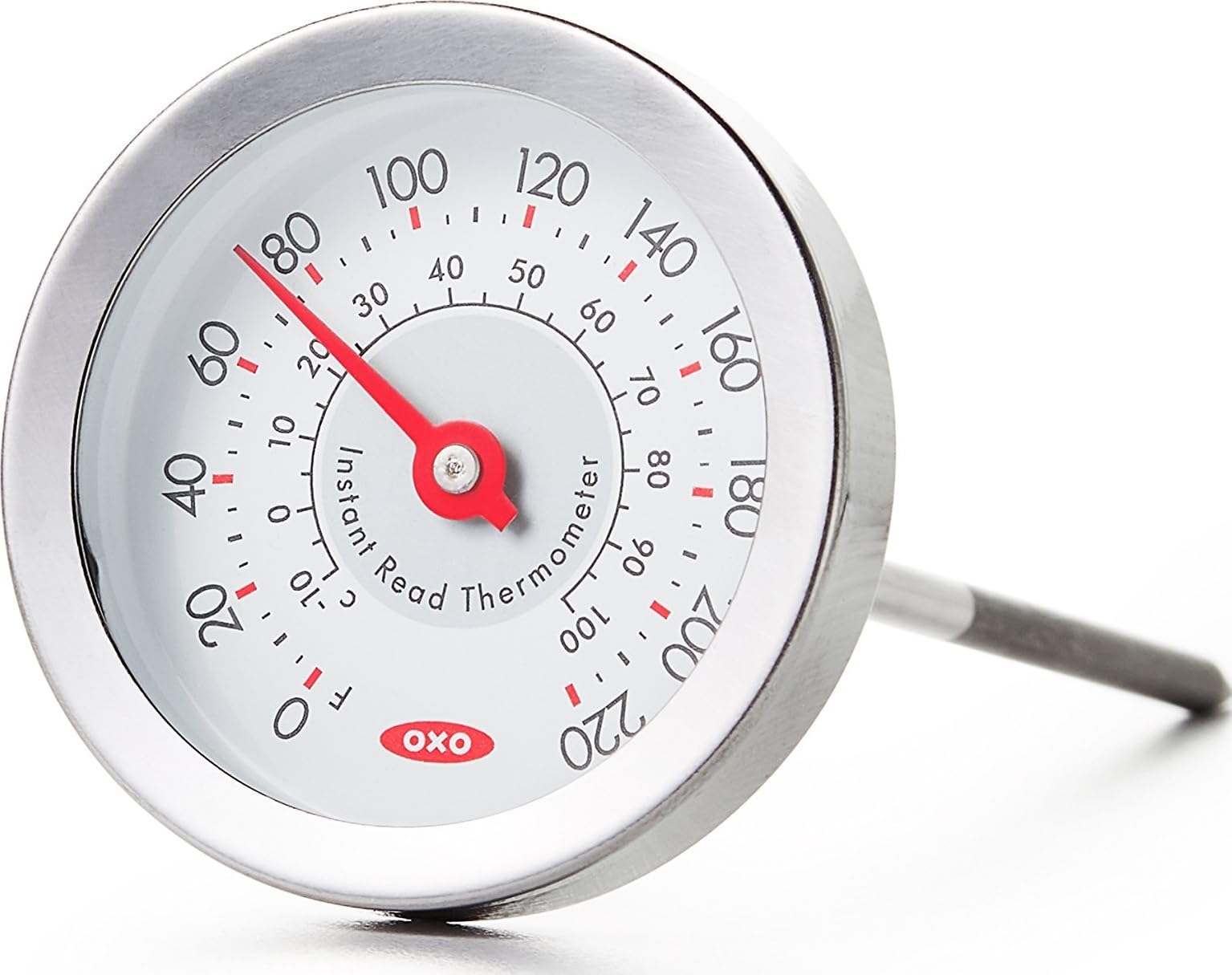
The 3-inch probe that tells you exactly how deep to push it with a shaded guide.
OXO’s take on the instant-read dial is all about removing guesswork—the probe cover prints both chef-recommended and USDA-recommended temperatures, and a shaded area on the stem shows the proper insertion depth. The rapid-responding bi-metallic coil delivers a quick readout, and the 2.24-ounce build is light enough to store anywhere.
The insertion guide fixes the most common mistake: owners mention it “works great when used correctly,” meaning you push the probe into the thickest part of the meat until it hits the grayed-out section. The slender pointed case slides easily into cooked meat, bread, or casseroles, and the large dial reads without a magnifying glass.
Accuracy gets mixed feedback, with some owners finding consistent readings and others reporting drift, so this rewards a quick calibration check. The trade-off for the thoughtful design is a niche fit—this is a spot-check tool, not a leave-in-the-oven thermometer.
Guided depth: the shaded insertion zone and printed target temps remove the two biggest mistakes beginners make with analog probes.
Trade-off: the 3-inch stem is shorter than the Reotemp’s 5-inch reach, so it suits steaks and roasts rather than deep pots.
Best for: cooks who want an idiot-proof instant-read with visual guides printed right on the tool.
Not ideal if: you need a waterproof or leave-in design—this is built for quick checks, not oven duty.
7. Taylor Instant Read Thermometer (1-Inch Dial)

The 1-inch dial that became a commercial kitchen standard because it survives what kills digitals.
This professional-grade pocket thermometer reads internal meat temperatures from 0 to 220°F, and its real superpower is longevity—commercial kitchens adopted it as the standard after their digital LCD screens kept dying while this analog kept working. The stainless steel construction is light and tough, with black graphics on a white background for at-a-glance readings.
The defining feature is recalibration: the durable plastic sleeve doubles as a recalibration tool, so you can reset the needle in ice water and boiling water before each shift. A commercial kitchen owner reports it “lasts a lot longer” than digitals and is easy to clean and sanitize without worrying about ruining the device.
The catch is the dial size—1 inch is genuinely small to read, and owners openly wish it were closer to 1.5 inches. It also requires calibration before each use for best accuracy, which is a habit, not a set-and-forget feature.
Built to be calibrated: the adjustable nut on the back means you can restore accuracy yourself, something pricier sealed models cannot do.
Honest limit: the compact dial trades readability for portability, so it suits pros who know their temps more than home cooks with aging eyes.
Choose this for: commercial kitchens or anyone who loves a tool that never needs batteries and can be recalibrated on demand.
pass on it if: you struggle to read small print—the 1-inch dial demands a close look.
8. OXO Good Grips Chef’s Precision Analog Leave-In Thermometer
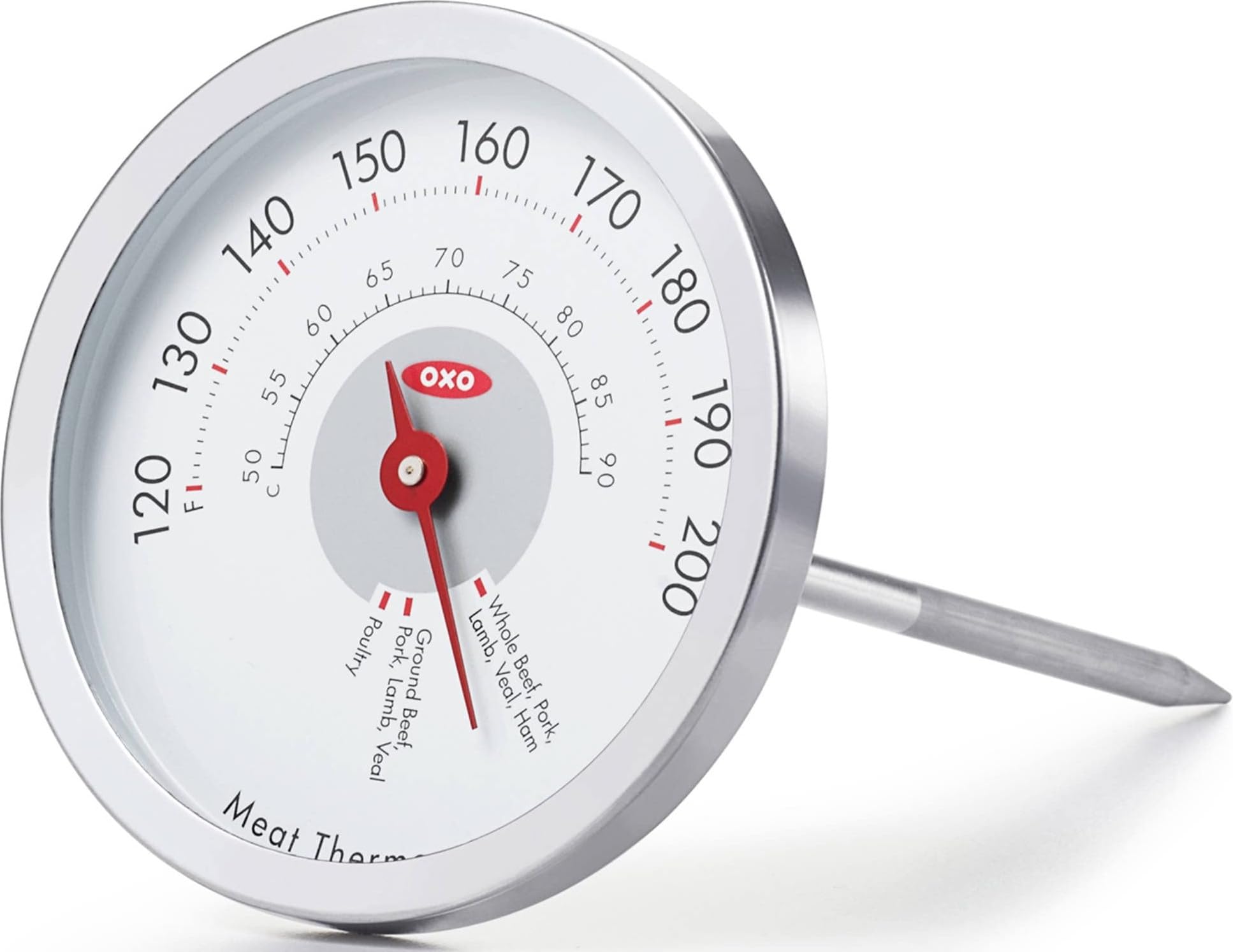
A leave-in oven thermometer with a 5.25-inch probe and USDA temps printed on the face.
Designed for the roast-and-walk-away cook, this OXO stays in the meat while it cooks, with a 5.25-inch probe that reaches deep into a turkey breast or roast. The thermometer face prints USDA-recommended temperatures, while the probe cover shows chef-recommended temps, and a shaded insertion guide prevents shallow placement errors.
The large dial with readable numbers draws consistent praise for legibility, and the 3.2-ounce build feels sturdy in hand. One owner reports their mother’s unit “still works perfectly” two years after receiving it as a gift, which speaks to the build quality when treated well.
The mixed reality is accuracy: some owners find it spot-on, while others report readings that left meat undercooked, and a glass-cracked unit was replaced promptly with good customer service. This makes a first-use calibration check worthwhile, and the 5.25-inch depth means it is an oven tool, not a quick-check probe.
Leave-in advantages
- 5.25-inch probe stays in thick cuts without touching the pan bottom
- USDA and chef temps printed on face and cover for instant reference
- Large, sturdy dial reads clearly across the kitchen
Read this first
- Accuracy is inconsistent from the start—verify against a known source before trusting it
- Glass face can crack if handled roughly, though support replaces units
Best for: home cooks roasting large cuts who prefer a sturdy leave-in dial with printed temp guides over a digital probe.
Look elsewhere if: you want a waterproof tool you can dunk in the sink—this needs gentler handling.
9. Taylor 8215N 8-Inch Bi-Therm Pocket Dial Thermometer
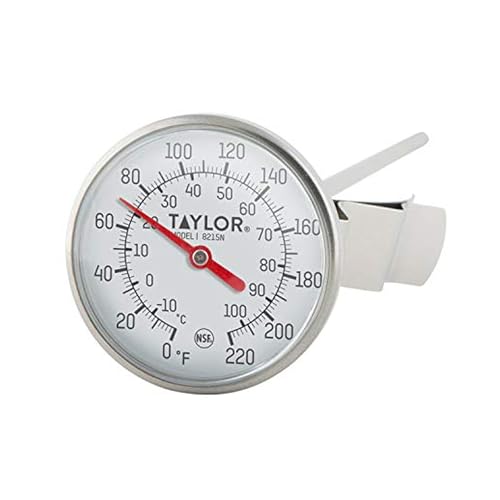
The 1.75-inch dial trusted for yogurt batches because it reads with 2-degree precision.
For precision batch work like yogurt making, this Taylor delivers a 0 to 220°F range with 2-degree Fahrenheit divisions and a 3-point calibration for ±2°F accuracy across the entire span. The 7.75-inch immersion depth lets the probe hang into a deep pot while the included clip holds it against the side, keeping it steady during a multi-hour ferment.
The anti-parallax dial face means the reading stays consistent even if you glance at it from an angle, and the superior shock protection helps it survive the bumps of a busy counter. Customers note using one for about 35 years without a single recalibration, calling it “accurate, durable” and noting the mechanical design never leaks red chemical fluid into food like older liquid-filled models.
Because it is a pocket dial with a 1.75-inch face, it is smaller than the Escali’s 2.5-inch display, though the finer 2-degree markings make it a fit for recipes that demand exactness. It lacks a protective storage case, so you will want to keep it in the included clip or a drawer slot.
Calibrated precision: the 3-point adjustment and ±2°F rating make this the most trustworthy dial for exacting recipes like yogurt and custards.
Fine markings: 2-degree divisions beat coarser dials for precision work, but the smaller face takes a closer read than a 2.5-inch model.
Reach for it if: your cooking demands exact temperatures—yogurt, custards, or darkroom work—where 2-degree accuracy matters.
Consider the Escali instead if: you prioritize a giant, glanceable dial for everyday roasting over fine precision markings.
Understanding the Specs
Dial Size and Readability
The dial size is the first thing you notice and the thing that determines whether you actually use the thermometer. A 2.5-inch face with bold, high-contrast markings lets you glance at a temperature from across the kitchen, while a 1-inch dial forces you to bring the tool close to your eyes. If you cook in dim grill light or have aging eyes, prioritize the largest dial you can find.
Probe Length and Immersion Depth
The probe length—or immersion depth—controls what the thermometer can safely measure. A 12-inch stem reaches the bottom of a deep fryer or stockpot without your hand near the oil, while a 1.9-inch insertion depth suits thin steaks and roasts. Match the probe to your tallest pot and thickest cut, because a short probe in a deep pot reads the oil at the surface, not the true temperature.
FAQ
What is the difference between an instant-read and a leave-in analog thermometer?
How deep should I insert the probe into meat?
Can I leave an analog thermometer in the oven while cooking?
How do I calibrate an analog meat thermometer?
What temperature range do I need for deep frying?
Why does my analog thermometer read differently from my digital one?
Are analog thermometers waterproof?
How long does an analog meat thermometer last?
Final Thoughts: The Verdict
For most cooks, the best analog meat thermometer is the Reotemp because its 2-inch waterproof dial and ±3°F accuracy cover nearly every kitchen and workshop need with one dependable tool. If you roast whole birds regularly, grab the Escali 2-pack for leave-in convenience with a 2.5-inch dial. And for deep frying or candy work, the defull with its 12-inch stem and 550°F range is the one to reach for.
How We Picked
We do not accept paid placement. Every pick is matched to a real buyer and a real use-case; we do not hands-on test units.
Sources & Methodology
Specifications: manufacturer listings and product documentation. Review insights: verified customer reviews, as of August 2026. Pricing: not shown on this page (it changes often); check the current price via the retailer link.
As an Amazon Associate, Gadgets Feed earns from qualifying purchases. This does not affect which products we feature.