
Our readers keep the lights on and my morning glass full of iced black tea. As an Amazon Associate, I earn from qualifying purchases.
Specs are compiled from manufacturer listings and verified buyer reviews and can change over time — please confirm the key details on the product page before buying.
If you just want your records and your speakers to sound right, a two-channel stereo receiver puts its whole budget into two channels instead of surround processing you will never use. The eight picks below cover the real spread: turntable-ready amps with phono stages, network receivers that stream high-resolution files, and a couple of compact designs that slip into a cabinet. Start with the Sony STRDH190 if you want the safest all-rounder — it holds 4.5+ stars across 10,000+ ratings, and it is the one most buyers end up happy with.
I’m Min — the founder and writer behind Gadgets Feed. This guide is built by comparing the manufacturers’ published specifications and the patterns across verified customer reviews, so you get each pick’s real strengths and trade-offs instead of marketing spin.
You will see why wattage numbers mislead, which inputs actually matter for a turntable, and where the cheaper units cut corners. Every pick here is a true two-channel receiver, not a multichannel AV box, so you can shop the analog stereo receiver list knowing each one is built for music first rather than movie effects.
Our Picks at a Glance


How To Choose The Best Analog Stereo Receiver
A stereo receiver is really three things in one box: a preamp that switches your sources, a power amp that drives your speakers, and a tuner for radio. Buying well means matching the phono stage to your turntable, the power rating to your speakers’ impedance, and the chassis size to your shelf.
Start with your speakers, not the wattage
Speaker impedance is the load your amp has to push, measured in ohms. The Sony STRDH190 is rated for 6–16 ohms speakers, which covers the vast majority of bookshelf and floorstanding models on the market. A low-impedance speaker demands more current, so check your speaker’s rating before you fall for a big wattage number. The Rockville Blutube, for example, is rated at 25W x 2 RMS into 8 ohms and 35W x 2 RMS into 4 ohms — the 4-ohm figure is higher because the load is harder, not because the amp got stronger.
Decide whether vinyl is part of the plan
A phono input is a dedicated circuit that boosts a turntable’s tiny signal and applies the RIAA equalization curve. Without one you need a separate phono preamp. The Sony, Onkyo, Denon, and both Yamaha network models here include phono inputs, so a turntable plugs straight in. If you have no records and never will, skip the phono stage and put that money toward a better DAC or more power.
Match the inputs to your actual sources
Count the sources you actually plug in — turntable, TV, streamer, CD player — before you pay for inputs you will never use. A TV wants an optical or HDMI connection, a streamer wants Wi-Fi or Bluetooth, and a CD player wants a plain RCA jack. The Marantz Stereo 70s carries six HDMI inputs including 8K, which suits a living room that doubles as a movie setup. The Rockville covers HDMI, optical, coaxial, USB, and RCA — broad for its tier — while the Sony keeps things simple with four stereo RCA inputs and a 3.5mm jack.
Quick Comparison
| Model | Best For | Power Output | Phono Input | Connectivity | Amazon |
|---|---|---|---|---|---|
| Sony STRDH190★ Best Overall | Most buyers | 100W x 2 (8 ohms) | Yes | Bluetooth, RCA, 3.5mm | Amazon |
| Rockville Blutube WDBest Retro Look | Vintage looks and tube warmth | 25W x 2 RMS (8 ohms) | — | Bluetooth, HDMI, Optical, Coaxial, USB, RCA | Amazon |
| Yamaha R-S202Best Two-Zone Value | Two-zone speaker switching | Up to 100W per channel (8 ohms) | — | Bluetooth, 4 x RCA-in, RCA-out | Amazon |
| Onkyo TX-8470 | Vinyl plus streaming | Over 100W per channel | Yes (MM/MC) | Wi-Fi, Bluetooth, HDMI | Amazon |
| Denon DRA-900H | Movie-and-music hybrid | 100W/Ch | Yes (MM) | Bluetooth, Wi-Fi, AirPlay 2, HEOS | Amazon |
| Yamaha R-N600A | Hi-res streaming value | — | Yes | Wi-Fi, Bluetooth, Ethernet, Optical | Amazon |
| Yamaha R-N800A | Serious network listening | — | Yes | Wi-Fi, Bluetooth, Ethernet, USB | Amazon |
| Marantz Stereo 70s | Slim two-channel home theater | 75W | Yes | 6 x HDMI (8K), HEOS, Bluetooth, AirPlay 2 | Amazon |
In‑Depth Reviews
1. Sony STRDH190 2-ch Home Stereo Receiver
Our pick — 4.5+★ from 10,000+ verified ratings; the strongest balance of quality and price.
A 100-watt workhorse that fits in a cabinet and takes a turntable without a fuss.
Two things make this the default recommendation. First, it pushes 100 watts x 2 into 8 ohms at 1 Kilo Hertz, enough to drive most bookshelf and floorstanding speakers cleanly. Second, it has a phono input sitting right next to four stereo RCA inputs and a 3.5mm jack, so a turntable, a CD player, and a phone can all live on the back panel at once.
The build quality is what wins people over — quality is the single most-discussed thing about this receiver, and the sound coming out of it runs a close second. Bluetooth streaming holds up well too, and the remote is the kind you keep on the arm of the sofa because switching sources is one button away. You can wire up to four speakers with A/B switching, playing both pairs at once or splitting them into separate zones.
At 5 ¼ inches tall it slides into a conventional AV cabinet without a fight, and the depth measures 11 inches against the Yamaha R-S202’s 20 inches — a big difference if your shelf is shallow. The catch is on the durability chatter: a small number of long-term buyers report issues down the road, so keep it ventilated rather than buried under a stack. It is also not a network receiver, so there is no Wi-Fi streaming or app control — Bluetooth is your wireless route.
What earns it first place
- 100W x 2 into 8 ohms drives most home speakers with room to spare
- Phono input means a turntable plugs in with no extra box
- A/B speaker switching for two pairs or two zones
- FM radio with 30 station presets and a full-size 1/4 inch headphone jack
- 5 ¼ inch profile fits standard AV furniture
Where it stops short
- No Wi-Fi or network streaming — Bluetooth only
- A handful of long-term owners mention reliability trouble
- 6–16 ohm speaker range rules out unusually low-impedance designs
Buy this one: if you want a turntable-ready amp with real headroom and no network complexity.
Look past it: if Wi-Fi streaming and app control are non-negotiable.
2. Rockville Blutube WD 70W Bluetooth Tube Amplifier Stereo Receiver
Real vacuum tubes, a glowing VU meter, and a two-tone cabinet that looks like it costs more.
This is the pick for someone who wants the system to be part of the room. The two-tone silver-and-wood finish and the VU meter — a needle that dances with the music in real time — give it a look no black plastic box matches. Underneath, vacuum tube amplification delivers 25W x 2 RMS at 8 ohms or 35W x 2 RMS at 4 ohms, and the warmth of that tube stage is what owners talk about most.
Connection coverage is unusually wide for the money: Bluetooth 2.1+EDR with a 33-foot range, plus HDMI, optical, coaxial, USB, and RCA inputs, including a Tiffany RCA input. The USB port plays WAV, MP3, WMA, APE, and FLAC files off a drive, so you can hand it a stick of music and skip the phone entirely. A 2-band equalizer gives you bass and treble dials to tune the sound to your room.
Two things to weigh honestly. Reliability and Bluetooth connectivity both draw mixed feedback — most owners are fine, but the wireless link is not the bulletproof part of this unit, so a wired optical or RCA connection is the safer daily route. And it is physically large: at 8.7 inches tall it stands well above the Marantz Stereo 70s’s 4.1 inches, so measure your shelf before you commit.
Where it shines: the sound quality and build quality are the two things owners praise most, and the tone control dials draw repeated credit for being genuinely useful rather than decorative.
What to plan around: tube amps run warm and this one is no exception — leave it breathing room rather than boxing it against a wall.
The right call for: a vinyl-and-streaming setup where the amp is on display, not hidden.
Think again if: you need reliable wireless as your main source or have a tight shelf.
3. Yamaha R-S202 Stereo Receiver with Built-In Bluetooth
Two speaker systems, forty radio presets, and enough power to fill a room.
Yamaha’s value story here is straightforward: up to 100W per channel at 8 ohms, a speaker selector for two separate systems, and 40 FM/AM preset stations. If you want music in the living room and the kitchen off one box, that speaker selector does the work — no second receiver needed.
Owners consistently point to value for money as the reason they are happy, with sound quality right behind it. Setup is simple enough that it does not eat an afternoon, and the black finish looks the part in a rack. The Bluetooth lets you stream from a phone, which covers the casual listening most people actually do.
The honest caveat is size. This is a deep unit at 20 inches front-to-back, versus the Sony STRDH190’s 11 inches — nearly double the depth, so it needs a genuinely deep cabinet or an open rack. Bluetooth also splits opinion, working cleanly for some and dropping for others, so treat the wired RCA inputs as your default and the wireless as a convenience. This is a renewed unit, which is worth knowing before you buy.
The practical read: two-zone speaker switching at this tier is the real draw — it turns one receiver into a whole-home audio hub.
Reach for it: when you want to run two pairs of speakers from one box on a mid-range budget.
skip it if: your cabinet is shallow or you insist on brand-new stock.
4. Onkyo TX-8470 2 Channel Stereo Receiver with Wi-Fi

A turntable obsessive’s receiver, with an isolated phono board and streaming built in.
Most receivers treat the phono stage as an afterthought. Onkyo did the opposite — a patented discrete op amp circuit and an isolated MM/MC phono board keep the delicate turntable signal away from distortion. If you own a moving-coil cartridge, that MC support is rare at this level and genuinely useful.
Around that vinyl core sits a modern network receiver. Wi-Fi and Bluetooth are built in, Roon, Tidal, and Deezer are supported, and Apple and Google voice assistants are on board. The amplifier is a dedicated two-channel design with a gold-plated terminal and audio-grade capacitors, and the soundstage depth is the thing owners bring up most. Power runs over 100 watts per channel, which is plenty for most rooms.
Setup is where opinions divide. Some buyers have it running quickly; others find the process frustrating, and connectivity draws mixed reports for both Bluetooth and Wi-Fi. The volume control also takes criticism from a minority. None of that dents the sound — but budget a patient half-hour for the initial configuration rather than expecting plug-and-play.
Why vinyl fans should care
- Isolated MM/MC phono board handles moving-coil cartridges others ignore
- Over 100W per channel with a dedicated two-channel amplifier design
- Roon Ready with Tidal and Deezer streaming built in
- Apple and Google voice assistant support
The friction points
- Setup frustrates a portion of buyers
- Bluetooth and Wi-Fi connections draw mixed reports
- Some owners dislike the volume control feel
Pick it for: a serious turntable that deserves a real phono stage, with streaming on the side.
Not for: anyone who wants to unbox and play in five minutes flat.
5. Denon DRA-900H 2-Channel Stereo Receiver

Two channels of music amp with a full 8K video switcher bolted on the back.
Denon built this for the person who wants one box for both. The audio side delivers 100W per channel from high-current amplifiers using Hi-Fi parts, tuned for a small-to-medium room. The video side is a genuine 8K HDMI section: three dedicated inputs and one output, 8K/60Hz and 4K/120Hz pass-through, upscaling on all six inputs, and support for Dolby Vision, HLG, HDR10+, and Dynamic HDR at 40Gbps.
Around that sits HEOS multi-room streaming over Bluetooth, Wi-Fi, or AirPlay 2, with the option to add Denon Home speakers through the HEOS app. A front USB port handles hi-res files, the integrated phono input with MM equalizer takes a turntable, and pre-outs for Main Zone, Zone 2, and dual subwoofers give you room to grow. Alexa voice control rounds it out.
Build and sound both earn strong marks — buyers describe performance that trades punches well above the price bracket. The catch is that this receiver covers so much ground that setup rewards patience: some owners get through configuration easily, others hit walls, and reliability draws a mixed read with a few units failing to power on. Buy from a seller with a clear return window and you are covered either way.
What it solves: one receiver, one remote, both a turntable and a game console — no separate AV box cluttering the rack.
What it asks: a patient setup session and a check on the return policy before it ships.
Match it to: a living room that plays records and streams movies from the same two speakers.
Hold off if: you want a pure music amp with nothing video-related inside.
6. Yamaha R-N600A Network Receiver with Streaming and DAC

The DAC is the headline here, and it changes what your existing files can sound like.
An ESS SABRE ES9010K2M Ultra DAC sits at the heart of this receiver, and the front-panel USB terminal plus network capability let it play DSD 11.2 MHz native and 384 kHz files. In plain terms, that is the resolution tier where a high-resolution download stops being a wasted purchase — the receiver can actually decode it.
Sound quality is the thing owners praise most, with value for money close behind. Tone controls for bass and treble give you basic shaping without menus, and the input count is broad enough that most systems plug in without an adapter. An optical terminal pulls TV sound through the same DAC, and phono input terminals take a turntable directly. The silver finish looks the part next to other hi-fi separates.
Connectivity is the one area with mixed reports — Wi-Fi and Bluetooth generally work, but the wireless link is not this unit’s strongest suit, so a wired Ethernet connection is the more reliable path if your router is nearby. Nothing about that touches the sound; it just means the streaming side prefers a cable.
Why it earns the spot: a DAC of this caliber at this tier is unusual, and it is the reason high-resolution files sound different here than through a budget streamer.
The one to buy: for a hi-res library that deserves proper decoding and a turntable on the same shelf.
Look elsewhere if: you stream only over wireless and want that to be the strong point.
7. Yamaha R-N800A Network Receiver with Phono and DAC

YPAO room correction and a step-up SABRE DAC — the network receiver for a dedicated listening room.
The step up from the R-N600A is real. This one uses the ESS SABRE ES9080Q Ultra DAC and adds YPAO calibration, Yamaha’s room-correction system that measures your space and adjusts the output to suit it. A high-performance USB DAC supports DSD 11.2 MHz native and 384 kHz playback, and phono input terminals take a turntable straight in.
What owners notice first is the sound. Speakers that felt flat open up, with detail and scale that makes the upgrade obvious. Versatility gets strong credit too — there are plenty of ways to route music through it, whether that is a network source, a USB drive, or a Bluetooth device. At 29.8 pounds it is a substantial, planted piece of kit that does not wander when you push a cable in.
Reliability, value, and build quality all draw mixed reads, so this is not a pick to make blind — it is the model for someone who wants the sound and accepts a higher outlay for the YPAO and DAC upgrades. Run the calibration properly on day one and let the room correction do its job; that is where the extra spend shows up.
The case for stepping up
- ESS SABRE ES9080Q Ultra DAC with DSD 11.2 MHz and 384 kHz support
- YPAO room calibration tailors output to your actual room
- Phono input, USB DAC, Wi-Fi, and Ethernet all built in
- 29.8 pounds of heft that stays put
Sizing the trade-offs
- Reliability draws mixed reports at this tier
- Value divides opinion given the premium outlay
- Build quality is not unanimously praised
Worth the stretch for: a dedicated listening room where YPAO correction measurably changes the result.
Probably overkill if: you have a small, forgiving room and a modest speaker pair.
8. Marantz Stereo 70s Slimline Stereo Receiver
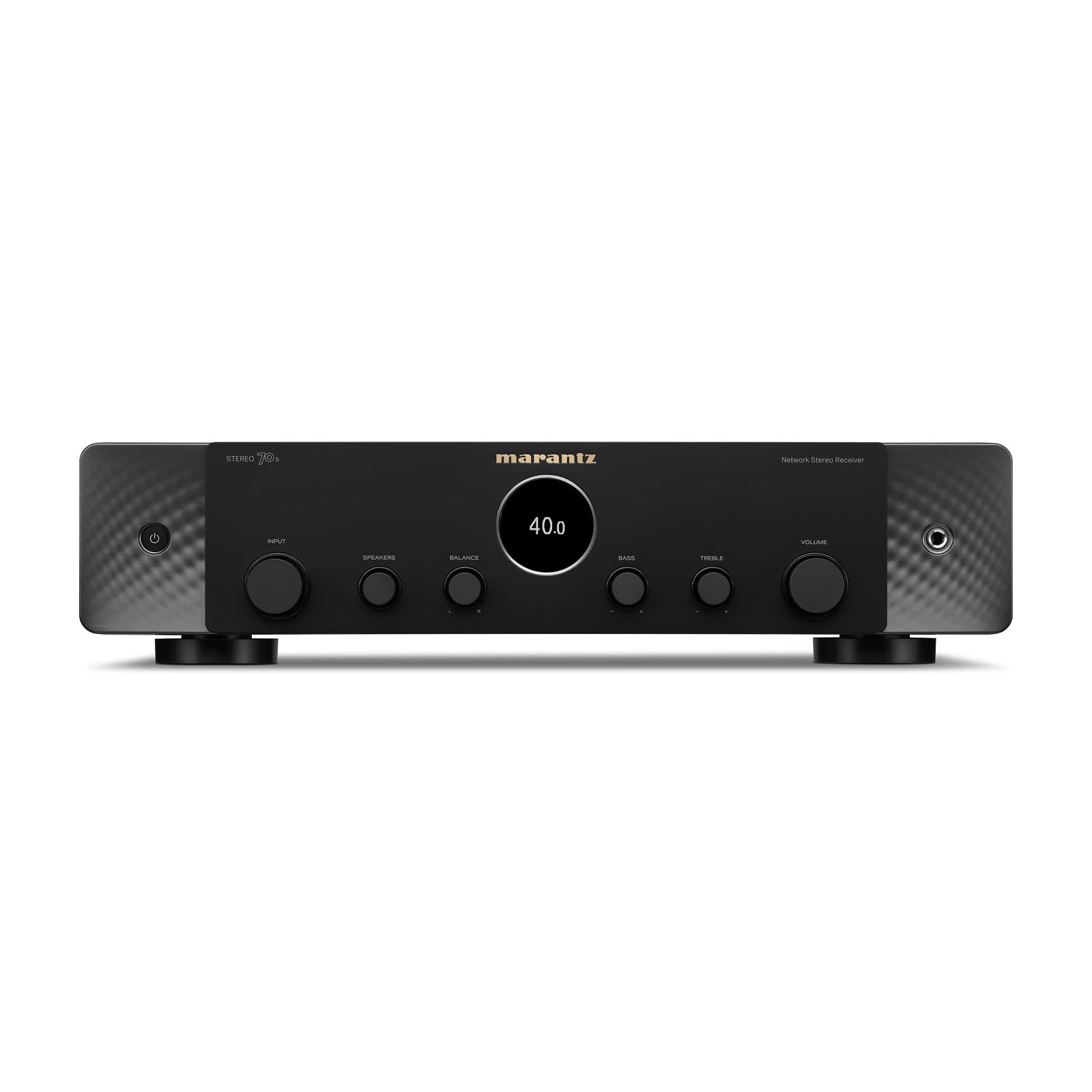
Seventy-five watts of Class A/B and six HDMI inputs, in a body just 4.1 inches tall.
The entire pitch lives in that height figure. At 4.1 inches tall this receiver fits where full-size AV boxes physically cannot, and yet behind the panel sits a fully discrete Class A/B amplifier delivering 75 watts. Marantz tuned it in Japan, and the warmth and three-dimensional spaciousness are the qualities owners single out.
The video side is unusually complete for a two-channel design: six HDMI inputs including 8K, with one ARC output for TV audio. You get true home theater from two speakers and up to two subwoofers, no surround array needed. HEOS handles streaming from Spotify Connect, AirPlay 2, Bluetooth, Tidal, and TuneIn, with high-res support up to 192 kHz/24-bit and DSD. A phono input, wired and Bluetooth headphone outputs, Zone 2 audio, and Speaker A+B connectivity cover the rest.
What sound quality this offers is not in doubt — it is the quality owners bring up most. The realistic caveat is simply that this is a premium piece with a smaller pool of long-term feedback than the mainstream picks above, so the track record is shorter. For a living room that needs a compact, elegant two-channel center, though, nothing else here fits the same gap.
The standout: six HDMI inputs including 8K on a two-channel amp is genuinely uncommon — most stereo receivers give you one optical jack and call it done.
The small print: a shorter verified track record than the volume sellers here, so weigh that against the craftsmanship.
Choose it when: cabinet height is the constraint and you refuse to drop to a soundbar.
Pass on it if: you need maximum power per dollar rather than a slim, tuned chassis.
Understanding the Specs
Watts per channel, and why the ohms matter
A wattage figure is meaningless without the impedance it was measured into. A receiver rated “100W x 2 at 8 ohms” delivers that power into an 8-ohm speaker; a 4-ohm speaker is a harder load and draws more current. That is why the Rockville lists 25W x 2 at 8 ohms but 35W x 2 at 4 ohms — the same amp, different load. Check your speakers’ impedance first, then compare wattage only between receivers rated into the same ohm load.
Phono inputs, MM and MC
A turntable outputs a very small signal that needs boosting and equalizing before an amplifier can use it. A phono input does that job in the box, and it comes in two flavours: MM (moving magnet, the common cartridge type) and MC (moving coil, lower output and fussier). The Onkyo TX-8470 supports both with an isolated board; the Sony, Denon, and both Yamaha network models include phono inputs. No phono input means buying a separate preamp.
FAQ
Will my turntable work with these receivers without an extra preamp?
Do I need 100 watts per channel for normal speakers?
What is the difference between a stereo receiver and an AV receiver?
Can I run two pairs of speakers from one of these receivers?
Does Bluetooth on a stereo receiver sound worse than a wired connection?
What does a built-in DAC add to a stereo receiver?
How much space does a stereo receiver need around it?
Is a renewed or refurbished stereo receiver a safe buy?
Can a two-channel receiver handle TV and movie sound?
Do these receivers support high-resolution streaming services?
Final Thoughts: The Verdict
For most people the analog stereo receiver worth buying is the Sony STRDH190, because it pairs 100W x 2 at 8 ohms with a phono input, A/B speaker switching, and a 5 ¼ inch profile that fits real furniture — and it is the most proven design here by a wide margin. If you have a serious turntable with a moving-coil cartridge, the Onkyo TX-8470 and its isolated MM/MC phono board is the one to reach for. And when cabinet height is the whole problem, the Marantz Stereo 70s fits where nothing else here will, at just 4.1 inches tall. Match the receiver to your speakers’ impedance and your actual sources, and it will stay useful for years.
How We Picked
We do not accept paid placement. Every pick is matched to a real buyer and a real use-case; we do not hands-on test units.
Sources & Methodology
Specifications: manufacturer listings and product documentation. Review insights: verified customer reviews, as of November 2026. Pricing: not shown on this page (it changes often); check the current price via the retailer link.
As an Amazon Associate, Gadgets Feed earns from qualifying purchases. This does not affect which products we feature.