
Our readers keep the lights on and my morning glass full of iced black tea. As an Amazon Associate, I earn from qualifying purchases.
Specs are compiled from manufacturer listings and verified buyer reviews and can change over time — please confirm the key details on the product page before buying.
An analog gauge is the honest workhorse of the garage — no dead batteries, no LCD that fades in the cold, just a needle and a spring that tell you the truth every time. A brass or bronze movement holds calibration for decades, so prioritize mechanical build over the cheapest dial. This guide breaks down the top mechanical picks by what they actually do well: low-pressure accuracy for ATVs, high-flow inflating for trucks, and the classic pencil gauges that never let you down.
I’m Min — the founder and writer behind Gadgets Feed. This guide is built by comparing the manufacturers’ published specifications and the patterns across verified customer reviews, so you get each pick’s real strengths and trade-offs instead of marketing spin.
You want a tool that reads true when you need it most, and this roundup of the best analog tire pressure gauge options sorts the rugged pros from the flimsy also-rans with zero guesswork.
Our Picks at a Glance


How To Choose The Best Analog Tire Pressure Gauge
The first question isn’t which brand — it’s what pressure range you actually need. A gauge built for 10-150 PSI is useless for a mountain bike tire at 8 PSI, just as a 0-30 PSI racing gauge will blow its internals on a truck tire at 80 PSI. Match the scale to the vehicle, and everything else falls into place.
Match the PSI Range to Your Rigs
Your passenger car tires typically need 30-35 PSI (pounds per square inch, the unit of air pressure), so a gauge that reads up to 60 PSI covers most drivers. But ATVs, UTVs, and lawn tractors run much lower — often 5-15 PSI — and a standard gauge can’t even register those low pressures accurately. That’s why dedicated low-pressure models exist, and why the range is the single most important spec on the box.
Dial, Pencil, or Inflator
A pencil gauge is the pocket-size classic: a sliding bar that shoots out when you press it on the valve, perfect for a quick check. A dial gauge gives you a big, readable face and often a bleeder valve to fine-tune pressure. An inline inflator combines a gauge with an air chuck so you can fill and measure in one motion, which is why shop guys love them for fleet work.
Look for Brass and a Rubber Guard
Brass or bronze internals hold calibration far longer than plastic mechanisms. A rubberized casing protects the delicate mechanism when you drop it on concrete — and you will drop it. These two details separate a decade-accurate tool from one that drifts by year two.
Quick Comparison
| Model | Best For | Pressure Range | Type | Key Feature | Amazon |
|---|---|---|---|---|---|
| Astro 3081★ Best Overall | Inflating & reading in one step | 0-174 PSI | Dial Inflator | 21-Inch stainless hose | Amazon |
| Milton S-917Low-Pressure Hero | Low-pressure ATV & lawn tires | 2-20 PSI | Pencil | Nickel-plated brass build | Amazon |
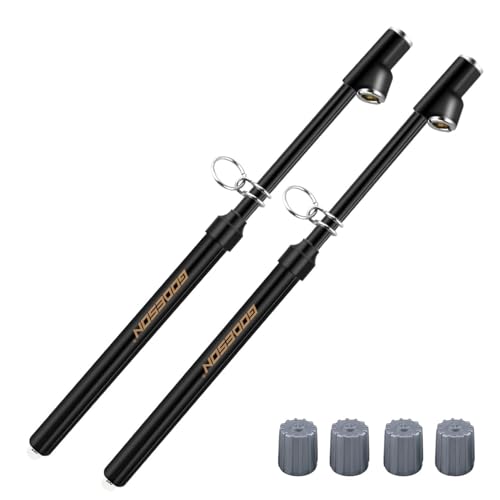
| GODESON GP316Trucker’s Pick | Dual-wheel trucks & semis | 10-150 PSI | Pencil (2-pack) | Dual-head zinc alloy chuck | Amazon |
| Tusk Low Pressure | ATV & motorcycle precision | 0-15 PSI | Dial | Hard case included | Amazon |
| Accu-Gage RH60X | Everyday car tire checks | 0-60 PSI | Dial | Bleeder valve & rubber guard | Amazon |
| JACO Elite JSP-100 | Glow-in-the-dark night checks | 0-100 PSI | Dial | 360-degree swivel chuck | Amazon |
| Joes Racing 32306 | Dirt bikes & race cars | 0-30 PSI | Dial | Glow-in-the-dark dial | Amazon |
| AstroAI 25.6″ | Heavy-duty truck inflation | 10-120 PSI | Inflator | Magnifying window lens | Amazon |
| Milton S-505 | Shop-grade fleet work | 10-160 PSI | Inflator | 15-Inch hose, made in USA | Amazon |
In‑Depth Reviews
1. Astro 3081 Dial Tire Inflator
Our pick — over 4.5★ from 400+ verified ratings; the strongest balance of quality and price.
The shop-grade inflator that finishes the job in one connection
This is the tool that turns a three-step chore into a single motion. The 3-in-1 design lets you inflate, deflate, and measure pressure with one two-position lever, so you’re not swapping a gauge for an air chuck mid-task. The aluminum die-cast body wears a rubber sleeve that soaks up drops, and the 3-1/8-Inch (80mm) gauge face reads to 0-12 Bar/174Psi — enough range for cars, trucks, and even semi tires.
Accuracy is where this dial earns its reputation. Buyers report it stays “accurate within 1 psi up to 110 psi” with 1 psi fidelity, meaning the needle lands where the spec says instead of teasing you with a fuzzy estimate. The braided hose swivels well at the chuck, which makes reaching awkward valve stems noticeably less frustrating. If you’re checking low pressures around 3.5-4.5 psi, it holds its composure there too, which is rare for a wide-range dial.
The trade-off is the top end of its range. It’s a shade less accurate at very low pressures compared to a dedicated TPMS-style gauge, and bike riders will need adapters for Presta valves — the standard Schrader chuck won’t grab them. But for anyone who wants to fill and verify in one pass without pulling out a separate gauge, this is the crowd favorite, backed by a 4.8-star standing across hundreds of owners.
What wins people over
- Inflatе, deflate, and read in one connection
- Rubber sleeve protects the mechanism on drops
- Reads true within 1 psi up to 110 psi
Reality check
- Needs adapters for Presta bike valves
- Slight accuracy dip at very low pressure
Grab it if: you want one tool that fills and measures without juggling gear.
Think twice if: you only check tiny low-pressure tires all day — a dedicated low-range gauge serves you better.
2. Milton S-917 Low-Pressure Pencil Gauge
The pocket-size precision tool for tires that barely need any air
If your world is ATV tires, golf carts, lawn tractors, or e-bikes, a standard gauge simply can’t read the low pressures those rigs run. This Milton pencil gauge covers exactly 2-20 PSI, which is the zone most gauges ignore, and it reads in both kPa and PSI. The nickel-plated brass tubing shrugs off the corrosion and bending that kills cheaper aluminum sticks.
Milton’s nickel-plated brass build resists corrosion and bending. Owners mention it as “accurate and dependable” for low-pressure work like RO units and air springs. The built-in pocket clip means you can tuck it into a shirt or jacket and always have it on hand. It reads to 2-20 PSI with a scale fine enough to catch a 1 psi variance between units — which owners accept as well within reason for this class of tool.
This is not the gauge for your sedan, and that’s fine — it’s not meant to be. If you need to check a car at 32 PSI, the 2-20 range tops out long before that. But for the specific world of low-pressure tires, this made-in-USA pencil gauge is the one buyers reach for every time, backed by a solid 4.4-star reputation.
Perfect fit if: you own ATVs, lawn mowers, or e-bikes that run below 20 PSI and want a gauge that actually resolves that range.
The honest limit: it stops at 20 PSI, so keep a separate gauge for anything that runs higher.
3. GODESON Dual Head Pencil Gauge (2-Pack)
Two rugged pencils that survive being run over by a semi
Dual wheels on trucks and RVs make the inner valve a contortionist’s nightmare. This GODESON solves that with two heads on the same body: a straight foot chuck for inner or hard-to-reach valves, and a 30-degree reverse chuck for the outer wheels. The zinc alloy body with a solid brass core and stainless steel barrel reads 10-150 psi on a two-sided ABS bar with 2 psi increments — a scale built for truck and semi pressures.
Buyers put its durability to a brutal test. As owners put it: “Always reads acurate even after running over it with a semi” — the kind of abuse that kills most gauges on day one. The black powder coating with a hanging ring keeps it ready on the shop wall, and the fact that you get a 2-pack means a spare for the glovebox or a second vehicle. Truck drivers report preferring these over any digital gauge they’ve been given.
The 10-150 PSI range makes it useless for the low-pressure ATV crowd, so don’t buy it for that. But for semis, trucks, SUVs, and RVs with Schrader valves, this is the heavy-duty value play, holding a 4.7-star score from hundreds of owners.
Reach for this if: you drive a truck, RV, or anything with dual wheels and want a gauge that takes a beating.
Look elsewhere if: your tires run under 10 PSI — the scale simply won’t register them.
4. Tusk Low Pressure Dial Gauge
The dial that reads the single-digit pressures off-roaders live by
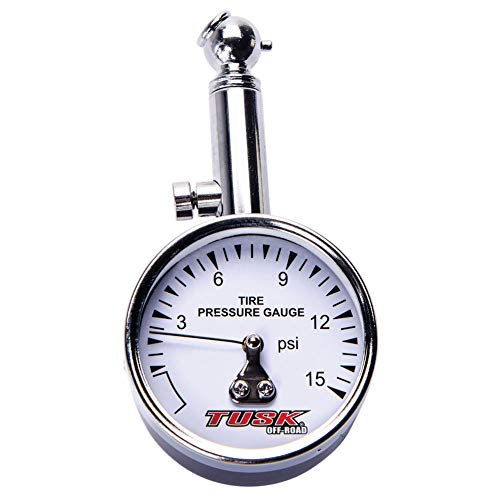
When you air down to 5 psi for a sand run or plowing, you need a gauge that resolves single digits instead of lumping them together. The Tusk dial is built exactly for that world, delivering precise readings from 0-15 PSI for ATV, UTV, and motorcycle tires. The clear analog face makes quick checks a glance-and-go, and the compact build tucks into a toolbox or glovebox without hogging space.
Owners praise its precision at the low end — one caught uneven pressure between ATV tires that a standard gauge missed entirely. The hard case protects the dial, and the 1/4″ NPT male thread mounts to standard fittings for inline use. Owners praise its accuracy for drag slicks and versatility for off-road rigs.
The catch is the ceiling: this gauge is not for anything above 15 PSI, and pushing it past that risks damage. It also doesn’t hold the reading — the needle drifts back to zero when you release, so you need to watch it while it’s seated on the valve. For the low-pressure crowd, those are fair trade-offs for a dial that actually works in the 3-15 PSI zone.
Why riders love it
- Resolves single-digit pressures accurately
- Hard case protects the dial in the field
- Ideal for ATV, UTV, and drag slicks
Know before you buy
- Not rated above 15 PSI — overpressure risks damage
- Needle doesn’t hold the reading once released
Who it fits: off-roaders and riders who live in the 3-15 PSI band and want a reliable dial there.
Who it doesn’t: anyone checking car or truck tires above 15 PSI.
5. Accu-Gage RH60X Professional Gauge

A 60 PSI dial with a bleeder that makes over-inflation a non-issue
For the daily driver, a 60 PSI dial is the perfect ceiling — car tires sit around 30 PSI, so you get a full sweep of resolution without wasting scale on ranges you’ll never touch. The Accu-Gage RH60X nails that niche with a fully geared precision movement and a bronze Bourdon tube, the classic mechanical heart that keeps readings honest. The flexible hose lets you read the dial without crouching at the wheel, and the rubber guard protects it from the inevitable garage-floor drop.
The bleeder valve is the feature that earns its keep. The needle holds your reading until you press the button, which also releases excess air to dial in the exact pressure you want. One owner used it to trim a 32 PSI fill down to spec without detaching the chuck once. It reads accurately even in freezing temperatures, which makes it a year-round companion, and it conforms to ANSI B40.1 Grade B accuracy — a real standard, not a marketing slogan.
The honest knock is longevity: a few customers note the hose crimp developing a leak after a couple of years, and one replacement unit failed to hold its reading before being swapped for a working one. It’s a single anecdote against a strong reputation, but it’s worth knowing. For most people, this remains the go-to homeowner gauge, backed by a 4.5-star score from a broad owner base.
Solid all-rounder: the bleeder valve plus a 60 PSI scale makes it the first gauge to grab for any car in the driveway.
Watch out: a minority report hose-crimp leaks over time — treat the hose gently and it should serve you well.
6. JACO Elite Tire Pressure Gauge (100 PSI)

A glow-in-the-dark dial that reads true at night and locks its reading
Night checks are where most gauges fail you — you can’t see the needle, so you trust a wrong reading. The JACO Elite fixes that with a 2-inch dial face coated in glow-in-the-dark material, so you get a clear read even under a dark highway overpass. The 100 PSI scale with 1 PSI resolution increments covers everything from cars to light trucks, and the reading locks in place until you press the reset button on the neck.
The build quality is the other half of the story. A thick 2.25-inch brass stem, rugged brass internals, and a shock-resistant rubberized gear-style guard make it feel solid in the hand — owners call it a “professional feel” compared to cheaper alternatives. The 360-degree swivel chuck reaches valve stems from any angle, which is a lifesaver on tight trailer or motorcycle setups. It’s calibrated to the ANSI B40.1 standard at ±1.5% accuracy, so it’s not just sturdy — it’s precise.
Reviewers point out mixed results: most get a perfectly accurate gauge, but some say units arrive out of calibration or fail to register pressure at all. It’s a quality-control lottery, though a lifetime warranty backs it up — a fair caveat. When you get a good one, it’s excellent, but you may want to weigh that risk before buying.
Standout spec: the glow-in-the-dark face reads in 1 PSI increments, so you can check pressure accurately in the dark without a flashlight.
The gamble: a minority receive units that are off-calibration from the start — the lifetime warranty is your safety net.
7. Joes Racing 0-30 PSI Glow Gauge

The 0-30 scale that dirt bikers and racers trust to the quarter-PSI
Dirt bike and race car tires run in the 6-15 PSI zone, and a wide-range gauge simply can’t resolve that. This Joes Racing dial is built for exactly that world, with a 0-30 PSI scale and 1 lb increments on a big 2-1/2 inch white face. The glow-in-the-dark dial keeps it readable in the pits at dusk, and the alloy steel and rubber construction holds up to the abuse of a racing weekend.
Accuracy is the reason racers swear by it. Shoppers say it matches a professional Longacre gauge within 1/4 PSI, and it caught a 14 PSI discrepancy that a cheap gauge had read as 8 PSI — the difference between a safe run and a dangerous one. The bleeder function lets you trim pressure without pulling the chuck, which is essential when you’re chasing a specific setup. It’s made in the USA, which explains the quality feel in the hand.
The fragility warning is the one to heed: over-pressurizing this gauge past its 30 PSI range can ruin it, and the company reportedly isn’t helpful about replacements. The hose, valve, and bleed all work great, but the gauge itself needs to be treated with respect. If you’re disciplined about staying within range, this is a superb low-pressure tool.
Built for the pits
- Matches pro gauges within 1/4 PSI
- Glow-in-the-dark dial for dusk checks
- Bleeder valve trims pressure in place
Handle with care
- Pushing past 30 PSI can ruin the mechanism
- No pressure-hold feature
Who it’s for: dirt bikers, racers, and anyone running Tubliss or low-pressure setups who needs real precision.
Who should skip it: anyone who might accidentally over-pressure it — the damage is permanent.
8. AstroAI 25.6″ Heavy-Duty Inflator
A 25.6-inch reach that gets dual wheels and tight corners without crawling
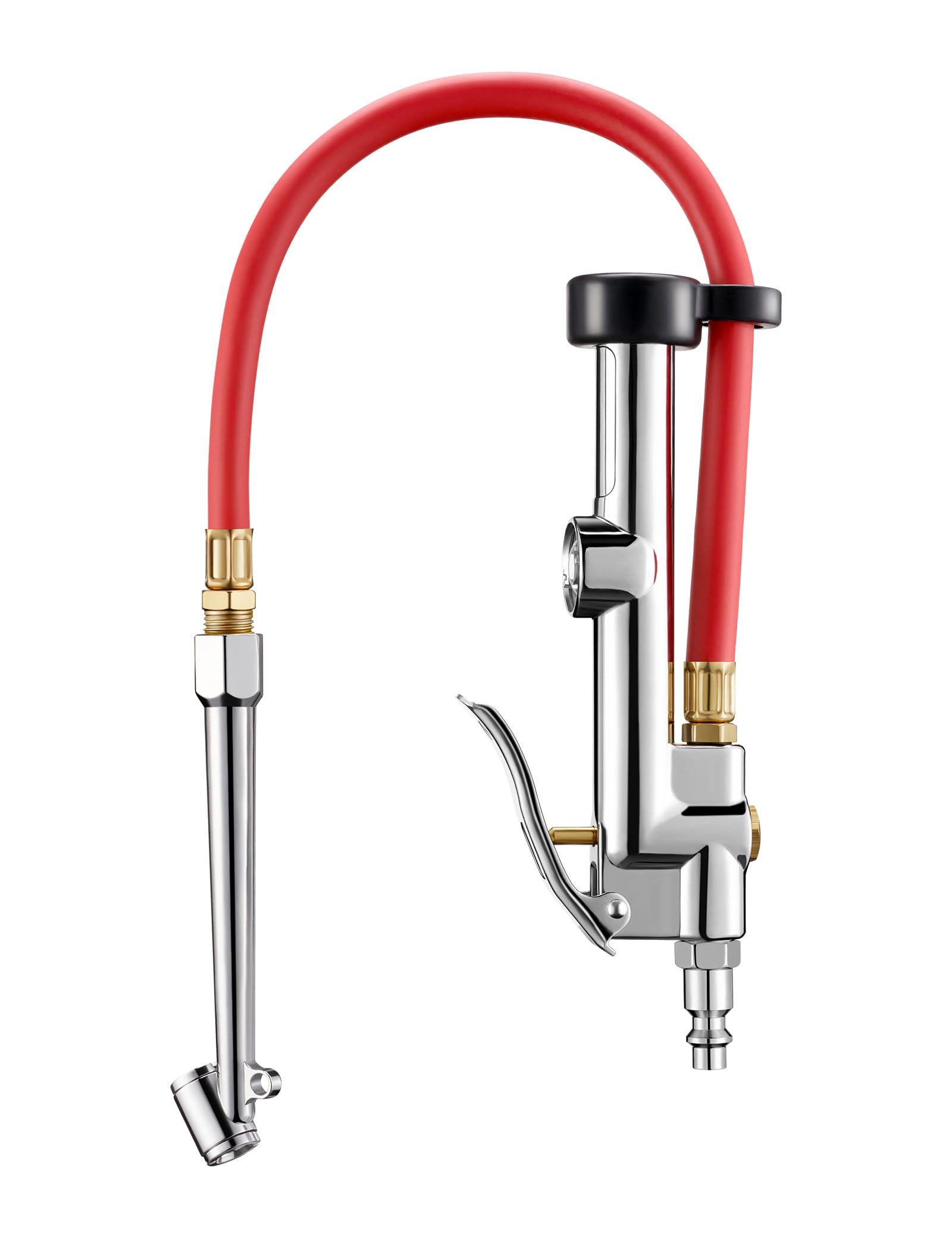
Dual-wheel trucks are the worst case for inflation — the inner valve is buried and the outer one sits in a tight corner. The AstroAI tackles both with a dual-head chuck: a straight chuck for inner wheels and a 30-degree reverse chuck for the exterior, all mounted on a 25.6-inch total length that keeps you standing instead of squatting. The 5.31-inch dual head gets into spaces a stubby chuck can’t touch.
Accuracy is certified to the ANSI B40.1 standard, measuring 10-120 PSI within ±2%, which is reassuring when you’re filling big truck tires where a few PSI matters. The magnifying window lens makes the dial genuinely easy to read, even at odd angles, and the bayonet-style connection clicks on and off the valve without losing air. It’s built from stainless steel and brass, so it’s ready for extreme conditions and heavy daily use.
The mixed feedback centers on readability and durability over time — some owners find the lens less clear than expected, and a few report wear on the mechanism after extended use. For the price, though, it’s a solid heavy-duty inflator that holds up well for truck and RV owners, earning a 4.4-star score from a broad base.
Best for: truck and RV owners who want one tool that reaches dual wheels and inflates without a second gauge.
The catch: the lens can be a touch less crisp than hoped — check it in bright light before you commit.
9. Milton S-505 Analog Inflator

The American-made inflator that outlives the truck it services
Some tools are bought for a season; the Milton S-505 is bought for a lifetime. This is a genuine made-in-USA inflator, and owners tell stories of their fathers’ examples still going strong after 60 years. The 15-inch hose with a full-swivel chuck reaches motorcycle valves and tight spots with ease, and the single-head design is ideal for those hard-to-reach stems. The 10-160 PSI scale with 2-lb increments covers everything from cars to heavy trucks.
The magnifying window lens is the feature older users rave about — it makes the dial readable without glasses, which one 71-year-old owner said eliminated the need to kneel and squint. The heavy-duty stainless steel construction feels tank-like, and the gauge and valve cartridges are both replaceable, so you never toss the whole tool for one worn part. In a single connection per tire, you inflate and read without swapping gauges, which halves the work on a 40-tire fleet check.
The recurring complaint is the chuck thread: it uses a custom thread and washer instead of the standard NPT, so adapting it requires a specific Lock’N Lube part. A minority also report leaks developing over long-term use, though most buyers report none at all. For shop-grade durability with American pedigree, this is the one that outlasts everything else on this list.
Built like a tank
- Genuine made-in-USA construction
- Magnified lens readable without glasses
- Replaceable gauge and valve cartridges
Know the quirks
- Chuck uses a custom thread, not standard NPT
- A few owners mention leaks developing over years
The verdict: if you want a shop-grade inflator that your grandkids could inherit, this is the one.
The caveat: budget for the specific adapter if you need to swap the chuck for a standard fitting.
Understanding the Specs
PSI Range vs. Resolution
The pressure range a gauge covers is its ceiling, but resolution is how finely it reads within that range. A 0-15 PSI gauge with 1 lb increments gives you far more usable precision for an ATV tire at 8 PSI than a 0-174 PSI dial ever could. Match the scale to your rigs, and the needle will land where the spec says.
Bourdon Tube & Brass Internals
The Bourdon tube is the curved brass or bronze tube inside a dial gauge that straightens as pressure rises, moving the needle. Brass and bronze hold their calibration far longer than plastic mechanisms, which is why shop-quality gauges cost more — they stay accurate for years instead of drifting after a season.
Bleeder Valve vs. Pressure Hold
A bleeder valve lets you release excess air without detaching the chuck, so you can trim a fill from 34 PSI down to 32 PSI in one motion. A pressure-hold feature locks the needle at the reading until you press a reset button, which is handy when the valve is hard to see while the gauge is seated. Some gauges do both; others do neither.
ANSI B40.1 Accuracy Standard
This is the industry standard for gauge accuracy, and when a gauge claims it, the manufacturer has certified the reading to a specific tolerance — often ±1.5% or ±2% of the scale. It’s a real engineering benchmark, not marketing fluff, and it’s the closest thing to a guarantee that the needle is telling the truth.
FAQ
What PSI range do I need for my car?
Why do ATV tires need a special low-pressure gauge?
Can I use a pencil gauge on truck tires?
What does the bleeder valve actually do?
Is analog more accurate than digital?
What is ANSI B40.1 accuracy certification?
How long does an analog gauge last?
Will a digital gauge be more reliable in winter?
What does a dual-head chuck do for me?
Can I use a low-pressure gauge on a regular car?
Final Thoughts: The Verdict
For most buyers, the analog tire pressure gauge winner is the Astro 3081 because it combines inflation, deflation, and measurement in one rugged tool that reads true within 1 PSI. If you need a dedicated low-pressure gauge for ATVs and lawn gear, grab the Milton S-917. And for shop-grade durability that could outlast your truck, the Milton S-505 is the one to reach for.
How We Picked
We do not accept paid placement. Every pick is matched to a real buyer and a real use-case; we do not hands-on test units.
Sources & Methodology
Specifications: manufacturer listings and product documentation. Review insights: verified customer reviews, as of August 2026. Pricing: not shown on this page (it changes often); check the current price via the retailer link.
As an Amazon Associate, Gadgets Feed earns from qualifying purchases. This does not affect which products we feature.