
Your engine’s performance, your HVAC system’s efficiency, or your industrial process’s integrity — it all depends on something you cannot see: vacuum pressure. Guessing at vacuum levels is a recipe for wasted time, failed diagnostics, and unreliable equipment. That is why a dedicated analog vacuum sensor is the difference between flying blind and knowing exactly what is happening inside your lines.
I’m Min — the co-founder and writer behind Gadgets Feed. I’ve spent countless hours cross-referencing datasheets and real-world user reports to isolate the meters that deliver repeatable, trustworthy results for mechanics, HVAC technicians, and automotive enthusiasts.
This guide filters through the noise to find the most dependable units for your specific application, helping you pinpoint the best analog vacuum sensor for your garage, workshop, or service truck without wasting a dime on unreliable gear.
How To Choose The Best Analog Vacuum Sensor
Selecting the right vacuum sensor depends entirely on your working medium and required precision. A gauge built for automotive intake manifold monitoring uses a very different scale and construction than one designed for HVAC deep vacuum evacuation. Understanding these differences saves you from buying a tool that reads the wrong numbers for your task.
Match the Measurement Scale to Your Application
Vacuum sensors measure pressure below atmospheric, but the units change by industry. Automotive engine gauges typically read inches of Mercury (inHg) from 0 to 30 inHg, while boost/vacuum combos add positive PSI. HVAC work demands micron-level resolution (0-20,000 microns) because deep vacuum below 500 microns is critical for refrigerant dehydration. Industrial process gauges often display kPa, mbar, or PSI. Choose a sensor whose native scale matches your equipment’s service specifications — do not rely on unit conversion as a workaround for an ill-suited range.
Mechanical vs. Electronic Sensor Construction
Mechanical vacuum gauges use a Bourdon tube or diaphragm that physically deflects with pressure changes, driving a needle. These are simple, require no power, and survive vibration and electrical noise, making them ideal for race vehicles and engine bays. Electronic sensors use a piezoresistive or capacitive element and output an analog voltage or a digital I2C signal. They offer higher resolution and remote monitoring capability but are sensitive to moisture, voltage spikes, and physical shock. For a pure analog vacuum sensor in a fixed installation like a filter housing or test bench, electronic types win on precision. For a dashboard gauge in a truck, mechanical types win on reliability.
Port Size, Fitting, and Environmental Sealing
The connection interface determines whether your sensor installs without adapters or leaks. The dominant standard is 1/4″ NPT male or female, though some automotive gauges use 1/8″ NPT or push-on hose barbs. Check your system port before ordering. For outdoor, marine, or engine-compartment use, look for stainless steel case and connection materials — brass and plastic corrode or crack under vibration and temperature cycles. A sensor with an IP rating or sealed electronics survives condensation and washdowns far longer than an open-board design.
Quick Comparison
On smaller screens, swipe sideways to see the full table.
| Model | Category | Best For | Key Spec | Amazon |
|---|---|---|---|---|
| Auto Meter 4384 | Mechanical | Engine vacuum monitoring | 0-30 inHg, 2-5/16″ dial | Amazon |
| MaxTow MT-DV01 | Hybrid | Turbo boost & vacuum | ±30 PSI / -30 inHg | Amazon |
| Supco VG64 | Digital Micron | HVAC deep vacuum | 0-20,000 microns | Amazon |
| CPS VG200 | Digital Micron | HVAC & refrigeration | Atm to 0 microns | Amazon |
| MEASUREMAN MA088 | Digital Industrial | Negative air pressure | ±15 PSI, 1% accuracy | Amazon |
| Adafruit MPRLS | I2C Breakout | Embedded/Arduino projects | 0-25 PSI abs, 1.1g | Amazon |
| Racor RK19671 | Mechanical Filter | Fuel filter restriction | Bottom mount, drag needle | Amazon |
In‑Depth Reviews
1. Auto Meter 4384 Ultra-Lite Mechanical Vacuum Gauge

The Auto Meter 4384 is the gold standard for a pure mechanical vacuum gauge on an engine. Its 2-5/16″ dial reads from 0 to 30 inHg with a needle that responds instantly to throttle changes with zero electrical dependency — no battery, no sensor box, no signal loss. The incandescent perimeter lighting provides clear night visibility, and the kit includes every fitting, line, and bulb you need for a clean install.
Users report rock-solid needle stability at idle on carbureted and fuel-injected engines alike. The mechanical Bourdon tube movement shrugs off under-hood heat and vibration that would drift a cheap electronic sensor. Multiple verified buyers confirm dead-accurate readings for setting carburetor mixture and detecting intake leaks. The only recurring complaint is moisture ingress — in humid climates, condensation can fog the lens, though this does not affect the gauge’s internal accuracy.
If you are monitoring engine vacuum on a street or race vehicle and want a gauge that simply works without troubleshooting, the 4384 delivers proven race-proven reliability. It is not designed for micron-level HVAC work, but for its intended automotive role, it is the benchmark.
Why it’s great
- Zero electrical power required for operation
- Fast, responsive needle with no lag or wandering
- Complete installation kit with all hardware included
Good to know
- Can fog internally in high-humidity conditions
- Plastic case may feel less premium than full-steel industrial gauges
2. MaxTow Double Vision 30 PSI Turbo Boost/Vacuum Gauge
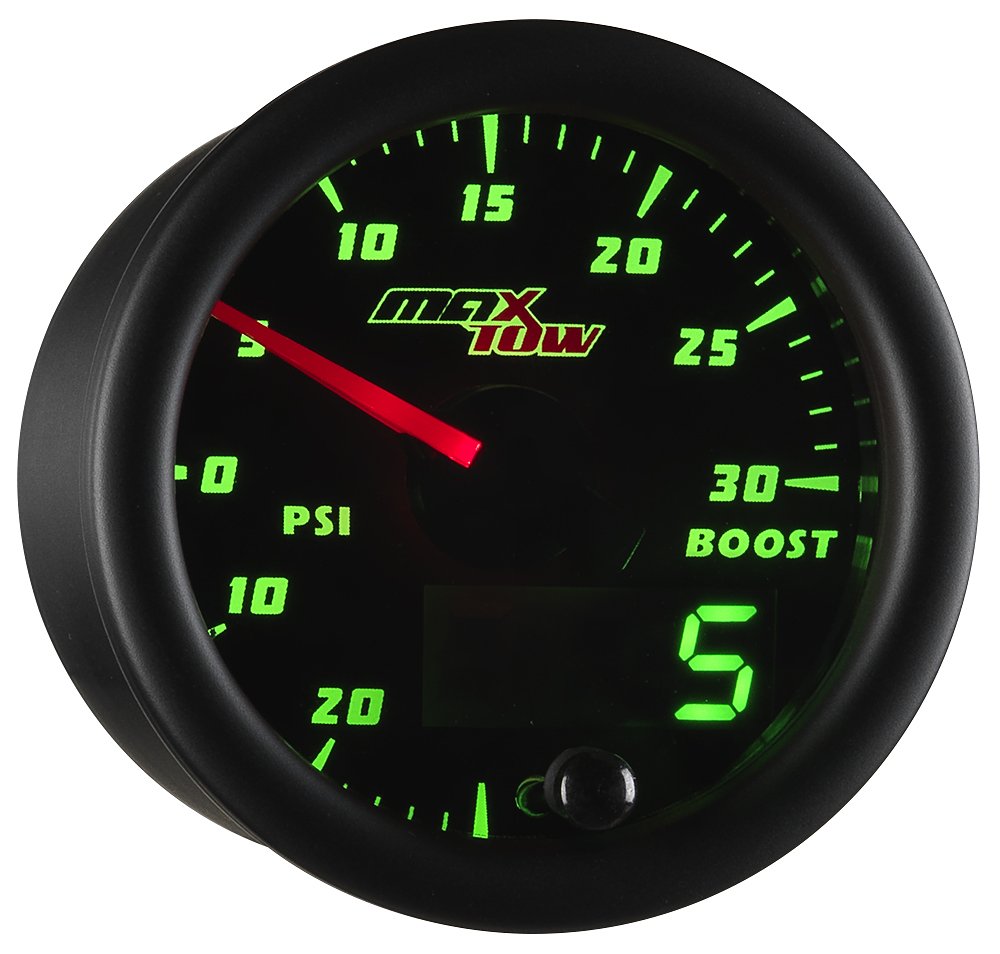
The MaxTow Double Vision bridges the gap between pure analog and full digital by offering both a physical needle and a numeric digital readout in one 52mm housing. It measures vacuum from -30 inHg to 0 and boost pressure from 0 to 30 PSI, making it a perfect fit for gas trucks with turbo or supercharged engines. The included electronic pressure sensor mounts remotely, so you only run a short silicone hose and an electrical harness through the firewall instead of a long vacuum line.
The green LED dial with selectable daytime and nighttime dimming levels keeps the display readable in direct sun and pitch-dark cabins. Verified buyers love the dual display for quick visual scanning — the needle provides trend data at a glance while the digital panel shows the exact number. The main failure point reported across multiple units is the remote sensor itself, with some users experiencing premature failure that the manufacturer’s warranty has not always resolved quickly.
For a boosted gas truck owner who wants both analog feel and digital precision, the MaxTow offers a feature set rarely found at this price tier. Just be aware the sensor reliability appears inconsistent, so keep the warranty documentation handy.
Why it’s great
- Dual analog needle plus digital numeric readout in one gauge
- Remote electronic sensor eliminates long vacuum line runs
- Multiple dimming modes for day and night driving
Good to know
- Some reported remote sensor failures across batches
- Dimmer button can feel finicky to operate
3. Supco VG64 Digital Vacuum Gauge

The Supco VG64 is the serious HVAC technician’s micron gauge, offering a wide 0 to 20,000 micron range with fine resolution from 0.5 to 1000 microns. It connects via a standard 1/4″ male flare fitting and features a backlit LCD with seven selectable measurement units. The response time is a brisk 0.5 seconds, giving you real-time feedback during system evacuation without waiting for a sluggish sensor to catch up.
The sensor design is optimized for oil resistance — a real advantage when pulling vacuum on refrigeration systems that inevitably leave residual oil in the lines. A removable magnetic hanging strap makes hands-free positioning easy on metal panels. Verified users routinely pull down to below 100 microns with this gauge, and many report repeatable accuracy over years of service. That said, a minority of units arrive with internal leaks that cause readings to drift upward over minutes, and the o-ring seal has been identified as a weak point that cannot be user-serviced.
For HVAC pros who demand micron-level accuracy on every evacuation, the VG64 is a trusted workhorse. Just verify function immediately upon arrival and exchange any unit that does not hold a stable reading.
Why it’s great
- Excellent micron resolution for deep vacuum work
- Durable oil-resistant sensor design
- Convenient magnetic strap for field use
Good to know
- Some units have internal o-ring leaks out of the box
- Readings can bounce around without proper connection seal
4. CPS VG200 Portable Digital Vacuum Gauge

The CPS VG200 is an American-made digital vacuum gauge that measures from atmosphere down to absolute zero microns, purpose-built for HVAC and refrigeration work. Its compact body runs on a single 9V battery and connects via a standard SAE thread. The LCD is clear and easy to read even in bright sunlight, and the gauge is light enough to hang directly from the hose connection without support.
Experienced technicians report that this gauge holds vacuum reliably overnight — a critical test for verifying system integrity before charging. Users have documented stable readings at 270 and 195 microns with zero drift over 12+ hours. The sensor is accurate enough to trust for diagnostic decisions, and the build quality stands up to daily field abuse. The one consistent complaint is the battery compartment: corrosion can develop if the battery is left installed during storage, and the terminal design is not sealed against moisture.
If you want a dependable, US-built micron gauge that delivers lab-grade consistency without the premium price of the high-end competition, the VG200 is tough to beat. Just remember to remove the battery between jobs.
Why it’s great
- American-made quality with proven long-term accuracy
- Holds stable vacuum readings overnight for leak checking
- Compact and lightweight for field portability
Good to know
- Battery compartment prone to corrosion if battery left in
- Thread style is SAE, not NPT — adapters may be needed
5. MEASUREMAN MA088 Digital Industrial Vacuum Gauge

The MEASUREMAN MA088 is a battery-powered digital vacuum gauge with a 2-1/2″ dial and a 304 stainless steel case and connection. It reads both vacuum and positive pressure up to ±15 PSI with 1% accuracy, and it can display in kPa, psi, kgf/cm², mbar, and MPa — a genuinely useful feature for cross-referencing different system specs. The bright LED backlight ensures readability in dim mechanical rooms, and the pressure progress bar gives a quick visual reference.
The 1/4″ NPT lower mount connects directly to most industrial and pneumatic systems, and the 150% overload protection helps survive accidental over-pressurization. Users on process lines confirm stable readings and easy unit switching. However, for HVAC evacuation work requiring deep vacuum below -1005 mBar, this gauge falls short — one verified buyer found it could only reach -985 mBar, making it unsuitable for refrigerant dehydration. It is also worth noting the gauge face is plastic, so it will scratch if wiped with abrasive cloths.
This gauge excels as a general-purpose digital indicator for negative air pressure monitoring on pneumatic lines, filter housings, and basic process checks. It is not a substitute for a micron-level HVAC gauge, but for its intended range, it delivers solid value.
Why it’s great
- Multiple display units for versatile cross-referencing
- Stainless steel wetted parts and connection for corrosion resistance
- Bright backlight and overload protection at 150%
Good to know
- Cannot reach true deep vacuum required for HVAC evacuation
- Plastic lens scratches more easily than glass
6. Adafruit MPRLS Ported Pressure Sensor Breakout

The Adafruit MPRLS is a tiny breakout board (17.8mm x 16.7mm) featuring a Honeywell MPRLS sensor that measures absolute pressure from 0 to 25 PSI via I2C. At just 1.1 grams, it is designed for embedded projects — Arduino, Raspberry Pi, ESP32, or any microcontroller that speaks I2C. The ported barb fits 0.1″ ID tubing, making it easy to plumb into pneumatic masts, environmental chambers, or DIY barometers.
The I2C address is fixed at 0x18, which causes integration headaches when prototyping on ESP32 platforms where that address conflicts with the Bluetooth stack. Multiple verified reviews report erratic reading jumps on ESP32 versus stable operation on Arduino and Raspberry Pi. There are also concerning reports of units failing entirely after a few hours of runtime, with I2C detection simply disappearing. The accuracy when working is surprisingly good — one user confirmed -0.007 inHg agreement with airport pressure readings — but the consistency does not inspire confidence for critical systems.
For hobbyist prototyping and low-pressure differential sensing where a sensor failure means a reboot, not a catastrophe, the MPRLS works well with careful platform selection. For any application requiring industrial reliability, look elsewhere.
Why it’s great
- Extremely small and lightweight for embedded integration
- Good absolute accuracy when operating normally
- Standard I2C interface works with most microcontrollers
Good to know
- Fixed I2C address conflicts with ESP32 Bluetooth stack
- Multiple reports of early failure after short runtime
7. Racor RK19671 Bottom Mount Vacuum Gauge

The Racor RK19671 is a dedicated bottom-mount vacuum gauge for Racor turbine series marine fuel filters. Its purpose is simple: show the restriction level across the filter element so you know when to change it before fuel starvation causes engine problems. The dual-pointer design features a primary needle that moves with current vacuum and a drag needle that stays at the highest reading, giving you a permanent record of the peak restriction since last reset.
The gauge body is built with a stainless steel T-handle for easy installation and removal, and the stainless construction stands up to the salt-laden engine room environment. Boat owners report perfect fitment on post-2012 Racor filter assemblies and consistent readings that help catch clogged filters early. However, the stem is 1/8″ longer than pre-2012 Racor filter heads, and the manufacturer confirms incompatibility with older models. Installing it on an older housing can prevent proper sealing, causing the entire diesel system to drain and requiring a difficult re-prime.
If you own a 2012 or newer Racor filter setup, this gauge is an OEM-quality upgrade that adds visible peace of mind to your fuel system monitoring. Pre-2012 owners will need a spacer or alternative gauge.
Why it’s great
- Drag needle retains peak reading for filter condition history
- Stainless steel construction resists marine corrosion
- OEM replacement for Racor turbine series filters
Good to know
- Stem length incompatible with pre-2012 Racor filter heads
- Premium price for a single-function mechanical gauge
FAQ
Can I use a mechanical automotive vacuum gauge for HVAC deep vacuum work?
What does the drag needle on a vacuum gauge do?
Why does my I2C vacuum sensor work on Arduino but not on ESP32?
Final Thoughts: The Verdict
For most users, the best analog vacuum sensor winner is the Auto Meter 4384 because its mechanical movement offers proven reliability, zero electrical dependency, and instant response for engine vacuum monitoring. If you want a dual analog-digital readout with turbo boost capability, grab the MaxTow Double Vision. And for HVAC professionals requiring micron-level accuracy on every evacuation, nothing beats the Supco VG64 for field-tested precision.