
Shooting with standard spherical lenses on an E-mount camera forces you to either crop for a cinematic widescreen look or accept a flat 16:9 frame. An anamorphic lens solves this physically, squeezing a wider horizontal field of view onto the sensor during capture and requiring desqueeze in post or on-camera to reveal the full 2.4:1 or 2.8:1 aspect ratio. The result is a filmic image with oval bokeh, horizontal lens flares, and a depth separation that spherical glass cannot replicate.
I’m Min — the co-founder and writer behind Gadgets Feed. This guide is built from hundreds of hours parsing optical bench data, customer review patterns, and manufacturer spec sheets so you know exactly which squeeze factor, mount compatibility, and aperture speed matters for your E-mount rig.
Whether you are building out a Sony FX6 kit for client work or upgrading your a6700 for independent projects, this deep-dive analysis identifies the best anamorphic lens e mount options across squeeze ratios and price tiers so you can make an informed purchase today.
How To Choose The Best Anamorphic Lens E Mount
An anamorphic lens is a specialized piece of cinema glass, and choosing the wrong one for your sensor size or shooting style can ruin your workflow. Your E-mount camera might be APS-C or full-frame, and the lens must cover that image circle without heavy vignetting. The squeeze factor, aperture speed, and flare character are the three pillars that define every serious option on this list.
Squeeze Factor 1.33x vs 1.6x
The squeeze factor determines how much wider your final frame will be after desqueezing. A 1.33x lens on a 16:9 sensor yields a 2.35:1 aspect ratio, making it the standard for Super 35 or APS-C cameras. A 1.6x squeeze delivers a much wider 2.8:1 image from a 16:9 sensor, or 2.4:1 from a 3:2 sensor, producing the ultra-wide IMAX-style framing that cinematographers seek. Choose 1.33x if you shoot mostly on APS-C and want to avoid heavy cropping. Choose 1.6x if you own a full-frame body and want the most dramatic anamorphic stretch.
Full-Frame Coverage vs S35/APS-C
Full-frame anamorphic lenses are physically larger, heavier, and more expensive, but they cover the entire 36mm x 24mm sensor without dark corners. Super 35 or APS-C anamorphic lenses have a smaller image circle and are lighter, cheaper, and more gimbal-friendly. If you own a Sony A7S III, FX6, or FX3, a full-frame anamorphic lens is the cleanest path. If you shoot on an FX30, a6700, or ZV-E10, an S35 anamorphic lens matches your sensor perfectly.
Aperture Speed and Flare Character
Anamorphic lenses lose about one stop of light compared to spherical lenses of the same f-number due to the squeeze. A T2.9 maximum aperture is typical and provides decent low-light performance on modern Sony sensors. Faster options like T1.8 or T1.2 exist, but they cost more in weight and price. Flare character is a taste decision: blue flare lenses produce the classic sci-fi streak associated with JJ Abrams, while neutral flare lenses suppress color contamination for a more natural, commercial look.
Quick Comparison
On smaller screens, swipe sideways to see the full table.
| Model | Category | Best For | Key Spec | Amazon |
|---|---|---|---|---|
| SIRUI 35mm T2.9 1.6X FF | Premium Full-Frame | Anamorphic purists | 1.6x squeeze, full-frame | Amazon |
| SIRUI 50mm T2.9 1.6X FF | Premium Full-Frame | Classic focal length | 1.6x squeeze, full-frame | Amazon |
| Viltrox 56mm F1.2 | Portrait Prime | Auto-focus bokeh | F1.2 aperture, 56mm | Amazon |
| VILTROX 16mm F1.8 FE | Ultra-Wide | Wide-angle auto-focus | F1.8, 105.6° FOV | Amazon |
| SIRUI 20mm T1.8 1.33X AF | AF Anamorphic | Video autofocus | 1.33x, T1.8, S35 AF | Amazon |
| SIRUI 40mm T1.8 1.33X AF | AF Anamorphic | Versatile AF anamorphic | 1.33x, T1.8, S35 AF | Amazon |
| SIRUI VP-1 50mm T1.4 | Cine Prime | 8K spherical cine | T1.4, interchangeable mount | Amazon |
| Sony 11mm F1.8 | Native AF | Vlogging/real estate | 11mm, F1.8, APS-C | Amazon |
| SIRUI Saturn 35mm T2.9 1.6X CF | Lightweight FF | Gimbal/FPV work | 1.6x, 415g, carbon fiber | Amazon |
| SIRUI 16mm T1.2 S35 | Fast Cine Wide | Low-light S35 | T1.2, 16mm, S35 | Amazon |
In‑Depth Reviews
1. SIRUI 35mm T2.9 1.6X Full-Frame Anamorphic Lens (E Mount)

The SIRUI 35mm T2.9 1.6X represents the gold standard for full-frame anamorphic on E mount. Its 1.6x squeeze factor unlocks a 2.8:1 aspect ratio on 16:9 sensors or 2.4:1 on 3:2, delivering the widest cinematic frame without needing an external desqueeze adapter. The all-metal construction with multi-coated optics ensures blue flares that are controllable, not overpowering, and the oval bokeh remains creamy even at T2.9.
Image quality reviews consistently highlight the Venus optical design’s sharpness at center frame, with mild edge softness that adds to the vintage anamorphic character rather than detracting from it. The 142.9mm length and 1073g weight are substantial, but this lens pairs beautifully with the Sony FX6 or A7S III on a studio rig. Focus ring rotation is 270°, giving you fine manual control for pulling focus in narrative shoots.
Professional videographers who shot weddings and music videos with this lens report that the horizontal lens flares alone sell the cinematic look. The T2.9 aperture is not the fastest on this list, but modern Sony sensors handle the light loss well. If you want the widest possible anamorphic frame from a full-frame camera, this is the lens to beat.
Why it’s great
- 1.6x squeeze produces the most dramatic anamorphic aspect ratio on full-frame
- Metal build with multi-coated optics delivers signature blue flares
- 270° focus ring rotation enables precise manual pull-focus
Good to know
- T2.9 aperture is dark compared to spherical fast primes
- Heavy at 1073g, less ideal for gimbal work
2. SIRUI 50mm T2.9 1.6X Full-Frame Anamorphic Lens (E Mount)

SIRUI’s Venus 50mm T2.9 1.6X provides the same full-frame 1.6x squeeze as the 35mm but in a tighter 50mm focal length. This is the anamorphic equivalent of the classic 85mm portrait field of view when desqueezed, making it ideal for interviews, narrative close-ups, and any situation where you want the subject to fill the frame with that signature oval bokeh behind them.
The 16-element, 13-group optical formula with Super Integrated Coating controls chromatic aberration and ghosting better than many spherical cinema lenses at this price point. Customer feedback from Sony A7C and A7R V users praises the Venus line for edge smoothness that looks more filmic than the clinically sharp Saturn series. The manual focus and aperture rings are tight but smooth, and the lens works with DJI RS3 and lidar follow focus systems without issues.
Reviews caution that some copies arrive with less than ideal packaging from third-party sellers, but SIRUI’s internal packaging is excellent. A small number of users found the image soft on high-resolution sensors like the A7R V at T2.9, though most agree that stopping down to T4 improves sharpness significantly while preserving the anamorphic character. For a 1.6x full-frame anamorphic at a 50mm focal length, this lens provides extraordinary value.
Why it’s great
- 50mm focal length delivers classic portrait compression with anamorphic oval bokeh
- Super Integrated Coating suppresses flare artifacts when not desired
- Works smoothly with gimbal follow focus systems
Good to know
- Some copies show edge softness on 61MP sensors at T2.9
- Packaging from certain Amazon sellers may arrive damaged
3. SIRUI Saturn 35mm T2.9 1.6X Full Frame Carbon Fiber (Neutral Flare)

The SIRUI Saturn 35mm T2.9 1.6X in neutral flare uses a carbon fiber barrel to achieve an astonishing 415g weight, making it the lightest full-frame 1.6x anamorphic lens on the market. This is the lens you want for FPV drone work, overhead rigging, or any situation where every gram matters for gimbal motors. Despite its weight savings, the Saturn incorporates 18 elements in 13 groups with spherical elements to minimize chromatic aberration.
The 1.6x squeeze factor provides the same ultra-wide 2.8:1 aspect ratio as the Venus line, but the Saturn’s optical design is sharper across the frame, especially at wider apertures. The neutral flare version produces soft, creamy streaks instead of the intense blue flares of the Venus lenses, making it better suited for commercial work and warm-toned scenes.
Wedding videographers on the FX30 and A7S III report that the Saturn 35mm delivers beautiful results without the lens overpowering the gimbal. The 0.9m minimum focus distance is adequate for medium shots but not for close-up detail work. A small number of reviewers found the neutral flare too subtle, and some struggled with focus breathing. For a full-frame anamorphic that fits on a drone, this is the only lightweight option that delivers true 1.6x squeeze.
Why it’s great
- 415g carbon fiber construction is the lightest 1.6x full-frame anamorphic available
- Neutral flare option produces clean commercial-friendly streak
- Sharp center resolution at T2.9
Good to know
- 120° focus ring rotation makes precise manual focus more challenging
- Some users report significant barrel distortion requiring correction in post
4. SIRUI Saturn 35mm T2.9 1.6X Full Frame Carbon Fiber (Blue Flare)
The blue flare version of the SIRUI Saturn 35mm T2.9 1.6X shares the same 415g carbon fiber body and 18-element optical formula as its neutral sibling, but the coating is tuned to produce that aggressive blue horizontal streak when a light source hits the lens. This is the lens for sci-fi shorts, music videos, and any project where you want the anamorphic flare to be a visible stylistic signature.
Image quality mirrors the neutral version: sharp center with controlled chromatic aberration, a 1.6x squeeze that opens up the 2.8:1 frame, and a compact 60.5mm diameter that fits standard gimbal form factors. The M58 x 0.75 filter thread allows you to add variable ND filters for outdoor shooting. Customer feedback from wedding videographers suggests the blue flare can be too strong for certain scenes, making it less versatile than the neutral version for all-purpose work.
Reviews mention that the blue flare is noticeable even with small light sources in the background, which can be either a creative asset or a distraction depending on your project. A small number of early buyers received copies with loose internal elements, but SIRUI’s 3-year warranty covers manufacturing defects. If you want the blue streak look in the lightest possible package, this is the lens to pick.
Why it’s great
- Dramatic blue anamorphic flares appear with minimal light source
- Carbon fiber build keeps weight at 415g for gimbal use
- Same sharp optical formula as the Saturn line
Good to know
- Blue flare may overpower scenes where a neutral look is preferred
- Some copies shipped with loose internal components
5. SIRUI VP-1 Vision Prime 1 T1.4 Full Frame Cine Lens (50mm)

The SIRUI VP-1 Vision Prime 1 is a spherical cine prime, not an anamorphic lens, but it earns its place on this list for filmmakers building an E-mount cine kit alongside their anamorphic glass. The T1.4 aperture is exceptionally fast, allowing you to shoot in low light while maintaining a shallow depth of field that approaches anamorphic character. The interchangeable mount system uses a pre-installed E mount with user-interchangeable RF, Z, and L mounts, future-proofing against camera system changes.
Engineered for 8K resolution, the VP-1 incorporates aspherical, ED, and HRI elements to deliver edge-to-edge sharpness with minimal chromatic aberration. The aluminum alloy body weighs around 600g, and the uniform design matches other VP-1 lenses for consistent gear position, filter thread, and color temperature. This is the lens to pair with your anamorphic set when you need a fast, clean spherical shot without stepping down in optical quality.
Wedding and event shooters report that the VP-1’s image is crisp and the interchangeable mount makes it a no-brainer for mixed Sony and Nikon setups. Some users note that the focus ring does not have hard stops, which is standard for modern cine lenses but may bother those used to vintage cinema glass. The T1.4 aperture produces soft, dreamy bokeh that complements anamorphic footage well.
Why it’s great
- Fast T1.4 aperture for low-light spherical work
- Interchangeable mount system works with E, RF, Z, and L
- Matched set design allows lens swaps without re-rigging
Good to know
- Spherical lens, does not provide anamorphic squeeze
- No hard stops on focus ring
6. VILTROX AF 16mm F1.8 FE Lens for Sony E Mount
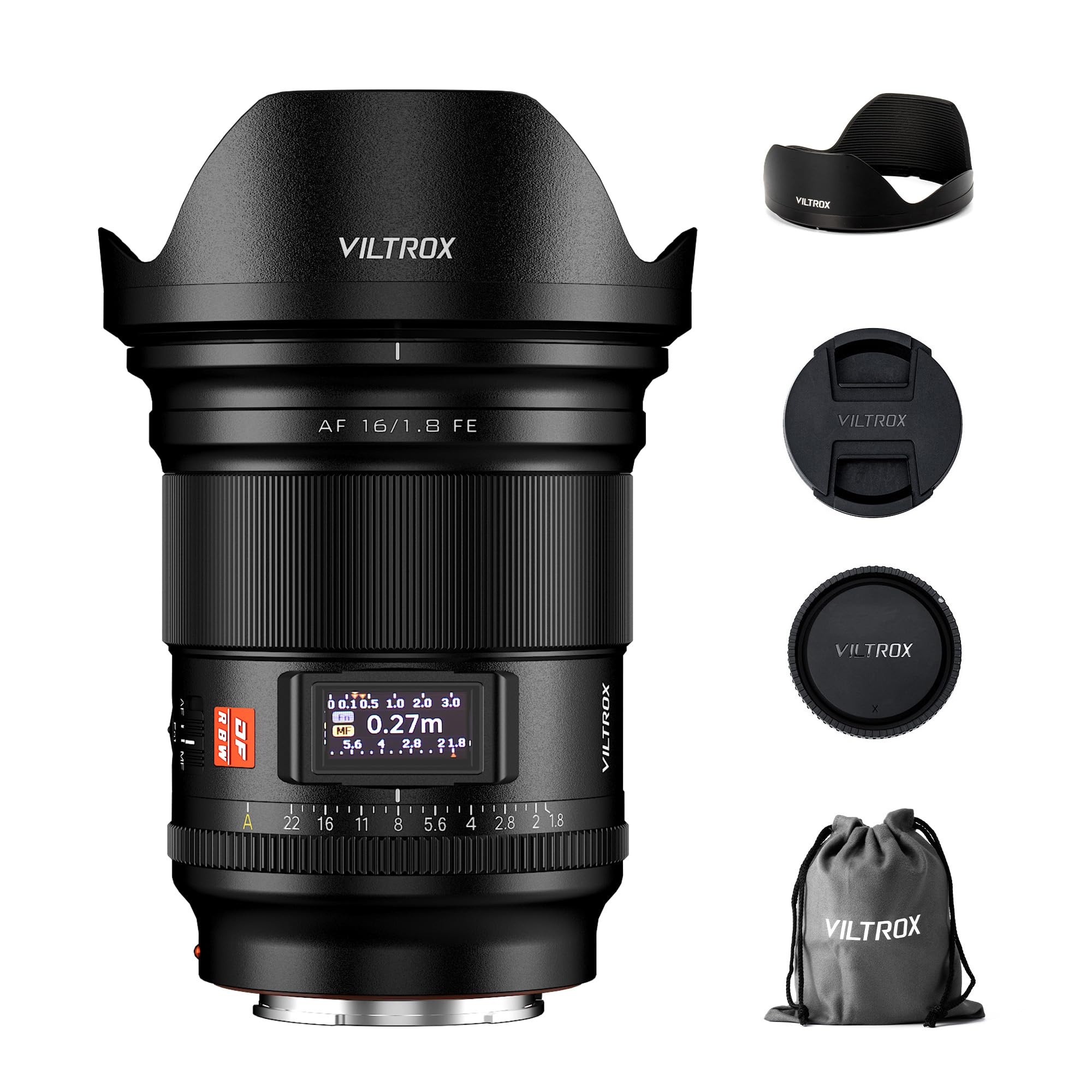
The VILTROX 16mm F1.8 FE is another spherical lens, but its ultra-wide 105.6° angle of view and fast F1.8 aperture make it a valuable companion for anamorphic shooters who need a clean wide establishing shot. The STM stepping motor provides quiet, precise autofocus with eye and face detection, something no anamorphic lens on this list offers. The built-in LCD display on the lens body shows aperture and focus distance, a rare feature for E-mount lenses at this price.
The optical construction uses 15 elements in 12 groups with three aspherical lenses and HD Nano Coating to control flare and ghosting. It is not an anamorphic lens, so you cannot get oval bokeh or horizontal flares, but for real estate video, landscape establishing shots, or vlogging, the 16mm coverage is unmatched. The metal body weighs 552g, and the 77mm filter thread accommodates standard cinema matte boxes.
Reviewers consistently highlight the lens as a great value for Sony shooters who need wide-angle coverage with reliable autofocus. Some users note pincushion distortion that requires correction in post, and the lens is not weather-sealed. If you are building a hybrid spherical-anamorphic kit, this 16mm F1.8 is the widest and fastest AF option available for E mount.
Why it’s great
- Ultra-wide 16mm field of view with fast F1.8 aperture
- Auto focus with eye detection is reliable for video and photo
- Built-in LCD display shows lens information at a glance
Good to know
- Spherical lens, no anamorphic squeeze or oval bokeh
- Pincushion distortion requires software correction
7. Viltrox 56mm F1.2 E Mount Auto Focus Prime Lens
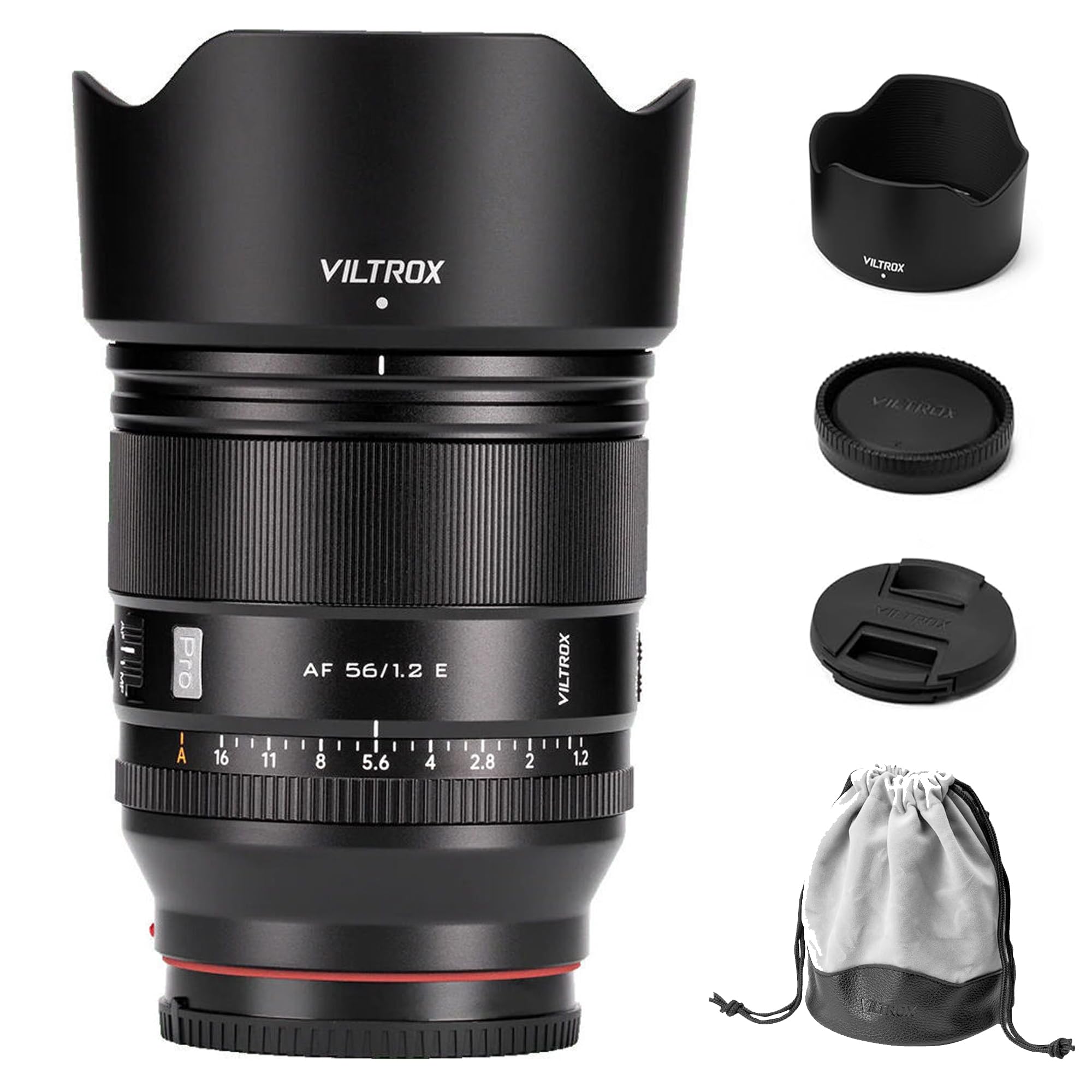
The Viltrox 56mm F1.2 is an APS-C portrait lens that provides an 85mm full-frame equivalent field of view. It is a spherical lens, but the F1.2 maximum aperture creates a shallow depth of field and bokeh that rivals anamorphic character for subject isolation. The autofocus system uses face and eye detection for both stills and video, making it one of the fastest portrait lenses you can mount on an a6700 or FX30.
Build quality is excellent, with a metal barrel and a de-clickable aperture ring that is useful for video work. The optical design delivers high-definition sharpness from center to edge, and the F1.2 aperture allows shooting in very low light without raising ISO. The lens is heavier than standard zoom alternatives, but the 56mm F1.2 provides a distinctive look that anamorphic shooters appreciate for b-roll and detail shots.
Customer reviews praise the clarity and bokeh but some note that autofocus hunts more frequently than Sony native glass, especially in mixed lighting conditions. The manual focus ring is smooth and usable. If you want a fast spherical lens that complements your anamorphic setup for close-up portrait work, the Viltrox 56mm F1.2 is a strong mid-range choice.
Why it’s great
- F1.2 aperture creates extreme bokeh and low-light capability
- Auto focus with eye detection is reliable for portraiture
- Metal build with de-clickable aperture ring
Good to know
- Autofocus hunts more than Sony native lenses in some conditions
- APS-C lens only, no full-frame coverage
8. SIRUI 20mm T1.8 1.33X S35 Autofocus Anamorphic Lens (Neutral Flare)

The SIRUI 20mm T1.8 1.33X is one of the only autofocus anamorphic lenses on the market, and it is built specifically for S35/APS-C E-mount cameras like the Sony FX30 and a6700. The 1.33x squeeze factor produces a 2.35:1 aspect ratio in 16:9 mode, and the STM stepping motor drives autofocus with eye-tracking capability. This is the lens for run-and-gun videographers who need anamorphic character without the manual focus learning curve.
The 20mm focal length provides a wide horizontal FOV equivalent to 22mm on full-frame, making it ideal for interior interviews, gimbal walkthroughs, and immersive environmental shots. The T1.8 aperture is fast for an anamorphic lens, supporting solid low-light performance. The neutral flare coating produces subtle streaks that do not contaminate skin tones. The lens weighs only 480g, which pairs well with compact stabilizers.
Early reviews on the FX30 confirm that autofocus is slightly slower than native Sony lenses but still reliable for most video scenarios. Corners are soft at T1.8, but center sharpness is very good. A small number of users report that the autofocus motor can be heard in quiet environments. For an autofocus anamorphic that covers the S35 sensor with a wide angle, this is a unique and compelling option.
Why it’s great
- Autofocus with eye tracking is rare and useful for anamorphic video
- Wide 20mm FOV suits gimbal and interior shooting
- Light 480g build works with small stabilizers
Good to know
- AF motor is audible in quiet scenes
- Corners are soft at T1.8
9. SIRUI 40mm T1.8 1.33X S35 Autofocus Anamorphic Lens (Neutral Flare)

The SIRUI 40mm T1.8 1.33X is the standard focal length sibling to the 20mm in SIRUI’s autofocus anamorphic line. The 40mm provides a natural perspective that works well for narrative dialogue, product cinematography, and general-purpose video work. The 1.33x squeeze delivers a 2.35:1 aspect ratio, and the STM motor provides autofocus with subject tracking. The lens weighs 614g and uses a 77mm filter thread, consistent with professional cine accessories.
Optically, the lens incorporates aspherical and cylindrical elements to minimize focus breathing and chromatic aberration. The T1.8 aperture is fast and creates hexagonal elliptical bokeh at T1.8, transitioning to classic oval bokeh as you stop down. The neutral flare coating produces natural streaks that do not overwhelm the image. Reviews note that the autofocus is good for solo productions but can be noisy and may hunt in low contrast situations.
Some users received copies with loose internal screws, though this appears to be a quality control issue affecting a small portion of early units. The autofocus system disables Sony’s internal desqueeze, so you must desqueeze in post. For an autofocus anamorphic in a standard focal length, the 40mm T1.8 is a versatile choice that covers most video projects.
Why it’s great
- 40mm focal length is versatile for narrative and commercial work
- Autofocus with subject tracking aids solo shooting
- Neutral flares and controllable bokeh
Good to know
- AF motor noise may be picked up by internal microphones
- Quality control issues reported by some early buyers
10. Sony E 11mm F1.8 APS-C Ultra-Wide-Angle Prime

The Sony 11mm F1.8 is a native APS-C ultra-wide prime with fast, silent autofocus and a compact form factor that weighs only 299g. While this is a spherical lens and not anamorphic, its extremely wide angle of view makes it a staple for vloggers and real estate videographers who pair it with an anamorphic lens for cinematic coverage. The two linear motors provide the fastest autofocus of any lens on this list, and the breathing compensation function is fully supported on compatible Alpha cameras.
The F1.8 aperture is bright for an 11mm lens, allowing good low-light performance and some background separation despite the wide angle. Image quality is sharp, though there is noticeable barrel distortion that requires in-camera or post-correction. Purple fringing wide open is reported by some users, but it clears up by F2.8. The minimum focus distance is short, enabling interesting close-up wide shots.
Real estate professionals and content creators consistently praise this lens for its ability to capture tight interiors while maintaining a cinematic look. It is not an anamorphic lens, so you will not get oval bokeh or horizontal flares, but the native Sony autofocus and lightweight design make it an essential part of any APS-C E-mount kit that also includes anamorphic glass.
Why it’s great
- Native Sony autofocus is fast, silent, and reliable
- Ultra-light 299g is ideal for vlogging and gimbal work
- F1.8 aperture provides solid low-light performance for a wide lens
Good to know
- Spherical lens does not produce anamorphic effects
- Barrel distortion and purple fringing require correction wide open
11. SIRUI Night Walker 16mm T1.2 S35 Cine Lens (E Mount)

The SIRUI Night Walker 16mm T1.2 is a spherical cine lens with an ultra-fast T1.2 aperture, designed for APS-C and Super 35 sensors. It is not an anamorphic lens, but its fast aperture and 16mm focal length make it an excellent entry-point for filmmakers who want to build a cinema kit before investing in anamorphic glass. The 14-element, 5-group optical structure with premium coatings minimizes chromatic aberration, and the 13-blade aperture produces smooth, circular bokeh.
The metal build is durable, weighing 592g with a standard 67mm filter thread. The 270° focus ring rotation allows precise manual focus, and the 0.3m minimum focus distance enables close-up wide shots. Customer reviews highlight that the lens is sharp at T4 and provides dreamy bokeh at T1.2, making it a strong low-light performer on cameras like the Sony FX30 and a6500.
Some users received used copies with missing rear lens caps, so inspect your delivery carefully. The lens has noticeable focus breathing and flaring, which adds to the cine character but may not suit all projects. For an affordable, fast cine lens that works alongside or ahead of an anamorphic purchase, the Night Walker 16mm T1.2 is a solid choice.
Why it’s great
- Ultra-fast T1.2 aperture captures excellent low-light footage
- 13-blade aperture produces smooth, circular bokeh
- Close 0.3m minimum focus allows wide-angle macro shots
Good to know
- Spherical lens, no anamorphic squeeze or oval bokeh
- Some copies shipped used or with missing accessories
FAQ
Can I use an APS-C anamorphic lens on a full-frame Sony camera?
Why does my anamorphic lens look darker than my spherical lenses?
What does desqueeze mean and do I need to do it in camera?
Are autofocus anamorphic lenses worth the higher cost?
Can I convert a spherical lens to anamorphic with an adapter?
Final Thoughts: The Verdict
For most users, the best anamorphic lens e mount winner is the SIRUI 35mm T2.9 1.6X Full-Frame because its 1.6x squeeze factor delivers the most dramatic cinematic aspect ratio on full-frame Sony cameras with trustworthy build quality and beautiful blue flares. If you need an ultra-lightweight lens for gimbal or drone work, grab the SIRUI Saturn 35mm T2.9 1.6X Carbon Fiber (Neutral Flare). And for autofocus anamorphic shooting on an APS-C camera, nothing beats the SIRUI 20mm T1.8 1.33X AF.