
A dedicated anamorphic lens is the only way to get a true, distortion-free 2.39:1 or 2.40:1 aspect ratio on a home theater projector without cropping pixels or relying on digital zoom. Instead of throwing away vertical resolution to create black bars, a lens squeezes the wider image onto the projector’s native chip and then unsqueezes it optically at the screen, preserving every bit of detail and brightness. This is how serious home cinema enthusiasts eliminate the top and bottom letterbox bars on a scope screen while maintaining a 16:9 frame for standard content.
I’m Min — the co-founder and writer behind Gadgets Feed. This guide results from many hours of cross-referencing optical specs, customer feedback on edge-to-edge sharpness, and real-world mounting considerations for the anamorphic lens ecosystem.
Whether you use a standalone lens sled between the projector and screen or a built-in solution, choosing the right anamorphic lens for projector means balancing squeeze factor, throw distance, and lens-element quality against your specific room dimensions and screen material.
How To Choose The Best Anamorphic Lens For Projector
Selecting the right anamorphic system requires understanding three interdependent variables: squeeze factor, throw distance, and the native aspect ratio of your projector’s imaging chip. A mismatch in any of these will produce a distorted or dim image that defeats the purpose of going anamorphic in the first place.
Squeeze Factor and Chip Compatibility
The squeeze factor determines how much the lens compresses the horizontal axis. A 1.33x lens on a 16:9 native chip produces a 2.35:1 image, which is the standard for most scope screens. A 1.6x squeeze pushes the width further to 2.76:1, which requires a wider screen and a projector with enough horizontal resolution to avoid softness. If your projector uses a 0.65-inch DLP chip with 1920×1080 resolution, a 1.6x lens will spread those pixels very thin, often resulting in visible pixel structure. A 1.33x lens is safer for 1080p projectors, while a 1.6x lens is better suited for native 4K projectors with 3840 horizontal pixels.
Lens Sled Design and Mounting
Most aftermarket anamorphic lenses require a motorized sled that moves the lens in and out of the light path when switching between 16:9 and 2.35:1 content. The sled must maintain precise optical alignment — a misalignment of even 1mm can introduce pincushion distortion or horizontal bowing at the screen edges. Premium sleds use linear rails and backlash-free stepper motors, while budget options rely on manual sliding mechanisms. If your projector has a fixed lens that cannot be shifted optically, you will need a sled with fine-tuned vertical and horizontal adjustment screws to center the lens on the projector’s output.
Throw Distance and Image Size
An anamorphic lens magnifies the image horizontally, which effectively increases the image width without changing the throw distance. This means if you previously projected a 120-inch 16:9 image from a given distance, adding a 1.33x anamorphic lens will produce a roughly 160-inch-wide scope image at the same throw. You must verify that your projector’s zoom range can accommodate the required image width without clipping or vignetting. A lens with too short a throw ratio will cause the outer edges of the projected image to fall outside the lens barrel, resulting in a dark ring around the frame. Use a throw ratio calculator with the lens’s squeeze factor applied to verify compatibility before buying.
Quick Comparison
On smaller screens, swipe sideways to see the full table.
| Model | Category | Best For | Key Spec | Amazon |
|---|---|---|---|---|
| SIRUI 50mm T2.9 1.6X | Premium Cinematic Lens | Full-frame anamorphic with 1.6x squeeze | 1.6x Squeeze Factor | Amazon |
| Valerion VisionMaster Pro2 | Laser Projector | Scope screen with 15,000:1 contrast | 0.9-1.5x Optical Zoom | Amazon |
| XGIMI HORIZON 20 | Laser Projector | IMAX Enhanced with lens shift | 3200 ISO Lumens | Amazon |
| Epson HC 5050UB | 3LCD Projector | Motorized lens memory for scope ratio | 1,000,000:1 Contrast | Amazon |
| NexiGo Aurora Pro MKII | UST Laser Projector | Ultra-short throw with laser dimming | 0.21:1 Throw Ratio | Amazon |
| Hisense XR10 | Long Throw Laser | Bright room with 6000 ANSI lumens | 6000 ANSI Lumens | Amazon |
| NEBULA Cosmos 4K SE | Smart Projector | Built-in anamorphic via HybridBeam | 1800 ANSI Lumens | Amazon |
| SIRUI 20mm T1.8 1.33X | Entry-Level Cine Lens | APS-C/Super 35 with autofocus | 1.33x Squeeze Factor | Amazon |
| Metabones Speed Booster | Adapter/Lens | Blackmagic Pocket 4K compatibility | 0.64x Focal Reducer | Amazon |
In‑Depth Reviews
1. SIRUI 50mm T2.9 1.6X Full-Frame Anamorphic Lens

The SIRUI 50mm delivers a 1.6x squeeze factor that transforms a standard 3:2 sensor capture into a 2.4:1 aspect ratio, and when set to 16:9 mode, it extends out to a 2.8:1 ratio — wider than any commercial scope film. The optical design uses 16 elements in 13 groups with a super integrated coating that controls reflections, producing the signature blue horizontal flare anamorphic shooters seek. Build quality is heavy at 1073g, but the all-metal barrel and 10-blade aperture deliver smooth oval bokeh balls rather than the cat-eye shape common on cheaper lenses.
On full-frame sensors like the Sony A7R V or A9 III, this lens covers the entire image circle without vignetting, but some users report soft corners at T2.9 that improve noticeably when stopping down to T4. The Venus version of this lens is specifically tuned for cinematic rendering with smoother falloff compared to the sharper Saturn version, which some describe as having a “soap opera” effect. The focus ring and T-stop ring are damped with consistent tension, making it compatible with follow focus systems like the RS3 lidar without backlash.
One significant caveat is the 1.6x squeeze requires a projector or camera system that can desqueeze the image in post or in real time — not all projectors have an anamorphic mode that can handle a 1.6x stretch. If your projector only supports 1.33x desqueezing, you will need external processing via a Lumagen or MadVR to get the correct geometry. For those building a dedicated scope theater with a native 4K DLP and a compatible video processor, this lens provides the widest cinematic aspect ratio available in a single-element package.
Why it’s great
- 1.6x squeeze produces 2.8:1 ratio in 16:9 mode
- Venus version has smooth field curvature for cinematic look
- 10-blade aperture creates round bokeh at all stops
Good to know
- Requires 1.6x desqueeze support in projector/processor
- Soft in corners until stopped to T4 or T5.6
- Heavy at 1073g; needs sturdy sled with fine adjustment
2. SIRUI 20mm T1.8 1.33X Anamorphic Lens

The 20mm T1.8 is SIRUI’s first autofocus anamorphic lens, using an STM stepping motor that delivers smooth and quiet focus tracking — a game-changer for run-and-gun video shooters who cannot pull focus manually. With a 1.33x squeeze factor, it produces a 2.35:1 aspect ratio in 16:9 mode, which is the standard scope format for most projectors and cinemas. The lens covers a Super 35 image circle with a 37mm diameter, making it ideal for APS-C sensors like the Sony A6700 or the FX30.
Optically, the lens has a 20mm focal length that gives a horizontal field of view equivalent to a 22mm full-frame lens, making it wide enough for gimbal work in tight interiors. The T1.8 aperture allows good low-light performance, though the corners remain soft wide open — this is a characteristic of anamorphic lenses in general rather than a defect. The blue flare is mild and controllable, and the oval bokeh is present but less pronounced than on the 50mm 1.6x version.
For projector use, the 1.33x squeeze is much easier to integrate than a 1.6x lens because most projectors with an anamorphic mode support 1.33x desqueezing natively. The lens weighs only 480g, which is light enough for smaller sled mechanisms without requiring heavy-duty support rails. Autofocus works well for stills and video, though some users note it is slightly slower than native Sony lenses — acceptable for narrative work but not for fast-action sports.
Why it’s great
- First anamorphic with STM autofocus and eye tracking
- Lightweight 480g; ideal for gimbal and compact sleds
- 1.33x squeeze works with most projector anamorphic modes
Good to know
- Corners are soft at T1.8; improves stopped down
- Only covers Super 35/APS-C, not full frame
- No image stabilization — relies on IBIS or gimbal
3. Valerion VisionMaster Pro2 Triple Laser Projector

The Valerion VisionMaster Pro2 is a DLP RGB triple-laser projector with a 0.9-1.5x optical zoom lens that, when paired with an external anamorphic lens, provides one of the most flexible scope setups available. Its 3000 ISO lumens brightness and 15,000:1 native contrast ratio with EBL (Enhanced Black Level) technology create deep blacks that hold up well even when projecting a 150-inch scope image. The ALPD laser engine eliminates rainbow artifacts, which is critical for anamorphic users who sit close to large screens.
The OpticFlex lens system has mechanical lens shift and a precision-threaded focus ring, making it easy to align the projector’s output with the anamorphic sled’s entrance pupil. The 4GB RAM and 128GB ROM with the MT9618 chipset handle 4K streaming without stutter, and the 4ms input lag in 1080p/120Hz mode makes it viable for competitive gaming on a scope screen. HDR10+ and Dolby Vision support ensure tone-mapped content looks correct across the wider aspect ratio.
One limitation is that the projector’s native throw ratio at the wide end (0.9:1) means the 16:9 image starts quite large, so adding a 1.33x anamorphic lens at that wide setting may overshoot a typical 120-inch scope screen. Users with longer throw distances (3.5m or more) will have enough zoom range to dial in the correct image size. The built-in Google TV interface with native Netflix and Prime Video simplifies content access, but the auto-keystone should be disabled when using an anamorphic lens because the digital correction degrades edge sharpness — use the mechanical lens shift instead.
Why it’s great
- Triple laser eliminates rainbow effect on large scope screens
- Mechanical lens shift and zoom for precise anamorphic alignment
- 4ms input lag suitable for gaming at 1080p/120Hz
Good to know
- Wide throw ratio at 0.9:1 limits room for anamorphic expansion
- Auto-keystone must be disabled when using anamorphic lens
- Fan noise fluctuates; audible in quiet scenes
4. XGIMI HORIZON 20 4K RGB Triple Laser Projector
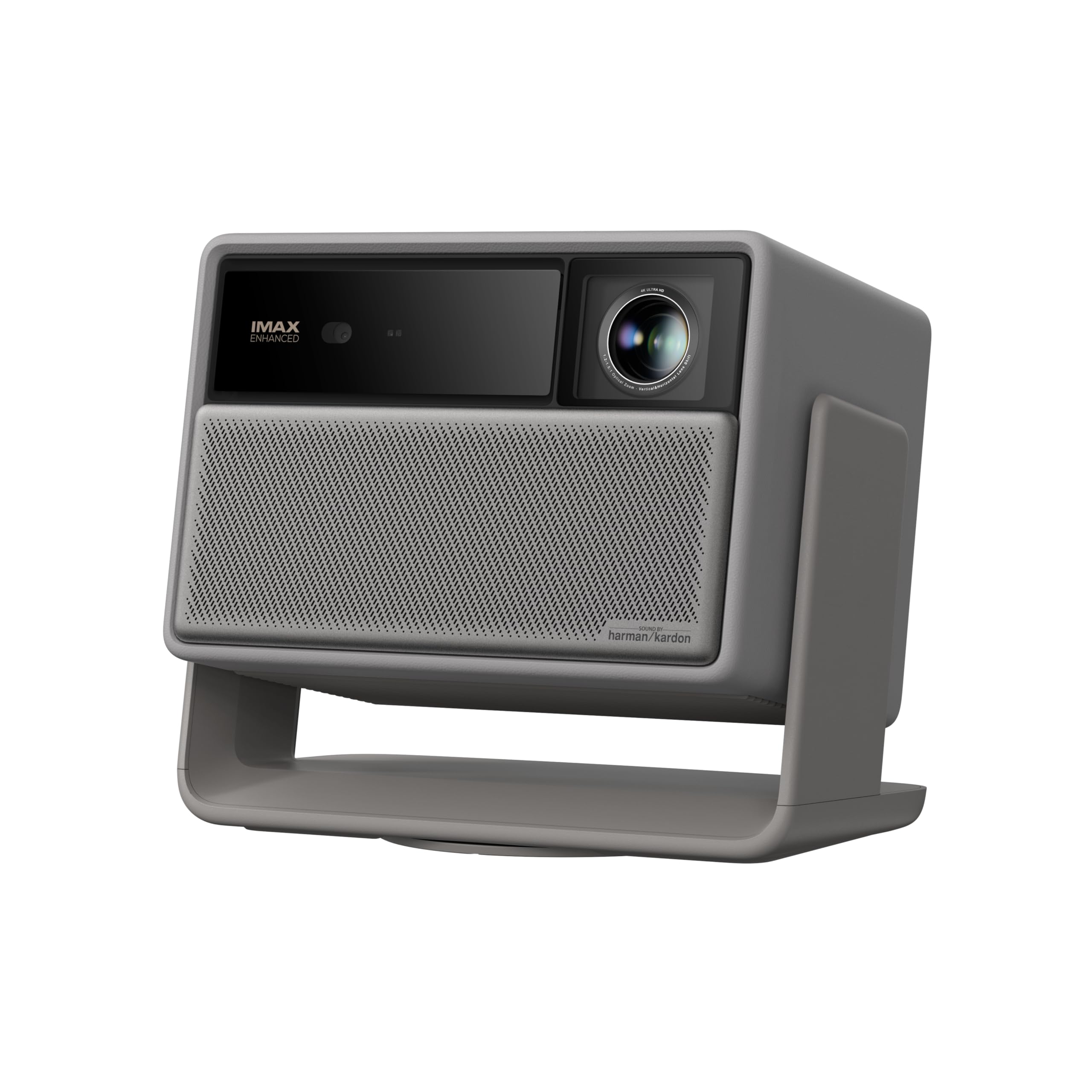
The XGIMI HORIZON 20 uses an RGB triple-laser engine rated at 3200 ISO lumens with a 100,000:1 contrast ratio, making it one of the brightest consumer projectors available for anamorphic setups. The optical zoom and lens shift allow precise manual adjustment of the image position without digital distortion, which is essential when coupling with a third-party anamorphic lens sled. IMAX Enhanced and Dolby Vision certification ensure that HDR content is tone-mapped correctly across the full width of a scope screen.
The Harman Kardon speaker system delivers 60W of audio, but for a dedicated scope theater, an external sound system via HDMI eARC is recommended. The built-in Google TV with licensed Netflix provides 4K streaming without an external dongle, reducing HDMI cable clutter between the projector and the anamorphic sled. Gaming features include a 1ms response time at 240Hz, though this is only achievable at 1080p — at native 4K the refresh rate drops to 60Hz.
One potential issue is that the HORIZON 20 has a fixed throw ratio of 1.2-1.9:1, which limits how far back you can place the projector relative to the screen. For a 120-inch scope image using a 1.33x lens, you will need at least 3.8m of throw distance. The auto-keystone and obstacle avoidance features should be disabled when using an anamorphic lens because they rely on digital warping that conflicts with the optical squeeze. The mechanical lens shift has 120% vertical and 40% horizontal adjustment, giving enough range to center the image on most scope screens.
Why it’s great
- 3200 ISO lumens for bright scope images in ambient light
- Mechanical lens shift avoids digital warping
- 240Hz/1ms gaming mode for low-latency projection
Good to know
- Fixed 1.2-1.9 throw ratio limits placement flexibility
- Auto-keystone must be off for anamorphic compatibility
- No motorized lens memory for 16:9 to scope switching
5. Epson Home Cinema 5050UB 4K PRO-UHD Projector

The Epson 5050UB remains a benchmark for anamorphic home theater because of its motorized lens with memory positions — it can store separate zoom, focus, and lens shift settings for 16:9 and 2.35:1 content. This makes switching between aspect ratios seamless without manually moving an external sled, though the 5050UB still benefits from an anamorphic lens if you want to maximize native resolution. The 3LCD design delivers 100% of the RGB color signal with no rainbow effect, a known advantage over single-chip DLP projectors when projecting large scope images.
The HDR processor handles 10-bit color, and the pixel-shifting engine produces a simulated 4K image from the 1920×1080 native chips. While this is not true native 4K, the output is sharp enough for most viewers at a typical 1.5x screen height seating distance. The 2600 lumens brightness is adequate for a dedicated light-controlled room, but in ambient light, you will notice the image washing out on a scope screen. The lens shift range is generous with ±96% vertical and ±47% horizontal, allowing mounting in almost any ceiling position.
The main limitations are the physical size (nearly 25 lbs) and the lack of smart streaming features — you will need an external streaming device or HTPC connected via HDMI. The 11-second HDMI handshake delay when switching between 4K and 1080p content can be annoying during a movie night. For users who want to build a serious scope theater with an anamorphic lens and motorized sled, the 5050UB’s lens memory is the most convenient implementation at this price tier, but you must factor in the cost of a separate streaming box and an external video processor for 1.6x desqueeze support.
Why it’s great
- Motorized lens memory stores anamorphic and 16:9 positions
- 3LCD eliminates rainbow artifacts on large scope images
- Wide lens shift range simplifies mounting
Good to know
- Native 1080p; pixel shift simulates 4K
- No built-in streaming — requires external device
- 11-second HDMI handshake delay on resolution change
6. NexiGo Aurora Pro MKII 4K Tri-Color Laser UST

The NexiGo Aurora Pro MKII is an ultra-short-throw projector with a 0.21:1 throw ratio, meaning it sits just inches from the wall while projecting a 150-inch image. This is a fundamentally different design from long-throw projectors that require a lens sled, because the light path on a UST is reflected off a mirror inside the chassis — there is no way to mount a separate anamorphic lens between the projector and the screen. Instead, the Aurora Pro MKII achieves an anamorphic-like aspect ratio through digital processing and its ALPD 5.0 laser engine, which has Scene Adapt Engine (SAE) for dynamic iris and laser dimming that produces a 30,000:1 contrast ratio.
Dolby Vision and HDR10+ support ensure that HDR content is displayed with proper tone mapping, and the 60W speakers with Dolby Atmos provide immersive audio without external speakers. For gamers, the 4.2ms to 8ms input lag in gaming mode is competitive for UST projectors, and the 120Hz refresh rate at 4K is achievable via HDMI 2.1. The laser light source is rated for 30,000 hours, which at average usage of 4 hours per day translates to over 18 years of life.
The key constraint for anamorphic enthusiasts is that this is a closed system — you cannot add a third-party anamorphic lens. If you want a true optical 2.35:1 image without digital scaling, a UST is not the right platform. However, for buyers who prioritize a compact setup with no ceiling mount and zero cable management, the digital anamorphic processing in the Aurora Pro MKII is a reasonable compromise that delivers a bright, color-accurate image without the complexity of a lens sled.
Why it’s great
- UST design eliminates ceiling mount and cable runs
- 30,000:1 contrast with dynamic laser dimming
- 4.2ms input lag for competitive gaming
Good to know
- No optical anamorphic lens compatibility — digital only
- Remote requires line-of-sight; placement is finicky
- Ambient light handling is poor without ALR screen
7. Hisense XR10 Triple Laser 4K Projector
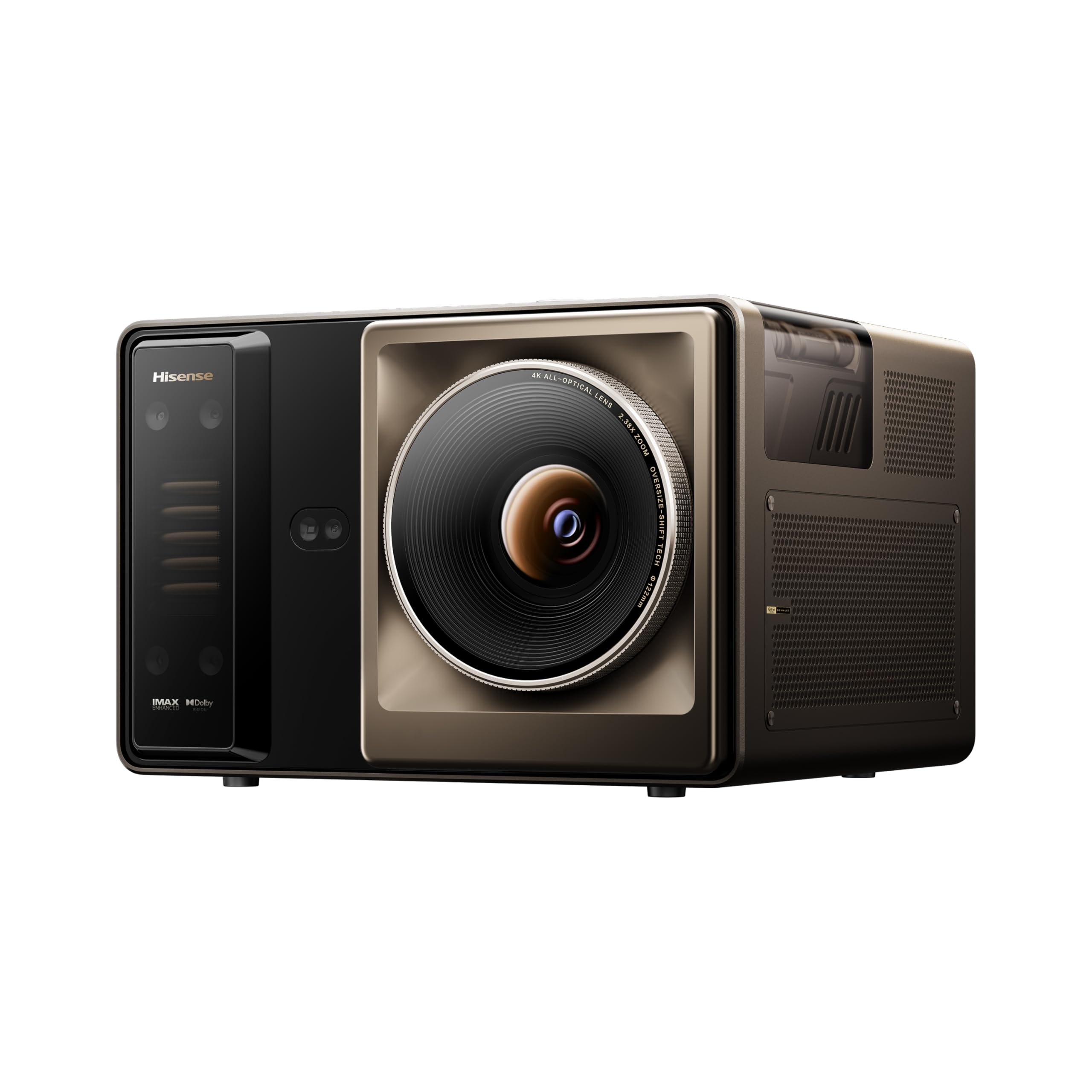
The Hisense XR10 is a long-throw triple-laser projector with an industry-first 17-element all-glass lens and a liquid cooling system that allows it to sustain 6000 ANSI lumens peak brightness without thermal throttling. This is the brightest consumer projector on this list, making it viable for media rooms with ambient light that would wash out most other projectors. The 0.84-2.0:1 optical zoom and mechanical lens shift provide ample adjustment range for fitting an anamorphic lens sled, and the 7-level iris gives control over black levels up to a 6000:1 contrast ratio.
IMAX Enhanced certification and Active 3D support add versatility beyond standard scope content, and the VIDAA smart OS provides access to over 1200 apps including Netflix and YouTube. The liquid cooling system uses a single-tube dual-channel design that is leak-proof, and the high-temperature-resistant glass ensures no image degradation over extended viewing sessions. For anamorphic use, the combination of high brightness and a wide zoom range means you can fill a 200-inch scope screen at a reasonable throw distance without running out of light.
The main trade-off is size and weight — the XR10 is a desktop unit that weighs significantly more than compact laser projectors, and it requires a sturdy shelf or cart. The VIDAA OS is not as polished as Google TV, and some users report occasional lag in the interface. For dedicated home theater builders who want to pair this with a high-end anamorphic lens and a motorized sled, the 6000 ANSI lumens provide enough headroom to use a 1.6x lens without the image becoming too dim for HDR content.
Why it’s great
- 6000 ANSI lumens for bright anamorphic projection
- 17-element all-glass lens maintains sharpness across zoom range
- Liquid cooling prevents thermal image degradation
Good to know
- Large and heavy; not suitable for ceiling mount
- VIDAA OS interface lags behind Google TV
- Active 3D compatibility requires compatible glasses
8. NEBULA Cosmos 4K SE Smart Projector

The NEBULA Cosmos 4K SE uses HybridBeam technology that combines LED and laser light sources to deliver 1800 ANSI lumens with 4K Dolby Vision support. While this projector does not have a dedicated anamorphic lens mount, its NebulaMaster image engine and intelligent setup features (autofocus, keystone correction, obstacle avoidance) make it one of the easiest smart projectors to use for scope content via digital scaling. The Google TV interface with licensed Netflix in 4K eliminates the need for a separate streaming box, and the IEA 4.0 system adjusts the image in real time.
For anamorphic enthusiasts on a budget, this is a compromise projector — you cannot add a third-party lens, but the digital anamorphic processing in the NebulaMaster engine does a reasonable job of stretching 16:9 content to a wider aspect ratio without severe artifacts. The built-in Dolby Audio provides adequate sound for casual viewing, and the portable form factor (4 kg) means you can move it between rooms. The 200-inch maximum screen size is achievable in a dark room, but ambient light significantly reduces contrast.
The biggest limitation is the lack of a motorized lens or lens shift — all adjustments are digital, which means some pixel resolution is lost when digitally scaling to a scope ratio. The single HDMI port also limits connectivity options if you want to daisy-chain a streaming device, soundbar, and anamorphic video processor. For the price, the Cosmos 4K SE is an excellent entry-level smart projector, but it is not a suitable platform for a serious anamorphic home theater installation.
Why it’s great
- Built-in Google TV with 4K Netflix — no external box needed
- Lightweight 4kg form factor for portability
- Dolby Vision support for HDR scope content
Good to know
- No physical lens shift — all adjustments are digital
- Only one HDMI port limits connectivity
- Digital anamorphic processing loses some pixel resolution
9. Metabones Speed Booster for Blackmagic Pocket 4K

The Metabones Speed Booster is a focal reducer/adapter that mounts on the Blackmagic Pocket Cinema Camera 4K, allowing the use of full-frame lenses while increasing the maximum aperture by one stop. While this is not a traditional anamorphic lens, it is often used as part of a cinema camera rig that feeds an anamorphic lens signal to a projector output. The 0.64x reduction factor means a 50mm full-frame lens becomes a 32mm equivalent on the BMPCC 4K sensor, giving a wider field of view for scope framing.
Build quality is solid with a metal mount and optical glass elements, but the unit ships without a rear cap and some users report receiving opened packages. The adapter supports automatic exposure control on compatible lenses, but manual focus lenses work best for anamorphic applications where precise control over the squeeze factor is needed. For projector use, the camera output would be fed through a video processor that desqueezes the anamorphic image before sending it to the projector.
This is a niche product within the anamorphic ecosystem — it only makes sense if you are already using a Blackmagic Pocket 4K as your source camera and want to shoot in an anamorphic format before projecting. For most projector owners who just want to watch scope movies, a direct projector-to-lens-sled setup is simpler and delivers better image quality. The Metabones adapter is best suited for hybrid workflows where the same content is captured and projected in an anamorphic format.
Why it’s great
- Increases aperture by one stop for better low-light capture
- Solid metal construction with optical glass elements
- Allows full-frame glass on MFT sensor for wider framing
Good to know
- Only works with Blackmagic Pocket 4K camera
- Not a standalone anamorphic lens — requires separate anamorphic optics
- Some units arrive with opened packaging
FAQ
Does a 1.33x anamorphic lens work with any projector?
What is the difference between a motorized and manual lens sled?
Does an anamorphic lens reduce image brightness?
Can I use an anamorphic lens with a UST projector?
Final Thoughts: The Verdict
For most users, the anamorphic lens for projector winner is the SIRUI 50mm T2.9 1.6X because its 1.6x squeeze factor produces the widest cinematic aspect ratio available in a single lens element, and the Venus optical coating delivers smooth field curvature that is ideal for projection desqueezing. If you want a complete projector system with built-in lens memory, grab the Valerion VisionMaster Pro2. And for a bright room where you need both ambient light rejection and anamorphic compatibility, nothing beats the Hisense XR10 with its 6000 ANSI lumens and all-glass lens system.