
Our readers keep the lights on and my morning glass full of iced black tea. As an Amazon Associate, I earn from qualifying purchases.
Specs are compiled from manufacturer listings and verified buyer reviews and can change over time — please confirm the key details on the product page before buying.
You can hold, take apart, and see inside a real eye when you pick the right anatomical eye model—whether you teach high school biology, prep for an optometry exam, or help a curious kid learn why we do not poke our eyes. The models here range from soft foam versions built for small hands to detailed PVC models that separate into seven labeled pieces, so your choice depends on who will use it and how rough they will be.
I’m Min — the founder and writer behind Gadgets Feed. This guide is built by comparing the manufacturers’ published specifications and the patterns across verified customer reviews, so you get each pick’s real strengths and trade-offs instead of marketing spin.
Below I break down the best anatomical eye model options by their construction, part count, and intended age group so you can match the right one to your classroom, clinic, or living room.
Our Picks at a Glance


How To Choose The Best Anatomical Eye Model
Before you buy, think about the age of the user and the setting. A model that is perfect for a college anatomy lab can be frustratingly delicate or too detailed for a five-year-old, while a soft toy-like version will not satisfy a nursing student who needs to identify the vitreous body.
Match the Material to the User
Rigid PVC plastic holds fine detail and stands up to repeated handling in a classroom, which is why most detailed models use it. Foam versions are lighter and softer, making them a safer pick for toddlers, but they wear out faster with rough play.
Check the Magnification and Part Count
Most teaching models enlarge the eye to 6X life size so the lens, cornea, and iris are easy to see. Some premium models use 3X instead. A higher part count — say seven detachable pieces versus a single solid piece — means more hands-on assembly practice but also more pieces to keep track of.
Quick Comparison
| Model | Best For | Magnification | Detachable Parts | Weight | Amazon |
|---|---|---|---|---|---|
| XINDAM 6X Enlarged Eye Model★ Best Overall | Anatomy students | 6X | Cornea, lens, iris | 1.43 lb | Amazon |
| Learning Resources Cross-Section ModelKid-Friendly Pick | Young kids | Not stated | Opens for inner view | 5.6 oz | Amazon |
| QWORK 6X Anatomy Model | Classroom demos | 6X | Seven sections | 1.46 lb | Amazon |
| Wadoy 6X Eyeball Model | Anatomy labs | 6X | Seven parts | 1.39 lb | Amazon |
| faruijie 6-Times Eye Model | Motor-skill learning | 6X | Seven parts | 1.72 lb | Amazon |
| Ultrassist Eye Anatomy Model | Medical teaching | 6X | Detachable | 1.39 lb | Amazon |
| EISCO Human Eye Model | Detailed study | 3X | Seven parts | 14.4 oz | Amazon |
In‑Depth Reviews
1. XINDAM 6X Enlarged Human Eye Anatomical Model
Our pick — over 4.5★ from 100+ verified ratings; the strongest balance of quality and price.
The 6X PVC model with detachable cornea, lens, and iris for hands-on anatomy study.
Built from corrosion-resistant PVC plastic, this 6X enlarged model sits on a base and lets you see the three layers of the eyeball wall plus the lens and vitreous body inside. The labeled diagram for the main parts makes it a ready-made study aid for anyone in an anatomy course.
High school teachers report their students love exploring it, and the model has helped spur discussion and engagement in class. An optometry student found the assembly easy even without instructions, noting you can take apart the cornea, lens, and iris to look inside.
The item measures 9.8 inches long by 6.2 inches wide, so it makes a solid presence on a desk. At 0.65 kg, it is sturdy enough to handle regular handling during study sessions.
Classroom proven: Teachers and students alike praise how it drives engagement, while the detachable cornea, lens, and iris make it a true hands-on tool.
Reach for this if: you are an anatomy student or teacher who wants a detailed, take-apart model for active study.
Look elsewhere if: you want a soft, throwable model for a toddler — the rigid PVC is built for study, not play.
2. Learning Resources Cross-Section Human Eye Model
The soft foam model that opens for inner exploration, safe for young children.
Made of soft foam and weighing just 5.6 ounces, this model is light enough for a child to toss around. The realistic eyeball opens for inner exploration, and it comes with a fact-filled activity guide plus a reproducible eye diagram to label.
Parents use it with kids as young as two, pairing it with educational shows about the eye and using it to explain why we keep our hands out of our eyes. The manufacturer recommends it for ages 7 and up, though homeschoolers at the Pre-K and K level find it sufficient for their lessons.
The trade-off is durability — foam breaks down faster than rigid plastic with heavy use, so it is best treated as a learning tool rather than an indestructible toy. But its low weight and softness make it a safe first anatomy model for young children.
Value winner: It is an affordable, visual way to identify the iris, cornea, lens, and pupil without the cost or complexity of a lab-grade model.
Best for: parents of young kids who want a safe, soft introduction to eye anatomy.
Think twice if: you need a durable model for daily classroom rotation — the foam will not survive rough handling for long.
3. QWORK 6X Human Eye Anatomy Model

The 6X PVC model with seven detachable sections for assembly practice.
This PVC model enlarges the eye to 6X life size and separates into seven sections, so students can practice disassembling and rebuilding the structure. It shows the cornea, iris, lens, and vitreous body, and a reinforced base keeps it firm on the desk during demonstrations.
Buyers report using it in an eye anatomy class and loving the ability to manipulate it while studying, calling the art and coloring great. At 1.46 pounds, it feels noticeably more substantial than the 1.39-pound Wadoy model, giving it a sturdier presence.
It also makes a meaningful donation piece — one was given to a vision screening organization to support free eye checks for people who cannot see an ophthalmologist. The only note is that it is a simple model, best for young students rather than advanced research.
Hands-on study: The seven detachable sections turn passive reading into active learning, which is exactly what anatomy students need.
Reach for this if: you want an affordable model that students can take apart and rebuild for practice.
skip it if: you need fine clinical detail for professional medical training — this is a teaching model, not a surgical reference.
4. Wadoy 6X Enlarged Eyeball Model
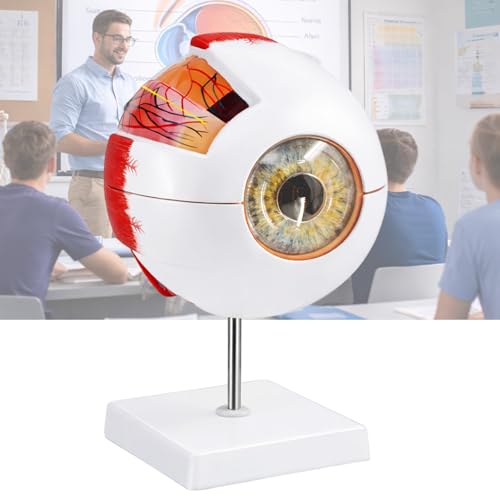
The 6X PVC model with seven parts, praised for quality in labs and as gifts.
This 6X model from Wadoy contains seven parts: the upper and lower eye, cornea, iris, lens, vitreous, and stand. The non-toxic PVC construction is corrosion-resistant, light, and strong, and it is easy to disassemble for teaching.
In an anatomy class, it proved the perfect tool for a student-led lab — aside from one upside-down number. It also works as a professional gift, with one going to an ophthalmologist who seemed to like it. The quality earns the most praise from owners, who call it a great learning tool.
At 1.39 pounds, it is lighter than the 1.46-pound QWORK model, so it is a touch easier to move between rooms. Its larger package (7.6 x 6.57 x 6.26 inches) gives it a substantial boxed presence for gifting.
Quality first: The build quality is the thing people rave about, making it a reliable pick for both classrooms and clinic offices.
Best for: anatomy teachers running student-led labs and professionals who want a display-worthy model.
Look elsewhere if: you need perfect labeling — the occasional upside-down number is a minor but real flaw.
5. faruijie 6-Times Enlarged Eye Model
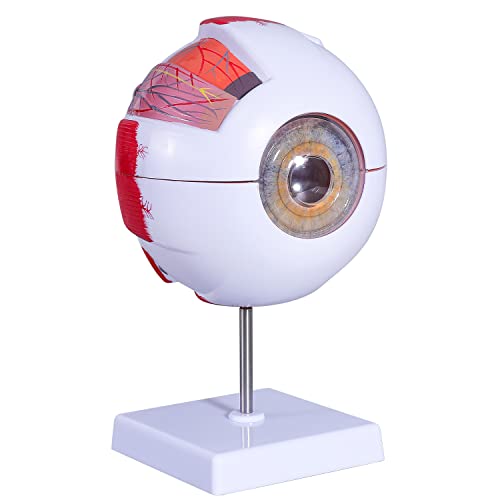
The 6X model with sagittal cut and seven parts, also aiding motor-skill practice.
This 6X enlarged model uses a sagittal cut — a vertical slice through the middle — so you can observe the outer, middle, and inner membranes in one view. It disassembles into seven parts: two eyeball halves, two vitreous pieces, the lens, iris, and cornea, with muscles and part of the choroid visible on the sclera.
At 1.72 pounds, it is the heaviest of the 6X models here, giving it a dense, quality feel in hand. The stable base is designed for hygiene and physiology courses as well as desktop decoration.
It has found a devoted fan in a family whose autistic nephew loves human anatomy — he takes it apart, puts it back together, and learns the parts while practicing motor skills. The only complaints relate to shipping issues rather than the model itself.
Dual purpose: It works as both a detailed anatomy teaching tool and a fidget-friendly learning aid for kids who need hands-on engagement.
Reach for this if: you want the most substantial-feeling 6X model with clear sagittal views of the eye’s layers.
Think twice if: you want the lightest model to carry between rooms — at 1.72 pounds, it is the heaviest in this group.
6. Ultrassist Eye Anatomy Model, 6X Enlarged
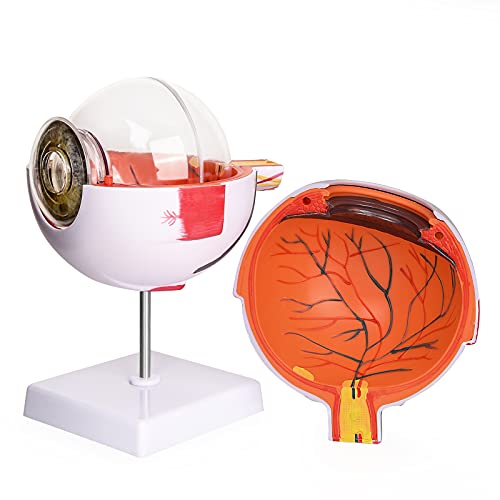
The 6X model that an eye surgeon actually keeps in the office.
This 6X enlarged model from Ultrassist is built from non-toxic, corrosion-resistant PVC that is designed to last. It comes with a sturdy base and is easy to install and dismantle, making it convenient for live demonstrations in medical training and science classes.
The size is the standout feature — an eye surgeon loved how big it is because visually impaired patients have an easier time reading this diagram. Seventh graders love it in the classroom, and it is praised as realistic and good quality.
Its 1.39-pound weight matches the Wadoy model exactly, making it equally portable. The detachable parts support the professional teaching use cases, from physiotherapists to radiology technicians.
Built for visibility: The large 6X scale is what wins people over, especially for patients or students who struggle with small diagrams.
Best for: medical professionals and teachers who need a large, easy-to-read model for patient education.
Look elsewhere if: you are on a tight budget and just need a basic study aid — the premium build commands a higher price.
7. EISCO Human Eye Model, 3X Enlarged
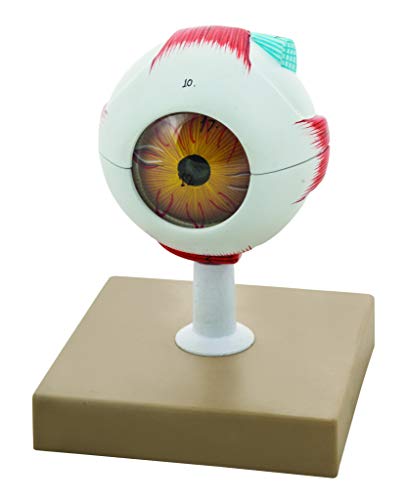
The hand-painted 3X model with 18 labeled structures for serious study.
Unlike the 6X models above, this EISCO model enlarges the eye to 3X life size — a smaller scale that lets the painter add finer detail. It is hand-painted by skilled artists and includes 18 labeled structures, each numbered on the model and matched to an included color key card.
It is custom molded from non-toxic polymers and PVC, and at 14.4 ounces it is the lightest rigid model in this lineup. Owners mention it is well made, not flimsy, and a great visual aid — one was used for a son’s science project on how the eye sees color.
The smaller magnification does have a trade-off: one owner found the globe hard to open (needing a knife) and noted the retina is not visible, which disappointed them for teaching. The pupil is a real hole and the cornea is removable, so inner access is still possible with effort.
Artist-level finish: Hand-painted detail and 18 labeled structures make this the most visually refined model, ideal for display-grade study.
Best for: students and collectors who want a beautifully painted, labeled reference model rather than a take-apart toy.
Think twice if: you need quick inner access — the globe can be tough to open and the retina is not visible.
Understanding the Specs
Magnification: 3X vs 6X
The magnification number tells you how much larger the model is than a real human eye. A 6X model like the XINDAM or QWORK makes the lens, cornea, and iris big enough to see clearly from across a desk, which is ideal for classroom demonstrations. A 3X model like the EISCO is smaller but allows for finer hand-painted detail, making it better for close study of labeled structures.
Detachable Part Count
The number of pieces a model separates into determines how hands-on the learning can be. A seven-part model — eyeball halves, vitreous, lens, iris, and cornea — lets students practice assembly and see each structure in isolation. A model that simply opens for inner viewing, like the foam Learning Resources version, offers a quicker but less detailed exploration, which suits younger children.
FAQ
What is the difference between a 3X and 6X eye model?
Which eye model is best for a toddler?
Are the detachable eye models easy to put back together?
What material are these eye models made from?
Can these models be used for professional medical teaching?
How many labeled structures does the EISCO model have?
Which eye model is the heaviest?
Do these models come with instructions?
Final Thoughts: The Verdict
For most people, the anatomical eye model winner is the XINDAM 6X Model because it combines a 6X enlarged scale, detachable inner parts, and teacher-approved engagement at a mid-range price. If you want a soft, safe model for a young child, grab the Learning Resources Cross-Section. And for a hand-painted display piece with 18 labeled structures, the EISCO 3X Model is the one to reach for.
How We Picked
We do not accept paid placement. Every pick is matched to a real buyer and a real use-case; we do not hands-on test units.
Sources & Methodology
Specifications: manufacturer listings and product documentation. Review insights: verified customer reviews, as of August 2026. Pricing: not shown on this page (it changes often); check the current price via the retailer link.
As an Amazon Associate, Gadgets Feed earns from qualifying purchases. This does not affect which products we feature.