
Our readers keep the lights on and my morning glass full of iced black tea. As an Amazon Associate, I earn from qualifying purchases.
Specs are compiled from manufacturer listings and verified buyer reviews and can change over time — please confirm the key details on the product page before buying.
You are scrolling through beige plastic hand models online, and you need one that actually teaches you the carpal bones — not one that gathers dust. The difference between a model that clearly shows the eight carpal bones and one that blurs them into a lump depends on a few specific specs: articulation (whether the joints bend), wire quality, and whether the forearm bones are included. This guide breaks down seven anatomical skeleton hand models by what they show, how they move, and what real buyers noticed when they unboxed them.
I’m Min — the founder and writer behind Gadgets Feed. This guide is built by comparing the manufacturers’ published specifications and the patterns across verified customer reviews, so you get each pick’s real strengths and trade-offs instead of marketing spin.
You will find a life-sized, articulated model that fits your study or practice needs in this roundup of the best anatomical skeleton hand models for medical students, educators, and healthcare professionals.
Our Picks at a Glance


How To Choose The Best Anatomical Skeleton Hand
Picking the right hand model means looking past the basic photos to three key factors that decide how useful the model actually is for your learning or teaching. You want a model that shows the bones accurately, lets you move them naturally, and holds up over time.
Articulation and Wire Quality
The best models use stainless steel wire to connect the bones, allowing each finger to flex and extend so you can study the ranges of motion. Cheaper models often use wire that bends out of shape quickly or lacks the tension to hold a pose.
Anatomical Accuracy and Detail
A life-size model should clearly show the eight carpal bones of the wrist, the five metacarpal bones of the palm, and the fourteen phalanges of the fingers. Some premium models also paint on the muscle origins and insertions, which helps you connect bone structure to muscle function.
Base and Display Stability
A sturdy base keeps the model upright during study without wobbling. Models mounted on a removable white base are easy to transport and store, while models glued to a fixed base are harder to pack away.
Quick Comparison
| Model | Best For | Item Weight | Articulation | Extra Details | Amazon |
|---|---|---|---|---|---|
| XINDAM Hand Skeleton★ Best Overall | Budget Study | 7.7 oz | Articulated | Life size | Amazon |
| Wellden Cranstein A-324Top Performer | Detailed Study | — | Flexible fingers | Includes ulna and radius | Amazon |
| EVOTECH SCIENTIFIC | Muscle Study | 9.5 oz | Stainless steel wire | Muscle origins painted | Amazon |
| Wellden 7-Part | Soft Tissue Anatomy | — | Magnetic connections | Muscles, nerves, arteries | Amazon |
| Vision Scientific VAJ210 | Natural Movement Study | 1 lb | Flexible wrist and fingers | Instruction manual included | Amazon |
| MAYMII PVC Hand | Detailed Budget | 8.8 oz | Wire articulation | Includes ulna and radius | Amazon |
| faruijie Hand Skeleton | Portable Study | 210 g | Stainless steel wire | Lightweight display stand | Amazon |
In‑Depth Reviews
1. XINDAM Human Hand Skeleton Model on Base
Our pick — 4.5★ from 200+ verified ratings; the strongest balance of quality and price.
The straight-ahead bone model that skips the frills and gets the job done.
The XINDAM model is the lightest of the bunch at 7.7 ounces, making it easy to carry between classes or store on a crowded shelf. It is made of PVC plastic (polyvinyl chloride, a lightweight, corrosion-resistant material) that resists corrosion and stays lightweight while still showing all the main anatomical structures of the hand skeleton. The life-size scale means you can compare it directly to your own hand to understand the relative bone positions.
The model is articulated, so the fingers have some movement, but it lacks the stainless steel wire found on higher-end models like the EVOTECH. Reviewers point out it works well as a basic teaching tool for introductory anatomy, though the bone detail is less sharp than the Wellden A-324. The biggest advantage is its simplicity: no painted details to wear off, no loose parts, just a clear view of the hand bones on a base.
One thing to keep in mind: the package dimensions at 10.71 x 5 x 3.19 inches are relatively compact, and the model arrives fully assembled, so there is no setup required.
Straightforward value
- Corrosion-resistant PVC plastic stays clean with minimal care
- Life-size scale for direct hand comparison
- No assembly needed right from the start
Detail limitations
- Bone detail is not as sharp as premium models
- No painted muscle or ligament markings
Good entry point: A reliable choice for high school biology or introductory college courses where a clear bone overview is all you need.
Not for advanced study: If your coursework requires identifying muscle origins or seeing fine bone ridges, you will want a higher-detail model.
2. Wellden Cranstein A-324 Hand Skeleton Anatomy Model
The gold standard for clarity at a hair over eight inches tall.
The Wellden Cranstein A-324 gives you a life-size hand at 22 cm, so every phalanx (finger bone) and carpal bone (wrist bone) sits at a scale you can directly relate to a real hand. Each finger moves independently, so you can pose it to show specific movements like flexion or extension without the whole model shifting on its base. The model includes the ulna and radius bones (the two forearm bones), giving you the full wrist joint context that cheaper models leave off.
Buyers report the plastic feels sturdy and washes clean easily. The individual phalanges, metacarpal bones (palm bones), and carpal bones are all distinct and clearly separated, so there is no guesswork about which bone is which. This one feels more substantial in hand without being heavy.
One catch: the base is not detachable, so storing the model flat takes more space in a drawer. But for a dedicated study desk, the stable base prevents tipping during handling.
Classroom-ready design
- Flexible fingers allow natural movement demonstrations
- Includes both ulna and radius bones for full wrist anatomy
- Washable plastic stands up to repeated handling
Storage trade-off
- Base is permanent and not removable
- No painted muscle origins for advanced study
Best for desk study: Ideal for anatomy students and educators who need a clear, durable model for daily reference and demonstrations.
Look elsewhere if: You need painted muscle insertion points or a completely packable design that breaks down flat.
3. EVOTECH SCIENTIFIC Hand Skeleton Model
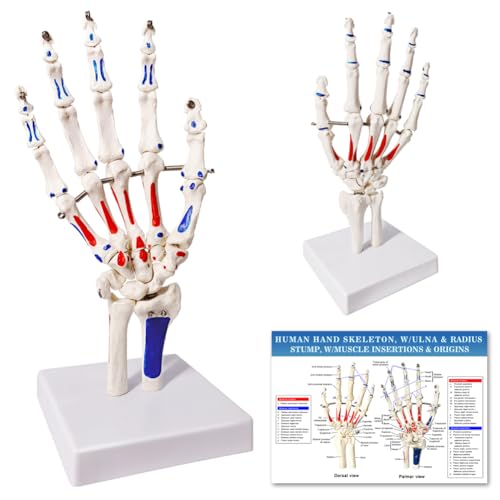
A bone model that paints the story of how muscles pull on the skeleton.
The EVOTECH SCIENTIFIC model stands apart because it paints the muscle origins and insertions (the spots where muscles attach to bone) directly onto the bones, so you can trace exactly where each tendon attaches. It weighs 9.5 ounces; the similar XINDAM model weighs 7.7 ounces and that extra mass comes from the detailed hand-painting and the sturdy ABS base (acrylonitrile butadiene styrene, a tough plastic). The stainless steel wire through each joint allows flexibility in the fingers while keeping the model durable enough for repeated classroom use.
The model includes the lower portions of the ulna and radius, so the wrist region is fully represented. An instruction manual comes in the package, which owners mention helps identify the painted muscle areas quickly. The brand claims the natural cast was developed by medical professionals and cast from an original human skeleton, which explains the accuracy in the bone shapes.
One limitation: reviewers mention the paint on the muscle origins can wear off with heavy handling over time, so it is best used on a desk rather than passed around a large group.
Visual learning advantage: The painted muscle insertions give you a direct visual link between bone structure and muscle function, something plain bone models cannot offer.
Durability check: The ABS base and stainless steel wire should last, but the hand-painted details need careful handling to stay intact.
Reach for this if: You are studying kinesiology (the science of human movement) or physical therapy and need to connect muscles to their bone attachment points visually.
Look elsewhere if: You prefer a model that students can pass around without worrying about wear on the painted details.
4. Wellden Medical Anatomical Hand Skeleton Model with Ligaments, Muscles, Nerves and Arteries

Seven separate pieces showing everything under the skin at once — bones, muscles, and more.
This Wellden model is the most comprehensive single model in the lineup because it shows the bones, muscles, tendons, ligaments (the tough bands that connect bone to bone), nerves, arteries, and veins all in one 7-part assembly. The dorsal side (the back of the hand) specifically displays the extensor muscles and portions of the tendons at the wrist, which is crucial for understanding how the hand opens and closes. Each part connects with magnets instead of glue or wire, so you can separate them to study individual structures and then click them back together.
The model is life-sized and includes the lower forearm, giving context to where the muscles and tendons originate before entering the hand. Buyers in medical fields note the level of detail is appropriate for patient education and clinical teaching. Compared to the EVOTECH model, this one adds the soft tissue layer that bone-only models miss entirely — the EVOTECH shows painted muscle origins, while this model adds actual three-dimensional muscles, nerves, and arteries.
One trade-off: the magnetic connections hold well for display but may feel less secure than wired joints when you are manipulating the fingers aggressively.
Soft tissue advantage
- Shows muscles, ligaments, nerves, and arteries alongside bones
- 7 separate parts connected by magnets for easy study
- Includes extensor muscles on the dorsal side
Handling consideration
- Small pieces can be lost if separated and not tracked
- Magnetic connections are less rigid than wired joints
Designed for deep study: Medical professionals and advanced students who need the full picture of bone plus soft tissue should put this model on their desk.
May be overkill if: You only need a basic bone overview for an introductory class and do not want to manage multiple pieces.
5. Vision Scientific VAJ210 Right Hand Skeleton

A wired model that bends like a real hand, made for lecture demonstrations.
The Vision Scientific VAJ210 focuses on realistic movement with a naturally flexible wrist and slightly flexible fingers, all wired together to show how the carpal bones interact during motion. At 1 pound, it gives it a solid feel on the base that smaller models lack. It shows the distal portions (the far ends) of the ulna and radius, so you can study the full wrist joint rather than a hand that stops abruptly at the palm.
The model is fully articulated (jointed with wire) to help you observe the orientation, relationships, and articular surfaces of each bone. An instruction manual walks you through the anatomy, which buyers appreciate when first learning the bone names. This one feels more like a real specimen weight, though the trade-off is that it takes up more space in a bag.
Customers note the finger flexibility is slightly looser than some other models, which makes it harder to hold a specific pose without the fingers drifting back.
Movement study focus: The flexible wrist and fingers let you demonstrate radial and ulnar deviation (side-to-side wrist movement), flexion, and extension in a way that fixed models cannot replicate.
Pose stability: The looser articulation is great for studying range of motion but less ideal for holding a static display position.
Choose this for: Demonstrating joint movement in a classroom or clinic where you need to show the wrist and fingers in action.
Pass on it if: You want a model that stays locked in one position for display or photography without any drift.
6. MAYMII High Quality PVC Human Hand Skeleton Model

A budget-priced model that refuses to cut corners on the wrist bones.
The MAYMII model punches above its class by including the lower portions of the ulna and radius, giving you a complete wrist that most models at this tier leave off. It weighs 8.8 ounces; the XINDAM model weighs 7.7 ounces and that extra weight partly comes from the higher-quality wire that holds the bones together with flexibility. The brand claims a hand-painted finish and attention to detail, and that the model was developed by medical professionals and cast from an original human skeleton.
The model is fully articulated with wire, allowing you to study the movement of each joint while keeping the bones securely connected. It mounts on a white base that can be disassembled, which makes storage easier than models with a fixed base — a clear advantage over the Wellden A-324. Shoppers say the bone detail is noticeably sharper than the XINDAM model, especially around the carpal bones where clarity matters most for understanding wrist anatomy.
One concern from reviews: the wire articulation can loosen over time if the fingers are bent aggressively in the same direction repeatedly.
Wrist-complete design: The included ulna and radius portions make this the best budget option for studying the full wrist joint rather than just the hand.
Detail for the price: The sharper bone detail and removable base give it an edge over other models in the same budget tier.
Ideal for budget-conscious students: If you need a life-size, articulated hand with full wrist bones and your budget is tight, this is the model to pick.
Consider a step up if: You plan to manipulate the fingers constantly for demonstrations and worry about wire longevity.
7. faruijie Hand Skeleton Model

A right-hand model built for portability without sacrificing the joint detail.
The faruijie model weighs 210 grams and it uses stainless steel wire to connect the joints for durability that plain wire models cannot match. It specifically represents the right hand and includes the eight carpal bones, five metacarpal bones, and fourteen phalanges called out in the product description. The lightweight plastic display stand at the bottom makes it easy to set up on any desk and pack away when you are done.
The brand claims the model is scientifically accurate and life-size, with each joint fixed with high-quality stainless steel wire that provides limited flexibility. Against the EVOTECH model, this one skips the painted muscle origins to keep the price lower while still giving you a clear view of the bone structure. Buyers mention the small stand is a plus for portability but can feel slightly unstable if the model is bumped during handling.
One detail: the fingers have limited flexibility compared to the more articulated models, so it is better for studying static bone positions than ranges of motion.
Travel-friendly build
- Stainless steel wire offers better durability than basic wire
- Lightweight stand makes packing and setup easy
- Clear carpal, metacarpal, and phalanx representation
Motion limits
- Finger flexibility is more restricted than fully articulated models
- Small base can tip under heavier handling
Best for mobile study: Students who need to bring their anatomy model between home and campus will appreciate the light weight and compact stand.
Not the top choice if: You need a model that can demonstrate a wide range of finger motion or handle rough daily use in a busy classroom.
Understanding the Specs
Articulation and Wire Material
Articulation means the joints are connected so the fingers and wrist can move. The wire type matters because stainless steel wire resists bending out of shape over time, while basic wire can loosen or snap with repeated use. A fully articulated model lets you study the range of motion at each joint, which is essential for understanding how the hand functions in movements like grasping or pinching.
Life-Size Scale and Included Bones
A life-size model measures about 22 cm from the wrist to the tip of the middle finger, matching the size of an adult human hand. The best models include the distal portions of the ulna and radius, which are the two forearm bones that form the wrist joint. Without those bones, the model stops at the carpal bones and leaves out the critical connection point between the hand and the arm.
FAQ
What is the difference between an articulated hand skeleton and a fixed one?
Does the hand skeleton model include the wrist bones?
Is the model made of real bone or plastic?
How durable is the wire articulation over time?
Can I remove the hand model from its base?
What does life-size mean for a hand skeleton model?
Does the model show the left or right hand?
How do I clean a PVC hand skeleton model?
Final Thoughts: The Verdict
If you want one dependable pick, the anatomical skeleton hand winner is the Wellden Cranstein A-324 because it combines life-size scale, flexible fingers, and clear bone detail in a durable package that suits both study and teaching. If you want painted muscle origins for kinesiology work, grab the EVOTECH SCIENTIFIC. And for the most comprehensive soft tissue view, the standout is the Wellden 7-Part Medical Model.
How We Picked
We do not accept paid placement. Every pick is matched to a real buyer and a real use-case; we do not hands-on test units.
Sources & Methodology
Specifications: manufacturer listings and product documentation. Review insights: verified customer reviews, as of July 2026. Pricing: not shown on this page (it changes often); check the current price via the retailer link.
As an Amazon Associate, Gadgets Feed earns from qualifying purchases. This does not affect which products we feature.