
Whether the bottom is mud, sand, rock, or a mix, you need an anchor designed to set fast and hold firm against wind, current, and wake. A poorly chosen anchor turns a calm cove into a drift race, forcing you to reset repeatedly instead of enjoying your boat.
I’m Min — the co-founder and writer behind Gadgets Feed. After spending dozens of hours cross-referencing seabed adaptability, holding power, material finishes, and real-world user reports across seven distinct anchor designs, I’ve broken down exactly which anchor fits your hull and your typical mooring conditions.
From the compact claw that sets instantly in mixed bottoms to the heavyweight delta that self-launches from a bow roller, every option here earned its spot through gritty customer feedback and cold engineering logic. The single best recommendation depends on your boat length and seabed, so let’s find the right anchor for boat for your next trip.
How To Choose The Best Anchor For Boat
Selecting the right anchor is a balance of boat displacement, primary seabed type, and how much chain and scope you can deploy. A lightweight folding anchor for a lake pontoon boat has different requirements than a heavy plow for a sailboat anchored overnight in a tidal channel. Understanding the four key variables—anchor style, material, weight, and rode configuration—keeps you from guessing at the dock.
Anchor Style and Seabed Compatibility
Claw anchors (Bruce-style) set quickly in rock, coral, and mixed bottoms, making them the go-to for variable seabeds. Fluke anchors (Danforth-style) excel in sand and mud, offering exceptional holding power per pound. Delta plows self-launch from bow rollers and dig into mud and grass reliably. Cube or box anchors offer massive holding power for pontoons in heavy current but require more storage space.
Material and Corrosion Resistance
Hot-dipped galvanized steel is the industry standard for saltwater use—the thick zinc coating resists rust for years, even when submerged continuously. Zinc-plated anchors are lighter on the wallet but chip and corrode after one season in salt, making them acceptable only for freshwater lakes where retrieval is immediate. Stainless steel anchors exist but command a premium and often add unnecessary weight for boats under 30 feet.
Weight and Boat Length Matching
The general rule is 1.5 to 2 pounds of anchor weight per foot of boat length, plus additional chain for scope. A 4.4-pound claw works for a 16-foot skiff, while a 19-pound cube handles a 25-foot pontoon in wind. Going too light results in dragging; going too heavy strains manual retrieval and storage.
Quick Comparison
On smaller screens, swipe sideways to see the full table.
| Model | Category | Best For | Key Spec | Amazon |
|---|---|---|---|---|
| Mantus M1 Anchor | Premium | Setting power in varied bottoms | 13 lb galvanized steel | Amazon |
| Better Boat Fluke Kit | Mid-Range | All-in-one kit for boats 15–24 ft | 8.5 lb hot dip galvanized | Amazon |
| Five Oceans Delta Wing | Premium | Self-launching for bow rollers | 9 lb plow / up to 27 ft boats | Amazon |
| Extreme Max Cube Anchor | Mid-Range | Pontoons in heavy wind/current | 19 lb zinc-plated, folds flat | Amazon |
| Seachoice Claw Anchor | Mid-Range | Reliable in tide and wind | 11 lb hot dipped galvanized | Amazon |
| SeaSense Fluke Super Hook | Entry-Level | Compact fluke for sand/mud | 10 lb galvanized, 24″ H | Amazon |
| Lewmar Claw Anchor | Value | Mixed seabed reliability | 4.4 lb galvanized steel | Amazon |
In‑Depth Reviews
1. Mantus M1 Anchor Galvanized

The Mantus M1 sets a new bar for holding power in mixed bottoms. Owners consistently report that the anchor digs in instantly on mud, grass, sand, and shell—and if it breaks loose due to a wind shift, it resets without intervention. One reviewer anchored a 4,000-pound boat through 30-mph gusts and ferry wakes without a single drag event. The heat-treated, hot-dipped galvanized steel construction ensures the shank and flukes resist corrosion even after years of continuous submersion in saltwater.
At 13 pounds, this anchor is best paired with a 6-foot chain leader and a scope of at least 5:1. The M1 requires a taller bow roller to accommodate its shank length—several users had to lower their roller pin for proper fitment, but once modified, it ran trouble-free for over five seasons. The lifetime warranty backs up the claim that this is a set-and-forget mooring tool for serious boaters.
For sailboats up to 30 feet or center consoles that overnight in tidal zones, the M1 provides peace of mind that cheaper anchors simply cannot match. The 35-pound variant held a 30-foot sailboat in 50-knot gusts, plowing deep enough that only the chain remained visible. That level of bite is rare in a consumer-grade anchor.
Why it’s great
- Sets instantly in mud, grass, sand, and shell
- Self-resets after veering without manual intervention
- Lifetime warranty with proven storm-level holding power
Good to know
- Shank length may require bow roller modification on some boats
- Premium price reflects the heat-treated steel and warranty
2. Better Boat Boat Anchor Kit with Rope and Chain

This complete kit removes the guesswork from rigging an anchor system. The 8.5-pound fluke anchor is hot-dipped galvanized—not zinc plated—so the finish resists rust in saltwater for multiple seasons. It includes 6 feet of 1/4-inch galvanized chain, 75 feet of 3/8-inch nylon rope with a stainless steel thimble, and two bow shackles. Everything connects out of the box, making it a turnkey solution for pontoons, deck boats, and fishing vessels between 15 and 24 feet.
Buyers consistently highlight the holding power in sand and mud. One owner with a heavy 25-foot cabin boat reported the anchor held perfectly in deep water with strong current. The pre-drilled recovery hole in the crown is a standout—if the fluke snags on rocks or roots, you can rig a retrieval line to pull it free from the opposite direction rather than cutting the rode and losing the anchor.
The shackles are the only weak point—some users noted they aren’t perfectly round and may loosen over time. Adding a nylon zip tie or replacing them with higher-quality shackles is a quick fix. For the price, you get a fully assembled anchoring system that outperforms piecemeal setups costing significantly more.
Why it’s great
- Complete kit with anchor, chain, rope, and shackles included
- Hot-dip galvanized construction resists saltwater corrosion
- Pre-drilled recovery hole prevents losing the anchor on snags
Good to know
- Included shackles may need upgrading for long-term reliability
- 8.5 lb weight is light for boats over 24 feet in heavy current
3. Five Oceans Delta Style Wing Boat Anchor
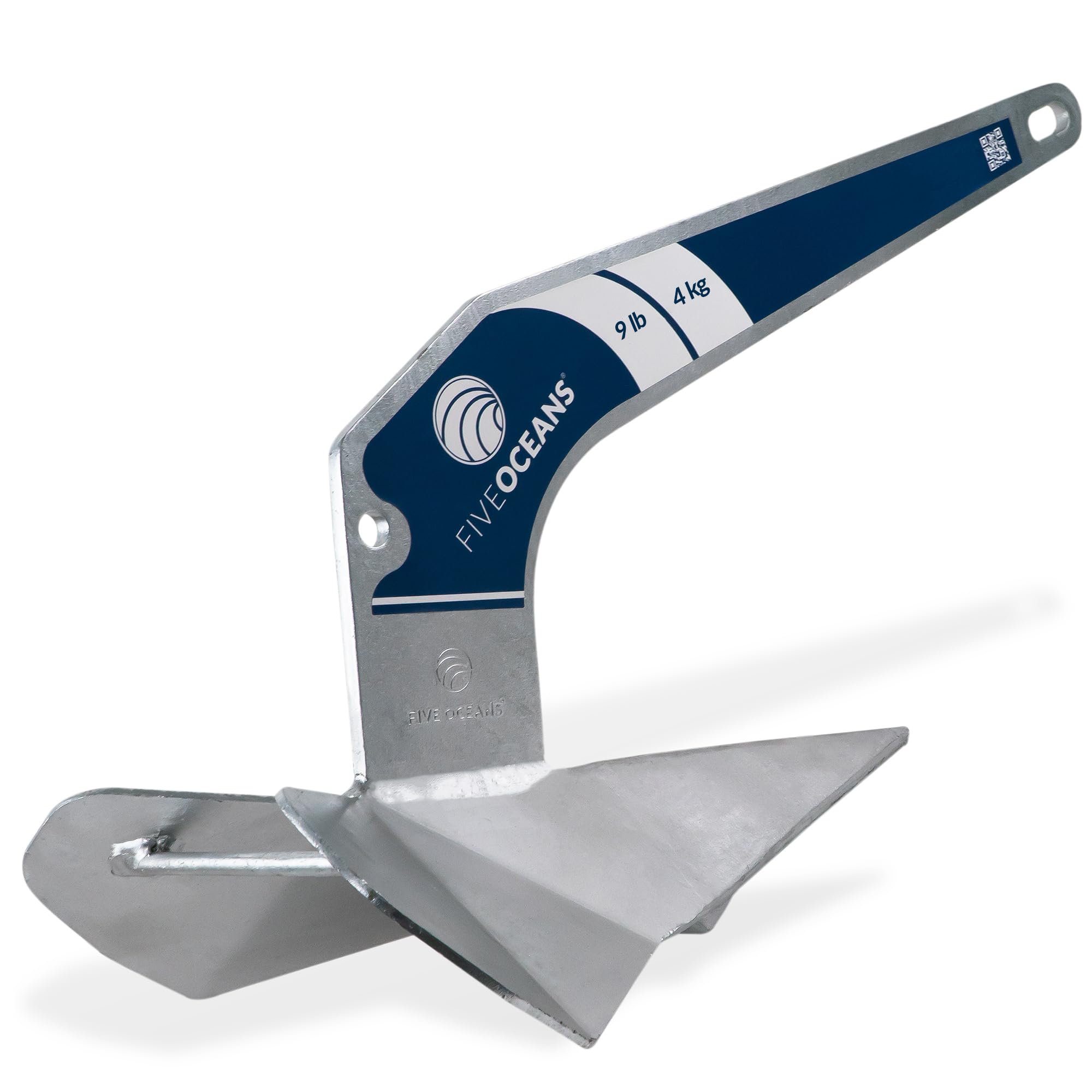
The Five Oceans Delta Wing is a one-piece plow anchor designed to self-launch from a bow roller without manual assistance. The balanced weight distribution lets it fall cleanly when released, making it ideal for boats equipped with windlasses. At 9 pounds with a length of 20.25 inches and a width of 9 inches, it fits standard roller setups and pulpits without modification.
Owners report excellent holding in chop and wind on vessels up to 27 feet. One reviewer on a 22-foot Mako confirmed no dragging in windy conditions, and another on a 26-foot center console noted the anchor stows compactly in a cabinet. The hot-dipped galvanized finish holds up well against saltwater exposure, though a single user lost the anchor when zip ties on the trip line failed on the third use in 30 feet of water.
The included trip line eye allows for easier breakout from snagged bottoms, though the manufacturer recommends a minimum chain diameter of 1/4 inch for proper setting. This anchor performs best in mud, sand, and rock, and is a strong contender for boaters who prefer a streamlined, low-maintenance plow design.
Why it’s great
- Self-launching design works seamlessly with bow rollers and windlasses
- One-piece construction offers high holding power without joints
- Hot-dipped galvanized finish resists corrosion in saltwater
Good to know
- Some users reported the anchor failing to break free on snags
- 9 lb version is best for boats up to 27 ft; larger boats need heavier models
4. Extreme Max BoatTector Cube Anchor

The Extreme Max Cube Anchor delivers massive holding power for pontoons and cabin cruisers in the 18- to 30-foot range. Its box-style design sets almost immediately and self-adjusts its positioning when wind or current shifts, preventing dragging. When not in use, the anchor folds flat to a collapsed dimension of 22.25 x 8 x 4.5 inches—small enough to slide under a pontoon seat or store in a ski locker.
One owner of a 24-foot pontoon reported that this anchor held steady in strong current and waves after multiple cheaper anchors had failed. A reviewer with a 25-foot pontoon noted that deployment and retrieval are straightforward, and the anchor fits compactly under a seat when folded. The zinc-plated finish is adequate for freshwater use, though saltwater boaters may prefer the hot-dipped galvanized anchoring kit from Better Boat or Seachoice for longevity.
Some buyers experienced a welding defect where the locking pin required shortening with a grinder before it would function properly. This QC issue is inconsistent—most units ship without problems—but it’s worth inspecting the pin mechanism before heading out. At 19 pounds, this anchor is heavy enough for most recreational boats but light enough for one person to handle.
Why it’s great
- Sets immediately and self-adjusts with wind and current changes
- Folds flat for compact storage under seats or in lockers
- Excellent holding power for pontoons up to 25 feet
Good to know
- Zinc-plated finish may not hold up in prolonged saltwater use
- Occasional welding defects require minor modification
5. Seachoice Claw Anchor

The Seachoice Claw Anchor is a Bruce-style design built for variable seabeds including sand, mud, rock, and oyster bottoms. Its hot-dipped galvanized steel construction provides excellent corrosion resistance for both saltwater and freshwater environments. At 11 pounds, this anchor is intended for boats up to 23 feet and stows easily on a bow roller.
Buyers consistently praise how quickly this anchor sets. One owner of a 24-foot pontoon reported the anchor held firm in winds over 15 mph on sandy bottom, outperforming previous fluke and folding anchors. A sailboat racing association uses this anchor weekly to set race courses on Lake Ontario, confirming reliable holding on the hard lake bottom off Oswego. The claw design also releases easily when pulled from the correct angle, reducing retrieval struggles.
The anchor’s aggressive shape can be hard on packaging, but the unit itself ships undamaged. Some users recommend combining the anchor with a swivel before the rope to prevent line twist during veering. Compared to the Lewmar claw at a similar weight, the Seachoice offers a heavier-duty galvanized coating at a slightly higher weight, making it a better fit for larger pontoons and deck boats.
Why it’s great
- Hot-dipped galvanized finish provides long-term corrosion resistance
- Claw design sets quickly in sand, mud, rock, and oyster bottoms
- Easy retrieval with minimal dragging resistance
Good to know
- Intended for boats up to 23 ft; heavier vessels need a larger model
- Adding a swivel helps prevent line twist during wind shifts
6. SeaSense Fluke Anchor Super Hook

The SeaSense Fluke Anchor Super Hook is a straightforward, well-priced fluke-style anchor that excels in sand and mud bottoms. At 10 pounds with a height of 24 inches and a width of 18.25 inches, it provides generous surface area for biting into soft seabeds. The galvanized finish offers decent corrosion resistance for freshwater lakes and coastal bays, though it isn’t hot-dipped—so saltwater boaters should rinse thoroughly after each use.
Buyers on 18- to 19-foot boats report consistent holding, even under high current. One owner anchored in Tampa Bay using a 3-foot chain and rope rode and held steady against strong tidal flow under the Skyway Bridge. Another user on the Tennessee River appreciated that the anchor grabbed well enough to snag trot lines—an indication of aggressive digging. The anchor is large, so measure your locker space before buying; several users noted it doesn’t fit standard anchor lockers but stores easily in ski lockers.
The biggest advantage of this anchor is the price-to-performance ratio. For a 10-pound fluke with reliable holding in sand and mud, the SeaSense costs significantly less than premium alternatives while delivering comparable grip. It pairs well with a 3-foot chain leader for boats in the 16- to 20-foot range.
Why it’s great
- Excellent holding power in sand and mud for boats up to 20 ft
- Aggressive fluke design digs in quickly in soft bottoms
- Exceptional value for a 10 lb galvanized fluke anchor
Good to know
- Dimensions are bulky; may not fit standard anchor lockers
- Galvanized finish is not hot-dipped, so saltwater corrosion is a concern
7. Lewmar Claw Anchor

The Lewmar Claw Anchor is a Bruce-style anchor designed for mixed seabeds and compact storage. At just 4.4 pounds, it’s the lightest entry in this guide, making it ideal for small skiffs, dinghies, or as a backup anchor. Despite the low weight, the one-piece high-tensile steel construction and heat treatment deliver surprising strength. The galvanized finish protects against moisture and weather in marine environments.
Customer feedback reveals this anchor punches above its weight class. One reviewer in Puerto Rico swears by Lewmar claws for every owned boat, stating the anchor holds well in every ocean floor encountered. Another owner paired the 4.4-pound anchor with 8 feet of 3/8-inch chain and 100 feet of 1/4-inch nylon, finding that sharpening the leading edges improved digging in hard sand. The claw sets quickly and resets as needed after veering, making it suitable for variable bottoms like sand, mud, mussels, and rock.
The main limitation is the front hole size—some users found it too small for a 3/8-inch shackle and drilled it out. The 4.4-pound version is best for boats under 16 feet or as a lunch hook. For larger vessels, Lewmar offers heavier sizes up to 16.5 pounds, which share the same reliable claw geometry.
Why it’s great
- Sets quickly and resets after veering in mixed sea beds
- Heat-treated, one-piece steel construction is rock solid
- Galvanized finish holds up well in saltwater environments
Good to know
- Front shackle hole may need drilling for 3/8-inch hardware
- 4.4 lb version is best for boats under 16 ft or as a secondary anchor
FAQ
What is the best anchor for sandy bottoms?
Can I use a zinc-plated anchor in saltwater?
How much chain should I use with my anchor?
Final Thoughts: The Verdict
For most users, the best overall anchor for boat is the Mantus M1 because it sets instantly in any bottom, holds through storms, and carries a lifetime warranty. If you want a complete ready-to-rig system that includes chain and rope, grab the Better Boat Fluke Kit. And for a compact claw anchor that works in mixed seabeds without breaking the bank, the Lewmar Claw Anchor is a proven performer for smaller boats.